
AI and RFID for Greenhouses: Intelligent Crop, Asset and Inventory Management
AI-Driven Greenhouse Operations with RFID Identification
AI and RFID for greenhouses combines artificial intelligence with connected identification, sensing, and greenhouse management systems to improve visibility across crops, materials, equipment, and production workflows. RFID can provide reliable identification of plant batches, trays, pots, containers, fertilizer materials, tools, irrigation components, and other tracked assets, while AI analyzes operational data to identify patterns, anomalies, and optimization opportunities. UHF RFID is particularly useful for reading multiple tagged items at controlled points, while HF and LF RFID can support shorter-range identification requirements.
For greenhouse operators, the value comes from connecting physical identification with production records, environmental data, inventory systems, and workforce activities. AI can use these relationships to support crop-location tracking, inventory reconciliation, environmental anomaly detection, irrigation decisions, disease-risk analysis, labor prioritization, and equipment maintenance. The result is a more traceable greenhouse operation in which managers can make decisions using current operational data instead of relying exclusively on manual counts and periodic inspections.
Greenhouse RFID and AI: From Smart Monitoring to Operational Decisions
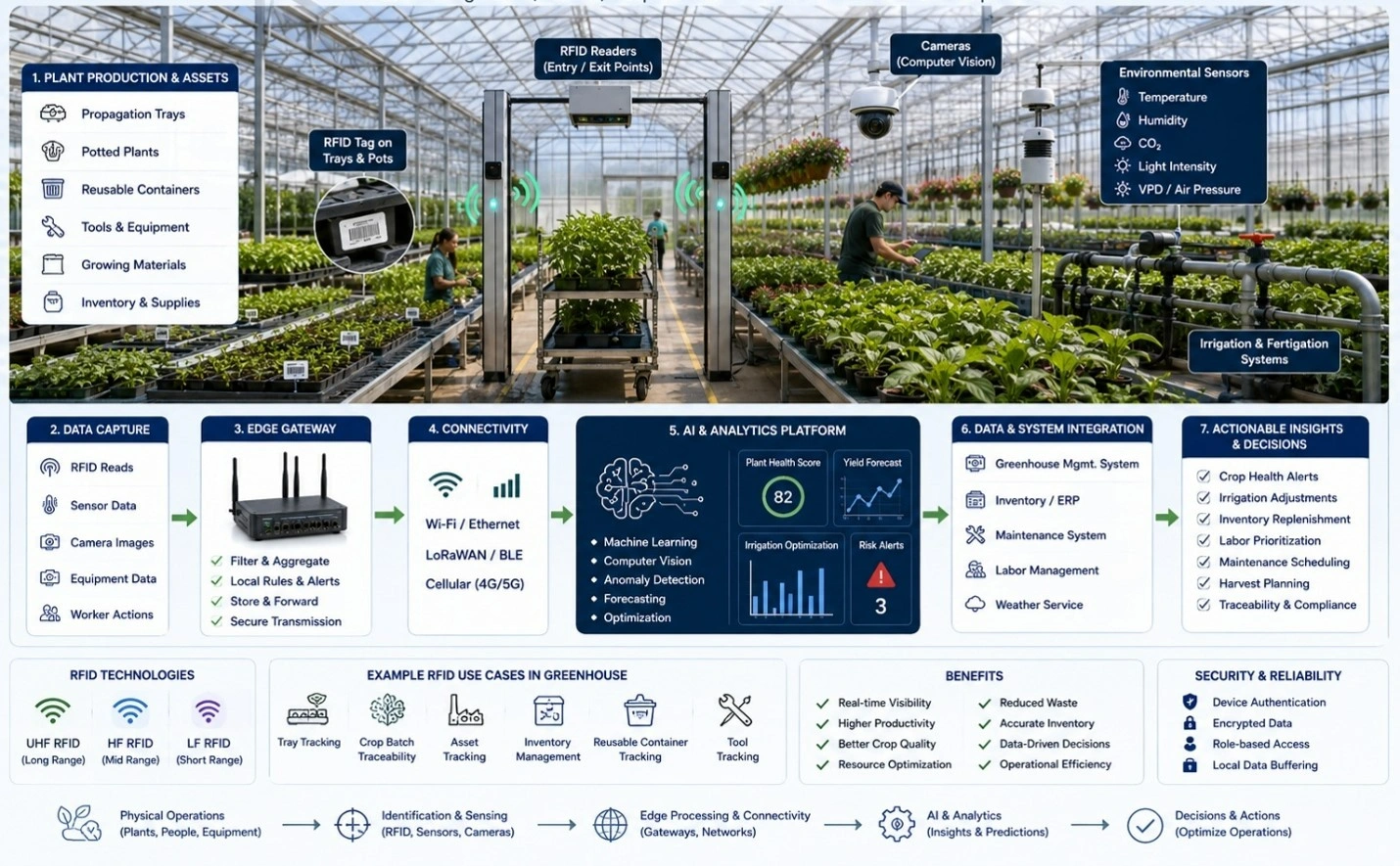
This infographic shows how greenhouse crops, tagged trays and containers, RFID readers, environmental sensors, cameras, and irrigation systems feed data into edge gateways and AI analytics. It connects those insights with greenhouse management, inventory, maintenance, and operational decisions while highlighting RFID use cases and security controls.
What AI and RFID Mean for Modern Greenhouse Production
Greenhouses generate large quantities of operational information. Crop batches move through propagation, transplanting, growing, treatment, harvesting, staging, and shipping. At the same time, greenhouse teams manage irrigation zones, nutrient delivery, climate-control equipment, lighting, ventilation, heating, cooling, fertigation, growing media, trays, containers, tools, pesticides, fertilizers, and packaging materials.
Manual identification and spreadsheet-based tracking can make it difficult to maintain a consistent relationship between physical assets and production records.
RFID provides machine-readable identity. AI provides interpretation.
This distinction is important. An RFID tag does not determine whether a crop is healthy or whether an irrigation strategy is optimal. It establishes an identity that software can associate with production events and other data. AI can then analyze the combined information.
For example, a tagged crop batch can be associated with:
- Propagation date
- Cultivar or variety
- Seed lot
- Growing zone
- Bench or rack location
- Transplant event
- Irrigation history
- Fertigation records
- Temperature exposure
- Relative humidity
- Light exposure
- Treatment records
- Inspection results
- Harvest date
- Quantity harvested
- Shipping destination
This creates a traceable production history that can support forecasting, anomaly detection, inventory management, quality analysis, and operational planning.
GAO supplies RFID hardware and related identification technologies that organizations can use as part of these greenhouse workflows. The appropriate RFID configuration depends on tag material, read distance, item density, environmental conditions, reader placement, and the specific production event being monitored.
Greenhouse Applications Where AI Creates Operational Value
AI applications in greenhouse operations should be tied to decisions that affect crop quality, production efficiency, inventory accuracy, resource consumption, and labor utilization.
AI Crop Health and Disease-Risk Monitoring
Computer vision and machine learning can analyze plant images for visible symptoms such as discoloration, leaf deformation, canopy irregularities, growth differences, and other indicators that warrant inspection.
RFID adds identity and production context. A camera may detect an anomaly, but the greenhouse system needs to determine which crop batch, cultivar, propagation group, or production zone is associated with that observation.
A practical workflow can therefore connect:
- RFID-tagged crop batch
- Camera observation
- Greenhouse zone
- Environmental measurements
- Irrigation events
- Fertigation history
- Human inspection records
- AI-generated risk score
The AI output should support inspection and decision-making rather than automatically declaring a plant to have a specific disease based only on an image.
AI Irrigation and Water Management
Water management is highly dependent on crop type, substrate, growing stage, environmental conditions, irrigation-zone configuration, and weather conditions for facilities with outdoor exposure.
AI can analyze historical irrigation events alongside:
- Soil or substrate moisture
- Temperature
- Relative humidity
- Solar radiation
- Vapor pressure deficit
- Crop stage
- Drainage measurements
- Irrigation duration
- Water volume
- Nutrient concentration
RFID can associate crop batches or containers with production zones and movement events. This makes it possible to analyze water-related outcomes by crop group rather than treating an entire greenhouse as a single homogeneous environment.
AI Fertigation and Nutrient Management
Fertigation systems combine irrigation with nutrient delivery. AI can analyze nutrient-related measurements, irrigation schedules, crop-stage information, and historical plant performance to identify deviations or opportunities for adjustment.
RFID can associate growing materials, nutrient inventory, crop batches, and production activities with specific records. This helps maintain traceability when multiple cultivars or production batches are processed simultaneously.
The system can also flag inconsistencies such as an unexpected fertilizer consumption rate, a mismatch between planned and actual application records, or abnormal readings from a nutrient-management system.
AI Yield Forecasting
Yield forecasting is one of the most valuable analytical applications for commercial greenhouse operations because production schedules affect labor, packaging, logistics, inventory, and customer commitments.
Machine learning models can combine:
- Historical yield
- Crop variety
- Planting density
- Crop age
- Environmental conditions
- Growing degree information where applicable
- Irrigation history
- Fertigation history
- Crop health observations
- Harvest records
RFID-based batch identification helps ensure that historical production data is associated with the correct crop group.
A forecasting model should be retrained and validated as production conditions change. Cultivar changes, greenhouse expansion, different lighting programs, unusual weather, and revised growing practices can all introduce model drift.
AI Inventory Management for Greenhouses
Greenhouses manage far more inventory than finished plants. Seeds, trays, pots, growing media, fertilizers, chemicals, irrigation components, replacement parts, packaging materials, tools, and equipment accessories can all affect production continuity.
RFID can automate identification at receiving, storage, staging, and consumption points. AI can analyze consumption patterns and identify unusual demand, likely stockouts, slow-moving materials, or discrepancies between expected and actual usage.
A greenhouse inventory system can therefore move beyond simple quantity tracking toward demand prediction.
AI Labor Prioritization
Greenhouse work is highly dependent on timing. Tasks such as transplanting, pruning, spacing, scouting, irrigation inspection, harvesting, grading, cleaning, and order preparation often have operational deadlines.
AI can prioritize work based on crop stage, production schedule, greenhouse conditions, historical labor requirements, pending orders, and observed anomalies.
RFID events can provide additional evidence about completed workflow stages. For example, movement of tagged trays from propagation to a growing area can automatically update production records and reduce manual data entry.
RFID-Enabled Crop and Material Traceability
Greenhouse traceability requires more than knowing that an item exists. The system should maintain the relationship between an item and its location, production stage, responsible workflow, and historical events.
UHF RFID for High-Volume Greenhouse Identification
UHF RFID is appropriate when greenhouse operations need longer read ranges and the ability to identify multiple tagged items within a reading zone.
Potential applications include:
- Tracking plant trays through propagation and transplanting
- Identifying batches at staging areas
- Monitoring reusable containers
- Tracking pots and transport carts
- Recording movement through processing points
- Managing packaging inventory
- Identifying tools and maintenance assets
- Automating receiving and dispatch records
Reader placement should be designed around the physical movement of greenhouse materials. A fixed reader at a doorway, conveyor, staging station, or controlled transfer point can provide more predictable results than attempting to read every tagged item across an entire greenhouse.
HF RFID for Controlled Short-Range Identification
HF RFID can be useful where a controlled, close-range read is preferable. It can support workstations, authentication points, specific material identification tasks, and applications where tags and readers are positioned close together.
The shorter read range can be an advantage when the system must identify a specific item without unintentionally reading nearby tagged objects.
LF RFID for Specialized Identification Requirements
LF RFID operates at lower frequencies and can be useful for specialized identification scenarios where its propagation characteristics and tag formats fit the application.
Technology selection should be based on the physical greenhouse workflow rather than on frequency alone. Tag construction, reader orientation, liquid content, metal structures, plant density, and the required read distance can all influence performance.
Connecting RFID Events with Greenhouse Production Data
An RFID event becomes significantly more valuable when it is associated with other operational information.
A typical event may contain:
- Tag ID
- Reader ID
- Timestamp
- Read location
- Associated crop or asset
- Production batch
- Operator or workstation
- Workflow stage
- Related order or inventory record
Middleware can normalize these events and send them to greenhouse management software, databases, analytics applications, or AI services.
For example, a tray entering a propagation area can trigger a production event. The system can associate the tray with a crop batch, cultivar, seed lot, expected transplant date, and assigned greenhouse zone. Later RFID reads can update the location history.
AI can then analyze these records to identify unusual dwell times, delayed movement, production bottlenecks, or inventory inconsistencies.
This approach turns RFID from a simple identification mechanism into a source of structured operational data for greenhouse decision-making.
RFID-Enabled Smart Greenhouse Traceability
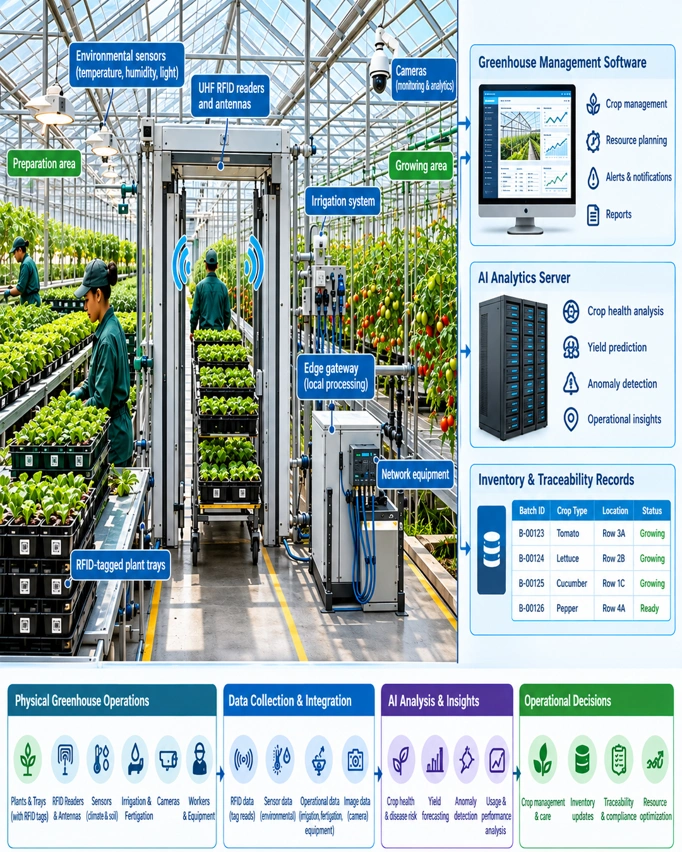
A realistic commercial greenhouse scene showing RFID-tagged plant trays passing through fixed UHF readers, with edge computing, greenhouse software, and AI analytics updating crop-batch locations, inventory, movement history, and production data.
Greenhouse Data Workflow from RFID Capture to AI Decision
A production-grade AI and RFID system generally follows a multi-stage data workflow.
Data Acquisition
RFID readers capture tag identifiers at defined read points. Environmental sensors and greenhouse controllers provide temperature, humidity, light, CO₂, irrigation, and other operational measurements. Cameras provide image data where computer vision is required.
The data should have reliable timestamps and identifiers so events can be correlated.
Edge Processing and Filtering
An edge gateway or local computing device can filter duplicate RFID reads, normalize sensor measurements, temporarily store data during network outages, and forward relevant events to centralized software.
This is particularly useful for greenhouse environments with unreliable external connectivity or large volumes of local sensor and camera data.
Data Integration
Middleware can translate device-specific messages into a common data structure. The integration layer may connect RFID readers and greenhouse equipment with:
- Greenhouse management software
- Inventory management systems
- ERP software
- Warehouse systems
- Production databases
- Maintenance management software
- Business intelligence tools
- AI and machine-learning services
A clean data model should preserve relationships between crop batches, locations, assets, environmental zones, production events, and inventory records.
AI Analytics
AI models can analyze historical and real-time information for anomaly detection, forecasting, classification, image analysis, optimization, and predictive maintenance.
The model output should include enough context for the greenhouse operator to understand why an alert or recommendation was generated.
Operational Action
The final step is a business or production decision.
Examples include:
- Inspect a crop zone
- Adjust an irrigation schedule
- Check a fertigation system
- Replenish greenhouse inventory
- Investigate a delayed crop batch
- Inspect a malfunctioning fan
- Prioritize harvesting
- Reassign labor
- Verify a shipment
- Review an abnormal environmental condition
The value of AI therefore comes from connecting predictions and anomalies to specific greenhouse workflows.
AI-Driven Greenhouse Data Flow and Management
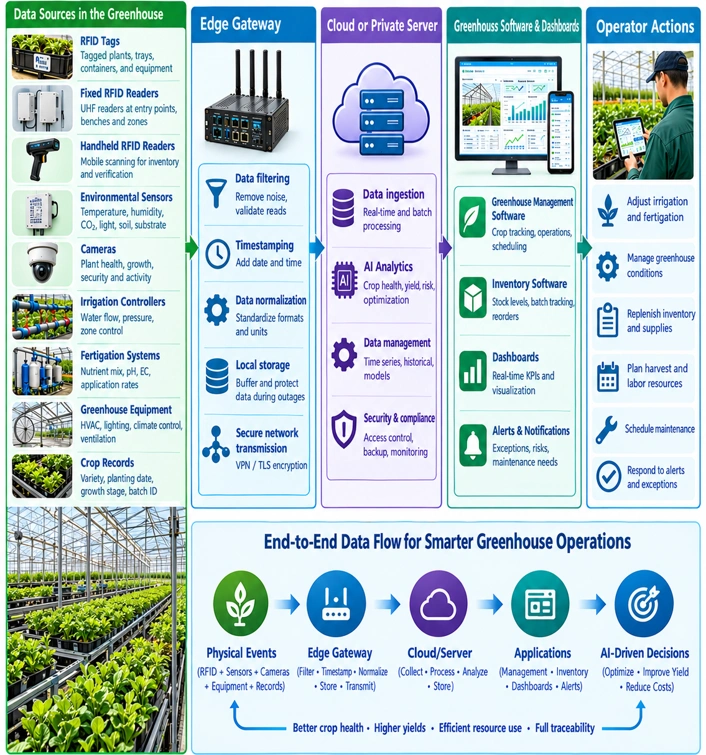
A technical data-flow diagram illustrating how RFID, sensors, cameras, irrigation systems, and crop records move through edge processing, secure network transmission, cloud/server analytics, and AI-driven greenhouse management applications.
Engineering Considerations for Greenhouse RFID Deployment
Greenhouses present several physical conditions that can influence RFID performance. Plant material can contain substantial water, while irrigation systems, metal structures, equipment, shelving, carts, pipes, and other conductive materials can affect radio-frequency behavior.
Reader and antenna placement should therefore be validated under real operating conditions.
Important design considerations include:
- Required read distance
- Tag orientation
- Tag attachment method
- Plant and water content
- Metal proximity
- Reader antenna polarization
- Reading-zone geometry
- Conveyor or cart speed
- Tag population density
- Expected simultaneous reads
- Electromagnetic interference
- Power availability
- Network connectivity
- Outdoor exposure where applicable
- Cleaning procedures
- Chemical exposure
- Physical impact
- Battery requirements for active devices
A pilot deployment should test actual tagged greenhouse materials rather than relying only on laboratory specifications.
Tag Selection for Plants, Trays and Containers
RFID tag selection is highly application-specific. A tag attached to a plastic tray may perform differently from a tag mounted near liquid-rich plant material or attached to a metal equipment asset.
The engineering team should test:
- Tag readability at the required distance
- Read consistency at different orientations
- Performance near water and growing media
- Performance near metal
- Durability during irrigation and handling
- Adhesive performance
- Environmental resistance
- Reusability requirements
- Cost per tagged item
Low-cost tags can be appropriate for high-volume consumables, while durable tags may be justified for reusable greenhouse assets.
Reader Placement and Read-Zone Control
A common deployment mistake is treating RFID coverage as equivalent to Wi-Fi coverage.
RFID is usually designed around controlled read zones. The objective is often to determine when a tagged object crosses a particular point rather than continuously locate every tagged object.
This distinction influences reader placement, antenna configuration, shielding, and software logic.
For example, a greenhouse may use readers at:
- Propagation-room entrances
- Transplanting stations
- Growing-zone transfer points
- Harvest staging areas
- Packing stations
- Shipping docks
- Inventory storage locations
Such controlled points can create reliable workflow events that are easier to interpret than uncontrolled reads across a large greenhouse.
AI Model Selection for Greenhouse Operations
Different greenhouse problems require different AI techniques.
Computer Vision
Computer vision is appropriate for image-based observations such as crop appearance, canopy development, visible anomalies, plant counting, and selected quality-control applications.
Time-Series Machine Learning
Time-series models can analyze environmental conditions, irrigation measurements, production trends, and equipment behavior over time.
Anomaly Detection
Anomaly detection can identify greenhouse conditions that differ substantially from established operational patterns. This can help identify unusual environmental behavior, equipment performance, crop movement, or inventory consumption.
Predictive Models
Predictive models can estimate production outcomes, maintenance requirements, resource demand, or other measurable future conditions.
Optimization Models
Optimization techniques can support decisions involving irrigation schedules, labor allocation, production timing, inventory replenishment, or greenhouse resource utilization.
AI selection should follow the decision requirement. A greenhouse does not necessarily need a complex deep-learning model when a validated statistical or machine-learning method can provide a more transparent and maintainable result.
Greenhouse Software, Cloud, Server and Edge Deployment
The software environment should match the greenhouse’s connectivity, data-volume, latency, integration, and data-governance requirements. RFID identification normally operates as one part of a larger software workflow rather than as an isolated application.
Cloud Version for Multi-Site Greenhouse Operations
A cloud-hosted deployment is useful when greenhouse operators need centralized access to information from multiple growing facilities, propagation sites, warehouses, or distribution locations.
A cloud system can support:
- Centralized RFID event storage
- Multi-greenhouse production reporting
- AI model execution
- Historical crop analysis
- Inventory forecasting
- Centralized dashboards
- Remote monitoring
- Software updates
- Cross-site KPI comparison
- Centralized user management
Cloud deployment does require dependable connectivity for functions that depend on real-time communication with remote services. Local buffering at an edge gateway can reduce the effect of temporary Internet interruptions.
Server Version for Controlled Greenhouse Environments
A server deployment can place the greenhouse software on a customer-managed server, private data center, farm server, or local edge server.
This approach can be appropriate when the greenhouse requires greater local control over operational data, low-latency processing, or continued operation during Internet outages.
Local processing can also be useful for camera-based applications because high-volume video does not always need to leave the greenhouse.
Hybrid Deployment
A hybrid approach can combine local RFID and sensor processing with centralized analytics.
For example, a local server can receive RFID events, filter duplicate reads, maintain temporary records, and continue critical workflows during connectivity interruptions. Selected information can then synchronize with cloud software for multi-site reporting and AI analysis.
This arrangement is particularly useful when greenhouse operations require both local resilience and centralized management.
Greenhouse AI and RFID Integration with Existing Systems
Integration should be designed around the software already responsible for production, inventory, procurement, maintenance, and shipping.
RFID events may need to flow into greenhouse management software when crop movements occur. Inventory systems may need updates when tagged materials are received or consumed. ERP systems may require production and material information for purchasing and financial processes.
Potential integration targets include:
- Greenhouse management systems
- ERP software
- Inventory management software
- Warehouse management systems
- Manufacturing or production databases
- Maintenance management systems
- Irrigation control systems
- Fertigation controllers
- Climate-control systems
- Laboratory information systems
- Order-management software
- Business intelligence systems
APIs are generally preferable for structured software-to-software integration when supported. Message brokers can be useful for event-driven RFID data. Database integration may be appropriate for legacy applications, while file exchange can remain practical for systems without modern APIs.
A strong integration design should prevent duplicate records. For example, one RFID read should not create multiple crop-movement events merely because several gateway components reported the same tag during a short interval.
Greenhouse KPIs for AI and RFID Programs
Technology performance should be evaluated against greenhouse production and operational outcomes.
Useful KPIs include:
- Crop-batch traceability accuracy
- RFID read accuracy
- RFID read-zone reliability
- Inventory record accuracy
- Inventory discrepancy rate
- Crop-location accuracy
- Crop movement cycle time
- Propagation-to-transplant cycle time
- Harvest forecast accuracy
- Yield forecast error
- Crop loss rate
- Crop quality rate
- Water use per production unit
- Fertilizer use per production unit
- Energy consumption per production unit
- Environmental excursion frequency
- Irrigation anomaly detection rate
- Disease-risk alert precision
- False-alert rate
- Equipment downtime
- Mean time to detect equipment abnormalities
- Labor hours per production batch
- Order fulfillment accuracy
- Shipping error rate
- RFID device availability
- Gateway availability
- AI model inference latency
- Data completeness
- Data synchronization delay
- User response time to critical alerts
The KPI should be connected to a measurable operational decision. For example, an RFID deployment should not be judged simply by the number of tags installed. Its value should be assessed through improvements in traceability, inventory accuracy, workflow visibility, or labor efficiency.
Commissioning and Testing a Greenhouse RFID System
Commissioning should validate the complete physical and digital workflow, not simply confirm that RFID readers can detect tags.
A commissioning process should verify:
- RFID reader configuration
- Antenna positioning
- Tag readability
- Read-zone boundaries
- Duplicate-read filtering
- Crop-batch association
- Asset identity mapping
- Timestamp accuracy
- Gateway connectivity
- Local data buffering
- Server or cloud ingestion
- API communication
- Dashboard accuracy
- AI data availability
- Alert generation
- User permissions
- Backup procedures
- Failure recovery
Testing should occur with actual greenhouse materials and normal operational traffic.
For example, a tray moving through a transfer point should generate the expected RFID event without incorrectly identifying adjacent trays. A tagged fertilizer container should remain identifiable after normal handling and exposure to the greenhouse environment.
Network-failure testing is also important. The system should demonstrate what happens when Internet access is interrupted, an RFID reader becomes unavailable, or an edge gateway loses power.
Pilot Deployment
A pilot should normally focus on one measurable workflow.
Suitable pilot areas include:
- Propagation-tray tracking
- Crop-batch movement
- Inventory receiving
- Harvest staging
- Reusable-container tracking
- Equipment tracking
- Irrigation-related data correlation
- AI crop-health analysis
The pilot should establish baseline measurements before installation and compare them with results after deployment.
Cybersecurity and RFID Data Protection
Connected greenhouse systems introduce security considerations across RFID readers, gateways, servers, cloud applications, APIs, databases, and user devices.
Recommended controls include:
- Unique device credentials
- Encrypted communications
- Role-based access control
- Least-privilege permissions
- Secure API authentication
- Network segmentation
- Firmware and software patching
- Audit logging
- Backup and recovery procedures
- Credential rotation
- Removal of inactive devices
- Monitoring of unusual device behavior
- Controlled remote administration
RFID itself does not make a greenhouse secure or insecure. The larger concern is how RFID data becomes connected to operational systems.
For example, an unauthorized user who gains access to crop-location records may obtain information about production schedules or inventory. A compromised gateway could potentially affect downstream data if the software accepts unvalidated events.
Systems controlling irrigation, fertigation, climate equipment, pumps, fans, or other physical equipment require additional controls because an incorrect automated command can have physical consequences.
Maintenance and Lifecycle Management
Greenhouse RFID deployments operate in environments involving humidity, irrigation, dust, fertilizer residues, cleaning chemicals, temperature changes, and frequent movement of equipment and plant materials.
Maintenance plans should therefore include:
- RFID reader inspection
- Antenna inspection
- Tag replacement
- Tag adhesion checks
- Gateway health monitoring
- Network monitoring
- Sensor calibration
- Camera cleaning
- Software updates
- Firmware updates
- AI model monitoring
- Database maintenance
- Backup testing
- User-access reviews
- Hardware replacement planning
Tag durability is especially important for reusable trays, carts, containers, and tools. A tag that performs well during initial testing but fails after repeated washing or handling can reduce traceability over time.
AI models also require lifecycle management. Changes in crop varieties, greenhouse lighting, camera position, growing practices, seasonal conditions, and production processes can change the data distribution used by a model.
Model performance should therefore be monitored after deployment rather than assuming that initial validation remains permanently accurate.
Scaling AI and RFID Across Greenhouse Facilities
Scaling from one greenhouse zone to multiple facilities introduces additional requirements.
The system should maintain consistent identifiers for:
- Greenhouses
- Growing zones
- Benches
- Crop batches
- Cultivars
- Containers
- Equipment
- RFID tags
- RFID readers
- Production events
- Inventory items
Multi-site deployments also require consistent KPI definitions. If one greenhouse calculates crop yield differently from another, centralized AI analytics can produce misleading comparisons.
GAO’s RFID technologies can support different identification requirements across greenhouse operations, including UHF RFID, HF RFID, and LF RFID configurations. Hardware selection should remain tied to the physical workflow, tag population, read distance, environmental conditions, and integration requirements rather than applying one RFID configuration everywhere.
Practical Engineering Recommendations for Greenhouse AI and RFID
Several implementation principles can reduce deployment risk.
- Start with a defined operational problem. Select crop traceability, inventory accuracy, harvest planning, or another measurable requirement before selecting hardware.
- Test RFID in the actual greenhouse. Water, plants, metal structures, containers, and equipment can change RFID performance compared with laboratory conditions.
- Treat identity as foundational data. Incorrect crop-batch or asset identification can undermine downstream AI analytics.
- Control RFID read zones. Carefully positioned readers often produce more useful workflow events than attempting broad uncontrolled coverage.
- Separate identification from intelligence. RFID establishes identity and events, while AI analyzes those events alongside environmental, production, and operational data.
- Design for network failures. Local buffering can prevent temporary connectivity problems from becoming permanent data gaps.
- Validate AI with real greenhouse data. Models should be tested across crop varieties, seasons, lighting conditions, production stages, and operational changes.
- Monitor false alerts. Excessive alerts can reduce operator trust and cause important notifications to be overlooked.
- Plan maintenance before installation. Tags, readers, antennas, gateways, cameras, and sensors all require lifecycle management.
- Expand in controlled stages. Demonstrate measurable value in one workflow before extending the deployment across additional growing areas or facilities.
Business Value of AI and RFID for Greenhouses
A properly designed AI and RFID system can improve greenhouse operations by creating a stronger relationship between physical production activities and digital records.
Potential benefits include:
- More accurate crop-batch traceability
- Faster inventory reconciliation
- Reduced manual data entry
- Better visibility into crop movement
- Improved production forecasting
- More timely identification of operational anomalies
- Better labor prioritization
- More structured harvest planning
- Improved reusable-container tracking
- Better equipment-maintenance visibility
- Improved historical production analysis
- More consistent operational reporting
- Stronger data foundations for AI models
The largest benefit often comes from combining previously isolated information. A crop batch, its location, environmental history, irrigation events, production stage, and inventory requirements can become connected records rather than separate spreadsheets and manual observations.
That connection gives greenhouse managers a more complete basis for decisions.
Selecting an AI and RFID Strategy for Greenhouse Operations
A practical greenhouse deployment should begin with the workflow rather than the RFID frequency.
A suitable planning process is:
- Define the production or operational problem.
- Establish the baseline KPI.
- Identify the physical objects that need identification.
- Determine where RFID events should occur.
- Select UHF, HF, or LF RFID according to the required read conditions.
- Select tags based on material and environmental exposure.
- Design reader and antenna placement.
- Determine required environmental and production data.
- Select edge, cloud, server, or hybrid processing.
- Define software integration requirements.
- Establish cybersecurity controls.
- Conduct a controlled pilot.
- Validate RFID performance.
- Validate AI performance.
- Train greenhouse personnel.
- Commission the complete workflow.
- Measure KPI changes.
- Expand after demonstrating operational value.
GAO provides RFID products and related technologies that can be evaluated for greenhouse identification, inventory, traceability, and workflow applications. Our hardware solutions can be incorporated into broader systems that connect RFID events with greenhouse software, AI analytics, environmental monitoring, and production processes.
Key Takeaways for AI and RFID in Greenhouses
AI and RFID for greenhouses is most effective when identification data is connected with crop production, environmental conditions, inventory, equipment, and operational workflows. RFID provides reliable identity and movement events, while AI can use those events with other data to support forecasting, anomaly detection, computer vision, resource optimization, and maintenance decisions.
UHF RFID is often suited to higher-volume controlled read points, while HF and LF RFID can serve shorter-range or specialized identification requirements. Successful deployments depend on tag selection, read-zone engineering, accurate crop-batch identity, reliable integration, cybersecurity, AI validation, and continuous maintenance.
GAO supports organizations evaluating RFID hardware and systems for greenhouse production, inventory, traceability, and operational monitoring. Readers, tags, antennas, and related RFID technologies should be selected according to the actual greenhouse environment and workflow.
Building the Future of Industrial AI and IoT with Aperture Venture Studio and GAO RFID Inc.
For more than three decades, GAO Group of Companies has invested heavily in R&D for industrial RFID, BLE, and IoT. As AI became useful in industrial applications, we expanded our work in AI and connected identification technologies and founded Aperture Venture Studio to advance AI and IoT solutions relevant to areas such as greenhouse production, crop traceability, and intelligent agricultural operations.
Aperture has attracted AI and IoT technical experts, executives, investors, and leading companies. We have also developed Aperture Ventures Summit and TekSummit to discuss advanced AI and IoT topics. These efforts support technical communities working on practical applications of AI, RFID, and connected technologies.
We welcome you to join us as:
- Advisors, co-founders, or employees
- Investors
- Customers