
AI and RFID for Grocery Chains
How AI Improves Grocery Chain Operations
AI for grocery chains combines artificial intelligence with data captured from stores, distribution centers, refrigeration systems, point-of-sale environments, and connected assets to improve decisions across the retail supply chain. RFID, including UHF RFID for item and case identification and HF or LF RFID for selected proximity or identification applications, can provide machine-readable information about products and assets as they move through receiving, backroom storage, replenishment, merchandising, and fulfillment processes. AI then turns this operational data into forecasts, anomaly detection, recommendations, and automated actions.
For grocery chains, the value is not simply knowing where inventory is. The objective is to reduce out-of-stocks, improve inventory accuracy, protect high-value or high-shrink merchandise, manage perishables more effectively, predict replenishment requirements, and identify operational exceptions before they affect customers. A well-designed system can connect RFID readers and sensors with POS, warehouse management, order management, inventory management, electronic shelf labels, workforce systems, refrigeration controls, and business intelligence software.
GAO supplies RFID, BLE, and IoT hardware products and systems that can support these data acquisition requirements across grocery stores, distribution facilities, cold-storage areas, and backroom operations.
AI for Grocery Chains: RFID-Enabled Inventory and Store Operations
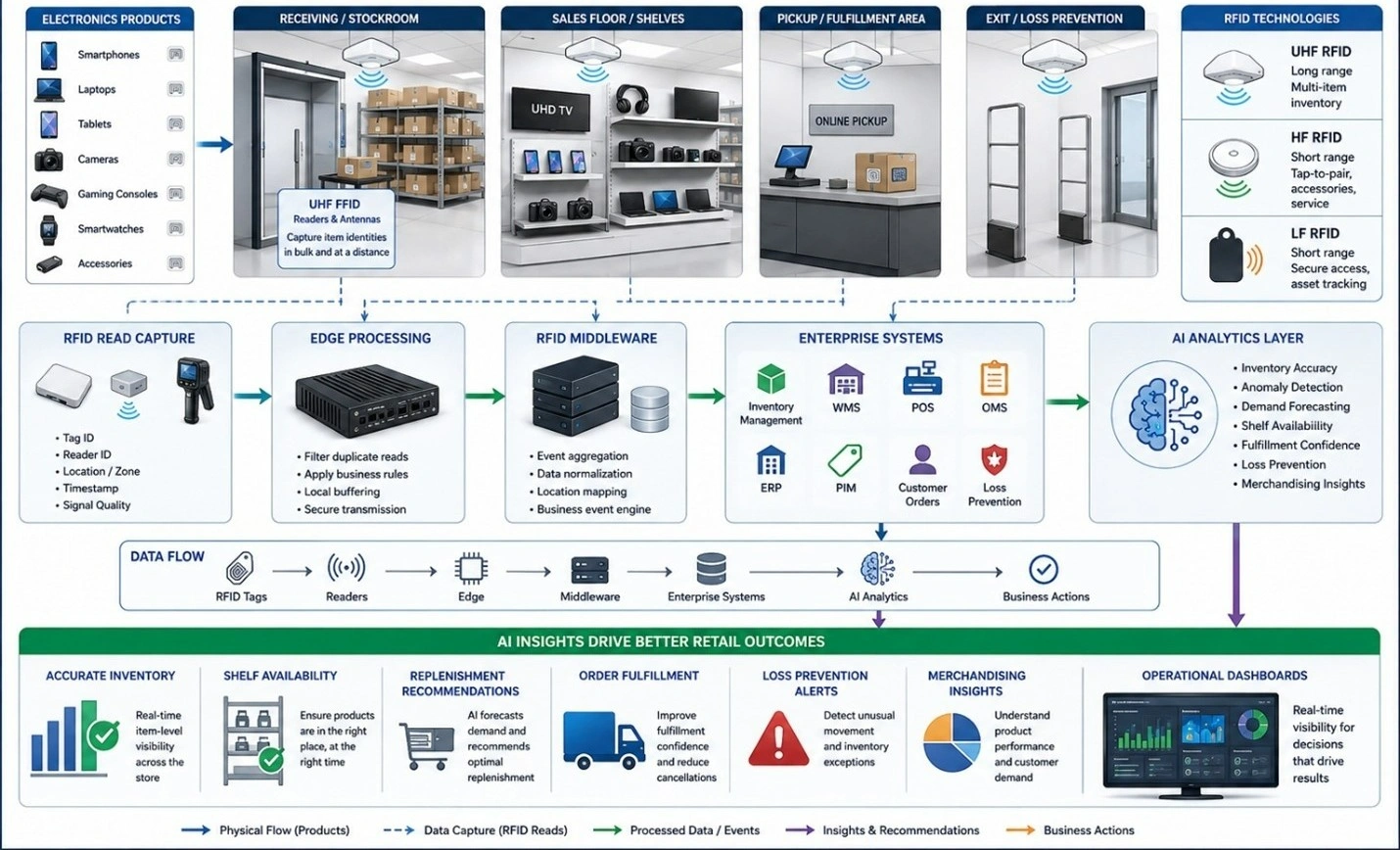
This infographic shows how RFID, POS data, environmental sensors, computer vision, and workforce systems feed AI analytics for grocery distribution centers and stores. It highlights applications including inventory management, shelf replenishment, fresh food operations, cold-chain monitoring, loss prevention, order fulfillment, and store operations.
Why AI Matters to Modern Grocery Chains
Grocery operations generate unusually high volumes of transaction, inventory, pricing, movement, freshness, and environmental data. A single chain may manage thousands of SKUs across supermarkets, hypermarkets, convenience-oriented locations, dark stores, distribution centers, and regional warehouses. Perishables add another layer of complexity because the commercial value of an item can decline rapidly with time, temperature excursions, handling errors, or poor rotation.
AI helps grocery operators identify patterns that are difficult to manage through manual processes or static reports. Demand forecasting can combine historical sales with seasonality, promotions, holidays, weather signals, local purchasing behavior, and store-level trends. Anomaly detection can identify unusual inventory movements, unexpected shrink patterns, abnormal refrigerated-equipment behavior, or discrepancies between physical stock and recorded transactions.
The operational distinction is important. Traditional reporting often explains what happened after a problem becomes visible. AI-driven grocery management is more useful when it predicts what is likely to happen and identifies the operational action most likely to prevent a loss or service failure.
For example, a grocery chain may have sufficient system-recorded stock for a product while the actual shelf is empty because inventory remains in a backroom location. RFID-assisted inventory visibility can provide more granular movement information, while AI can prioritize which discrepancies require immediate attention based on sales velocity and customer impact.
GAO’s RFID and IoT hardware can serve as part of the physical data collection layer used to support these store-level and distribution-center processes.
Priority AI Applications Across Grocery Chain Operations
AI Inventory Management and Stock Accuracy
Inventory in grocery chains is affected by receiving errors, misplaced cases, shelf replenishment delays, damaged merchandise, returns, internal transfers, and shrinkage. AI can analyze item movement and transaction data to distinguish normal inventory variation from operational exceptions.
RFID-enabled identification can strengthen the physical inventory signal by allowing tagged items, cases, totes, or selected assets to be detected at controlled reading points or during inventory processes. UHF RFID is particularly relevant where longer read ranges and rapid identification of multiple tagged items are required.
AI can use these signals to support:
- Store-level inventory reconciliation
- Backroom-to-shelf inventory visibility
- Receiving verification
- Automated cycle-count prioritization
- Inventory discrepancy detection
- Replenishment prioritization
- High-value inventory tracking
- Inter-store and distribution-center transfer verification
The strongest use cases connect physical movement data to commercial context. A discrepancy affecting a fast-moving refrigerated product can deserve more immediate intervention than a discrepancy involving a slow-moving nonperishable item.
AI Fresh Food and Perishable Inventory Management
Fresh produce, meat, seafood, dairy, prepared foods, and other perishables create operating conditions that differ from conventional retail merchandise. Grocery chains must manage shelf life, rotation, temperature, markdowns, spoilage, and demand volatility simultaneously.
AI can combine product movement, sales velocity, expiration information, environmental measurements, and replenishment history to identify products at elevated risk of waste. The resulting workflow may recommend earlier replenishment, targeted markdowns, stock redistribution, or operational inspection.
RFID can support item, case, container, or process identification where tags are suitable for the product and operating environment. Environmental sensors can complement RFID by providing temperature and humidity information for refrigerated rooms, cold-storage areas, or other controlled environments.
A practical grocery implementation should not assume that every fresh product must be individually RFID tagged. Tagging economics, food-contact requirements, packaging characteristics, moisture, metal interference, reading conditions, and expected inventory value all influence where RFID provides sufficient return.
AI Demand Forecasting and Replenishment
Demand forecasting is one of the most commercially important AI applications for grocery chains because inventory availability affects both revenue and waste.
Machine learning models can evaluate historical demand, promotional calendars, seasonality, day-of-week patterns, local store behavior, product substitutions, and other operational variables. Forecasts can then feed replenishment systems and store execution workflows.
RFID can contribute an additional physical inventory signal that helps distinguish between a product being unavailable because it was sold, unavailable because it is still in the backroom, or unavailable because inventory records are inaccurate.
The technical objective is therefore not to make AI replace existing inventory systems. It is to improve the quality, timeliness, and context of the signals used by those systems.
AI Loss Prevention and Shrink Detection
Shrink remains a major operational concern for grocery operators because losses can arise from theft, administrative errors, damaged products, process failures, and inventory discrepancies.
AI can identify unusual patterns such as repeated unexplained stock movements, irregular receiving quantities, unexpected product disappearance, or discrepancies between recorded transactions and detected physical movement. Computer vision may provide another data source for identifying suspicious events, while RFID can strengthen object-level or case-level movement visibility in selected areas.
A practical loss-prevention workflow should correlate multiple signals rather than treating an RFID event alone as proof of a loss. Store policies, transaction context, exception thresholds, and human investigation remain important.
AI Shelf Availability and Replenishment Execution
An item may be present in the store but unavailable to the customer because it is located in an inaccessible backroom, stored in the wrong section, or waiting for replenishment. This distinction is particularly important for high-volume grocery SKUs.
AI can prioritize replenishment work using inventory position, sales velocity, time since last replenishment, expected demand, and other operational factors. RFID events can help determine whether products associated with a shelf replenishment task have entered or remained in the expected store area.
Where computer vision is deployed, image-based shelf analysis can complement RFID data by examining shelf conditions directly. The combined approach can be more useful than relying on either technology independently.
AI Grocery Inventory Management Workflow: RFID Events to Operational Action
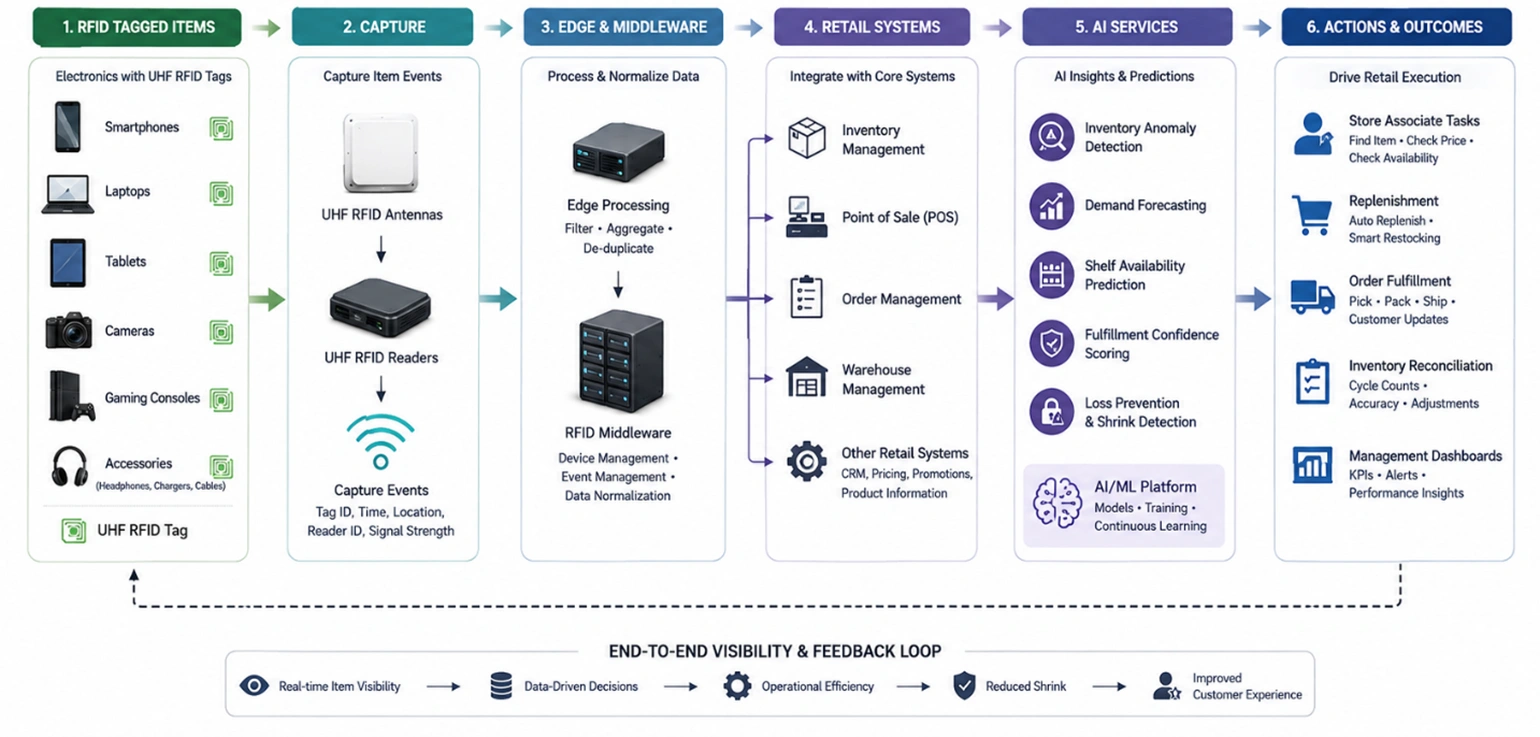
This workflow diagram shows how UHF RFID data moves from tagged grocery products and physical readers through edge processing, middleware, enterprise systems, and AI analytics. It illustrates how machine learning identifies inventory discrepancies, stockout risks, replenishment priorities, and shrink anomalies before generating actionable tasks for grocery store personnel and managers.
Grocery RFID Deployment by Operational Environment
RFID deployment should be designed around the physical and commercial characteristics of each grocery environment. The most effective implementations typically begin with processes where reliable identification can solve a measurable operational problem.
Distribution Centers and Receiving Areas
Distribution centers can use UHF RFID to identify tagged cases, pallets, totes, containers, or selected products at receiving and shipping points. Reader portals or controlled reading zones can capture movement events while edge processing can filter duplicate reads and generate cleaner business events.
AI can use these events to identify receiving discrepancies, unexpected shipment patterns, routing exceptions, and inventory-flow bottlenecks.
Store Backrooms and Stockrooms
Backrooms are often where inventory visibility becomes difficult. Products can be physically present but poorly positioned, awaiting shelf replenishment, returns processing, or internal movement.
RFID can help establish a more reliable movement history for suitable tagged merchandise. AI can then use that information to prioritize store tasks based on customer demand and inventory risk.
Sales Floors and Merchandising Areas
RFID deployment on the sales floor requires careful consideration of reader placement, antenna orientation, tag performance, shelving materials, product packaging, customer movement, and unintended reads from adjacent areas.
For selected product categories, RFID can support inventory auditing and replenishment workflows. When combined with computer vision, electronic shelf labels, and POS information, it can contribute to a broader store-operations decision system.
Refrigerated and Cold-Storage Areas
Cold environments require hardware selection and installation practices appropriate for condensation, temperature variation, cleaning procedures, and equipment constraints. RFID may identify products or containers, while environmental sensors capture temperature or humidity conditions.
AI can correlate these data streams to detect unusual temperature patterns, operational deviations, or conditions that could increase product-loss risk. The solution should be engineered so that environmental monitoring remains effective even where RFID tagging is not economically or technically appropriate.
Realistic RFID Deployment Across a Grocery Store
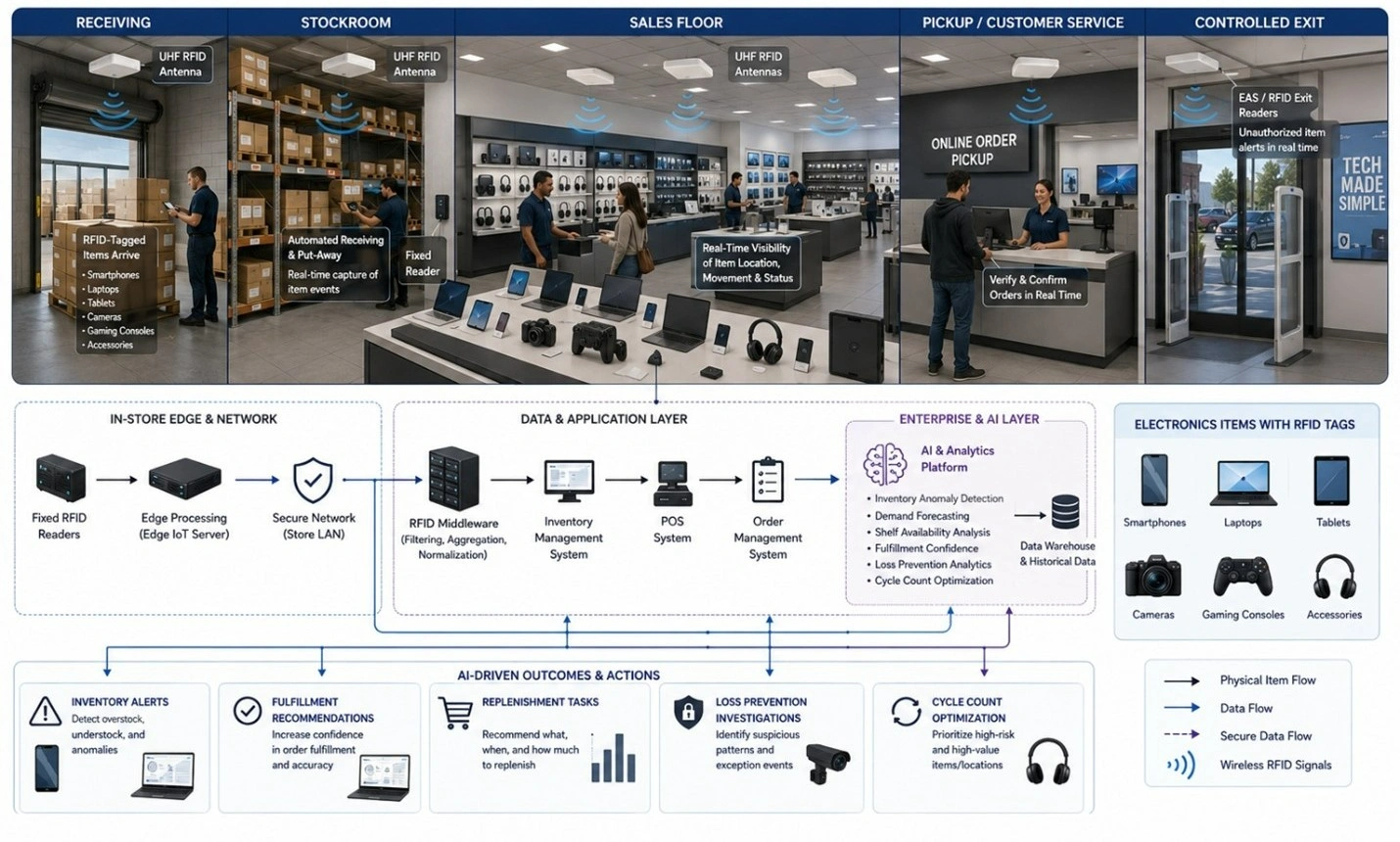
This visual illustrates a technically credible grocery-store RFID deployment spanning receiving, backroom inventory, refrigerated storage, sales-floor operations, and checkout. It shows fixed and handheld RFID readers, tagged products and reusable containers, environmental sensors, edge hardware, inventory software, AI analytics, POS systems, and a store operations dashboard working together to provide real-time inventory visibility and operational insights.
From RFID Events to AI-Driven Grocery Decisions
A grocery AI solution typically follows a layered operational flow rather than sending raw RFID reads directly into business applications.
The process begins with physical data capture. RFID readers detect tags at defined locations or during handheld inventory activities. Other data sources may include POS transactions, warehouse management systems, order records, refrigeration sensors, computer vision systems, and workforce applications.
The communication layer transports these events to edge devices, local servers, or cloud software. Edge processing can remove duplicate reads, apply filtering rules, buffer data during connectivity interruptions, and convert low-level reader events into higher-level business events.
Middleware then normalizes information from multiple sources so that AI models and enterprise applications receive consistent data. This is important because a grocery chain may operate different reader types, POS systems, inventory databases, store networks, and software versions across its locations.
AI services can apply forecasting, classification, anomaly detection, optimization, or predictive-maintenance models. The resulting insight should then connect to an operational workflow, such as creating a replenishment task, prioritizing a cycle count, flagging a receiving discrepancy, escalating a cold-storage exception, or notifying a loss-prevention team.
The final stage is human or automated action. Store associates, inventory managers, distribution-center personnel, merchandising teams, facilities staff, and security personnel may each receive different views of the same underlying operational event.
Grocery RFID-to-AI Data Flow Architecture
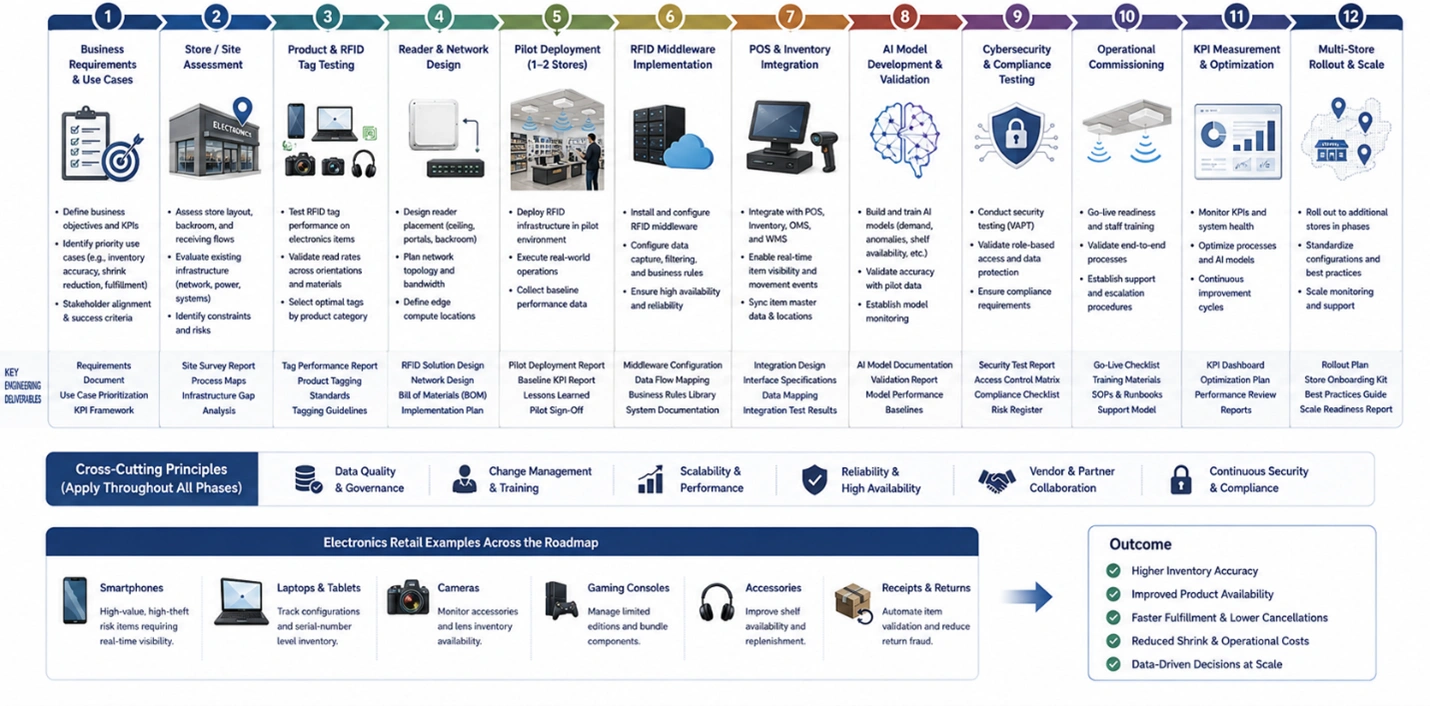
This architecture diagram traces the complete data journey from UHF RFID-tagged grocery products and reusable assets through fixed and handheld readers, edge processing, secure networking, middleware, and AI analytics. It connects AI capabilities such as inventory forecasting, anomaly detection, shrink analysis, replenishment, and freshness-risk prediction to enterprise systems and operational actions.
AI, RFID Hardware and Grocery Software Integration
A successful grocery deployment depends on the complete system rather than RFID hardware alone. Reader selection, antenna configuration, tag placement, network design, middleware, software integration, data quality, and operational workflows all affect the final result.
UHF RFID is generally the principal RFID option when grocery applications require longer read ranges, rapid multi-tag identification, or automated detection at defined movement points. HF RFID can be appropriate for shorter-range identification or controlled proximity applications, while LF RFID can serve specialized low-frequency identification requirements where its characteristics fit the operating environment.
Supporting hardware can include:
- Fixed RFID readers and antennas
- Handheld RFID readers
- UHF RFID tags and labels
- HF or LF RFID tags for selected applications
- Edge computers and industrial gateways
- Temperature and humidity sensors
- Barcode scanning equipment
- Network switches and secure wireless infrastructure
- Industrial enclosures and mounting hardware
- Reusable container and tote identification devices
The software layer may connect RFID events to inventory management, warehouse management, order management, POS, business intelligence, loss-prevention software, maintenance systems, and store task-management applications.
GAO provides RFID and related IoT hardware that organizations can incorporate into these solutions based on application requirements, read-zone design, operating environment, and integration needs.
Cloud and Server Deployment Options
Cloud-hosted deployment can be useful for grocery chains operating many geographically distributed stores because centralized analytics and machine learning services can simplify model management and enterprise-wide reporting. It can also support consolidated data analysis across stores and distribution facilities.
Privately hosted server deployment may be more suitable where a grocery organization requires tighter control over data location, local processing, network isolation, or integration with existing data-center systems. Edge or local servers can also support use cases where immediate processing is more important than sending every raw event to a remote environment.
A hybrid design is often practical. Time-sensitive event processing can remain close to the store, while aggregated information and model outputs can be transmitted to centralized systems for regional or enterprise analysis.
The correct choice depends on network reliability, data governance, latency requirements, existing IT capabilities, application scale, cybersecurity policies, and the operational consequence of connectivity loss.
Engineering Considerations Before Deployment
Grocery RFID and AI projects should begin with measurable operational objectives rather than hardware installation targets. The first design question is not how many RFID readers a chain can deploy. It is which grocery process requires better information and what financial or operational outcome will improve when that information becomes available.
Important engineering considerations include:
- SKU and product-category selection based on tagging economics
- Tag attachment and readability across packaging materials
- Metal and liquid interference
- Reader and antenna positioning
- Read-zone containment and unintended reads
- Store and distribution-center network reliability
- Edge buffering during connectivity interruptions
- Data normalization across different stores and systems
- Integration with existing inventory and POS software
- AI model training and validation using representative store data
- Cybersecurity controls for devices, credentials, networks, and APIs
- User permissions and role-specific operational dashboards
- Maintenance, reader calibration, and hardware replacement procedures
- Pilot testing before multi-store rollout
Operational success should also be measured using grocery-specific indicators such as inventory-record accuracy, out-of-stock frequency, shelf availability, shrink rate, receiving discrepancy rate, perishable waste, replenishment task completion, inventory counting time, and forecast accuracy.
Business and Operational Benefits of AI-Enabled Grocery Management
Combining AI with RFID and complementary store data can improve grocery operations by turning fragmented inventory and process signals into prioritized decisions. The value comes from connecting physical merchandise movement with sales demand, replenishment activity, fresh-food conditions, and store execution.
Higher Inventory Accuracy and Lower Out-of-Stocks
More reliable physical inventory signals can reduce the gap between recorded stock and merchandise actually available for sale. AI can rank discrepancies according to sales velocity, promotional activity, inventory value, and expected customer demand.
The resulting workflow can reduce unnecessary cycle counts while directing store associates toward discrepancies most likely to cause a stockout or lost sale.
Lower Food Waste and Better Freshness Management
Perishable inventory requires decisions that account for both time and demand. AI can identify products or product groups whose expected sales trajectory suggests elevated spoilage risk.
Combining sales forecasts with expiration information and temperature history can support earlier interventions, including replenishment adjustments, markdown recommendations, transfer decisions, or targeted inspection. This approach helps grocery operators address waste before products become unsellable.
Faster Receiving and Distribution Operations
Automated identification of cases, pallets, totes, and selected products can reduce manual verification effort at receiving and shipping points. AI can further identify recurring discrepancies and process bottlenecks by analyzing movement events across distribution facilities and stores.
Distribution managers can use these insights to investigate supplier discrepancies, loading errors, delayed transfers, or unusual shipment patterns without relying solely on manual reconciliation.
More Targeted Loss Prevention
AI-supported anomaly detection can identify unusual inventory behavior while RFID provides additional evidence about physical movement. Combining RFID events with POS records, transaction history, receiving records, and other available signals creates a stronger basis for investigation than using any one source independently.
This can help loss-prevention teams focus on exceptions that have commercial significance rather than reviewing large volumes of routine activity.
Better Labor Utilization
Store labor is often consumed by repetitive inventory checks, manual searches, exception handling, and backroom organization. AI can prioritize tasks according to likely business impact, allowing associates to spend less time searching for inventory and more time completing actions that improve shelf availability and customer service.
The result is not simply fewer manual activities. Better prioritization can help match limited labor capacity with the products, departments, and stores where intervention has the highest expected return.
Grocery KPIs for Measuring AI and RFID Performance
A grocery chain should evaluate an AI and RFID deployment using operational and financial measures rather than device counts alone. Reader quantity, tagged-item volume, or event volume can demonstrate system scale, but they do not establish business value.
Useful performance indicators include:
- Inventory-record accuracy
- Out-of-stock rate
- Shelf availability
- Backroom inventory visibility
- Cycle-count time per store
- Receiving discrepancy rate
- Inventory reconciliation time
- Shrink rate
- Perishable waste value
- Markdown recovery rate
- Forecast accuracy
- Replenishment task completion rate
- Stock search time
- Distribution-center receiving throughput
- Transfer discrepancy rate
- Cold-storage temperature exception rate
- Mean time to detect operational exceptions
- Mean time to resolve inventory exceptions
- RFID read accuracy within defined read zones
- Percentage of AI recommendations accepted by operations teams
Financial analysis should also compare avoided waste, reduced labor effort, improved product availability, inventory carrying costs, shrink reduction, and sales recovery against tagging, hardware, software, integration, maintenance, and training costs.
A pilot should establish baseline measurements before deployment. Without a baseline, a later improvement may be difficult to attribute to the new system rather than seasonal demand, promotional changes, staffing differences, or other operational factors.
Deployment, Commissioning and Optimization
A grocery deployment should progress through controlled stages so that technical performance and business assumptions can be validated before wider rollout.
Select the Right Grocery Use Case
The initial use case should have a measurable operational problem, a suitable data source, and a clear decision workflow. Receiving verification, high-value inventory, selected backroom inventory, fresh-food risk, and distribution-center movement are possible starting points depending on the chain’s operating model.
The strongest pilot candidates usually have sufficient transaction volume to produce meaningful data while remaining operationally controlled enough for accurate measurement.
Validate RFID Read Performance
Physical testing should evaluate tag placement, orientation, read range, antenna configuration, reader power settings, reader density, interference, and unintended reads.
Liquid-rich grocery products, metal-containing packaging, tightly packed cases, refrigerated environments, and densely stocked shelves can affect RFID performance. These conditions should be tested using representative products rather than relying only on laboratory or vendor demonstrations.
Read zones should also be designed around business events. A receiving portal, for example, should capture the intended shipment movement without unintentionally recording merchandise from adjacent areas.
Commission the Data Pipeline
Raw RFID reads should not automatically become business transactions. Edge processing and middleware should apply filtering, deduplication, timestamping, location association, event normalization, and business rules as appropriate.
The commissioning process should verify that a physical event produces the correct logical event. A case entering a receiving zone should become a receiving event associated with the correct store, shipment, time, and product identifier rather than simply appearing as an isolated tag read.
Validate AI Models
AI models should be tested against representative store conditions and historical data before operational decisions become automated.
Forecasting models should be assessed using suitable accuracy measures and segmented by factors such as product category, store format, demand volatility, promotional periods, and perishability. Anomaly-detection models should be evaluated for false positives because excessive alerts can cause store personnel to ignore the system.
Human review should remain part of high-impact workflows until model performance is demonstrated consistently.
Scale Through Standardized Store Design
Multi-store deployment becomes easier when common hardware configurations, installation practices, data interfaces, security controls, device-management procedures, and acceptance tests are documented.
Standardization should not mean identical deployment everywhere. Store size, refrigeration configuration, shelf arrangement, network availability, product mix, and local operating practices can require controlled variations.
GAO’s experience supplying RFID, BLE, and IoT hardware products and systems supports this type of deployment planning by aligning hardware selection with the physical operating conditions of the target site.
Cybersecurity, Privacy and Operational Resilience
RFID readers, edge computers, gateways, application interfaces, cloud services, and store networks create additional technical entry points that must be governed as part of the grocery technology environment.
Device and application security should include:
- Unique device identities and controlled credentials
- Role-based access to operational applications
- Secure network segmentation where appropriate
- Encryption for data in transit and sensitive stored information
- API authentication and authorization
- Secure firmware and software-update procedures
- Logging and monitoring for administrative and device activity
- Vulnerability management and patching
- Backup and recovery procedures
- Defined incident-response processes
- Controlled remote access for maintenance and support
Privacy considerations become particularly important when inventory systems are integrated with staff badges, workforce applications, video systems, customer-related records, or other data that may identify individuals. System designers should collect only the information required for the intended operational purpose and apply appropriate retention and access controls.
Operational resilience also matters. A store should remain capable of receiving goods, selling products, and maintaining essential operations during temporary network or cloud outages. Edge buffering and local processing can help preserve important events until connectivity is restored, while critical functions should have defined degraded-operation procedures.
Interoperability with Grocery Enterprise Systems
RFID and AI systems rarely operate in isolation. Their practical value increases when their outputs can be consumed by existing grocery software.
Relevant integrations can include:
- Point-of-sale systems for transaction context
- Inventory management systems for stock reconciliation
- Warehouse management systems for distribution-center processes
- Order management systems for fulfillment and replenishment
- Enterprise resource planning systems for purchasing and financial processes
- Transportation management systems for shipment and transfer visibility
- Workforce-management systems for task assignment
- Computerized maintenance management systems for equipment service
- Building and refrigeration monitoring systems
- Business intelligence and reporting software
- Loss-prevention and security systems
Common integration methods include APIs, message queues, event streams, database interfaces, file exchange, and middleware adapters. The preferred method depends on the existing software environment and the required latency.
A key engineering principle is to preserve a consistent identifier structure. Product IDs, location IDs, shipment IDs, asset IDs, and timestamps need to map reliably across systems. Poor identifier governance can undermine otherwise accurate RFID reads and AI models.
Practical Implementation Recommendations for Grocery Chains
Grocery chains considering AI-enabled inventory and store operations should start with business process requirements and then select RFID and supporting technologies that can produce the required data reliably.
A practical implementation approach is to:
- Define the operational problem and target KPI before selecting hardware
- Choose product categories and locations where RFID provides measurable value
- Test tags using the chain’s real packaging, shelving, refrigeration, and handling conditions
- Design reader zones around specific business events rather than maximum read range
- Process RFID data at the edge where filtering, buffering, or low-latency decisions are required
- Normalize data before feeding AI models and business applications
- Combine RFID with POS, inventory, environmental, and other relevant operational signals
- Validate AI recommendations against actual store outcomes
- Design role-specific workflows so managers and store associates receive actionable exceptions
- Establish cybersecurity, device-management, and maintenance procedures before scaling
- Measure baseline and post-deployment performance using agreed grocery KPIs
- Expand only after the pilot demonstrates reliable technical and commercial results
The unspoken implementation risk is deploying more sensors and readers without changing the decision process around them. More data does not automatically produce better grocery operations. A successful solution closes the loop from physical observation to a clear operational action and measurable result.
The Role of GAO in AI-Enabled Grocery Operations
GAO supports organizations with RFID, BLE, and IoT hardware products and systems used for identification, tracking, sensing, and connected operational processes. For grocery applications, the appropriate hardware configuration depends on product characteristics, read-zone requirements, store layout, operating temperature, network conditions, installation constraints, and integration requirements.
Headquartered in New York City and Toronto, Canada, GAO is recognized among the leading B2B and B2G RFID and BLE suppliers and works with organizations across the United States and Canada. GAO and its sister companies, GAO Research and GAO Tek, form GAO Group, which has served Fortune 500 companies, research organizations, universities, and government agencies for three decades.
GAO’s R&D investment, quality-assurance processes, and technical support capabilities can help customers address the practical hardware and system considerations involved in RFID and IoT deployments.
Building an AI-Ready Grocery Operation
AI for grocery chains is most effective when it is connected to reliable operational data and embedded into everyday store and supply-chain decisions. RFID can strengthen physical inventory visibility, while AI adds forecasting, prioritization, anomaly detection, and predictive capabilities. The combination can address concrete grocery challenges such as out-of-stocks, shrink, receiving discrepancies, replenishment delays, perishable waste, and inefficient inventory counting.
Deployment should remain grounded in measurable use cases, representative testing, interoperable software, cybersecurity, and controlled rollout. Grocery chains can learn more about GAO’s RFID, BLE, and IoT hardware products and systems and evaluate how those technologies can support specific store, distribution, inventory, and operational requirements.
Building the Future of Industrial AI and IoT with Aperture Venture Studio and GAO RFID Inc.
For more than three decades, GAO Group of Companies has invested heavily in R&D for industrial RFID, BLE, and IoT. As generative AI became increasingly useful for industrial applications, we expanded our work across AI and IoT, including RFID and BLE, and founded Aperture Venture Studio to build, launch, and scale next-generation AI and IoT solutions for industries that depend on connected operational data.
Aperture has attracted AI and IoT technical experts, entrepreneurial and operational executives, influential investors, and leading companies. We have also developed the Aperture Ventures Summit and TekSummit to explore advanced AI and IoT topics and strengthen technical communities.
We welcome participation as Advisors, Co-founders or Employees, Investors, or Customers.