
AI and RFID for Ground Handling
AI-Driven Ground Handling for Baggage, GSE, and Turnaround Operations
Artificial intelligence is changing ground handling by helping airport operators and ground service providers turn operational data into faster, more consistent decisions. AI for Ground Handling can analyze baggage movements, ground support equipment (GSE), aircraft turnaround events, staffing activity, service requests, and operational exceptions. RFID provides an important data capture mechanism for identifying and locating tagged assets, equipment, baggage-related items, containers, and operational resources at controlled airport locations. Combined with IoT sensors, computer vision, machine learning, edge processing, and airport information systems, these technologies can support real-time operational awareness and predictive decision-making. Practical deployments can connect RFID readers and tags with gateways, edge servers, middleware, databases, dashboards, and systems such as baggage handling, resource management, maintenance, and airport operational systems. The resulting solution helps ground handling teams detect exceptions earlier, improve resource utilization, reduce manual reconciliation, and make aircraft turnaround activities more measurable and data-driven.
AI-Based Airport Ground Handling Operations: RFID, IoT and AI Data Flow
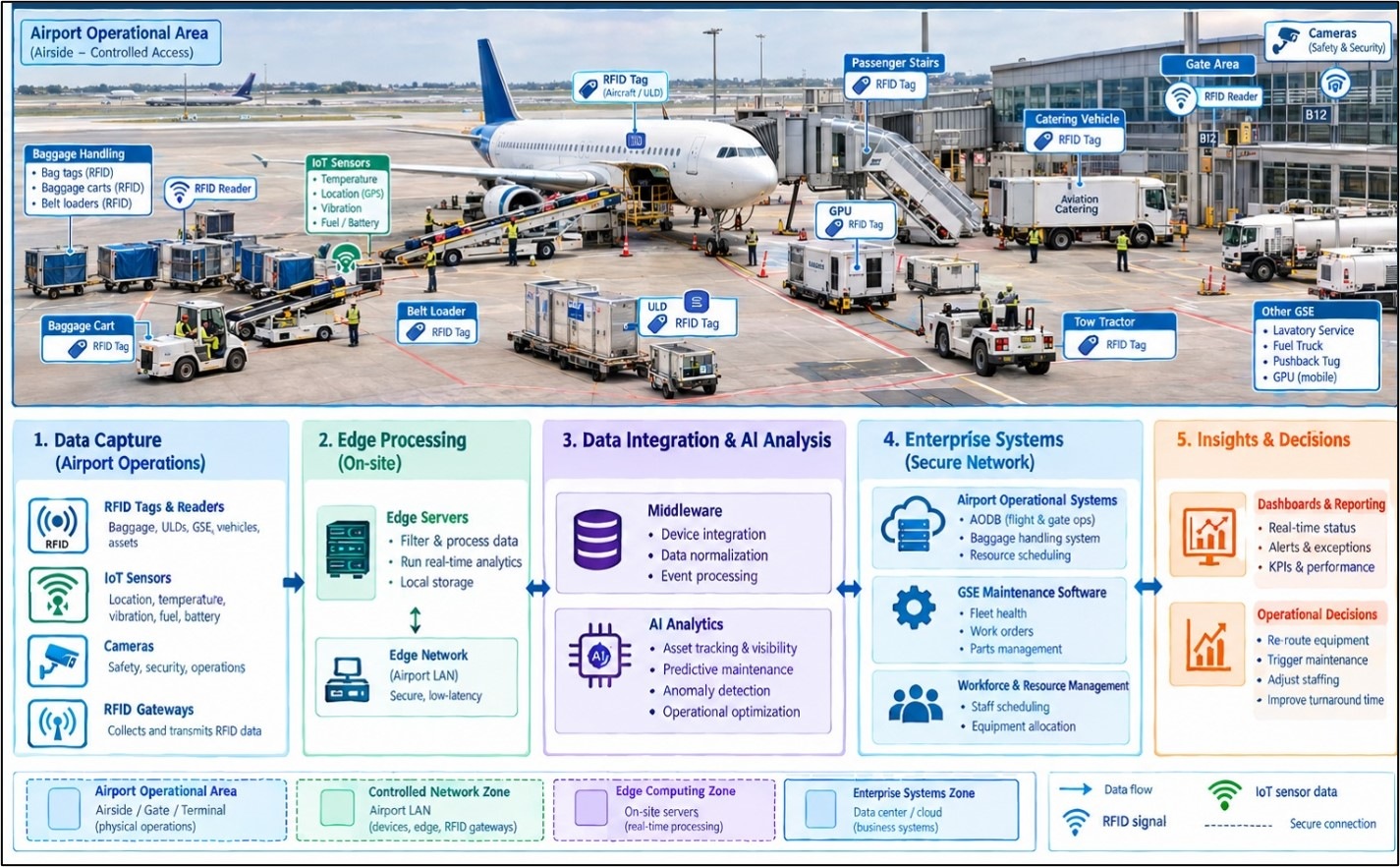
This technical diagram illustrates how AI-based ground handling connects airport physical operations with RFID tags and readers, IoT sensors, cameras, edge computing, middleware, AI analytics, and enterprise systems. It shows data flowing from baggage, ULDs, GSE, vehicles, and gate activities through secure network zones to operational databases, maintenance software, workforce management, dashboards, and real-time operational decisions.
What AI Means for Modern Ground Handling
Ground handling involves tightly coordinated activities that must occur within aircraft turnaround windows. Ramp agents, baggage handlers, load control personnel, GSE operators, dispatchers, maintenance technicians, supervisors, and airline or airport operations teams depend on accurate information about equipment, personnel, baggage, aircraft servicing, and task status.
AI can process this information to identify operational patterns that are difficult to detect through manual observation. Machine learning models can evaluate historical turnaround data, equipment utilization, task completion times, delay patterns, and exception events. Computer vision can analyze selected operational areas where visual detection is technically and operationally appropriate. Edge AI can support low-latency processing close to cameras, RFID readers, sensors, and airport operational equipment.
RFID complements these capabilities by supplying machine-readable identification and event data. A tagged GSE asset, for example, can be detected as it enters a controlled zone. A sequence of RFID reads can help establish equipment movement between staging, maintenance, and aircraft service areas. The resulting events can be normalized by middleware before being analyzed with AI models.
The value does not come from RFID identification alone. Ground handling organizations gain more operational value when identification events are combined with task information, aircraft schedules, maintenance records, staffing data, location information, and historical operating patterns.
GAO supplies RFID, BLE, and IoT hardware products and systems that can support these types of data-capture requirements. Selection should be based on the airport environment, read-zone geometry, asset type, tag placement, interference conditions, network availability, and required detection accuracy rather than simply selecting readers by nominal read range.
Ground Handling Applications for AI and RFID
AI-Based GSE Tracking and Utilization
Ground support equipment is distributed across ramps, equipment pools, maintenance areas, staging zones, and gates. Common assets include baggage tractors, belt loaders, ground power units, passenger stairs, aircraft tugs, catering trucks, water service vehicles, lavatory service vehicles, deicing equipment, and cargo handling equipment.
RFID can provide equipment identification at defined checkpoints while BLE, GNSS, telematics, or other positioning technologies can supplement location information where continuous tracking is required. AI models can use these events to identify underutilized equipment, recurring congestion, abnormal movement patterns, and potential equipment shortages.
A practical system can associate equipment identifiers with maintenance records and operational schedules. If a tagged belt loader repeatedly appears in maintenance areas or exhibits abnormal utilization patterns, the system can flag the asset for inspection. Predictive models can also estimate future GSE demand based on flight schedules, aircraft types, historical service requirements, and operating conditions.
Baggage and ULD Visibility
Ground handling organizations manage baggage containers, carts, ULDs, and other equipment across baggage make-up areas, transfer zones, staging locations, ramps, and aircraft loading areas.
RFID events can help establish when tagged items pass through designated checkpoints. AI can correlate these events with flight schedules, loading requirements, expected transfer movements, and historical handling patterns.
An exception model can identify situations such as an expected item failing to appear at a required checkpoint within an operational time window. Rather than relying solely on manual reconciliation, supervisors can receive an exception requiring investigation.
For ULD operations, RFID identification can be associated with build-up, staging, movement, loading, unloading, and return events. The exact process depends on the airport’s existing baggage handling and cargo procedures.
Aircraft Turnaround Optimization
Aircraft turnaround consists of multiple interdependent activities, including passenger disembarkation, baggage unloading, cabin servicing, catering, fueling, potable water and lavatory servicing, cargo handling, GSE positioning, boarding, baggage loading, and departure preparation.
AI can analyze historical turnaround records to determine which activities most frequently create delays. RFID and other IoT technologies can provide event timestamps that improve the accuracy of operational data.
For example, an RFID event can indicate when a designated GSE asset reaches a gate area. A separate system event can indicate when servicing begins. Combining these signals allows analytics software to compare equipment arrival with planned task timing.
The objective is not simply to track equipment. The objective is to understand the relationship between resource availability, task execution, aircraft turnaround milestones, and operational exceptions.
Predictive GSE Maintenance
Unexpected GSE failures can disrupt ramp operations and force supervisors to find replacement equipment under time pressure.
Maintenance AI can combine equipment identity, operating hours, fault records, inspection results, service history, telematics, and utilization patterns. RFID can help associate physical equipment with the correct maintenance record when assets enter maintenance facilities or inspection zones.
A predictive maintenance model can estimate failure risk or identify equipment requiring inspection. Such predictions should be treated as decision-support outputs and validated against maintenance procedures rather than automatically replacing technician judgment.
AI-Based Resource Allocation
Ground handling resources include equipment, personnel, parking positions, baggage carts, ULDs, service vehicles, and specialized GSE. Demand varies according to flight schedules, aircraft type, passenger volume, transfer activity, weather, and operational disruptions.
AI can forecast resource requirements and identify potential shortages before they affect turnaround operations. RFID-generated equipment events provide an additional source of operational data for determining where assets are located and how frequently they are used.
Resource allocation software can then help supervisors decide whether equipment should remain in its current location, be moved to another gate, sent for maintenance, or returned to an equipment pool.
Ground Handling GSE RFID Deployment Scenario: Real-Time Asset Tracking and AI Analytics
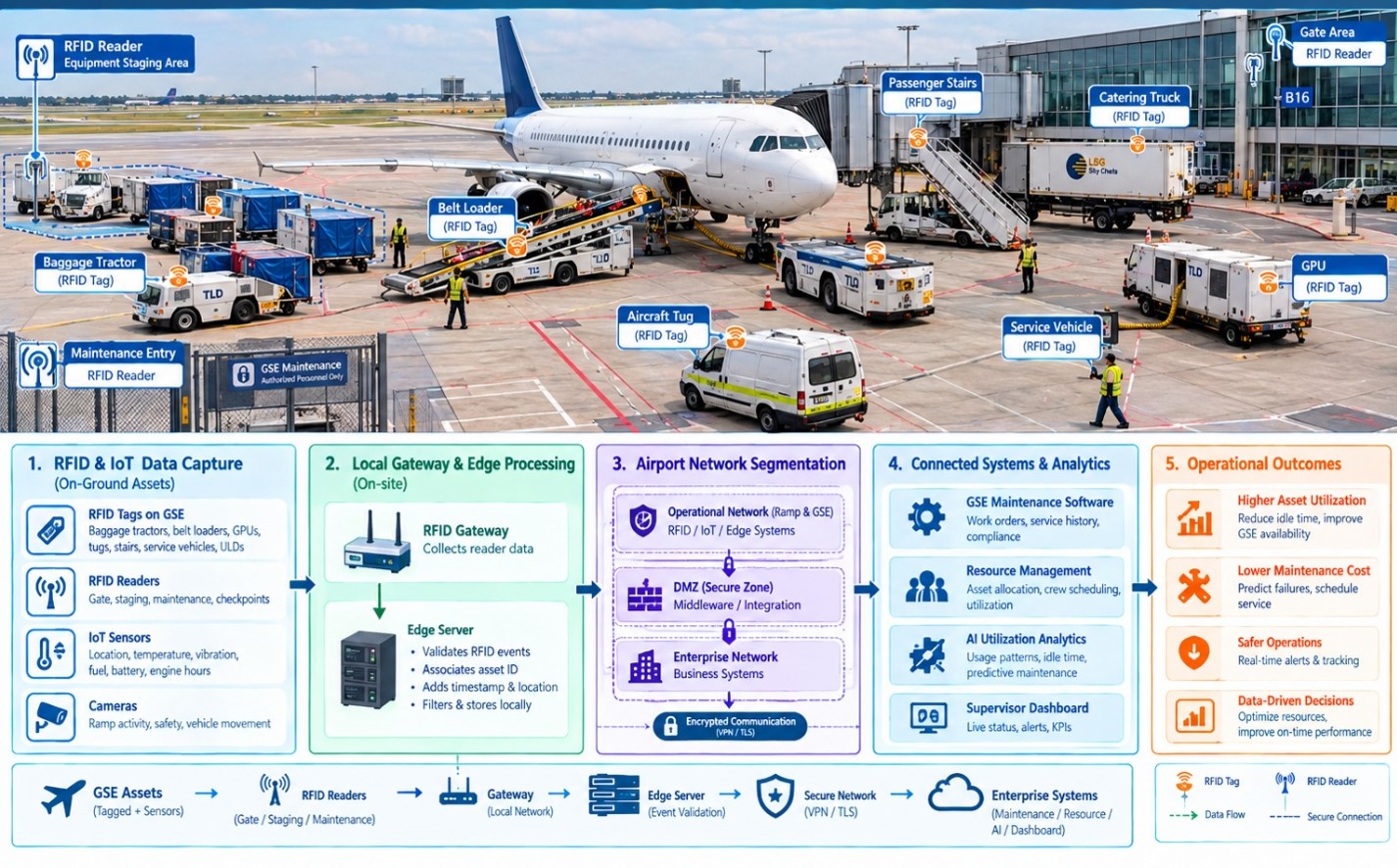
This deployment diagram shows how UHF RFID and IoT technologies can track ground support equipment across an airport ramp. RFID-tagged baggage tractors, belt loaders, GPUs, aircraft tugs, passenger stairs, and service vehicles are monitored by fixed readers at staging areas, maintenance entrances, and gate-side checkpoints. Captured events pass through a local RFID gateway to an edge server for validation, asset identification, timestamps, and location processing. The edge environment securely connects with GSE maintenance software, resource management systems, AI utilization analytics, and supervisor dashboards to support better equipment allocation, predictive maintenance, operational visibility, and data-driven ground handling decisions.
Ground Handling Operational Workflow: From Data Capture to AI Decision
An AI-enabled ground handling system normally begins with physical operational events. These events may originate from RFID readers, IoT sensors, telematics devices, cameras, airport systems, mobile applications, or manually entered operational records.
Data Acquisition
RFID readers detect tagged assets at defined airport locations. Fixed readers are suitable for controlled zones such as equipment depots, maintenance entrances, baggage handling checkpoints, or selected staging areas. Handheld RFID readers can support inventory verification and exception investigation.
IoT devices can contribute equipment telemetry, environmental information, operating status, or other sensor readings. Computer vision systems can provide additional information where cameras are permitted and appropriately positioned.
Communication and Edge Processing
Reader and sensor events are transmitted through the airport’s wired or wireless network to gateways or edge computing resources. Edge processing can filter duplicate reads, validate event structure, apply local business rules, and reduce unnecessary data transmission.
For time-sensitive ground handling processes, edge processing can also support local alert generation when network connectivity to a central system is temporarily unavailable.
Middleware and Event Normalization
Raw RFID reads are not necessarily meaningful operational events. Middleware can convert reader output into structured events such as:
- GSE asset detected at equipment staging
- GSE asset entered maintenance zone
- ULD detected at staging checkpoint
- Tagged asset detected near aircraft gate
- Asset failed to appear at expected checkpoint
- Equipment remained in a restricted or unexpected zone
Event normalization allows different readers, sensors, and software systems to use consistent identifiers and timestamps.
AI Analytics
The normalized data can be stored in operational databases or analytics systems. Machine learning models can evaluate historical and current information for demand forecasting, anomaly detection, equipment utilization analysis, turnaround performance analysis, and predictive maintenance.
AI models should be selected according to the decision being supported. Time-series models may be appropriate for demand forecasting, anomaly detection methods can identify unusual equipment behavior, and classification models can support defined operational risk categories.
Operational Decision
AI outputs can be delivered through dashboards, alerts, mobile applications, maintenance workflows, or resource management systems. A supervisor may receive an alert about a missing GSE asset, an expected equipment shortage, or an unusual turnaround condition.
The final action can remain with an authorized operational employee, particularly for safety-critical ramp activities.
AI-Enabled Ground Handling: End-to-End Workflow
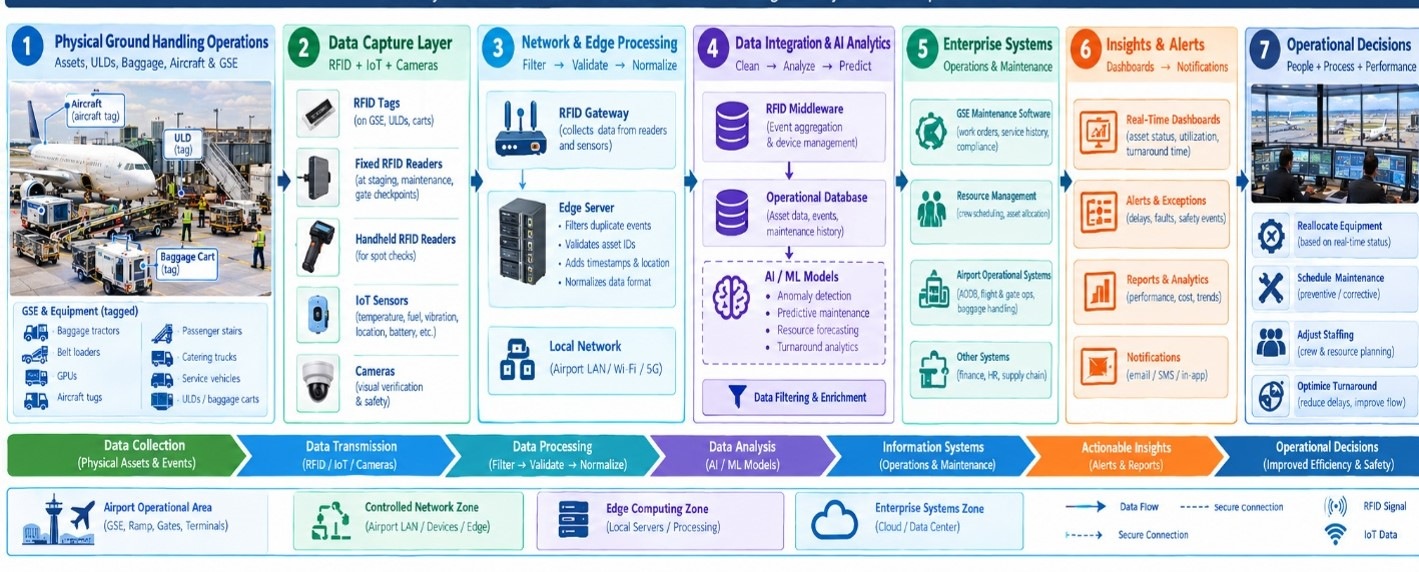
This end-to-end workflow illustrates how AI and connected technologies can transform airport ground handling operations. It traces the flow from physical assets and events—including aircraft, ULDs, baggage carts, and ground support equipment—to RFID tags, IoT sensors, cameras, and data-capture systems. Network and edge-processing layers filter, validate, and normalize incoming data before middleware, operational databases, and AI/ML models analyze it. The workflow then connects insights with maintenance, resource management, and airport operational systems, generating real-time dashboards, alerts, reports, and notifications. Finally, these insights support operational decisions such as equipment allocation, predictive maintenance, staffing adjustments, and turnaround optimization.
End-to-end AI-enabled ground handling workflow showing physical airport operations, RFID/IoT data capture, edge processing, AI analytics, enterprise systems, alerts, and operational decisions.
RFID, AI, and Supporting Technologies for Ground Handling
A practical Ground Handling solution uses multiple technologies rather than treating RFID as an isolated system.
UHF RFID
UHF RFID is particularly useful where ground handling organizations need non-line-of-sight identification across controlled zones and want to identify multiple tagged assets efficiently. Tag selection must consider mounting surfaces, outdoor exposure, metal equipment, orientation, and required read performance.
Fixed UHF readers can monitor defined transition points, while handheld readers can support inspections, asset searches, and reconciliation.
HF and LF RFID
HF RFID can be appropriate for shorter-range identification where controlled proximity reads are desirable. LF RFID can be useful in specialized identification applications requiring close-range interaction.
The appropriate RFID frequency depends on the physical environment, asset characteristics, read distance, interference, tag availability, and operational process.
IoT Sensors and Telematics
IoT sensors and GSE telematics can provide information that RFID cannot provide by itself, such as operating hours, battery status, engine information, temperature, vibration, or equipment status. Combining these data sources gives AI models a broader operational view.
Computer Vision
Computer vision can support selected ground handling use cases such as equipment detection, zone monitoring, queue analysis, and operational compliance observation. Camera placement, lighting, privacy requirements, network bandwidth, model accuracy, and edge processing requirements must be evaluated before deployment.
Edge Computing
Edge servers can process operational data near the airport environment. This is useful when low latency, local processing, network resilience, or data governance requirements make centralized processing less suitable.
Cloud and Private Server Deployment
A cloud-hosted deployment can provide centralized analytics, software management, data aggregation, and multi-location reporting. It can be appropriate for organizations operating across multiple airports that need centralized visibility.
A privately hosted server deployment can place software on customer-managed edge servers, private data centers, or other controlled infrastructure. This approach can be preferable when airport operational requirements, cybersecurity policies, data governance, network isolation, or integration constraints favor greater infrastructure control.
A hybrid deployment can keep time-sensitive processing close to airport operations while sending selected normalized data to cloud-based analytics.
Technical Capabilities and Operational Improvements
AI-based Ground Handling systems create value by combining operational events from GSE, baggage processes, ULD movements, aircraft turnaround activities, maintenance records, and workforce operations. RFID can supply reliable identification events at defined checkpoints, while other IoT technologies provide location, telemetry, and sensor information.
Real-Time Operational Visibility
Ground handling supervisors need to know where critical equipment is located and whether it is available for an assigned operation. A unified event stream can associate GSE identity, location events, aircraft assignment, task status, and timestamps.
AI can evaluate these events against expected operating patterns. A baggage tractor that remains away from its assigned gate, for example, can be flagged when its location and schedule indicate a potential resource conflict.
The quality of this capability depends heavily on event design. Reader placement should correspond to actual operational decision points rather than attempting to blanket an entire ramp with readers. Read zones must also account for metal surfaces, vehicle orientation, tag mounting, interference, and the movement characteristics of airport equipment.
Turnaround Delay Prediction
Aircraft turnaround delays often arise from interactions between several activities rather than from a single isolated task. AI models can analyze historical turnaround duration, GSE arrival times, baggage activity, servicing milestones, aircraft type, gate conditions, and other available operational variables.
A prediction model can identify a growing probability of delay before the scheduled departure time. The ground handling supervisor can then investigate the underlying constraint and reallocate available resources.
The prediction should be connected to actionable operational information. A dashboard that merely reports a high delay probability provides less value than one that identifies the contributing factors, such as late equipment arrival, incomplete baggage loading, or an unresolved servicing task.
Equipment Utilization Optimization
GSE utilization can vary substantially between gates, shifts, equipment pools, and airport operating periods. AI analytics can identify assets that are consistently underused, heavily utilized, repeatedly relocated, or unavailable for significant portions of a shift.
RFID checkpoint events provide evidence of equipment movement, while telematics or maintenance systems can provide operating information. Combining these data sources allows utilization analysis to distinguish between an asset that is physically present but idle and one that is actively serving aircraft.
This information can support decisions about equipment allocation, fleet sizing, maintenance scheduling, and replacement planning.
Exception Detection
Ground handling operations contain numerous expected sequences. AI-based anomaly detection can compare actual event sequences with those expected for a particular aircraft service or GSE workflow.
Examples include:
- A required GSE asset does not appear within the expected preparation window.
- Equipment is detected in an unexpected operating zone.
- A tagged ULD does not reach a planned checkpoint.
- A maintenance asset is detected outside its expected service location.
- Equipment utilization changes substantially from its historical operating pattern.
- Multiple assets become concentrated in an area where congestion is normally low.
Exception detection should use operational thresholds and contextual information to minimize unnecessary alerts.
Workforce and Task Coordination
Ground handling depends on coordinated work by ramp agents, baggage teams, GSE operators, maintenance personnel, dispatchers, and supervisors. AI can analyze task completion patterns and resource availability to identify potential bottlenecks.
RFID is generally not a substitute for workforce management software. Instead, physical asset events can complement task and scheduling information. A system can correlate the arrival of required equipment with the planned start of a ground service task.
Operational decisions should account for training, safety procedures, airport access requirements, and established responsibility boundaries.
Business Value of AI for Ground Handling
AI can improve ground handling performance when it is connected to measurable operational objectives.
Faster Resource Response
Better visibility into GSE and operational assets reduces the time supervisors spend searching for equipment or manually reconciling asset status. Automated event capture can provide a more current view of equipment movement and availability.
More Predictable Turnaround Operations
Historical operational data allows AI models to identify conditions associated with longer turnaround times. Early warnings give ground handling teams additional time to investigate and respond.
Reduced Manual Reconciliation
Manual asset counts, equipment searches, and checkpoint recording consume staff time and can introduce data-entry errors. RFID-supported identification can automate selected checkpoints and provide machine-readable event records.
Improved GSE Availability
Predictive maintenance and utilization analytics can help maintenance teams identify equipment requiring attention before a failure affects a scheduled operation. The benefit depends on the quality of equipment telemetry, maintenance records, and historical failure data.
Better Operational Accountability
Timestamped events provide a more consistent operational record. When properly integrated with task management and airport systems, these records can help organizations analyze service performance and determine where process improvements are required.
Scalable Airport Operations
A modular implementation can begin with a limited number of high-value processes, such as GSE tracking or equipment maintenance, before expanding to additional gates, equipment pools, or airport locations.
GAO can support these deployments with RFID and IoT hardware products and systems selected around the operational requirements of the ground handling environment. Engineering decisions should consider the complete operating process rather than treating the reader or tag as an isolated component.
Ground Handling KPIs for AI and RFID Programs
A successful deployment should define measurable performance indicators before implementation. Relevant KPIs can include:
KPI
Ground Handling Relevance
Aircraft turnaround time
Measures total time required to prepare an aircraft for departure
On-time departure rate
Indicates whether turnaround activities support scheduled departures
GSE utilization rate
Measures how effectively available equipment is being used
GSE availability
Tracks equipment available for operational assignment
GSE downtime
Measures time equipment is unavailable due to maintenance or faults
Mean time to repair
Indicates maintenance response efficiency
Equipment search time
Measures time spent locating required GSE
Baggage handling exception rate
Tracks irregular baggage-related operational events
ULD processing time
Measures time across defined ULD handling stages
Task completion variance
Compares actual task duration with planned duration
RFID read-event accuracy
Measures the quality of captured identification events
Exception alert precision
Indicates how often generated alerts represent useful operational conditions
Predictive maintenance accuracy
Evaluates maintenance model performance
Resource reassignment time
Measures how quickly equipment or resources can be redirected
Ramp congestion indicators
Helps identify operational bottlenecks in equipment movement
KPIs should be tied to specific operational processes. A high RFID read count, for example, is not itself a business success metric. The useful measure is whether captured events improve equipment visibility, reduce reconciliation work, or support better operational decisions.
Engineering and Integration Considerations
RFID Reader Placement
Reader locations should be selected according to operational workflows. Equipment depot exits, maintenance entrances, baggage checkpoints, ULD handling points, and gate-side staging areas can be more useful than indiscriminate coverage.
Read-zone testing should account for tag orientation, vehicle speed, antenna positioning, metal surfaces, reflective materials, environmental exposure, and simultaneous tag populations.
Tag Selection and Mounting
GSE assets can include metal structures, engines, batteries, hydraulic systems, and exposed outdoor surfaces. Standard passive tags may not perform equally well across all equipment types.
Engineering validation should examine:
- Asset material and surface geometry
- Tag attachment method
- Required read distance
- Outdoor and weather exposure
- Impact and vibration
- Cleaning chemicals and maintenance conditions
- Reader antenna orientation
- Expected asset speed through read zones
Event Deduplication
A moving GSE asset can generate multiple RFID reads within a short period. Middleware should consolidate these raw observations into meaningful events using time windows, reader location, antenna information, and asset identity.
Without event filtering, AI models may receive large volumes of redundant observations that distort utilization calculations and increase storage and processing requirements.
System Integration
AI Ground Handling software may need to exchange information with:
- Airport operational databases
- Ground handling management systems
- GSE maintenance management systems
- Baggage handling systems
- ULD management systems
- Resource management systems
- Workforce management software
- Airline operational systems
- Enterprise asset management systems
- Business intelligence and reporting systems
Integration should use controlled interfaces and clearly defined identifiers. Asset IDs, aircraft identifiers, flight numbers, timestamps, gate identifiers, and task IDs should have consistent formats across connected systems.
Network Resilience
Airport ramp operations cannot assume continuous network availability. Edge systems can buffer events locally and forward them when connectivity is restored.
Time synchronization is also important because AI analysis and operational investigations depend on accurate event ordering. RFID readers, gateways, edge servers, and connected systems should use appropriate time synchronization mechanisms.
Cybersecurity for AI-Enabled Ground Handling
Ground handling systems connect physical airport operations with information technology, making cybersecurity a critical engineering consideration.
Security controls should include appropriate network segmentation between operational equipment, RFID infrastructure, edge servers, enterprise applications, and external services.
Identity and access management should restrict administrative and operational functions according to user responsibilities. Role-based access control can prevent users from modifying configuration or maintenance information beyond their assigned authority.
Communication between readers, gateways, servers, and software should use appropriate encryption and authenticated connections. Device credentials and certificates should be managed throughout the equipment lifecycle.
Additional controls can include:
- Network segmentation and firewall policies
- TLS-protected communications
- Device authentication
- Role-based access control
- Secure credential management
- Software and firmware update procedures
- Audit logging
- Backup and recovery procedures
- Vulnerability management
- Monitoring for unusual network behavior
- Controlled remote administration
- Data retention policies
AI models also require governance. Model inputs should be monitored for missing, duplicated, delayed, or anomalous data. Changes to operational processes can alter the data distribution and reduce model performance, making periodic validation necessary.
Implementing AI for Ground Handling
Successful deployment should begin with a clearly defined operational problem rather than with the technology itself.
Define the Operational Scope
Select a measurable process such as GSE visibility, equipment maintenance, ULD tracking, baggage exception management, or turnaround analysis.
Document the current workflow, manual activities, decision points, existing systems, and operational constraints.
Survey the Physical Environment
Conduct an RFID site survey and identify equipment materials, reader locations, antenna positions, network availability, power requirements, environmental exposure, and potential interference.
Airport ramps require particular attention to vehicle movement, weather, equipment density, and maintenance activities.
Establish the Data Model
Define the identifiers and events that the system must capture. A useful data model can include:
- Asset ID
- Asset type
- RFID tag ID
- Reader ID
- Antenna ID
- Location or zone
- Timestamp
- Aircraft or flight association
- Task association
- Maintenance status
- Event type
- Confidence or validation status
Commission and Test
Testing should occur under actual operating conditions. Engineers should test tagged assets at realistic speeds and orientations and validate read performance during normal airport activity.
AI models should initially operate with controlled monitoring so teams can compare predictions with actual operational outcomes.
Integrate With Existing Systems
Integration should be staged. A typical sequence is physical data capture, event processing, operational database integration, analytics, and then automated or semi-automated workflows.
Avoid replacing established airport systems unnecessarily. AI and RFID should provide useful operational information through defined interfaces.
Optimize After Deployment
Post-deployment analysis should examine missed reads, duplicate events, false alerts, network interruptions, model errors, asset-tag failures, and user feedback.
Reader placement, event filtering, AI thresholds, dashboards, and workflow rules can then be adjusted according to measured results.
Practical Recommendations for Ground Handling Organizations
A technically sound implementation should prioritize operational value, measurable results, and controlled expansion.
- Start with a high-value process where asset visibility or predictive analysis can produce a measurable operational improvement.
- Map the complete Ground Handling workflow before selecting RFID reader locations.
- Use UHF RFID for suitable non-line-of-sight asset identification scenarios, while evaluating HF or LF RFID where shorter-range identification better fits the workflow.
- Combine RFID with IoT telemetry, telematics, BLE, computer vision, or other sensing technologies when additional operational information is required.
- Process repetitive RFID observations into meaningful operational events before sending data to AI models.
- Keep safety-critical decisions under appropriate human operational control.
- Use edge processing where low latency or local resilience is important.
- Select cloud, private server, or hybrid deployment according to airport IT policies, data governance, connectivity, integration requirements, and operational latency.
- Validate RFID tags and reader configurations using actual GSE and airport operating conditions.
- Define KPIs before deployment and compare results against a documented baseline.
- Secure readers, gateways, servers, APIs, and user accounts as part of the initial system design.
- Establish procedures for tag replacement, reader maintenance, firmware updates, model monitoring, and system recovery.
- Expand only after the initial use case demonstrates reliable data quality and measurable operational value.
GAO’s experience supplying RFID, BLE, and IoT hardware products and systems can support organizations evaluating identification and sensing requirements for airport operations. The appropriate solution depends on the assets being tracked, physical environment, required detection behavior, existing software, and deployment constraints.
Key Takeaways for AI-Enabled Ground Handling
AI for Ground Handling is most effective when artificial intelligence is connected to reliable operational data and clearly defined decisions. RFID can provide structured identification events for GSE, ULDs, and other tagged assets, while IoT sensors, telematics, computer vision, airport systems, and maintenance records add operational context.
The most valuable applications include GSE tracking and utilization, turnaround analysis, predictive maintenance, resource allocation, exception detection, baggage and ULD visibility, and operational forecasting.
A successful implementation requires more than installing readers and tags. Ground handling organizations should define workflows, engineer read zones, normalize events, integrate existing software, establish cybersecurity controls, validate AI models, and measure outcomes through operational KPIs.
Organizations evaluating these technologies can learn more from GAO’s RFID, BLE, and IoT products and technical expertise when developing a practical data-capture and AI solution for ground handling operations.
Building the Future of Industrial AI and IoT with Aperture Venture Studio and GAO RFID Inc.
For more than three decades, GAO Group of Companies has invested heavily in R&D for industrial RFID, BLE, and IoT technologies. As AI has become increasingly useful for industrial and operational applications, our work has expanded toward combining AI with connected sensing technologies. This includes solutions relevant to aviation ground handling, where AI can use RFID and IoT-generated operational data to improve asset visibility, maintenance analysis, and resource decisions.
We have founded Aperture Venture Studio to support the development of AI and IoT companies and solutions across industries, including applications involving intelligent asset management and connected operations.
Aperture has attracted AI and IoT technical experts, entrepreneurial and operational executives, influential investors, and leading companies. We have also developed the Aperture Ventures Summit and TekSummit to discuss advanced AI and IoT topics.
GAO is headquartered in New York City and Toronto, Canada, and is recognized among leading global B2B and B2G suppliers of BLE and RFID technologies. GAO, GAO Research Inc., and GAO Tek Inc. form the GAO Group, serving organizations across the United States and Canada, including Fortune 500 companies, research organizations, universities, and government agencies.
Our organizations have invested substantially in R&D, supported by quality assurance processes and technical assistance delivered remotely or onsite. We welcome participation from:
- Advisors, co-founders, or employees
- Investors
- Customers