
AI and RFID for Healthcare Infrastructure
AI and RFID for Healthcare Infrastructure in the Digital Age
Healthcare infrastructure is rapidly evolving from disconnected medical assets and manual workflows toward intelligent, data-driven clinical environments. AI and RFID technologies enable hospitals, clinics, laboratories, pharmacies, research facilities, and healthcare networks to continuously identify, locate, analyze, and optimize critical medical resources while improving operational efficiency, patient safety, regulatory compliance, and clinical decision-making. Together, these technologies transform traditional identification systems into intelligent operational ecosystems capable of supporting predictive healthcare operations.
Artificial Intelligence combined with RFID creates a continuous digital representation of healthcare assets, medical equipment, pharmaceuticals, laboratory samples, surgical instruments, patient movement, and environmental conditions. RFID automatically captures operational events without requiring direct line-of-sight scanning, while AI analyzes historical and real-time information to identify anomalies, forecast demand, optimize workflows, automate inventory replenishment, reduce equipment loss, and improve resource utilization.
Healthcare organizations increasingly deploy AI + RFID solutions across emergency departments, operating rooms, pharmacies, sterile processing departments, intensive care units, laboratories, medical warehouses, and enterprise healthcare networks. Whether deployed through cloud-hosted software or privately managed enterprise server infrastructure, these systems provide healthcare professionals with timely operational intelligence while supporting interoperability with Hospital Information Systems (HIS), Electronic Health Records (EHR), Laboratory Information Systems (LIS), Enterprise Resource Planning (ERP), Computerized Maintenance Management Systems (CMMS), and building management systems.
For nearly three decades, GAO has supplied RFID and IoT hardware products and systems to organizations throughout the United States and Canada. Headquartered in New York City and Toronto, we have supported Fortune 500 companies, research institutions, universities, and government organizations with enterprise-grade identification and sensing technologies backed by extensive engineering experience.
Understanding AI and RFID for Healthcare Infrastructure
Healthcare infrastructure encompasses the physical, digital, and operational systems that support patient care throughout hospitals and healthcare facilities. AI and RFID extend these systems by providing automated identification, location awareness, operational intelligence, and predictive decision support across clinical and non-clinical environments.
Traditional barcode systems require manual scanning and human intervention. RFID allows tagged assets or items to be automatically identified through radio frequency communication without direct visibility. AI then processes this continuously collected information to discover operational patterns, predict future events, recommend actions, and automate routine decisions.
The combination forms an important component of the Artificial Intelligence of Things (AIoT), where connected identification devices continuously generate operational data for machine learning algorithms.
Healthcare organizations typically implement AI and RFID to support:
- Medical equipment tracking
- Patient identification
- Surgical instrument management
- Medication authentication
- Blood product traceability
- Laboratory specimen tracking
- Cold chain monitoring
- Hospital inventory optimization
- Linen management
- Biomedical asset lifecycle management
- Staff workflow optimization
- Infection prevention
- Regulatory documentation
- Clinical resource planning
Unlike isolated RFID deployments, AI continuously improves operational performance by learning from historical trends, environmental conditions, workflow patterns, and enterprise healthcare operations.
Why AI Is Transforming RFID-Based Healthcare Infrastructure
Healthcare environments produce enormous volumes of operational information every day.
Examples include:
- Equipment movement
- Patient admissions
- Medication dispensing
- Laboratory workflows
- Operating room schedules
- Pharmacy inventories
- Sterilization cycles
- Maintenance records
- Clinical staffing
- Supply chain deliveries
Manual analysis of this information is neither practical nor sufficiently responsive for modern healthcare operations.
Artificial intelligence introduces capabilities such as:
- Predictive analytics
- Computer vision integration
- Time-series forecasting
- Machine learning classification
- Deep learning
- Reinforcement learning
- Optimization algorithms
- Digital twins
- Generative AI assisted reporting
- Natural language processing for maintenance documentation
- Large language model assisted operational search
- Anomaly detection
- Predictive maintenance
- Inventory optimization
These AI methods transform RFID event streams into actionable operational intelligence.
Healthcare organizations can predict equipment shortages before they occur, identify unusual medication movement, detect inefficient clinical workflows, forecast surgical inventory demand, optimize housekeeping schedules, and improve utilization of expensive diagnostic equipment.
Rather than replacing healthcare professionals, AI supports faster operational decisions while allowing clinicians to spend more time on patient care.
ployments, AI continuously improves operational performance by learning from historical trends, environmental conditions, workflow patterns, and enterprise healthcare operations.
How AI Converts RFID Data into Healthcare Operational Decisions
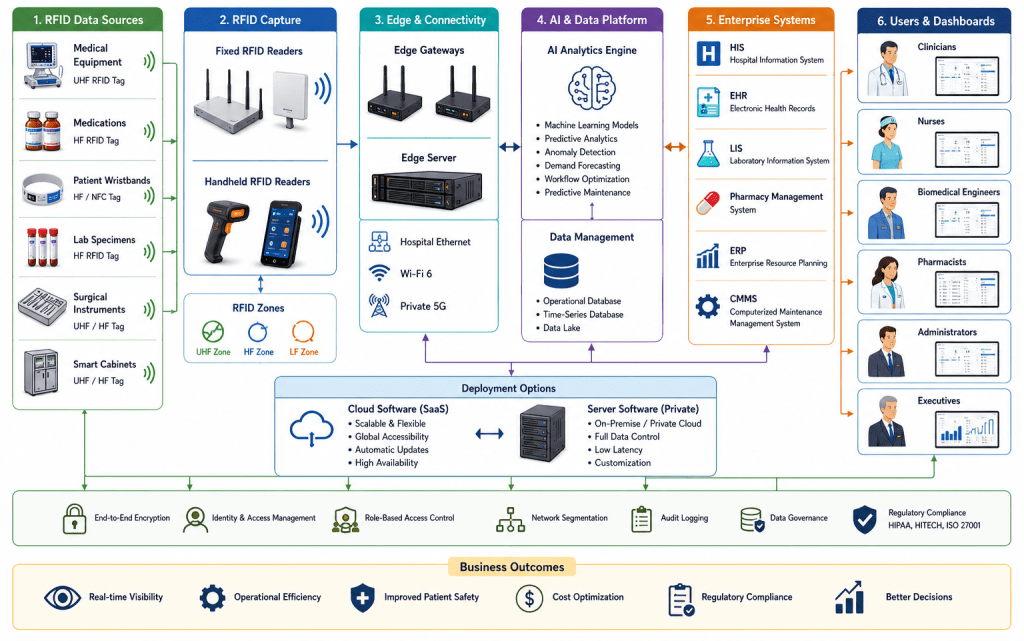
The integrated AI and RFID healthcare framework illustrates how AI and RFID technologies integrate across modern healthcare infrastructure, from RFID-tagged medical assets and edge data collection to AI analytics, enterprise healthcare systems, and user dashboards. It highlights secure communication networks, cloud and private server deployments, cybersecurity controls, and the continuous flow of operational data that enables predictive analytics, automation, and informed clinical and administrative decision-making.
Fundamental Relationship Between AI and RFID in Healthcare
RFID serves as the real-time sensing and identification layer.
Artificial intelligence serves as the decision intelligence layer.
Each complements the other throughout the healthcare information lifecycle.
RFID Responsibilities
RFID performs automatic identification of physical objects through radio frequency communication.
Healthcare deployments commonly use:
- UHF RFID for medical asset tracking
- HF RFID for medication authentication
- HF NFC for patient interaction
- LF RFID for specialized identification applications
- Passive RFID tags
- Active RFID tags
- Battery-assisted passive tags
- RFID smart labels
- Wearable patient wristbands
RFID readers capture:
- Identity
- Location
- Timestamp
- Reader position
- Signal strength
- Movement history
These events become operational records for AI analysis.
AI Responsibilities
Artificial intelligence converts RFID event data into operational intelligence.
Typical AI functions include:
- Equipment utilization prediction
- Inventory forecasting
- Staff workflow optimization
- Resource allocation
- Anomaly detection
- Equipment loss prevention
- Demand forecasting
- Capacity planning
- Predictive maintenance
- Supply chain optimization
- Clinical workflow analysis
- Operational simulation
Rather than reacting after problems occur, AI enables proactive healthcare operations.
End-to-End Operational Workflow of AI and RFID in Healthcare Infrastructure
A complete enterprise deployment consists of multiple interconnected layers, each contributing specific technical capabilities.
Step 1. RFID Data Acquisition
Healthcare assets receive RFID identification appropriate to their operational requirements.
Examples include:
- Infusion pumps
- Ventilators
- Defibrillators
- Wheelchairs
- Patient beds
- Blood bags
- Pharmaceutical inventory
- Surgical trays
- Endoscopes
- Implantable devices
- Laboratory samples
- Medical waste containers
RFID readers automatically capture movement events throughout hospitals.
Data collected typically includes:
- Asset ID
- Timestamp
- Reader location
- Zone transition
- User interaction
- Environmental sensor readings
- Temperature
- Humidity
- Motion status
- Battery condition for active tags
Step 2. Communication Infrastructure
Captured RFID information travels across healthcare communication networks.
Typical communication technologies include:
- Ethernet
- Wi-Fi 6
- Wi-Fi 6E
- Private 5G
- Fiber backbone
- Power over Ethernet
- MQTT
- HTTPS
- REST APIs
- OPC UA where integrated with healthcare facilities management
- TCP/IP
- IPv6
Healthcare environments require redundant communication paths to maintain operational continuity.
Network segmentation commonly separates:
- Clinical systems
- Administrative systems
- Medical devices
- Guest access
- Biomedical engineering systems
- Building automation
Step 3. Edge Processing
Edge servers reduce latency while minimizing unnecessary network traffic.
Typical edge processing functions include:
- RFID event filtering
- Duplicate removal
- Signal quality evaluation
- Local caching
- Temporary storage during network interruptions
- Device authentication
- Encryption
- Initial AI inference
- Local alert generation
- Reader health monitoring
Edge processing is particularly valuable for emergency departments, operating rooms, pharmacies, and intensive care units where immediate responses are required.
Step 4. Enterprise Data Management
Validated RFID events are transferred into enterprise databases where they become part of long-term healthcare operational records.
Common storage technologies include:
- Relational databases
- Time-series databases
- Data lakes
- Distributed object storage
- Healthcare operational data repositories
Historical information enables AI to continuously improve prediction accuracy while supporting audit requirements established by healthcare regulations and accreditation bodies.
GAO has helped healthcare organizations deploy RFID hardware that integrates with existing enterprise software, enabling reliable identification data collection while preserving compatibility with established hospital information environments.
AI Analytics and Decision Intelligence for RFID-Enabled Healthcare Infrastructure
Once RFID events are collected, filtered, and stored, AI software transforms operational data into actionable intelligence. Instead of merely reporting where an asset or patient is located, AI identifies patterns, predicts future operational conditions, recommends corrective actions, and, where appropriate, automates selected workflows.
Healthcare organizations increasingly combine historical RFID event data with operational, clinical, maintenance, and environmental information to improve decision quality across the enterprise.
AI Data Sources Used Alongside RFID
AI models become more accurate when RFID data is combined with additional operational information, including:
- Electronic Health Record (EHR) data
- Hospital Information System (HIS) transactions
- Enterprise Resource Planning (ERP) inventory records
- Computerized Maintenance Management System (CMMS) work orders
- Laboratory Information System (LIS) specimen status
- Pharmacy dispensing records
- Real-time location information
- Equipment utilization history
- Maintenance logs
- Environmental sensor readings
- Temperature and humidity monitoring
- Clinical scheduling systems
- Admission, discharge, and transfer (ADT) events
- Purchasing records
- Supplier delivery information
This broader operational context enables AI to evaluate relationships that individual systems cannot identify independently.
Machine Learning Models Commonly Used
Healthcare infrastructure benefits from multiple AI techniques, each addressing different operational challenges.
Supervised Learning
Used when historical labeled data is available.
Typical healthcare applications include:
- Equipment demand prediction
- Inventory forecasting
- Patient flow estimation
- Maintenance prediction
- Medication consumption forecasting
Common algorithms include:
- Random Forest
- Gradient Boosting
- XGBoost
- Support Vector Machines
- Logistic Regression
Unsupervised Learning
Used to identify hidden operational patterns without predefined labels.
Applications include:
- Equipment utilization clustering
- Workflow optimization
- Department usage analysis
- Supply chain segmentation
- Inventory anomaly detection
Common methods include:
- K-Means
- DBSCAN
- Hierarchical clustering
- Principal Component Analysis (PCA)
Deep Learning
Deep neural networks process highly complex relationships among operational variables.
Healthcare use cases include:
- Predictive workflow optimization
- Demand forecasting
- Multi-variable resource planning
- Computer vision integration with RFID workflows
- Complex anomaly detection
Typical architectures include:
- Artificial Neural Networks
- Convolutional Neural Networks (CNNs)
- Long Short-Term Memory (LSTM) networks
- Transformer-based models
Reinforcement Learning
Reinforcement learning continuously improves operational policies based on observed outcomes.
Healthcare applications include:
- Dynamic inventory optimization
- Equipment allocation
- Bed management
- Staff scheduling assistance
- Autonomous warehouse routing
Generative AI
Generative AI does not replace RFID or operational AI models but complements them by simplifying information access.
Typical functions include:
- Operational report generation
- Maintenance summary creation
- Natural language querying of inventory
- Clinical logistics documentation
- Executive operational summaries
- Knowledge retrieval for biomedical engineering teams
RFID Technologies Supporting Healthcare Infrastructure
Different RFID frequencies are selected according to healthcare operational requirements, reading distance, environmental conditions, and object characteristics.
Ultra High Frequency (UHF) RFID
UHF RFID typically operates between 860 MHz and 960 MHz, depending on regional regulations.
Healthcare applications include:
- Medical equipment tracking
- Hospital inventory management
- Linen management
- Warehouse logistics
- Wheelchair tracking
- Infusion pump management
- Mobile diagnostic equipment
Advantages include:
- Long read distance
- Fast multi-tag reading
- High inventory throughput
- Efficient warehouse operations
Engineering considerations include:
- Metal interference
- Liquid absorption
- Antenna positioning
- Reader coverage planning
High Frequency (HF) RFID
HF RFID operates at 13.56 MHz.
Healthcare applications include:
- Medication authentication
- Blood product identification
- Laboratory specimen tracking
- Patient identification
- Smart medication cabinets
- Pharmaceutical verification
- Near Field Communication (NFC) interactions
Advantages include:
- Stable short-range reading
- Better performance near liquids
- Controlled read zones
- Improved security for close-proximity transactions
Low Frequency (LF) RFID
LF RFID typically operates around 125 kHz or 134.2 kHz.
Healthcare applications include:
- Specialized medical identification
- Legacy healthcare systems
- Equipment authentication
- Selected access control systems
Advantages include:
- Excellent penetration through water-rich environments
- Reliable operation near biological materials
- Stable performance in challenging electromagnetic environments
Supporting Hardware Across the Healthcare Environment
Successful AI and RFID deployments depend on coordinated hardware selection rather than individual devices.
Typical enterprise hardware includes:
- Fixed RFID readers
- Handheld RFID readers
- Mobile RFID computers
- RFID antennas
- Smart cabinets
- RFID printers and encoders
- Passive RFID tags
- Active RFID tags
- Battery-assisted passive tags
- Patient wristbands
- Medical equipment tags
- Laboratory specimen labels
- Pharmaceutical labels
- Edge gateways
- Industrial edge servers
- High-availability server clusters
- Network switches
- Wi-Fi access points
- Private 5G infrastructure
- Uninterruptible power supplies (UPS)
- Environmental monitoring sensors
GAO supplies a broad portfolio of RFID readers, tags, antennas, accessories, and supporting IoT hardware that organizations integrate into healthcare infrastructure according to their operational and regulatory requirements.
Enterprise Software Integration
RFID information delivers the greatest value when integrated into existing healthcare software rather than operating as an isolated identification system.
Common integration targets include:
- Electronic Health Record (EHR)
- Hospital Information System (HIS)
- Laboratory Information System (LIS)
- Radiology Information System (RIS)
- Pharmacy management software
- Enterprise Resource Planning (ERP)
- Warehouse Management System (WMS)
- Computerized Maintenance Management System (CMMS)
- Building Management System (BMS)
- Identity and Access Management (IAM)
- Security Information and Event Management (SIEM)
- Business intelligence dashboards
Integration commonly uses:
- REST APIs
- HL7
- HL7 FHIR
- DICOM where imaging workflows are involved
- MQTT
- AMQP
- HTTPS
- SOAP where legacy healthcare applications require it
- SQL connectors
- Message brokers
Deployment Models for AI & RFID Healthcare Infrastructure: Cloud-Based vs. On-Premises
Healthcare organizations select deployment architecture according to operational requirements, regulatory obligations, cybersecurity policies, and infrastructure maturity.
| Feature | Cloud-Based AI & RFID Healthcare Infrastructure | On-Premises AI & RFID Healthcare Infrastructure |
| Deployment Environment | Hosted on cloud systems managed by service providers | Installed and operated within the healthcare organization’s own infrastructure |
| System Response Time | Suitable for most healthcare applications with internet-dependent performance | Delivers faster response due to local processing and reduced network dependency |
| Scalability | Resources can be expanded dynamically based on demand | Expansion depends on available local computing and storage resources |
| Infrastructure Management | Maintenance, monitoring, and backups are handled by the cloud provider | Managed by the hospital’s IT department and technical staff |
| Software & AI Updates | AI algorithms and RFID management software are updated centrally | Updates are scheduled and deployed according to organizational policies |
| AI Model Integration | Supports rapid deployment of preconfigured AI services | Enables customized AI models tailored to specific clinical workflows |
| Patient Data Storage | Data is stored in selected cloud regions, subject to provider policies | Patient and RFID-generated data remain within the organization’s local servers |
| Security & Compliance | Security responsibilities are shared between the provider and healthcare organization | Full control over security measures and regulatory compliance remains with the organization |
| Implementation Cost | Lower upfront investment with subscription-based pricing | Higher initial capital expenditure for servers and networking infrastructure |
| Customization Capability | Supports moderate customization through cloud services | Offers extensive customization for integrating AI and RFID into existing healthcare systems |
Cloud-hosted software is generally appropriate for multi-site healthcare organizations seeking centralized management and simplified scalability.
Server deployments are often preferred where strict data governance, low latency, private infrastructure, or organization-specific customization requirements exist. These deployments may operate within hospital data centers, privately hosted cloud environments, regional healthcare networks, or dedicated enterprise facilities rather than only traditional on-premises installations.
Healthcare Applications of AI and RFID
Healthcare infrastructure includes numerous operational areas where AI and RFID deliver measurable improvements.
Medical Equipment Tracking
AI predicts equipment demand while RFID continuously identifies equipment locations.
Benefits include:
- Reduced equipment search time
- Higher utilization
- Lower capital expenditure
- Improved maintenance scheduling
Pharmacy Operations
RFID automates medication identification while AI forecasts inventory requirements.
Applications include:
- Controlled substance monitoring
- Expiration management
- Inventory optimization
- Counterfeit detection support
Laboratory Operations
RFID improves specimen traceability while AI predicts workflow bottlenecks and laboratory capacity requirements.
Surgical Instrument Management
RFID verifies instrument sets before and after procedures.
AI identifies sterilization trends, predicts maintenance requirements, and supports instrument lifecycle management.
Patient Flow Optimization
AI analyzes RFID movement data to identify congestion, improve bed utilization, reduce waiting times, and optimize staff allocation.
Cybersecurity, Privacy, and Regulatory Considerations
Healthcare infrastructure manages sensitive operational and patient-related information, making cybersecurity and privacy essential design requirements.
Engineering best practices include:
- End-to-end encryption
- TLS-protected communications
- Role-based access control (RBAC)
- Multi-factor authentication
- Zero Trust security principles
- Network segmentation
- Continuous vulnerability assessments
- Security event monitoring
- Audit logging
- Digital certificate management
- Secure firmware updates
- Hardware root of trust where supported
Relevant standards and regulations may include:
- HIPAA
- HITECH Act
- FDA guidance for medical devices where applicable
- ISO 13485
- ISO 14971
- ISO/IEC 27001
- ISO/IEC 27701
- IEC 62304 for applicable medical software
- NIST Cybersecurity Framework
- GS1 identification standards
- EPCglobal standards for RFID
GAO applies stringent quality assurance processes and supports customers remotely and onsite, helping organizations integrate RFID hardware into secure healthcare environments while aligning with applicable industry standards and operational requirements.
Deployment Lifecycle and Engineering Best Practices
Enterprise healthcare implementations benefit from a structured lifecycle that reduces technical risk and improves long-term operational value.
Key phases include:
- Clinical and operational requirements assessment
- RFID frequency and hardware selection
- Radio frequency site survey
- Infrastructure design
- AI use case definition
- Communication network planning
- Cloud versus server architecture selection
- Integration with enterprise healthcare software
- Pilot deployment
- Commissioning and acceptance testing
- Interoperability validation
- Cybersecurity verification
- User training
- Operational monitoring
- AI model refinement
- Preventive maintenance
- Continuous optimization
Engineering observations include:
- Conduct RF surveys before reader installation to identify interference from medical equipment, metal structures, and liquid-rich environments.
- Design redundant communication paths for mission-critical clinical areas such as emergency departments and operating rooms.
- Define data governance policies early to support regulatory compliance, AI model quality, and lifecycle management.
- Validate integrations with EHR, HIS, ERP, and CMMS software using representative production workflows before full-scale deployment.
- Monitor AI model performance over time and retrain models as operational processes, equipment inventories, and patient volumes evolve.
Business Value and Operational Outcomes
Organizations implementing AI and RFID across healthcare infrastructure commonly achieve:
- Improved asset visibility
- Faster equipment retrieval
- Higher equipment utilization
- Reduced inventory waste
- Better medication traceability
- Enhanced patient safety
- Lower operational costs
- More accurate maintenance planning
- Greater regulatory compliance
- Improved workforce productivity
- Better executive decision support
- Increased operational resilience
These improvements result from the combination of automated identification, continuous operational data collection, AI-driven analytics, and integration with enterprise healthcare software.
Advancing Intelligent Healthcare Infrastructure with GAO
AI and RFID are becoming foundational technologies for modern healthcare infrastructure by connecting physical assets with intelligent operational decision-making. RFID provides continuous, reliable identification of equipment, medications, specimens, and other critical resources, while AI transforms operational data into predictive insights that improve efficiency, resource utilization, patient safety, and long-term planning. Whether implemented through cloud-hosted software or privately managed server infrastructure, successful deployments depend on careful architecture design, interoperability, cybersecurity, standards compliance, and continuous optimization.
Headquartered in New York City and Toronto, GAO is recognized among the world’s leading B2B suppliers of RFID and BLE technologies. Together with our sister companies, GAO Research and GAO Tek, we have supported organizations across North America for nearly three decades with engineering expertise, extensive research and development, quality-focused hardware products and systems, and expert technical support. We encourage healthcare organizations, system integrators, and engineering teams to explore how GAO’s RFID technologies and implementation experience can support secure, scalable, and intelligent healthcare infrastructure initiatives.
Advisory Invitation
Aperture is developing Industrial AI + IoT ventures, each organized as an independent Delaware C-Corp with its own founding leadership team and seed financing. These initiatives build upon the 30-year enterprise IoT foundation established by GAO, utilizing their proven engineering resources, domain knowledge, and core technologies. We are inviting a select group of accomplished executives, technology leaders, entrepreneurs, and industry specialists to contribute as founding advisors. If this opportunity aligns with your interests or you would like additional information, please submit your questions through our Contact Us page.