
AI and RFID for Heavy Equipment
AI-Driven RFID Solutions for Heavy Equipment Manufacturing
Artificial intelligence combined with RFID is transforming heavy equipment manufacturing by improving production visibility, equipment traceability, predictive maintenance, quality assurance, and lifecycle management. Rather than simply identifying parts or assets, modern AI systems analyze RFID-generated operational data alongside sensor readings, production records, maintenance histories, and enterprise software to support intelligent decision-making across manufacturing operations.
Heavy equipment manufacturers operate highly complex production environments involving large fabricated structures, hydraulic systems, diesel engines, powertrains, attachments, welding stations, machining centers, paint facilities, assembly lines, warehouses, and global supply chains. AI-enabled RFID solutions improve visibility throughout these environments by continuously monitoring work-in-progress, production assets, reusable tooling, components, and finished machines while identifying patterns that affect quality, productivity, maintenance, and operational efficiency.
For organizations manufacturing excavators, bulldozers, wheel loaders, motor graders, cranes, mining equipment, forestry machinery, road construction equipment, agricultural machinery, and specialized industrial equipment, AI-assisted RFID systems provide accurate operational intelligence that supports engineering teams, production managers, maintenance personnel, quality engineers, logistics coordinators, and executive decision makers.
GAO has helped organizations across North America deploy RFID and Industrial IoT hardware products and systems that improve asset visibility, manufacturing intelligence, equipment tracking, and operational performance through technically sound implementations tailored to demanding industrial environments.
Understanding AI-Driven RFID in Heavy Equipment Manufacturing
Heavy equipment manufacturing involves thousands of serialized components moving through fabrication, machining, welding, painting, subassembly, final assembly, testing, storage, shipping, aftermarket support, and field service operations. Each process generates operational data that can be enhanced through RFID identification and interpreted by artificial intelligence.
Rather than viewing RFID as a standalone identification technology, modern Industrial AI solutions treat RFID as one of several important data acquisition technologies supporting intelligent manufacturing systems.
AI analyzes information collected from:
RFID-tagged components
RFID-tagged welding fixtures
Production tooling
Engine assemblies
Hydraulic cylinders
Gearboxes
Chassis structures
Boom assemblies
Buckets
Axles
Counterweights
Final assembled machines
Returnable transport assets
Industrial containers
Supplier shipments
Finished equipment inventory
Machine learning models combine RFID events with manufacturing execution records, programmable logic controller (PLC) data, industrial sensor measurements, machine vision inspection results, vibration monitoring, torque measurements, dimensional inspection reports, telematics information, and enterprise business data to identify production bottlenecks, predict failures, optimize inventory movement, and improve manufacturing quality.
This approach aligns with Artificial Intelligence of Things (AIoT), where connected industrial devices, RFID systems, sensors, Edge AI, machine learning, and enterprise software work together to automate operational decisions throughout heavy equipment manufacturing facilities.
AI-Driven RFID Architecture Diagram for Smart Heavy Equipment Manufacturing
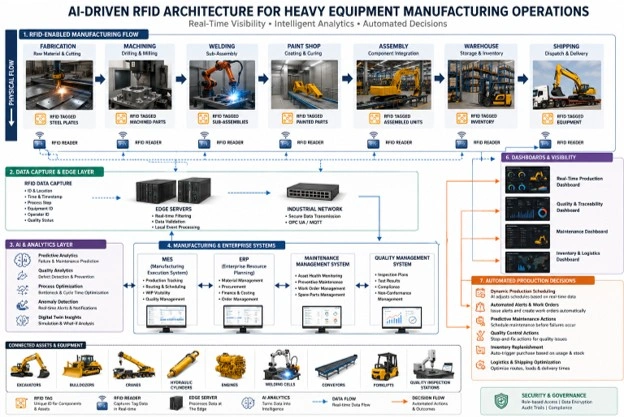
Why AI is Transforming Heavy Equipment Manufacturing
Heavy equipment manufacturers face increasing production complexity due to highly configurable equipment, extended product lifecycles, global supply chains, stricter quality requirements, labor shortages, and increasing customer expectations regarding equipment reliability.
Artificial intelligence helps manufacturers convert operational data into actionable recommendations that improve manufacturing performance throughout the equipment lifecycle.
Major operational drivers include:
Managing thousands of serialized components across multiple production stages
Tracking reusable manufacturing fixtures
Monitoring expensive machining tools
Reducing assembly errors
Preventing incorrect component installation
Improving production scheduling
Detecting manufacturing anomalies earlier
Optimizing warehouse operations
Reducing equipment downtime
Improving maintenance planning
Supporting digital quality documentation
Enhancing supplier traceability
Heavy equipment production differs significantly from discrete consumer manufacturing because equipment often weighs several tons, requires extensive manual assembly, undergoes multiple inspection stages, and involves numerous engineered variants. AI models therefore require manufacturing-specific operational context rather than generic production analytics.
Using RFID-generated production events together with engineering data enables AI systems to recognize patterns such as repeated delays at welding stations, recurring quality issues associated with specific suppliers, abnormal work-in-progress accumulation, excessive movement of large fabricated structures, and inefficient utilization of specialized assembly equipment.
GAO supports manufacturers by supplying industrial RFID hardware, readers, antennas, tags, and IoT systems designed for challenging production environments where metal surfaces, harsh temperatures, vibration, dust, and electromagnetic interference are common.
AI Applications Across Heavy Equipment Manufacturing Operations
AI-enabled RFID systems support numerous operational functions throughout heavy equipment manufacturing.
Intelligent Production Asset Tracking
Heavy equipment manufacturing facilities contain thousands of valuable production assets that require continuous visibility.
Examples include:
Welding fixtures
Assembly jigs
Hydraulic test equipment
Engine stands
Torque tools
CNC tooling
Material handling racks
Forklift attachments
Paint carriers
Reusable shipping containers
Mobile inspection equipment
AI identifies abnormal movement patterns, predicts asset shortages, and recommends equipment redistribution before production delays occur.
Work-in-Progress Visibility
Large structural components often remain in production for several days or weeks.
RFID automatically records movement through:
Steel preparation
CNC machining
Robotic welding
Manual welding
Heat treatment
Surface preparation
Painting
Engine installation
Hydraulic installation
Electrical integration
Functional testing
Final inspection
AI analyzes production flow to identify bottlenecks, estimate completion times, and recommend scheduling adjustments that improve throughput.
Predictive Maintenance for Manufacturing Equipment
Manufacturing equipment such as robotic welders, machining centers, paint systems, conveyor systems, overhead cranes, hydraulic presses, compressors, and automated guided vehicles continuously generate operational information.
RFID identifies production assets while AI evaluates:
Equipment utilization
Maintenance history
Failure frequency
Spare parts consumption
Operator usage
Runtime hours
Downtime trends
Repair intervals
Maintenance planners receive recommendations before failures interrupt production.
Quality Traceability
Heavy equipment manufacturers require comprehensive production records throughout the product lifecycle.
RFID identifies:
Individual components
Supplier lots
Assembly stations
Inspection checkpoints
Calibration equipment
Torque verification
Welding operators
Test equipment
Paint batches
AI correlates manufacturing events to identify the root causes of quality deviations while supporting regulatory compliance, warranty investigations, and continuous improvement initiatives.
Intelligent Inventory Management
Heavy equipment manufacturers often manage:
Steel inventory
Hydraulic hoses
Bearings
Fasteners
Powertrain components
Electrical harnesses
Pumps
Valves
Engines
Axles
Tires
Tracks
Buckets
Wear parts
AI forecasts inventory requirements using RFID movement history, production schedules, supplier lead times, and historical consumption trends.
Finished Equipment Logistics
After assembly, finished machines continue moving through:
Quality inspection
Functional testing
Customer customization
Yard storage
Export preparation
Transportation
Dealer distribution
AI continuously analyzes RFID location data to improve shipping schedules, yard utilization, transportation planning, and customer delivery performance.
AI-Enabled RFID Workflow Diagram for Heavy Equipment Manufacturing and Production
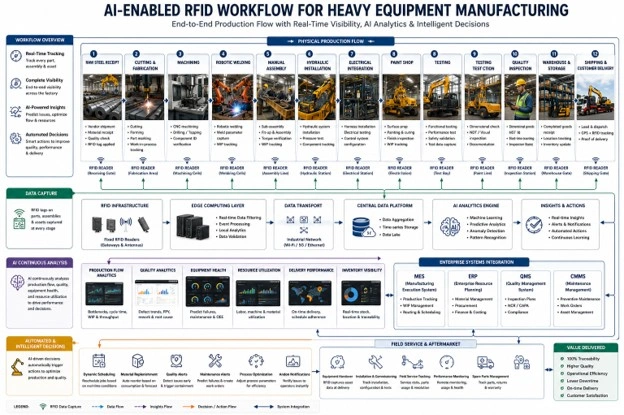
Operational Workflow of AI-Enabled RFID Systems in Heavy Equipment Manufacturing
Successful deployment depends on establishing a complete operational workflow that converts physical manufacturing events into actionable intelligence.
Data Acquisition
Industrial RFID tags are attached to production assets, fabricated structures, reusable fixtures, work carriers, engine assemblies, hydraulic systems, transport containers, and finished equipment. Fixed readers installed at fabrication cells, machining centers, welding stations, paint lines, assembly areas, warehouses, and shipping docks automatically capture identification events as materials move through production.
Complementary data sources include industrial sensors, PLCs, barcode scanners, torque tools, coordinate measuring machines, machine vision systems, vibration sensors, environmental monitors, telematics units, and operator terminals. Together, these inputs provide a comprehensive digital record of manufacturing activity.
Communication Infrastructure
Captured RFID events are transmitted over industrial Ethernet, Wi-Fi, private 5G, or secure fieldbus-connected gateways to edge servers or centralized computing resources. Message queuing protocols and industrial communication standards help ensure reliable data delivery despite the electrically noisy conditions common in welding and machining environments.
Edge Processing and Event Filtering
Edge software validates RFID reads, filters duplicate events, associates tag identifiers with production orders, and enriches data with timestamps, workstation identifiers, and equipment status. Performing this processing close to the production floor reduces latency and minimizes unnecessary network traffic before information is forwarded to higher-level systems.
Enterprise Software Integration
Processed events are synchronized with manufacturing execution systems, enterprise resource planning, computerized maintenance management systems, product lifecycle management software, warehouse management systems, and quality management applications. This integration allows engineering, operations, procurement, maintenance, and logistics teams to work from a consistent operational dataset.
AI Analytics and Business Actions
Machine learning models analyze historical and real-time production data to identify trends such as recurring assembly delays, abnormal equipment utilization, quality deviations, or inventory imbalances. The resulting insights can trigger maintenance work orders, recommend production schedule adjustments, notify quality engineers of potential issues, or optimize material replenishment before shortages affect manufacturing throughput.
AI-Enabled RFID Deployment Scenario in a Heavy Equipment Manufacturing Plant
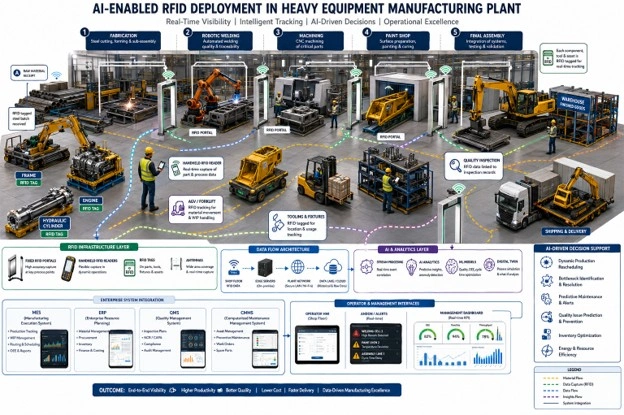
RFID Technologies, AI Components, and Deployment Models for Heavy Equipment Manufacturing
A successful AI-enabled heavy equipment manufacturing solution depends on selecting RFID technologies that match production environments, integrating them with industrial software, and deploying AI where operational decisions can be made efficiently. The objective is not simply to identify assets but to convert operational events into actionable manufacturing intelligence.
RFID Technologies for Heavy Equipment Manufacturing
Different RFID frequencies support different manufacturing processes.
UHF RFID (Ultra High Frequency)
UHF RFID is widely used for long-range identification of heavy equipment components, pallets, transport racks, reusable containers, fabricated structures, finished machines, and warehouse inventory. Properly selected on-metal tags and rugged industrial tags provide reliable performance on steel chassis, engine blocks, hydraulic cylinders, buckets, and other metallic assemblies commonly found in heavy equipment production.
Typical applications include:
Work-in-progress tracking
Yard management
Warehouse automation
Shipping verification
Finished equipment identification
Returnable transport asset management
Production logistics
HF RFID (High Frequency)
HF RFID is suitable where shorter read distances and controlled identification are preferred.
Typical applications include:
Operator authentication
Workstation access
Electronic work instructions
Tool identification
Calibration management
Maintenance documentation
LF RFID (Low Frequency)
LF RFID performs well in environments involving moisture, oils, or close-proximity identification.
Typical applications include:
Maintenance tooling
Specialized industrial fixtures
Harsh environment identification
Legacy industrial systems
Rather than relying on one RFID technology throughout an entire facility, manufacturers frequently deploy multiple RFID frequencies according to operational requirements.
Hardware Supporting AI-Enabled Manufacturing
A complete solution typically includes:
Industrial RFID readers
Fixed RFID portals
Handheld RFID readers
On-metal RFID tags
High-temperature RFID tags
Ruged industrial antennas
Industrial gateways
Edge computing servers
Industrial PCs
PLCs
Machine vision cameras
Environmental sensors
Vibration sensors
Torque measurement systems
Barcode scanners
Wireless access points
Private 5G or industrial Wi-Fi infrastructure
Operator terminals
Large production displays
GAO supplies industrial RFID hardware designed for manufacturing environments where metal structures, welding operations, vibration, dust, temperature variation, and continuous equipment movement present significant engineering challenges.
AI Software Components
Artificial intelligence supports manufacturing decisions using several complementary technologies.
Machine learning models identify production trends, forecast equipment failures, estimate inventory demand, and predict production completion times.
Computer vision systems inspect weld quality, paint coverage, dimensional accuracy, surface defects, component presence, and assembly verification.
Edge AI enables immediate responses at production workstations without depending entirely on centralized computing resources.
Predictive analytics evaluate maintenance histories, production schedules, supplier performance, and equipment utilization.
Generative AI assists maintenance personnel, production planners, and engineering teams by summarizing operational reports, recommending troubleshooting procedures, generating maintenance documentation, and answering technical questions using approved manufacturing knowledge.
Communication Infrastructure
Reliable communication is essential for connecting manufacturing operations.
Common communication technologies include:
Industrial Ethernet
OPC UA
MQTT
REST APIs
Modbus TCP
PROFINET
EtherNet/IP
Secure Wi-Fi
Private 5G
VPN connections
TLS encryption
These technologies enable manufacturing systems to exchange operational information while maintaining reliability across production facilities.
Cloud Version and Server Version
Selecting the appropriate deployment model depends on production requirements, cybersecurity policies, data sovereignty, latency expectations, and existing manufacturing software.
Cloud Version
Cloud-hosted software is appropriate when manufacturers operate multiple facilities, require centralized reporting, or need simplified software maintenance. Cloud deployments support fleet-wide analytics, supplier collaboration, enterprise reporting, AI model management, and scalable data storage. Organizations with distributed manufacturing operations often benefit from cloud-based dashboards and consolidated production intelligence.
Server Version
Server deployments place software on customer-managed infrastructure such as factory servers, private data centers, regional computing facilities, or edge servers located close to production operations. This approach is often selected when manufacturing processes require very low latency, strict cybersecurity controls, confidential engineering data, or continued operation during temporary internet disruptions. Edge servers can continue processing RFID events, machine data, and AI inference locally while synchronizing with central systems when network connectivity is available.
Many heavy equipment manufacturers implement a hybrid deployment where edge servers perform real-time operational processing while cloud resources support enterprise reporting, long-term analytics, AI model training, and multi-site performance benchmarking.
Cloud vs. Server AI-Enabled RFID Deployment Comparison for Heavy Equipment Manufacturing
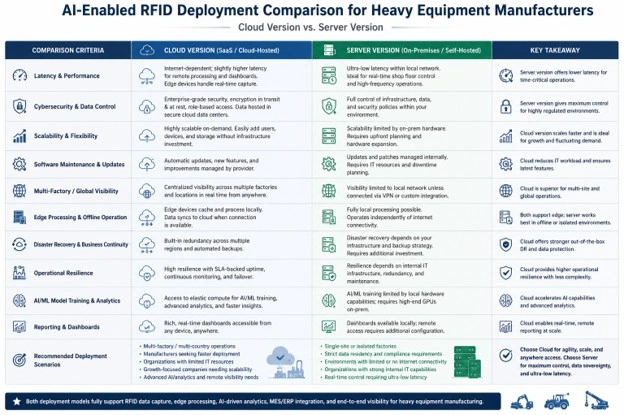
Security and Engineering Considerations
Manufacturing environments require cybersecurity measures that protect operational technology as well as business information.
Recommended practices include:
- Role-based access control
- Multi-factor authentication
- Encrypted communications
- Digital certificate management
- Secure API authentication
- Network segmentation between IT and OT environments
- RFID reader authentication
- Continuous security monitoring
- Vulnerability management
- Software patch management
- Secure backup strategies
- Event logging
- Device lifecycle management
- Engineering teams should also evaluate:
- Reader placement near large steel structures
- RF interference from welding operations
- Tag orientation
- Environmental durability
- High-temperature exposure
- Maintenance accessibility
- Read-zone optimization
- Equipment movement patterns
- Power redundancy
- Industrial network resilience
- Conducting pilot deployments before facility-wide implementation helps validate read performance, workflow integration, and operational impact under actual manufacturing conditions.
- GAO’s engineering teams have supported organizations by providing RFID hardware, system guidance, and technical expertise for deployments that demand reliable identification performance in complex industrial settings.
Technical Capabilities and Operational Benefits
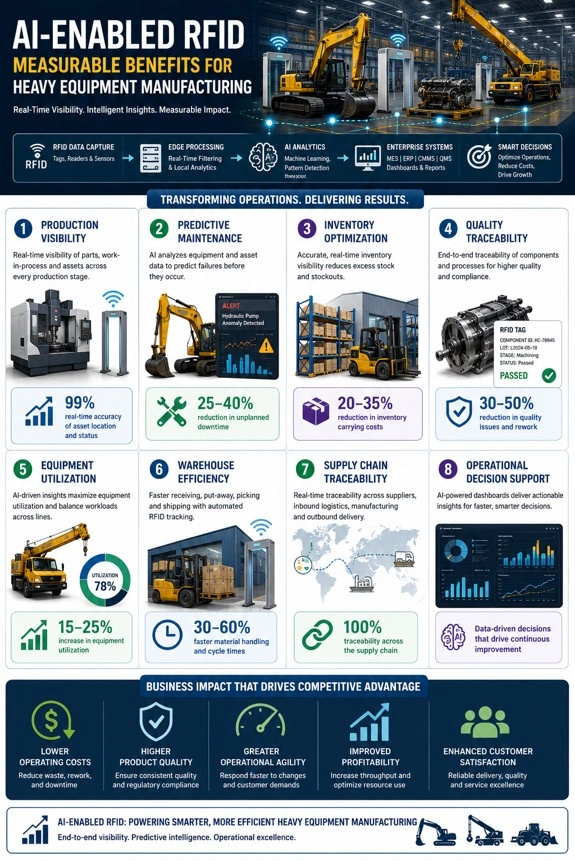
Combining AI with RFID-generated operational data delivers measurable improvements across heavy equipment manufacturing.
Improved Production Visibility
Continuous identification of materials, tooling, assemblies, and finished equipment enables production managers to understand manufacturing status without relying solely on manual reporting.
Better Equipment Utilization
AI identifies underutilized production assets, recommends workload balancing, and improves utilization of expensive machining centers, robotic welding cells, cranes, and specialized assembly equipment.
Higher Manufacturing Quality
Correlating RFID events with inspection records, torque data, machine vision results, and supplier information supports faster root cause analysis and improved process consistency.
Predictive Maintenance
AI identifies maintenance patterns before failures interrupt production, helping reduce unplanned downtime while extending equipment service life.
Inventory Optimization
Demand forecasting based on production schedules and RFID movement history reduces excess inventory while maintaining component availability for manufacturing.
Improved Supply Chain Traceability
Serialized identification improves visibility across suppliers, manufacturing facilities, distribution centers, dealers, and aftermarket service organizations.
Scalable Manufacturing Operations
Well-designed RFID and AI solutions support production expansion, additional manufacturing lines, new product introductions, and multi-site operations without requiring fundamental changes to operational workflows.
AI-Enabled RFID Benefits Infographic for Heavy Equipment Manufacturing
Implementation Recommendations
Organizations planning AI-enabled RFID initiatives should adopt a phased implementation strategy aligned with manufacturing objectives.
Recommended practices include:
Define measurable business objectives before technology selection.
Identify high-value production assets and critical workflows.
Select RFID tags appropriate for metallic surfaces, environmental conditions, and expected service life.
Validate reader locations through on-site RF testing.
Integrate RFID events with existing MES, ERP, EAM, CMMS, WMS, PLM, and quality management software.
Establish data governance policies for asset identifiers, event histories, and AI training datasets.
Train production, maintenance, quality, and logistics personnel on revised operational procedures.
Continuously monitor key performance indicators such as work-in-progress cycle time, asset utilization, inventory accuracy, first-pass yield, equipment availability, and maintenance response time.
Periodically retrain AI models using current manufacturing and maintenance data to maintain prediction accuracy.
Scale deployments incrementally after validating operational performance and user adoption.
With headquarters in New York City and Toronto, Canada, GAO is recognized among the leading global suppliers of RFID and BLE technologies. For more than three decades, organizations including Fortune 500 companies, research institutions, universities, and government agencies throughout the United States and Canada have relied on GAO’s investment in research and development, rigorous quality assurance, and expert remote and on-site technical support.
Advancing Intelligent Heavy Equipment Manufacturing with AI and RFID
Heavy equipment manufacturers are under increasing pressure to improve productivity, product quality, asset utilization, and operational resilience while managing complex supply chains and highly configurable machinery. AI-driven decision-making supported by RFID identification enables manufacturers to transform production events into actionable operational intelligence across fabrication, machining, assembly, quality assurance, logistics, maintenance, and aftermarket support.
Successful implementations depend on thoughtful planning, appropriate RFID technology selection, reliable system integration, secure communications, effective data governance, and continuous optimization of AI models. By combining practical engineering expertise with industrial RFID hardware and IoT technologies, GAO helps manufacturers build intelligent identification systems that support long-term operational improvements and informed decision-making throughout the equipment lifecycle.
Building the Future of Industrial AI and IoT with Aperture Venture Studio and GAO
For more than three decades, GAO Group of Companies has invested extensively in research and development for industrial RFID, BLE, and IoT technologies. As generative AI has demonstrated significant value in industrial environments, we have expanded our work in AIoT by advancing solutions that combine artificial intelligence with RFID, BLE, sensors, and connected industrial systems for applications such as heavy equipment manufacturing.
To further accelerate practical innovation in industrial AI and IoT, we established Aperture Venture Studio to help develop and scale advanced AI and IoT initiatives across a wide range of industrial sectors. Aperture has attracted experienced AI researchers, IoT specialists, operational executives, industry leaders, and investors while fostering technical collaboration through the Aperture Ventures Summit and TekSummit. These initiatives have strengthened vibrant technical communities focused on AI and IoT innovation. We welcome opportunities to collaborate with advisors, investors, customers, and technology professionals who share our vision of advancing intelligent industrial systems.