
AI and RFID for Industrial QA Laboratories
AI and RFID for Industrial Quality Assurance Laboratories
AI is transforming Industrial QA Laboratories by turning laboratory records, sample movements, equipment data, and quality-control activities into actionable operational intelligence. RFID provides the identification and data-capture layer needed to connect physical laboratory assets with software systems. UHF RFID is particularly useful for tracking tagged samples, containers, equipment, and consumables across larger laboratory environments, while HF and LF RFID can support more specialized identification requirements. AI can analyze RFID-generated events together with laboratory information, equipment status, test schedules, and quality records to identify anomalies, improve workflow planning, and strengthen traceability. For Industrial QA Laboratories, this combination can reduce manual identification activities, improve chain-of-custody visibility, and provide more reliable information for quality decisions. GAO supplies RFID, BLE, and IoT hardware products and systems that can support laboratory asset identification, tracking, monitoring, and data collection.
RFID and AI System Architecture for Industrial QA Laboratories
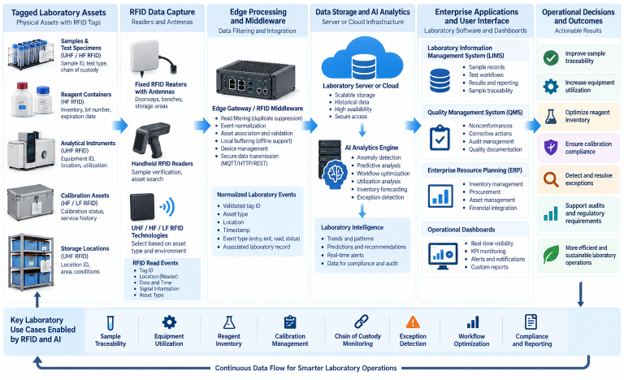
Short Description: Shows how RFID-tagged laboratory assets move through readers, edge processing, AI analytics, LIMS, QMS, ERP, dashboards, and operational decisions.
How AI Improves RFID-Based Industrial QA Laboratory Operations
Industrial QA Laboratories manage large volumes of samples, test specimens, reference materials, reagents, laboratory instruments, calibration equipment, and quality records. Many of these assets move through multiple controlled stages before a test result is released.
A typical laboratory workflow may involve sample receipt, identification, registration, preparation, testing, review, storage, retention, and disposal. Manual barcode scanning and handwritten identification can introduce delays or data-entry errors, particularly when technicians handle large batches of samples.
RFID can automate physical identification and movement capture. An RFID tag provides a unique identifier, while an RFID reader captures that identifier when the tagged item passes through an appropriate read zone or is presented to a reader.
AI adds an analytical layer to these RFID events. Instead of simply reporting that a sample entered a laboratory area, AI can analyze the event in relation to expected workflows, test schedules, technician activities, instrument availability, and historical laboratory behavior.
Potential applications include:
- Sample and specimen tracking
- Chain-of-custody monitoring
- Laboratory equipment tracking
- Calibration asset management
- Reagent and consumable inventory monitoring
- Test-batch identification
- Sample location visibility
- Laboratory workflow optimization
- Exception and anomaly detection
- Predictive equipment maintenance
- Quality documentation support
- Laboratory inventory forecasting
The practical objective is not to replace laboratory personnel or quality procedures. AI and RFID provide better information so laboratory professionals can make decisions with greater visibility and less manual data collection.
RFID Applications in Industrial QA Laboratories
Sample and Specimen Tracking
Sample traceability is one of the strongest use cases for RFID in Industrial QA Laboratories.
Samples may move from receiving areas to preparation benches, analytical instruments, temporary storage, quarantine locations, review areas, and retention storage. Each movement can become an electronic event when RFID infrastructure is installed at relevant points.
A tagged sample container can be associated with a laboratory information management system record. RFID events can then supplement the digital record with physical movement information.
AI can evaluate these events against expected laboratory workflows. If a sample remains in a preparation area longer than expected, moves into an incorrect area, or does not reach a scheduled testing location, the system can generate an exception for laboratory personnel.
This can be particularly useful where sample volume is high and manual location checks consume technician time.
Chain-of-Custody Visibility
Quality laboratories frequently require controlled handling and documented sample custody. RFID can provide additional evidence of where a tagged sample was detected and when the event occurred.
The system can associate RFID reads with:
- Sample ID
- Batch or lot number
- Laboratory location
- Reader location
- Date and time
- Process stage
- Operator or workstation where available
- Test assignment
- Sample status
AI can analyze this event history to identify deviations from predefined custody workflows.
For example, an unexpected movement between controlled laboratory zones could trigger an alert for investigation. AI can also identify recurring workflow deviations that may indicate a process-design problem rather than an isolated incident.
Laboratory Equipment Tracking
Industrial QA Laboratories often operate analytical instruments, balances, environmental chambers, test fixtures, microscopes, reference equipment, mobile carts, and other valuable assets.
RFID can provide an electronic identity for these assets and improve visibility across laboratory rooms, equipment storage areas, maintenance locations, and calibration zones.
AI can combine RFID movement records with equipment schedules and maintenance information.
This can help identify:
- Equipment that is rarely used
- Equipment frequently moved between laboratories
- Equipment approaching scheduled maintenance
- Assets missing from expected locations
- Bottlenecks caused by limited instrument availability
GAO can provide RFID hardware and related IoT technologies for organizations seeking to connect physical laboratory assets with software-based tracking and monitoring processes.
Calibration Asset Management
Calibration is critical for laboratory equipment where measurement accuracy depends on controlled instrument performance.
RFID tags can identify instruments and calibration assets. Reader events can establish when equipment enters a calibration area, returns to service, or moves to another laboratory.
AI can analyze calibration schedules, equipment usage, historical failures, and movement patterns to help prioritize maintenance activities.
A laboratory can therefore move toward condition- and usage-informed maintenance rather than relying exclusively on fixed calendar schedules, where appropriate.
Reagent and Consumable Inventory Management
Industrial QA Laboratories may maintain significant inventories of reagents, chemicals, test kits, containers, reference materials, filters, and other consumables.
RFID can support automated identification and inventory events when tagged materials enter storage, leave storage, or move into laboratory work areas.
AI can analyze consumption patterns and identify unusual usage. For example, consumption of a particular reagent may increase significantly for a specific test program. A predictive model can use historical usage and scheduled laboratory workloads to identify potential shortages.
Inventory intelligence can include:
- Current stock visibility
- Consumption rate
- Reorder requirements
- Storage location
- Lot identification
- Expiration monitoring
- Usage history
- Laboratory demand forecasting
RFID should complement rather than replace laboratory inventory controls. Regulatory, safety, storage, and chemical-handling requirements remain applicable regardless of the identification technology used.
AI-Driven Laboratory Workflow Optimization
Industrial QA Laboratory workflows often contain waiting periods between sample preparation, instrument availability, testing, result review, and final disposition.
RFID event data can reveal where physical samples spend time throughout the process.
AI can use this information to identify recurring bottlenecks.
For example, if samples consistently accumulate before a particular analytical instrument, the underlying issue may be insufficient instrument capacity, scheduling conflicts, preparation delays, or an upstream process imbalance.
AI-based workflow analysis can help laboratory managers examine:
- Sample queue duration
- Instrument utilization
- Preparation time
- Waiting time
- Retest frequency
- Sample throughput
- Storage dwell time
- Testing turnaround time
- Exception frequency
This is more useful than simply counting RFID reads because the objective is to understand why laboratory operations behave as they do.
From RFID Data Capture to AI Decision-Making
A complete AI and RFID solution for Industrial QA Laboratories begins with physical identification and ends with a laboratory or quality decision.
The data flow can include the following stages:
- RFID tag is attached or associated with a sample, specimen, instrument, reagent, or other laboratory asset
- RFID reader detects the tag at a defined location
- Reader software filters duplicate or unreliable reads
- Edge or server software validates the event
- Event data is associated with the relevant laboratory record
- Middleware transfers information between RFID software and laboratory applications
- Database stores historical RFID events and laboratory relationships
- AI models analyze movement, timing, utilization, inventory, or quality-related patterns
- Analytics software presents trends, exceptions, and predictions
- Alerts are delivered to appropriate laboratory or quality personnel
- Personnel investigate the event and take corrective or preventive action
- Resulting operational data becomes part of the historical dataset
The quality of this workflow depends on accurate tag association, reliable reader placement, synchronized timestamps, correct laboratory identifiers, and consistent master data.
RFID infrastructure should therefore be designed around actual laboratory workflows instead of simply installing readers wherever convenient.
RFID Technology Selection for Industrial QA Laboratories
UHF RFID
UHF RFID is well suited to applications requiring longer read ranges and rapid identification of multiple tagged assets. It can be useful for laboratory storage areas, sample containers, equipment tracking, inventory areas, and controlled movement points.
However, laboratory environments can contain liquids, metal instruments, foil packaging, dense sample containers, and other materials that influence RF performance.
Tag selection should therefore consider the material and geometry of the tagged object.
HF RFID
HF RFID generally operates at a shorter range and can be useful for controlled read points or applications where close-range identification is appropriate.
It may be suitable where the laboratory process naturally requires an item to be presented to a reader.
LF RFID
LF RFID can support specialized identification applications where lower-frequency operation and close-range reading characteristics are appropriate.
The correct RFID frequency should be selected according to the physical laboratory environment, required read distance, tag type, data requirements, and workflow.
RFID Readers, Antennas, and Laboratory Infrastructure
RFID readers form the primary interface between physical tagged assets and laboratory software. Antennas determine how the RF field is shaped and therefore have a direct effect on read performance.
Reader placement should account for:
- Laboratory room layout
- Doorways and controlled access points
- Metal laboratory equipment
- Liquid-containing samples
- Storage racks
- Sample transport carts
- Reader orientation
- Required read zone
- Potential cross-reads
A common engineering problem is excessive read coverage. If a reader detects tags outside the intended process zone, the software may incorrectly conclude that a sample has entered a particular laboratory area.
Read-zone design should therefore be treated as a process-control issue, not simply a wireless coverage problem.
Reader configuration can include filtering, duplicate suppression, antenna selection, transmit power management, and event timing rules.
Edge processing can further reduce unnecessary data transmission by converting raw reads into meaningful laboratory events before forwarding them to centralized software.
AI Models for Industrial QA Laboratory RFID Data
Anomaly Detection
Anomaly detection can identify unusual sample movements, unexpected equipment locations, abnormal dwell times, or unusual inventory consumption.
Predictive Analytics
Predictive models can estimate laboratory workload, equipment utilization, reagent consumption, or likely workflow delays based on historical information.
Classification
Classification models can categorize laboratory events according to predefined operational conditions, such as normal movement, delayed processing, unexpected location, or inspection required.
Optimization
Optimization models can evaluate instrument scheduling, sample queues, laboratory capacity, and asset allocation to identify more efficient operating patterns.
AI models should not be treated as a substitute for laboratory quality procedures. Model outputs should be explainable enough for responsible personnel to understand why an exception or recommendation was generated.
Cloud and Server Deployment for Industrial QA Laboratories
Industrial QA Laboratories can deploy RFID and AI software through cloud-hosted systems, customer-managed servers, or hybrid configurations.
Cloud Version
Cloud deployment can be appropriate for organizations operating multiple laboratories that require centralized visibility.
A cloud-hosted system can consolidate RFID events, laboratory asset information, analytics, and AI processing across locations.
Potential advantages include:
- Centralized data management
- Multi-location visibility
- Easier software maintenance
- Centralized analytics
- Remote access
- Simplified expansion to additional laboratories
Connectivity should be evaluated carefully because RFID readers and edge devices still require reliable communication with the software environment.
Server Version
Server deployment can run on laboratory servers, customer-managed infrastructure, private data centers, or other privately hosted environments.
This approach can be appropriate where laboratory data requires controlled infrastructure, where local processing is important, or where existing LIMS and quality systems are tightly integrated with private networks.
Local processing can also support time-sensitive functions such as event validation, reader management, buffering, and immediate workflow alerts.
A hybrid deployment can combine local RFID processing with centralized AI analytics where laboratory operations require both local responsiveness and broader organizational visibility.
Integrating RFID with Laboratory Enterprise Software
RFID becomes significantly more valuable when laboratory identification data is integrated with existing enterprise software instead of operating as an isolated tracking solution.
Laboratory Information Management System (LIMS) Integration
LIMS is the central software used by many Industrial QA Laboratories to manage sample registration, testing workflows, result approval, and reporting. RFID events can automatically update sample locations, custody status, and workflow progress within the LIMS database.
Typical LIMS integration supports:
- Automatic sample check-in and check-out.
- Test assignment based on sample identity.
- Chain-of-custody documentation.
- Sample storage location updates.
- Retention and disposal tracking.
- Audit trail generation.
AI can analyze LIMS records together with RFID movement history to identify delayed workflows, repeated retesting, missing samples, or abnormal processing times.
Quality Management System (QMS) Integration
QMS software manages corrective actions, non-conformance records, audits, inspections, and quality documentation.
RFID events can trigger quality workflows when:
- Equipment enters quarantine.
- Samples require investigation.
- Calibration expires.
- Environmental monitoring identifies an exception.
- Unauthorized movement occurs.
AI can prioritize quality events based on historical severity and operational impact instead of relying only on static rules.
ERP Integration
ERP software connects laboratory inventory, purchasing, production, maintenance, and financial processes.
RFID inventory events can automatically synchronize reagent consumption, equipment availability, and laboratory stock levels with ERP inventory records.
Benefits include:
- Reduced manual inventory updates.
- Better procurement planning.
- Improved stock accuracy.
- Faster replenishment decisions.
- Better visibility into laboratory operating costs.
AI-Driven Laboratory Analytics and Operational Intelligence
RFID provides continuous operational events, while AI converts those events into measurable laboratory intelligence.
Sample Throughput Analytics
AI analyzes RFID timestamps throughout laboratory workflows to calculate:
- Sample turnaround time.
- Queue duration.
- Preparation time.
- Testing duration.
- Review time.
- Storage duration.
Laboratory managers can identify which workflow stages contribute most to delays.
Instrument Utilization Analytics
RFID-tagged instruments generate movement and usage events.
AI combines these events with laboratory schedules to estimate:
- Instrument utilization percentage.
- Idle equipment time.
- Peak demand periods.
- Shared equipment conflicts.
- Maintenance-related downtime.
Inventory Consumption Analytics
AI examines RFID inventory events alongside laboratory workloads.
This supports:
- Forecasting reagent demand.
- Identifying excessive consumption.
- Monitoring expiration trends.
- Detecting unusual inventory loss.
- Optimizing laboratory stock levels.
Quality Trend Analytics
AI models can analyze RFID-linked laboratory events together with inspection records, calibration history, and test outcomes.
Possible analytical outputs include:
- Recurring quality deviations.
- Equipment associated with failed tests.
- Frequently delayed sample categories.
- Laboratory zones with repeated custody exceptions.
- Trends in corrective actions.
Security and Compliance for RFID in Industrial QA Laboratories
Industrial QA Laboratories frequently operate under strict quality, traceability, and regulatory requirements. RFID deployments should therefore include cybersecurity and operational governance from the beginning.
Device and Network Security
Security considerations include:
- Authentication for RFID readers.
- Encrypted communication between readers and servers.
- Secure APIs for enterprise software integration.
- Role-based access control.
- Reader firmware management.
- Network segmentation for laboratory devices.
Data Integrity
Laboratory traceability depends on trustworthy records.
AI and RFID systems should validate:
- Duplicate reads.
- Missing timestamps.
- Incorrect asset associations.
- Unexpected location events.
- Reader synchronization.
- Event sequencing.
Regulatory Support
RFID traceability can assist laboratories operating under regulated quality systems by strengthening documentation and audit readiness.
Relevant standards and frameworks may include:
- ISO/IEC 17025 Laboratory Competence.
- ISO 9001 Quality Management.
- GMP laboratory quality procedures.
- GLP laboratory practices.
- FDA electronic records guidance where applicable.
- Internal laboratory SOPs.
AI supports compliance by identifying documentation gaps, missing custody events, or overdue calibration activities before audits occur.
Laboratory KPIs Enabled by AI and RFID
Industrial QA Laboratories should define operational KPIs before deploying AI analytics. RFID-generated events provide measurable operational evidence instead of relying solely on manual reporting.
Key KPIs include:
- Sample turnaround time.
- Sample processing rate.
- Chain-of-custody compliance rate.
- Equipment utilization.
- Calibration compliance rate.
- Inventory accuracy.
- Reagent consumption rate.
- Sample location accuracy.
- Lost or misplaced sample rate.
- Test completion rate.
- Average laboratory dwell time.
- Instrument downtime.
- RFID read accuracy.
- Exception resolution time.
- Corrective action completion rate.
AI continuously analyzes these KPIs across laboratories, departments, sample categories, or instrument types.
AI Benefits for Industrial QA Laboratories Using RFID
AI enhances RFID-based laboratory operations by improving operational visibility, reducing manual effort, and supporting proactive quality management.
Improved Sample Traceability
RFID automatically records sample movement throughout laboratory workflows.
AI evaluates the complete movement history and identifies missing custody events or unexpected workflow deviations before results are released.
Faster Laboratory Workflows
AI identifies waiting periods and recommends workflow improvements based on historical RFID timing information.
This can reduce unnecessary delays between preparation, testing, review, and storage.
Better Equipment Availability
RFID improves visibility into instrument locations and maintenance status.
AI predicts equipment demand and highlights scheduling conflicts before they affect testing capacity.
Reduced Manual Identification Errors
Automated RFID identification reduces repetitive manual scanning and transcription activities.
AI validates laboratory records against RFID events to identify inconsistent or incomplete information.
Predictive Maintenance for Laboratory Equipment
AI combines RFID movement records with maintenance history and utilization patterns.
Maintenance teams receive earlier visibility into equipment approaching service thresholds.
Stronger Inventory Management
AI forecasts reagent consumption and laboratory inventory requirements using RFID consumption history and scheduled testing workloads.
Enhanced Audit Readiness
RFID-generated audit trails provide historical evidence for sample custody, equipment calibration, inventory movement, and workflow progression.
AI identifies documentation gaps before regulatory or internal audits.
Engineering Best Practices for RFID Laboratory Deployment
Successful RFID deployment requires careful engineering rather than simply installing readers throughout a laboratory.
Recommended practices include:
- Define laboratory workflows before selecting RFID hardware.
- Select RFID frequency according to laboratory environment.
- Validate tag performance on laboratory materials.
- Perform RF site surveys before reader installation.
- Design controlled read zones.
- Avoid overlapping antenna coverage.
- Integrate RFID events with LIMS and QMS.
- Establish standardized laboratory asset identifiers.
- Configure duplicate-read filtering.
- Synchronize timestamps across systems.
- Monitor reader health continuously.
- Test workflows using actual laboratory samples.
- Train AI models using validated laboratory data.
- Establish maintenance procedures for RFID infrastructure.
A pilot deployment should validate the complete operational workflow before expanding across multiple laboratories.
Deployment Lifecycle for AI and RFID in Industrial QA Laboratories
Organizations should approach deployment through clearly defined implementation stages.
| Deployment Stage | Engineering Objective |
|---|---|
| Planning | Identify laboratory workflows, assets, KPIs, compliance requirements, and integration needs. |
| Hardware Selection | Select UHF, HF, or LF RFID tags, readers, antennas, and edge devices. |
| Site Survey | Measure RF behavior around laboratory equipment, liquids, storage racks, and controlled zones. |
| Software Integration | Connect RFID software with LIMS, QMS, ERP, databases, and AI analytics. |
| Commissioning | Validate readers, antennas, timestamps, asset identifiers, and workflow events. |
| Pilot Testing | Follow actual laboratory samples through complete testing workflows. |
| Optimization | Tune reader coverage, AI models, workflow rules, and dashboards. |
| Scaling | Expand to additional laboratories while maintaining standardized identifiers and security policies. |
GAO supports organizations by supplying RFID hardware products, readers, antennas, tags, gateways, and engineering expertise for industrial identification and tracking applications.
Scaling AI and RFID Across Multiple QA Laboratories
Large organizations often operate multiple Industrial QA Laboratories supporting manufacturing, supplier quality, materials testing, environmental testing, and product validation.
Multi-site RFID deployment requires standardized governance.
Important considerations include:
- Common laboratory asset identifiers.
- Shared RFID configuration policies.
- Standard laboratory workflows.
- Unified AI models where appropriate.
- Centralized reporting definitions.
- Site-specific workflow customization.
- Reader firmware management.
- Security policy consistency.
AI can compare operational performance across laboratories and identify facilities with unusually long turnaround times, higher inventory consumption, or recurring workflow bottlenecks.
This enables continuous improvement across laboratory networks rather than isolated facility optimization.
Future Trends for AI and RFID in Industrial QA Laboratories
AI and RFID technologies continue evolving toward greater automation and predictive laboratory operations.
Emerging trends include:
- AI-assisted laboratory scheduling.
- Predictive calibration planning.
- RFID-enabled autonomous inventory counting.
- Digital laboratory twins using RFID movement history.
- AI-powered laboratory anomaly investigation.
- Computer vision combined with RFID verification.
- Edge AI processing for laboratory events.
- Sustainability reporting linked to laboratory inventory and equipment utilization.
These developments support more intelligent laboratory operations while maintaining traceability and quality documentation.
AI-Enabled Industrial QA Laboratory Intelligence Cycle
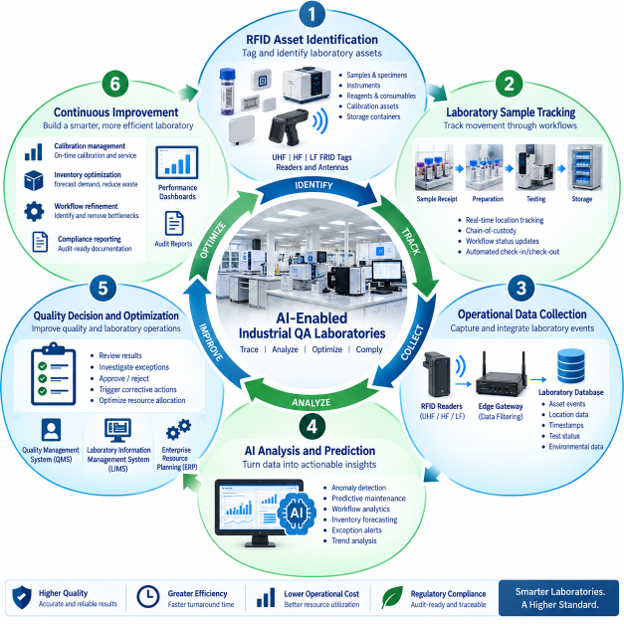
Short Description: Circular six-stage process connecting RFID identification, sample tracking, data collection, AI analysis, quality decisions, and continuous laboratory improvement.
Key Technical Takeaways for Industrial QA Laboratories
AI-powered RFID systems provide Industrial QA Laboratories with continuous visibility into laboratory assets, sample movement, equipment utilization, inventory consumption, and quality workflows. RFID automates physical identification through UHF, HF, and LF technologies, while AI transforms operational events into predictive insights, anomaly detection, workflow optimization, and laboratory intelligence.
Successful implementation depends on accurate asset identification, well-designed RF read zones, reliable software integration, secure communications, validated timestamps, and standardized laboratory workflows. Organizations should begin with measurable operational objectives, deploy a pilot using real laboratory processes, establish KPIs, validate AI outputs, and scale deployment only after operational performance is verified.
GAO provides RFID, BLE, and IoT hardware products and systems that support laboratory asset identification, sample traceability, inventory monitoring, equipment tracking, and industrial data collection for organizations seeking reliable Industrial QA Laboratory solutions.
Building the Future of Industrial AI and IoT with Aperture Venture Studio and GAO RFID Inc.
For more than three decades, GAO Group of Companies has invested heavily in research and development of industrial RFID, BLE, and IoT technologies. As AI became increasingly valuable for industrial applications, we expanded our work in AI-enabled identification, asset tracking, quality monitoring, and laboratory automation solutions for Industrial QA Laboratories.
We have also founded Aperture Venture Studio to support the development and growth of advanced AI and IoT technologies across industrial quality assurance, laboratory automation, manufacturing quality control, and intelligent testing environments.