
AI-Powered Iron Ore Mining Using RFID Solutions for Intelligent Mining Operations
How AI-Powered RFID Solutions Improve Iron Ore Mining Operations
Artificial intelligence is reshaping iron ore mining by enabling data-driven decisions across drilling, blasting, hauling, beneficiation, stockpile management, maintenance, and workforce safety. RFID serves as a foundational data acquisition technology within Industrial AI and IoT solutions by providing reliable identification and traceability of assets, equipment, materials, and personnel operating throughout open-pit and underground iron ore mines. AI transforms these data streams into predictive insights that improve productivity, equipment utilization, operational safety, and maintenance planning.
Iron ore mining environments present unique operational challenges including abrasive dust, vibration, large mobile equipment, remote operating locations, dynamic ore movement, and harsh weather conditions. AI-powered RFID solutions help mining organizations continuously monitor critical assets, automate operational workflows, reduce manual data collection, improve inventory accuracy, and optimize production planning. Combined with Industrial IoT sensors, computer vision, edge computing, and enterprise mining software, RFID enables intelligent mining systems capable of supporting modern digital mining initiatives while improving operational resilience and decision-making.
GAO has supported organizations across North America by supplying RFID, BLE, and Industrial IoT hardware and systems that enable reliable identification, asset visibility, and operational intelligence across demanding industrial environments.
AI-Powered RFID Deployment Across an Iron Ore Mining Operation
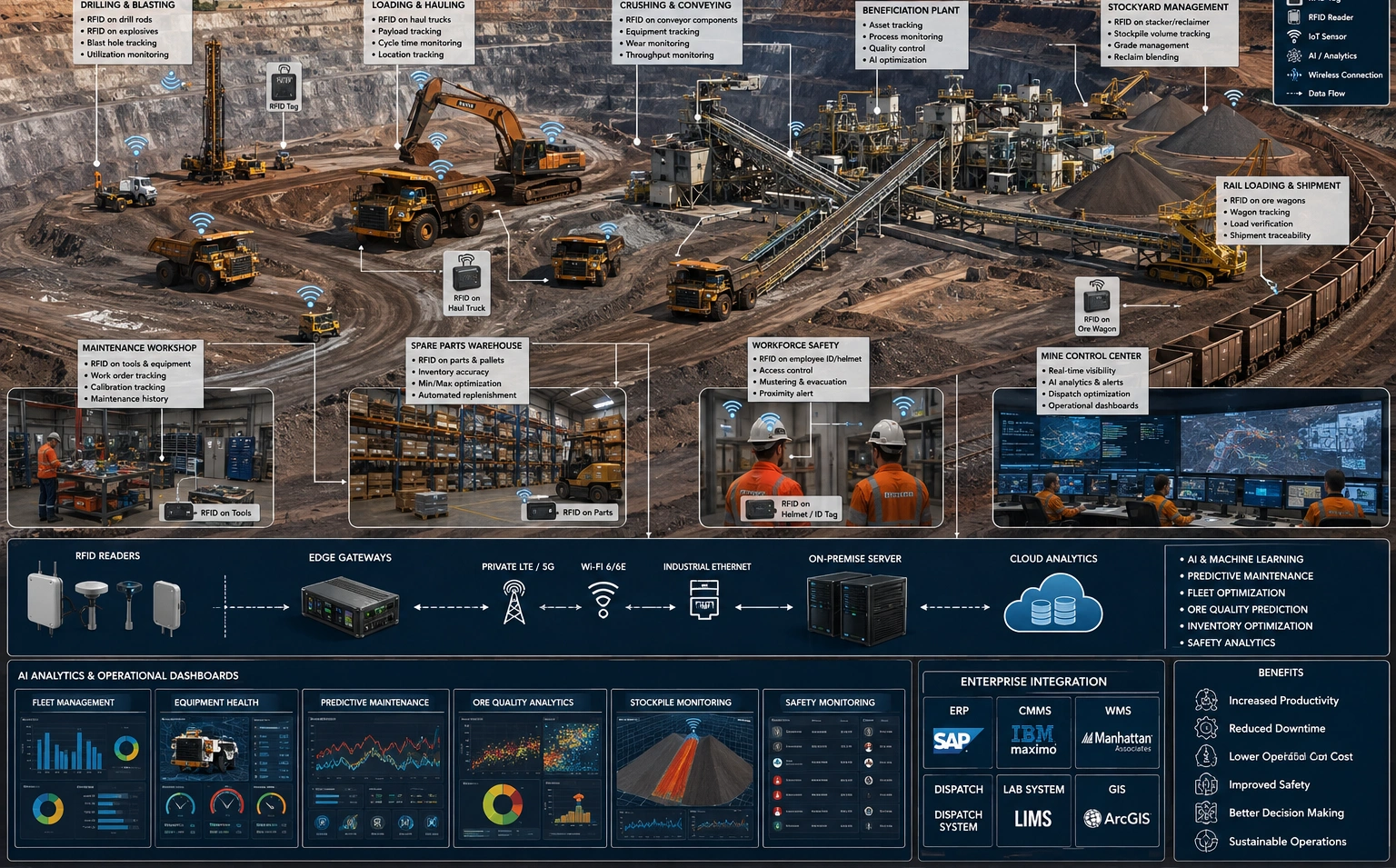
This illustration presents a comprehensive AI-enabled RFID solution deployed across an open-pit iron ore mining operation, covering drilling, hauling, crushing, beneficiation, stockyard management, maintenance, rail loading, and centralized mine control. It demonstrates how RFID, Industrial IoT devices, edge computing, AI analytics, and enterprise software work together to improve asset visibility, predictive maintenance, fleet optimization, ore traceability, workforce safety, and operational decision-making.
Understanding AI-Driven RFID Systems for Iron Ore Mining
Modern iron ore mines generate enormous volumes of operational data from mobile fleets, mineral processing equipment, geological surveys, maintenance activities, environmental monitoring systems, and production control systems. AI-powered mining solutions integrate these diverse data sources to create intelligent operational recommendations that improve productivity while reducing operational risk.
Within these intelligent mining systems, RFID functions as the reliable identification layer that associates physical mining assets with digital operational records. Depending on operational requirements, deployments typically combine:
- UHF RFID for long-distance identification of haul trucks, rail wagons, ore containers, pallets, and yard assets.
- HF RFID for maintenance records, tool management, laboratory samples, and controlled access applications.
- LF RFID for harsh metallic environments, heavy equipment identification, and applications requiring excellent resistance to interference.
AI models analyze RFID-generated operational events together with sensor measurements, fleet telemetry, weather information, production schedules, vibration monitoring, fuel consumption, conveyor throughput, crusher utilization, and maintenance histories. The resulting insights support predictive maintenance, equipment dispatch optimization, production forecasting, inventory optimization, workforce safety monitoring, and supply chain coordination.
Unlike traditional RFID deployments focused primarily on identification, AI-driven mining solutions continuously learn operational patterns and recommend actions that improve mine performance over time.
AI Applications Across Iron Ore Mining Operations
Iron ore mining contains multiple interconnected operational stages where AI-supported RFID systems significantly improve visibility and decision-making.
Exploration and Geological Operations
RFID assists in identifying:
- Core sample containers
- Geological specimens
- Survey equipment
- Exploration tools
- Laboratory samples
AI correlates exploration data with geological models to improve ore body characterization and drilling recommendations.
Drilling and Blasting
AI combines RFID data with blast planning software to monitor:
- Drill rods
- Drill bits
- Explosive inventories
- Detonator tracking
- Blast hole preparation
- Equipment availability
These insights reduce drilling delays while improving explosive accountability and regulatory compliance.
Loading and Haulage
Large mining fleets generate continuous operational events.
RFID identifies:
- Haul trucks
- Excavators
- Wheel loaders
- Fuel trucks
- Water trucks
- Mobile maintenance units
AI optimizes:
- Truck dispatch
- Queue management
- Payload balancing
- Fuel efficiency
- Cycle time
- Fleet utilization
- Road congestion prediction
Crushing and Beneficiation
Ore processing facilities depend upon synchronized material movement.
RFID enables tracking of:
- Ore batches
- Conveyor maintenance assets
- Wear components
- Screens
- Crusher liners
- Spare parts
AI predicts:
- Crusher failures
- Conveyor bottlenecks
- Throughput losses
- Equipment degradation
- Maintenance windows
Stockyard and Rail Logistics
Stockpile management is essential for shipment quality.
RFID identifies:
- Ore stockpiles
- Rail wagons
- Loading equipment
- Shipment batches
- Export inventory
AI optimizes:
- Blending strategies
- Inventory reconciliation
- Rail scheduling
- Shipment sequencing
- Customer order fulfillment
Maintenance and Reliability Engineering
Maintenance departments benefit significantly from RFID-enabled asset identification.
Tracked assets include:
- Bearings
- Hydraulic pumps
- Electric motors
- Gearboxes
- Welding equipment
- Calibration instruments
- Mobile maintenance tools
- Lubrication equipment
AI predicts:
- Remaining useful life
- Failure probability
- Spare inventory demand
- Technician scheduling
- Preventive maintenance intervals
AI-Enabled RFID Workflow for End-to-End Iron Ore Mining Operations
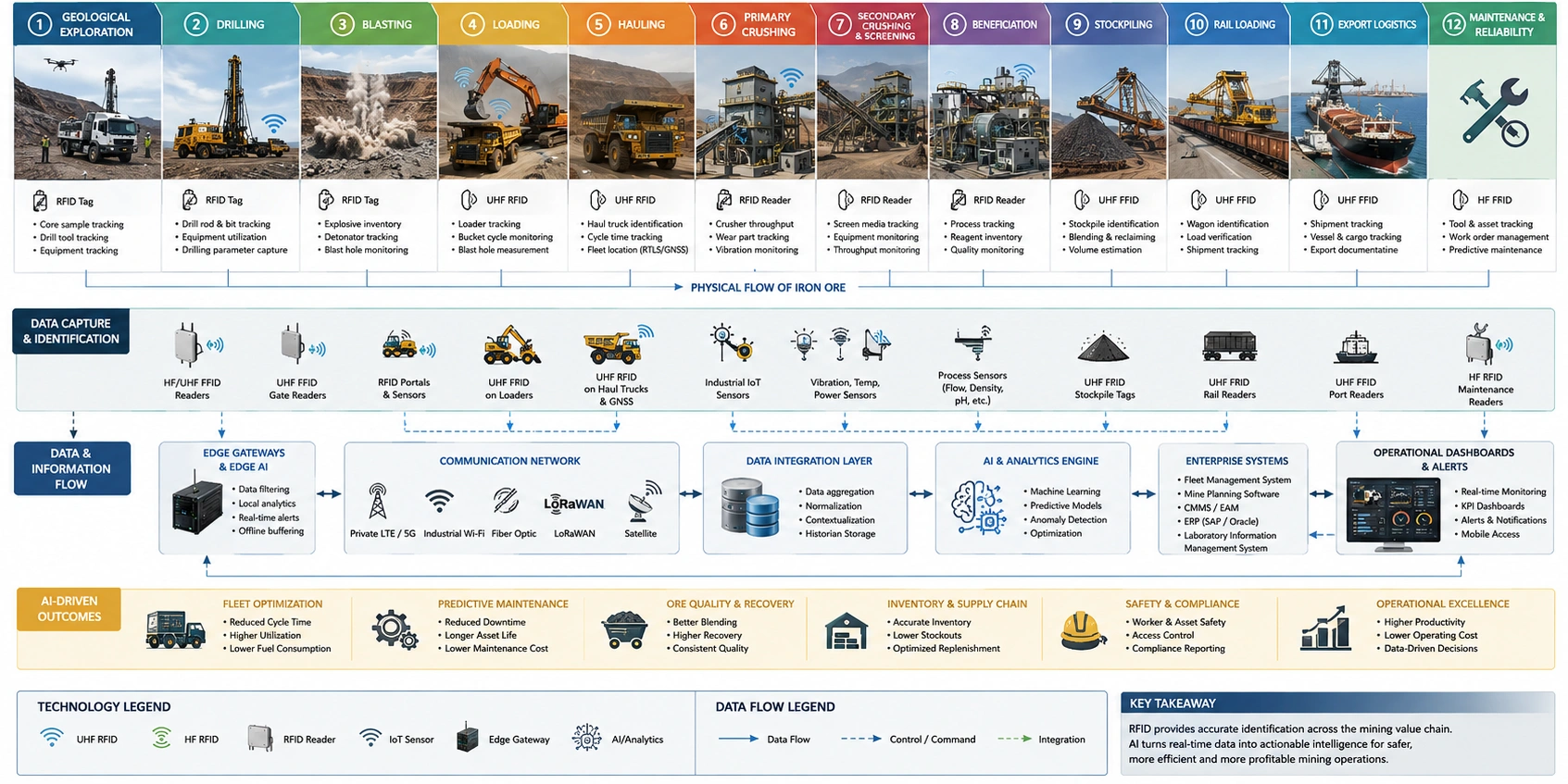
This workflow diagram illustrates the complete iron ore mining lifecycle enhanced by AI and RFID technologies, from geological exploration and drilling to beneficiation, rail loading, export logistics, and maintenance. It highlights how RFID identification, Industrial IoT sensors, edge gateways, AI analytics, enterprise software integration, and operational dashboards enable real-time visibility, predictive maintenance, fleet optimization, ore traceability, and data-driven decision-making throughout mining operations.
End-to-End Operational Workflow for AI-Enabled Iron Ore Mining
Successful AI implementation requires continuous information flow across mining operations rather than isolated automation projects.
The workflow generally includes the following stages:
Data Acquisition
Operational information originates from numerous field devices, including:
- RFID readers
- RFID tags
- GNSS receivers
- Fleet telematics
- Conveyor sensors
- Vibration sensors
- Temperature sensors
- Load cells
- Computer vision cameras
- Environmental monitoring stations
- Fuel monitoring systems
RFID uniquely identifies physical assets while IoT sensors measure operational conditions in real time.
Edge Data Processing
Industrial edge computers installed throughout mining facilities perform:
- RFID event filtering
- Duplicate read elimination
- Local asset validation
- Temporary buffering
- Sensor aggregation
- Initial AI inference
- Alarm generation
Edge processing reduces communication latency while allowing mine operations to continue during temporary network interruptions.
Communication Infrastructure
Iron ore mines typically rely on multiple communication technologies simultaneously:
- Industrial Ethernet
- Private LTE
- Private 5G
- Fiber optic backbone
- Wi-Fi 6
- LoRaWAN
- Satellite communications for remote sites
- OPC UA
- MQTT
- REST APIs
Network redundancy is particularly important because mining equipment often operates across extensive open-pit areas.
Enterprise Software Integration
Processed operational information integrates with software including:
- Fleet Management Systems
- Computerized Maintenance Management Systems (CMMS)
- Enterprise Resource Planning (ERP)
- Manufacturing Execution Systems for beneficiation plants
- Laboratory Information Management Systems
- Warehouse Management Systems
- Asset Performance Management software
- Geological modeling software
- Dispatch systems
- Production reporting systems
These integrations allow AI models to evaluate operational conditions using complete business and engineering context.
AI Analytics and Decision Support
Machine learning continuously analyzes:
- Production rates
- Equipment health
- Material movement
- Workforce location
- Maintenance history
- Inventory consumption
- Haul cycle performance
- Fuel utilization
- Weather impacts
- Conveyor availability
Outputs include predictive alerts, maintenance recommendations, dispatch optimization, production forecasts, inventory replenishment, safety notifications, and operational dashboards supporting mine supervisors and control room personnel.
RFID, AI Technologies, and Supporting Infrastructure for Iron Ore Mining
Successful AI-driven iron ore mining solutions require carefully coordinated hardware, software, communications, and cybersecurity components that operate reliably despite dust, vibration, extreme temperatures, moisture, and electromagnetic interference commonly found throughout mining operations.
RFID Hardware
Typical deployments include:
- Rugged industrial UHF RFID readers installed at crusher entrances, weighbridges, maintenance workshops, fuel stations, warehouse gates, and rail loading facilities.
- Fixed HF RFID readers supporting maintenance shops, laboratories, and controlled storage rooms.
- LF RFID readers for metallic equipment identification and specialized industrial applications.
- Passive UHF tags attached to haul trucks, excavators, wheel loaders, rail wagons, ore containers, conveyor components, pallets, and reusable material bins.
- Rugged encapsulated RFID tags designed to withstand impact, vibration, corrosion, dust ingress, and washdown procedures.
- Handheld RFID readers used by maintenance technicians, warehouse operators, and inspection personnel.
GAO provides industrial RFID hardware engineered for demanding environments where long equipment lifecycles and operational reliability are essential.
Artificial Intelligence Technologies
AI capabilities commonly deployed within iron ore mining include:
- Predictive maintenance models
- Time-series forecasting
- Computer vision for conveyor inspection
- Deep learning for defect detection
- Reinforcement learning for fleet dispatch optimization
- Machine learning classification models
- Anomaly detection algorithms
- Remaining useful life estimation
- Production forecasting
- Ore quality prediction
- Workforce safety analytics
These models continuously improve operational recommendations as additional historical mining data become available.
Supporting Industrial IoT Components
Complementary technologies often include:
- Industrial IoT gateways
- Edge AI servers
- GPU-enabled inference devices
- Industrial PLCs
- SCADA software
- Distributed Control Systems
- Digital twin software
- GNSS positioning
- Condition monitoring sensors
- Smart cameras
- Environmental monitoring stations
Cloud Version
Cloud-hosted deployments are appropriate when organizations require centralized visibility across multiple iron ore mining sites. Cloud software simplifies large-scale analytics, enterprise reporting, AI model management, remote expert collaboration, and long-term historical data analysis. Cloud environments also support rapid deployment of advanced machine learning services while reducing internal infrastructure management responsibilities.
Server Version
Server-based deployments are commonly selected for remote mines with limited connectivity, strict operational control requirements, or cybersecurity policies requiring local data processing. Customer-managed servers located within mine data centers or regional operational facilities provide deterministic performance, lower latency, improved resilience during communication outages, and tighter integration with existing operational technology systems.
Many mining organizations adopt hybrid deployments where operational control remains on privately managed servers while selected datasets synchronize with cloud software for corporate reporting, AI model training, and enterprise-wide optimization.
Headquartered in New York City and Toronto, GAO serves organizations throughout North America by supplying RFID and Industrial IoT solutions backed by decades of engineering experience, rigorous quality assurance processes, and technical support for complex industrial deployments.
AI-Enabled RFID Solution Diagram for Intelligent Iron Ore Mining Operations
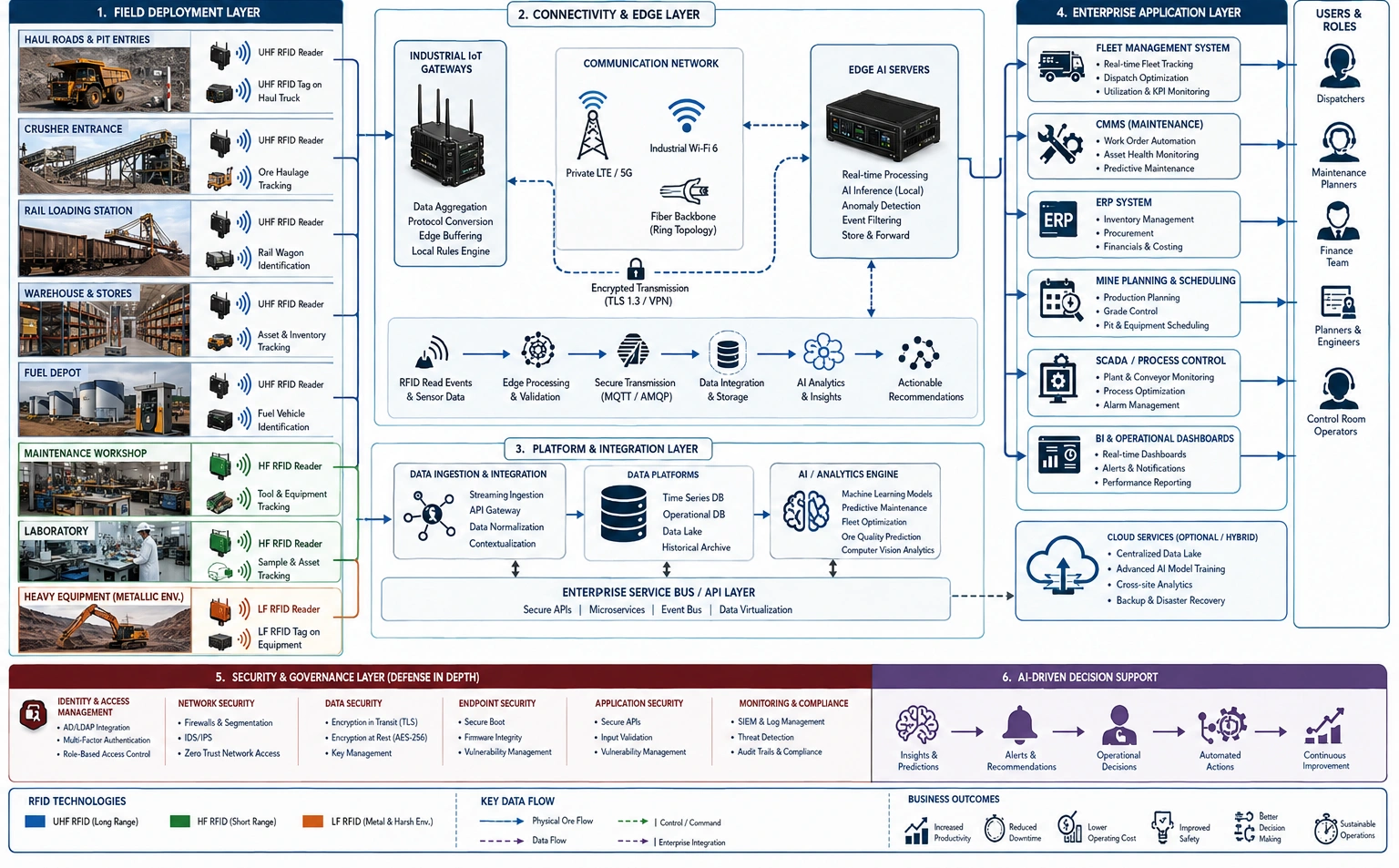
This engineering solution diagram illustrates the end-to-end deployment of AI-enabled RFID across an iron ore mining operation, from field devices and Industrial IoT gateways to edge AI servers, enterprise software, and cloud services. It demonstrates how UHF, HF, and LF RFID technologies integrate with fleet management, CMMS, ERP, SCADA, AI analytics, and cybersecurity controls to deliver secure, real-time operational intelligence and data-driven decision support.
Technical Capabilities and Operational Value of AI-Enabled RFID for Iron Ore Mining
Combining artificial intelligence with RFID-enabled Industrial IoT systems allows iron ore mining organizations to move beyond basic asset identification toward predictive, data-driven operations. RFID supplies trusted identity information for mobile equipment, materials, maintenance assets, and personnel, while AI analyzes operational patterns to recommend actions that improve safety, production efficiency, and resource utilization. This combination creates measurable improvements across the mining value chain.
Intelligent Fleet Management
Haul trucks, hydraulic excavators, wheel loaders, dozers, graders, and service vehicles operate continuously across large mine sites. RFID identifies each vehicle as it passes fixed checkpoints, fueling stations, maintenance bays, weighbridges, and crusher entrances.
AI analyzes this information together with fleet telemetry to improve:
- Truck dispatch efficiency
- Haul route optimization
- Equipment utilization
- Payload consistency
- Idle time reduction
- Fuel consumption
- Queue management
- Shift productivity
Mining supervisors can identify bottlenecks before they significantly affect ore production.
Predictive Maintenance and Asset Reliability
Iron ore mines operate capital-intensive assets where unexpected failures can interrupt production for hours or days.
RFID automatically records maintenance activities for:
- Primary crushers
- Cone crushers
- Grinding mills
- Conveyor drives
- Bucket wheel excavators
- Hydraulic systems
- Gearboxes
- Electric motors
- Pumps
- Dust suppression equipment
AI correlates maintenance history, vibration analysis, lubricant condition, operating hours, temperature trends, and inspection records to estimate component degradation and recommend maintenance before failures occur.
Benefits include:
- Reduced unplanned downtime
- Improved maintenance scheduling
- Longer equipment service life
- Lower spare parts inventory
- Higher equipment availability
- Better workforce planning
Ore Traceability and Quality Management
Iron ore quality directly affects beneficiation efficiency and customer specifications.
RFID enables batch identification throughout:
- Mine faces
- Haulage operations
- Primary crushing
- Screening
- Beneficiation
- Stockpile management
- Rail loading
- Export terminals
AI evaluates:
- Ore grade variation
- Moisture trends
- Blending effectiveness
- Recovery rates
- Concentrate quality
- Shipment consistency
This improves production planning while reducing quality-related shipment issues.
Warehouse and Spare Parts Optimization
Mining operations maintain thousands of critical spare parts.
RFID supports identification of:
- Bearings
- Conveyor rollers
- Hydraulic cylinders
- Electrical components
- Filters
- Valves
- Welding supplies
- Personal protective equipment
- Calibration devices
- Mobile tools
AI forecasts inventory demand using historical maintenance activities, seasonal operating conditions, equipment health, and procurement lead times.
Inventory improvements include:
- Lower emergency purchasing
- Reduced obsolete inventory
- Faster maintenance execution
- Improved warehouse accuracy
- Better procurement planning
Workforce Safety and Compliance
Worker safety remains one of the highest priorities within iron ore mining.
RFID-enabled identification supports:
- Personnel access control
- Contractor verification
- Emergency evacuation accountability
- Restricted area monitoring
- Underground personnel identification
- Equipment authorization
AI assists by identifying:
- High-risk operational patterns
- Fatigue indicators from operational schedules
- Unauthorized equipment usage
- Repeated near-miss locations
- Congestion around loading zones
- Unsafe traffic interactions
These insights strengthen operational safety programs while supporting regulatory compliance.
Conventional vs. AI-Enabled RFID Iron Ore Mining Operations Comparison
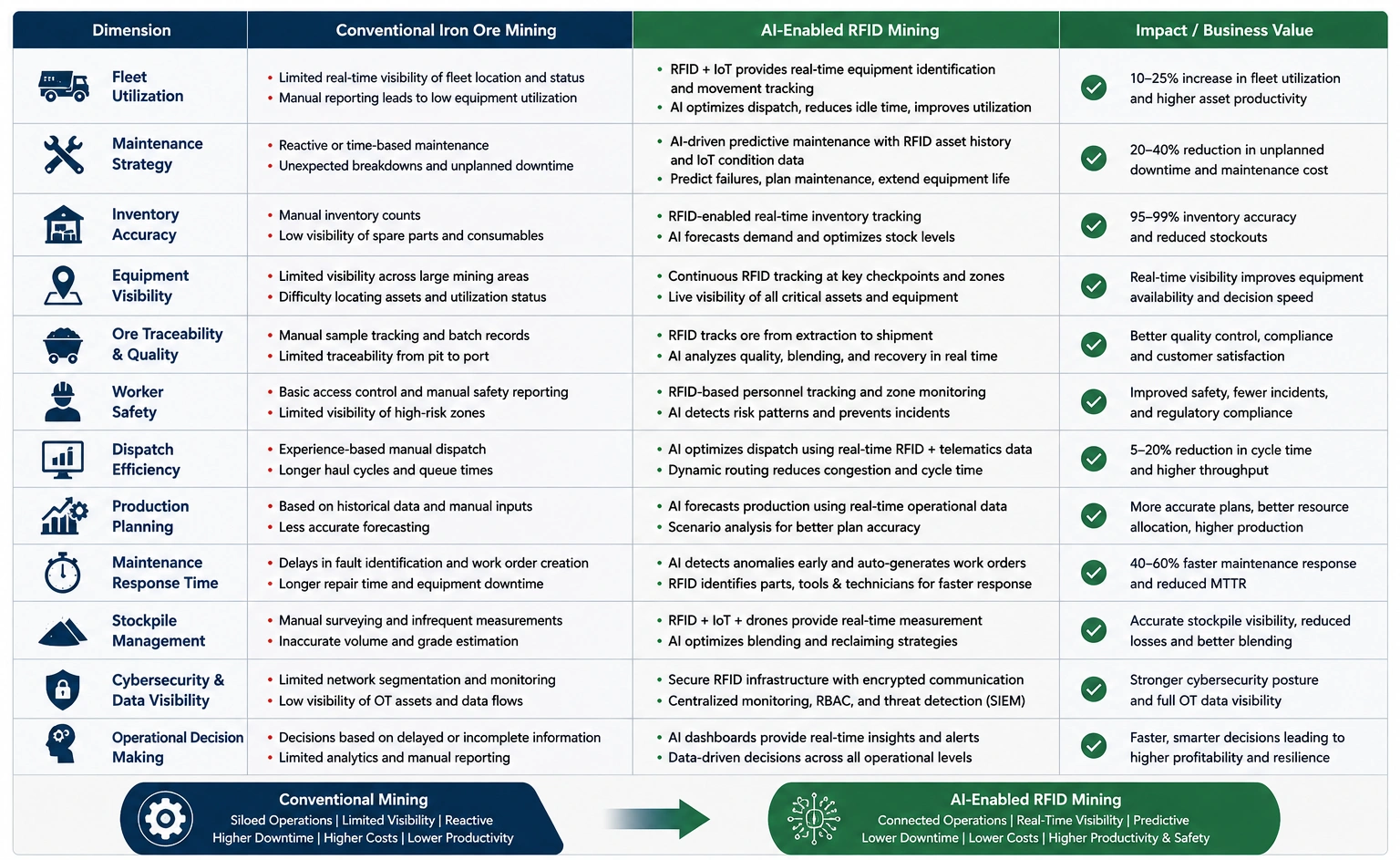
This comparison table highlights the operational differences between conventional iron ore mining and AI-enabled RFID mining across key performance areas, including fleet utilization, maintenance, inventory accuracy, ore traceability, worker safety, production planning, and cybersecurity. It demonstrates how integrating RFID with AI and Industrial IoT enables predictive operations, real-time visibility, improved decision-making, and measurable productivity gains.
Engineering Best Practices for Deploying AI-Enabled RFID in Iron Ore Mining
Successful implementation depends on engineering design rather than simply installing RFID readers. Mining environments introduce challenges such as metallic equipment, abrasive dust, vibration, long communication distances, electromagnetic interference, and constantly changing operational layouts. Careful planning improves long-term performance and minimizes maintenance requirements.
Conduct a Site Engineering Assessment
Evaluate operational conditions before selecting hardware.
Consider:
- Haul road layouts
- Crusher entry points
- Rail loading facilities
- Maintenance workshops
- Stockyard traffic
- Conveyor transfer stations
- Environmental exposure
- Reader mounting locations
- Power availability
- Communication coverage
Field testing helps determine optimal antenna placement and reader configuration.
Select Appropriate RFID Technology
Technology selection should match operational requirements.
- UHF RFID for long-range identification of vehicles, rail wagons, pallets, and outdoor assets.
- HF RFID for laboratory workflows, maintenance documentation, and controlled-access areas.
- LF RFID where metal interference or harsh industrial conditions require improved reliability.
Many iron ore mines benefit from using multiple RFID technologies within the same solution.
Design Reliable Communications
Reliable communications improve AI performance.
Recommended practices include:
- Redundant fiber backbone connections
- Private LTE or private 5G coverage
- Industrial Ethernet within processing plants
- Wi-Fi coverage in workshops
- MQTT messaging for Industrial IoT devices
- Network segmentation between IT and operational technology environments
Integrate Operational Software
Maximum operational value is achieved when RFID data integrates with existing mining software.
Typical integrations include:
- Fleet Management Systems
- Enterprise Resource Planning software
- Computerized Maintenance Management Systems
- Geological modeling software
- Dispatch software
- Warehouse Management Systems
- Asset Performance Management software
- Laboratory Information Management Systems
- Production reporting software
Integration eliminates duplicate data entry while improving operational consistency.
Validate AI Models Continuously
Mining conditions evolve over time because of:
- New ore bodies
- Seasonal weather
- Equipment replacement
- Operational expansion
- Production strategy changes
AI models should be retrained periodically using updated operational data to maintain prediction accuracy.
RFID Technology and Deployment Decision Tree for AI-Enabled Iron Ore Mining
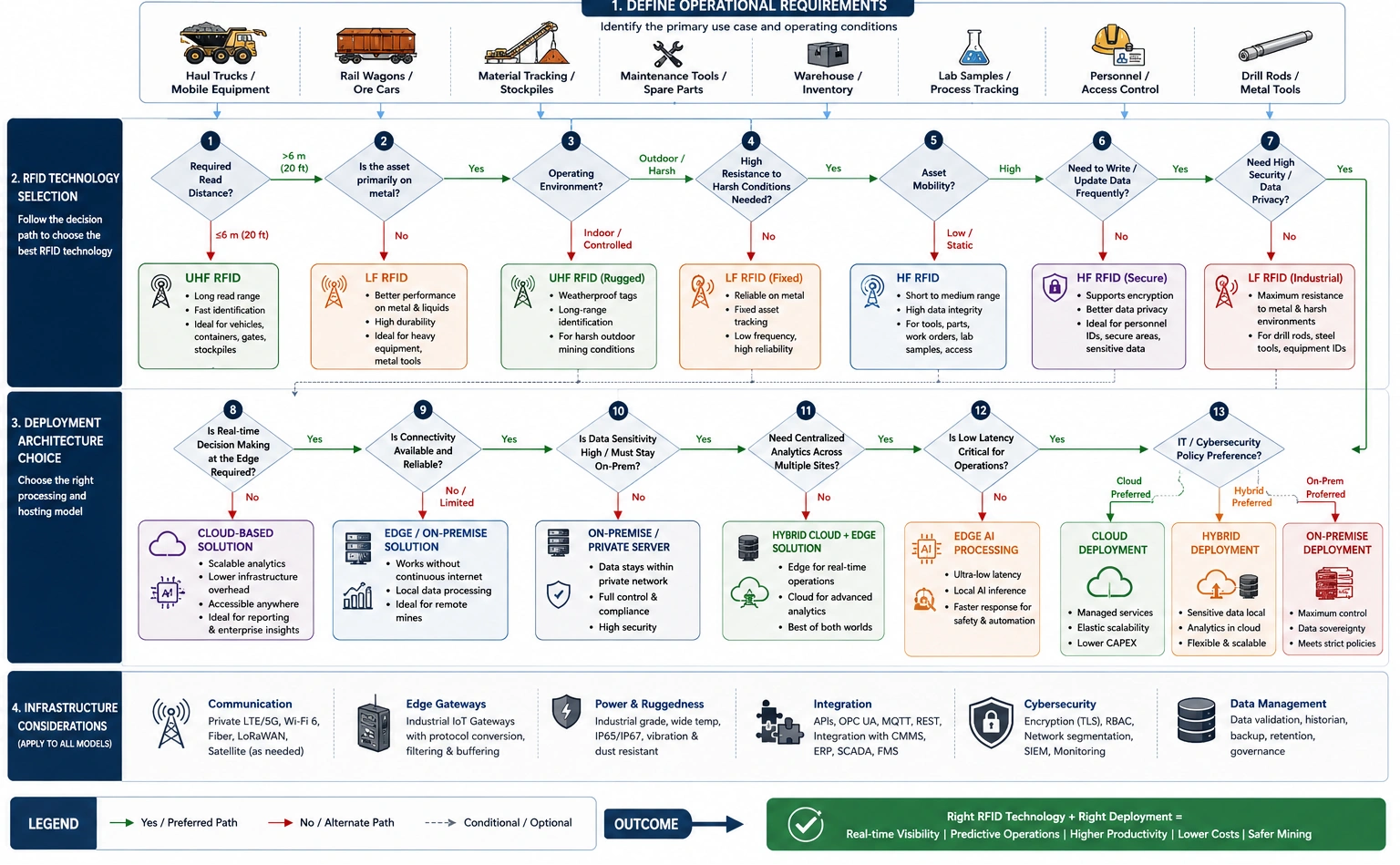
This engineering decision tree guides mining professionals through selecting the most suitable RFID technology and deployment model for iron ore mining applications. It evaluates operational requirements such as asset type, read distance, environmental conditions, mobility, cybersecurity, connectivity, and latency to recommend UHF, HF, or LF RFID along with edge AI, cloud, server, or hybrid deployments.
Cybersecurity, Scalability, and Long-Term Operational Considerations
AI-enabled RFID solutions become increasingly valuable as operational data grows. Maintaining secure communications and scalable software is therefore essential throughout the deployment lifecycle.
Recommended security practices include:
- Mutual authentication between readers and servers
- TLS-encrypted communications
- Role-based access control
- Multi-factor authentication for administrative users
- Secure API integration
- Network segmentation
- Continuous security monitoring
- Centralized log management
- Firmware validation
- Routine vulnerability assessments
- Backup and disaster recovery procedures
Scalable deployments should also support:
- Additional mine sites
- Expanded processing facilities
- New mobile equipment
- Higher RFID read volumes
- Additional AI workloads
- Long-term historical data retention
- Future Industrial IoT sensor integration
GAO assists organizations by supplying RFID hardware and supporting customers with deployment planning, hardware selection, testing, and integration guidance for complex industrial environments.
Key Performance Indicators for AI-Driven Iron Ore Mining
Organizations typically evaluate solution performance using operational and business metrics aligned with production, maintenance, safety, and logistics objectives.
Common KPIs include:
- Overall Equipment Effectiveness (OEE)
- Equipment availability
- Mean Time Between Failures (MTBF)
- Mean Time to Repair (MTTR)
- Fleet utilization rate
- Haul cycle time
- Payload accuracy
- Ore recovery percentage
- Crusher throughput
- Conveyor availability
- Stockpile inventory accuracy
- Rail wagon turnaround time
- Warehouse inventory accuracy
- Spare parts availability
- Fuel consumption per ton
- Predictive maintenance accuracy
- Safety incident frequency
- Contractor compliance rate
- Asset location accuracy
- Production cost per ton
Monitoring these KPIs enables continuous operational improvement and supports data-driven investment decisions.
Emerging Trends in AI-Powered Iron Ore Mining
Iron ore mining continues to adopt advanced Industrial AI and IoT capabilities as digital transformation initiatives mature.
Emerging developments include:
- Autonomous haul truck coordination
- AI-assisted blast optimization
- Digital twin models for mine operations
- Edge AI for low-latency operational decisions
- Computer vision for conveyor inspection
- AI-assisted ore grade prediction
- Drone-based stockpile measurement
- Predictive energy optimization
- Carbon emissions monitoring
- Automated rail logistics optimization
- Remote operations centers
- Foundation models supporting mining decision assistance
These technologies increasingly complement RFID by providing richer operational context for AI-driven decision-making.
Advancing Intelligent Iron Ore Mining with GAO
Artificial intelligence supported by RFID and Industrial IoT technologies is enabling iron ore mining organizations to improve production visibility, equipment reliability, worker safety, inventory accuracy, and operational decision-making. Rather than functioning as an isolated identification technology, RFID provides trusted operational data that strengthens predictive analytics, maintenance planning, fleet optimization, and ore traceability across the complete mining lifecycle.
For more than three decades, GAO has supplied RFID, BLE, and Industrial IoT hardware products and systems supporting customers throughout the United States and Canada, including Fortune 500 companies, leading research organizations, prestigious universities, and government agencies. Together with its sister companies, GAO Research Inc. and GAO Tek Inc., all headquartered in New York City and Toronto, GAO combines sustained investment in research and development, rigorous quality assurance, and expert remote and onsite technical support to help organizations implement reliable Industrial AI and IoT solutions for demanding operational environments.
Organizations seeking to modernize iron ore mining operations can work with GAO to evaluate RFID technologies, identify appropriate AI integration strategies, and implement scalable solutions aligned with production, maintenance, logistics, and safety objectives.
Building the Future of Industrial AI and IoT with Aperture Venture Studio and GAO RFID Inc.
For more than three decades, GAO Group of Companies has invested extensively in research and development of industrial RFID, BLE, and Industrial IoT technologies. As generative AI has become increasingly valuable for intelligent mining operations, we have expanded our AI and IoT capabilities and established Aperture Venture Studio to accelerate the development and adoption of advanced Industrial AI and IoT solutions for sectors such as iron ore mining. Aperture brings together leading AI specialists, IoT engineers, operational executives, investors, and industry partners. Through initiatives including the Aperture Ventures Summit and TekSummit, we foster collaboration on emerging AI and Industrial IoT technologies while strengthening technical communities. We welcome advisors, employees, investors, and customers who share our commitment to advancing intelligent industrial solutions.
End-to-End AI-Enabled RFID Deployment Across the Iron Ore Mining Lifecycle
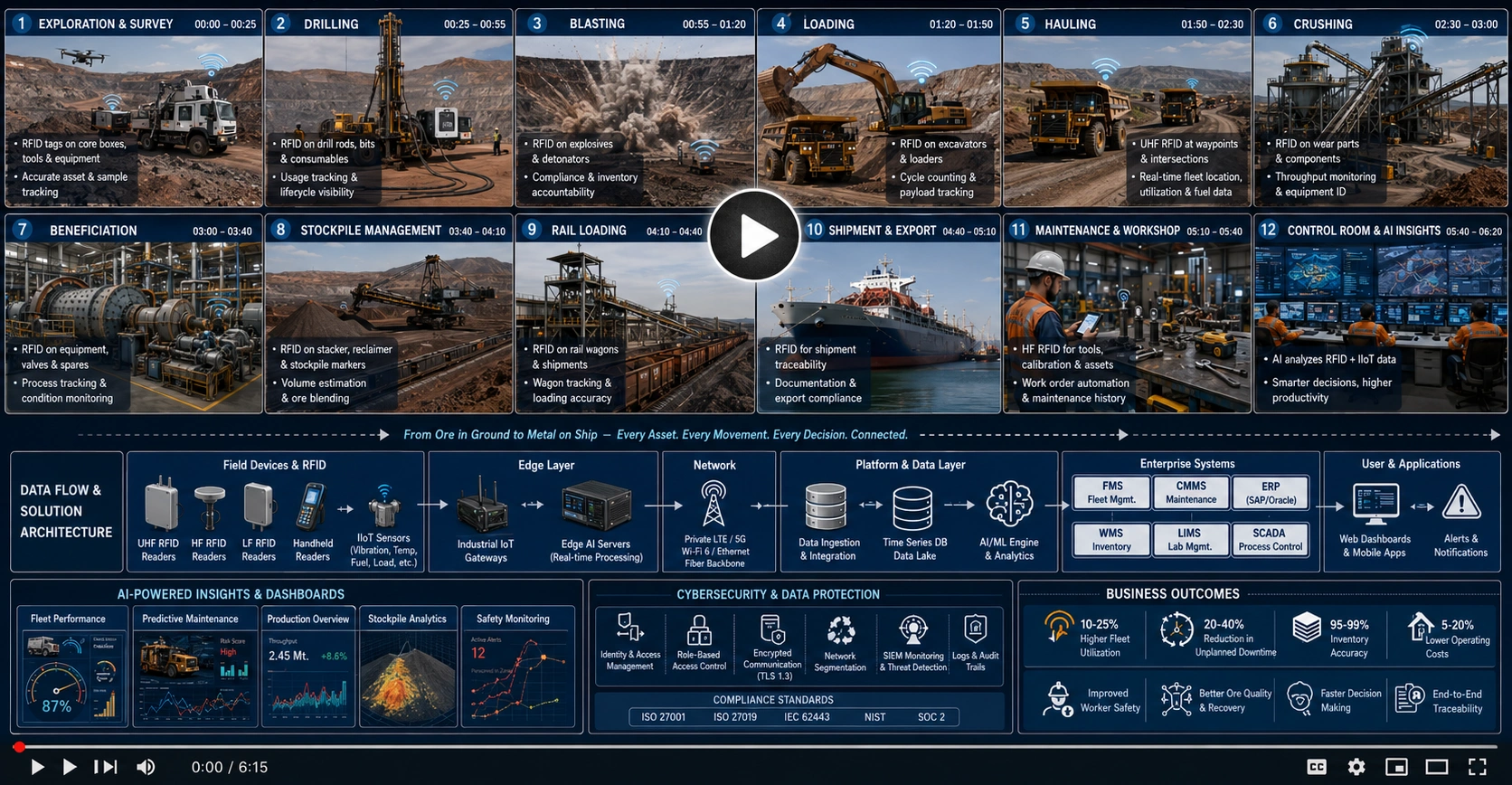
This storyboard-style visual illustrates the complete deployment of AI-enabled RFID throughout the iron ore mining lifecycle, from geological exploration and drilling to beneficiation, rail loading, export, and executive decision support. It demonstrates how RFID, Industrial IoT, edge AI, enterprise software, cybersecurity, and operational dashboards work together to optimize fleet management, predictive maintenance, ore traceability, inventory control, worker safety, and production planning.