
AI and RFID for K-12 Schools
Intelligent AI-Driven RFID Solutions for Modern K-12 Schools
Artificial intelligence combined with RFID technology is transforming how K-12 schools manage students, educational assets, campus safety, libraries, transportation, and daily operations. Rather than simply identifying tagged objects, AI analyzes information collected from RFID readers to detect patterns, predict operational issues, automate routine processes, and support faster administrative decisions. This enables schools to improve student safety, reduce equipment losses, optimize resource utilization, strengthen compliance, and reduce administrative workloads.
Within K-12 education, RFID serves as the primary data acquisition technology while AI converts continuous operational data into actionable intelligence. Together they enable smarter attendance monitoring, library circulation management, classroom asset visibility, school bus tracking, cafeteria automation, emergency preparedness, and preventive maintenance. Educational administrators increasingly view AI-enabled RFID systems as an important component of digital school modernization because they improve operational efficiency while providing measurable improvements in security, accountability, and student services. Organizations such as GAO have supplied RFID hardware and intelligent identification systems to educational institutions and public sector organizations across North America, supporting reliable deployments through proven engineering expertise and comprehensive technical support.
AI-Enabled RFID Smart Campus for K-12 Schools: Intelligent Student Safety, Asset Tracking, and School Operations
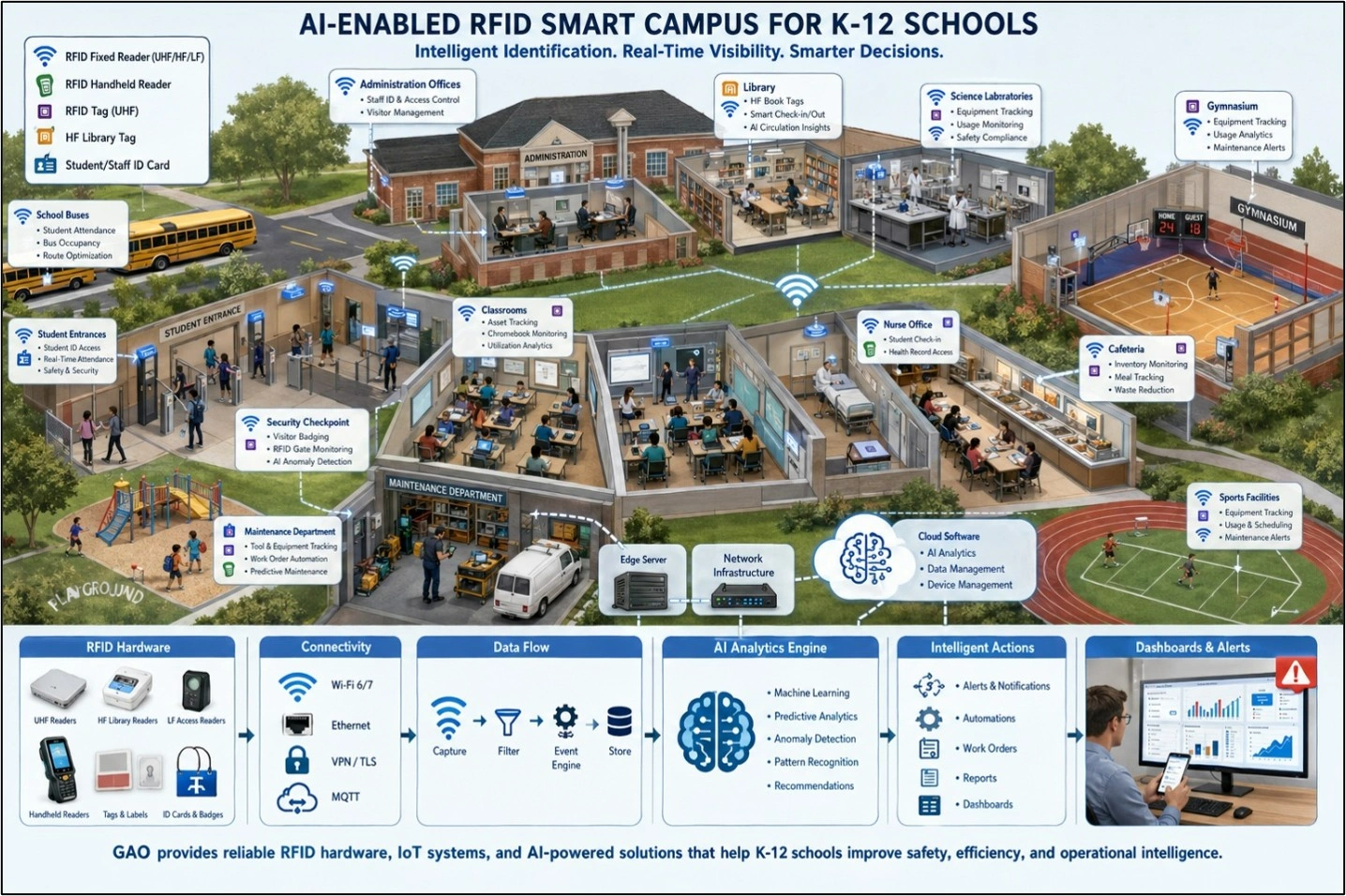
This illustration presents a comprehensive AI-enabled RFID smart campus deployment for a modern K-12 school. It demonstrates how RFID readers, student identification cards, library tags, asset tags, edge servers, wireless networks, cloud software, and AI analytics work together to automate attendance, asset tracking, library management, transportation monitoring, maintenance, campus security, and administrative decision-making through real-time operational intelligence.
Understanding AI-Powered RFID Solutions in K-12 Education
Modern K-12 schools manage thousands of physical and digital assets while simultaneously ensuring student safety, regulatory compliance, efficient facility operations, and effective learning environments. Traditional manual tracking methods often create administrative burdens, inventory inaccuracies, delayed responses, and limited operational visibility.
RFID addresses these challenges by automatically identifying tagged students, educational materials, laboratory equipment, technology devices, library books, maintenance tools, sports equipment, musical instruments, and transportation assets without requiring manual data entry. Artificial intelligence expands these capabilities by continuously learning operational behaviors, recognizing anomalies, forecasting resource requirements, and recommending operational improvements.
Typical AI-enabled RFID solutions for K-12 schools include:
- AI student attendance automation
- AI library circulation management
- AI classroom asset tracking
- AI Chromebook lifecycle management
- AI school bus monitoring
- AI cafeteria inventory optimization
- AI laboratory equipment management
- AI maintenance scheduling
- AI emergency evacuation accountability
- AI visitor access monitoring
- AI sports equipment inventory
- AI music instrument tracking
- AI instructional resource allocation
- AI lost asset detection
- AI utilization analytics
Unlike conventional identification systems that merely report tag locations, AI continuously evaluates RFID-generated operational data to identify inefficiencies before they affect teaching, learning, or school operations.
Educational environments particularly benefit because AI continuously adapts to changing schedules, student movement patterns, seasonal activities, maintenance cycles, and equipment usage across multiple campuses.
Operational Challenges Facing Modern K-12 Schools
School districts operate increasingly complex educational environments where thousands of students, teachers, administrators, maintenance personnel, transportation staff, and external contractors interact daily across multiple facilities. These environments generate operational challenges that traditional manual processes struggle to manage efficiently.
Common operational challenges include:
- Manual attendance consuming valuable instructional time
- Lost classroom technology devices
- Missing STEM laboratory equipment
- Library inventory discrepancies
- School bus accountability
- Visitor management
- Cafeteria inventory waste
- Emergency evacuation accountability
- Preventive maintenance scheduling
- Athletic equipment losses
- Device lifecycle management
- Teacher resource allocation
- Student identification accuracy
- Security incident investigations
- Multi-campus inventory synchronization
AI-enabled RFID solutions directly address these operational issues by automating identification while enabling intelligent analysis of continuously collected operational information.
Because every RFID event contributes additional operational knowledge, AI models continuously improve forecasting accuracy and operational recommendations over time.
GAO has helped organizations implement RFID hardware systems that provide reliable data capture suitable for advanced AI analytics, enabling schools to build dependable operational intelligence from trusted identification infrastructure.
From Manual Challenges to AI-Powered RFID Intelligence in K-12 Schools
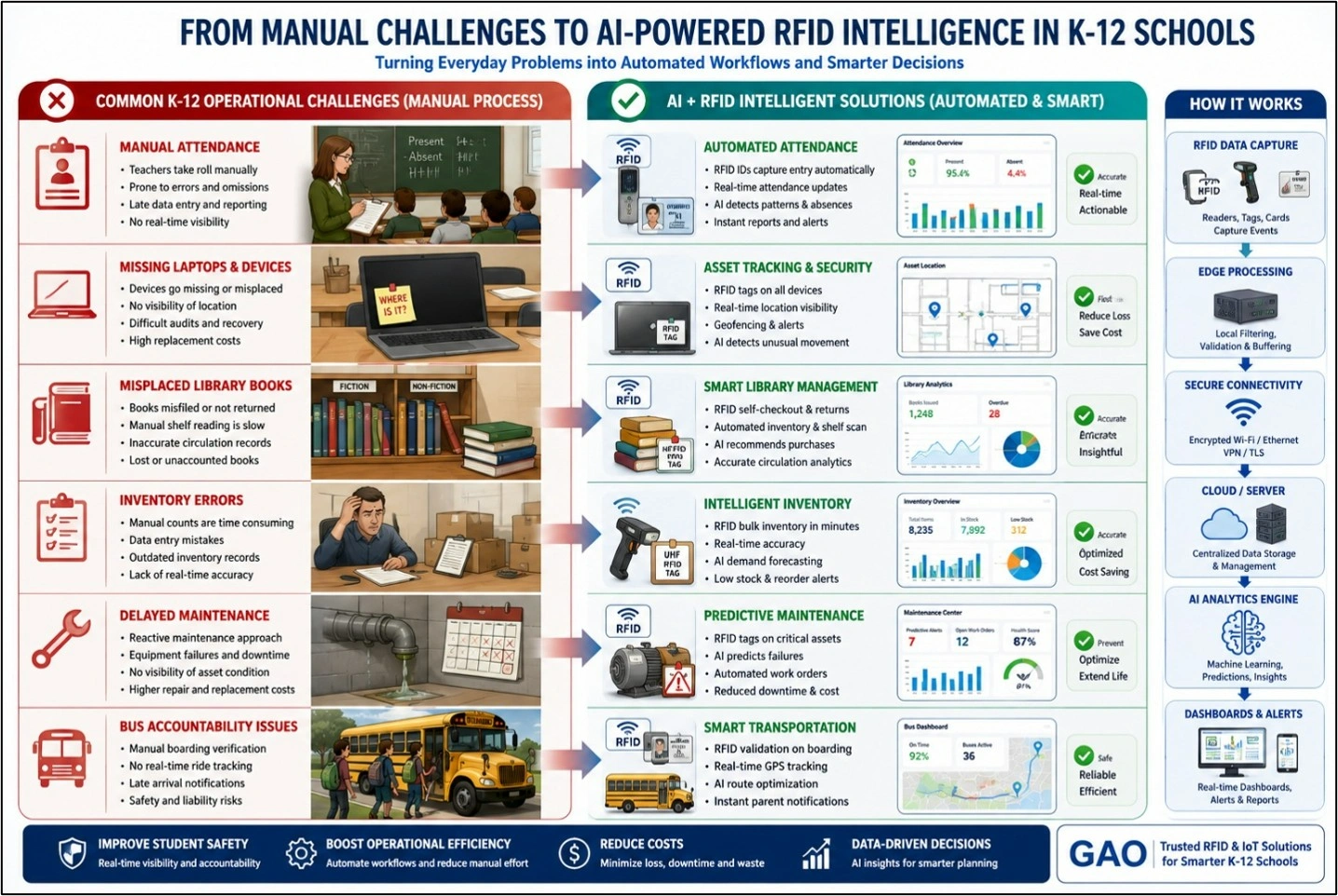
This infographic compares traditional manual school operations with AI-enabled RFID workflows across key K-12 functions. It illustrates how automated attendance, intelligent asset tracking, smart library management, predictive maintenance, transportation monitoring, and operational analytics replace labor-intensive processes, improving visibility, efficiency, student safety, and decision-making.
AI Applications Across K-12 School Operations
AI-driven RFID data supports nearly every operational department within modern K-12 schools.
Student Attendance Management
HF student identification cards automatically register attendance when students enter classrooms or designated checkpoints. AI detects unusual attendance patterns, chronic absenteeism, late arrivals, unauthorized campus departures, and enrollment anomalies while assisting administrators with intervention planning.
Library Automation
HF RFID tags enable automated circulation, shelf management, inventory verification, self-checkout stations, and security gates. AI evaluates borrowing behavior, predicts high-demand materials, recommends acquisition priorities, identifies underutilized collections, and improves circulation efficiency.
Classroom Technology Management
Chromebooks, tablets, interactive displays, projectors, robotics kits, calculators, and audiovisual equipment equipped with UHF RFID tags can be continuously monitored throughout classrooms and storage rooms. AI identifies underutilized devices, predicts replacement cycles, detects abnormal movement, and recommends redistribution among classrooms.
STEM Laboratory Management
Science laboratories require accurate tracking of microscopes, sensors, robotics equipment, measuring instruments, chemical storage containers, and specialized instructional devices.
AI evaluates equipment utilization, calibration schedules, maintenance history, reservation demand, and replacement forecasting.
School Transportation
RFID student identification combined with bus-mounted readers records boarding and departure events automatically.
AI analyzes:
- Bus occupancy
- Route efficiency
- Student boarding trends
- Delayed arrivals
- Transportation capacity
- Driver performance indicators
- Route optimization opportunities
Cafeteria Operations
RFID-supported inventory tracking enables AI to optimize food inventory, expiration management, meal forecasting, supplier planning, and consumption analytics while reducing food waste.
Athletic Department Management
Sports equipment frequently moves between storage facilities, playing fields, gymnasiums, and transportation vehicles.
AI supports:
- Equipment accountability
- Uniform distribution
- Seasonal inventory forecasting
- Maintenance scheduling
- Asset utilization analysis
Facility Maintenance
Maintenance teams track tools, replacement components, HVAC equipment, electrical assets, custodial supplies, and mechanical systems using RFID identification.
AI predicts preventive maintenance schedules, identifies recurring equipment failures, estimates spare inventory requirements, and optimizes technician assignments.
AI-Powered RFID Operational Workflow for K-12 Schools
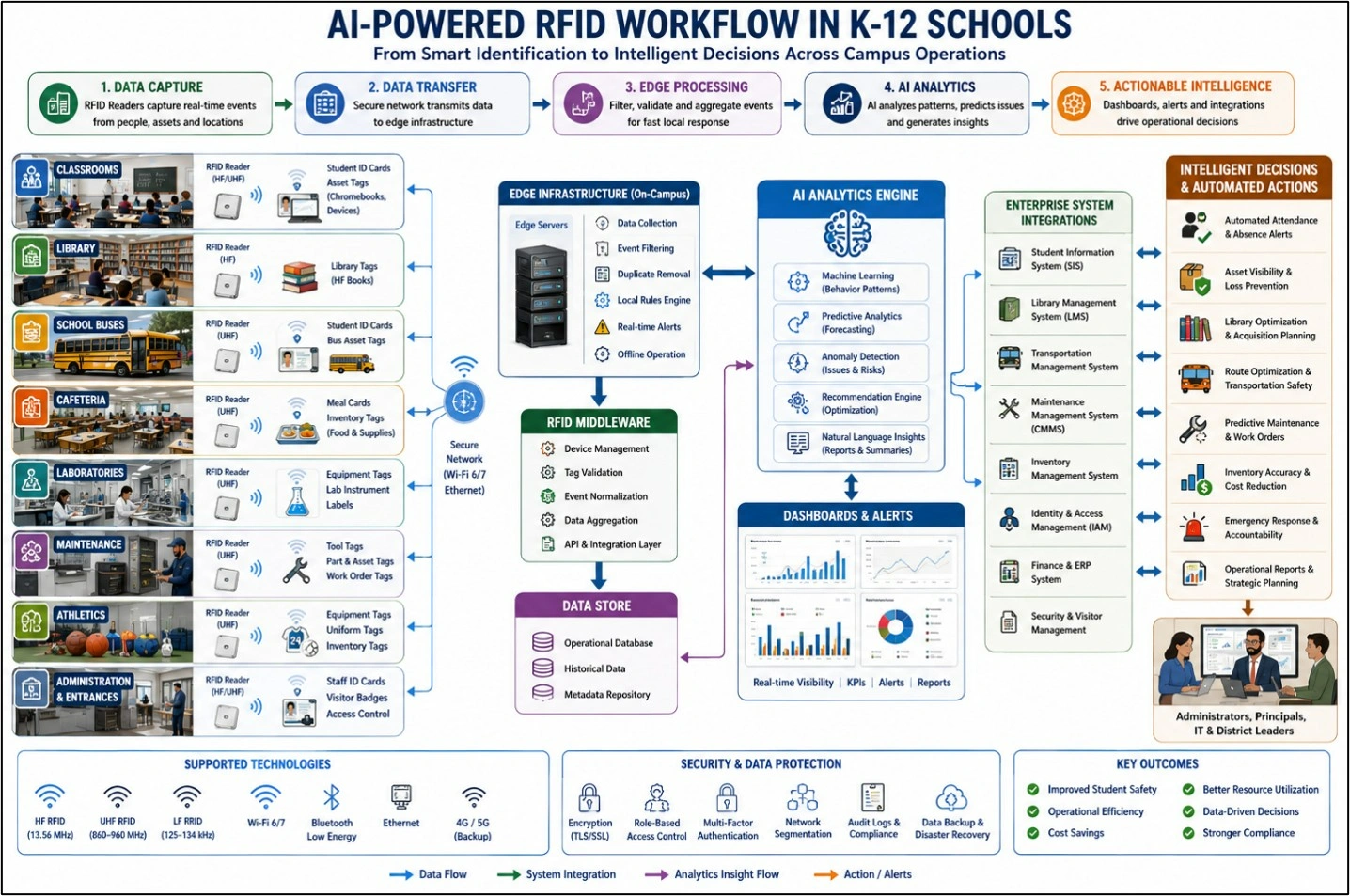
This operational workflow diagram illustrates how RFID-generated data flows from classrooms, libraries, school buses, cafeterias, laboratories, maintenance departments, athletics, and administrative areas through secure networking, edge processing, middleware, and AI analytics. The processed information integrates with school information systems and management software to provide real-time dashboards, automated alerts, predictive insights, and data-driven administrative decisions that improve safety, efficiency, and resource management.
End-to-End Operational Workflow for AI-Enabled RFID in K-12 Schools
Successful deployments require considerably more than installing RFID tags and readers. Reliable educational intelligence depends on properly designed information flow from data capture through automated operational decision-making.
Educational Asset and Student Identification
Every monitored entity receives an RFID identifier appropriate for operational requirements.
Examples include:
- Student identification cards
- Teacher identification badges
- Visitor credentials
- Library books
- Chromebooks
- Tablets
- Scientific equipment
- Musical instruments
- Sports equipment
- Maintenance tools
- Furniture
- Medical equipment
- School buses
HF RFID is commonly selected for library circulation and student identification because of its short reading distance and controlled interactions. UHF RFID is widely deployed for asset tracking where longer read ranges improve inventory efficiency. LF RFID remains useful for specialized access control and legacy identification applications.
Data Acquisition
RFID readers capture identification events through strategically deployed infrastructure including:
- Classroom entrances
- Library circulation desks
- Security gates
- Hallways
- Equipment storage rooms
- Bus entrances
- Cafeteria service areas
- Maintenance workshops
- Receiving departments
- Administrative offices
Handheld RFID readers supplement fixed infrastructure during inventory verification and audits.
Communication Infrastructure
Captured RFID events travel through secure communication networks including:
- Ethernet
- Wi-Fi
- Private VLANs
- VPN connections
- TLS encrypted communications
- Secure REST APIs
- MQTT messaging where appropriate
Reliable network segmentation minimizes latency while improving operational resilience.
Edge Processing
Edge servers located within school facilities perform immediate processing functions including:
- Reader management
- Duplicate filtering
- Temporary buffering
- Event validation
- Local analytics
- Emergency processing
- Device monitoring
Processing data locally allows critical operational functions to continue during temporary Internet outages.
Middleware and Integration
RFID middleware standardizes device communications before distributing validated information into school software systems.
Typical integrations include:
- Student Information Systems (SIS)
- Library Management Systems (LMS)
- Computerized Maintenance Management Systems (CMMS)
- Identity and Access Management software
- School transportation software
- Inventory management software
- Help desk software
- Financial systems
- Building management systems
- Security information systems
This integration prevents duplicate data entry while enabling consistent operational visibility across departments.
Cloud and Server Deployment Models for AI-Enabled RFID in K-12 Schools
Selecting the appropriate deployment model depends on school district size, cybersecurity policies, regulatory requirements, IT staffing, budget, and long-term operational objectives. Many K-12 organizations also adopt hybrid deployments where critical operational functions remain locally managed while AI analytics and reporting are delivered through cloud services.
Cloud Version
A cloud-hosted deployment places AI software, analytics engines, dashboards, reporting tools, and centralized device management within a managed cloud environment. RFID readers installed throughout schools securely transmit validated events to cloud software where AI continuously analyzes operational activity.
Cloud deployments are often appropriate for:
- Multi-school districts
- Schools with limited local IT resources
- Rapid deployment projects
- Centralized administration
- Disaster recovery requirements
- Automatic software updates
- Remote management
- District-wide reporting
Advantages include:
- Centralized monitoring across multiple campuses
- Elastic computing resources for AI workloads
- Simplified software maintenance
- High availability
- Faster feature deployment
- Reduced local server administration
- Secure remote access for authorized administrators
Server Version
A server deployment places AI software, RFID middleware, databases, dashboards, and management applications on customer-managed servers located within school data centers, private cloud infrastructure, or other privately hosted computing environments.
Server deployments are commonly selected when schools require:
- Greater operational control
- Strict data governance
- Local processing
- Lower network dependency
- Integration with existing private infrastructure
- Custom software development
- Long-term infrastructure management
Benefits include:
- Full administrative control
- Low latency processing
- Local storage of operational data
- Flexible integration with existing school systems
- Greater customization opportunities
- Independent maintenance scheduling
Many districts combine local edge processing with centralized cloud analytics to balance resilience, performance, and administrative efficiency.
Cloud vs. Server Deployment Comparison for AI-Enabled RFID in K-12 Schools
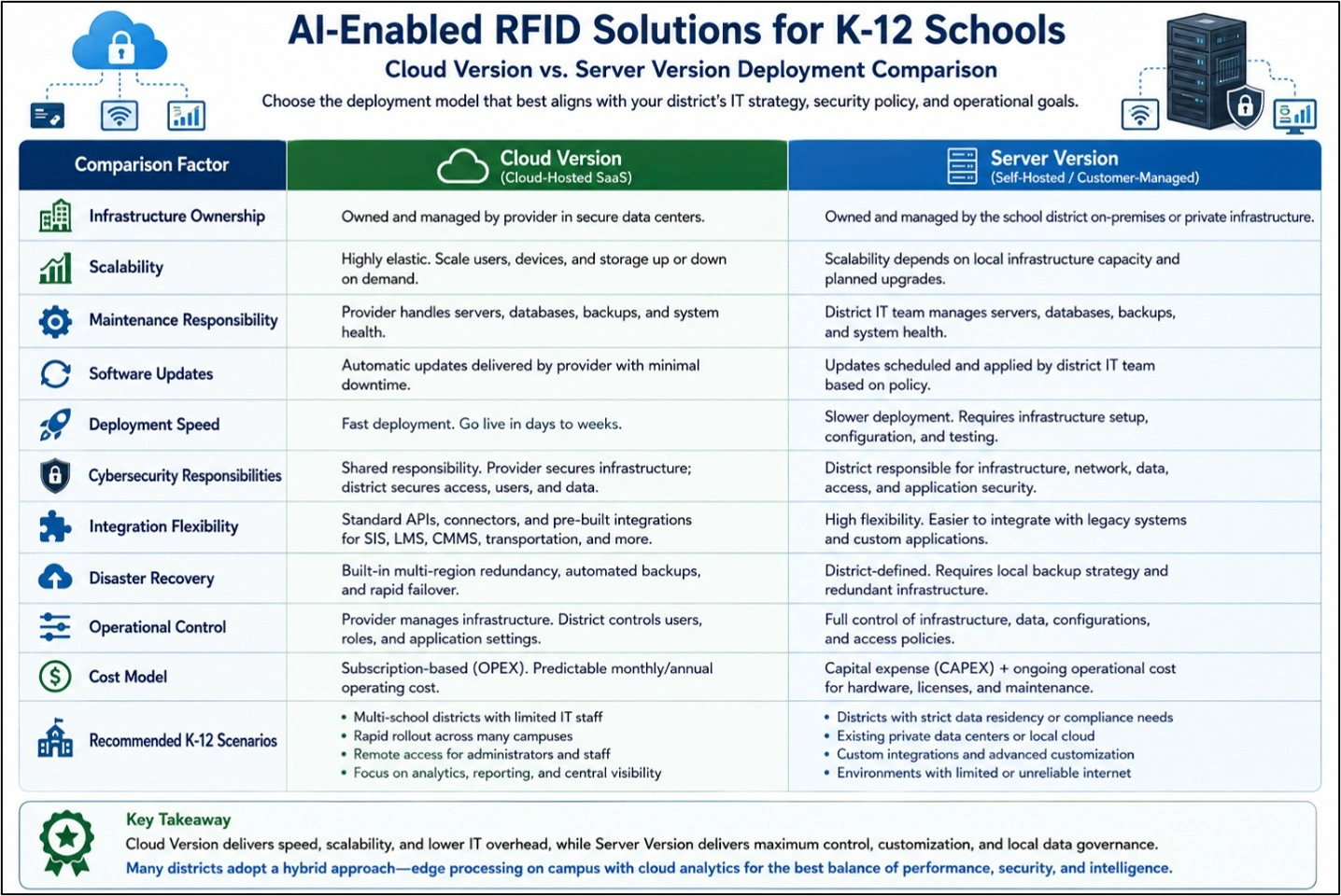
This comparison table evaluates Cloud Version and Server Version deployments for AI-enabled RFID solutions in K-12 schools. It compares infrastructure ownership, scalability, maintenance responsibilities, software updates, cybersecurity, integration flexibility, disaster recovery, operational control, cost models, and recommended deployment scenarios, helping school districts choose the most appropriate solution based on their IT strategy and operational requirements.
Core Components Supporting AI-Powered RFID Solutions
Reliable AI-driven school operations depend on coordinated hardware, software, networking, and security components rather than any single technology.
RFID Hardware
Typical hardware deployed throughout K-12 schools includes:
- UHF fixed RFID readers
- HF library readers
- LF access control readers
- Handheld RFID inventory readers
- RFID antennas
- Student identification cards
- Staff identification badges
- Visitor badges
- Asset tags
- Library book tags
- Printer and tag encoding equipment
- Smart lockers
- RFID security gates
Artificial Intelligence Technologies
Educational AI software commonly incorporates:
- Machine learning
- Predictive analytics
- Time-series forecasting
- Pattern recognition
- Anomaly detection
- Recommendation engines
- Natural language processing for reporting
- Computer vision where camera systems complement RFID
- Edge AI for localized decision-making
These AI capabilities transform operational events into actionable recommendations instead of simple identification records.
Supporting Software
Typical software integrated into K-12 deployments includes:
- Student Information Systems
- Library Management Systems
- Inventory management software
- Maintenance management software
- Building management software
- Identity management software
- Transportation management software
- Security event monitoring software
- Mobile administrative applications
- Reporting and business intelligence software
Communication Infrastructure
Reliable communication is essential for continuous operation.
Common technologies include:
- Gigabit Ethernet
- Wi-Fi 6 and Wi-Fi 7
- Fiber backbone connections
- VPN connectivity
- Secure APIs
- MQTT messaging
- TLS encryption
- Network segmentation
- Redundant switching
Cybersecurity and Data Protection for K-12 RFID Systems
Educational institutions manage sensitive information relating to students, staff, facilities, and school operations. Protecting this information requires multiple layers of security throughout the RFID solution.
Recommended security controls include:
- Role-based access control
- Multi-factor authentication
- Encrypted communications
- Secure device authentication
- Certificate management
- Continuous vulnerability assessment
- Security event logging
- Audit trails
- Network segmentation
- Secure API authentication
- Backup and disaster recovery procedures
- Endpoint protection
- Firmware lifecycle management
- Continuous monitoring of reader health
AI further strengthens cybersecurity by identifying unusual device behavior, abnormal asset movement, suspicious access patterns, and operational anomalies that may indicate equipment theft or unauthorized activity.
For school districts operating multiple campuses, centralized security monitoring simplifies incident response while improving visibility across distributed facilities.
Layered Cybersecurity for AI-Enabled RFID Systems in K-12 School Districts
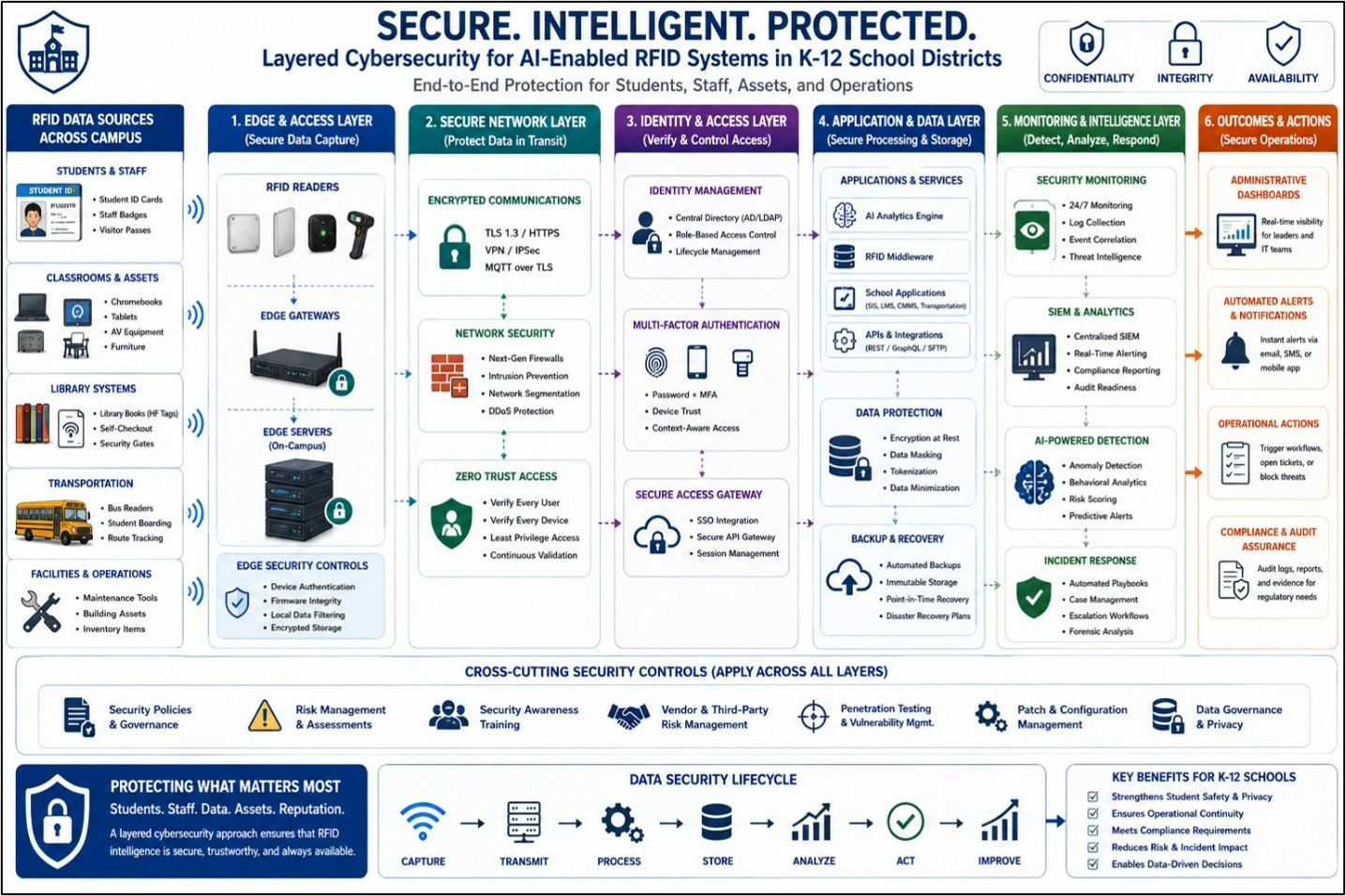
This security diagram illustrates a defense-in-depth approach for protecting AI-enabled RFID systems across K-12 school districts. It shows how RFID devices, student identification, educational assets, secure communications, identity and access management, firewalls, AI-powered threat detection, SIEM monitoring, audit logging, and centralized administrative dashboards work together to safeguard student data, school operations, and connected infrastructure.
Technical Capabilities and Business Value for K-12 Schools
Combining AI with RFID-generated operational data provides measurable improvements across educational administration, facilities management, student services, and resource planning.
Key technical capabilities include:
- Automated student attendance verification
- Continuous educational asset visibility
- Intelligent library circulation analysis
- Predictive maintenance scheduling
- Equipment utilization analytics
- Automated inventory reconciliation
- Lost asset detection
- School bus occupancy monitoring
- Cafeteria inventory forecasting
- Visitor accountability
- Emergency evacuation reporting
- Multi-campus operational reporting
- AI-assisted resource allocation
- Historical trend analysis
- Real-time operational dashboards
Business benefits include:
- Reduced administrative workload
- Improved instructional time through automated attendance
- Lower technology replacement costs
- Increased inventory accuracy
- Better regulatory documentation
- Reduced equipment loss
- Improved maintenance efficiency
- Enhanced student safety
- Faster emergency accountability
- Improved budget planning
- Higher utilization of educational resources
- Better district-wide operational visibility
Because AI continuously learns from operational history, forecasting accuracy improves over time, enabling administrators to make more informed planning decisions.
GAO has supported organizations throughout North America by providing RFID readers, identification hardware, and IoT systems that serve as dependable foundations for intelligent operational solutions. Headquartered in New York City and Toronto, Canada, GAO is recognized among the world’s leading B2B and B2G suppliers of RFID and BLE technologies, serving Fortune 500 companies, leading research organizations, universities, and government agencies through decades of engineering investment, rigorous quality assurance, and expert technical support.
AI-Powered RFID Executive Dashboard for K-12 School District Operations
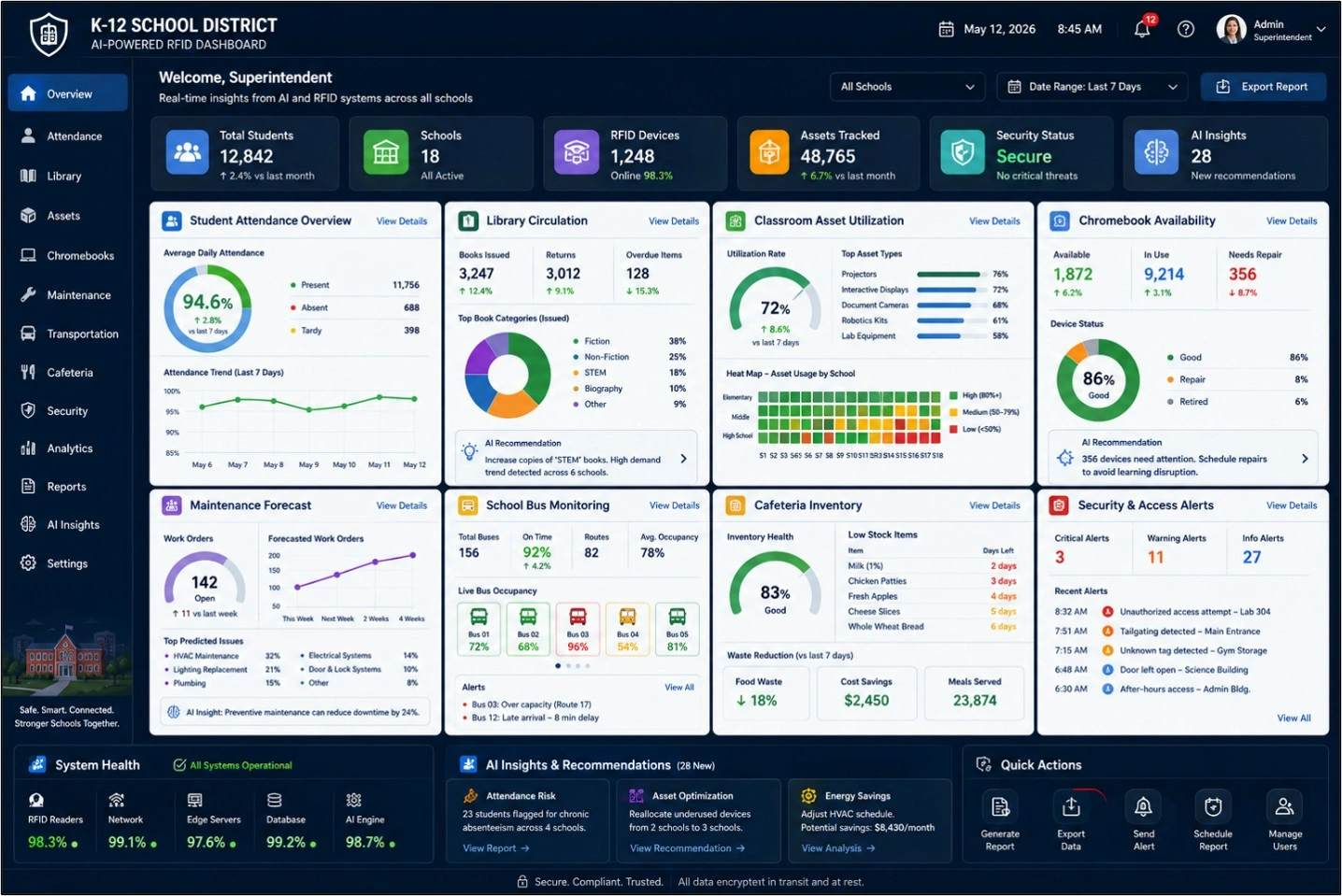
This executive dashboard demonstrates how AI transforms RFID-generated data into actionable operational intelligence for K-12 school administrators. It consolidates real-time student attendance, library circulation, classroom asset utilization, Chromebook availability, maintenance forecasts, school bus occupancy, cafeteria inventory, security alerts, equipment status, and AI-generated recommendations into a unified decision-support interface for district-wide management.
Engineering Best Practices for Successful Implementation
Organizations planning AI-enabled RFID deployments should begin with clearly defined operational objectives rather than focusing solely on hardware selection.
Recommended implementation practices include:
- Conduct comprehensive site surveys before reader installation.
- Select HF, UHF, or LF RFID based on operational requirements.
- Define measurable KPIs before deployment.
- Perform pilot implementations before district-wide rollout.
- Validate read accuracy under real classroom conditions.
- Integrate RFID data with existing school software wherever practical.
- Establish cybersecurity policies before production deployment.
- Train administrative, IT, library, transportation, and maintenance personnel.
- Monitor system performance using operational dashboards.
- Periodically review AI model performance and retrain models using updated operational data.
- Develop preventive maintenance schedules for RFID infrastructure.
- Document reader locations, firmware versions, and configuration settings.
- Perform regular inventory validation and system health assessments.
These engineering practices improve long-term reliability, reduce operational disruptions, and maximize the value of AI-assisted decision-making.
Advancing Smarter K-12 Education with AI-Powered RFID Solutions
AI-enabled RFID solutions are helping K-12 schools modernize student attendance, library operations, educational asset management, transportation, maintenance, and campus safety through intelligent automation and data-driven decision-making. By combining reliable RFID identification with AI analytics, schools gain better operational visibility, stronger accountability, and improved resource utilization while reducing manual administrative effort.
As educational technology continues to evolve, AI-supported RFID systems will play an increasingly important role in helping school districts improve efficiency, strengthen security, and deliver better learning environments. We at GAO continue to support educational organizations by supplying dependable RFID hardware, IoT technologies, and engineering expertise that help schools successfully deploy intelligent identification solutions tailored to their operational needs.
Building the Future of Industrial AI and IoT with Aperture Venture Studio and GAO RFID Inc.
For more than three decades, GAO Group of Companies has invested extensively in research and development of industrial RFID, BLE, and IoT technologies. As generative AI has demonstrated significant value across education and other operational environments, we have expanded our AI and IoT capabilities and established Aperture Venture Studio to accelerate the development and growth of advanced AI and IoT solutions that address real-world operational challenges across multiple industries, including education.
Aperture has attracted leading AI and IoT technical specialists, experienced operational executives, respected investors, and prominent industry organizations. Through initiatives such as Aperture Ventures Summit and TekSummit, we foster collaboration on advanced AI and IoT technologies while strengthening technical communities. We welcome participation from:
- Advisors, co-founders, and employees
- Investors
- Customers seeking advanced AI and IoT solutions