
AI and RFID for Libraries: Intelligent Library Operations and Asset Management
AI-Driven Library Management with RFID
AI and RFID for Libraries combines artificial intelligence with connected identification, sensing, and library management technologies to improve how libraries track, circulate, locate, secure, and maintain physical collections. AI analyzes circulation histories, item-location data, inventory events, patron service patterns, and operational exceptions, while RFID provides automated identification of books, media, equipment, and other tagged library assets. UHF RFID, HF RFID, and LF RFID can support different library environments depending on read distance, tag form factor, security requirements, and interoperability needs. The resulting system can support AI-assisted inventory management, automated check-in and check-out, shelf verification, misplaced-item detection, collection analytics, loss prevention, and staff workflow optimization.
For libraries managing large collections across public, academic, research, and institutional facilities, the combination can reduce repetitive scanning, improve collection visibility, and provide better operational data for decisions about staffing, shelving, acquisitions, maintenance, and patron services.
AI-Powered RFID Library Management and Intelligent Operations
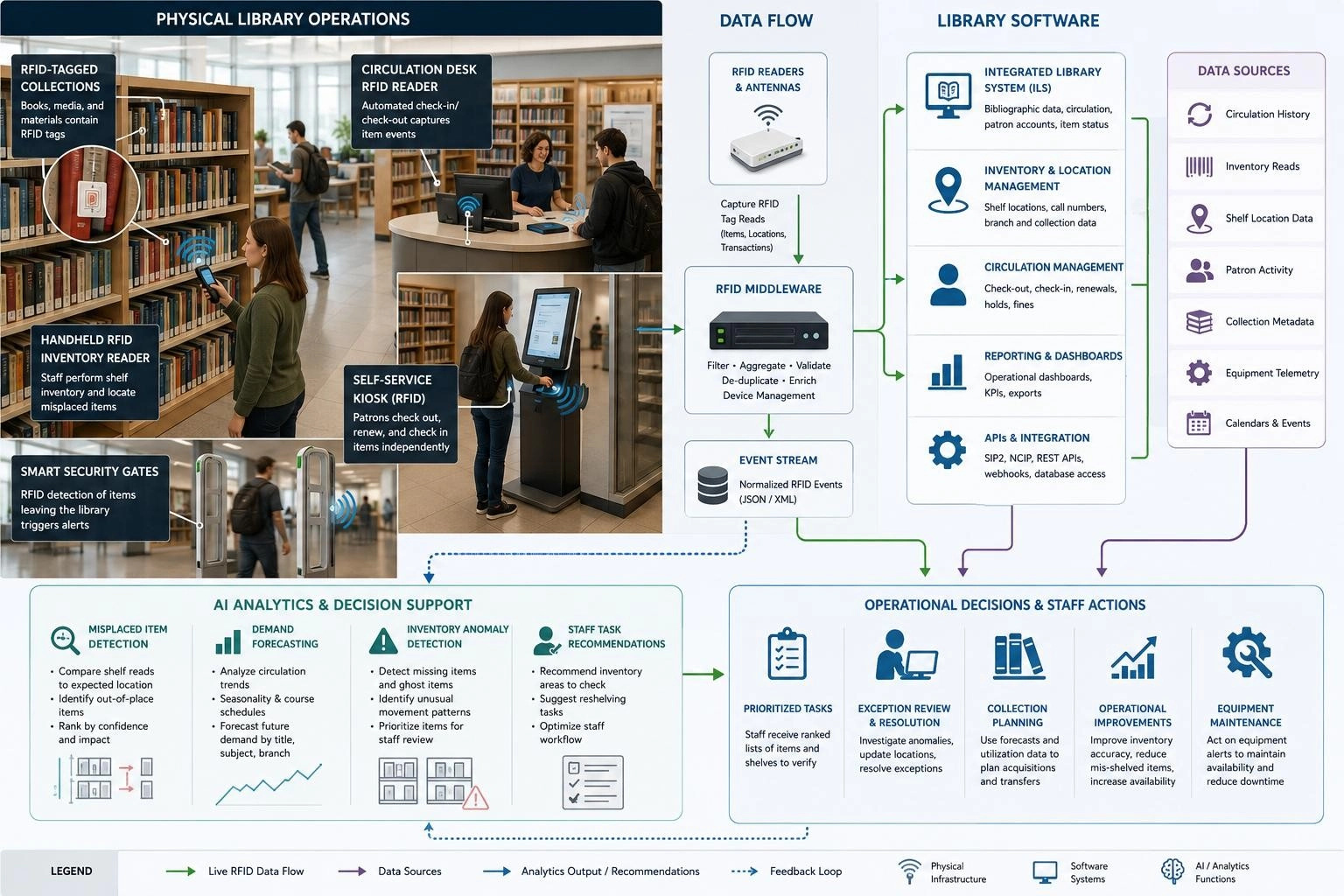
This visual illustrates how RFID-tagged library collections, handheld and fixed RFID readers, self-service kiosks, and security gates generate operational data for library software. AI analytics uses circulation, inventory, shelf-location, and equipment data to detect misplaced items, forecast demand, identify anomalies, recommend staff tasks, and support collection and operational decisions.
What AI-Powered Library Operations Actually Solve
Libraries have operational requirements that are substantially different from general inventory environments. A library collection can contain hundreds of thousands or millions of individually managed items, while each item may repeatedly move between shelves, circulation points, sorting areas, repair rooms, reserves, branches, and patron locations. The operational objective is therefore not simply to count inventory. It is to maintain reliable item identity, bibliographic association, current status, expected location, circulation history, and availability.
AI improves this process by interpreting the data generated by library transactions and RFID events rather than treating every RFID read as an isolated event. For example, repeated reads of a book in an unexpected shelf zone can be correlated with the item’s catalog record, previous location, circulation status, and neighboring shelf sequence. A machine learning model can then identify a likely mis-shelving event and prioritize it for staff verification.
Relevant library applications include:
- AI-assisted library inventory management that identifies missing, misplaced, duplicate, or unexpectedly located items.
- Automated shelf verification using handheld RFID readers and location-aware software.
- AI-supported circulation analysis that identifies demand patterns by collection, title, subject, branch, or time period.
- Automated check-in and sorting using RFID readers, conveyors, bins, and library management software.
- Self-service circulation supported by RFID-enabled kiosks and real-time item-status validation.
- Intelligent loss-prevention analysis using RFID security gates and transaction history.
- AI-assisted reserve collection management for high-demand course materials.
- Equipment and technology asset tracking for laptops, tablets, audiovisual equipment, scanners, and other circulating assets.
- Predictive maintenance for automated sorting equipment, self-service kiosks, RFID readers, printers, and other library infrastructure.
- Staff task prioritization based on inventory exceptions, overdue workflows, high-demand materials, and service-level requirements.
- Collection utilization analysis that combines circulation events with physical inventory information.
- Branch-level collection balancing based on demand, availability, item movement, and historical borrowing patterns.
Library Use Cases and Deployment Scenarios
Academic and Research Libraries
Academic libraries can use AI-assisted RFID systems to improve shelf accuracy across large research collections, reserve materials, special collections where appropriate, and high-turnover course resources. A university library may combine handheld RFID inventory readers with the integrated library system to identify items that have been physically detected but whose recorded location does not match the expected shelving sequence.
AI can further analyze circulation frequency, course-related demand, seasonal borrowing patterns, and interlibrary movement to identify collections requiring faster reshelving or redistribution. Research libraries can use similar data to improve collection visibility without treating AI predictions as authoritative catalog decisions. Staff validation remains important for ambiguous records, sensitive collections, and bibliographic exceptions.
Public Libraries and Branch Networks
Public library systems often manage multiple branches with frequent transfers of books, DVDs, games, educational materials, and other circulating items. RFID provides automated item identification during check-in, check-out, sorting, and inventory activities, while AI can analyze movement patterns across branches.
A branch network can use these data to identify persistent transfer delays, frequently misplaced items, unusually high loss rates, and demand imbalances. AI-generated recommendations can help staff determine where additional copies may be useful or where existing copies should be redistributed, subject to collection-development policies.
School and K-12 Libraries
School libraries can apply RFID to simplify circulation and periodic inventory while using AI analytics to understand borrowing behavior, collection utilization, and missing-item patterns. Smaller deployments may use HF RFID or UHF RFID depending on reader placement, required read distance, tag format, and budget.
For school environments, the solution should minimize collection of personally identifiable patron information. AI models can often operate on aggregated circulation and inventory information rather than requiring persistent analysis of individual student identities.
Special and Institutional Libraries
Corporate, government, medical, legal, and specialized institutional libraries may use RFID for controlled collections, technical manuals, standards documents, media, research materials, and equipment. The primary requirement may be precise location and custody tracking rather than high-volume public circulation.
Where collections contain sensitive information, private server deployment, network segmentation, role-based access control, audit logging, and data minimization can be more appropriate than sending all operational data to an external cloud service.
AI and RFID Deployment Comparison Across Library Types
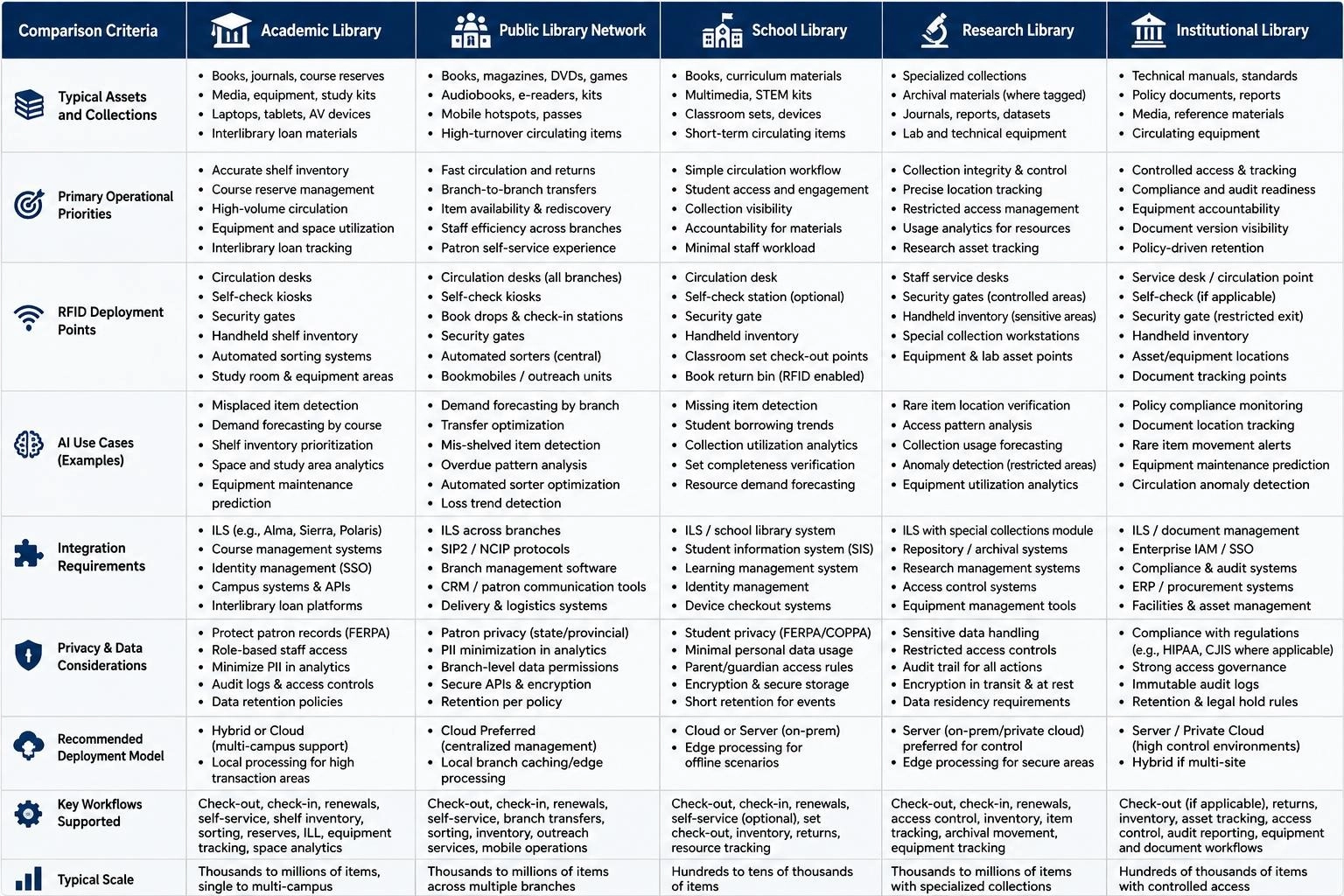
This comparison infographic shows how AI-assisted RFID solutions differ across academic, public, school, research, and institutional libraries. It compares typical collections, operational priorities, RFID deployment points, AI use cases, software integration, privacy requirements, deployment models, workflows, and implementation scale.
From RFID Events to AI-Assisted Library Decisions
A practical library deployment should treat RFID as one source of operational data rather than the entire solution. The complete workflow begins when an RFID tag is read and ends when library staff or software takes an operational action.
Data Acquisition at Library Workstations and Shelves
RFID tags attached to books, media, equipment, or other authorized assets provide electronic identification. HF RFID is commonly useful for short-range item interaction such as circulation points, while UHF RFID can support longer read distances and rapid identification during shelf inventory. LF RFID may be appropriate for specialized identification requirements, although its read characteristics generally make it less suitable for dense, high-volume library inventory compared with UHF and HF deployments.
RFID readers capture tag identifiers and associated event information. Handheld readers can support shelf-by-shelf inventory, while fixed readers can operate at circulation stations, automated sorting points, security gates, or controlled entry and exit locations.
The engineering objective is to capture reliable events while minimizing false reads, missed reads, duplicate events, and interference caused by reader placement, shelving materials, liquids, metal objects, or closely spaced tags.
Communication and Edge Processing
Reader devices communicate with local computers, gateways, or middleware through interfaces such as Ethernet, USB, serial connections, Wi-Fi, or other supported communication methods. Edge processing can normalize raw RFID reads before they reach library software.
For example, middleware can suppress duplicate reads, associate events with reader locations, apply time windows, and translate device-specific data into a common event format. This prevents the AI system from receiving millions of redundant reads that do not represent meaningful library events.
Library Software Integration
Normalized RFID events can be associated with records in an integrated library system or library services system. Common integration mechanisms may include APIs, database interfaces, SIP2, NCIP, or vendor-specific interfaces, depending on the library software environment.
The integration should preserve the distinction between physical RFID identity and bibliographic identity. An RFID tag identifier should not be treated as a substitute for the authoritative catalog or item record. Instead, the system should use controlled mappings between the RFID identifier, item barcode or identifier where applicable, bibliographic record, circulation status, and physical location.
AI Analytics and Operational Actions
Once reliable events are available, AI models can identify patterns that are difficult to detect through simple rules. Examples include unusual circulation demand, repeated mis-shelving, abnormal inventory discrepancies, transfer delays, and equipment failure patterns.
AI should generally produce a recommendation, exception, confidence score, or prioritized task rather than silently modifying authoritative library records. This human-in-the-loop approach is particularly important where incorrect automated actions could affect patron access, collection records, privacy, or acquisition decisions.
AI-Assisted RFID Workflow for Intelligent Library Operations
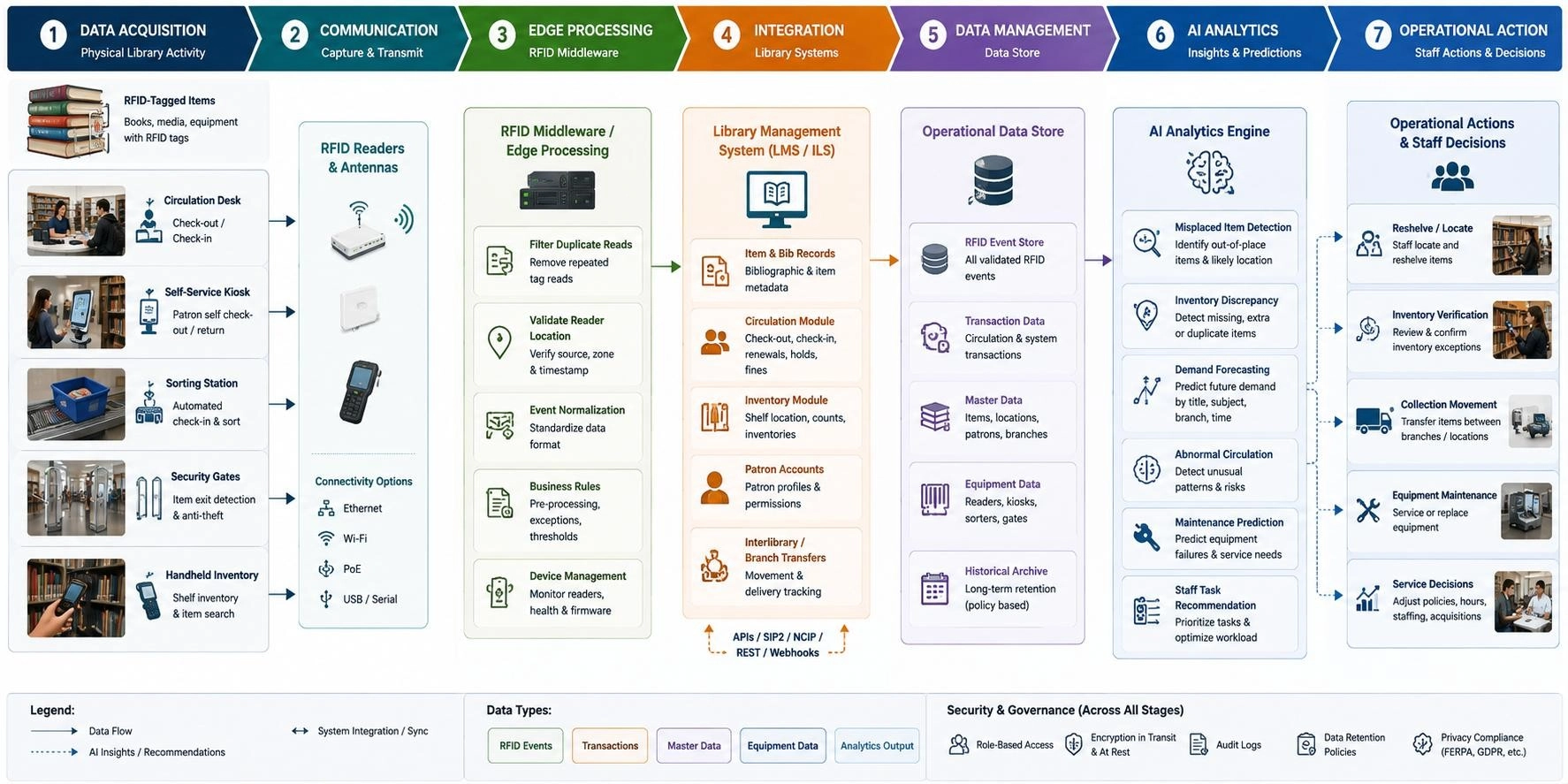
This workflow diagram shows how RFID data moves from tagged books, media, and equipment through readers, edge middleware, library management software, data storage, and AI analytics. It illustrates how AI-generated insights such as misplaced-item detection, inventory discrepancies, demand forecasts, and maintenance predictions lead to staff actions and library service decisions.
RFID Hardware, AI Software, and Library System Integration
A library RFID deployment normally combines several technical components rather than relying on RFID readers alone.
- RFID tags provide machine-readable item identity and should be selected according to item material, attachment method, expected lifespan, read environment, and library workflow.
- HF RFID readers can support short-range identification at circulation desks and self-service stations where controlled read zones are desirable.
- UHF RFID readers can support rapid identification over larger areas, making them useful for handheld shelf inventory and selected fixed-reader applications.
- LF RFID can serve specialized identification requirements where its short-range characteristics and system constraints are appropriate.
- Handheld RFID inventory readers allow staff to scan shelves without manually handling every book or media item.
- Fixed RFID readers can automate identification at circulation stations, sorting equipment, controlled entrances, and other defined read zones.
- RFID antennas determine the physical read field and require careful placement to reduce unwanted reads between adjacent work areas.
- RFID middleware filters and normalizes device events before integration with library software.
- Library management software remains the authoritative environment for catalog, circulation, patron service, acquisition, and item-status functions.
- AI software analyzes historical and real-time operational data to identify patterns, anomalies, forecasts, and recommended actions.
- Databases or analytical data stores retain normalized RFID events and selected library operational data according to retention policies.
- APIs and interoperability interfaces allow RFID events and AI outputs to interact with circulation and inventory workflows.
- Network infrastructure provides connectivity among readers, workstations, servers, cloud services, and library applications.
- Identity and access management controls which staff members can view, modify, or administer operational data.
- Audit logging records important administrative and automated actions for troubleshooting, accountability, and security review.
Cloud and Server Deployment for Library RFID Systems
Libraries should select a deployment model according to data sensitivity, IT staffing, network reliability, integration requirements, scalability, and institutional policy.
Cloud Version
A cloud-hosted software deployment can centralize RFID event processing, AI analytics, dashboards, and multi-branch reporting. This model can be particularly useful for public library systems with geographically distributed branches or organizations that want centralized software maintenance.
Cloud deployment can simplify software updates and provide scalable computing resources for analytics. However, libraries should evaluate network availability, data residency requirements, API security, vendor access controls, retention policies, and integration dependencies before moving operational data to cloud infrastructure.
Server Version
A server deployment can run software on customer-managed servers, private data centers, edge servers, institutional infrastructure, or other privately hosted environments. This model can be appropriate for universities, government libraries, research institutions, and organizations with strict internal data-control requirements.
Server deployment can also reduce dependence on external connectivity for selected workflows. A local RFID processing service can continue filtering and validating reader events even if external cloud connectivity is temporarily unavailable.
Hybrid Library Deployment
A hybrid design can place latency-sensitive RFID processing near circulation or inventory operations while sending selected normalized data to cloud analytics. This approach can reduce unnecessary network traffic and allow sensitive operational records to remain within controlled infrastructure.
The preferred design should be determined during requirements analysis rather than selected solely because cloud or server deployment is currently popular. Library branch count, reader density, transaction volume, existing ILS infrastructure, security policy, and available IT support should drive the decision.
Cloud, Server, and Hybrid Deployment for AI-Assisted Library RFID Systems
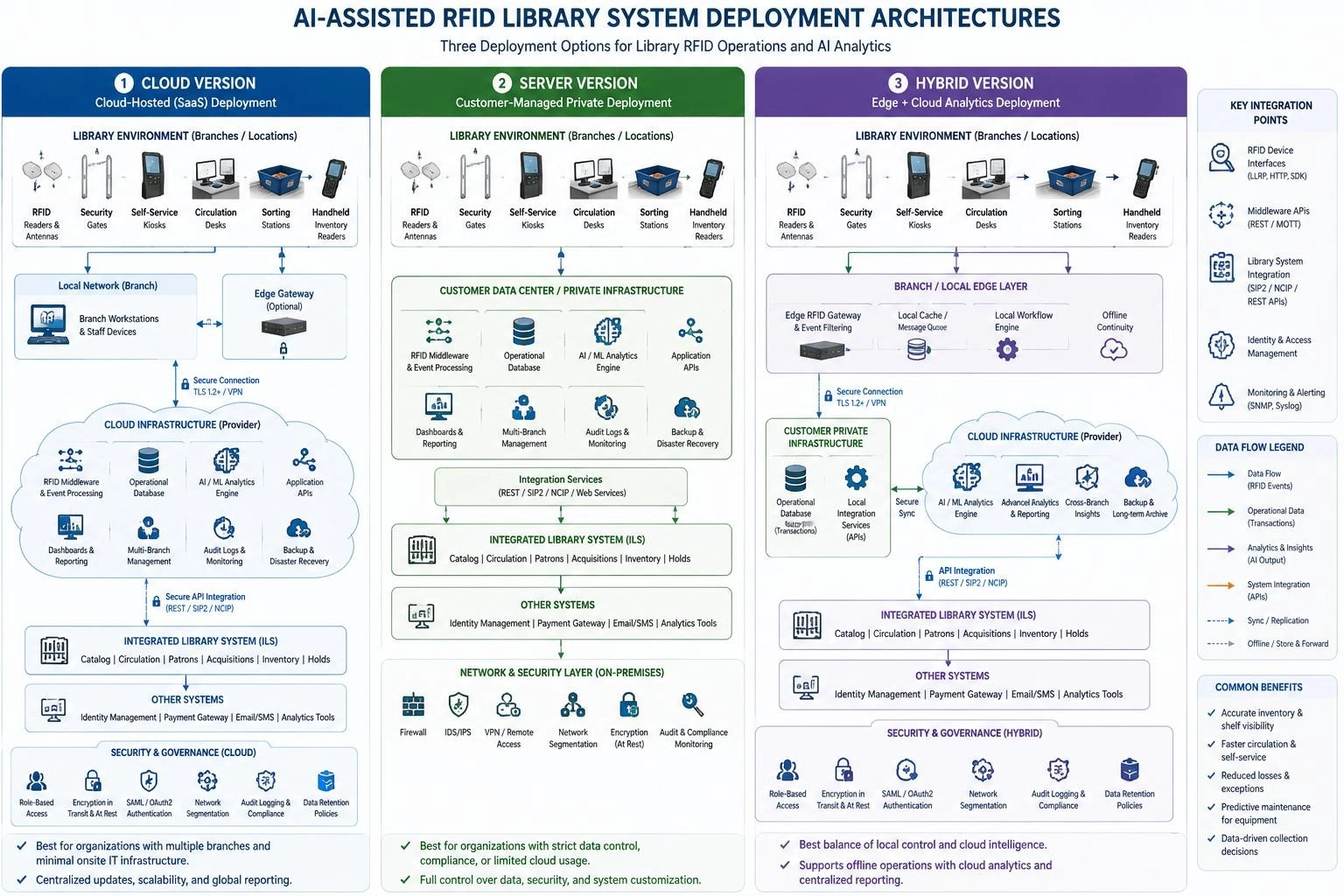
This deployment diagram compares cloud-hosted, customer-managed server, and hybrid approaches for AI-assisted RFID library operations. It shows how RFID readers, security gates, self-service kiosks, circulation desks, and handheld inventory devices connect to RFID processing, library management software, AI analytics, databases, APIs, and security controls under each deployment model.
Engineering Considerations Before Library RFID Deployment
Successful library deployments depend heavily on physical and software engineering decisions made before installation.
- Perform an RFID site survey before selecting reader quantities, antenna locations, and tag types.
- Test RFID performance on actual books, magazines, DVDs, boxed media, equipment, and other representative collection materials.
- Evaluate shelving density because tightly packed items can produce different read behavior from isolated tags.
- Test read zones around circulation desks and security gates to prevent unintended identification of nearby items.
- Establish tag-to-item mapping procedures before mass tagging or tag replacement.
- Define authoritative data ownership between RFID middleware, AI software, and the integrated library system.
- Separate operational RFID identifiers from personally identifiable patron information wherever practical.
- Establish event-retention periods appropriate to the library’s privacy and records-management requirements.
- Validate API behavior and transaction handling before connecting automated RFID events to production circulation records.
- Test ofline behavior for handheld inventory devices, branch connectivity, and server or cloud outages.
- Use role-based access control for staff dashboards, configuration tools, inventory data, and administrative functions.
- Monitor reader health, antenna performance, network connectivity, application errors, and unusual event volumes.
- Commission the system using representative library workflows rather than testing only individual RFID devices.
- Establish procedures for damaged tags, unreadable items, duplicate identifiers, reader failures, and incorrect location data.
- Train circulation and collection-management staff on exception handling rather than expecting RFID automation to eliminate human verification.
Realistic UHF RFID Shelf Inventory Deployment in a University Library
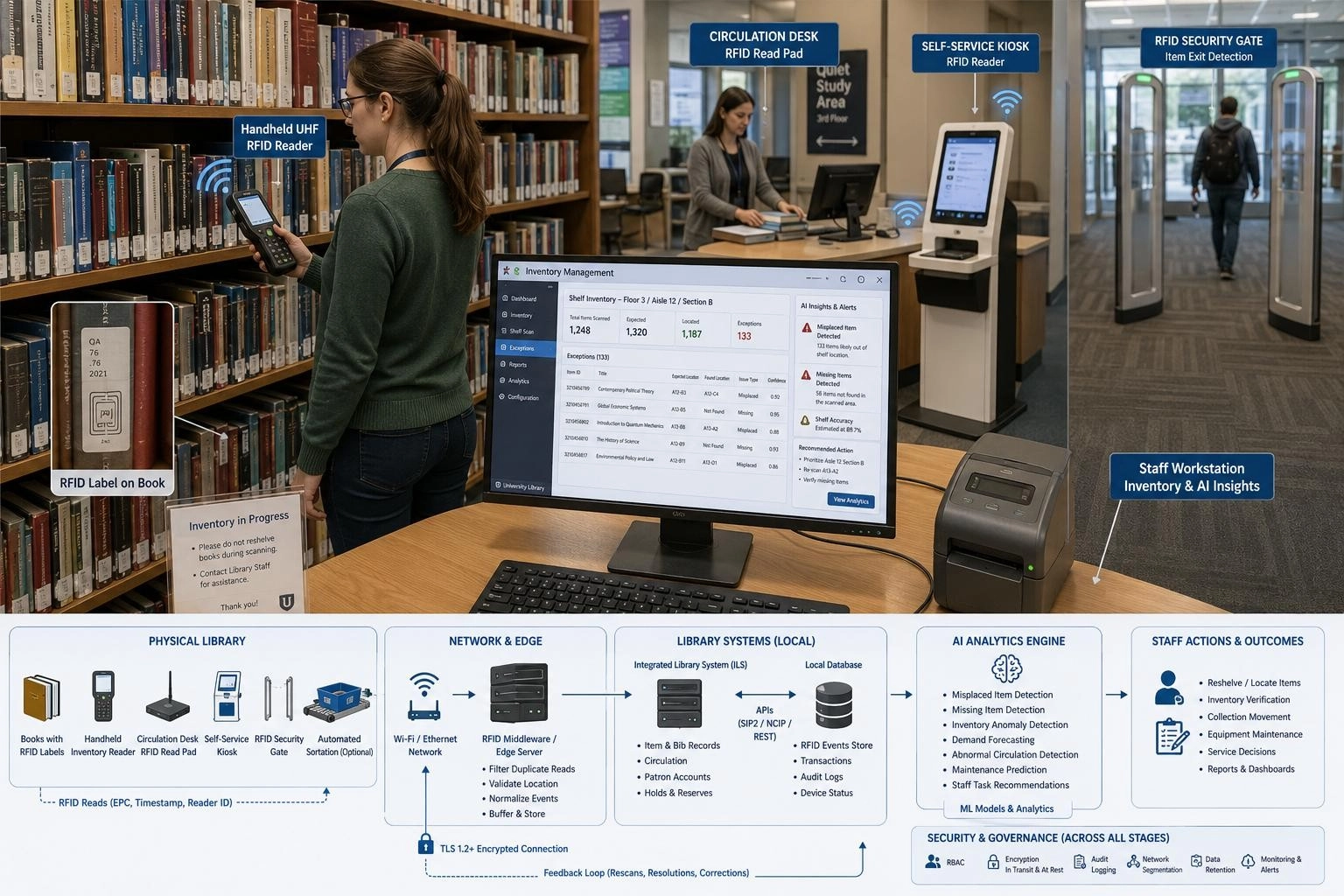
This visual shows a librarian using a handheld UHF RFID reader to scan tagged books during shelf inventory in a university library. It also depicts RFID-enabled circulation and self-service equipment, security gates, library inventory software, AI-generated shelf exceptions, and the connected workflow from RFID data capture through staff actions.
AI Capabilities That Improve Library Operations
AI becomes most useful after a library has established reliable item identity, transaction data, and location information. The objective is not to replace established library workflows, but to make operational data more actionable.
Intelligent Inventory and Mis-Shelving Detection
Traditional inventory processes can identify whether an item is present, but they often require staff to interpret exceptions manually. AI can compare RFID inventory events with expected shelf locations, item circulation status, neighboring item sequences, and historical movement patterns.
A library can use this analysis to prioritize shelves or collections that are most likely to contain discrepancies. Rather than generating an undifferentiated list of thousands of exceptions, the software can rank anomalies according to confidence, operational impact, and collection priority.
This is particularly useful for large academic libraries, public library branches, and research collections where staff time is limited and a small number of misplaced items can remain difficult to locate.
Demand Forecasting and Collection Utilization
Circulation records provide a strong source of operational information for AI models. Models can analyze historical checkouts, renewals, seasonal demand, course schedules where available, branch-level activity, subject categories, and item availability.
Combined with RFID-based physical inventory data, AI can distinguish between an item that is genuinely unavailable and one that exists in the collection but is incorrectly located or undergoing an unrecorded movement. Demand forecasting can support:
- Collection planning and purchasing decisions
- Branch-to-branch item transfers
- Reserve collection preparation
- Identification of frequently requested materials
- Staffing decisions during high-volume circulation periods
- Identification of underutilized collections
- Prioritization of inventory verification
- Evaluation of self-service circulation capacity
AI recommendations should remain subject to collection-development policies and professional judgment. Forecasting is an aid to decision-making rather than a replacement for librarianship.
Exception Detection
Rules are effective for straightforward conditions such as “item not detected” or “item checked in.” AI becomes more valuable when multiple variables interact.
A model could identify an unusual pattern involving an item repeatedly detected outside its expected location, frequent transfers between branches, unusually long processing intervals, or a mismatch between circulation and physical inventory events.
The system can then create an exception for staff review.
Predictive Maintenance for Library Equipment
AI can also be applied beyond collection management. RFID readers, self-service kiosks, automated sorting equipment, printers, conveyors, scanners, and related infrastructure generate operational telemetry.
Models can analyze error frequency, device availability, transaction latency, reader performance, and service history to identify equipment that may require inspection.
Predictive maintenance is especially valuable where a failed circulation station or sorter can create queues and increase manual processing.
Technical Performance and Business Value
The measurable value of AI-assisted RFID for libraries comes from connecting physical collection visibility with operational software and decision support.
| Capability | Operational Effect | Why It Matters |
|---|---|---|
| Automated RFID identification | Reduces manual item scanning | Staff can process larger collections with less repetitive handling |
| Shelf inventory automation | Accelerates collection verification | More frequent inventory cycles become practical |
| AI anomaly detection | Prioritizes unusual item and location events | Staff focus on exceptions with greater operational impact |
| Demand forecasting | Improves visibility into future collection demand | Supports better allocation and acquisition decisions |
| Automated check-in | Reduces repetitive circulation work | Shortens processing time and supports higher transaction volumes |
| RFID security monitoring | Provides item-level exit events | Supports loss investigation and collection protection |
| Equipment telemetry | Detects abnormal device behavior | Helps reduce unexpected service interruptions |
| Centralized analytics | Combines operational information | Supports branch, collection, and management decisions |
The benefits depend on data quality. A poorly installed RFID system can produce incomplete reads, false positives, duplicate events, or incorrect location information. AI cannot reliably compensate for systematically defective source data.
For that reason, library RFID projects should measure read accuracy, exception accuracy, transaction latency, system availability, inventory completion time, and false-alert rates alongside traditional operational KPIs.
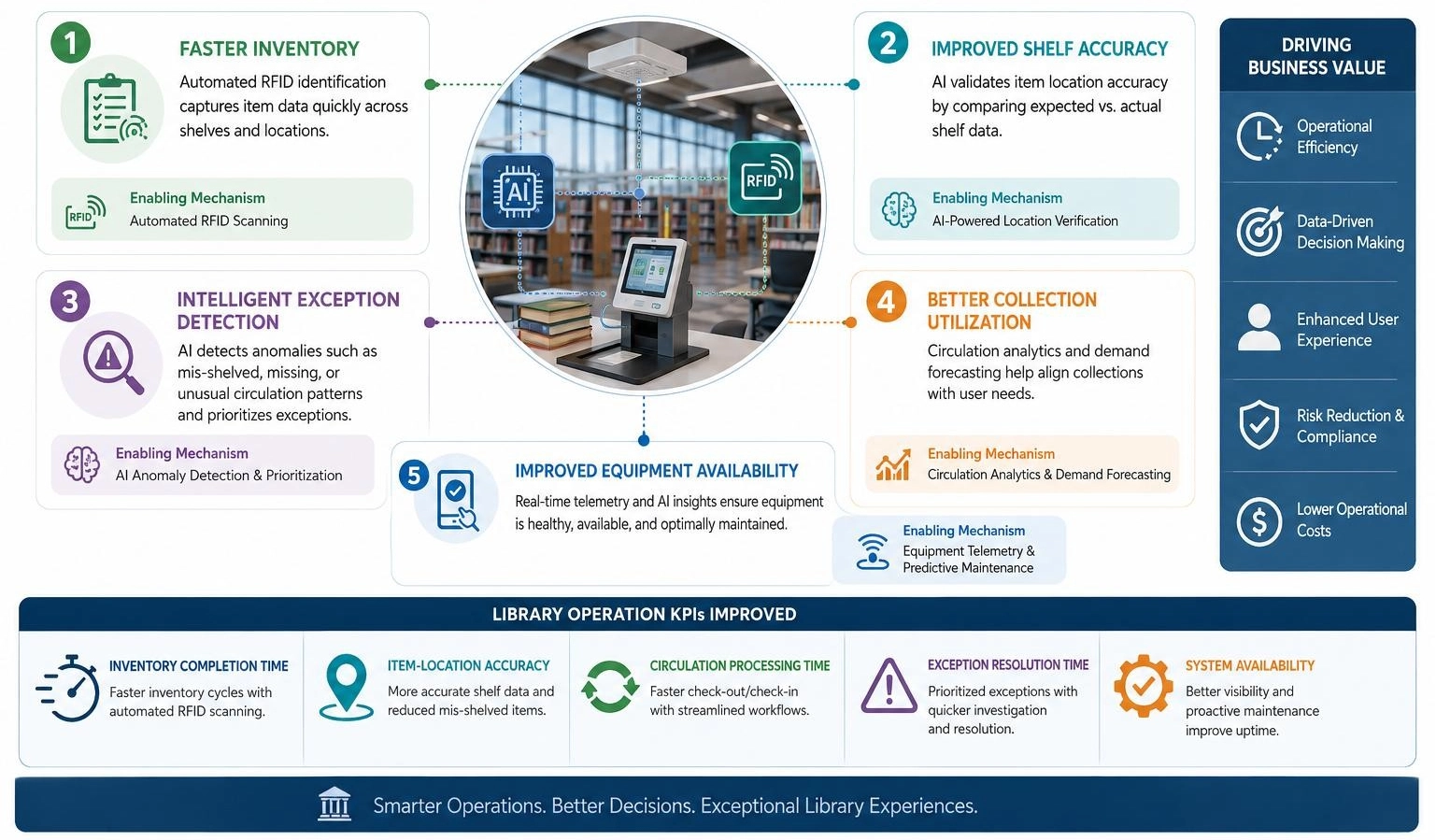
AI-Assisted RFID Benefits for Library Operations: Efficiency, Accuracy, and Equipment Availability
This infographic illustrates five key operational benefits of AI-assisted RFID in modern libraries: faster inventory, improved shelf accuracy, intelligent exception detection, better collection utilization, and improved equipment availability. It connects each benefit to enabling technologies such as automated RFID identification, AI anomaly detection, circulation analytics, demand forecasting, and equipment telemetry.
Library KPIs for AI and RFID Performance
Libraries should define measurable performance indicators before deployment so that the technology can be evaluated against operational objectives.
Useful KPIs include:
- Inventory completion time per collection or branch
- Item-location accuracy
- RFID read success rate
- Missed-read rate
- False-read rate
- Duplicate RFID event rate
- Check-in transaction time
- Check-out transaction time
- Self-service transaction completion rate
- Automated sorting accuracy
- Mis-shelved item detection rate
- Missing-item resolution time
- Inventory discrepancy resolution time
- Item transfer processing time
- Branch transfer cycle time
- Circulation volume per staff hour
- Staff time spent on manual inventory
- Collection utilization rate
- Item availability rate
- High-demand item fulfillment rate
- RFID reader availability
- Self-service kiosk availability
- Automated sorter availability
- RFID middleware uptime
- AI alert precision
- AI alert false-positive rate
- AI recommendation acceptance rate
- Mean time to resolve equipment failures
- Network and application transaction latency
- Security-event investigation time
KPIs should be measured against a baseline established before implementation. A reduction in manual scanning time is useful, but libraries should also examine whether more frequent inventories improve item availability and whether AI-generated exceptions actually lead to faster resolution.
Security, Privacy, and Data Governance
Library environments require careful treatment of patron information. RFID identifies physical items, but circulation records can connect those items to individuals. A technically capable implementation therefore needs a deliberate separation between item telemetry and personally identifiable information.
Recommended controls include:
- Use unique technical identities for RFID devices and software services.
- Apply role-based access control to circulation, inventory, administration, and analytics functions.
- Encrypt sensitive data during network transmission and when stored.
- Maintain audit logs for administrative changes, privileged access, and significant automated actions.
- Minimize the transfer of patron identifiers into AI analytics where aggregated data are sufficient.
- Define retention periods for RFID events and analytical records.
- Segment RFID devices and operational equipment from general-purpose user networks where appropriate.
- Secure APIs with authentication, authorization, certificate-based controls, or other mechanisms appropriate to the environment.
- Maintain software and firmware patching procedures for readers, gateways, servers, and workstations.
- Monitor unusual authentication attempts and abnormal device behavior.
- Restrict administrative configuration of reader power, antenna settings, and event-processing rules.
- Validate third-party integrations before allowing production access to library records.
AI introduces an additional governance requirement. Libraries should know which data are used for model training, which information is retained for inference, and whether outputs can expose sensitive operational or patron information.
A human review process should be retained for decisions involving patron accounts, sensitive collections, disputed records, and other high-impact exceptions.
Interoperability with Library Software
RFID deployments frequently coexist with an established integrated library system rather than replacing it. This makes interoperability one of the most important engineering considerations.
A typical integration may involve RFID middleware between physical readers and library software. The middleware can translate reader-specific events, filter repeated reads, validate device locations, and expose normalized events to downstream applications.
Common library interoperability technologies may include SIP2 and NCIP, alongside REST APIs, database interfaces, and vendor-specific integration methods.
The correct interface depends on the existing library software and its supported capabilities. The implementation team should document:
- Item identifier relationships
- Circulation transaction states
- Check-in and check-out workflows
- Location and branch codes
- Item status values
- RFID event formats
- Error and retry behavior
- API authentication
- Event timestamps
- Duplicate-event handling
- Ofline transaction behavior
- Data synchronization rules
A key implementation principle is to avoid allowing multiple applications to become competing sources of truth. The library management system should remain authoritative for appropriate bibliographic and circulation records, while RFID middleware manages device events and AI software provides analytics and recommendations.
Implementation Lifecycle for Library AI and RFID Systems
Requirements and Site Assessment
The project should begin with a workflow analysis rather than an RFID hardware order.
Teams should document circulation volumes, collection sizes, shelving layouts, branch connectivity, self-service requirements, automated sorting equipment, existing library software, network infrastructure, privacy requirements, and staffing workflows.
A physical site survey should evaluate shelf construction, reader placement, electromagnetic conditions, circulation-desk layout, security-gate positioning, and locations where unintended reads could occur.
RFID Selection and Proof of Concept
RFID tag and reader selection should be based on actual library materials and operating conditions. A proof of concept should include representative books, magazines, media cases, equipment, shelving, circulation stations, and inventory workflows.
Testing should measure read performance rather than relying only on manufacturer specifications.
For handheld inventory, the evaluation should examine read consistency while a staff member moves through realistic aisles. For circulation stations, testing should determine whether the desired item is reliably identified without reading adjacent items.
Integration and Data Validation
The next stage connects RFID middleware with library software and establishes item mappings. Test data should remain separated from production records until transaction behavior has been validated.
AI models should initially operate in an observation or recommendation mode. This allows the library to compare model outputs with librarian decisions before enabling automated actions.
Commissioning and Acceptance Testing
Acceptance testing should cover complete workflows rather than isolated components. Examples include:
- Tagging an item and associating it with the correct record
- Checking the item out through an RFID-enabled station
- Returning the item through automated check-in
- Detecting the item during shelf inventory
- Moving the item between locations
- Generating an inventory exception
- Resolving a misplaced-item alert
- Handling an unreadable or damaged RFID tag
- Operating during temporary network loss
- Recovering from reader or server failure
- Recording administrative changes in audit logs
Performance acceptance criteria should be defined before testing begins.
Optimization and Ongoing Maintenance
RFID deployments should be monitored after commissioning because library environments change. Shelving layouts, collection density, circulation furniture, equipment, network conditions, and software integrations may all change over time.
Maintenance should include reader health monitoring, firmware management, antenna inspection, tag replacement procedures, software updates, API monitoring, backup verification, and periodic AI model evaluation.
AI models should also be monitored for changes in data distributions. A model trained on historical circulation behavior may become less accurate when branch policies, collection strategies, opening hours, or patron behavior change.
AI-Assisted RFID Library System Implementation Lifecycle: From Planning to Continuous Optimization
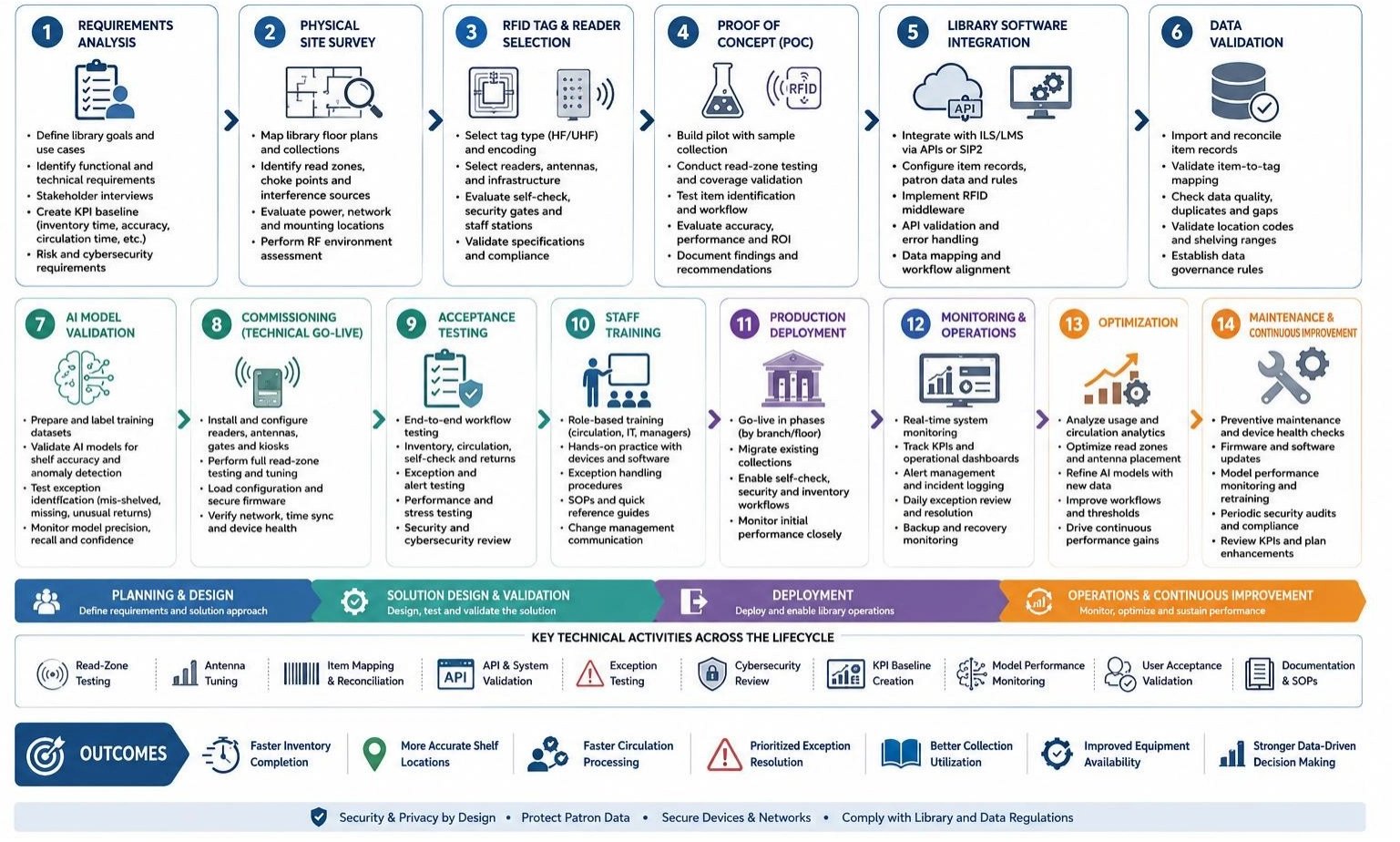
This lifecycle infographic visualizes the practical implementation of an AI-assisted RFID system across 14 sequential stages, from requirements analysis and physical site surveying to deployment, monitoring, optimization, and maintenance. It highlights key technical activities including read-zone testing, API validation, item mapping, exception testing, cybersecurity review, KPI baselining, and AI model performance monitoring.
Scaling from One Library to a Multi-Branch System
Scaling an RFID deployment requires more than installing additional readers. Each branch may have different shelving layouts, network conditions, collection sizes, circulation volumes, and equipment.
A scalable implementation should standardize core data structures while allowing controlled site-specific configuration.
Important scaling considerations include:
- Consistent RFID tag identification and item-mapping rules
- Standard reader configuration templates
- Centralized device inventory
- Branch-specific reader and antenna profiles
- Common API and integration conventions
- Centralized monitoring of reader health and software availability
- Consistent cybersecurity policies
- Controlled software and firmware updates
- Common KPI definitions across branches
- Centralized AI model governance
- Local workflows for branch-specific exceptions
- Disaster recovery and backup procedures
- Capacity planning for RFID event volumes
A public library system may benefit from centralized analytics while retaining local operational processing at each branch. Academic institutions may prefer local server deployment where institutional policies require greater control over data and infrastructure.
Practical Design Trade-Offs for Libraries
No single RFID configuration is optimal for every library.
UHF RFID can provide advantages for rapid shelf inventory and larger read zones, but read-field control must be carefully engineered in dense shelving environments. HF RFID can provide more controlled short-range interactions at circulation stations, although it is less suited to some longer-range inventory applications.
Fixed readers can automate defined workflows but require careful antenna positioning and may increase installation complexity. Handheld readers offer operational flexibility and are particularly effective for shelf inventory, but they depend on staff movement and workflow discipline.
Cloud software can simplify centralized analytics and multi-branch management, while privately hosted server deployments can provide greater infrastructure control. A hybrid model may offer a practical compromise when libraries require local continuity with centralized analytics.
AI can prioritize exceptions and forecast demand, but model outputs should be evaluated against actual librarian decisions. Automation should be increased only when accuracy, explainability, and operational risk are understood.
These trade-offs should be documented during design review rather than discovered after production deployment.
GAO Expertise in RFID and Connected Library Solutions
GAO supplies RFID, BLE, and other IoT hardware products and systems that can support organizations implementing connected identification and asset-management workflows. Our experience supplying technology to organizations across North America provides practical context for projects where physical devices must operate reliably alongside software, networks, and operational processes.
Headquartered in New York City and Toronto, Canada, GAO is recognized among the leading global B2B and B2G suppliers of BLE and RFID technologies. GAO and its sister companies, GAO Research and GAO Tek, operate as part of GAO Group, with operations based in New York City and Toronto.
For three decades, GAO Group has served customers in the United States and Canada, including Fortune 500 companies, major research and development organizations, universities, and government agencies. This experience is relevant to library projects because successful RFID deployments require more than individual reader devices. They require appropriate hardware selection, integration planning, quality assurance, technical testing, and support throughout the operating lifecycle.
GAO has invested substantially in research and development and maintains stringent quality-assurance processes for its products and systems. Technical support can be provided remotely or onsite depending on project requirements.
AI-Assisted RFID Library Integration: Hardware, Software, Analytics, and Technical Support
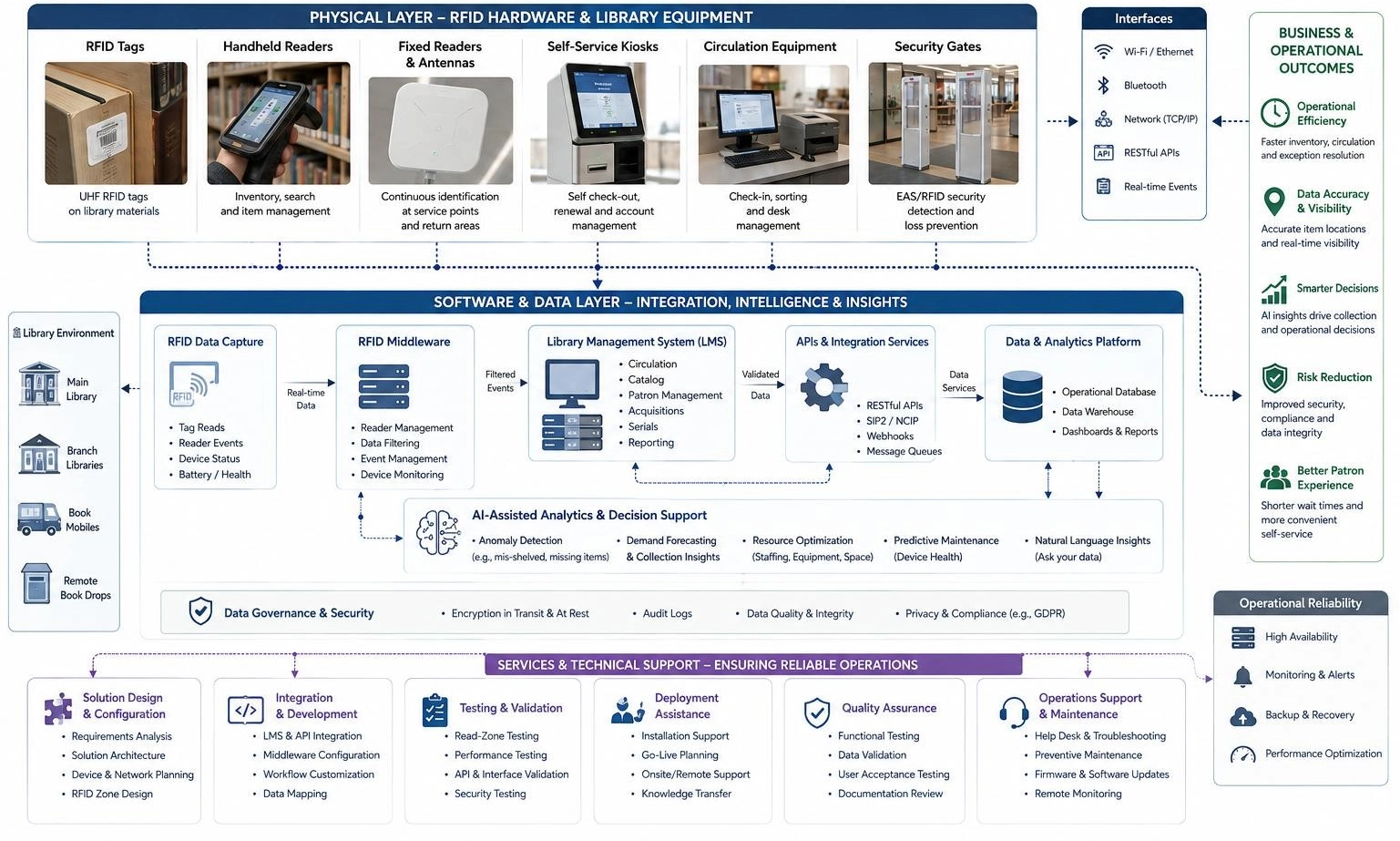
This technical integration illustration shows how RFID tags, readers, antennas, kiosks, circulation equipment, and security gates connect with RFID middleware, library management systems, APIs, databases, analytics, and AI-assisted decision support. It also highlights configuration, integration, testing, deployment assistance, quality assurance, troubleshooting, and maintenance as essential functions for reliable library operations.
Implementation Recommendations for AI-Powered Library Operations
A technically sound library deployment should follow several practical principles.
- Begin with operational problems such as inventory accuracy, circulation throughput, misplaced items, branch transfers, or equipment downtime rather than starting with a specific AI model.
- Establish a reliable RFID data layer before introducing complex machine learning.
- Select UHF, HF, or LF RFID according to the actual read environment and workflow.
- Validate tags and readers using representative library materials.
- Treat the integrated library system as the authoritative source for appropriate catalog and circulation records.
- Use middleware to filter and normalize RFID events before analytics.
- Introduce AI initially as a decision-support mechanism rather than unrestricted automation.
- Establish measurable baseline KPIs before deployment.
- Separate patron identity from physical asset analytics whenever individual-level information is unnecessary.
- Test privacy, cybersecurity, API, ofline, and failure-recovery behavior before production rollout.
- Use human review for high-impact or ambiguous AI recommendations.
- Monitor model precision and false-positive rates after deployment.
- Standardize configurations before expanding from one branch or building to multiple sites.
- Maintain documented procedures for damaged tags, reader failures, duplicate identifiers, and data synchronization errors.
- Reassess AI models and RFID performance when collection policies, physical layouts, or library software change.
Key Takeaways for Library Decision-Makers
AI-assisted RFID can move library operations beyond basic item identification by connecting physical collection visibility with intelligent analytics and workflow decisions. RFID supplies timely evidence about where tagged items are detected, while AI can interpret those events alongside circulation, inventory, equipment, and historical operational data.
The strongest implementations focus on measurable library outcomes: faster inventory, improved item-location accuracy, more efficient circulation, better exception handling, stronger equipment availability, and improved collection utilization.
Successful deployment depends on accurate RFID data, carefully engineered read zones, reliable library software integration, privacy-aware data governance, secure infrastructure, and disciplined AI validation.
Libraries evaluating these technologies should begin with a site assessment and workflow analysis, establish baseline KPIs, test representative RFID hardware, validate integration with existing library software, and introduce AI gradually through measurable operational use cases.
GAO can provide RFID, BLE, and IoT hardware products and systems, together with technical expertise relevant to deployment, integration, testing, and ongoing support. Organizations can learn more about GAO’s RFID solutions, engineering capabilities, and technical resources when evaluating AI-enabled library operations.
Building the Future of Industrial AI and IoT with Aperture Venture Studio and GAO RFID Inc.
For more than three decades, GAO Group of Companies has invested heavily in R&D of industrial RFID, BLE, and IoT. As generative AI has become increasingly useful in practical applications, we have continued developing AI and IoT technologies, including RFID and BLE, and have founded Aperture Venture Studio to support advanced AI and IoT solutions relevant to connected library operations and other industries.
Aperture has attracted AI and IoT technical experts, entrepreneurial and operational executives, influential investors, and leading companies. We have also developed the Aperture Ventures Summit and TekSummit to discuss advanced AI and IoT topics and foster technical communities.
We welcome you to join us as:
- Advisors, co-founders, or employees
- Investors
- Customers