
AI and RFID for Logging
AI-Powered Logging Operations and RFID-Enabled Timber Traceability
AI-powered logging combines machine learning, connected forestry equipment, sensors, computer vision, geospatial data, and RFID-supported identification to improve how timber, equipment, crews, and harvesting activities are monitored and managed. In logging operations, RFID primarily provides dependable identification at selected checkpoints, while AI analyzes operational, environmental, equipment, and supply-chain data to support better decisions.
Modern logging operations must coordinate harvest planning, road access, felling, processing, skidding, forwarding, loading, timber transport, log scaling, chain-of-custody records, and delivery to sawmills or wood-processing facilities. These activities often occur across remote forest locations where connectivity, weather, terrain, equipment utilization, and worker safety create significant operational challenges.
AI helps transform fragmented field data into forecasts, anomaly detection, optimization recommendations, and operational insights. RFID can strengthen identification and traceability for selected timber loads, equipment, tools, containers, and reusable assets. GAO supplies RFID, BLE, and IoT hardware products and systems that can support connected logging and forestry operations.
AI, RFID, and Connected Equipment in Modern Logging Operations
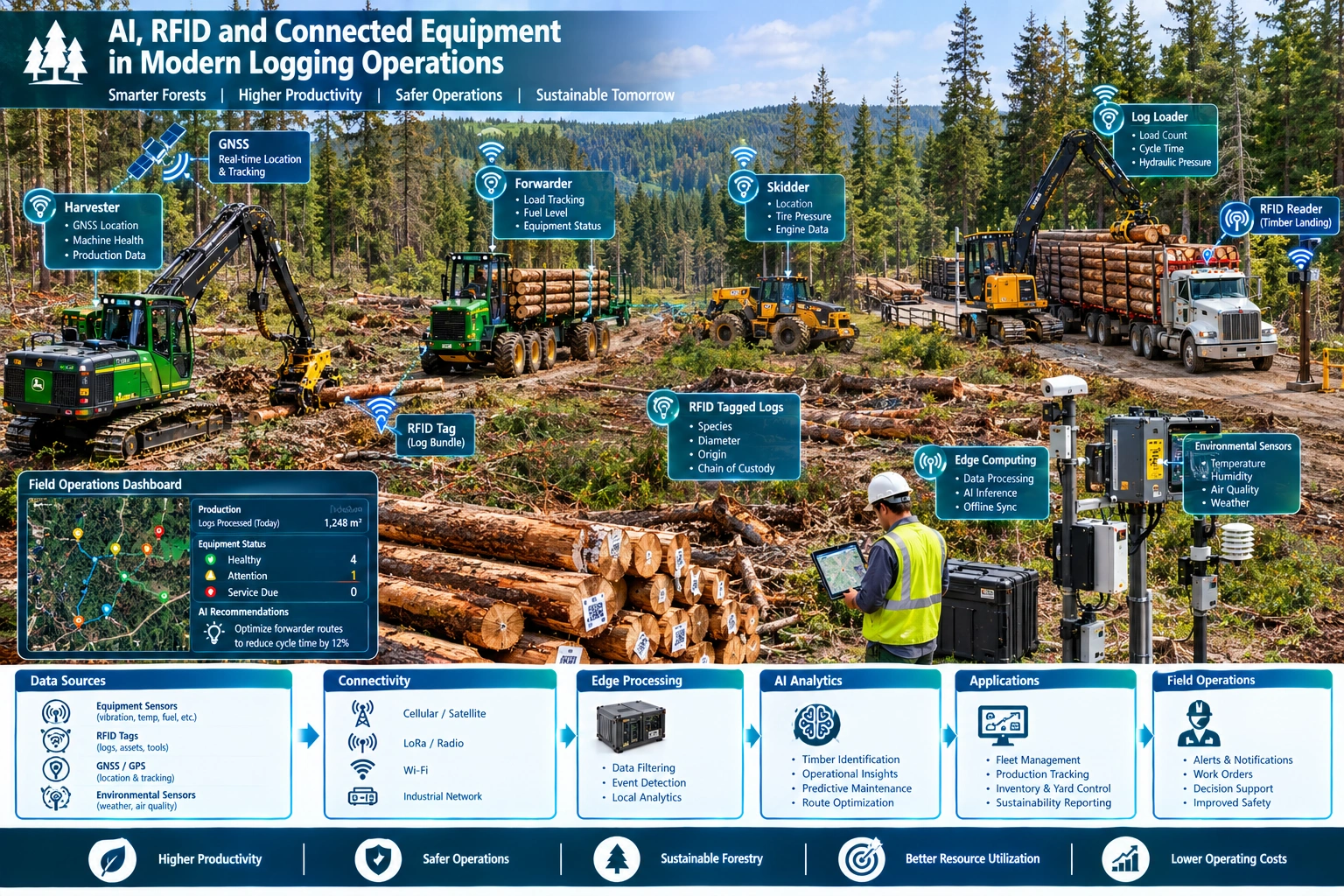
This visual depicts a realistic managed-forest logging operation with harvesters, forwarders, skidders, log loaders, and timber trucks. RFID-tagged assets, GNSS-enabled equipment, environmental sensors, and edge computing provide operational data for AI-supported production tracking, equipment monitoring, timber identification, and field decisions.
Understanding AI-Enabled RFID Systems in Logging
RFID Supports Identification at Critical Logging Checkpoints
Logging operations require accurate identification of physical assets and selected timber movements. RFID can support identification workflows where barcodes may be difficult to scan because of mud, moisture, weather exposure, equipment vibration, or the need for non-line-of-sight reading.
Depending on the use case, UHF RFID, HF RFID, and LF RFID may be used for reusable forestry assets, equipment identification, maintenance tools, timber-load identification, containers, transport equipment, and controlled operational checkpoints.
Logging environments require careful engineering because RFID performance can be affected by:
- Moisture and wet timber
- Rough terrain
- Tag mounting conditions
- Mechanical impact
- Long read distances
- Dense timber stacking
- Metal equipment
- Harsh weather
- Reader installation constraints
- Vehicle movement speed
RFID should therefore be selected according to a specific logging workflow rather than being treated as a universal solution for tracking every individual tree or log.
AI Converts Forestry and Logging Data into Operational Intelligence
Artificial Intelligence of Things, commonly called AIoT or AI and IoT, combines artificial intelligence with IoT devices, connected equipment, sensors, and industrial systems. In logging, AIoT can combine Industrial AI, Edge AI, machine learning, computer vision, geospatial analytics, and connected forestry machinery.
AI models can analyze RFID events together with data from:
- GNSS receivers
- Harvester production computers
- Telematics systems
- Fuel monitoring systems
- Engine diagnostics
- Hydraulic pressure sensors
- Weather stations
- Terrain and elevation data
- Drone imagery
- Computer vision systems
- Forest inventory databases
- Timber transportation records
This combination enables AI to interpret operational conditions rather than simply recording equipment or timber movements.
For example, an AI system can identify whether a timber load is following the planned route, whether equipment utilization is declining, whether fuel consumption is abnormal, whether a harvesting area is producing less timber than forecast, or whether maintenance indicators suggest a developing equipment problem.
Why AI and RFID Matter for Modern Logging
Logging operations are highly variable. Terrain, weather, tree species, stem diameter, stand density, road conditions, harvesting methods, machine availability, fuel consumption, and transport capacity can all influence production performance.
Traditional reporting may provide information after a shift or after timber reaches a landing or mill. AI allows field data to be analyzed more quickly, helping supervisors identify changes during active operations.
RFID contributes identification and event data at selected points, while AI provides the analytical layer needed to understand patterns and recommend actions.
GAO has supported organizations by supplying RFID and IoT hardware products and systems for applications requiring dependable identification, asset visibility, and connected operational data.
High-Value AI Applications in Logging Operations
AI Timber Tracking and Chain-of-Custody Management
Timber traceability is a major operational requirement for logging companies, landowners, forestry contractors, transport operators, and wood-processing facilities.
AI can combine harvest records, timber-load information, RFID events, GNSS data, transport records, and delivery information to improve chain-of-custody visibility.
Relevant applications include:
- Timber-load identification
- Harvest-block tracking
- Load reconciliation
- Landing inventory monitoring
- Truck dispatch analysis
- Delivery verification
- Route deviation detection
- Timber movement forecasting
RFID can support controlled identification points at landings, loading areas, weigh stations, storage yards, and receiving facilities. The AI system can then compare actual movement events with planned harvesting and transport activities.
AI Harvest Planning and Production Forecasting
Harvest planning requires analysis of forest inventory, stand characteristics, terrain, road access, environmental restrictions, equipment capacity, and production targets.
AI can analyze historical production data together with forestry inventory information to support forecasts for:
- Harvest volume
- Machine productivity
- Equipment requirements
- Fuel consumption
- Hauling capacity
- Harvest completion time
- Landing capacity
- Road utilization
AI-assisted planning does not replace professional forestry judgment. Instead, it can help forestry managers evaluate multiple variables and identify patterns that affect operational outcomes.
AI Equipment Management and Predictive Maintenance
Logging equipment operates under demanding conditions involving vibration, shock, hydraulic loading, dust, mud, temperature changes, and uneven terrain.
Critical equipment may include:
- Harvesters
- Feller bunchers
- Skidders
- Forwarders
- Log loaders
- Delimbers
- Processors
- Chippers
- Forestry trucks
AI-driven predictive maintenance can analyze machine telemetry and condition data to identify potential problems before equipment failure interrupts harvesting operations.
Relevant data sources include:
- Engine diagnostics
- Hydraulic pressure
- Hydraulic oil temperature
- Vibration data
- Fuel consumption
- Operating hours
- Fault codes
- Lubrication information
- Maintenance history
- Production load
RFID can support maintenance workflows by identifying tools, replacement components, inspection equipment, and selected assets used by maintenance crews.
AI-Driven Predictive Maintenance for Logging Operations
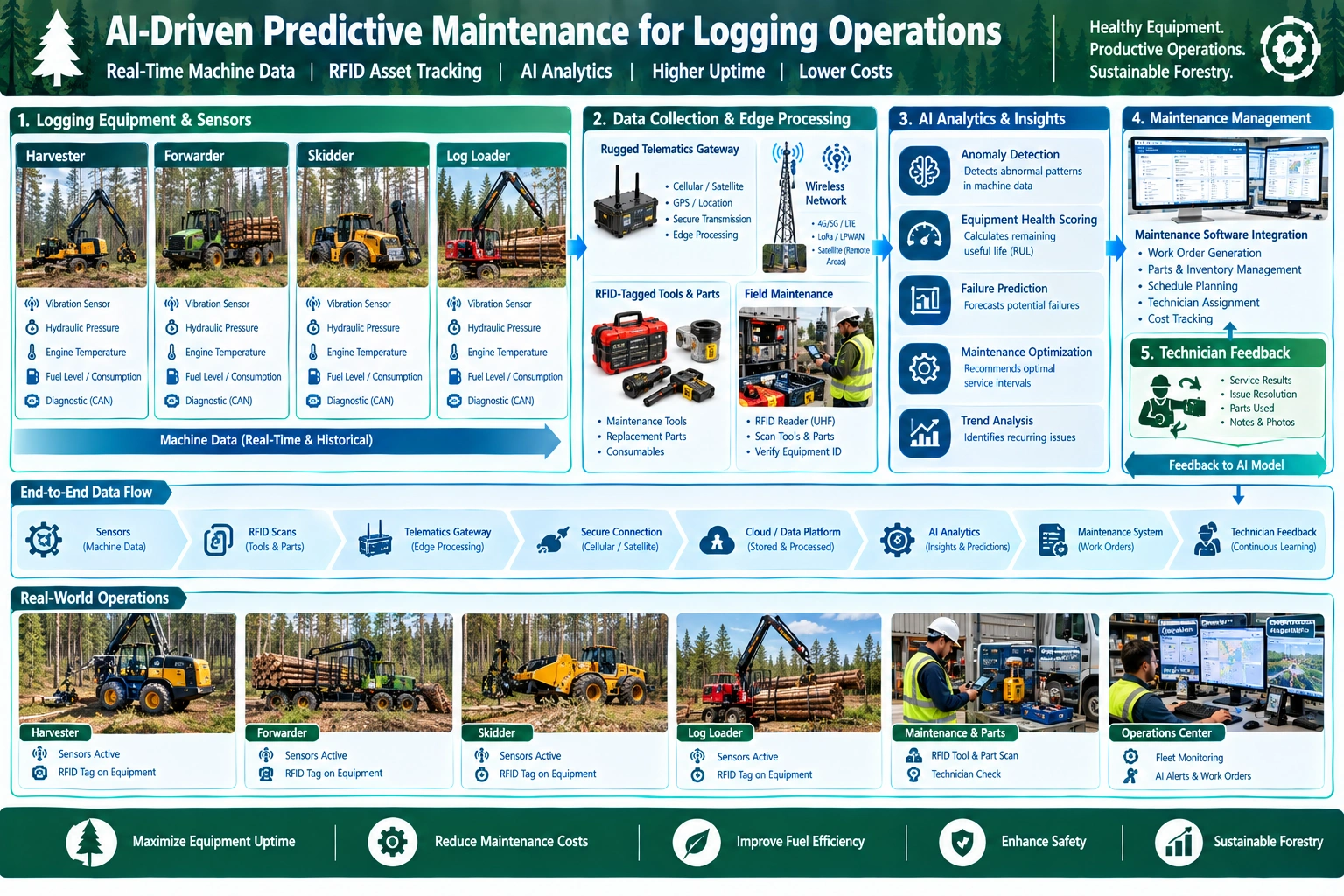
This workflow diagram shows harvesters, forwarders, skidders, and log loaders sending sensor and telematics data through edge processing into AI analytics. It connects RFID-tagged tools and parts with maintenance software, predictive alerts, work orders, and technician feedback to improve equipment uptime and operational efficiency.
AI Logging Fleet Optimization
Forestry equipment and transport fleets must operate efficiently across changing harvesting blocks and remote locations.
AI can analyze:
- Equipment utilization
- Idle time
- Travel distance
- Fuel consumption
- Harvest production
- Operator shift data
- Truck availability
- Landing inventory
- Road conditions
This information can help supervisors identify whether production delays are caused by equipment availability, excessive travel, loading constraints, transport shortages, or changing forest conditions.
AI can support recommendations for:
- Equipment allocation
- Truck dispatching
- Harvest sequence
- Landing management
- Fuel planning
- Maintenance scheduling
AI Safety and Hazard Monitoring
Logging is a high-risk operational environment. AI and connected sensing technologies can support safety monitoring by identifying selected operational hazards and unusual conditions.
Depending on the deployment, AI can analyze:
- Equipment proximity
- Restricted-area entry
- Vehicle movement
- Operator fatigue indicators where appropriately governed
- Hazardous weather
- Road conditions
- Equipment alarms
- Communication loss
Computer vision and proximity technologies may provide additional information for safety systems. Any AI-supported safety solution should complement established forestry safety procedures and should not replace mandatory training, equipment safeguards, or regulatory requirements.
AI Environmental and Operational Compliance Monitoring
Logging operations may be subject to requirements involving harvest boundaries, protected areas, watercourses, road access, environmental conditions, and timber documentation.
AI can combine GIS information, GNSS data, drone imagery, and operational records to identify potential deviations requiring review.
Applications may include:
- Harvest-boundary monitoring
- Road-use analysis
- Sensitive-area proximity alerts
- Environmental condition monitoring
- Timber documentation analysis
- Operational exception reporting
AI recommendations should be reviewed by qualified forestry and environmental personnel where regulatory or compliance decisions are involved.
The Logging Data-to-Decision Workflow
An effective AI-enabled logging system should connect field data to practical operational decisions. The workflow must account for remote connectivity, equipment movement, weather conditions, and intermittent communications.
Data Acquisition in Forest Operations
Data acquisition begins with forestry machinery, timber-handling operations, field sensors, and identification points.
Typical data sources include:
- RFID readers and antennas
- UHF, HF, or LF RFID tags
- GNSS equipment
- Forestry-machine telematics
- Engine control systems
- CAN bus data
- Hydraulic sensors
- Fuel sensors
- Weather stations
- Rugged cameras
- Drone imagery
- Road-condition sensors
- Machine fault logs
- Operator-entered production records
Each source should support a defined operational objective. Excessive data collection without a specific harvesting, maintenance, safety, or timber-traceability purpose can increase communication and storage costs.
Communication Infrastructure for Remote Logging Sites
Connectivity is one of the most significant engineering challenges in logging operations.
Depending on site conditions, communication infrastructure may include:
- Cellular networks
- Private LTE or 5G
- Satellite communications
- Industrial Wi-Fi at fixed landings
- Long-range wireless systems
- Vehicle telematics gateways
- Store-and-forward edge communication
Protocols and interfaces may include:
- MQTT
- HTTPS
- REST APIs
- OPC UA
- CAN bus gateways
- SQL connectors
- Forestry equipment APIs
Remote systems should be designed to tolerate intermittent connectivity. Critical field data can be temporarily stored on rugged edge devices and synchronized when communications become available.
Edge Processing in Remote Forestry Operations
Edge computing is particularly valuable in logging because harvesting operations may occur far from dependable network infrastructure.
Rugged edge computers can process selected data locally and perform functions such as:
- RFID event filtering
- GNSS data processing
- Equipment anomaly detection
- Local machine-learning inference
- Sensor-data normalization
- Temporary data storage
- Camera analysis
- Communication buffering
Edge AI enables time-sensitive analysis without requiring every raw sensor or image stream to be transmitted immediately to centralized software.
AI Analytics and Operational Decision-Making
Once field data is collected and normalized, AI models can evaluate equipment performance, timber movement, production trends, and operational exceptions.
AI may perform:
- Time-series forecasting
- Equipment anomaly detection
- Production prediction
- Route optimization
- Inventory forecasting
- Computer vision analysis
- Geospatial pattern detection
- Maintenance prioritization
AI results should be connected to practical field actions.
Examples include:
- Dispatch additional hauling capacity.
- Inspect equipment showing abnormal hydraulic behavior.
- Review unexpected route deviations.
- Adjust harvesting sequences.
- Investigate declining machine productivity.
- Reconcile a timber-load exception.
- Schedule maintenance before equipment availability is affected.
The most effective deployments clearly identify who receives the AI recommendation and what operational action should follow.
Integration with Forestry and Business Software
Logging data can become more useful when connected to existing operational and business systems.
Integration may include:
- Forestry management software
- Harvest planning systems
- GIS software
- Fleet management software
- Equipment telematics systems
- Maintenance management software
- ERP software
- Timber inventory systems
- Transportation management software
- Business intelligence software
Integration should use documented APIs and controlled data interfaces where possible. Forestry operations should avoid unnecessary changes to critical equipment-control systems.
RFID, AI Models, Software, and Deployment Components for Logging
AI-enabled logging solutions require coordinated field hardware, communications, software, cybersecurity controls, and analytical systems. Technology selection should be based on terrain, operational scale, connectivity, and the specific logging problem being addressed.
RFID Hardware for Forestry and Logging Environments
RFID hardware selection should begin with the identification requirement and environmental conditions.
UHF RFID may be suitable for longer-range identification at controlled timber landings, loading checkpoints, vehicle portals, equipment zones, and asset-management locations. HF RFID may be appropriate for close-range identification of tools or equipment where controlled scanning is required. LF RFID can support specialized short-range identification requirements where environmental conditions and existing systems make it appropriate.
A field survey should evaluate:
- Required read range
- Tag attachment methods
- Timber moisture
- Reader installation locations
- Vehicle speed
- Dense log stacking
- Metal interference
- Weather exposure
- Mechanical shock
- Power availability
GAO can provide RFID readers, antennas, tags, and supporting IoT hardware selected according to defined forestry and logging requirements.
AI Models for Logging Operations
Different logging applications require different AI approaches.
Predictive maintenance may use anomaly detection, regression, classification, and time-series models. Harvest forecasting may use predictive analytics and geospatial data models. Computer vision can analyze imagery from cameras or drones. Optimization algorithms can support fleet allocation and transport planning.
Models should be trained and validated using representative logging conditions. A model developed from controlled data may perform differently when exposed to changing weather, terrain, vegetation, machine vibration, dust, or inconsistent communications.
Cloud Version
The Cloud Version uses cloud-hosted software managed within cloud infrastructure. Processed field data can be transmitted from logging equipment, telematics gateways, or edge devices to centralized software.
This deployment model may be appropriate when:
- Multiple harvesting operations require centralized visibility.
- Forestry managers need multi-region reporting.
- Historical data is used for centralized AI analysis.
- Remote operational teams require controlled access.
- IT teams prefer managed infrastructure.
Cloud systems should use encrypted communications, access controls, identity management, audit logging, data backups, and defined retention policies. High-volume imagery may be processed at the edge before selected results are transmitted.
Server Version
The Server Version deploys software on customer-managed servers, private data centers, edge servers, forestry operation centers, or other privately hosted infrastructure.
This model may be appropriate when:
- Connectivity is unreliable.
- Local processing is operationally important.
- Data-control requirements limit external hosting.
- Existing forestry software is privately hosted.
- High-volume sensor or imagery data requires local processing.
Server deployments require clear responsibilities for software patching, backup management, cybersecurity monitoring, capacity planning, and disaster recovery.
Security and Supporting Infrastructure
Logging systems often combine remote field equipment with business software, making cybersecurity and device management important.
Recommended controls include:
- Network segmentation where applicable
- Encrypted communications
- Device identity management
- Role-based access control
- Multi-factor authentication for remote administration
- Secure gateway configuration
- Software patch management
- Centralized security logging
- Backup and recovery procedures
- Restricted remote access
- Monitoring for communication anomalies
Security controls should not prevent essential forestry operations from continuing when cloud services or communications are temporarily unavailable.
Key Technical Capabilities and Business Value for AI-Enabled Logging
AI applications supported by RFID, machine telematics, GNSS, sensors, geospatial data, and connected forestry equipment can improve decision-making across timber harvesting, fleet management, maintenance, transportation, and chain-of-custody operations.
The greatest value is achieved when each technology component supports a clearly defined logging problem rather than collecting operational data without a specific decision or performance objective.
Improved Timber Traceability and Chain-of-Custody Visibility
Logging operations involve multiple transfers between harvest blocks, extraction routes, timber landings, loading areas, logging trucks, weigh stations, storage yards, and receiving facilities.
RFID-supported identification at selected checkpoints can provide reliable movement and asset events. AI can combine those events with harvesting records, GNSS data, load documentation, transport schedules, and receiving records to identify exceptions.
Potential improvements include:
- Better visibility into timber loads
- Faster reconciliation of load records
- Improved landing inventory awareness
- Identification of unexpected movement events
- Reduced manual record verification
- Improved delivery tracking
- Faster investigation of timber discrepancies
The value is created when physical identification events are connected to operational context. A logging supervisor can investigate why a load was delayed or missing instead of simply seeing that an RFID tag was detected.
Reduced Equipment Downtime in Forest Operations
A harvester, forwarder, skidder, feller buncher, or log loader operating far from a maintenance facility can create substantial operational disruption when an unexpected failure occurs.
AI-driven predictive maintenance analyzes equipment condition data to identify developing problems before a failure significantly affects harvesting operations.
Potential benefits include:
- Earlier detection of abnormal hydraulic conditions
- Identification of unusual engine behavior
- Improved maintenance prioritization
- Better spare-parts planning
- Reduced emergency maintenance activity
- Improved equipment availability
- Better maintenance labor scheduling
The effectiveness of predictive maintenance depends on representative equipment data, accurate maintenance history, and clear procedures for responding to AI-generated alerts.
RFID can support maintenance processes by identifying selected tools, replacement parts, diagnostic equipment, and reusable maintenance assets.
Improved Harvest Productivity and Equipment Utilization
Logging productivity is influenced by stand conditions, terrain, machine capability, operator performance, extraction distance, road access, and weather.
AI can analyze machine production records and operational data to identify productivity patterns across different harvesting conditions.
Useful analytical outputs may include:
- Production variation by harvesting block
- Machine idle-time analysis
- Excessive travel-distance identification
- Equipment utilization trends
- Fuel-consumption anomalies
- Forwarding or skidding bottlenecks
- Truck-loading delays
- Production forecast variance
These insights can help forestry managers understand whether reduced production is caused by equipment limitations, road conditions, timber characteristics, transport constraints, or operational sequencing.
AI Fleet and Timber Transportation Optimization
Timber harvesting depends on coordination between production equipment and transportation capacity. A harvesting operation may produce timber faster than trucks can remove it, causing landing congestion and operational delays.
AI can analyze:
- Timber production rates
- Landing inventory
- Truck locations
- Estimated arrival times
- Road conditions
- Loading capacity
- Delivery schedules
- Historical transport performance
AI can then support decisions involving truck dispatching, harvesting sequences, loading priorities, and transport planning.
RFID identification can provide supporting confirmation at controlled loading and receiving points, particularly for reusable assets and selected timber-load workflows.
Enhanced Safety and Operational Awareness
Connected forestry equipment and AI analytics can improve situational awareness by identifying unusual operational conditions.
Potential applications include:
- Equipment proximity monitoring
- Restricted-area alerts
- Hazardous road-condition reporting
- Abnormal equipment movement
- Severe-weather notifications
- Communication-loss detection
- Equipment alarm prioritization
AI-supported safety systems should complement established forestry safety management practices. They should not replace trained operators, machine safety systems, emergency procedures, or applicable regulatory requirements.
Scalable Intelligence Across Multiple Logging Operations
Logging contractors and forestry organizations may operate across multiple harvesting blocks, regions, and timber supply areas.
A standardized data system can help compare selected performance metrics across operations while preserving local differences in terrain, equipment, timber species, and harvesting methods.
Scalability can be supported through:
- Standardized equipment identifiers
- Consistent data definitions
- Reusable RFID configurations
- Common telematics integration procedures
- Repeatable edge-processing configurations
- Standard KPI definitions
- Centralized AI model governance
- Site-specific field connectivity strategies
GAO supplies RFID, BLE, and IoT hardware products and systems that can support repeatable connected logging deployments.
Operational KPIs for AI and RFID Logging Projects
AI and RFID logging projects should be evaluated using measurable operational outcomes rather than technology deployment metrics alone.
Relevant logging KPIs may include:
- Timber harvested per shift
- Volume harvested per machine hour
- Equipment availability
- Equipment utilization
- Machine idle time
- Unplanned downtime
- Mean time between failures
- Mean time to repair
- Fuel consumption per production unit
- Forwarding productivity
- Skidding productivity
- Timber landing inventory
- Timber-load reconciliation accuracy
- Truck turnaround time
- Truck utilization
- Loading-cycle duration
- Transportation schedule adherence
- Harvest completion variance
- Equipment maintenance backlog
- Road travel time
- Timber dwell time at landings
- RFID read reliability
- RFID exception rate
- Asset search time
- Data synchronization latency
- Communication availability
- AI model precision
- AI model recall
- Maintenance-alert response time
- Production forecast accuracy
KPI definitions should be standardized before deployment. For example, equipment utilization should clearly distinguish productive operating time from engine runtime and idle time.
Engineering Considerations for RFID and AI Logging Deployments
Logging environments require engineering decisions that account for remote locations, weather exposure, uneven terrain, vibration, power limitations, and changing communications availability.
Begin with Harvest Workflow Mapping
The deployment process should begin with a detailed mapping of the logging workflow.
The process map should identify:
- Harvest boundaries
- Felling areas
- Processing locations
- Skidding routes
- Forwarding routes
- Timber landings
- Loading points
- Haul roads
- Weigh stations
- Receiving facilities
- Maintenance locations
The objective is to identify where better information could improve an operational decision.
For example, a timber-traceability project may begin at the landing and loading point, while an equipment-maintenance project may begin with harvester telematics and maintenance records.
Conduct RFID Testing Under Actual Field Conditions
RFID equipment should be tested in the actual logging environment before large-scale deployment.
Testing should evaluate:
- Read distance
- Tag orientation
- Tag durability
- Timber moisture conditions
- Weather exposure
- Reader mounting
- Vehicle movement
- Log stacking
- Equipment vibration
- Power availability
Field testing is essential because forestry conditions can differ significantly between harvesting areas, seasons, equipment configurations, and timber types.
Design for Intermittent Connectivity
Remote forest operations may experience unreliable cellular or internet access.
Systems should therefore support:
- Local data storage
- Store-and-forward communication
- Data synchronization
- Offline operation
- Communication recovery procedures
- Local AI inference where required
Edge devices should continue collecting and processing essential information during communication interruptions and synchronize selected records when connectivity becomes available.
Establish Data Quality and Identity Standards
AI analysis depends on consistent and reliable data.
Common data-quality problems can include:
- Missing GNSS records
- Inconsistent equipment identifiers
- Duplicate RFID events
- Incorrect timestamps
- Incomplete maintenance records
- Sensor calibration errors
- Communication gaps
- Inconsistent production reporting
Recommended controls include standardized asset naming, synchronized timestamps, duplicate-event filtering, validation rules, data ownership procedures, and regular data-quality reviews.
Protect Forestry Equipment and Operational Data
Logging operations may connect field machinery, mobile communication systems, edge devices, and business software.
Cybersecurity controls should include:
- Device authentication
- Encrypted communications
- Role-based access control
- Secure remote administration
- Gateway configuration management
- Software patching
- Logging and monitoring
- Backup procedures
- Recovery planning
Security requirements should be designed so that essential forestry operations can continue safely if external cloud services or communications are unavailable.
Plan for Long-Term Maintenance
Connected logging systems require maintenance beyond the initial installation.
Organizations should establish procedures for:
- RFID hardware inspection
- Tag replacement
- Reader configuration verification
- Sensor calibration
- Edge-device maintenance
- Communication testing
- Software updates
- AI model performance monitoring
- Cybersecurity reviews
GAO can provide RFID and IoT hardware along with technical support for organizations requiring assistance with deployment, integration, and ongoing system maintenance.
A Practical Implementation Roadmap for AI-Enabled Logging
A phased implementation can reduce technical risk and allow logging organizations to validate operational value before expanding the deployment.
Select a High-Impact Logging Problem
The first project should address a measurable operational challenge.
Potential starting points include:
- Unplanned equipment downtime
- Timber-load traceability
- Landing inventory visibility
- Excessive machine idle time
- Fuel-consumption anomalies
- Truck dispatch delays
- Maintenance asset losses
The selected use case should have a responsible operational owner and clearly defined performance KPIs.
Assess Existing Field Equipment and Data
The deployment team should document existing systems and available information sources.
The assessment may include:
- Forestry machinery models
- Telematics capabilities
- CAN bus interfaces
- GNSS systems
- RFID infrastructure
- Communication coverage
- Fleet management software
- Forestry management software
- GIS systems
- Maintenance software
- Historical production records
This assessment helps identify integration requirements before equipment and software are deployed.
Run a Controlled Field Pilot
A pilot should focus on a specific harvesting block, timber landing, equipment group, or operational workflow.
Pilot validation should include:
- RFID read reliability
- Tag durability
- Communication reliability
- Data completeness
- Edge-processing performance
- AI model accuracy
- Operator usability
- Integration reliability
- Cybersecurity controls
The pilot should operate under realistic weather, terrain, and production conditions.
Validate Operational and Business Outcomes
Technical performance alone does not demonstrate operational value.
A pilot should determine whether the system improves decisions such as:
- Earlier maintenance intervention
- Faster timber reconciliation
- Improved truck dispatching
- Reduced equipment idle time
- Better production forecasting
- Improved landing inventory visibility
The organization should compare results against the baseline established before deployment.
Scale Through Repeatable Deployment Procedures
Following successful validation, the solution can expand to additional harvest areas, equipment fleets, and logging operations.
Standardization should include:
- Hardware selection guidelines
- RFID tag specifications
- Reader installation procedures
- Data models
- Edge-device configurations
- Communication requirements
- Cybersecurity controls
- KPI definitions
- Commissioning checklists
- Maintenance procedures
Repeatable deployment procedures can reduce implementation variation while allowing adjustments for local terrain and operating conditions.
Practical Technology Trade-Offs in Logging
No individual technology solves every logging visibility or operational intelligence requirement.
RFID is effective for controlled identification events, while GNSS and telematics are generally better suited to tracking mobile forestry equipment over large geographic areas. Continuous location monitoring may also require BLE, RTLS, satellite-based tracking, or other technologies depending on coverage and accuracy requirements.
Cloud-hosted software can support centralized reporting across multiple operations, while edge computing and privately hosted servers can provide better resilience when connectivity is unreliable.
Computer vision can provide useful information from drone and field imagery, but performance may be affected by weather, lighting, vegetation, dust, and image quality.
AI models can improve forecasting and anomaly detection, but they require representative data, ongoing validation, and clear operational procedures.
Technology decisions should therefore be based on the logging workflow, terrain, communication availability, required decision speed, cybersecurity requirements, and expected operational value.
Implementation Lessons for AI and RFID Logging Systems
Practical deployment experience highlights several important considerations for logging organizations.
- Start with an operational problem rather than selecting technology first.
- Use RFID where controlled physical identification creates measurable value.
- Validate tags and readers in actual forestry conditions.
- Design field systems for communication interruptions.
- Use edge processing when immediate local decisions are required.
- Standardize equipment, asset, and timber identifiers.
- Connect AI recommendations to specific operational actions.
- Involve machine operators, maintenance teams, and forestry managers during design.
- Establish baseline KPIs before measuring AI outcomes.
- Monitor AI model performance as harvesting conditions change.
- Plan for ongoing maintenance of sensors, RFID equipment, communications, and edge devices.
These practices help ensure that AI and connected identification technologies become practical tools for field operations rather than isolated technology deployments.
Building Smarter, More Connected Logging Operations with GAO
AI-enabled logging can improve visibility into timber movement, equipment condition, harvesting productivity, transport coordination, maintenance requirements, and operational exceptions. RFID serves as an enabling identification technology for selected assets and checkpoints, while GNSS, telematics, sensors, geospatial analytics, and Industrial AI provide broader operational intelligence.
Successful logging projects begin with specific field challenges and expand through controlled pilots. Site testing, communication resilience, data-quality management, cybersecurity controls, and realistic operator workflows are essential for reliable results.
GAO and its sister companies, GAO Research Inc. and GAO Tek Inc., form part of the GAO Group, with operations based in New York City and Toronto, Canada. For more than three decades, the organization has served customers across the United States and Canada, including Fortune 500 companies, research organizations, universities, and government agencies.
GAO supplies RFID, BLE, and IoT hardware products and systems supported by substantial research and development investment, stringent quality assurance processes, and expert technical support available remotely or onsite. Organizations exploring connected logging, timber tracking, equipment intelligence, or AI-supported forestry operations can learn more about GAO’s technology solutions and technical expertise.
Building the Future of Industrial AI and IoT with Aperture Venture Studio and GAO RFID Inc.
For more than three decades, GAO Group of Companies has invested heavily in research and development involving industrial RFID, BLE, and IoT technologies. As generative AI and Industrial AI have demonstrated practical value for connected field operations, timber traceability, equipment intelligence, and forestry analytics, we have continued developing AI and IoT technologies and founded Aperture Venture Studio to support the advancement of AI and IoT solutions for industries including forestry and logging.
Aperture brings together AI and IoT technical experts, operational executives, influential investors, and leading organizations. Through Aperture Ventures Summit and TekSummit, we support discussions about advanced AI and IoT technologies and help strengthen technical communities.
We welcome you to join us as:
- Advisors, co-founders, or employees
- Investors
- Customers