
AI and RFID for Machine Tool Manufacturing
AI-Powered RFID for Intelligent Machine Tool Manufacturing
Machine tool manufacturing demands extremely high precision, repeatable quality, accurate tool management, and continuous production visibility. Artificial intelligence combined with RFID enables manufacturers to transform production data into actionable operational intelligence by automatically identifying machine components, cutting tools, workpieces, fixtures, pallets, and production assets throughout machining operations. AI continuously analyzes this operational information to optimize production scheduling, predict maintenance requirements, improve tool utilization, reduce downtime, and support quality assurance across machining facilities.
Within machine tool manufacturing, RFID serves as the data acquisition technology that enables AI-driven manufacturing intelligence. RFID readers automatically capture production events without requiring manual barcode scanning or operator intervention, while AI models evaluate production performance, detect anomalies, forecast equipment failures, and recommend operational improvements. Together, these technologies improve machining efficiency, increase Overall Equipment Effectiveness (OEE), strengthen production traceability, and provide manufacturing engineers with accurate operational insights. Organizations implementing intelligent RFID solutions also benefit from improved inventory accuracy, enhanced work-in-progress visibility, better resource utilization, and faster decision-making across manufacturing operations. GAO has supplied RFID hardware and industrial IoT solutions that help manufacturers modernize production monitoring while supporting reliable identification of assets across demanding machining environments.
Understanding AI-Driven RFID in Machine Tool Manufacturing
Machine tool manufacturing produces precision equipment such as CNC machining centers, turning centers, milling machines, grinding machines, drilling machines, boring machines, EDM systems, laser cutting equipment, and automated manufacturing cells. Production environments involve thousands of uniquely identified components, precision tooling assemblies, fixtures, gauges, spare parts, and finished machines moving through fabrication, machining, assembly, inspection, testing, packaging, and shipment.
Traditional manufacturing execution relies heavily on manual data entry, barcode scanning, operator reporting, and periodic inventory verification. These methods frequently introduce data latency, incomplete production records, misplaced tooling, inaccurate inventory, and delayed maintenance decisions.
AI-driven manufacturing intelligence addresses these limitations by combining Industrial AI with RFID-based identification. RFID readers continuously capture the location and status of tagged manufacturing assets while AI algorithms evaluate production trends, equipment utilization, machining efficiency, tool wear, production bottlenecks, and maintenance indicators.
Rather than simply identifying assets, AI interprets manufacturing data to answer operational questions such as:
- Which CNC machining centers are approaching maintenance thresholds?
- Which cutting tools are nearing end-of-life based on actual machining history?
- Which production cells are limiting throughput?
- Which work orders are falling behind schedule?
- Which fixtures or pallets remain idle longer than expected?
- Which machining operations exhibit abnormal cycle-time variation?
- Which production assets require immediate engineering attention?
These insights enable production managers, manufacturing engineers, maintenance planners, quality engineers, operations managers, and plant leadership to make faster, evidence-based decisions.
Machine tool manufacturing also demands strict process repeatability, dimensional accuracy, and complete production traceability. AI-supported RFID systems help maintain digital records throughout machining operations while integrating with manufacturing software responsible for scheduling, inventory control, quality management, maintenance planning, and production reporting.
GAO supports organizations deploying RFID hardware, readers, antennas, and identification solutions that contribute to reliable manufacturing visibility throughout complex machining operations.
AI-Driven RFID System Architecture for Machine Tool Manufacturing Operations
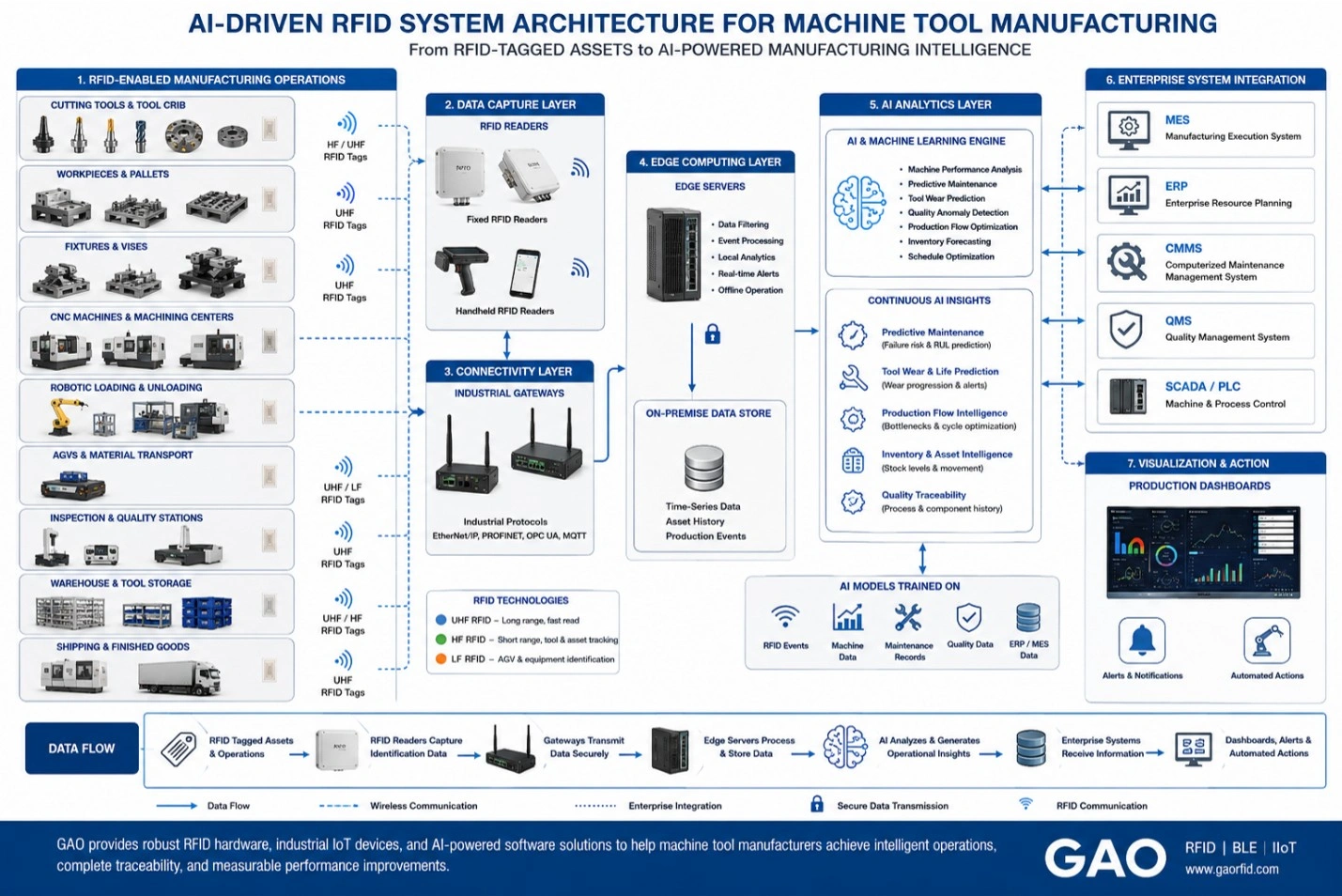
Operational Workflow from RFID Data Capture to AI-Driven Manufacturing Decisions
Machine tool manufacturing consists of interconnected production processes where production accuracy, equipment availability, and tooling management directly affect manufacturing performance. AI-supported RFID solutions improve visibility across each stage while enabling intelligent decision support.
CNC Machining Operations
RFID automatically identifies workpieces, cutting tools, fixtures, and pallets entering machining centers. AI evaluates machining duration, spindle utilization, setup efficiency, and tool consumption to optimize production scheduling.
Tool Crib Management
Machine tool manufacturers maintain thousands of cutting tools, inserts, holders, adapters, gauges, and measuring instruments.
AI evaluates:
- Tool consumption
- Remaining tool life
- Tool availability
- Tool replacement forecasting
- Inventory replenishment
- Tool utilization across machining centers
Production Scheduling
AI analyzes RFID-generated production events to identify workflow bottlenecks, machine idle time, production delays, queue buildup, and resource conflicts.
Production planners gain improved visibility into:
- Work order progression
- Machine utilization
- Operator allocation
- Production balancing
- Manufacturing capacity
Assembly Operations
Finished machine assemblies involve numerous precision components requiring complete traceability.
RFID identifies:
- Major assemblies
- Hydraulic systems
- Electrical cabinets
- Servo motors
- Linear guides
- Ball screws
- Spindles
- Control systems
AI verifies production sequencing while identifying missing assemblies before final integration.
Quality Assurance
Inspection stations automatically identify products entering dimensional verification, coordinate measuring machine (CMM) inspection, calibration, and functional testing.
AI detects recurring quality trends by correlating machining history, tooling usage, inspection outcomes, and production parameters.
Warehouse and Logistics
RFID provides continuous visibility of:
- Raw materials
- Semi-finished components
- Finished machine tools
- Spare parts
- Service inventory
- Packaging materials
AI recommends inventory optimization, replenishment priorities, warehouse slotting improvements, and shipping schedules.
AI-Enabled RFID Workflow for Machine Tool Manufacturing from Raw Material Receipt to Machine Shipment
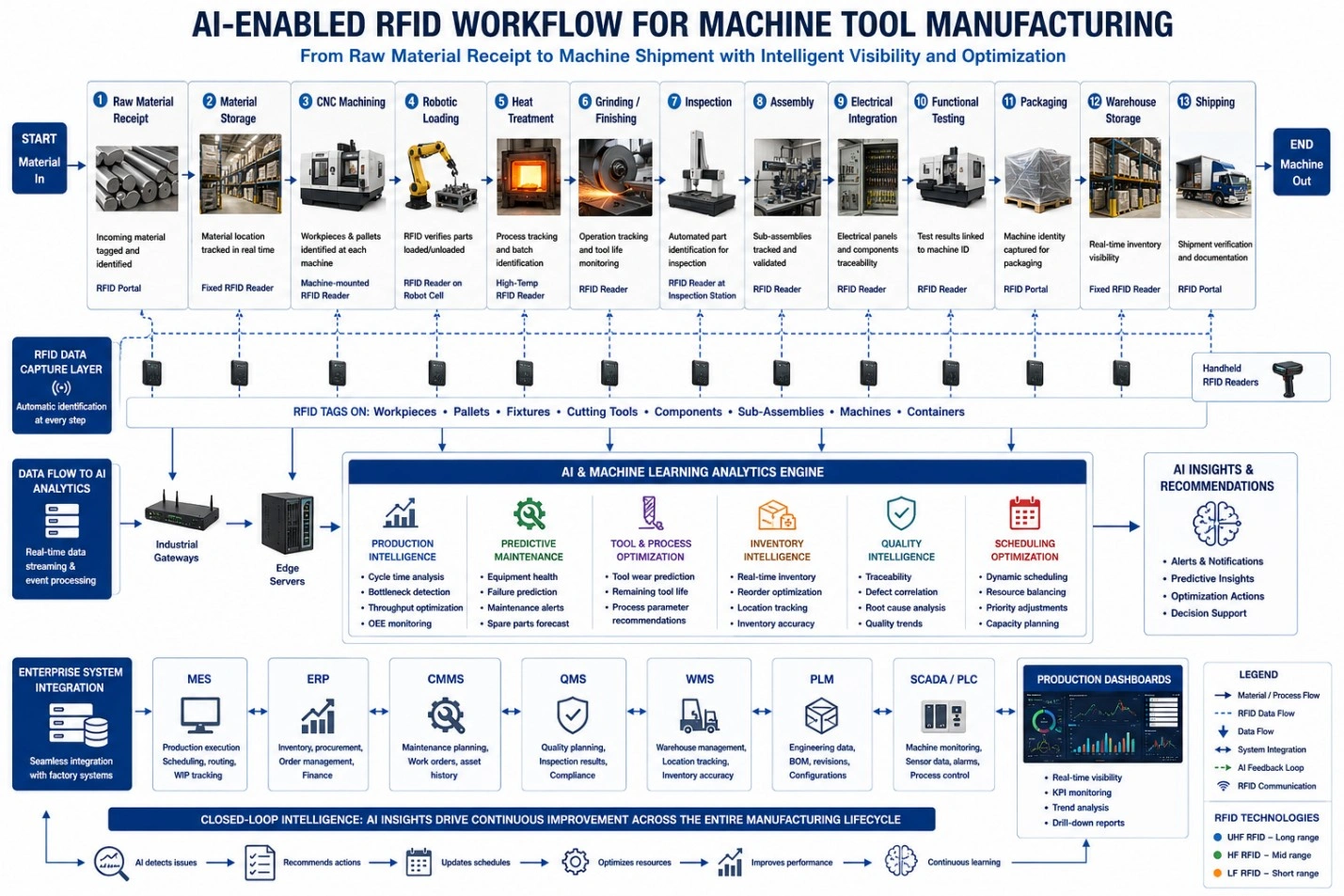
Operational Workflow from RFID Data Capture to AI-Driven Manufacturing Decisions
Machine tool manufacturers generate thousands of operational events every production shift. Intelligent manufacturing depends on transforming these events into meaningful operational intelligence rather than simply recording production activities.
RFID Data Acquisition
RFID tags attached to cutting tools, pallets, fixtures, workpieces, containers, spare parts, and finished machines are automatically detected by strategically positioned readers throughout production facilities.
Captured information typically includes:
- Asset identity
- Production location
- Process stage
- Timestamp
- Machine association
- Operator workstation
- Inventory movement
Communication Infrastructure
Industrial communication networks securely transfer RFID events to manufacturing software using protocols appropriate for factory automation, including Ethernet/IP, PROFINET, Modbus TCP, OPC UA, MQTT, and REST APIs where required. Industrial switches, gateways, and redundant network paths help maintain reliable communications between production equipment and supervisory systems.
Edge Processing
Local edge servers preprocess RFID events by filtering duplicate reads, validating asset identifiers, correlating machine states, and aggregating production data before forwarding relevant information for AI analysis. Processing data close to machining equipment reduces latency for production monitoring and supports near real-time operational responses.
AI Analytics
Machine learning models continuously evaluate:
- Production throughput
- Tool wear progression
- Machine utilization
- Predictive maintenance indicators
- Inventory movement
- Production cycle variation
- Equipment availability
- Process deviations
- Resource utilization
Computer vision systems may also complement RFID by validating part orientation, detecting machining defects, or confirming assembly completeness where optical inspection is required.
Enterprise Software Integration
RFID-derived operational data integrates with manufacturing software including:
- Manufacturing Execution Systems (MES)
- Enterprise Resource Planning (ERP)
- Computerized Maintenance Management Systems (CMMS)
- Product Lifecycle Management (PLM)
- Warehouse Management Systems (WMS)
- Quality Management Systems (QMS)
- Supervisory Control and Data Acquisition (SCADA)
This integration provides synchronized production records across engineering, maintenance, inventory, procurement, quality, and operations teams.
Business Actions
AI recommendations can automatically support:
- Maintenance work order creation
- Tool replacement scheduling
- Production rescheduling
- Inventory replenishment
- Quality inspections
- Machine utilization balancing
- Operator notifications
- Executive production reporting
These automated actions shorten response times while reducing manual coordination across production departments.
AI-Powered RFID Deployment Scenario for Smart Machine Tool Manufacturing Facilities
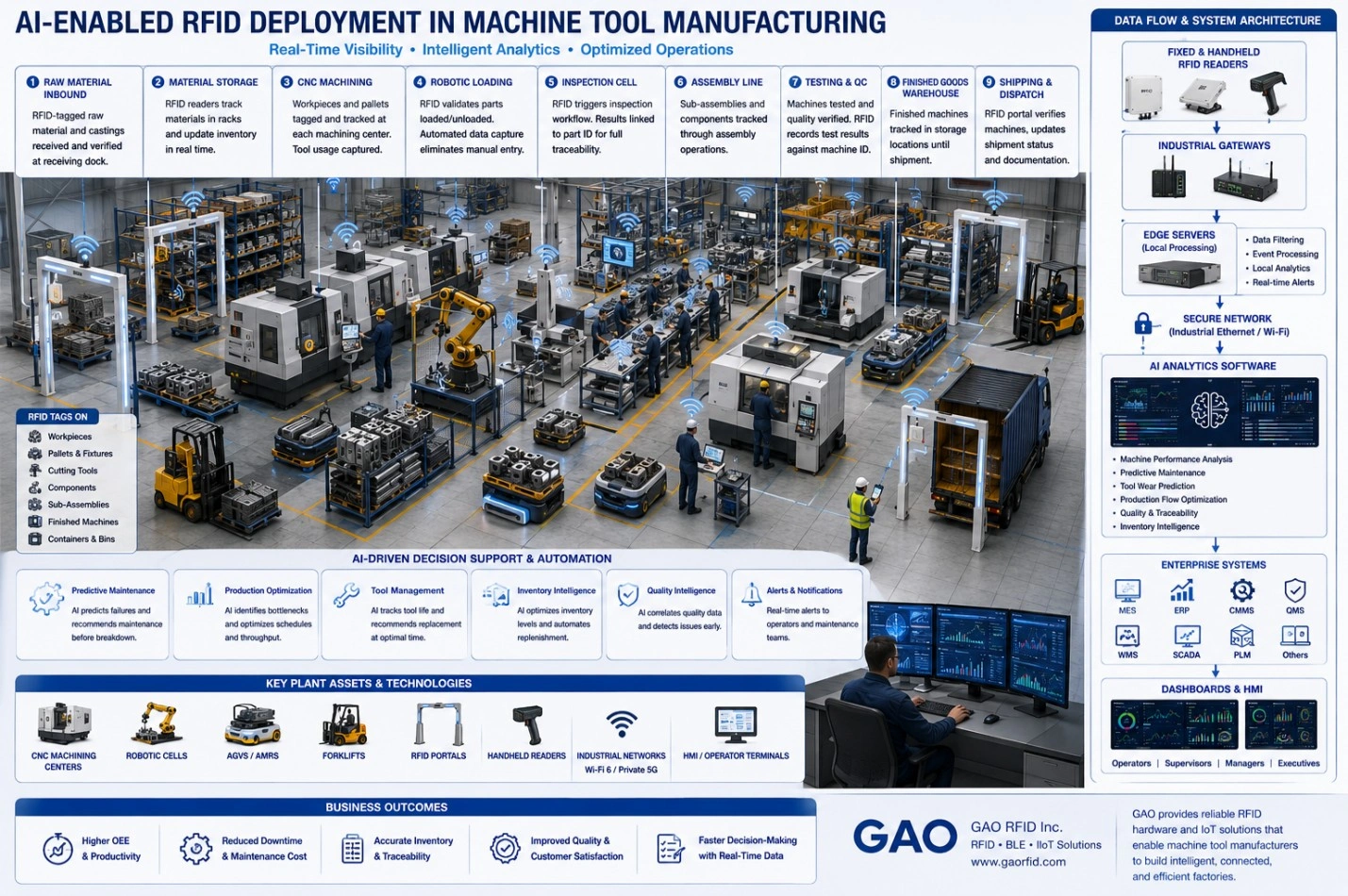
RFID Technologies, AI Methods, Software, Communications, Deployment Models, and Security
RFID functions as the primary identification technology supporting intelligent machine tool manufacturing by providing reliable, automated data capture across machining, assembly, warehouse, and inspection operations. Depending on operational requirements, manufacturers deploy Low Frequency (LF), High Frequency (HF), or Ultra High Frequency (UHF) RFID systems.
LF RFID is commonly selected for specialized tooling or environments where close-range identification and resistance to metallic interference are important. HF RFID is frequently used for tool identification, work-in-progress tracking, calibration records, and production process verification because of its dependable read performance at short distances. UHF RFID supports longer read ranges suitable for pallet tracking, warehouse logistics, finished machine identification, shipping verification, and automated portal applications.
A complete intelligent manufacturing solution combines RFID tags, industrial readers, antennas, handheld readers, programmable logic controllers (PLCs), industrial gateways, edge servers, factory networks, AI software, production databases, dashboards, and enterprise business systems. Each component contributes to accurate production visibility, allowing AI models to evaluate manufacturing performance based on continuously updated operational data rather than periodic manual reports.
Machine learning techniques commonly applied within machine tool manufacturing include anomaly detection, predictive maintenance modeling, production forecasting, inventory optimization, clustering of equipment operating patterns, regression analysis for cycle-time prediction, and reinforcement learning for production scheduling improvements. These models benefit from high-quality RFID event data because accurate asset identification strengthens training datasets and improves analytical reliability.
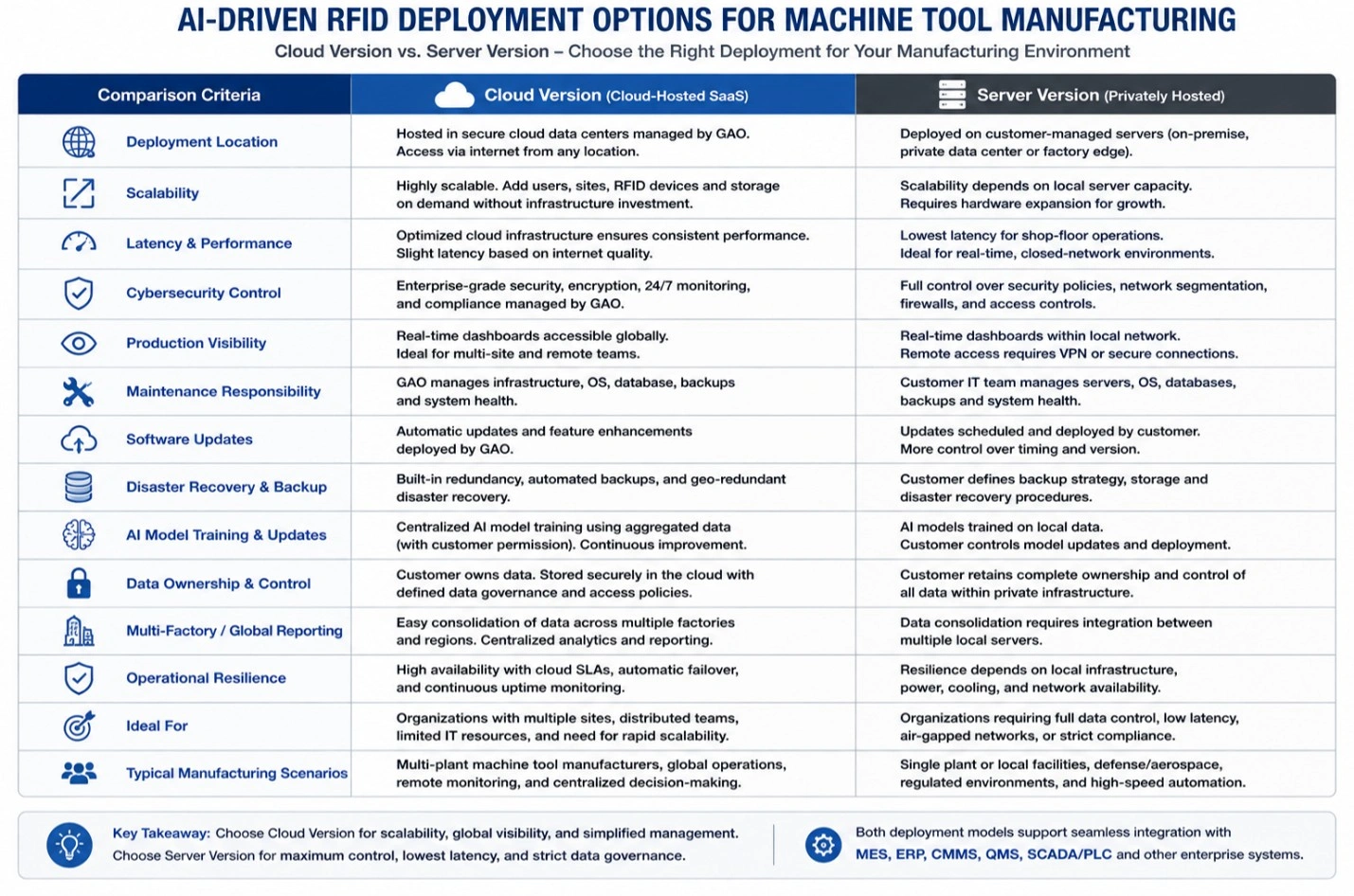
Organizations typically deploy intelligent manufacturing software using one of two approaches.
Cloud Version places application software within a cloud-hosted Software-as-a-Service environment managed by the solution provider. This approach is well suited for manufacturers operating multiple production facilities that require centralized reporting, consolidated production visibility, software updates, and simplified scalability. Cloud deployments also simplify collaboration among engineering, production, and executive teams located across different regions while reducing local infrastructure management.
Server Version installs software on customer-managed edge servers, private manufacturing servers, factory data centers, or other privately hosted computing environments. This approach is frequently preferred when production data must remain under direct organizational control, when latency requirements are extremely low, or when manufacturing operations continue during limited external network connectivity. Local deployments can also simplify integration with existing factory automation systems and support highly customized manufacturing workflows.
Communication between RFID infrastructure and manufacturing software commonly relies on industrial Ethernet, OPC UA, MQTT, Modbus TCP, REST APIs, and secure database interfaces. Reliable synchronization among PLCs, CNC controllers, MES, ERP, CMMS, and QMS software ensures production information remains consistent throughout manufacturing operations.
Security mechanisms include role-based access control, encrypted communications, network segmentation, device authentication, audit logging, secure firmware management, vulnerability monitoring, and backup procedures designed to protect production records and operational continuity. GAO has assisted manufacturers by supplying RFID hardware products that integrate with industrial communication environments while supporting dependable identification across demanding machine tool manufacturing operations.
Technical Capabilities and Operational Benefits of AI-Driven RFID in Machine Tool Manufacturing
Machine tool manufacturers increasingly rely on intelligent production systems to improve machining precision, maximize equipment availability, reduce production variability, and support data-driven operational decisions. RFID-enabled data acquisition allows AI to continuously evaluate manufacturing conditions and convert production events into actionable intelligence that benefits engineering, maintenance, production planning, quality assurance, and supply chain operations.
Intelligent Production Visibility
Continuous identification of workpieces, cutting tools, fixtures, pallets, and finished machine assemblies provides manufacturing teams with near real-time visibility throughout production.
AI analyzes production events to identify:
- Production bottlenecks
- Idle machining centers
- Material flow disruptions
- Work-in-progress accumulation
- Schedule deviations
- Resource constraints
Production supervisors can respond more quickly because operational conditions are continuously evaluated rather than discovered during periodic reporting.
Predictive Maintenance
Machine tool manufacturing depends on highly reliable CNC machines, spindle systems, ball screws, servo drives, hydraulic systems, coolant systems, tool changers, conveyors, and robotic automation.
AI combines RFID identification with equipment operating history, maintenance records, machine utilization, and sensor information to estimate equipment health and forecast maintenance requirements before failures interrupt production.
Typical maintenance improvements include:
- Reduced unplanned downtime
- Improved spare parts planning
- Extended equipment availability
- Lower maintenance costs
- Better technician scheduling
- Increased maintenance efficiency
Intelligent Tool Lifecycle Management
Tooling represents one of the largest operational costs within precision machining.
RFID identifies every cutting tool, holder, insert, boring bar, milling cutter, reamer, tap, gauge, and measuring instrument throughout its lifecycle.
AI evaluates:
- Remaining tool life
- Tool wear progression
- Tool utilization frequency
- Historical machining performance
- Replacement timing
- Tool inventory optimization
These insights help manufacturers reduce premature tool replacement while minimizing the risk of machining with worn tooling.
Production Scheduling Optimization
Manufacturing schedules continuously change because of engineering revisions, customer priorities, machine maintenance, material availability, and workforce allocation.
AI evaluates live production information to recommend:
- Work order sequencing
- Machine balancing
- Labor allocation
- Capacity planning
- Material prioritization
- Production rescheduling
This improves throughput without requiring manual analysis of thousands of production events.
Inventory and Warehouse Intelligence
Machine tool manufacturers often maintain extensive inventories of castings, fabricated components, precision bearings, linear guides, motors, electrical assemblies, control cabinets, spare parts, tooling, and finished products.
AI-supported RFID systems improve:
- Inventory accuracy
- Warehouse utilization
- Material replenishment
- Finished goods visibility
- Spare parts management
- Shipping verification
Warehouse personnel spend less time searching for materials while production interruptions caused by missing inventory become less frequent.
Quality Traceability
Every manufactured machine contains hundreds or thousands of components requiring documented production history.
RFID automatically records component movement throughout fabrication, machining, heat treatment, grinding, assembly, inspection, calibration, testing, packaging, and shipment.
AI correlates these production records with inspection outcomes to identify recurring quality issues associated with:
- Specific machines
- Tooling conditions
- Production shifts
- Materials
- Suppliers
- Manufacturing processes
This supports faster root cause analysis and continuous process improvement.
Cloud vs. Server RFID Deployment Comparison for AI-Driven Machine Tool Manufacturing
Engineering Best Practices for Intelligent RFID Deployment
Successful implementation depends on careful engineering rather than simply installing RFID readers. Machine tool manufacturing environments contain metallic equipment, coolant systems, rotating machinery, robotic cells, electrical cabinets, and high-density tooling storage that require disciplined deployment planning.
Recommended engineering practices include:
- Perform RF site surveys before hardware installation to identify signal reflections, interference sources, and optimal reader placement.
- Select RFID tag types according to operating temperature, coolant exposure, vibration, metal proximity, and expected service life.
- Establish standardized asset identification rules for cutting tools, fixtures, pallets, workpieces, spare parts, and finished machines.
- Validate read accuracy under actual machining conditions instead of laboratory testing alone.
- Integrate production events with MES, ERP, CMMS, QMS, SCADA, and PLC environments using standardized interfaces.
- Implement role-based access controls so engineering, maintenance, production, and warehouse personnel access only appropriate operational information.
- Develop governance procedures for AI model validation, retraining, and performance monitoring using representative manufacturing data.
- Define measurable success criteria such as OEE improvement, inventory accuracy, maintenance response time, production throughput, and quality performance before deployment.
Organizations that adopt these engineering practices generally achieve more reliable long-term performance and greater confidence in AI-assisted operational decision-making.
GAO has supported manufacturing organizations by providing RFID hardware products together with technical guidance that assists engineering teams during deployment, testing, commissioning, and operational optimization.
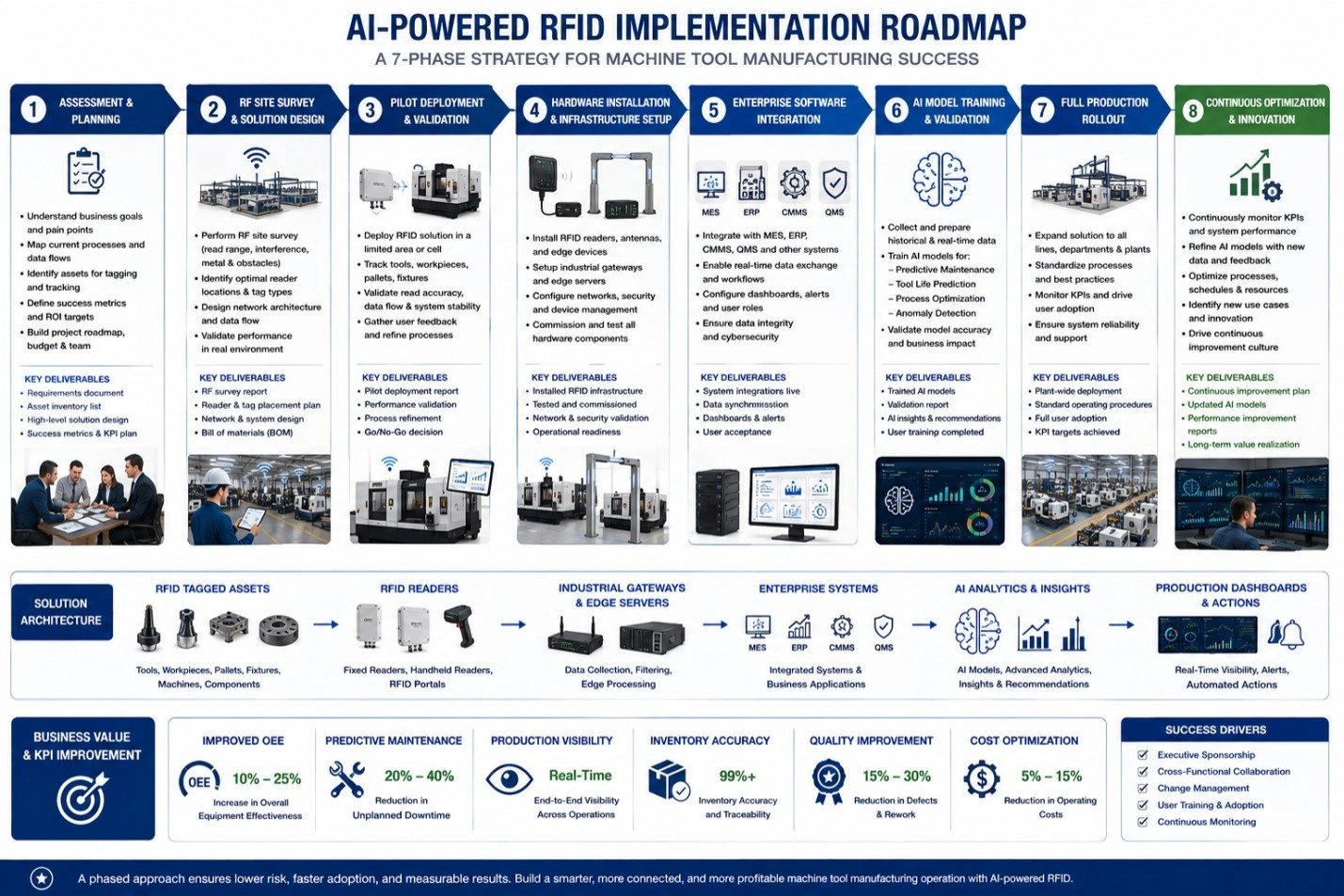
AI-Powered RFID Implementation Roadmap for Machine Tool Manufacturing
Security, Scalability, and Long-Term Operational Considerations
Machine tool manufacturers must protect production information while ensuring manufacturing systems remain available under demanding operating conditions.
Recommended security practices include:
- Encrypted communication between RFID devices and manufacturing software
- Multi-factor authentication for administrative access
- Role-based authorization for production personnel
- Network segmentation separating operational technology from corporate information technology
- Secure firmware updates for RFID readers and gateways
- Continuous security monitoring and audit logging
- Backup and disaster recovery procedures for production databases
- Regular vulnerability assessments and software patch management
Scalability should also be considered during project planning. Manufacturers often begin with a pilot focused on a machining cell or tool crib before expanding to assembly, warehouse operations, quality inspection, and multiple production facilities.
Future expansion may include:
- Autonomous mobile robots
- Collaborative robots
- Computer vision inspection
- Digital twins
- Energy optimization
- Advanced scheduling
- Industrial analytics
- Additional Industrial AI applications
Planning for future growth reduces redevelopment costs and allows manufacturing software to evolve with changing operational requirements.
Why Machine Tool Manufacturers Are Investing in AI-Driven RFID
Growing demand for precision manufacturing, shorter product development cycles, labor shortages, increasing equipment complexity, and stricter quality requirements are encouraging manufacturers to improve operational intelligence.
AI-supported RFID solutions help organizations address these challenges by providing:
- Greater production transparency
- Better machining efficiency
- Higher Overall Equipment Effectiveness
- Reduced inventory discrepancies
- Faster maintenance response
- Improved quality traceability
- Better production planning
- More accurate operational reporting
- Increased manufacturing resilience
Manufacturers that combine reliable automatic identification with Industrial AI are better positioned to optimize production performance while maintaining the traceability expected by customers across the machinery manufacturing sector.
Machine tool manufacturing continues to evolve toward highly connected, data-driven production environments where accurate operational information directly influences productivity, quality, maintenance, and business performance. RFID enables reliable identification of production assets, while AI transforms manufacturing data into meaningful recommendations that improve machining efficiency, scheduling, maintenance planning, inventory management, and quality assurance.
Successful implementation requires careful planning, appropriate hardware selection, software integration, cybersecurity controls, and ongoing optimization. When these elements work together, manufacturers gain measurable improvements in production visibility, operational efficiency, and long-term manufacturing performance.
Headquartered in New York City and Toronto, Canada, GAO is recognized among the world’s leading B2B suppliers of RFID and BLE technologies. Together with its sister companies, GAO Research and GAO Tek, GAO has served organizations across the United States and Canada for more than three decades, including Fortune 500 companies, leading research institutions, prestigious universities, and government agencies. Through sustained investment in research and development, rigorous quality assurance, and expert remote and onsite technical support, we continue helping manufacturers deploy dependable RFID hardware and intelligent IoT solutions that address real operational challenges.
For organizations evaluating intelligent manufacturing initiatives, our engineering team can help identify appropriate RFID technologies, deployment approaches, and integration strategies that align with machine tool manufacturing requirements.
Building the Future of Industrial AI and IoT with Aperture Venture Studio and GAO RFID Inc.
For more than three decades, GAO Group of Companies has invested extensively in research and development of industrial RFID, BLE, and IoT technologies. As generative AI has demonstrated significant value in manufacturing and industrial automation, we have expanded our work in AI and IoT solutions, including RFID and BLE, and established Aperture Venture Studio to accelerate the advancement and adoption of intelligent industrial technologies across manufacturing and other sectors. Aperture has attracted leading AI and IoT experts, experienced business and operational executives, influential investors, and major technology organizations. Through initiatives such as the Aperture Ventures Summit and TekSummit, we foster technical collaboration and knowledge sharing that strengthen AI and IoT communities. We welcome participation as:
- Advisors, co-founders, or employees
- Investors
- Customers seeking advanced AI and IoT solutions