
AI Powered RFID Solutions for Mineral Processing Plants in Modern Mining Operations
AI Powered RFID Solutions for Mineral Processing Plants
Modern mineral processing plants operate in highly demanding environments where ore throughput, equipment availability, process efficiency, energy consumption, safety, and product quality must be continuously optimized. Artificial intelligence integrated with RFID-enabled identification systems is helping mineral processing facilities improve operational visibility by transforming physical assets, equipment, materials, spare parts, personnel, and production data into actionable intelligence. AI analyzes information collected from RFID systems together with process instrumentation, industrial control systems, laboratory data, maintenance records, and production history to improve operational decisions throughout concentrators, crushing plants, grinding circuits, flotation systems, thickening facilities, filtration plants, and tailings operations.
Mineral processing plants increasingly require continuous monitoring, automated decision support, predictive maintenance, material traceability, inventory visibility, and production optimization. AI powered RFID solutions enable these capabilities while integrating with existing operational technology and enterprise software. Organizations throughout North America increasingly deploy these solutions to improve plant utilization, minimize downtime, optimize maintenance schedules, enhance workforce safety, and increase recovery rates while maintaining regulatory compliance. Through decades of supplying industrial RFID, BLE, and IoT hardware solutions, GAO has supported industrial organizations implementing reliable identification and sensing technologies across demanding operational environments.
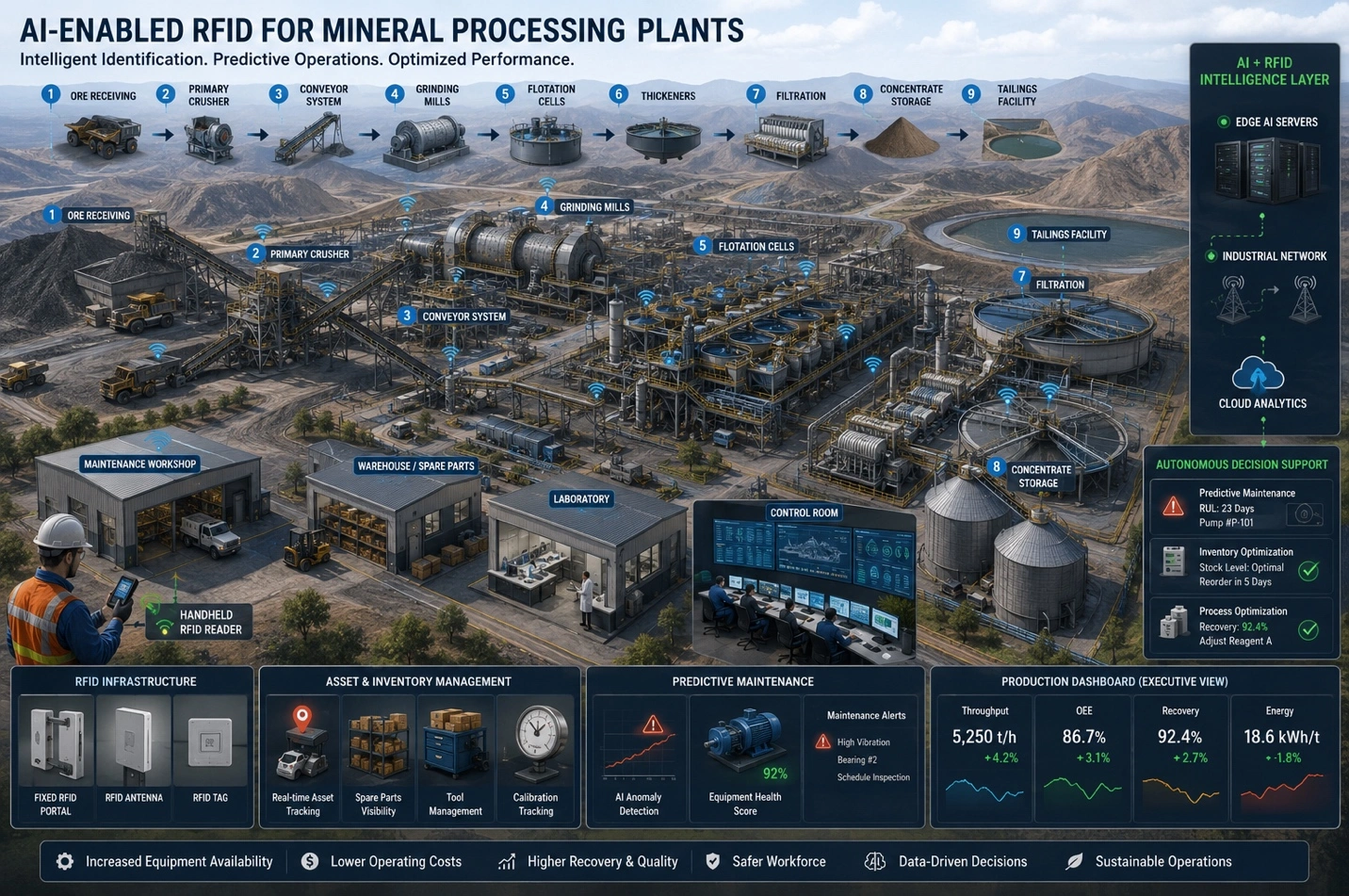
AI-Enabled RFID Deployment Across a Modern Mineral Processing Plant
This illustration presents an aerial view of a modern mineral processing plant where RFID-enabled asset identification and Artificial Intelligence work together to improve operational visibility, predictive maintenance, inventory management, production monitoring, and executive decision-making. It demonstrates how connected equipment, industrial communications, edge AI, and cloud analytics support more efficient, reliable, and data-driven mineral processing operations.
Understanding AI Driven RFID Solutions for Mineral Processing Plants
Mineral processing plants continuously transform mined ore into marketable concentrates through a sequence of complex physical and chemical processes. Every stage generates operational data from conveyors, crushers, mills, flotation circuits, classifiers, pumps, cyclones, reagent dosing systems, dewatering equipment, sampling stations, laboratories, maintenance workshops, warehouses, and utility systems. While conventional automation systems monitor process variables such as pressure, density, flow rate, particle size distribution, pulp level, motor current, and temperature, they often lack complete visibility into the movement and lifecycle of physical assets.
RFID introduces persistent digital identification for equipment, spare parts, maintenance tools, consumables, laboratory samples, mobile assets, safety equipment, and personnel. Artificial intelligence extends these identification capabilities by recognizing operational patterns, predicting equipment failures, optimizing maintenance planning, detecting production anomalies, and recommending operational improvements using data collected throughout the processing plant.
Unlike standalone identification technologies, AI-powered RFID solutions correlate asset identity with operational context. For example, an RFID-tagged slurry pump can be associated with vibration measurements, bearing temperatures, maintenance history, spare component availability, operating hours, historical failures, maintenance technician assignments, and production schedules. Machine learning models continuously evaluate this information to estimate remaining useful life and recommend maintenance interventions before catastrophic failures occur.
This combination supports higher concentrator availability, improved asset utilization, better spare parts management, increased recovery efficiency, and reduced maintenance costs while minimizing production interruptions.
GAO supplies industrial RFID hardware, readers, antennas, tags, and related IoT technologies that support these demanding industrial environments requiring high durability, long operational life, and reliable identification performance.
AI Applications Throughout Mineral Processing Plant Operations
Artificial intelligence supported by RFID identification delivers measurable improvements across virtually every operational area within mineral processing plants.
Ore Receiving and Stockpile Management
RFID identifies haul trucks, ore batches, blending locations, stockpile movements, and receiving operations while AI optimizes stockpile blending strategies, ore routing decisions, and crusher feed consistency.
Crushing and Conveying Systems
AI evaluates RFID-tagged conveyor components, motors, rollers, pulleys, gearboxes, and maintenance records to predict mechanical failures, optimize inspections, and reduce unexpected conveyor downtime.
Grinding Circuit Optimization
Grinding mills consume significant energy throughout mineral processing operations. AI analyzes RFID-tracked mill liners, grinding media inventory, maintenance schedules, bearing performance, and historical wear patterns to optimize maintenance planning and maximize mill availability.
Flotation Process Management
RFID identifies reagent inventories, laboratory samples, maintenance equipment, instrumentation components, and calibration devices while AI optimizes reagent consumption, flotation recovery, froth stability, and process consistency.
Thickening and Filtration
Artificial intelligence continuously evaluates RFID-tagged pumps, valves, thickener drives, filter presses, and instrumentation to optimize maintenance intervals, equipment availability, and production throughput.
Maintenance and Reliability Engineering
Maintenance planners gain complete visibility into RFID-tagged spare parts, replacement assemblies, maintenance tools, calibration instruments, and repair history. AI prioritizes maintenance activities based on equipment criticality, predicted failures, operational risk, and production schedules.
Laboratory Information Management
Laboratory samples equipped with RFID identification improve chain of custody while AI correlates assay results with production performance, metallurgical recovery, and process optimization.
Warehouse Operations
AI enhances warehouse inventory management by analyzing RFID-tagged bearings, motors, pumps, valves, instrumentation components, electrical equipment, lubricants, and consumables, reducing stock shortages while preventing excess inventory.
Workforce Safety
Personnel badges incorporating RFID improve worker accountability during confined space entry, shutdown maintenance, emergency evacuation, contractor management, and restricted-area access. AI identifies unsafe operational patterns and assists safety supervisors in proactive risk management.
AI-Enabled RFID Workflow Across the Mineral Processing Lifecycle
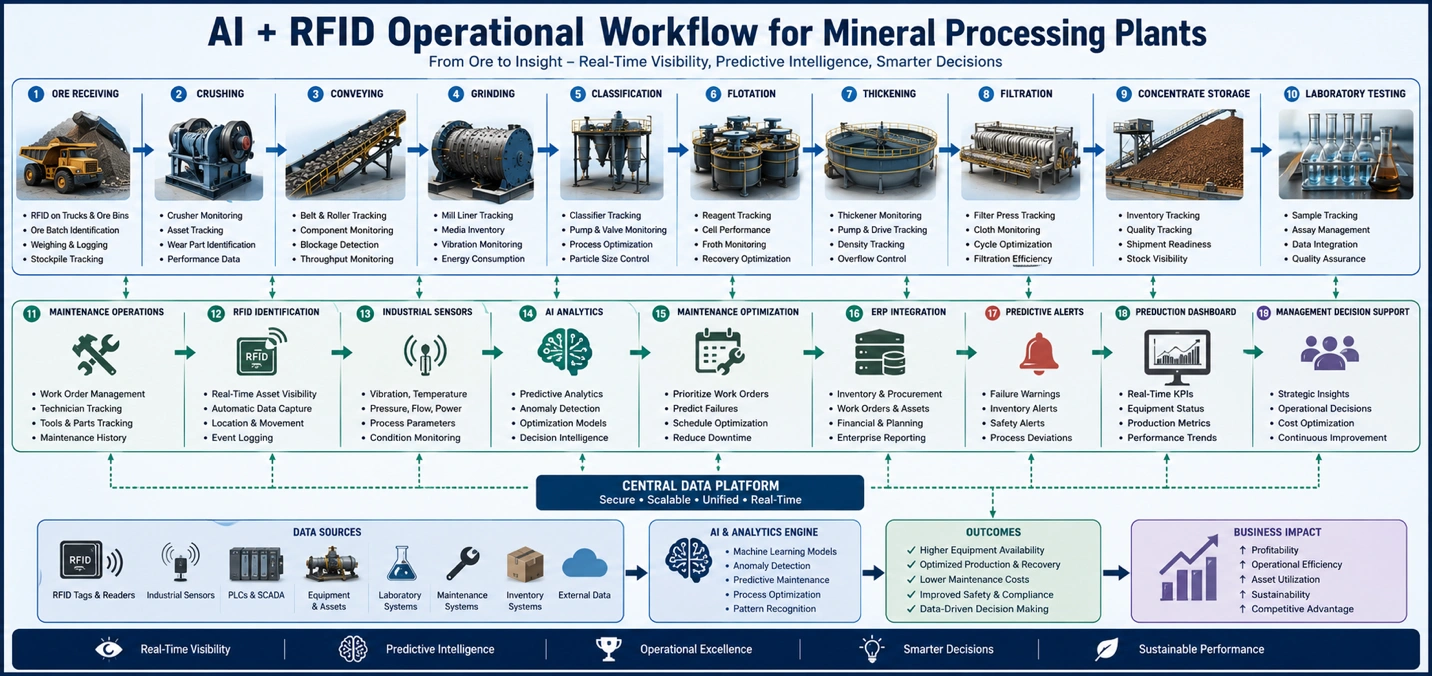
This workflow diagram illustrates the complete operational lifecycle of a mineral processing plant, from ore receiving through crushing, grinding, classification, flotation, thickening, filtration, concentrate storage, and tailings management. It shows how RFID identification, industrial sensors, edge processing, AI analytics, enterprise software integration, predictive alerts, and executive dashboards work together to optimize production, maintenance, asset visibility, and operational decision-making.
Operational Workflow from RFID Data Capture to AI Driven Decision Making
Effective mineral processing depends on timely operational information flowing across multiple industrial systems. AI powered RFID solutions create continuous digital visibility from physical assets through intelligent business decision support.
RFID Identification and Data Acquisition
Industrial RFID tags identify equipment, maintenance components, laboratory samples, ore containers, mobile assets, forklifts, maintenance vehicles, process instruments, electrical panels, spare parts, conveyors, motors, pumps, crushers, flotation equipment, and operator safety equipment.
Fixed RFID readers positioned throughout processing facilities automatically capture asset movements while handheld readers support inspections, maintenance verification, warehouse operations, and equipment commissioning.
Industrial Communications
Captured RFID information travels through industrial Ethernet, fiber networks, Wi-Fi, private LTE, 5G industrial communications, and secure TCP/IP infrastructure toward local processing servers or cloud-hosted software.
Industrial gateways aggregate information from RFID readers together with PLCs, SCADA systems, historians, distributed control systems, vibration monitoring equipment, condition monitoring sensors, laboratory information systems, and environmental monitoring devices.
Edge Processing
Edge computing software filters duplicate reads, validates asset identities, timestamps operational events, synchronizes local databases, detects abnormal equipment movement, and performs initial AI inference for latency-sensitive operations.
Critical maintenance alerts remain available even during temporary network interruptions.
AI Analytics
Machine learning models continuously analyze equipment utilization, production bottlenecks, maintenance history, laboratory assays, inventory turnover, conveyor loading, grinding performance, flotation recovery, energy consumption, and operational anomalies.
Predictive analytics estimate component failures while optimization algorithms recommend maintenance windows that minimize production disruption.
Enterprise Software Integration
Processed operational information integrates with:
- Enterprise Resource Planning systems
- Computerized Maintenance Management Systems
- Manufacturing Execution Systems
- Laboratory Information Management Systems
- Asset Performance Management software
- Production reporting software
- Inventory management systems
- Workforce management systems
- Environmental compliance software
These integrations improve planning, procurement, maintenance coordination, production reporting, and operational visibility.
Business Decision Support
Executives, plant managers, reliability engineers, maintenance planners, metallurgists, warehouse supervisors, and operations managers receive dashboards showing equipment health, asset utilization, maintenance priorities, inventory levels, production KPIs, and operational risks.
AI continuously recommends operational adjustments that improve plant performance while reducing maintenance costs and production interruptions.
Realistic AI-Enabled RFID Deployment in a Mineral Processing Plant
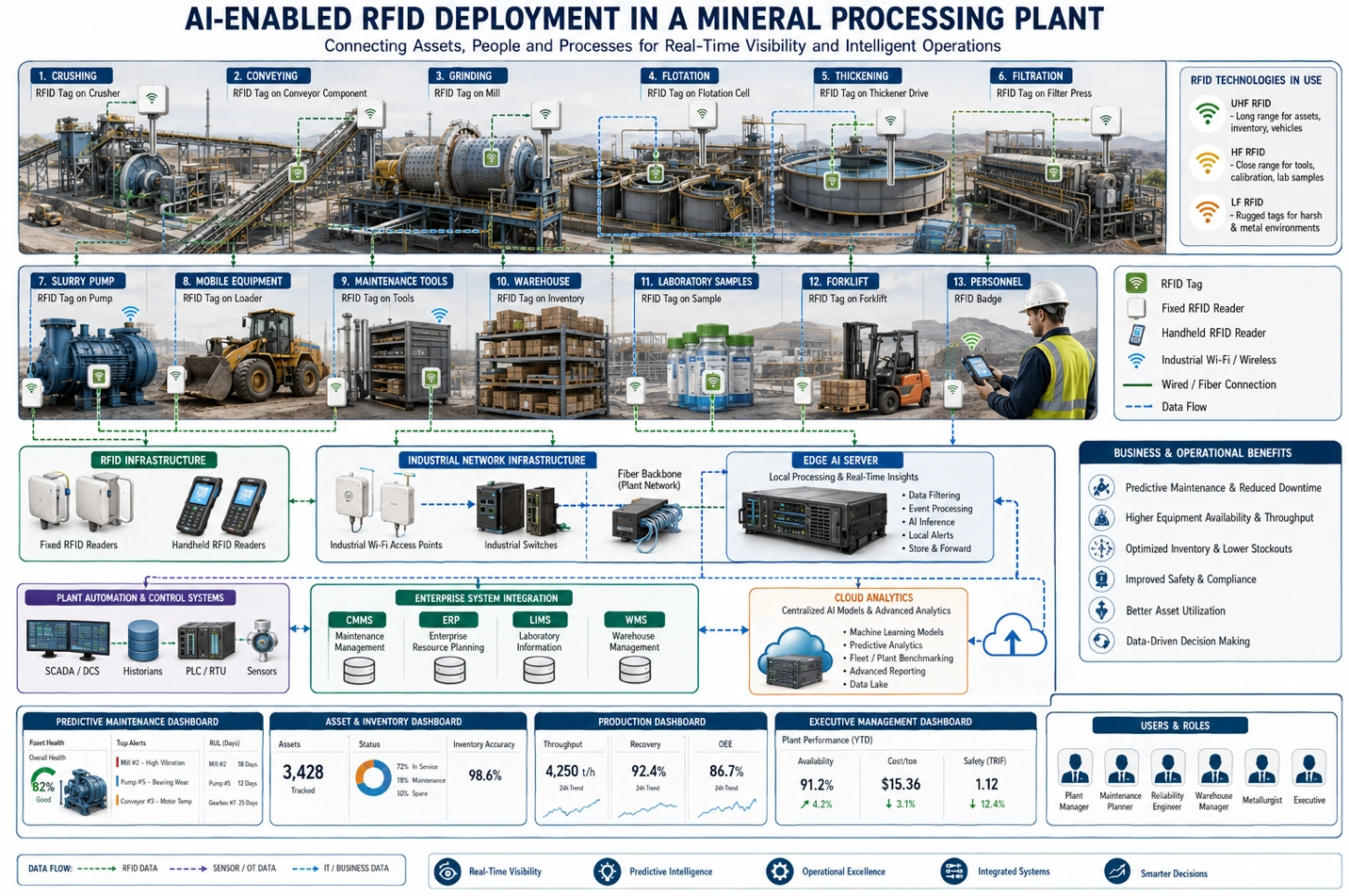
This deployment diagram illustrates how RFID technology is implemented across a mineral processing plant by tagging critical equipment, maintenance tools, warehouse inventory, laboratory samples, mobile equipment, and personnel. It shows the flow of data through fixed and handheld RFID readers, industrial Wi-Fi, fiber networks, edge AI servers, SCADA systems, CMMS, ERP software, cloud analytics, and executive dashboards to enable predictive maintenance, asset visibility, production optimization, and informed operational decision-making.
Technology Components Supporting AI Enabled Mineral Processing Intelligence
Successful mineral processing intelligence combines industrial identification technologies with advanced analytics, operational software, industrial networking, cybersecurity, and scalable computing resources. RFID serves as one enabling technology within a broader Industrial AI solution rather than operating independently.
UHF RFID is commonly deployed throughout warehouses, maintenance facilities, concentrate storage areas, mobile equipment yards, and logistics operations where long read distances improve inventory visibility and automated asset identification. HF RFID is frequently selected for laboratory sample tracking, maintenance documentation, calibration records, and controlled maintenance workflows requiring shorter read ranges and reliable close proximity identification. LF RFID performs well around metal-rich environments, wet processing areas, and specialized industrial applications where challenging operating conditions require robust identification performance.
Industrial RFID readers connect to programmable logic controllers, industrial gateways, supervisory control and data acquisition software, historians, distributed control systems, laboratory information management software, and computerized maintenance management systems. Together these systems provide contextual operational data that AI models use to understand equipment condition, maintenance history, process performance, workforce activities, and material movement.
Artificial intelligence functions extend well beyond equipment monitoring. Machine learning algorithms forecast failures of grinding mills, slurry pumps, flotation blowers, conveyor drives, hydrocyclones, filter presses, thickener drives, compressors, and electrical distribution equipment. Deep learning models evaluate inspection images, infrared thermography, vibration signatures, lubrication analysis, and historical maintenance records to identify degradation trends before failures interrupt production. Reinforcement learning methods can recommend optimized maintenance scheduling or operational adjustments that balance throughput, energy consumption, and equipment reliability.
Communication infrastructure typically includes industrial Ethernet, fiber optic networks, secure Wi-Fi, private LTE or 5G where mobility requirements justify wireless connectivity. MQTT, OPC UA, Modbus TCP, EtherNet/IP, and REST APIs are commonly used to exchange operational information among industrial software systems while maintaining interoperability with existing automation investments.
Cloud-hosted deployments are appropriate for organizations operating multiple mineral processing plants requiring centralized reporting, fleetwide benchmarking, AI model management, remote engineering collaboration, and consolidated executive dashboards. Cloud environments also simplify software updates, scalable analytics, and cross-site performance comparisons.
Server-based deployments are preferred where regulatory requirements, low-latency decision making, intermittent connectivity, cybersecurity policies, or continuous production operations require customer-managed computing resources located within processing facilities or privately managed data centers. These deployments allow local AI inference, uninterrupted operational monitoring, and tighter integration with existing industrial control systems even during external network outages.
Cybersecurity remains fundamental throughout deployment. Role-based access control, encrypted communications, secure device authentication, network segmentation, audit logging, vulnerability management, and continuous monitoring help protect operational technology from cyber threats while maintaining reliable production operations.
GAO provides industrial RFID hardware and related IoT technologies designed for demanding operating conditions, supporting customers integrating reliable identification systems into broader Industrial AI initiatives.
Layered AI-Enabled RFID Solution for Mineral Processing Plants
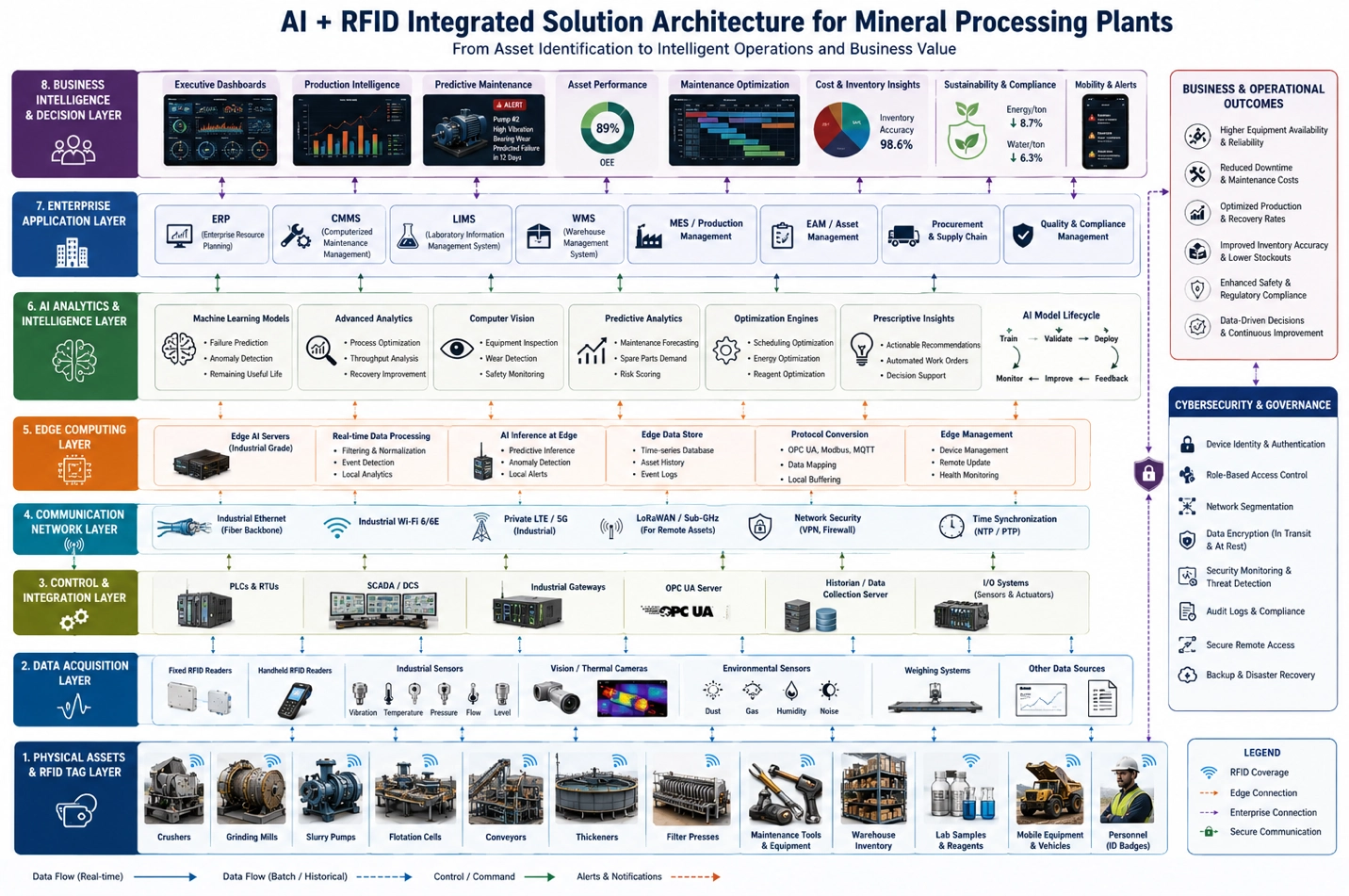
This layered engineering diagram illustrates how RFID identification, industrial sensors, PLCs, SCADA systems, industrial gateways, communication networks, edge AI computing, enterprise software, and AI analytics interact within a mineral processing plant. It demonstrates the complete flow of operational data from physical assets through secure processing and enterprise integration to predictive maintenance, production intelligence, executive dashboards, and data-driven operational decision-making.
Technical Capabilities and Operational Value of AI Driven RFID in Mineral Processing Plants
Modern mineral processing facilities generate millions of operational events every day from crushers, grinding circuits, flotation systems, thickening units, filtration equipment, mobile machinery, warehouses, laboratories, and maintenance workshops. AI uses RFID-generated identification data together with process instrumentation and operational records to transform these events into actionable operational intelligence.
Rather than functioning only as an identification technology, RFID becomes a trusted data source supporting AI models that continuously improve production, maintenance, inventory management, and operational planning.
Predictive Maintenance for Critical Processing Equipment
Unplanned failures of SAG mills, ball mills, slurry pumps, hydrocyclones, flotation blowers, conveyor drives, thickener gearboxes, and filter presses can significantly reduce plant throughput and increase operating costs.
RFID identifies individual assets, replacement components, maintenance tools, lubrication equipment, and service records. AI correlates this information with vibration analysis, thermal imaging, oil analysis, motor current signatures, operating hours, maintenance history, and production loads to estimate remaining useful life.
Benefits include:
- Reduced unexpected equipment failures
- Improved maintenance scheduling
- Better spare parts planning
- Increased equipment availability
- Extended equipment service life
- Lower maintenance costs
- Reduced production interruptions
Maintenance planners can prioritize work orders based on equipment criticality instead of relying solely on fixed maintenance intervals.
Intelligent Asset Tracking
Thousands of valuable assets continuously move throughout a mineral processing plant.
Examples include:
- Portable pumps
- Welding equipment
- Calibration instruments
- Sampling devices
- Mobile maintenance carts
- Forklifts
- Laboratory equipment
- Portable gas detectors
- Electrical testing instruments
- Heavy maintenance tools
RFID continuously identifies these assets while AI detects unusual movement patterns, predicts shortages, recommends redistribution of equipment between maintenance crews, and identifies underutilized assets.
This reduces unnecessary purchases while improving maintenance productivity.
Spare Parts Optimization
Large concentrators often maintain extensive inventories of bearings, motors, pumps, seals, couplings, valves, instrumentation, electrical components, liners, grinding media, filters, and critical replacement assemblies.
AI analyzes RFID inventory movement together with procurement history, supplier lead times, equipment reliability statistics, maintenance forecasts, and production schedules.
The resulting recommendations help organizations:
- Reduce excess inventory
- Prevent stockouts
- Improve procurement planning
- Lower warehouse carrying costs
- Improve maintenance readiness
- Increase inventory accuracy
Warehouse personnel spend less time searching for critical components while maintenance teams experience fewer repair delays.
Material Traceability
Material traceability remains essential throughout mineral processing.
RFID enables identification of:
- Ore batches
- Laboratory samples
- Concentrate shipments
- Reagent deliveries
- Maintenance materials
- Waste materials
- Tailings monitoring equipment
AI correlates this information with production records, metallurgical recovery, quality testing, environmental reporting, and shipment documentation.
Complete traceability supports regulatory compliance, quality assurance, and production optimization.
Workforce Productivity
Personnel equipped with RFID identification badges can be associated with maintenance assignments, inspection routes, training certifications, permit-to-work activities, confined-space access, and emergency response procedures.
AI identifies workflow bottlenecks, excessive travel time, delayed inspections, workforce utilization trends, and recurring maintenance inefficiencies.
Managers receive operational recommendations that improve labor allocation while supporting worker safety.
Production Optimization
Artificial intelligence combines RFID identification with production information collected from distributed control systems, laboratory assays, density measurements, flow meters, online analyzers, and historian databases.
AI models continuously recommend improvements involving:
- Ore blending
- Mill loading
- Reagent consumption
- Flotation residence time
- Water utilization
- Energy efficiency
- Equipment utilization
- Throughput balancing
These recommendations help improve concentrate recovery while minimizing operating costs.
Operational Improvements Achieved with AI-Enabled RFID in Mineral Processing Plants
This infographic summarizes the measurable operational improvements achieved by combining AI with RFID across mineral processing plants. It highlights benefits including predictive maintenance, intelligent asset tracking, inventory optimization, laboratory traceability, workforce productivity, equipment utilization, production optimization, energy efficiency, maintenance planning, safety compliance, environmental reporting, executive dashboards, and data-driven operational intelligence that collectively improve plant performance and operational resilience.
Engineering Considerations for Successful Deployment
Successful implementation requires considerably more than installing RFID tags and readers. Long-term reliability depends on engineering decisions made during planning, commissioning, integration, and ongoing optimization.
Asset Identification Strategy
Organizations should establish standardized identification policies covering:
- Fixed processing equipment
- Rotating equipment
- Electrical assets
- Instrumentation
- Maintenance tools
- Spare parts
- Laboratory samples
- Mobile equipment
- Safety equipment
- Personnel identification
Consistent naming conventions improve AI model accuracy and simplify integration with existing maintenance and production software.
Tag Selection
Mineral processing environments introduce unique challenges including:
- Dust accumulation
- High vibration
- Chemical exposure
- Slurry contact
- Metal interference
- High humidity
- Temperature fluctuations
- Pressure washing
- Mechanical impact
Industrial-grade RFID tags should be selected according to mounting surface, environmental exposure, reading distance, chemical resistance, and expected service life.
Reader Placement
Reader locations should be determined using site surveys and radio frequency testing.
Typical installations include:
- Conveyor transfer points
- Warehouse entrances
- Maintenance workshops
- Crusher feed stations
- Laboratory receiving areas
- Concentrate storage
- Vehicle maintenance facilities
- Mobile equipment yards
- Security checkpoints
- Personnel access points
Reader density should balance coverage, read accuracy, and infrastructure costs.
AI Model Governance
Reliable AI recommendations depend upon:
- High-quality operational data
- Accurate asset master records
- Consistent maintenance history
- Reliable laboratory information
- Clean inventory databases
- Continuous model validation
- Human engineering oversight
AI should augment operational decision-making rather than replace experienced metallurgists, maintenance engineers, reliability specialists, and plant operators.
Cybersecurity
Industrial cybersecurity should protect:
- RFID readers
- Edge servers
- Wireless communications
- Operational databases
- AI software
- Maintenance systems
- Production records
- User authentication
- Administrative access
Recommended practices include network segmentation, encrypted communications, multi-factor authentication, security monitoring, regular software updates, vulnerability assessments, and role-based permissions.
GAO assists organizations by supplying industrial RFID hardware that integrates with secure Industrial AI deployments while supporting long-term operational reliability.
Key Performance Indicators Improved Through AI Enabled RFID
Organizations commonly measure implementation success using operational and business metrics such as:
- Overall Equipment Effectiveness (OEE)
- Plant availability
- Equipment utilization
- Mean Time Between Failures (MTBF)
- Mean Time to Repair (MTTR)
- Maintenance schedule compliance
- Spare parts inventory accuracy
- Inventory turnover
- Warehouse picking efficiency
- Concentrate recovery
- Production throughput
- Energy consumption per ton processed
- Reagent consumption
- Laboratory turnaround time
- Asset search time
- Workforce productivity
- Safety incident frequency
- Environmental compliance performance
- Downtime reduction
- Return on investment
Monitoring these indicators enables continuous improvement and helps justify future expansion of AI-enabled identification technologies across additional processing facilities.
Executive AI and RFID Operations Dashboard for Mineral Processing Plants
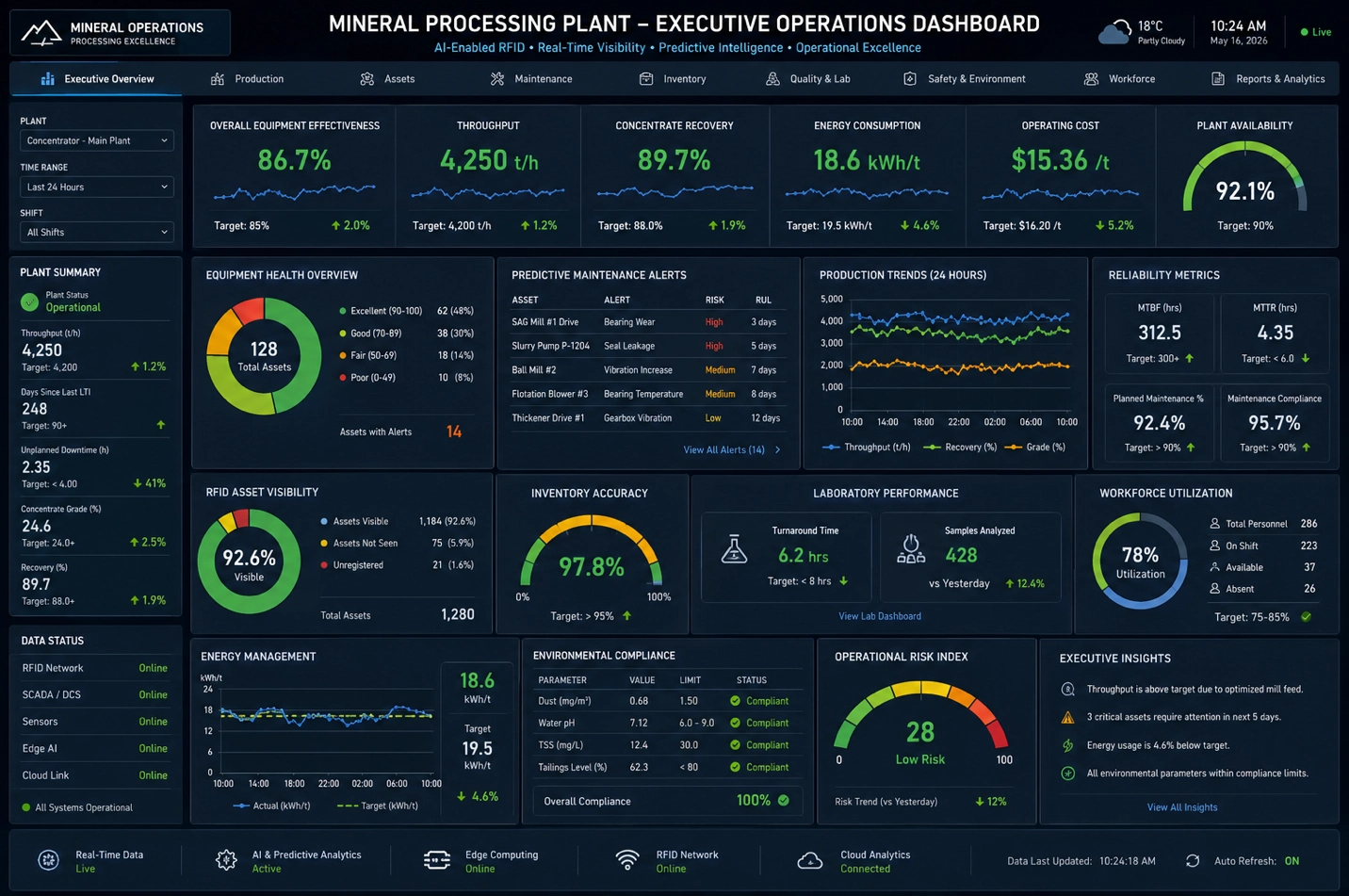
This executive dashboard illustrates how operational intelligence is presented to plant leadership through a centralized industrial control interface. It combines real-time KPIs, RFID asset visibility, equipment health, predictive maintenance alerts, production throughput, OEE, MTBF, MTTR, energy consumption, inventory accuracy, laboratory performance, workforce utilization, environmental compliance, concentrate recovery, and operational risk indicators to support faster, data-driven management decisions.
Advancing Mineral Processing Performance with AI Driven RFID Solutions
Artificial intelligence supported by RFID identification is reshaping mineral processing plants by connecting physical assets with operational intelligence. By combining asset identification, predictive analytics, maintenance optimization, inventory visibility, laboratory traceability, and production decision support, organizations can improve equipment reliability, maximize concentrator throughput, strengthen workforce safety, and reduce operational costs.
Successful implementation depends upon thoughtful engineering design, appropriate RFID technology selection, reliable industrial communications, secure software integration, high-quality operational data, and continuous AI model improvement. Organizations that approach deployment strategically are better positioned to increase plant efficiency while supporting sustainability objectives and long-term operational resilience.
For more than three decades, GAO Group has served customers throughout the United States and Canada, including numerous Fortune 500 companies, leading research organizations, prestigious universities, and government agencies. Headquartered in New York City and Toronto, Canada, GAO is recognized among the world’s leading B2B suppliers of RFID and BLE technologies. Through substantial investment in research and development, rigorous quality assurance processes, and expert remote and onsite technical support, we help organizations deploy dependable RFID and Industrial AI solutions tailored to demanding mineral processing environments. We invite you to learn more about GAO’s technologies, engineering expertise, products, and technical services to support your digital transformation initiatives.
Building the Future of Industrial AI and IoT with Aperture Venture Studio and GAO RFID Inc.
For more than three decades, GAO Group of Companies has invested extensively in research and development of industrial RFID, BLE, and IoT technologies. As generative AI has matured into a practical tool for industrial operations, we have expanded our work in Industrial AI, AIoT, RFID, and intelligent sensing while establishing Aperture Venture Studio to accelerate the development and commercialization of advanced AI and IoT solutions for industries such as mining and mineral processing.
Aperture has attracted leading AI researchers, industrial IoT specialists, experienced technology executives, respected investors, and major industry participants. We have also developed the highly successful Aperture Ventures Summit and TekSummit to explore emerging topics in Industrial AI and IoT. Together, these initiatives have fostered diverse technical communities dedicated to advancing intelligent industrial operations. We welcome participation from:
- Advisors, co-founders, and employees
- Investors
- Customers seeking advanced Industrial AI and RFID solutions