
AI and RFID for Mining Equipment
AI Asset Tracking and RFID Identification for Mining Equipment Manufacturing
AI-driven asset tracking and RFID identification are transforming how mining equipment manufacturers manage production traceability, component serialization, rebuild cycle documentation, and field-deployed machine fleets operating in the most demanding geological and environmental conditions on earth. By integrating machine learning with UHF RFID, HF RFID, and LF RFID identification, manufacturers of electric rope shovels, hydraulic mining excavators, haul trucks, underground loaders, continuous miners, longwall systems, and drill rigs gain real-time visibility across multi-stage production lines, structural fabrication shops, and global distribution networks that paper-based documentation and manual barcode workflows cannot reliably support.
GAO supplies RFID hardware products and systems that mining equipment manufacturers deploy to automate machine identification, verify ground-engaging tool (GET) configurations, enforce structural weld compliance documentation, and feed production data into AI-powered analytics. The connected manufacturing environment that results allows AI models to convert raw RFID event data into production intelligence that reduces unplanned downtime, improves rebuild parts traceability across dealer and rebuild center networks, and tightens quality control across hoist rope assemblies, dipper handles, hydraulic crowd systems, and diesel-electric powertrain installations.
Layered AI and RFID Architecture for Mining Equipment Manufacturing
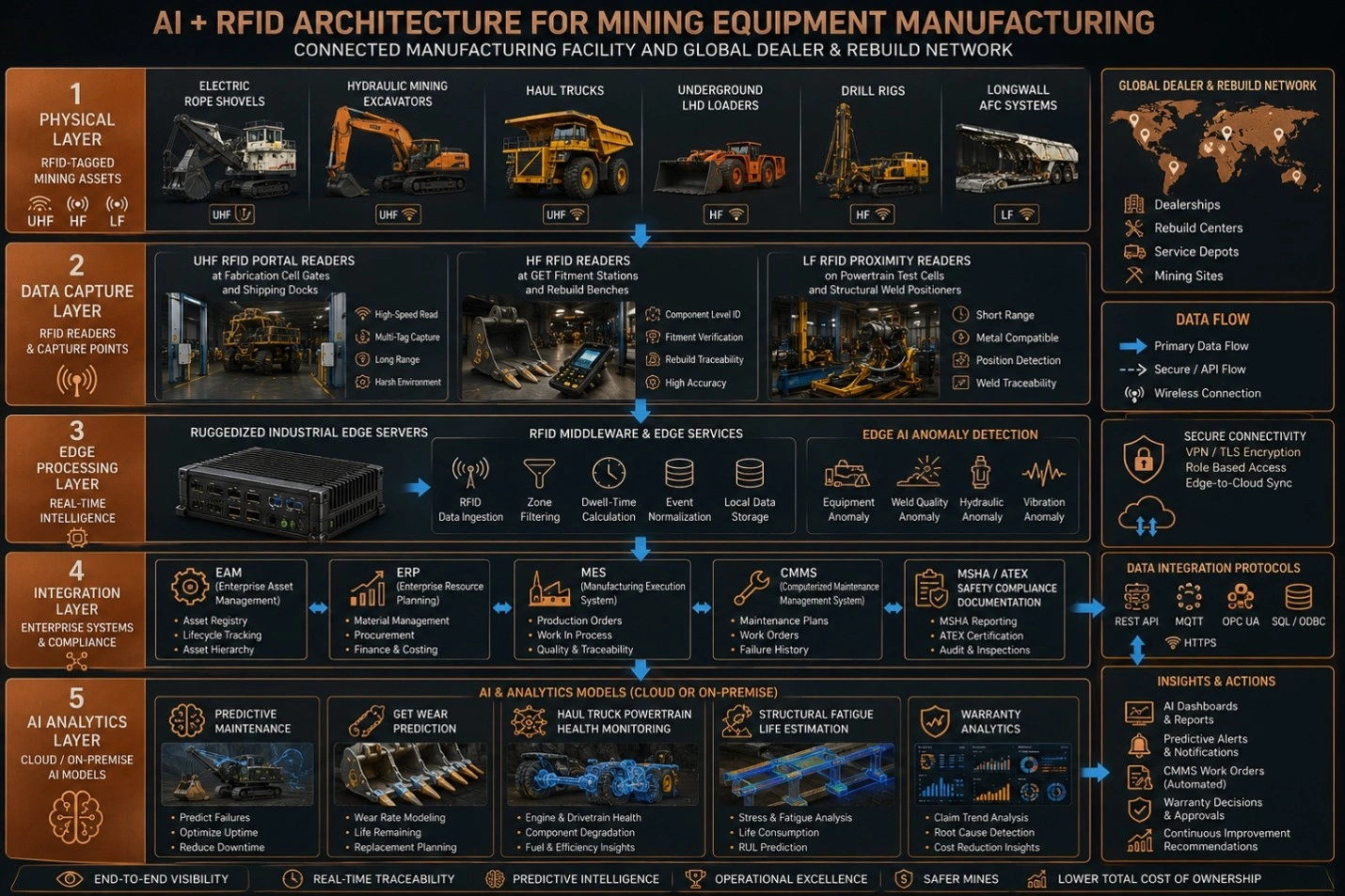
RFID and AI Fundamentals in Mining Equipment Manufacturing
Mining equipment manufacturing produces the heaviest, most structurally demanding capital machinery in the industrial world. Product lines span electric rope shovels (ERS) with dipper capacities from 40 to over 130 cubic yards, hydraulic face shovels and backhoe mining excavators from 200 to 800 metric tonnes operating weight, rigid frame haul trucks with payload ratings from 90 to 360 metric tonnes, articulated haul trucks, underground load-haul-dump (LHD) loaders, underground haulage trucks, continuous miners, longwall shearers and armored face conveyors (AFC), and rotary and down-the-hole (DTH) drill rigs. Each machine involves thousands of serialized components including structural steel fabrications machined from high-yield-strength plate, forged and cast ground-engaging tools (GET) such as teeth, adapters, and shrouds, high-pressure hydraulic systems rated to 5000 psi and above, diesel-electric and diesel-mechanical powertrains, and safety-critical hoist rope, crowd rope, and dipper bail assemblies subject to ASME B30 and mine-specific statutory inspection requirements.
RFID assigns a unique digital identity to each serialized asset, sub-assembly, and component carrier in the mining equipment production environment. UHF RFID, operating under EPC Gen2 / ISO 18000-63 in the 860 to 960 MHz frequency band, provides long-range identification of large structural fabrications, powertrain modules, and finished machines as they transit production bay gates, blast booth entry and exit portals, and shipping dock gateways. HF RFID at 13.56 MHz, conforming to ISO 15693 or ISO 14443A, is deployed at GET fitment stations, rebuild bench verification points, and safety-critical component inspection cells where short-range, high-accuracy identification of individual forged parts, rope end terminations, and calibration instruments is required. LF RFID at 125 to 134 kHz provides reliable identification of large cast and forged structural components, engine blocks, and final drive housings on machining fixtures and powertrain test cells where the extreme metal mass and proximity to high-current welding equipment make UHF identification unreliable.
AI models including supervised classification, anomaly detection, time-series forecasting, computer vision, and reinforcement learning process the continuous RFID event streams generated across a mining equipment manufacturing facility. Integrated with Enterprise Asset Management (EAM) systems such as IBM Maximo or SAP Plant Maintenance, ERP platforms, MES, CMMS, and mine site fleet management software such as Modular Mining DISPATCH, Wenco Fleet Management, or Komatsu FrontRunner, AI models detect assembly non-conformances, predict structural fatigue life for rope shovel boom and dipper handle assemblies, forecast powertrain component life consumption on haul truck fleets, and generate warranty analytics that guide product engineering decisions for GET wear performance and hydraulic system reliability.
This combination of AI with RFID represents a practical implementation of AIoT in mining equipment manufacturing. AIoT solutions in this industry incorporate Edge AI running on explosion-proof or intrinsically safe ruggedized servers for underground manufacturing environments, machine vision for structural weld geometry and GET dimensional inspection, and Physical AI in autonomous haulage and drilling applications that connect factory-produced machine configurations to field autonomous guidance systems. RFID-captured production event data becomes the foundational input for AI models that drive continuous improvement across fabrication, assembly, quality, rebuild, and field service operations.
Mining Equipment Manufacturing Applications and AI-RFID Deployment Scenarios
Structural Fabrication Traceability for Rope Shovel and Excavator Frames
Electric rope shovel lower works frames, gantry structures, and boom assemblies, along with hydraulic mining excavator upper structures, carbody frames, and swing bearing rings, are fabricated from ultra-high-strength steel plate through multi-pass submerged arc welding (SAW), flux-cored arc welding (FCAW), and manual shielded metal arc welding (SMAW) processes governed by AWS D1.1, D1.5 bridge code, and OEM-specific weld procedure specifications (WPS). UHF RFID tags affixed to structural fabrication carriers and weldment jigs allow MES-integrated readers to automatically record which welding procedure, operator qualification certificate, preheat and interpass temperature records, filler metal heat number, and non-destructive examination (NDE) results apply to each structural assembly. AI weld quality classification models correlate RFID-linked welding parameter data with ultrasonic testing (UT), magnetic particle testing (MT), and radiographic testing (RT) records to identify process configurations that predict sub-surface discontinuities in critical stress areas of rope shovel booms and mining excavator revolving frames before structural assemblies advance to final assembly.
GAO RFID readers deployed at structural fabrication cells and NDE inspection stations in mining equipment manufacturing plants provide the continuous identification data that AI-driven structural quality models require to maintain fatigue life records and support OEM product liability documentation for machines that operate under cyclic loading conditions exceeding 100,000 duty cycles annually.
Ground-Engaging Tool Fitment Verification and Wear Life Prediction
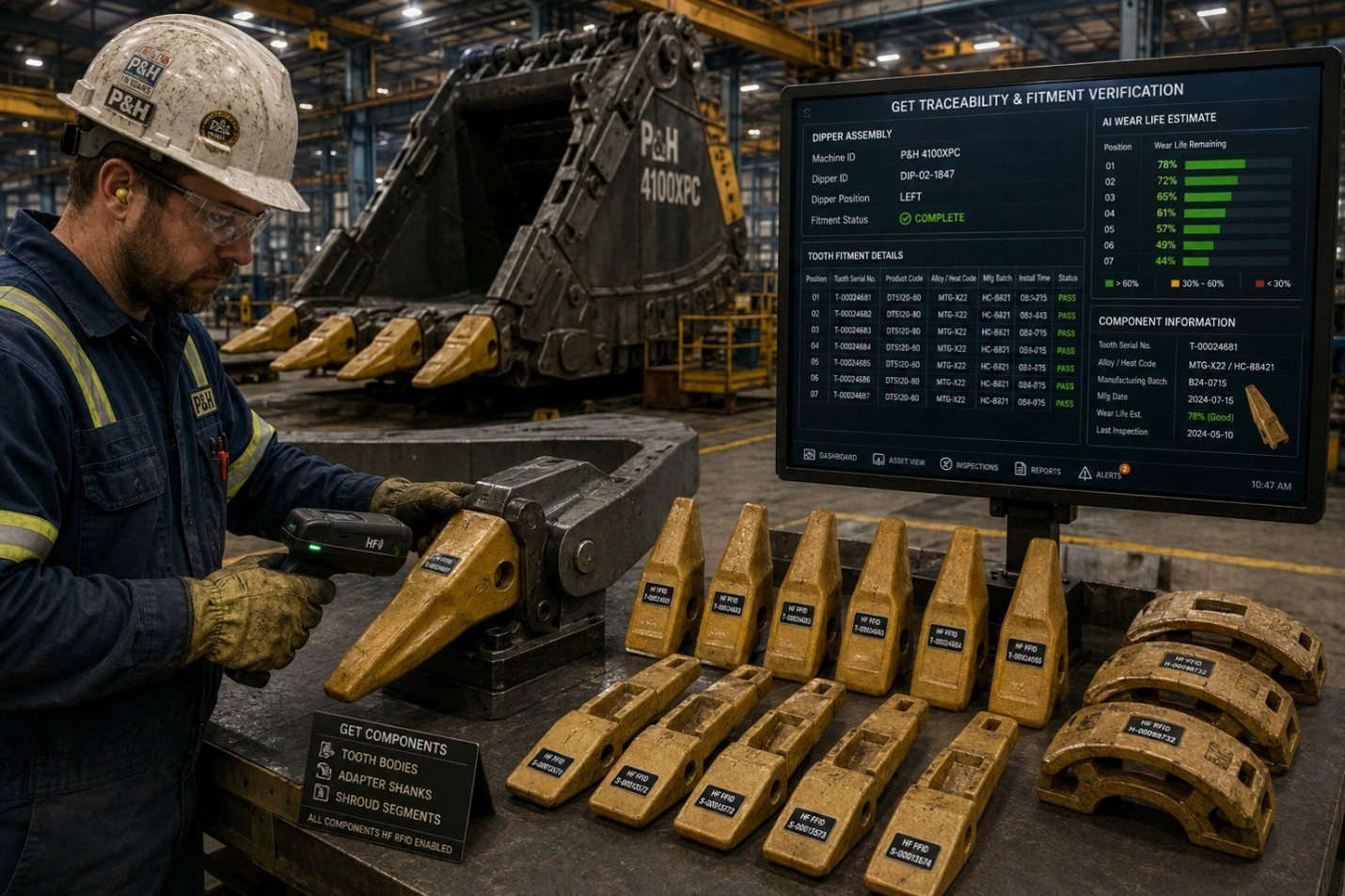
Ground-engaging tools including drag teeth, lip shrouds, wing shrouds, corner adapters, heel blocks, and dipper lip segments fitted to rope shovel dippers and hydraulic excavator buckets represent the highest per-hour wear cost component in surface mining operations. HF RFID tags embedded in GET adapter shanks, tooth bodies, and shroud mounting points allow readers at GET fitment stations in the manufacturing facility and at mine site GET management stations to automatically record which tooth pattern, alloy grade, heat treatment batch, and manufacturing process revision was applied to each serialized position on each dipper or bucket assembly. AI GET wear prediction models trained on RFID-linked production data and mine site GET consumption records from specific ore body conditions, bench height configurations, and digging cycle rates can generate position-specific wear rate predictions that allow mine maintenance planners to schedule GET changes before tooth loss events that damage costly dipper lips and bucket structural components.
HF RFID-Enabled GET Fitment Verification in Mining Equipment Manufacturing
Haul Truck Powertrain Assembly and Diesel-Electric System Traceability
Ultra-class and large rigid frame haul trucks operate diesel-electric or diesel-mechanical powertrains where the diesel engine, AC or DC electric drive system, wheel motors, dynamic retarding grids, and rear axle final drives each represent capital values exceeding one million dollars per component. LF RFID tags on engine blocks, wheel motor housings, and final drive cases allow identification through the machining, assembly, and powertrain test cell stages, creating a serialized component history that links manufacturing process parameters to field operating hour consumption and failure records. AI powertrain life consumption models trained on RFID-linked production data and fleet management system operating records can predict remaining useful life for wheel motors and final drives based on actual payload history, grade resistance, retarding event frequency, and thermal cycle accumulation, enabling mine maintenance planners to schedule component exchanges before unplanned failure events that strand a 360-tonne haul truck in a production critical position on a mine haul road.
GAO has supplied LF and UHF RFID reader systems to mining equipment manufacturing facilities for powertrain component identification and test cell traceability, replacing manual stamped-number recording processes that introduced transcription errors into safety-critical powertrain history records.
Safety-Critical Component Inspection Compliance and Rope Shovel Hoist System Traceability
Electric rope shovels operate safety-critical hoist ropes, crowd ropes, and dipper bail pin assemblies subject to ASME B30.5 mobile crane and B30.7 base-mounted drum hoist standards and mine-specific statutory inspection intervals governed by MSHA regulations in the United States and equivalent agencies in Australia, Canada, Chile, and South Africa. HF RFID tags on rope end terminations, bail pin assemblies, and hoist drum components allow inspection engineers to scan and confirm current inspection status, rope diameter measurement records, discard criteria evaluations, and certified inspector identity at each statutory interval without manual record retrieval from paper inspection logs. AI inspection compliance models generate automated overdue alerts when RFID-tracked hoist components approach their statutory inspection interval based on actual operating hours accumulated since last inspection, reducing the risk of statutory violation resulting in mine shutdown orders.
Work-in-Process Flow Across Large-Format Mining Equipment Assembly Bays
Mining equipment assembly, including the build of electric rope shovels with 150-tonne upper structures, 400-tonne haul trucks, or 800-tonne hydraulic mining excavators, progresses through sequential assembly bays over weeks or months, with structural assemblies, powertrain modules, hydraulic systems, and electrical cabinets converging at final assembly in a precise sequence. UHF RFID portal readers at assembly bay entry and exit points automatically record work order location, dwell time, and sub-assembly arrival sequence without operator data entry. AI scheduling and throughput models analyze live WIP position data against assembly build plans to identify critical path delays and enable production planners to authorize expedited component shipments or assembly bay resequencing before delivery commitments to mining customers operating on mine construction project timelines are missed.
Finished Equipment Dispatch, PIN Serialization, and Global Rebuild Network Traceability
Finished mining equipment requires accurate Product Identification Number (PIN) serialization, CE or ATEX certification documentation where applicable, export documentation for international mine site deliveries, warranty registration, and rebuild center stock records at the point of factory departure. UHF RFID tags integrated into machine frames and major assemblies allow dispatch teams to confirm complete machine configurations through RFID portal readers at loading dock gates and rail loading points. AI models cross-reference RFID-confirmed shipping records against mine site purchase orders and export compliance documentation, flagging missing attachments, unregistered GET configurations, or incomplete safety certification packages before machines are loaded onto specialized heavy transport vehicles or rail flatcars for mine site delivery.
Predictive Maintenance for Mining Equipment Manufacturing Assets
Mining equipment manufacturers operate large-scale production assets including robotic and semi-automatic welding systems for structural fabrication, large-capacity plate rolls and press brakes, horizontal boring mills for carbody and final drive machining, and AC and DC powertrain test cells. LF RFID identification of production machinery combined with vibration sensor arrays, motor current monitoring, and oil debris analysis feeds AI predictive maintenance models that detect early deterioration in boring mill spindle bearings, weld positioner drive systems, and plate roll gear assemblies. AI anomaly detection enables maintenance teams to schedule corrective action during planned weekend shutdown windows rather than responding to mid-shift mechanical failures that halt entire rope shovel or haul truck assembly lines.
End-to-End Operational Workflow: RFID Data Capture to AI-Driven Decisions in Mining Equipment
The complete data pipeline in an AI-enabled mining equipment manufacturing facility flows from physical asset identification through AI-driven decision output across production, quality, safety compliance, rebuild, and mine site fleet management functions.
Data Acquisition and RFID Event Capture
Fixed UHF RFID readers at structural fabrication cell gates, assembly bay entry and exit portals, GET fitment stations, powertrain test cells, safety inspection benches, and shipping dock gateways continuously identify RFID-tagged work orders, structural fabrications, major sub-assemblies, and finished machines. HF RFID readers at GET fitment stations, rope inspection points, and safety-critical component verification benches capture component identity, inspection status, and certification records in real time. LF RFID proximity readers on powertrain machining fixtures, final drive assembly stands, and wheel motor test cells confirm component identity for manufacturing history logging and AI life prediction data association. Handheld UHF readers allow rebuild center technicians and mine site GET management teams to audit RFID-tagged components without manual inventory count procedures, maintaining traceability continuity through the full machine life cycle from factory to mine site to rebuild.
Edge Processing and Local Alert Generation
Ruggedized industrial edge servers deployed within the manufacturing network aggregate raw RFID read events from all reader nodes and apply local event deduplication, zone-based filtering, and dwell-time calculation before forwarding structured data to enterprise systems. Edge processing ensures that time-critical production alerts, such as an overdue statutory inspection component being presented at a GET fitment station or a powertrain test cell result falling outside the acceptance band for a specific haul truck model, are generated with sub-second latency without requiring cloud connectivity. Edge AI models executing on factory-floor servers perform initial anomaly detection on structural welding parameter streams and powertrain test cell performance data, ensuring alerts reach quality engineers and safety compliance teams even during network disruptions common in remote mining equipment manufacturing facilities.
Middleware Integration and Enterprise System Connectivity
RFID middleware aggregates reader event data from multiple production zones and maps RFID identifiers to business objects within MES, ERP, CMMS, EAM, and mine site fleet management software. Standard integration protocols including REST APIs, MQTT, OPC-UA, and direct database connectors synchronize production events with SAP PM, IBM Maximo, Infor EAM, and mine site fleet management solutions. Bi-directional integration allows ERP production orders to push machine build specifications and MSHA or ATEX safety certification requirements to RFID middleware, presenting assembly checklists and compliance verification requirements to identified operators at critical assembly stations. Mine site fleet management software integration connects RFID-linked factory production records to machine operating hour, payload, and fault code histories in the field, providing the training data that AI powertrain life prediction and GET wear models require to generate accurate remaining useful life estimates for specific mine site operating conditions.
AI Analytics and Production Decision Output
Structured RFID event data from middleware feeds AI analytics models deployed on cloud infrastructure or privately hosted server environments. Supervised classification models detect structural weld non-conformances by correlating RFID-tracked SAW and FCAW process parameters with NDE inspection records. Time-series forecasting models predict WIP throughput rates for rope shovel, hydraulic excavator, and haul truck assembly lines. Anomaly detection models monitor powertrain test cell performance and robotic welding cell health. Warranty analytics models correlate RFID production histories with EAM field maintenance records to identify component batch failure patterns. GET wear prediction models combine factory RFID production data with mine site consumption records to generate ore-body-specific wear life estimates. AI outputs are delivered as production dashboards, EAM work orders, safety compliance alerts, and GET management recommendations within existing MES, ERP, and mine site fleet management interfaces.
AI and RFID Data Pipeline Workflow for Mining Equipment Manufacturing
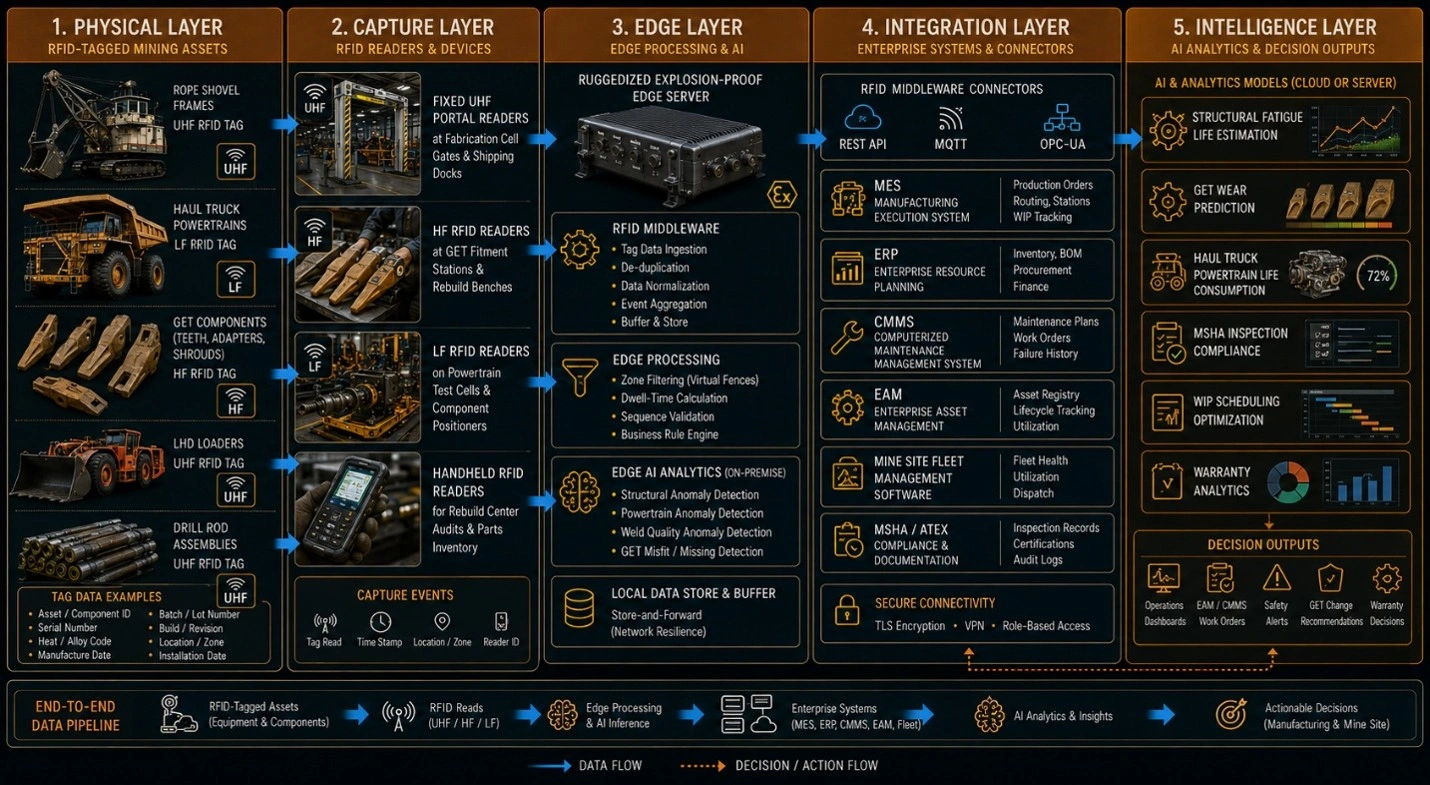
RFID Hardware, AI Software, and Deployment Infrastructure for Mining Equipment
A complete AI and RFID solution for mining equipment manufacturing integrates purpose-engineered hardware, layered software, communication protocols, and deployment models. Component selection is driven by the extreme RF environment of steel-intensive heavy manufacturing plants, the physical scale of rope shovel and haul truck assemblies, explosion-proof or intrinsically safe certification requirements for underground manufacturing environments, data latency requirements for safety-critical production alerts, and the IT governance policies of the mining equipment manufacturer.
RFID Hardware for Mining Equipment Manufacturing Environments
Fixed UHF RFID readers operating under EPC Gen2 / ISO 18000-63 are deployed at structural fabrication cell gates, assembly bay entry and exit portals, GET fitment stations, safety-critical component inspection benches, and shipping dock gateways. UHF antenna engineering in mining equipment plants must address the most severe RF multipath environments encountered in industrial manufacturing: electric rope shovel lower works frames measuring 15 to 20 meters in length, haul truck frames spanning 14 meters, and rope shovel gantry structures rising 10 meters or more above the assembly floor create extreme RF reflection and signal shadowing conditions. Pre-installation site surveys using calibrated spectrum analyzers and read-zone mapping tools are mandatory to achieve reliable detection without phantom reads. Portal antenna arrays at assembly bay transitions for rope shovels and large haul trucks typically require six to twelve antennas in optimized configurations to achieve full structural cross-section coverage.
HF RFID readers at 13.56 MHz, conforming to ISO 15693 or ISO 14443A standards, are deployed at GET fitment stations, hoist rope termination inspection benches, torque-critical fastener verification points, and warranty parts receiving counters at rebuild centers. HF tags embedded in GET adapter shanks, rope end fittings, and safety-critical pin assemblies provide tamper-resistant identification that survives the abrasive ore, hydraulic fluid, and high-temperature environments of both manufacturing and mine site operations. LF RFID readers at 125 to 134 kHz identify large cast and forged structural components, engine blocks, wheel motor housings, and final drive cases on machining fixtures and powertrain test cells. For underground mining equipment manufacturing environments, RFID hardware must carry IECEx or ATEX Zone 1 or Zone 2 certification depending on the mine site classification applicable to the manufacturing facility. GAO supplies UHF, HF, and LF RFID reader hardware, directional antenna products, and metal-mount tag configurations for mining equipment manufacturing, including IECEx and ATEX-certified reader models and IP68-rated tags validated for ore abrasion, hydraulic fluid, and high-pressure wash exposure.
AI Models and Software for Mining Equipment Manufacturing Intelligence
AI models deployed in mining equipment manufacturing include supervised classification models for structural weld non-conformance detection trained on SAW and FCAW process parameter data correlated with UT and RT NDE results, time-series forecasting models for assembly bay WIP scheduling and component delivery critical path management, anomaly detection algorithms for powertrain test cell health monitoring and robotic welding cell performance assessment, GET wear prediction models trained on RFID-linked alloy heat treatment data and mine site consumption records segmented by ore body hardness and bench configuration, haul truck wheel motor and final drive remaining useful life models trained on RFID production data and fleet management system payload and grade resistance histories, and warranty analytics models that correlate RFID production histories with EAM field maintenance claim records. All models are trained on data specific to the mining equipment manufacturer’s machine configurations, structural steel grades, GET alloy specifications, and the actual mine site operating conditions of the deployed fleet.
Supporting AI software includes RFID event data normalization pipelines, feature engineering modules deriving production variables from raw timestamps and dwell calculations, model training environments with version control for periodic retraining as new mine site field performance data accumulates, and inference engines delivering predictions within the latency constraints of assembly line and safety inspection decision workflows. Model explainability outputs support MSHA, Australian Mine Safety and Inspection Act, and Chilean Sernageomin compliance audit documentation where regulatory inspectors require evidence of the production controls applied to safety-critical hoist and structural assembly decisions.
Communication Protocols and Network Infrastructure
Fixed UHF RFID reader nodes connect to edge servers via wired industrial Ethernet, providing deterministic latency for assembly gate identification events where large equipment frames transit portal antennas at low speeds over read windows of five to fifteen seconds. Handheld UHF readers for rebuild center audits and mine site GET management connect via industrial Wi-Fi 6 networks or LTE private networks where Wi-Fi infrastructure is impractical across large mine site surface areas. MQTT protocol streams RFID event data from edge servers to cloud or server analytics environments. OPC-UA provides the standardized interface between RFID middleware and MES or SCADA systems at robotic welding cells and automated blast and paint lines. Mine site fleet management software integration uses proprietary API connections to Modular Mining DISPATCH, Wenco Fleet Management, Komatsu FrontRunner, and Hitachi iXMC systems to associate RFID-linked factory production records with machine operating hour, payload cycle, and fault code histories in the field.
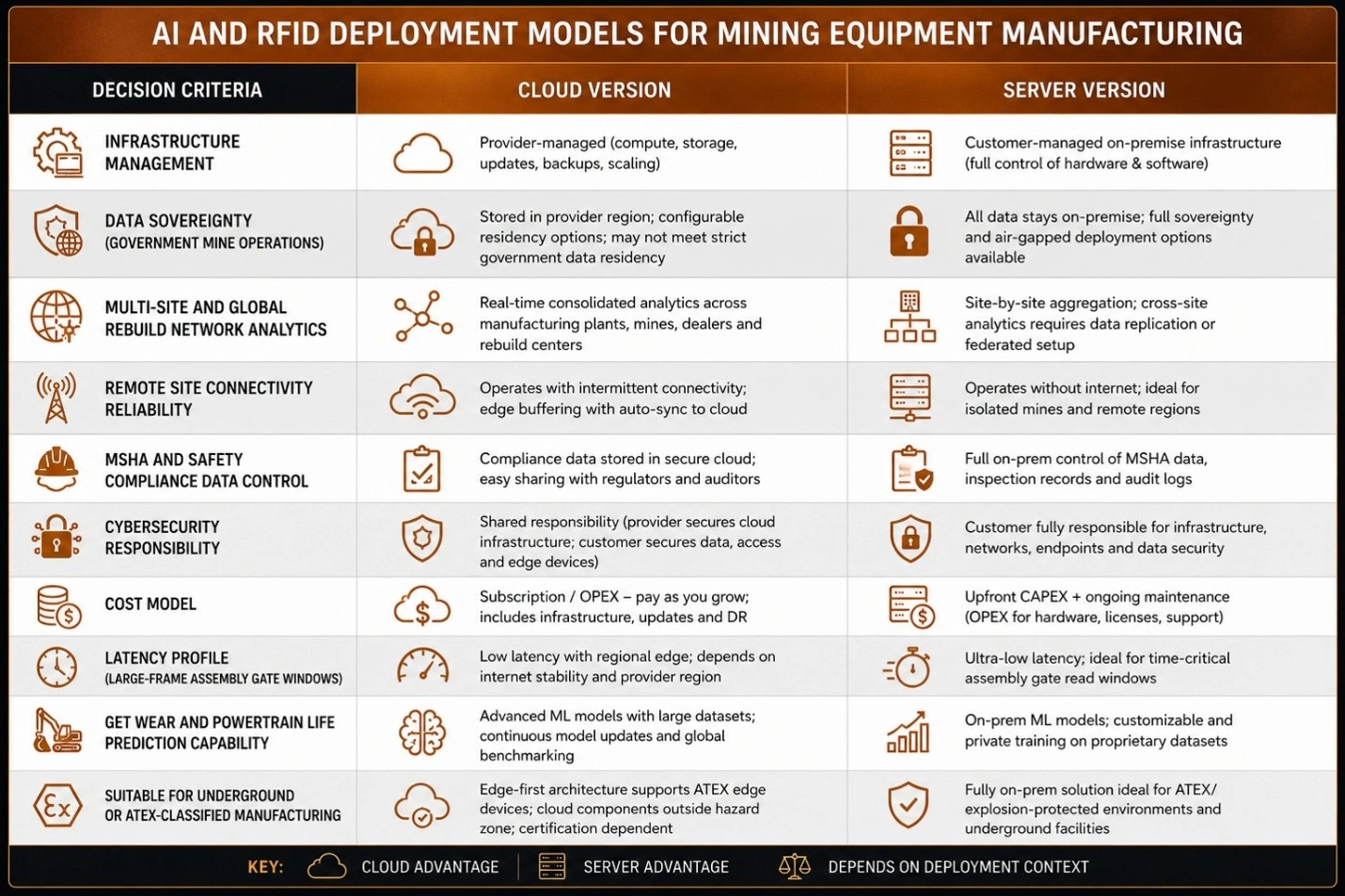
Cloud and Server Deployment Models for Mining Equipment AI Solutions
Mining equipment AI and RFID solutions are deployed in two primary models based on data governance requirements, remote manufacturing site connectivity, and multi-site operational footprint across global mining equipment manufacturing and rebuild operations.
The Cloud Version hosts AI analytics, RFID data management, GET wear analytics, warranty and rebuild analytics, and production reporting within cloud provider infrastructure such as AWS, Microsoft Azure, or Google Cloud. Cloud deployment suits mining equipment manufacturers operating multiple manufacturing facilities, global rebuild centers, and mine site service depots across different continents, where consolidated cross-facility production analytics, shared AI model training on aggregated GET wear and powertrain failure datasets from diverse ore body conditions, and multi-site WIP visibility deliver insights that single-facility deployments cannot achieve. Cloud-hosted AI models benefit from elastic compute for retraining GET wear prediction models as new mine site consumption data arrives from global fleet operations, and for multi-site haul truck powertrain life prediction models that require global payload and grade resistance datasets to achieve accuracy across diverse mining conditions. TLS 1.3 encryption in transit and AES-256 at rest, combined with role-based access control and Active Directory integration, address cybersecurity requirements for cloud-hosted production and mine site safety compliance data.
The Server Version deploys AI analytics and RFID middleware on privately hosted server infrastructure managed by the mining equipment manufacturer. This includes manufacturing facility edge servers, private data center environments, and customer-managed virtual server deployments, extending beyond on-premises installations to any privately controlled server infrastructure. Server deployment is preferred by mining equipment manufacturers supplying machinery to government-owned mining operations in jurisdictions with data sovereignty requirements, by manufacturers at remote facilities where satellite internet connectivity cannot support reliable cloud data synchronization, and by organizations whose security policies require production traceability and MSHA safety compliance records to remain within organization-controlled infrastructure. GAO supplies RFID hardware products and systems compatible with both cloud-connected and privately hosted server AAI environments, including IECEx and ATEX-certified hardware for underground manufacturing environments where explosion-proof certification is required.
AI and RFID Deployment Models for Mining Equipment Manufacturing
Cybersecurity and Safety-Critical Data Integrity
RFID networks in mining equipment manufacturing handle MSHA hoist inspection records, ATEX certification documentation, structural weld traceability records subject to AWS D1.1 and D1.5 audit requirements, GET serial number histories that support mine site safety investigation documentation, and EAM field maintenance claim histories subject to statutory record retention requirements. Industrial network segmentation isolates RFID reader networks from corporate IT using DMZ configurations. UHF Gen2 RFID tag memory bank encoding prevents unauthorized modification of safety-critical component identification data. Access to RFID middleware and AI analytics is governed through role-based authentication integrated with enterprise identity management systems, with tamper-evident audit logs supporting MSHA, Sernageomin, and Australian mine safety regulatory inspection requirements.
Key Benefits of AI and RFID Integration in Mining Equipment Manufacturing
Combining AI with RFID identification across mining equipment manufacturing, rebuild, and mine site service operations delivers measurable improvements in structural quality, safety compliance performance, GET cost management, powertrain life prediction accuracy, warranty cost reduction, and rebuild center traceability. Each benefit reflects operational dynamics specific to mining equipment rather than generic heavy manufacturing outcomes.
Structural Fatigue Life Documentation and NDE Efficiency
AI structural quality models that correlate RFID-tracked SAW and FCAW welding process parameters with UT, MT, and RT NDE results can identify which welding configurations and filler metal batches in high-yield-strength steel are statistically associated with sub-surface discontinuities in critical fatigue zones of rope shovel boom chord welds, dipper handle pivot connections, and hydraulic excavator revolving frame swing bearing ring welds. Directing NDE inspection resources toward RFID-identified high-risk weld joints, rather than applying uniform sampling, improves detection probability while reducing total inspection cycle time per machine. Mining equipment manufacturers using AI-guided NDE prioritization report improvements in structural non-conformance detection rates and reductions in field structural fatigue cracks that require costly boom or revolving frame repairs at remote mine sites.
GET Cost Management and Mine Site Wear Optimization
AI GET wear prediction models that combine RFID-linked alloy heat treatment production records with mine site consumption data segmented by ore body hardness index, bench height, digging cycle rate, and material fragmentation characteristics can generate position-specific wear life estimates that allow mine planners to optimize GET change intervals, minimize tooth loss events that damage costly dipper lips and bucket shells, and select the most appropriate alloy specification and tooth geometry for each specific ore body condition. Mining operations that implement AI-driven GET management consistently report reductions in GET cost per tonne of material moved and reductions in unplanned GET-related downtime on rope shovels and hydraulic excavators.
Haul Truck Powertrain Life Prediction and Fleet Availability
AI wheel motor and final drive remaining useful life models that combine RFID-linked manufacturing process records with fleet management system payload cycle counts, grade resistance profiles, and retarding event frequencies specific to each haul truck serial number can generate machine-specific component exchange recommendations weeks before projected failure, allowing mine maintenance planners to schedule component exchanges during planned maintenance windows without impacting production. Mining operations managing ultra-class haul truck fleets with AI-driven powertrain life prediction report reductions in unplanned haul truck availability losses and improvements in wheel motor mean time between failures compared with fixed-interval replacement programs.
MSHA and Statutory Inspection Compliance Reliability
Automated RFID tracking of hoist rope inspection intervals, statutory discard criteria evaluations, and certified inspector identity records eliminates the risk of MSHA or equivalent statutory inspection overruns that result in mine shutdown orders with immediate production impact. AI compliance models that monitor RFID-tracked inspection status against actual operating hours accumulated since last inspection generate proactive overdue alerts before statutory violation occurs, replacing manual paper log monitoring that creates compliance gaps during high-production periods when inspection scheduling receives less attention. Mining operations using RFID-linked hoist inspection compliance management consistently report improvements in statutory inspection compliance rates and reductions in MSHA citation events related to hoist and rigging inspection documentation.
Rebuild Center Traceability and Component Life Cycle Management
RFID traceability records that follow major components including wheel motors, final drives, hydraulic pumps, and swing drives from original manufacturing through field service life and into rebuild centers allow mining equipment rebuild operations to verify original build specifications, identify components that have exceeded OEM rebuild eligibility criteria based on operating hour history, and confirm that rebuild parts meet the same alloy, heat treatment, and dimensional specifications as new OEM components. AI rebuild analytics models that correlate RFID-linked component histories with post-rebuild field performance records can identify which rebuild process variables most reliably predict full-life performance recovery, enabling rebuild centers to optimize process controls and warranty provisions for rebuilt major assemblies.
Warranty Cost Reduction and Supplier Corrective Action
RFID production traceability records that connect each shipped machine PIN to its complete structural fabrication history, GET alloy batch records, powertrain assembly records, and safety certification documentation allow mining equipment manufacturers to distinguish design-driven warranty failures from manufacturing process variation and supplier component quality issues. AI warranty analytics models identify specific component batch cohorts associated with elevated field failure rates within weeks of mine site deployment, enabling proactive supplier corrective action before widespread warranty cost exposure develops across the global installed fleet.
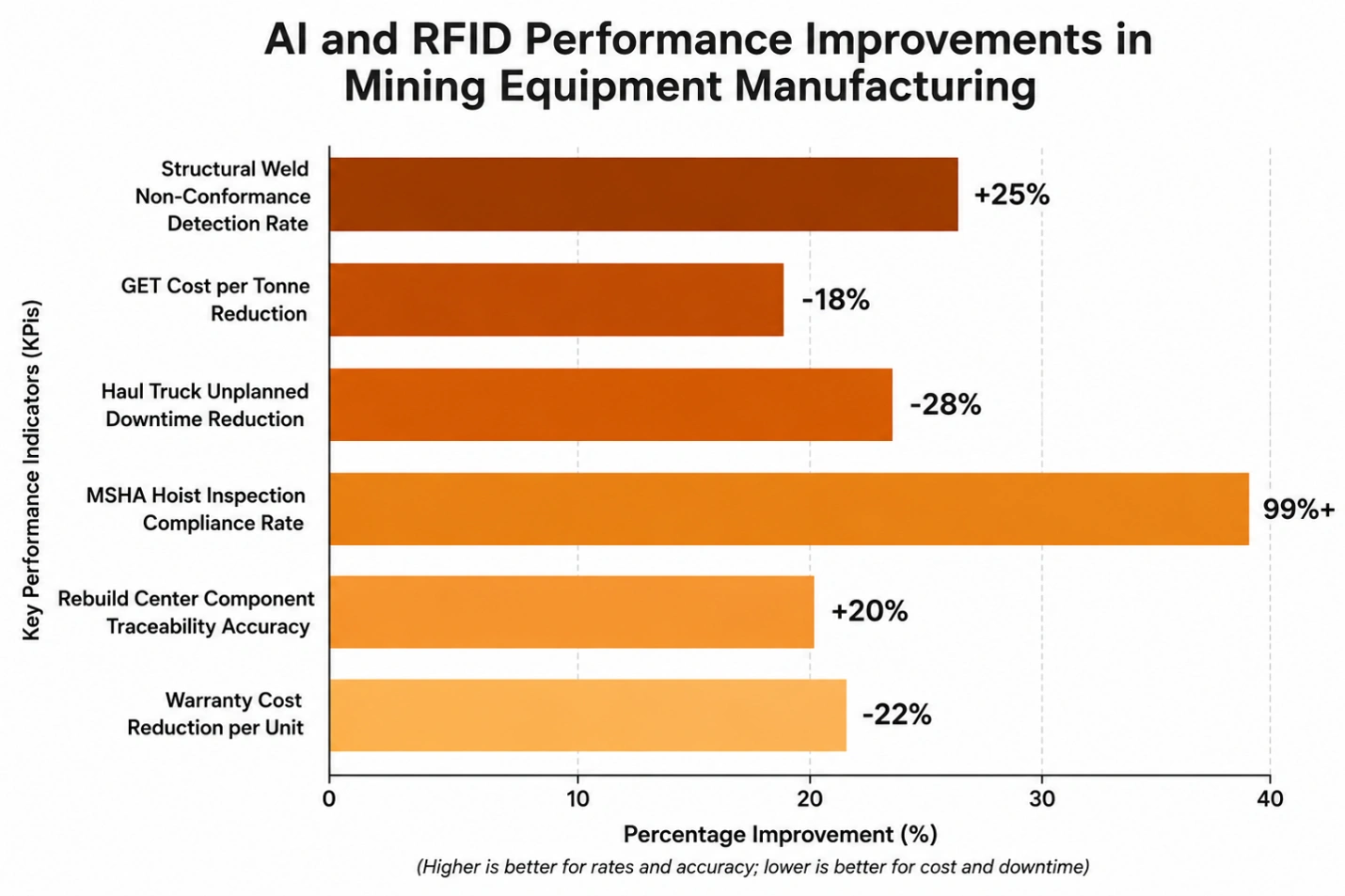
AI and RFID Performance Improvements in Mining Equipment Manufacturing
Implementing AI and RFID in Mining Equipment Manufacturing: Technical Summary and Recommendations
AI and RFID solutions for mining equipment manufacturing address structural weld traceability, safety-critical hoist and GET compliance documentation, haul truck powertrain life prediction, GET wear optimization, and warranty cost management challenges that manual identification and paper-based documentation systems cannot resolve at the scale and reliability required by mine sites operating under continuous production pressure and statutory safety obligations. The combination of UHF, HF, and LF RFID identification with AI analytics creates a production intelligence layer that connects mining equipment factory assembly data to mine site field performance records, enabling AI models to improve as field performance data accumulates from global fleet operations across diverse ore body conditions and mining jurisdictions.
Successful deployment begins with pre-installation RFID site surveys in each production area to address the extreme RF interference conditions created by rope shovel and haul truck structural assemblies, high-current SAW welding equipment, and blast booth metal structures. IECEx or ATEX-certified RFID hardware must be specified for any manufacturing areas classified under mine safety explosion protection requirements. LF and UHF metal-mount RFID tags rated for ore abrasion, hydraulic fluid, and high-pressure wash exposure must be validated in the specific production environment before full-scale deployment. Middleware integration with existing MES, ERP, EAM, CMMS, and mine site fleet management software requires early API mapping, particularly for fleet management software integration where field performance data is the primary training input for AI GET wear and powertrain life prediction models.
Mining equipment manufacturers should establish KPIs before implementation: target improvements in structural NDE non-conformance detection rates, MSHA hoist inspection compliance rates, GET cost per tonne of material moved, haul truck wheel motor mean time between failures, and warranty cost per machine shipped. AI model training requires six to twelve months of RFID-linked production, NDE inspection, and mine site field performance data collection before predictive recommendations achieve the accuracy required for high-confidence maintenance planning decisions on assets with capital values exceeding ten million dollars per machine. Phased deployment starting with the structural fabrication department and GET fitment stations typically delivers the highest early return in a mining equipment manufacturing facility.
Ranked among the top 10 RFID and BLE hardware suppliers globally, GAO has supplied UHF, HF, and LF RFID hardware products and systems to mining equipment manufacturers and heavy industrial machinery operations across North America. With three decades of R&D investment and stringent quality assurance processes, GAO provides engineering support for hardware selection, explosion-proof certification guidance, site survey, and deployment commissioning both remotely and onsite. To learn more about RFID hardware products, IECEx and ATEX-certified reader configurations, and technical support for mining equipment manufacturing applications, contact GAO’s engineering team or explore the product catalog on gaorfid.com.
Building the Future of Industrial AI and IoT with Aperture Venture Studio and GAO RFID Inc.
For more than three decades, GAO Group of Companies has invested heavily in R&D of industrial RFID, BLE, and IoT technologies, including the hardware products and systems that power AI asset tracking, structural weld quality intelligence, GET wear prediction, haul truck powertrain life estimation, MSHA safety compliance, and production intelligence solutions for mining equipment manufacturing. Since generative AI was proven useful in industrial mining and heavy equipment applications, we have been developing AI and IoT (including RFID and BLE) technologies, and we have founded Aperture Venture Studio to build, launch, and scale next-generation AI and IoT companies for mining equipment manufacturers and the broader machinery manufacturing industry.
Aperture has attracted top AI and IoT technical experts, entrepreneurial and operational executives, influential investors, and leading mining equipment and industrial machinery companies. We have also developed the Aperture Ventures Summit and TekSummit to advance discussions on AI and IoT in heavy mining equipment manufacturing and mine site fleet operations, building diversified technical communities for AI and IoT innovation across the global mining equipment industry.
We welcome you to join us as:
- Advisors, Co-founders, or Employees
- Investors, or
- Customers.