
AI and RFID for Mixed-Use Developments
AI-Enabled Property Operations in Mixed-Use Developments
Mixed-use developments combine residential towers, retail stores, offices, hospitality facilities, parking structures, loading areas, and shared amenities within one property environment. AI-enabled RFID solutions help property operators identify, locate, monitor, and manage physical assets and operational activities across these interconnected spaces. UHF RFID can support long-range identification of tagged assets and inventory, while HF and LF RFID can address shorter-range identification and controlled access scenarios. AI adds value by converting RFID observations into operational insights, such as detecting abnormal asset movement, predicting maintenance requirements, optimizing inventory, identifying workflow bottlenecks, and supporting security operations. For mixed-use developments, the practical objective is not simply to deploy RFID readers. It is to connect identification data with building management, facilities management, parking, security, work-order, tenant-service, and analytics systems so that property teams can make faster and more informed decisions.
AI and RFID Operational Map for Mixed-Use Development
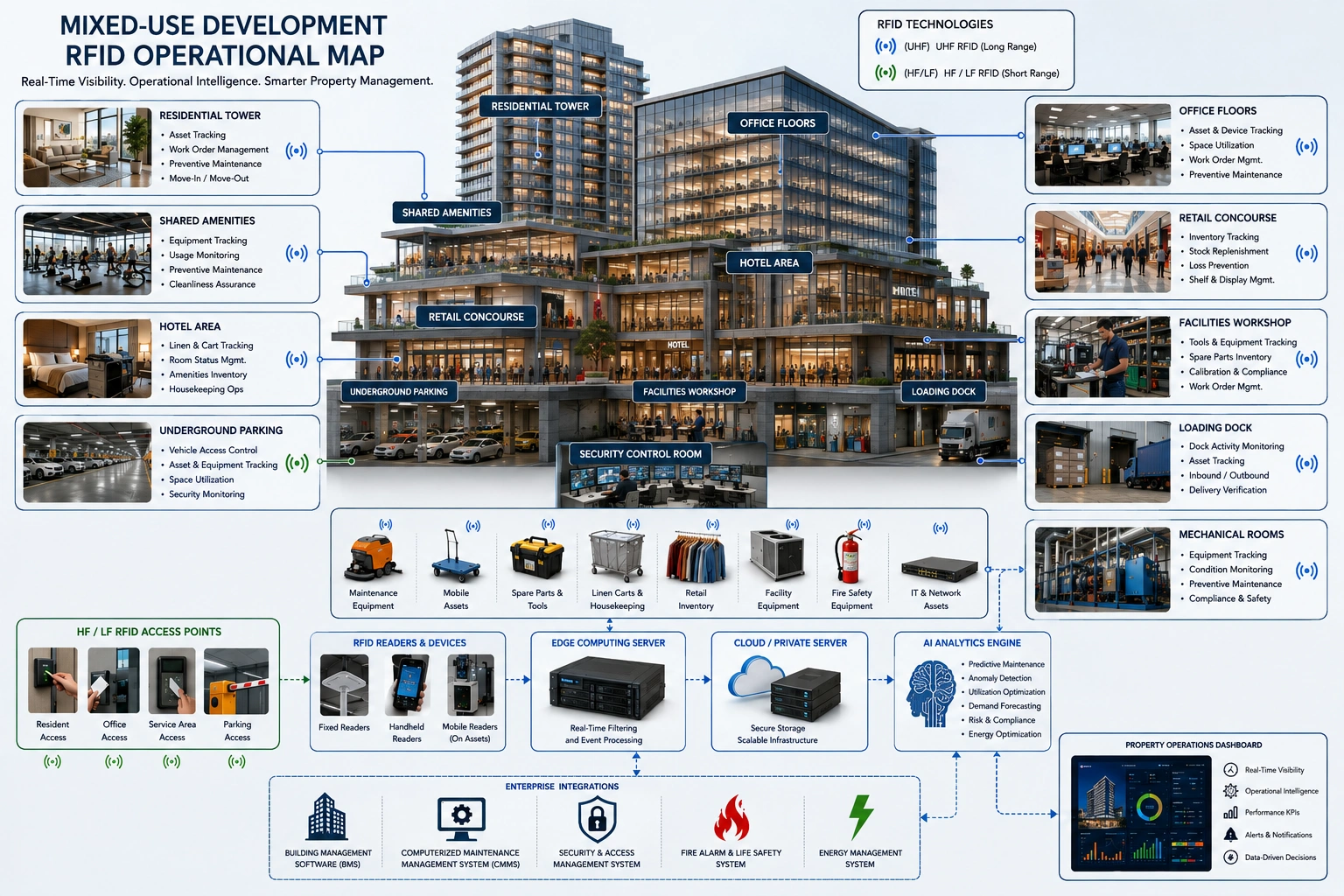
Enterprise infographic showing how UHF RFID asset tracking and HF/LF RFID access points connect residential, office, hotel, retail, parking, facilities, loading, and mechanical zones to edge processing, AI analytics, enterprise systems, and property operations dashboards.
How AI-Enabled RFID Changes Mixed-Use Property Operations
AI-enabled RFID for mixed-use developments combines physical identification with data analysis and operational automation. RFID supplies machine-readable observations about tagged objects, while AI, machine learning, computer vision, and related AIoT methods help interpret those observations alongside information from building systems and business applications.
The resulting solution can support several property functions:
- AI asset tracking for facilities equipment, tools, mobile maintenance carts, housekeeping equipment, and shared-property assets.
- AI inventory management for maintenance parts, consumables, retail stock, hotel supplies, and engineering stores.
- AI facilities management by correlating asset identity, location, service history, sensor readings, and work orders.
- AI preventive and predictive maintenance by identifying equipment usage patterns and abnormal maintenance activity.
- AI security operations by identifying unexpected movement of tagged assets through designated zones.
- AI parking and loading operations by associating authorized vehicles, equipment, deliveries, and access events with operational records.
- AI tenant and property services by improving visibility into shared equipment and service-response workflows.
- AI housekeeping and hospitality operations by tracking carts, linen-related assets, equipment, and high-value movable property where RFID tagging is operationally appropriate.
The important engineering principle is that RFID observations should become part of an operational workflow rather than remain isolated reader events. A reader detecting a tagged maintenance pump, for example, has limited value by itself. When that event is associated with the pump’s asset record, current work order, technician assignment, service history, and equipment condition, the system can provide substantially more useful operational intelligence.
AI Asset Management Across Shared Property Areas
Mixed-use developments create an unusual asset-management problem because many assets cross organizational and physical boundaries. A maintenance tool may move from an engineering workshop to a residential tower. A cleaning cart may move between a hotel and common areas. Spare parts may be transferred from a central engineering store to a retail tenant service area.
AI can establish expected movement patterns and identify deviations. A mixed-use property operator can define normal zones, authorized movements, custody requirements, and service workflows for different asset classes. RFID events then provide the identification layer needed to compare actual movement with expected behavior.
GAO supplies RFID hardware products and systems that can be incorporated into these workflows, including fixed readers, antennas, tags, and handheld RFID equipment selected according to read range, material characteristics, mounting conditions, and operating environment.
Mixed-Use Development Applications and Deployment Scenarios
Different areas of a mixed-use property create different RFID and AI requirements. A successful implementation normally starts with operational processes rather than reader installation.
| Mixed-Use Development Area | AI Application | RFID Role | Operational Outcome |
|---|---|---|---|
| Facilities engineering | Predictive maintenance and asset intelligence | Identify equipment and maintenance assets | Better service prioritization and asset visibility |
| Engineering stores | AI inventory management | Identify parts, tools, and consumables | Faster stock reconciliation |
| Residential towers | Common-area asset management | Track shared equipment and service assets | Reduced asset loss and search time |
| Retail areas | Inventory and service support | Identify tagged merchandise or operational assets | Improved item visibility |
| Hotel operations | Housekeeping and equipment tracking | Identify carts and selected movable assets | Better utilization and accountability |
| Parking facilities | Asset and access-event intelligence | Identify tagged equipment and authorized items | Better control of operational movements |
| Loading docks | Delivery and material flow analysis | Identify tagged goods, equipment, or containers | More traceable receiving workflows |
| Security operations | Abnormal movement detection | Capture tagged-object movement | Faster investigation and response |
| Shared amenities | Equipment utilization analysis | Identify movable property | Better scheduling and replacement planning |
Facilities Engineering and Maintenance
Facilities engineering is one of the strongest applications because mixed-use developments contain large populations of mechanical, electrical, plumbing, life-safety, and building-service assets.
Relevant equipment may include:
- HVAC air-handling units and associated service equipment
- Pumps and motor-driven equipment
- Electrical distribution equipment
- Generator and emergency-power support equipment
- Fire protection service equipment
- Building automation system components
- Water-treatment and plumbing equipment
- Maintenance tools and test instruments
- Portable ladders, carts, and specialized service equipment
- Replacement motors, valves, filters, belts, and other spare parts
RFID can associate physical equipment with digital asset records. AI can then evaluate service history, work-order frequency, location, operating conditions, and inspection observations to identify assets requiring attention.
The engineering challenge is data quality. A predictive model cannot compensate for incorrect asset IDs, inconsistent maintenance records, missing location information, or poorly defined equipment hierarchies. RFID implementation should therefore be coordinated with the property’s computerized maintenance management system (CMMS) and asset master-data structure.
Retail and Commercial Tenant Operations
Retail environments introduce additional requirements because tenant spaces may have independent inventory systems, operating procedures, and security policies. The property operator should not assume that all tenant inventory needs to be placed under one RFID system.
A more practical approach is to identify shared-property processes where RFID provides clear operational value. Examples include loading-dock equipment, shared service tools, tenant-maintenance assets, building-owned fixtures, high-value equipment, and controlled engineering materials. AI can analyze movement patterns and service requests across these processes without unnecessarily combining tenant-specific commercial data.
Parking, Loading Docks, and Service Access
Parking structures and loading docks create controlled transition points where physical movement can be associated with property operations. Tagged maintenance equipment leaving an engineering store can be associated with a work order. A tagged delivery container entering a designated receiving area can be matched with a scheduled delivery record. A high-value property asset moving through a restricted service corridor can generate an exception when the movement does not match an authorized workflow.
Such implementations require careful consideration of reader placement, antenna orientation, metal structures, vehicle interference, RF reflections, and privacy requirements.
RFID Deployment Scenario in a Mixed-Use Development
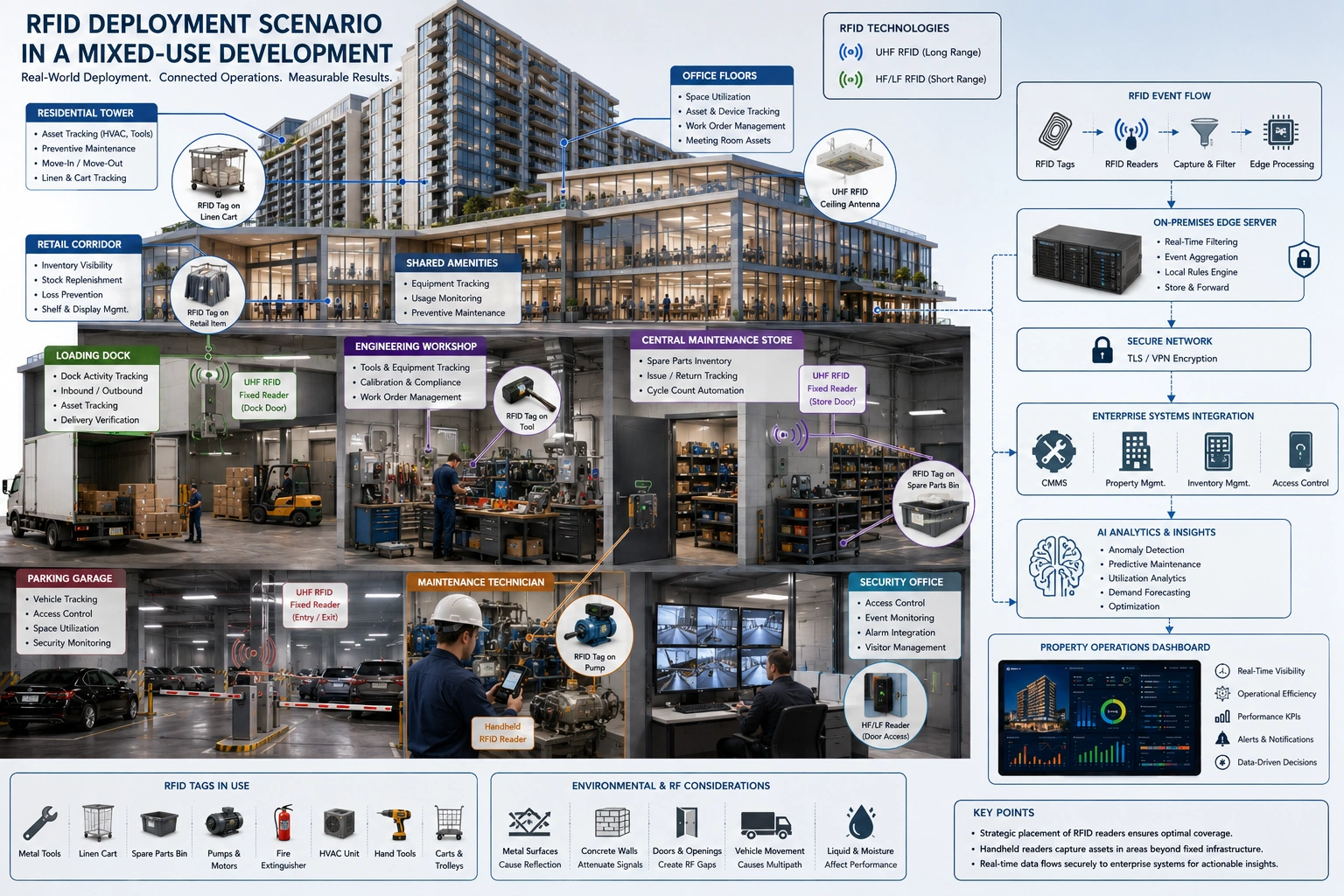
Realistic cutaway view showing RFID readers, antennas, handheld devices, and tagged assets deployed across loading, retail, residential, workshop, maintenance, parking, and security areas, with event data flowing to edge processing, enterprise systems, and AI analytics.
Mixed-Use Development Operational Challenges AI Can Address
The value of AI becomes clearer when mapped to specific property-management problems.
Asset Search and Misplacement
Facilities teams can lose substantial time searching for shared tools, carts, test equipment, and maintenance assets distributed across multiple towers and service areas. RFID provides identity observations at defined checkpoints, while AI can use historical movement data to estimate likely locations or flag unusual movement.
Maintenance Prioritization
A mixed-use development can contain thousands of maintainable assets with different criticality levels. AI can help prioritize work by considering asset criticality, service history, failure patterns, inspection findings, and operational impact. RFID strengthens this process by reliably associating technicians and physical equipment with the corresponding digital asset record when the workflow is designed correctly.
Inventory Accuracy
Engineering stores must maintain filters, bearings, belts, valves, electrical components, plumbing parts, safety supplies, and other consumables. Manual counting can become difficult when materials move frequently between the store and multiple buildings. RFID-assisted inventory processes can improve identification accuracy, while AI can forecast consumption, detect unusual withdrawals, and support reorder decisions.
Unauthorized Asset Movement
Security teams generally need more than camera footage to understand an asset movement event. RFID can establish the identity of the object involved, while AI can correlate the event with access permissions, work orders, scheduled activities, and historical behavior. The result is a more contextual security alert rather than a simple reader notification.
From RFID Events to AI-Driven Property Decisions
A technically sound mixed-use RFID deployment follows a data path that connects physical events to operational action.
Data Acquisition at the Property Level
The process begins with RFID tags and readers positioned according to the workflow being monitored. UHF RFID is generally suitable where longer read ranges and portal-style or area-based identification are needed. HF RFID is useful for shorter-range interactions where controlled proximity is desirable, while LF RFID can be appropriate for selected specialized identification and access scenarios.
Handheld RFID readers add another capability by allowing facilities personnel to perform inventory checks, asset audits, commissioning activities, and field verification. Reader selection should account for tag orientation, reader-to-tag distance, material composition, metal surfaces, liquid-filled objects, doorway geometry, RF interference, and required read-rate performance.
Edge Processing and Event Filtering
Raw RFID observations can contain duplicate reads and transient events. An edge computing layer or RFID middleware can apply filtering rules, deduplicate observations, associate readers with physical zones, and transform low-level reads into meaningful events.
For example:
Raw event: Tag ID detected by Reader 07.
Operational event: Engineering pump EP-204 entered the north maintenance workshop.
AI-ready event: EP-204 entered the workshop outside its scheduled service window while an open corrective-maintenance work order exists.
This transformation is essential because AI models generally produce more useful results from contextualized events than from unprocessed reader data.
Enterprise Software Integration
The RFID event layer can exchange information with:
- CMMS and computerized maintenance management software
- Building management systems (BMS)
- Building automation systems (BAS)
- Property management systems (PMS)
- Inventory management software
- Access-control systems
- Security information systems
- Work-order management software
- ERP systems
- Data warehouses and analytics environments
- Cloud-based AI services
- Privately hosted databases and application servers
APIs, message queues, webhooks, database interfaces, or middleware connectors can be used depending on the existing IT environment.
RFID Hardware, AI Software, and Deployment Models for Mixed-Use Developments
A mixed-use development requires RFID hardware and AI software to be selected around specific workflows rather than deployed uniformly throughout the property. Building construction, asset materials, read zones, network availability, tenant boundaries, and security requirements all affect the design.
RFID Hardware for Property Operations
- UHF RFID fixed readers: Suitable for engineering stores, loading areas, service entrances, controlled corridors, and other locations where multiple tagged assets must be identified automatically.
- UHF RFID antennas: Antenna type, polarization, gain, orientation, and mounting position should be selected according to the physical read zone and surrounding materials.
- UHF RFID tags: Asset tags should be selected according to the substrate. Metal-mount tags are important for steel equipment, while specialized tags may be required for equipment containing liquids or dense materials.
- HF RFID readers and tags: Appropriate for short-range identification, controlled interactions, selected access applications, and workflows where close proximity is desirable.
- LF RFID equipment: Useful for selected legacy identification, specialized access, and proximity-oriented applications.
- Handheld RFID readers: Support facilities inspections, inventory counts, asset audits, commissioning, and field-service activities.
- RFID gateways and edge devices: Provide local connectivity and event processing between readers and property IT systems.
- Network infrastructure: Ethernet, Wi-Fi, VLANs, firewalls, and secure remote connectivity support communication between RFID equipment and software.
GAO provides RFID hardware and systems that can be configured for fixed, handheld, and workflow-specific deployments. Hardware selection should be validated through a site survey and proof-of-concept rather than based only on nominal reader specifications.
AI Methods for Mixed-Use Property Management
AI methods become useful when RFID observations are combined with operational data.
- Anomaly detection: Identifies unusual asset movements, inventory withdrawals, or equipment activity.
- Predictive analytics: Estimates maintenance requirements from historical work orders, asset conditions, usage patterns, and related sensor data.
- Demand forecasting: Helps engineering stores anticipate consumption of frequently used maintenance materials.
- Classification models: Categorize asset movements, service events, or operational exceptions.
- Time-series analysis: Evaluates recurring patterns in equipment utilization and maintenance activity.
- Optimization models: Help allocate shared equipment, technicians, or maintenance resources.
- Natural language processing: Can extract structured information from maintenance notes, inspection reports, and work-order descriptions.
- Computer vision: Can complement RFID in locations where visual confirmation of an asset, vehicle, package, or operational condition is necessary.
The AI model should remain subordinate to the operational workflow. A property operator should be able to understand why an alert was generated and what action is expected.
Cloud Version and Server Version
A Cloud Version can host RFID event processing, databases, analytics, dashboards, and AI services within managed cloud infrastructure. This approach is appropriate when multiple properties need centralized monitoring, remote administration, scalable data storage, and integration with cloud-based property-management applications.
A Server Version can run software on customer-managed edge servers, private data centers, facility servers, or other privately hosted infrastructure. This model can be preferable when property operators require greater control over data location, network isolation, integration with existing private systems, or continued local operation during external connectivity interruptions.
A hybrid implementation can keep time-sensitive RFID event processing close to the property while sending selected operational data to cloud-based analytics.
Security and Data Governance for AI-Enabled RFID
RFID deployments in mixed-use developments can generate information about physical assets, employee activities, service operations, and access events. Security therefore needs to be considered from the reader layer through the application layer.
Network and Device Security
RFID readers and edge devices should be placed on appropriately segmented network zones. Firewalls, access-control policies, encrypted communications, secure credentials, device hardening, and controlled administrative access reduce the attack surface.
Useful controls include:
- Network segmentation for RFID devices and operational systems
- Role-based access control
- Strong authentication for administrative interfaces
- Encrypted communications where supported
- Secure API authentication
- Device inventory and firmware-management procedures
- Centralized logging and security monitoring
- Regular vulnerability assessment
- Backup and recovery procedures
- Controlled remote administration
Privacy and Tenant Boundaries
Mixed-use developments can include residential occupants, commercial tenants, hotel guests, contractors, employees, visitors, and delivery personnel. RFID should therefore be used according to a clearly defined operational purpose.
Property operators should distinguish between asset identification and individual tracking. A maintenance asset can normally be tracked as an operational object without requiring unnecessary collection of personal information. Where RFID events can be associated with people, access credentials, or employee activity, applicable privacy requirements and organizational policies should be considered during system design. AI models should also use the minimum information necessary for the intended operational outcome.
Engineering Design, Commissioning, and Integration Considerations
RFID performance inside mixed-use buildings can vary significantly from laboratory conditions. Concrete structures, steel beams, elevator equipment, mechanical rooms, electrical infrastructure, glass, liquids, shelving, vehicles, and dense inventory can affect radio-frequency behavior.
Site Survey and Read-Zone Design
Before installation, engineering teams should document:
- Asset dimensions and materials
- Tag mounting surfaces
- Expected tag orientation
- Required read distance
- Door and corridor dimensions
- Reader and antenna mounting locations
- Metal structures and RF-reflective surfaces
- Electrical equipment that may affect installation
- Network availability
- Required read accuracy
- Expected asset throughput
- Areas requiring exclusion or shielding
A reader should not simply be installed wherever power and network connectivity are available. The read zone must correspond to the business event being detected.
Commissioning and Testing
Commissioning should test real tagged assets rather than relying only on sample tags. Useful acceptance tests include:
- Read-rate testing under normal asset orientation
- Detection testing at different distances
- Duplicate-event testing
- False-read testing outside the intended zone
- Doorway and portal testing
- Metal and liquid asset testing
- Handheld inventory verification
- Network interruption testing
- Middleware event-filtering validation
- API integration testing
- CMMS and inventory-record reconciliation
- AI alert validation against known operational scenarios
A proof-of-concept covering representative zones is often more informative than a property-wide deployment performed without field validation.
Integration with Property Software
The RFID solution should establish consistent identifiers between physical assets and software records. Asset IDs, location codes, equipment hierarchies, work-order numbers, inventory SKUs, and property zones should use controlled mappings.
RFID event → zone identification → asset identity → business context → software record → AI analysis → recommended action → work order or operational response.
This prevents the RFID system from becoming another isolated source of operational data.
Operational Improvements and Business Value
Combining AI with RFID can improve mixed-use property operations because physical asset observations become actionable operational information.
Faster Asset Location and Service Response
RFID can reduce the time technicians spend manually searching for shared tools and equipment. AI can further improve the process by identifying likely locations from recent movement patterns and active work orders. The KPI should be measured as actual asset search time, mean time to locate, or service-response time, rather than simply counting RFID reads.
More Accurate Engineering Inventory
RFID-assisted counts can provide faster reconciliation of engineering stores. AI forecasting can then estimate future consumption using historical withdrawals, seasonal property activity, planned maintenance, and recurring service requirements. This can reduce both excessive inventory and stockouts, although forecasting should account for emergency-maintenance requirements and critical spare-parts policies.
Better Maintenance Prioritization
AI can combine RFID-based asset identity and movement with CMMS history, inspection information, equipment criticality, and service frequency. For example, a frequently serviced pump associated with repeated corrective work orders can receive higher maintenance attention than a similar low-criticality asset with stable service history. The AI recommendation should remain explainable enough for facilities engineers to validate before a maintenance decision is executed.
Improved Asset Security
RFID can establish physical movement events, while AI can distinguish routine movement from potentially abnormal activity. A useful alert might identify:
- Asset: Portable electrical test instrument
- Expected zone: Engineering workshop
- Observed zone: Loading dock
- Context: No open work order or approved transfer
- AI assessment: Unusual movement
- Action: Security or facilities verification
This is more operationally useful than simply notifying staff that an RFID tag was detected.
Better Utilization of Shared Equipment
Mixed-use developments frequently share carts, tools, maintenance equipment, inspection instruments, and other resources across buildings. AI can analyze RFID-derived utilization histories to identify equipment that is consistently underused, frequently unavailable, or concentrated in one property zone. Property managers can use these insights when deciding whether to relocate, consolidate, or purchase additional equipment.
KPIs for AI and RFID in Mixed-Use Developments
Performance should be measured using operational outcomes rather than technology deployment volume. Relevant KPIs include:
- Asset location accuracy
- Mean asset search time
- RFID read accuracy
- Inventory reconciliation accuracy
- Engineering stockout rate
- Spare-parts inventory turnover
- Maintenance response time
- Mean time to repair
- Preventive-maintenance compliance
- Unplanned equipment downtime
- Work-order completion time
- Asset utilization rate
- Unauthorized movement detection rate
- False-alert rate
- Loading-dock processing time
- Equipment transfer time between properties
- Technician productivity
- Manual inventory labor hours
- Asset loss rate
- Cost per tracked asset
A baseline should be established before deployment. Otherwise, an organization may know how many tags and readers were installed without knowing whether property operations actually improved.
Standards, Interoperability, and Deployment Best Practices
RFID projects should consider relevant technical standards and organizational requirements rather than treating RFID as a standalone hardware installation. For UHF RFID deployments, EPCglobal/GS1-related identification practices and the EPC Gen2 / ISO/IEC 18000-63 family are important references. HF and LF deployments may use different standards depending on the selected technology and application.
Integration should also consider established enterprise interfaces and data practices used by property-management, maintenance, access-control, and building-management systems.
Key engineering practices include:
- Define the operational event before selecting RFID hardware.
- Establish asset-identification conventions before large-scale tagging.
- Perform RF site surveys in representative building areas.
- Test tags on the actual equipment substrates.
- Separate reader infrastructure from general user networks where appropriate.
- Use middleware to normalize and filter reader events.
- Establish API and data ownership requirements early.
- Validate AI recommendations against known operational outcomes.
- Keep humans responsible for safety-critical maintenance decisions.
- Establish cybersecurity and firmware-management procedures.
- Document reader locations, antenna orientation, tag placement, and configuration.
- Monitor false reads and missed reads after commissioning.
- Review KPIs periodically and adjust read zones and workflows when necessary.
- Expand the deployment based on demonstrated operational value rather than installing RFID throughout every area.
Where GAO Fits in Mixed-Use RFID Deployments
GAO supports organizations with RFID, BLE, and other IoT hardware products and systems that can be applied to asset identification, inventory workflows, facilities operations, security processes, and other connected-property requirements. Its hardware portfolio can support different identification ranges and deployment approaches, allowing system integrators and property technology teams to select equipment according to actual operating conditions.
Headquartered in New York City and Toronto, Canada, GAO is ranked among the top 10 leading B2B and B2G, with a lesser degree of B2B2C and B2D, BLE and RFID suppliers globally. GAO’s role in a mixed-use development project can extend beyond supplying readers or tags to providing technical guidance for hardware selection, deployment configuration, and system implementation.
GAO’s broader organization has served U.S. and Canadian customers for three decades, including Fortune 500 companies, leading R&D organizations, prestigious universities, and government agencies. Significant investment in product and system R&D, stringent quality-assurance processes, and remote or onsite technical support provide useful engineering resources for projects where RFID performance and operational reliability are important.
Key Takeaways for AI-Enabled Mixed-Use Developments
AI-enabled RFID is most valuable when it solves a defined mixed-use property problem such as asset search, engineering inventory, maintenance prioritization, equipment utilization, controlled material movement, or operational security.
The implementation should begin with workflows and measurable KPIs rather than technology selection. UHF, HF, and LF RFID should be selected according to the required identification distance, physical environment, asset material, and interaction model. Middleware should transform reader observations into meaningful business events, while AI should analyze those events together with CMMS, BMS, inventory, security, and property-management data.
A phased deployment, representative proof of concept, controlled integration, and post-commissioning KPI review can reduce technical risk. Property owners, facilities teams, IT groups, security teams, and system integrators can work with GAO to evaluate RFID hardware, connected systems, and technical implementation approaches for specific mixed-use development requirements.
Building the Future of Industrial AI and IoT with Aperture Venture Studio and GAO RFID Inc.
For more than three decades, GAO Group of Companies has invested heavily in R&D of industrial RFID, BLE, and IoT. As generative AI has become increasingly useful for industrial and property operations, we have been developing AI and IoT technologies that connect identification, sensing, and intelligent decision-making. We have also founded Aperture Venture Studio to advance AI and IoT solutions relevant to areas such as smart buildings, connected assets, and mixed-use property operations.
Aperture has attracted AI and IoT technical experts, entrepreneurial and operational executives, influential investors, and leading companies.
We have also developed Aperture Ventures Summit and TekSummit to discuss advanced AI and IoT topics.
These activities have helped build technical communities around AI and IoT.
We welcome you to join us as:
- Advisors, Co-founders, or Employees
- Investors
- Customers