
AI and RFID for Natural Gas Utilities
AI-Driven Asset Management and Field Operations for Natural Gas Utilities
AI for Natural Gas Utilities combines artificial intelligence, connected sensors, operational data, and field systems to improve how gas distribution and transmission assets are identified, inspected, maintained, and repaired. RFID provides a practical identification layer for physical assets such as valves, regulators, meter assemblies, pressure-control equipment, maintenance tools, replacement components, and inspection records. When RFID data is combined with GIS, SCADA, mobile workforce software, EAM or CMMS systems, and AI analytics, gas utilities can establish more reliable relationships between physical assets and their digital records.
The value is not simply faster asset identification. AI can correlate asset history, inspection results, pressure behavior, work orders, environmental conditions, and failure patterns to prioritize field actions. This is particularly relevant to integrity management, leak response, preventive maintenance, emergency work, and distribution-system risk evaluation. U.S. gas pipeline operators operate under extensive safety requirements, including 49 CFR Part 192, while PHMSA’s recent guidance continues to emphasize risk evaluation and effective distribution integrity management.
GAO supplies RFID, BLE, and IoT hardware products and systems that can support these operational workflows, including identification and data-capture requirements across utility environments.
AI-Enabled Asset Intelligence for Natural Gas Utilities
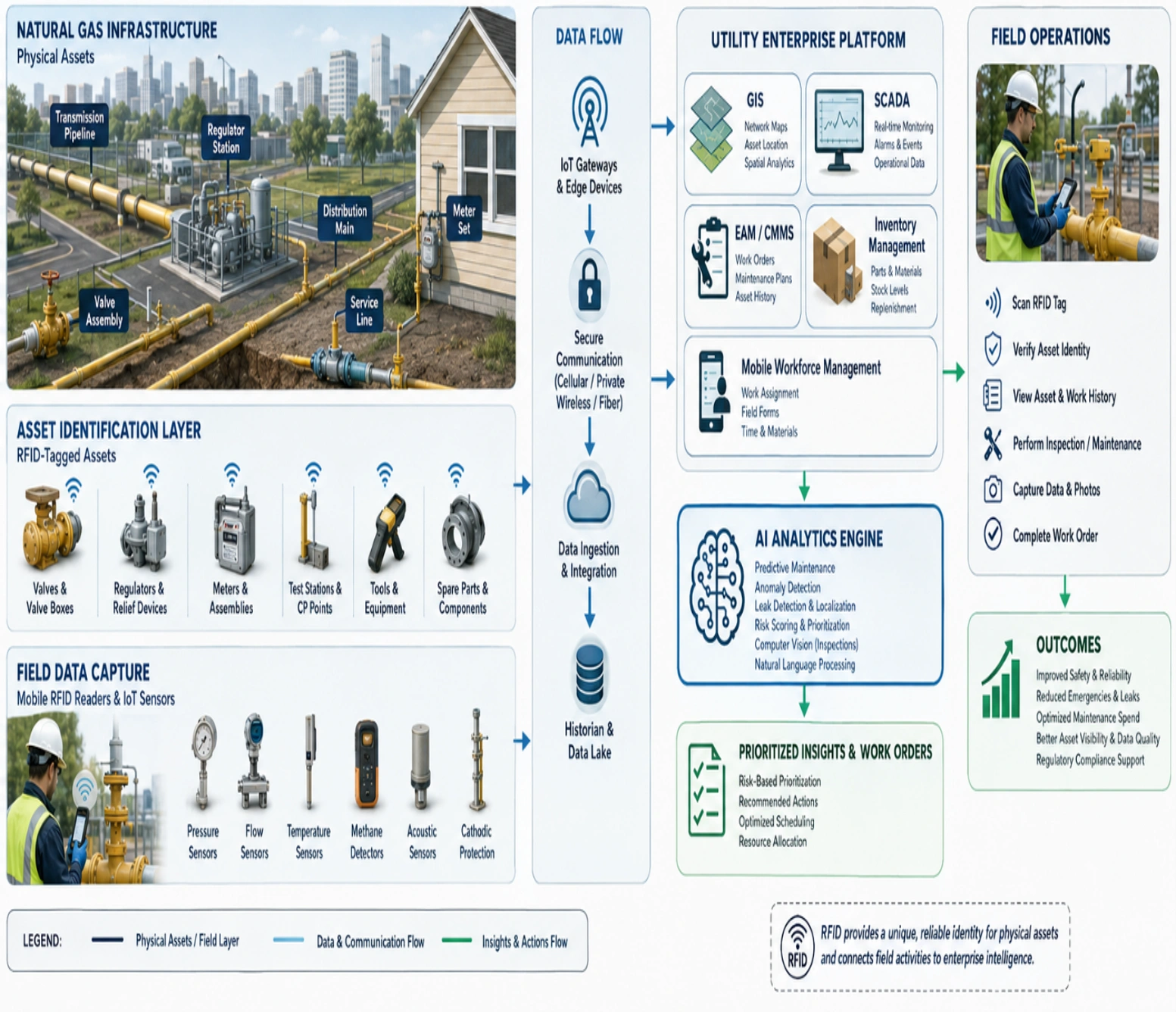
The infographic illustrates how RFID-tagged natural gas utility assets connect field technicians, IoT sensors, secure communications, GIS, SCADA, EAM/CMMS, and AI analytics. It shows the progression from physical asset identification and field data capture to risk-based insights, prioritized work orders, and improved utility operations.
Why AI Matters for Natural Gas Utility Operations
Natural gas utilities manage distributed infrastructure that is difficult to observe continuously. Buried mains, service lines, valves, regulator stations, cathodic protection equipment, meter sets, pressure-control devices, odorization equipment, and above-ground facilities can have different inspection intervals, operating histories, materials, failure modes, and geographic risks.
Traditional asset records often depend on combinations of GIS records, spreadsheets, barcodes, handwritten inspection information, photographs, work orders, and technician knowledge. The operational problem occurs when these information sources are not reliably associated with the physical asset being serviced.
RFID can strengthen that association. A durable tag attached to an appropriate asset provides a machine-readable identity that field personnel can verify using a handheld reader. The identity can then be associated with location, asset class, installation information, inspection history, maintenance records, photographs, test results, and work instructions.
AI adds a decision layer to the resulting data. Rather than treating every valve inspection, pressure anomaly, corrosion observation, or maintenance request as an isolated event, machine-learning models can identify patterns across historical and current information. For example, an AI system can help rank assets for inspection by considering age, material, previous defects, maintenance history, operating conditions, location, and other risk factors.
This approach supports the broader integrity-management objective of identifying, prioritizing, assessing, evaluating, repairing, and validating pipeline integrity. PHMSA describes gas transmission integrity management as a risk-based process that particularly considers pipeline segments where failures could affect High Consequence Areas.
The same principle applies to distribution operations, although distribution networks require different risk-management methods because assets are frequently located in densely populated urban environments. PHMSA distinguishes these distribution integrity requirements through Distribution Integrity Management Programs, or DIMP.
Priority AI Applications in Natural Gas Utilities
AI and RFID are particularly valuable when they are embedded in existing operational workflows rather than deployed as isolated technology projects.
AI Asset Tracking and Identification
An AI-enabled asset tracking system can use RFID to establish a reliable physical identity for equipment while AI analyzes the associated operational record.
Relevant assets include:
- Distribution valves and valve boxes
- Regulator and relief equipment
- Meter sets and associated assemblies
- Pressure-control equipment
- Cathodic protection test stations
- Pipeline maintenance equipment
- Portable gas detection equipment
- Inspection tools
- Spare parts and replacement components
- Emergency response equipment
The important engineering consideration is tag selection. RFID tags must tolerate the physical environment, including moisture, soil exposure, temperature variation, metallic surfaces, chemical exposure, and mechanical impact. UHF RFID is useful for longer-range identification and inventory workflows, while HF RFID can be appropriate for shorter-range controlled identification. LF RFID may be considered for specialized applications requiring characteristics associated with lower-frequency operation.
RFID should not be treated as a substitute for GIS coordinates, asset attributes, or engineering records. Its strongest role is to provide a dependable physical-to-digital identity that complements those systems.
AI-Assisted Predictive Maintenance
Predictive maintenance can combine equipment history with operational measurements to identify assets whose failure probability or maintenance priority is increasing.
For a natural gas utility, relevant data can include:
- Previous work orders and repair history
- Inspection findings
- Pressure and flow measurements
- Valve operating history
- Regulator performance
- Corrosion observations
- Cathodic protection measurements
- Asset age and material
- Environmental and weather conditions
- Leak investigation records
- Location and consequence information
AI models can produce anomaly scores, failure-risk estimates, remaining-useful-life estimates, or maintenance priorities. These outputs should support, rather than replace, engineering judgment and required inspection procedures.
The practical benefit is prioritization. A utility with thousands of distributed assets does not necessarily need the same maintenance action at every location. AI can help maintenance planners direct limited field resources toward assets with the strongest evidence of elevated risk.
AI for Leak Detection and Response
Leak management is one of the most important applications for AI in natural gas utilities. Pressure, flow, acoustic, methane, operational, inspection, and geographic data can be analyzed to identify abnormal conditions and assist with localization.
RFID contributes by helping technicians verify the identity of valves, regulator stations, test points, equipment, and other field assets during investigation and repair.
The combination can support a workflow such as:
- Sensor or operational data indicates an abnormal condition.
- AI evaluates the signal against historical operating behavior.
- The system estimates whether the event is consistent with a leak or another operational condition.
- GIS identifies affected pipeline segments and nearby assets.
- The field application identifies the relevant valve, regulator, or inspection point.
- RFID verifies the physical asset at the work location.
- The technician records findings and corrective actions.
- The completed work order updates the asset record for future AI analysis.
Advanced leak detection is receiving increased regulatory attention in the United States. PHMSA’s 2025 rulemaking described requirements involving advanced detection technologies such as aerial and vehicle surveys, handheld detection devices, and continuous monitoring systems.
AI should therefore be viewed as an analytical layer supporting detection, prioritization, and response rather than as a standalone leak-detection device.
AI-Enabled Natural Gas Leak Response Workflow
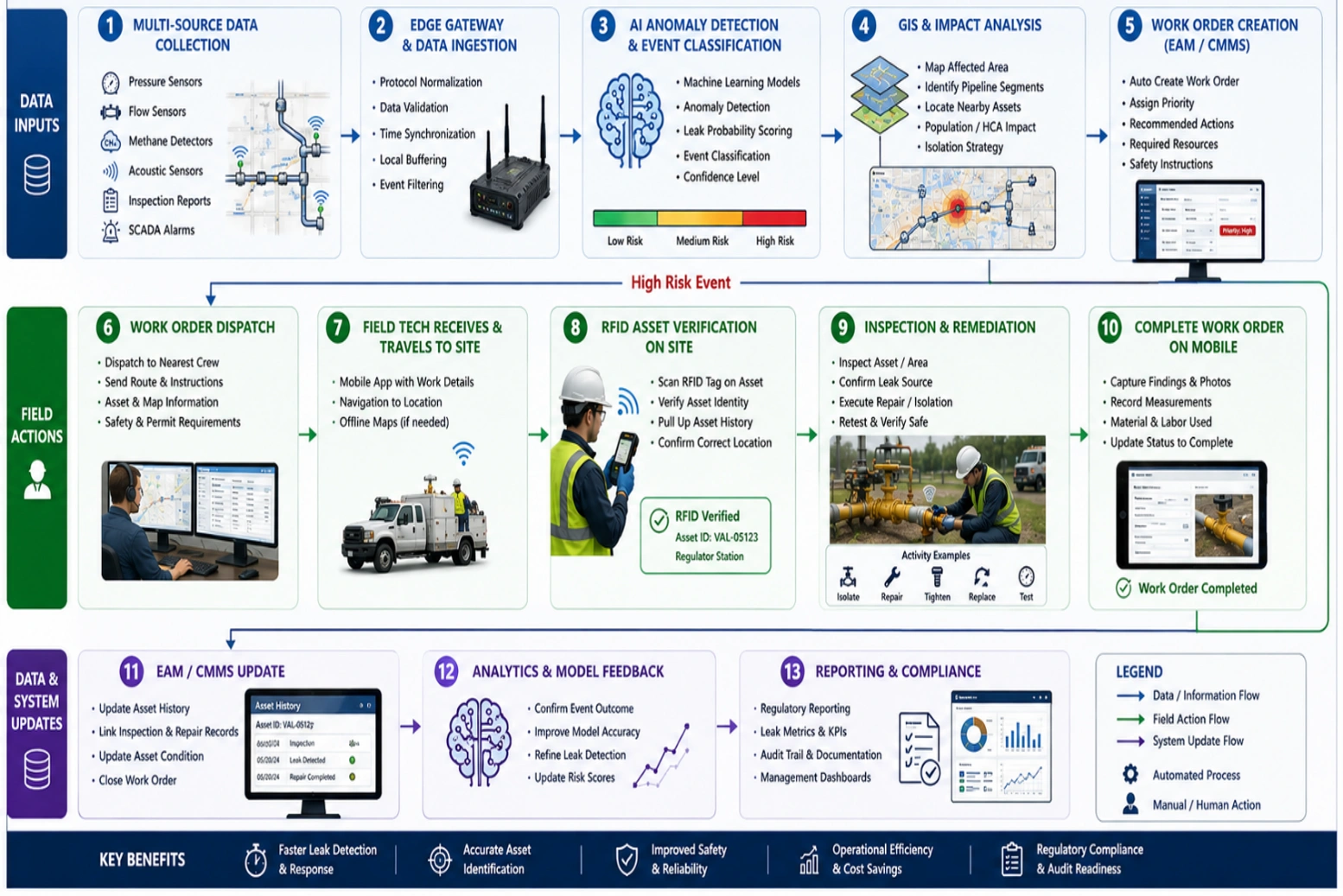
The workflow shows how natural gas utilities can combine pressure, flow, methane, acoustic, inspection, and SCADA data with AI anomaly detection and GIS analysis. It follows the process from event classification and work-order dispatch through RFID asset verification, field remediation, EAM/CMMS updates, model feedback, and compliance reporting.
Natural Gas Utility Workflows That Benefit from AI
AI and RFID are particularly valuable when they are embedded in existing operational workflows rather than deployed as isolated technology projects.
Inspection and Maintenance
A technician receives a work order containing the asset identity, location, inspection requirements, previous findings, and safety information. At the site, RFID provides a machine-readable confirmation of the equipment being inspected. The technician records measurements, photographs, defects, and observations through a mobile application.
The resulting information can be synchronized with the utility’s EAM, CMMS, GIS, or inspection database. AI can subsequently use the accumulated history to identify recurring defects, unusual inspection results, or assets that warrant additional attention.
Emergency Response
During a gas emergency, speed and asset certainty matter. Field personnel may need to locate and operate isolation valves, identify regulator stations, verify equipment, and understand the relationship between an affected segment and surrounding infrastructure.
GIS provides spatial context while RFID can provide local physical identification. AI can assist with event classification, prioritization, recommended response actions, and information retrieval from historical records.
The final decision remains subject to utility operating procedures, qualified personnel, safety requirements, and applicable regulatory obligations.
Materials and Spare-Parts Management
Natural gas utilities also maintain inventories of valves, fittings, regulators, meters, detection instruments, PPE, repair materials, and specialized tools. RFID can identify items as they move through warehouses, vehicles, maintenance depots, and field locations.
AI can analyze consumption rates, maintenance demand, seasonal patterns, and historical replacement requirements to improve replenishment planning. This reduces the risk that a critical component is unavailable when a repair crew needs it.
RFID-Enabled Natural Gas Utility Field Operations
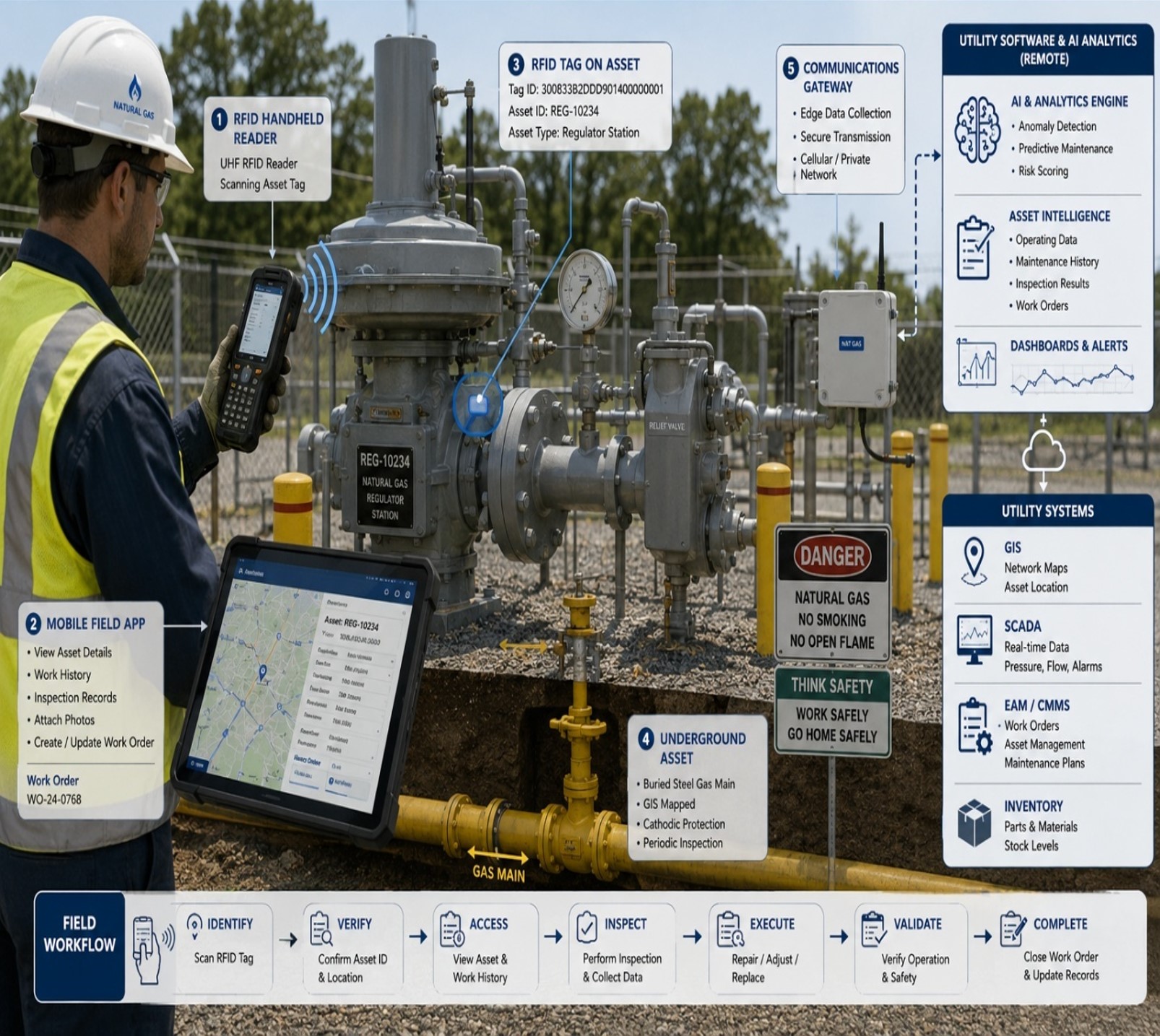
The visual shows a field technician using a rugged UHF RFID reader to verify a tagged regulator-station asset while accessing GIS location, asset history, and work-order information on a mobile device. A communications gateway connects field data with utility software, including SCADA, EAM/CMMS, inventory systems, and remote AI analytics for maintenance and operational decisions.
AI, RFID, and the Natural Gas Utility Data Chain
A reliable solution depends on connecting physical asset identity with operational data.
A typical data chain includes:
- Physical assets: Valves, regulators, meters, test stations, tools, inspection equipment, and replacement components.
- RFID identification: Tags provide unique identifiers that can be read during inspection, maintenance, inventory, and field verification.
- IoT and operational sensing: Pressure, flow, temperature, vibration, methane, cathodic protection, and other measurements provide condition information where applicable.
- Edge processing: Local gateways can filter, normalize, buffer, and securely transmit field information.
- Communication: Cellular, private wireless, Wi-Fi, Ethernet, LPWAN, or other suitable networks can transport data depending on location and operational requirements.
- Utility software: GIS, SCADA, EAM, CMMS, mobile workforce management, inspection systems, and inventory software provide operational context.
- AI analytics: Machine learning, anomaly detection, classification, forecasting, computer vision, and risk scoring can identify patterns and support decisions.
- Field action: Dispatchers, engineers, inspectors, maintenance crews, and emergency responders use the resulting information to make operational decisions.
A gas utility should design this chain around the existing system of record. Introducing RFID without establishing asset identity governance, or deploying AI without reliable historical data, will not solve underlying data-quality problems.
Deployment Considerations for Natural Gas Utility AI Systems
The deployment model should reflect operational criticality, connectivity, cybersecurity requirements, data ownership, and integration constraints.
A cloud-hosted deployment can be appropriate when a utility wants centralized analytics, scalable computing resources, multi-site visibility, and simplified software infrastructure management. AI models can process large historical datasets while field applications exchange information through secure APIs and managed services.
A server-based deployment can be more appropriate where operational data must remain within customer-managed infrastructure, where connectivity is limited, or where utility cybersecurity and data-governance policies require private hosting. Edge servers can also provide local processing when immediate decisions are required or network availability is intermittent.
A hybrid approach can place time-sensitive processing near the field while transferring selected data to centralized servers or cloud services for broader analytics.
For gas utilities, the engineering boundary between operational technology and information technology deserves particular attention. SCADA and control systems should not be exposed to AI applications merely because data needs to be analyzed. Data flows should be deliberately designed, access should follow least-privilege principles, and changes to operational systems should pass through established cybersecurity, testing, and management-of-change processes.
PHMSA’s gas transmission requirements include management-of-change provisions alongside integrity-management and corrosion-control requirements, reinforcing the importance of controlled operational changes.
Cloud vs. Server Deployment for Natural Gas Utility AI
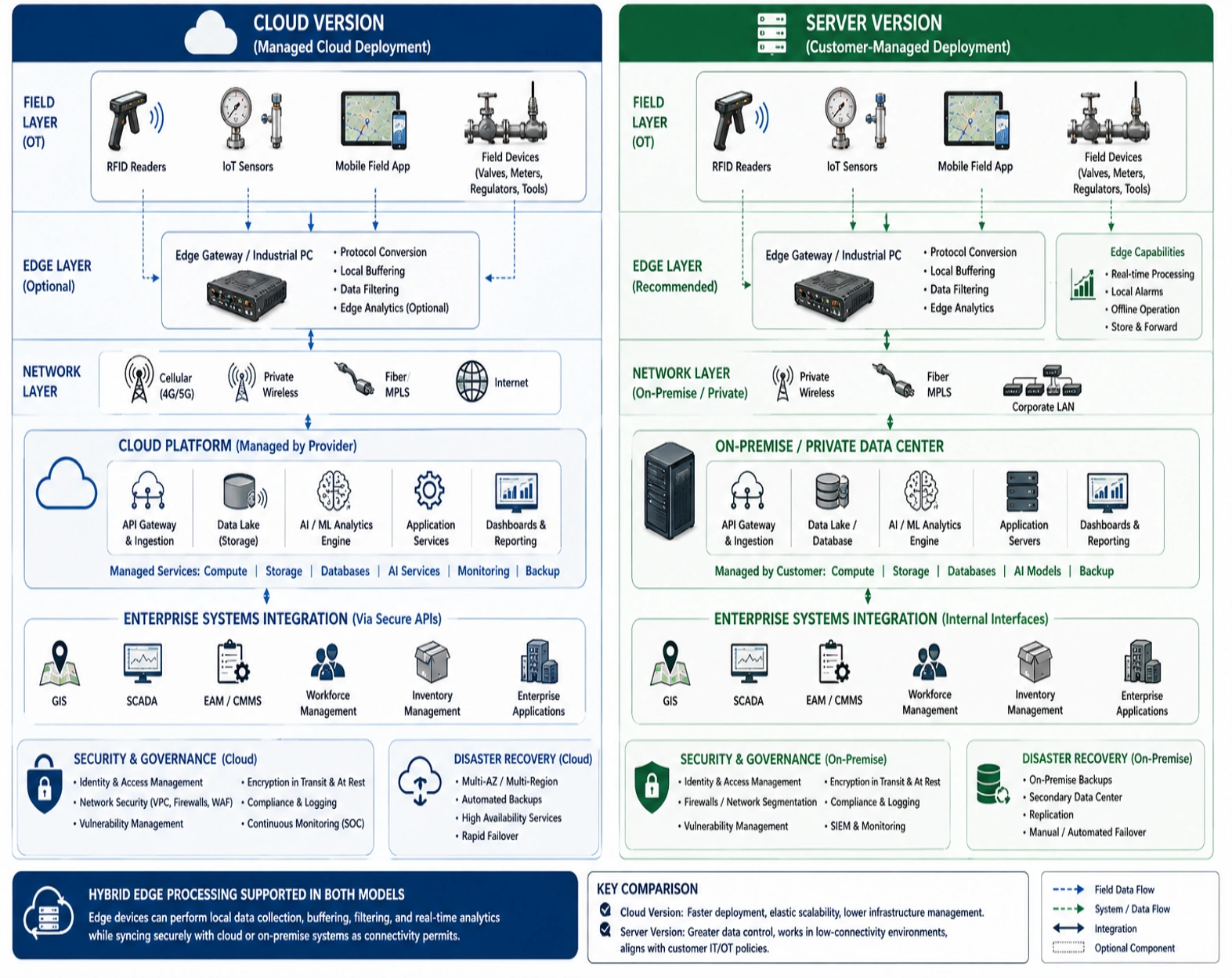
The diagram compares cloud-hosted and customer-managed server deployments for AI-enabled natural gas utility systems, covering field devices, RFID readers, IoT sensors, edge processing, communications, enterprise integrations, cybersecurity, and disaster recovery. It also shows how hybrid edge processing can support either deployment model.
Engineering Foundations for Reliable Deployment
Successful implementation starts with the physical operating environment rather than the AI model.
Natural gas utilities should first establish which assets require unique identification, what information must be associated with each asset, how field personnel will interact with the system, and which existing applications will remain authoritative.
Important engineering considerations include:
- RFID tag selection: Metallic assets, underground environments, outdoor exposure, and equipment geometry can significantly affect read performance.
- Reader placement: UHF RFID requires appropriate reader-to-tag orientation and sufficient RF performance; read zones should be tested under actual field conditions.
- Asset identity: RFID identifiers should map consistently to the utility’s authoritative asset records.
- GIS synchronization: Physical asset identification should remain consistent with spatial records and network connectivity.
- Data quality: AI models depend on accurate inspection, maintenance, sensor, and asset-history data.
- Edge resilience: Gateways should be capable of buffering data during connectivity interruptions where operationally necessary.
- Cybersecurity: RFID readers, gateways, mobile devices, APIs, servers, and cloud services should be incorporated into the utility’s security controls.
- Human verification: AI recommendations should remain explainable enough for qualified engineers, dispatchers, and field technicians to understand why an asset or event has been prioritized.
- Regulatory alignment: Technology deployment must complement, not replace, required integrity-management, inspection, maintenance, reporting, and safety procedures.
PHMSA’s regulatory framework places substantial emphasis on pipeline design, operation, maintenance, integrity management, reporting, and safety. Consequently, AI and RFID deployments should be engineered as supporting systems within established utility processes rather than treated as replacements for those controls.
GAO’s experience supplying RFID, BLE, and IoT hardware and systems can support the physical identification and data-capture layer required by these workflows, while the final system design should be matched to the utility’s asset types, field conditions, software environment, and operating procedures.
AI-Enabled RFID Deployment Lifecycle for Natural Gas Utilities
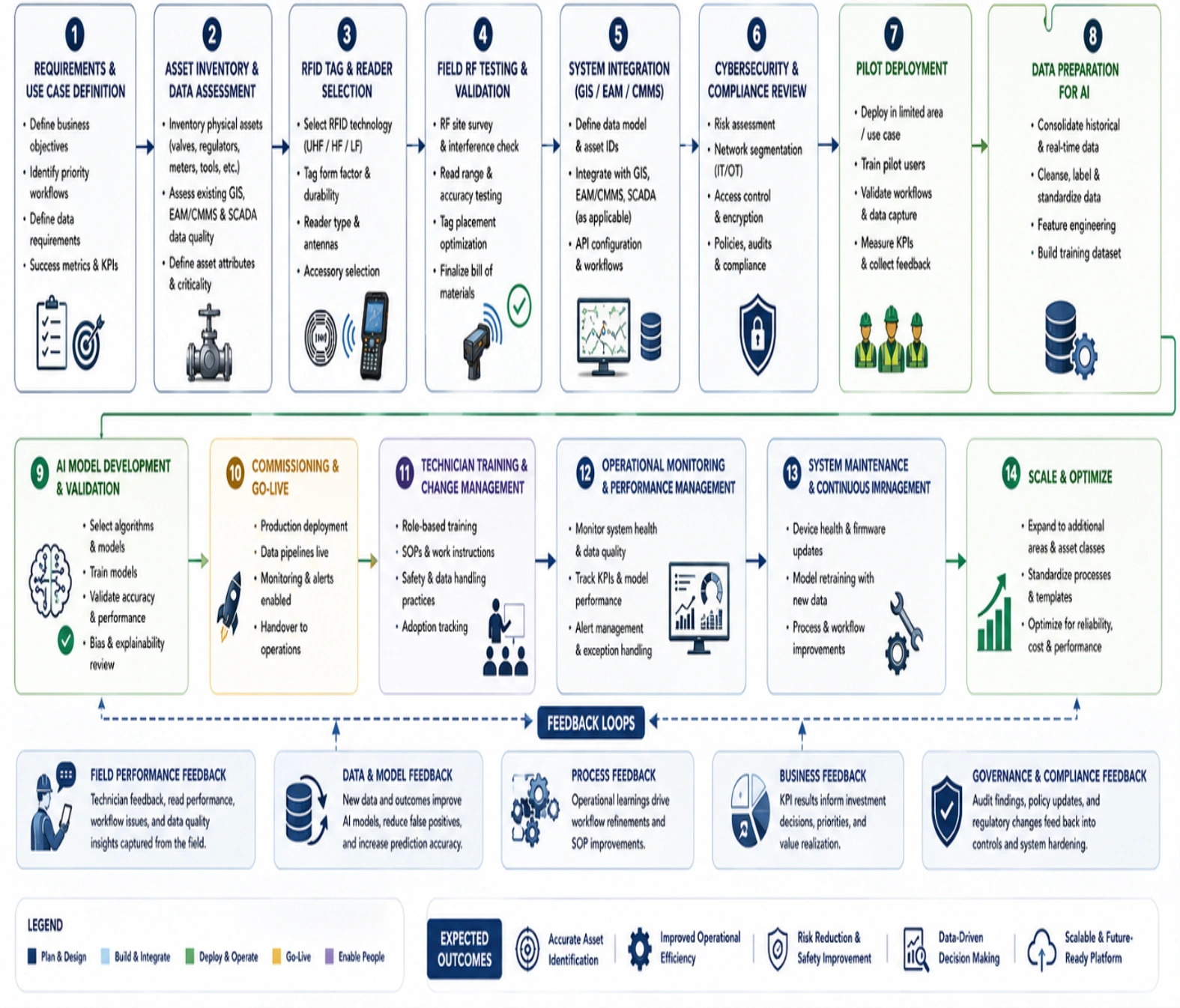
The lifecycle diagram maps the deployment of AI-enabled RFID systems from requirements definition and asset assessment through RFID selection, field testing, system integration, cybersecurity review, pilot deployment, AI model validation, commissioning, training, and operational scaling. Feedback loops show how field performance, data quality, model results, process improvements, and governance continuously refine the system.
AI Models and Analytics for Natural Gas Utility Decision-Making
AI becomes useful when natural gas utility data is transformed into decisions that field and operations teams can act on. Different utility workflows require different analytical approaches rather than one general-purpose model.
Predictive Analytics for Asset Risk
Predictive models can evaluate historical maintenance, inspection, operating, and asset information to identify patterns associated with elevated maintenance risk. Relevant variables may include asset age, material type, service history, previous defects, operating conditions, geographic context, and inspection results.
A risk model can produce a ranked list of assets requiring engineering review. The ranking should remain traceable to the underlying variables so that utility personnel can determine whether the recommendation is operationally reasonable.
Anomaly Detection for Gas Distribution Networks
Anomaly detection can identify deviations from expected pressure, flow, temperature, methane measurements, or equipment behavior. This is especially useful where a utility has large quantities of time-series data but limited personnel available to manually review every measurement.
Edge processing can perform initial filtering close to the data source, while centralized AI services can conduct more computationally intensive analysis. The division should be determined by response-time requirements, connectivity, computing capacity, and cybersecurity constraints.
Computer Vision for Utility Inspections
Computer vision can analyze photographs or video captured during inspections. Applications may include identifying visible corrosion, coating deterioration, damaged enclosures, vegetation encroachment, equipment condition, signage issues, or other observable conditions.
Computer vision does not eliminate inspection standards or qualified personnel. Its practical value is in assisting technicians and engineers by highlighting potentially significant observations for review and creating more consistent inspection records.
AI-Assisted Work-Order Prioritization
AI can combine asset condition, inspection history, geographic information, customer impact, previous failures, and work-order history to help maintenance planners prioritize work.
RFID adds confidence at the execution stage. A technician can scan the physical asset and verify that the work order corresponds to the equipment actually being serviced. This reduces the possibility of associating inspection or repair information with the wrong asset.
Integrating RFID with GIS, SCADA, EAM, and CMMS
A natural gas utility rarely needs another isolated application. The practical objective is to connect physical asset identity with existing systems.
GIS Integration
GIS normally provides the spatial representation of pipeline networks and associated assets. RFID provides a physical identifier that can be mapped to the corresponding GIS record.
A field technician can therefore scan an RFID tag, retrieve the associated asset record, and use GIS information to understand the asset’s position and relationship with nearby mains, valves, regulator stations, and other network components.
The integration should maintain a consistent asset identifier across the RFID database and GIS rather than creating a separate identity structure that technicians must reconcile manually.
SCADA and Operational Data
SCADA systems provide real-time or near-real-time information from monitored utility equipment. Depending on the system design, AI analytics can consume selected SCADA data without directly controlling SCADA equipment.
A controlled data interface can provide AI systems with measurements such as:
- Pressure
- Flow
- Temperature
- Equipment status
- Alarm states
- Operational events
- Historical trends
The AI system can then return analytical information to authorized utility applications without becoming an uncontrolled pathway into operational control systems.
EAM and CMMS Integration
EAM and CMMS software manages work orders, maintenance schedules, asset history, parts, labor, and maintenance costs. RFID can provide the asset confirmation needed when technicians begin or complete work.
An integrated workflow can automatically associate:
- RFID asset ID
- Work-order number
- Technician identity
- Inspection timestamp
- Measurements
- Photographs
- Repair activity
- Replacement parts
- Completion status
This creates a stronger historical record for future maintenance analysis and AI model training.
Natural Gas Utility Systems Integration with RFID and AI
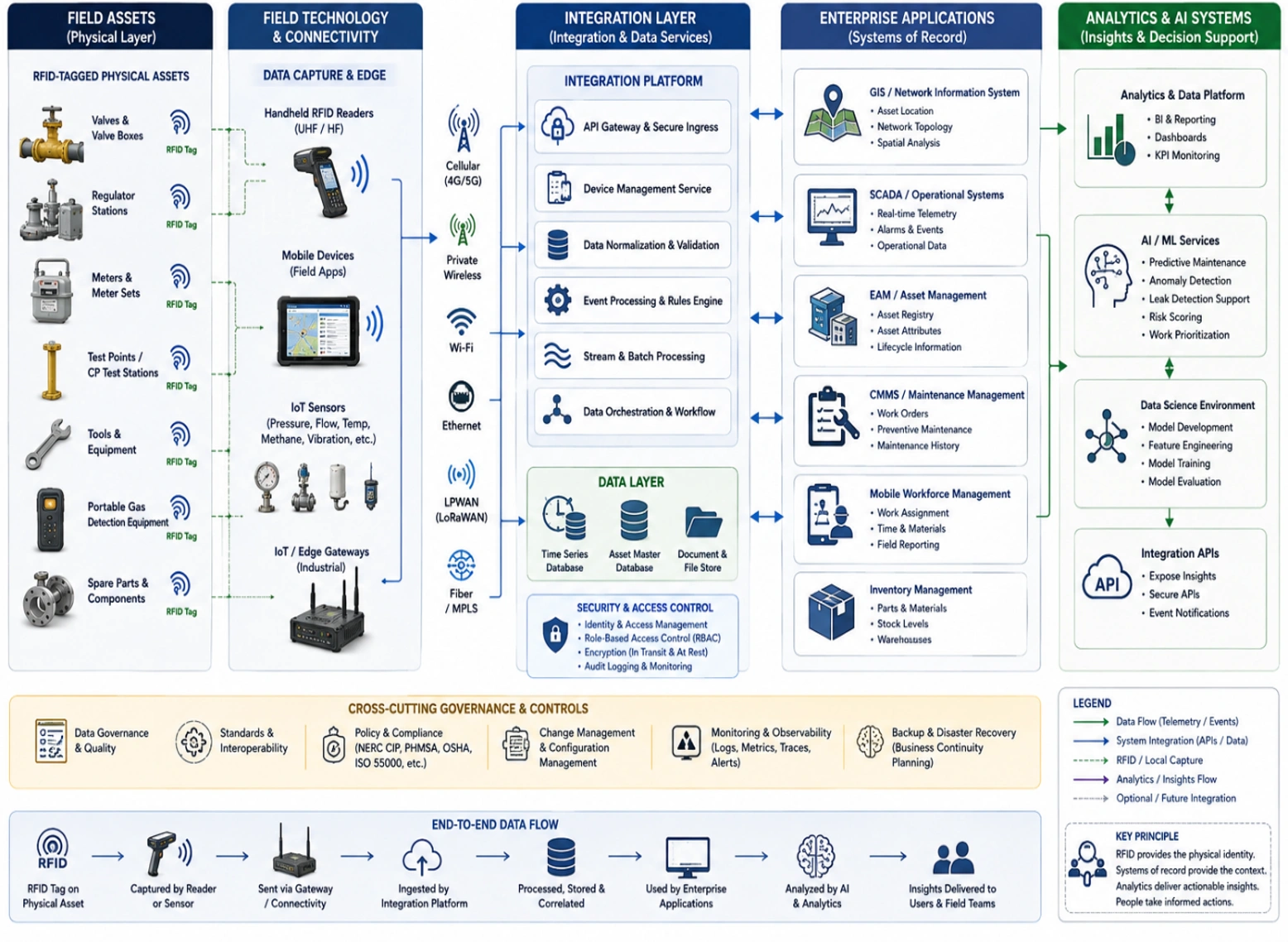
The diagram shows how RFID-tagged valves, regulators, meters, tools, and inspection equipment connect through handheld readers, IoT gateways, and secure communications to an integration layer. It maps controlled interfaces with GIS, SCADA, EAM, CMMS, workforce and inventory systems, while AI and analytics use the resulting data for predictive maintenance, anomaly detection, risk scoring, and work prioritization.
Communication and Edge Infrastructure
Natural gas utility infrastructure is geographically dispersed. A single communications technology may therefore be unsuitable for every location.
Field systems may use combinations of cellular networks, Wi-Fi, Ethernet, private wireless networks, LPWAN technologies, or other communications infrastructure depending on the location and required data volume.
RFID itself is generally a local identification technology. A handheld reader or fixed reader captures the tag identity, while a separate communication network transfers the resulting information to utility software.
This distinction is important when designing the system. RFID does not automatically provide wide-area connectivity, GPS positioning, gas detection, or pipeline monitoring. Those functions require appropriate complementary technologies.
Edge computing can reduce unnecessary data transmission by performing tasks close to the field. An edge gateway might normalize sensor readings, temporarily store information, validate device connectivity, and forward selected events to centralized systems.
For a remote regulator station, for example, the gateway may need to continue collecting information during a temporary network outage and synchronize with the central system once connectivity is restored.
Cybersecurity for AI and RFID in Natural Gas Utilities
Cybersecurity must cover the complete data path rather than only the AI application.
The attack surface can include RFID readers, mobile devices, IoT gateways, wireless networks, APIs, databases, servers, cloud services, and interfaces connecting IT and OT environments.
Key controls include:
- Device authentication and authorization
- Role-based access control
- Encryption for data in transit and at rest
- Secure API authentication
- Network segmentation
- Centralized logging and monitoring
- Credential lifecycle management
- Firmware and software update procedures
- Vulnerability management
- Backup and disaster recovery
- Mobile-device security
- Controlled access between AI systems and operational networks
AI systems introduce additional considerations. Training data should be protected from unauthorized modification because manipulated historical data can affect model outputs. Model access should also be controlled, and significant analytical decisions should retain an auditable record.
Natural gas utilities should evaluate cybersecurity requirements against their applicable regulatory and organizational controls. Technology selection should follow the utility’s existing security governance rather than creating a parallel security process.
GAO can support the hardware and connected-device portion of an implementation, while utility operators remain responsible for defining their cybersecurity policies, network controls, operational procedures, and regulatory compliance requirements.
RFID Selection for Natural Gas Utility Assets
Selecting RFID technology requires testing the physical environment rather than choosing hardware solely from nominal read-range specifications.
UHF RFID
UHF RFID is generally well suited to applications requiring longer read distances and faster identification of multiple tagged items. Natural gas utilities can consider UHF RFID for warehouse inventory, vehicle inventories, maintenance equipment, spare parts, and selected above-ground asset identification.
Metallic surfaces can affect RFID performance, so utility equipment may require tags specifically designed for mounting on metal.
HF RFID
HF RFID operates at shorter distances and can be useful where deliberate close-range identification is preferred. It can suit controlled interactions where a technician intentionally places or brings a reader close to the tagged asset.
LF RFID
LF RFID operates at lower frequencies and may be appropriate for specialized identification applications where its characteristics provide a practical advantage. Selection should be based on the physical environment, reader requirements, tag availability, and required operating distance.
The correct choice depends on the asset and workflow. A utility should conduct field tests using the actual tag, mounting surface, reader, enclosure, and environmental conditions expected during deployment.
Performance Metrics for AI-Enabled Natural Gas Utility Operations
Technology deployment should be evaluated using operational KPIs rather than RFID read counts or AI model accuracy alone.
Relevant measures include:
| Operational Area | Example KPI | Why It Matters |
| Asset management | Asset record accuracy | Measures the reliability of physical-to-digital asset relationships |
| Field service | Work-order completion time | Indicates whether technicians can execute maintenance efficiently |
| Inspection | Inspection completion rate | Tracks execution of required inspection activities |
| Asset identification | Correct asset verification rate | Measures whether technicians identify the intended equipment |
| Maintenance | Preventive maintenance compliance | Indicates whether planned maintenance is completed as scheduled |
| Emergency response | Response time | Measures the speed of mobilization and field action |
| Leak management | Detection-to-response interval | Measures how quickly potential events move toward investigation |
| Inventory | Stock accuracy | Measures the reliability of physical inventory records |
| AI operations | False-positive rate | Indicates how often analytical alerts require no operational action |
| AI operations | Detection recall | Measures the proportion of relevant events identified by the model |
| Data quality | Missing or inconsistent asset attributes | Identifies weaknesses affecting analytics and field execution |
| System operations | Data synchronization success | Measures reliability between field and central systems |
A useful KPI program should distinguish between technical performance and operational outcomes. For example, a high RFID read rate is not necessarily valuable if technicians still associate the wrong asset with the work order. Similarly, a highly accurate AI classifier in a test dataset may provide little operational value if the utility’s field data is incomplete or arrives too late for action.
Scaling from Pilot to Utility-Wide Deployment
A pilot should test operational assumptions, not merely demonstrate that an RFID reader can detect a tag.
A strong pilot should include representative assets, actual field conditions, normal technicians, existing software interfaces, and realistic operating constraints.
Recommended evaluation areas include:
- RFID performance on actual utility equipment
- Tag durability and mounting methods
- Reader performance in field conditions
- Mobile application usability
- GIS and EAM/CMMS integration
- Data synchronization
- Network availability
- Cybersecurity controls
- AI data quality
- Alert usefulness
- Technician acceptance
- Maintenance workflow impact
- Regulatory and safety-process compatibility
The pilot should establish measurable baseline values before implementation. This allows the utility to determine whether the technology produces a meaningful operational improvement.
Once the pilot demonstrates repeatable performance, deployment can expand by asset class, service territory, maintenance function, or facility type. Scaling should retain configuration governance so that new locations do not create inconsistent tag IDs, asset attributes, workflows, or integration rules.
Practical Implementation Recommendations for Natural Gas Utilities
The most reliable implementations begin with an operational problem rather than an RFID specification or AI model.
A natural gas utility considering this approach should:
- Identify high-value workflows such as inspection, maintenance, emergency response, inventory, or asset verification.
- Define which physical assets require unique identification.
- Establish the authoritative asset record and identifier.
- Select RFID tags based on actual mounting surfaces and environmental exposure.
- Test readers in representative field conditions.
- Integrate RFID identification with GIS, EAM, CMMS, or the appropriate system of record.
- Separate field identification from wide-area communication requirements.
- Establish data-quality rules before training predictive models.
- Use edge processing where connectivity or response time requires it.
- Keep AI systems separated from direct control functions unless a specific, validated control design exists.
- Establish cybersecurity requirements before connecting devices to production networks.
- Measure operational KPIs before and after deployment.
- Validate AI outputs with qualified utility personnel.
- Scale only after the pilot demonstrates measurable operational value.
GAO’s role can include supplying RFID, BLE, and IoT hardware and supporting systems appropriate to the identified field workflow. GAO’s broader technical work is supported by R&D and engineering capabilities across the GAO Group, which has served customers in the United States and Canada for more than three decades, including Fortune 500 companies, research organizations, universities, and government agencies.
Technical and Business Value of AI-Enabled Utility Asset Intelligence
AI and RFID can create value for natural gas utilities when they address specific operational weaknesses.
Improved asset visibility comes from reliably associating physical equipment with digital records. RFID helps establish that identity at the point of field interaction.
Better maintenance prioritization comes from combining asset history, inspection information, operating conditions, and failure patterns. AI can help maintenance teams focus attention where the available evidence indicates higher risk.
Faster field verification results when technicians can identify equipment electronically instead of relying exclusively on labels, paperwork, or visual interpretation.
Stronger data quality results when inspection and maintenance records are directly associated with verified physical assets.
Improved operational analysis becomes possible when historical asset information is consistently structured and available for machine-learning models.
Scalable utility operations become more achievable when the same identification and integration standards can be applied across service territories, facilities, and asset classes.
These benefits depend on implementation quality. AI cannot compensate for inaccurate asset records, poorly selected RFID hardware, unreliable communications, or weak integration practices.
AI-Enabled Natural Gas Utility KPI Dashboard
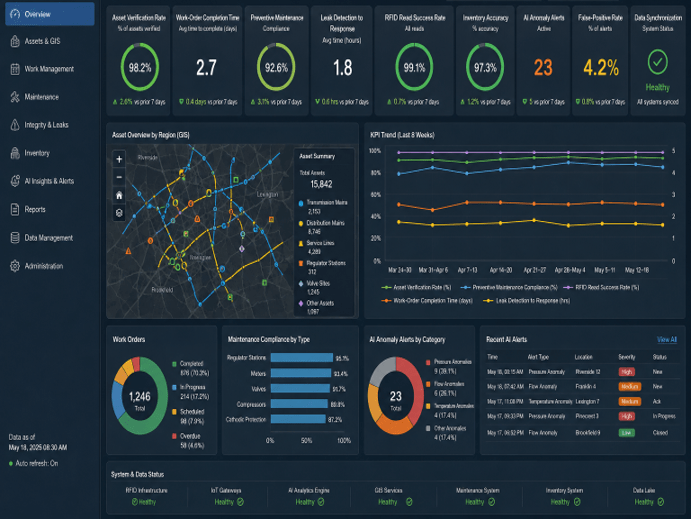
Enterprise operations dashboard showing key performance indicators for asset verification, work-order completion, preventive maintenance, leak detection response, RFID performance, inventory accuracy, AI anomaly alerts, false-positive rates, and data synchronization, with GIS-linked asset views and operational trend charts.
Building a Reliable AI and RFID Strategy for Natural Gas Utilities
AI can help natural gas utilities move from fragmented asset information toward more predictive, data-driven maintenance and field operations. RFID strengthens the physical identity layer by allowing technicians and inventory teams to verify equipment, tools, parts, and other tagged assets. GIS, SCADA, EAM, CMMS, IoT sensing, edge computing, and AI analytics then provide the surrounding operational context.
The strongest implementations begin with a defined utility workflow, validate RFID performance in real field conditions, establish reliable asset identities, integrate with existing systems, protect IT and OT boundaries, and measure operational outcomes. AI should augment qualified engineering and field decisions rather than bypass established safety and integrity processes.
GAO provides RFID, BLE, and IoT hardware products and systems that can support these requirements. With headquarters in New York City and Toronto, Canada, GAO is recognized among leading B2B and B2G RFID and BLE suppliers and has extensive experience supporting organizations across the United States and Canada. GAO’s R&D, quality assurance, and technical support capabilities provide a foundation for organizations evaluating practical connected-device deployments.
Building the Future of Industrial AI and IoT with Aperture Venture Studio and GAO RFID Inc.
For more than three decades, GAO Group of Companies has invested heavily in R&D for industrial RFID, BLE, and IoT technologies. As generative AI has become increasingly useful for industrial applications, we have expanded our work in AIoT, combining AI with connected sensors, RFID, BLE, and industrial systems. We have also founded Aperture Venture Studio to support the development and scaling of AI and IoT solutions relevant to industrial applications such as natural gas utility asset management and field operations.
Aperture brings together AI and IoT technical experts, operational leaders, investors, and industry participants. Through Aperture Ventures Summit and TekSummit, we also facilitate discussion of advanced AI and IoT technologies.
We welcome you to join us as:
- Advisors, co-founders, or employees
- Investors
- Customers