
AI and RFID for Network Equipment Warehouses
How AI Improves Network Equipment Warehouse Operations
AI and RFID can help network equipment warehouses improve inventory accuracy, asset visibility, receiving, picking, staging, shipping, and equipment lifecycle control. Network equipment warehouses handle high-value and operationally critical equipment such as routers, switches, radio units, antennas, optical networking equipment, batteries, power supplies, fiber equipment, racks, test instruments, and maintenance spares. These assets may move through receiving docks, inspection areas, storage racks, kitting zones, staging areas, outbound shipping, repair processing, and returns.
RFID supplies automated physical identification events, while AI analyzes those events together with warehouse management records, purchase orders, shipment information, work orders, asset histories, and demand patterns. UHF RFID is particularly useful for bulk identification across warehouse operations, while HF and LF RFID can support shorter-range or specialized identification requirements.
For network equipment warehouses, the practical objective is not simply to identify tagged items. The objective is to connect physical equipment movement with warehouse decisions, inventory control, deployment schedules, and telecom asset requirements. GAO provides RFID, BLE, and IoT hardware products and systems that can support these connected warehouse workflows.
AI and RFID Network Equipment Warehouse Operations
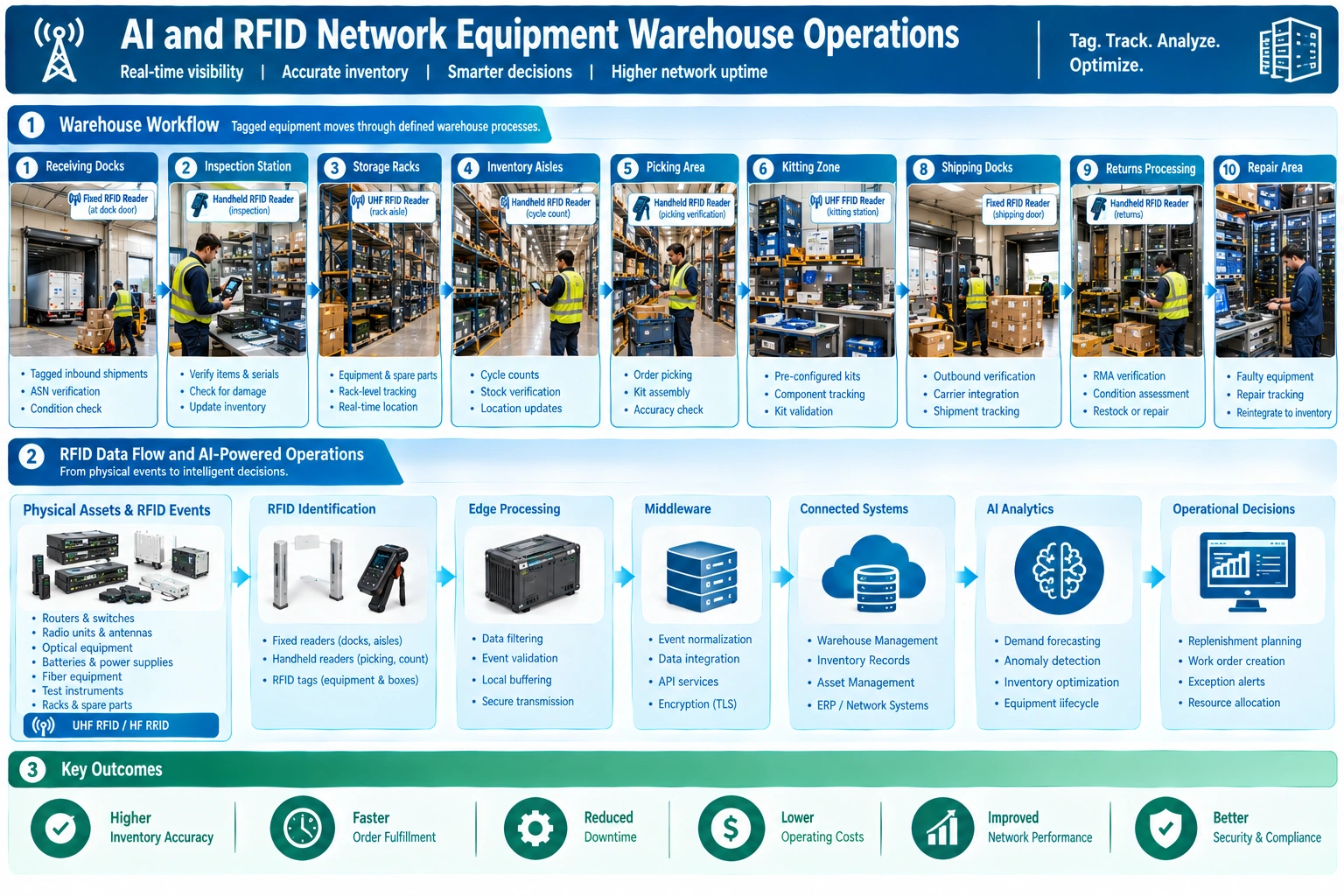
This infographic follows tagged network equipment through receiving, inspection, storage, picking, kitting, shipping, returns, and repair, with RFID data flowing into edge processing, warehouse systems, AI analytics, and operational decisions.
AI-Enabled Inventory Management for Network Equipment Warehouses
Network equipment warehouses must maintain accurate records for equipment that can vary substantially in value, dimensions, ownership, deployment status, configuration, and service requirements. A warehouse may simultaneously handle new equipment awaiting deployment, returned equipment, repairable units, customer-specific inventory, engineering spares, emergency replacement equipment, and decommissioned assets.
Manual inventory processes can create discrepancies when equipment is moved without a corresponding transaction, placed in an incorrect storage location, returned without proper reconciliation, or physically present while the software record shows another status.
AI-enabled inventory management uses RFID observations as one source of operational evidence. The system can compare physical observations against inventory records and expected warehouse workflows.
Inventory Reconciliation
RFID readers can identify multiple tagged assets during cycle counts, reducing the need for warehouse personnel to inspect individual labels manually. AI can then compare observed assets with expected quantities and locations.
This allows warehouse teams to prioritize exceptions such as:
- High-value equipment missing from its expected location
- Equipment recorded as shipped but still physically present
- Equipment physically present but absent from the inventory record
- Duplicate asset records
- Assets assigned to an incorrect warehouse location
- Equipment repeatedly associated with inventory discrepancies
AI-based prioritization is particularly useful when warehouse inventories contain thousands of network components and only a small percentage require investigation.
Equipment Location Management
Warehouse location accuracy is critical when field deployment depends on rapid equipment retrieval. RFID can associate equipment with storage zones, racks, bins, staging areas, and shipping locations.
AI can analyze movement history and identify unusual location changes. A router assigned to a regional deployment project, for example, may be expected to remain within a specific staging area until shipment. An unexpected movement into another processing area can be flagged for review.
High-Value Equipment Control
Network equipment warehouses may contain expensive radio systems, routers, switches, optical transport equipment, power equipment, and specialized test instruments. These assets justify tighter movement controls than low-value consumables.
RFID can create automated identification points at controlled warehouse exits and internal transfer areas. AI can analyze movement patterns and prioritize exceptions involving high-value or mission-critical assets.
Network Equipment Warehouse Receiving and Putaway
Receiving establishes the initial physical and digital record of incoming equipment. Errors at this stage can propagate through the entire asset lifecycle.
A typical receiving workflow may involve purchase-order verification, unloading, identification, quantity validation, inspection, asset registration, labeling, location assignment, and putaway.
RFID can automate identification during receiving by reading multiple tagged items as they enter the warehouse. The resulting events can be matched with purchase orders and expected shipment contents.
AI can assist by detecting receiving anomalies such as unexpected quantities, equipment associated with the wrong purchase order, repeated supplier discrepancies, or assets arriving in an unusual condition or sequence.
AI-Assisted Receiving Verification
Warehouse personnel can use RFID handheld readers or fixed readers to compare physical equipment against expected shipment records.
AI can prioritize discrepancies based on factors such as equipment criticality, supplier history, shipment urgency, and project requirements.
This is particularly useful when equipment is received for network expansion projects with strict installation schedules. A missing optical module or power component may delay a larger equipment deployment even if the primary network device has already arrived.
Intelligent Putaway
After receiving, equipment must be placed in an appropriate storage location. Putaway decisions may depend on equipment dimensions, weight, environmental requirements, deployment destination, turnover rate, security requirements, and compatibility with existing stock.
AI can analyze historical movement and demand patterns to recommend suitable storage locations.
Fast-moving network equipment can be positioned where retrieval is efficient, while specialized or project-specific equipment can be grouped according to deployment requirements.
Network Equipment Warehouse Receiving and AI-Assisted Putaway Workflow
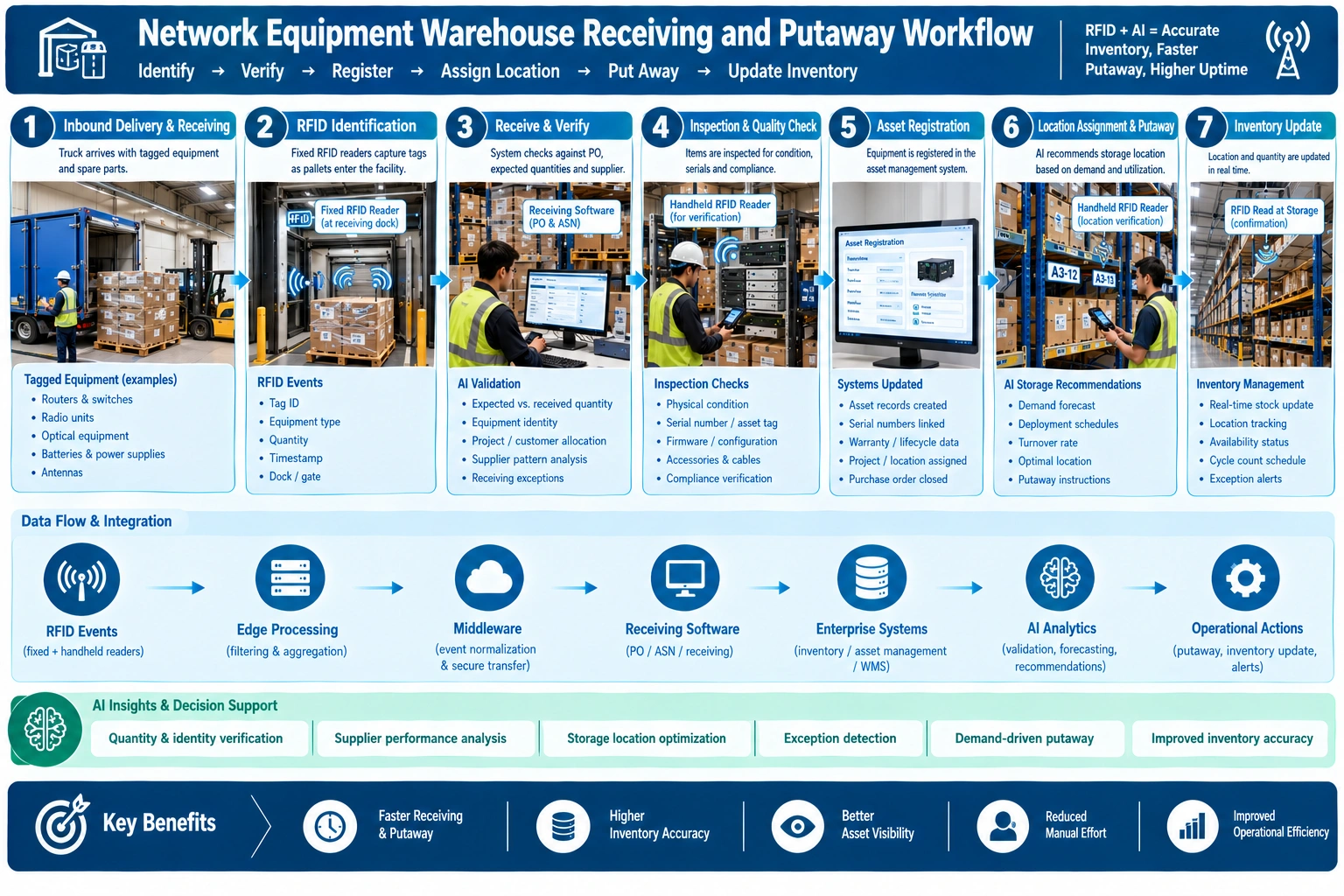
This workflow shows tagged network equipment moving from inbound delivery and RFID identification through verification, inspection, asset registration, AI-guided storage assignment, putaway, and real-time inventory updates.
AI and RFID for Network Equipment Picking and Kitting
Picking accuracy directly affects deployment schedules. A warehouse may need to assemble a complete equipment kit containing a radio unit, mounting hardware, power equipment, optical components, cables, antennas, and associated accessories before releasing the kit to a field-service or network deployment team.
Picking errors can result in incomplete shipments, additional warehouse labor, transportation delays, and field-service rescheduling.
RFID can verify selected equipment as warehouse personnel move through picking zones. AI can compare the physical items selected with the requirements of a deployment order, work order, project, or replenishment request.
Picking Verification
A handheld RFID reader can identify multiple tagged items in a picking cart or staging area. The software can compare the observed equipment with the expected pick list.
Instead of relying entirely on manual barcode scanning, the warehouse can use RFID observations to detect missing, extra, or incorrectly selected equipment.
Project-Based Kitting
Network expansion projects often require equipment to be grouped according to destination site, installation phase, or deployment team.
AI can analyze project schedules and warehouse inventory to help determine which equipment should be assembled into kits first. RFID provides the physical verification needed to confirm that the intended equipment has actually been placed into the kit.
Shipment Readiness
A shipment can be considered operationally ready when all required equipment has been verified and associated with the correct destination.
AI can identify incomplete kits before loading. This provides warehouse personnel with an opportunity to correct the problem before the shipment leaves the facility.
AI-Driven Warehouse Staging and Shipping
Staging areas often contain equipment temporarily positioned for field deployment, customer delivery, repair transfer, or inter-warehouse movement. These areas can become difficult to manage when multiple projects have overlapping schedules.
RFID can provide visibility into which assets have entered or left staging zones. AI can compare actual staging activity with planned shipment schedules.
Shipment Verification
Fixed RFID readers at outbound doors can automatically identify tagged equipment moving toward a shipping area. The system can compare those observations with shipment documentation.
AI can identify:
- Equipment assigned to the wrong destination
- Missing items from a scheduled shipment
- Unexpected equipment in a shipment
- Equipment associated with a different project
- Delayed equipment awaiting shipment
- Repeated shipping exceptions
Cross-Warehouse Transfers
Large telecommunications operations may use regional warehouses or specialized facilities. Equipment transferred between warehouses must remain accurately associated with the correct asset and inventory records.
RFID movement events can provide automated transfer evidence. AI can identify unusual transfer durations or discrepancies between sending and receiving locations.
Emergency Equipment Dispatch
Network outages may require urgent shipment of replacement equipment. AI can prioritize available equipment based on inventory position, asset status, geographic location, and operational urgency.
RFID can verify that the selected equipment is physically available before dispatch and can confirm movement through the shipping process.
AI for Network Equipment Warehouse Demand and Inventory Planning
Inventory planning must balance equipment availability against storage capacity, procurement lead times, capital requirements, and network deployment schedules.
Traditional replenishment methods may rely heavily on historical consumption. Network equipment warehouses have additional demand signals, including network expansion projects, equipment modernization programs, maintenance requirements, failure rates, regional deployment schedules, and emergency replacement demand.
AI can combine these signals to improve inventory planning.
Spare-Part Demand Forecasting
AI forecasting models can analyze historical withdrawals of power supplies, optical components, batteries, modules, cables, connectors, and other maintenance items.
The model can identify seasonal or regional demand patterns and estimate future requirements.
Deployment Demand Forecasting
Warehouse demand may increase sharply when a telecom operator begins a network modernization or expansion program.
AI can incorporate planned deployment schedules into inventory forecasts. RFID provides additional visibility into equipment already received, staged, picked, or allocated to projects.
Inventory Allocation
The same equipment may be required by multiple regional facilities. AI can help determine where available inventory should be positioned based on projected demand, equipment criticality, transportation time, and existing stock.
RFID can verify the physical inventory position used by these decisions.
Network Equipment Warehouse Operational Workflow
A complete AI and RFID workflow connects physical equipment movement with warehouse software and operational actions.
Asset Identification
Each selected asset receives an appropriate RFID tag associated with its unique equipment or inventory identifier.
RFID Data Capture
Fixed readers and handheld readers capture equipment observations during receiving, storage, picking, staging, shipping, returns, and inventory counting.
Edge and Middleware Processing
RFID middleware filters repeated observations, normalizes tag identifiers, associates readers with warehouse locations, and converts raw reads into meaningful movement events.
Warehouse Software Integration
Validated events are connected to warehouse management software, inventory records, purchase orders, shipment records, asset management software, and project or work-order information.
AI Analysis
AI models evaluate inventory discrepancies, equipment movement, demand patterns, shipment readiness, replenishment requirements, and operational exceptions.
Warehouse Action
The resulting recommendations or alerts can trigger inventory investigations, picking corrections, replenishment actions, shipment verification, location updates, or supervisor review.
AI and RFID for Network Equipment Warehouses: AI Systems, Deployment, and Business Outcomes
RFID Hardware for Network Equipment Warehouses
RFID deployment in a network equipment warehouse normally combines fixed readers, handheld readers, RFID tags, antennas, gateways, and supporting identification devices. The hardware selection depends on equipment size, tag placement, read distance, metal content, packaging, rack density, and warehouse workflow.
GAO provides RFID hardware and related IoT products that can be incorporated into warehouse inventory and asset-tracking solutions.
UHF RFID Readers and Antennas
UHF RFID is generally appropriate for warehouse inventory applications requiring longer read ranges and rapid identification of multiple tagged items. Fixed readers can be installed at receiving doors, shipping lanes, staging areas, or controlled transition points.
Antenna positioning is important because network equipment frequently contains metal chassis, power supplies, mounting brackets, and other conductive materials. Antenna polarization, orientation, reader power, and tag placement should therefore be validated during commissioning rather than selected only from nominal reader specifications.
Handheld RFID Readers
Handheld RFID readers support cycle counting, exception investigation, rack-level inventory verification, and asset searches. Warehouse personnel can use them to locate equipment without scanning every barcode individually.
Handheld RFID is particularly useful when an inventory discrepancy has already been identified by the warehouse software or AI analysis.
RFID Tags for Network Equipment
Tag selection depends on the physical characteristics of the equipment and its packaging. Common considerations include:
- On-metal tags for metal chassis and cabinets
- General-purpose UHF tags for cartons and nonmetallic packaging
- Durable tags for reusable equipment containers
- High-temperature or industrial tags for demanding storage environments
- Serialized tags for equipment requiring individual asset traceability
HF and LF RFID can be considered for specialized identification requirements where their operating characteristics better match the application. UHF RFID is generally more suitable for high-volume warehouse inventory workflows.
RFID Middleware and Warehouse Software Integration
RFID readers generate identification events, but warehouse operations require those events to be converted into meaningful business transactions.
The RFID software layer can filter duplicate reads, associate tag identifiers with equipment records, apply location context, and forward validated events to warehouse management and enterprise systems.
Typical integrations include:
- Warehouse management systems
- Enterprise resource planning systems
- Asset management systems
- Inventory databases
- Manufacturing execution systems
- Order management systems
- Transportation management systems
- Service management software
- Network inventory databases
- Identity and access management systems
A well-designed integration separates raw RFID observations from confirmed warehouse transactions. This reduces the risk of treating every reader event as a physical inventory movement.
AI Software for Network Equipment Warehouse Operations
AI can analyze RFID events together with warehouse transactions, historical inventory records, equipment attributes, orders, maintenance requirements, and operational conditions.
Relevant AI methods include:
- Demand forecasting
- Anomaly detection
- Classification
- Pattern recognition
- Time-series analysis
- Predictive modeling
- Optimization algorithms
- Computer vision where visual verification is required
- Natural-language interfaces for warehouse queries
The objective is not simply to apply AI to RFID data. The objective is to use AI to identify conditions that require operational action.
For example, an AI model can identify an unusual inventory movement pattern, predict a shortage of a specific network equipment category, prioritize cycle counts, or identify repeated receiving discrepancies.
Cloud Version and Server Version Deployment
Cloud Version
The Cloud Version uses cloud-hosted SaaS deployment for centralized warehouse operations. RFID events, inventory transactions, AI processing, dashboards, alerts, and reporting can be delivered through cloud infrastructure.
This model is useful when an organization operates multiple warehouses and wants centralized visibility across locations.
Important engineering considerations include:
- Secure connectivity between warehouse sites and cloud services
- RFID event buffering during network interruptions
- Identity and access management
- Encryption in transit and at rest
- API integration with enterprise systems
- Data retention requirements
- Regional data requirements
- High availability and disaster recovery
Server Version
The Server Version can operate on edge servers, customer-managed servers, private data centers, factory servers, or privately hosted enterprise infrastructure.
This deployment can be appropriate when warehouse data must remain within controlled infrastructure or when the facility requires local processing with limited dependence on external connectivity.
A local deployment can also support low-latency RFID event processing. A hybrid design may combine local RFID processing with selected enterprise services hosted elsewhere.
Engineering Considerations for RFID Warehouse Deployment
RFID performance depends heavily on physical deployment conditions. Network equipment warehouses present several challenges because equipment may contain metal surfaces, dense racks, cables, power supplies, and mixed packaging materials.
Metal and RF Interference
Metal can detune conventional RFID tags and affect RF propagation. On-metal tags should be evaluated where required.
RF interference from other equipment should also be assessed during site surveys. Reader power should not simply be increased to compensate for poor antenna positioning because excessive read zones can create unintended reads from neighboring storage locations.
Read-Zone Design
Each RFID read zone should have a defined operational purpose.
Examples include:
- Receiving-zone identification
- Dock-door verification
- Rack-level inventory
- Staging-area verification
- Shipping confirmation
- Transfer-point tracking
Read zones should be tested under actual operating conditions, including forklifts, personnel, pallets, cartons, and simultaneous equipment movement.
Tag Placement
Consistent tag placement improves read reliability. A warehouse should establish tagging rules for different equipment categories.
For example, network switches, routers, optical transport equipment, wireless infrastructure equipment, and power equipment may require different tag positions because of differences in enclosure materials and geometry.
AI and RFID Cybersecurity
RFID warehouse systems should be treated as part of the enterprise technology environment rather than isolated identification equipment.
Security controls can include:
- Role-based access control
- Device authentication
- Secure reader configuration
- Network segmentation
- Encryption
- API authentication
- Audit logging
- Security event monitoring
- Credential rotation
- Firmware management
- Backup and recovery controls
- Data retention policies
RFID event streams should also be protected against unauthorized modification. Incorrect inventory events can propagate into warehouse, procurement, service, and network-management processes if validation controls are weak.
AI models require additional governance. Model inputs, decision thresholds, confidence scores, overrides, and resulting warehouse actions should be auditable.
Interoperability and Enterprise Integration
Network equipment warehouses rarely operate as standalone facilities. RFID data may need to move between warehouse systems, enterprise resource planning, asset management, service management, and telecommunications inventory systems.
Interoperability should therefore be considered during initial system design.
Common integration mechanisms include:
- REST APIs
- Webhooks
- Message queues
- Database interfaces
- Structured file exchange
- Event-driven messaging
- Standard enterprise authentication
- RFID reader management interfaces
The integration design should define the authoritative source for equipment identity, location, ownership, status, order information, and movement history.
Operational Challenges and AI-Enabled Improvements
Network equipment warehouses face several recurring operational challenges.
| Operational Challenge | RFID Contribution | AI Contribution |
|---|---|---|
| Inventory discrepancies | Automated item identification | Anomaly detection |
| Misplaced equipment | Location-aware reads | Asset-location prediction |
| Manual cycle counting | Rapid bulk identification | Count prioritization |
| Picking errors | Item-level verification | Exception prediction |
| Shipment errors | Automated shipment checks | Risk scoring |
| Stock shortages | Real-time inventory visibility | Demand forecasting |
| Excess inventory | Better asset traceability | Inventory optimization |
| Emergency dispatches | Rapid equipment identification | Dispatch prioritization |
| Receiving discrepancies | Automated identification | Pattern analysis |
| Inter-warehouse transfer errors | Movement verification | Transfer anomaly detection |
AI is most valuable when it converts RFID observations into prioritized work. Instead of asking warehouse personnel to investigate every discrepancy, the system can rank exceptions according to operational risk.
Key Performance Indicators for AI and RFID Warehouses
A deployment should establish measurable KPIs before implementation.
Relevant measures include:
- Inventory accuracy
- Inventory reconciliation time
- Cycle-count productivity
- Receiving processing time
- Putaway time
- Picking accuracy
- Kitting accuracy
- Shipment accuracy
- Order fulfillment time
- Equipment search time
- Warehouse transfer accuracy
- Inventory variance rate
- Stockout frequency
- Excess inventory
- Emergency dispatch response time
- RFID read reliability
- Exception resolution time
- Asset traceability coverage
- Equipment dwell time
- Warehouse labor productivity
KPIs should be compared against the baseline established before RFID deployment. Measuring only RFID read counts does not demonstrate business value.
AI and RFID Implementation Lifecycle
A practical implementation should progress through controlled engineering stages.
Planning and Requirements Analysis
Document equipment categories, warehouse processes, inventory volumes, existing software, required traceability, environmental conditions, and business KPIs.
RFID Site Survey
Evaluate receiving doors, storage racks, staging areas, shipping lanes, equipment materials, tag placement, reader locations, antenna coverage, and potential RF interference.
Hardware Selection
Select RFID tags, fixed readers, handheld readers, antennas, gateways, network equipment, and supporting hardware based on measured requirements.
GAO can provide RFID, BLE, and IoT hardware for organizations developing these connected warehouse solutions.
Pilot Deployment
Start with a representative warehouse process such as receiving, cycle counting, or shipping verification. Measure actual read performance and operational impact before expanding.
System Integration
Connect RFID middleware with warehouse management, enterprise resource planning, asset management, and other required enterprise systems.
AI Model Deployment
Introduce AI after sufficient operational data is available. Establish model inputs, validation rules, confidence thresholds, exception handling, and human override procedures.
Commissioning and Testing
Test the complete workflow from physical equipment identification through RFID event processing, enterprise integration, AI analysis, warehouse notification, and transaction completion.
Optimization
Tune antenna locations, reader settings, tag placement, event filtering, AI thresholds, dashboards, and workflow rules based on production data.
Maintenance and Scalability
Maintain RFID readers, antennas, tags, network connections, software components, security controls, and AI models. New warehouses and equipment categories should be added through controlled configuration and testing.
Business Benefits of AI and RFID for Network Equipment Warehouses
The combined use of RFID and AI can improve warehouse operations in several practical areas.
Higher inventory accuracy: Automated identification reduces dependence on manual scanning and helps reconcile physical inventory with warehouse records.
Faster equipment location: RFID can reduce the time required to locate network equipment, particularly when items are distributed across dense storage areas.
Improved receiving: Incoming equipment can be identified and matched against expected receipts before being placed into storage.
More accurate picking: RFID verification can identify incorrect equipment before an order reaches shipping.
Better shipment control: The system can compare staged equipment against the expected shipment contents.
Improved inventory planning: AI can identify demand patterns and support stocking decisions using historical warehouse and deployment data.
Reduced exception workload: AI can prioritize discrepancies and unusual transactions so warehouse teams focus on the highest-risk cases.
Improved traceability: Serialized equipment can maintain a more complete history of receiving, storage, movement, staging, and shipment.
Example Network Equipment Warehouse Deployment Scenario
Consider a regional telecommunications warehouse supporting network expansion projects across several service areas.
Incoming routers, switches, optical transport equipment, wireless equipment, power units, and installation materials receive serialized RFID identification. Fixed RFID readers at receiving areas automatically capture arriving equipment.
The warehouse system associates each RFID identifier with the equipment record and expected purchase or transfer order. Items are then assigned to storage locations.
During cycle counting, handheld RFID readers identify equipment in selected rack areas. AI compares the observed inventory with historical records and highlights unexpected movements, missing assets, duplicate records, and unusual dwell times.
When a field deployment order arrives, the warehouse system creates a picking list. RFID verification confirms the required equipment before staging. AI can prioritize urgent orders and identify equipment shortages that could delay deployment.
At the shipping area, RFID reads verify the final equipment set before dispatch. The resulting movement history can then be shared with the relevant enterprise systems.
Why GAO Is Relevant to AI and RFID Warehouse Solutions
GAO RFID Inc. provides RFID products and related technologies for asset identification, inventory visibility, tracking, and enterprise IoT applications. GAO’s experience in RFID and IoT can support organizations evaluating hardware selection, system integration, deployment requirements, and operational use cases.
GAO RFID Inc. is headquartered in New York City and Toronto and operates as part of the GAO Group with GAO Research Inc. and GAO Tek Inc. The organization has served customers across the United States and Canada, including Fortune 500 organizations, research and development firms, universities, and government organizations.
For network equipment warehouses, this experience is relevant where RFID deployment must operate alongside existing warehouse, enterprise, and telecommunications systems.
Conclusion
AI and RFID provide complementary capabilities for network equipment warehouses. RFID creates a reliable mechanism for identifying and tracking physical equipment, while AI analyzes warehouse data to identify anomalies, forecast demand, prioritize exceptions, and improve operational decisions.
A successful deployment depends on more than installing RFID readers. It requires appropriate tag selection, RF site engineering, warehouse software integration, cybersecurity, data validation, AI governance, operational testing, and continuous optimization.
Organizations can begin with high-value workflows such as receiving, cycle counting, picking, staging, or shipping and then expand RFID and AI capabilities as measurable operational benefits are demonstrated.
Building the Future of Industrial AI and IoT with Aperture Venture Studio and GAO RFID Inc.
Aperture Venture Studio and GAO RFID Inc. bring together experience in AI, IoT, RFID, BLE, engineering, and industrial technology. Their work spans practical connected solutions designed to improve physical operations through measurable data and automation.
GAO RFID Inc. contributes more than three decades of experience in RFID, BLE, and IoT research, development, products, and deployment support. Aperture Venture Studio connects experienced technology professionals, investors, and organizations around industrial AI and IoT opportunities.
Together, these capabilities support the continued development of practical AI and IoT solutions for warehouses, telecommunications operations, industrial facilities, and other asset-intensive environments.