
AI and RFID for Ocean Container Terminals
How AI Improves Maritime Shipping Operations
AI is changing maritime shipping by turning cargo, container, equipment, and operational data into actionable decisions across ports, terminals, vessels, and logistics facilities. AI-based cargo visibility systems can combine machine learning, computer vision, edge computing, IoT sensors, and RFID identification to determine where assets are, what condition they are in, and what operational action should occur next. RFID provides machine-readable identity and location events for tagged containers, pallets, returnable transport items, maintenance assets, tools, and other equipment, while AI analyzes these events alongside terminal, vessel, weather, gate, and logistics data.
For maritime shipping organizations, the value is not simply knowing that an asset was scanned. The objective is to reduce cargo search time, improve container handling, identify exceptions earlier, optimize yard movements, support maintenance, and improve shipment traceability. GAO supplies RFID, BLE, and IoT hardware and systems that can provide the data acquisition layer required for these AI-enabled maritime applications.
AI and RFID Maritime Shipping Operations Infographic
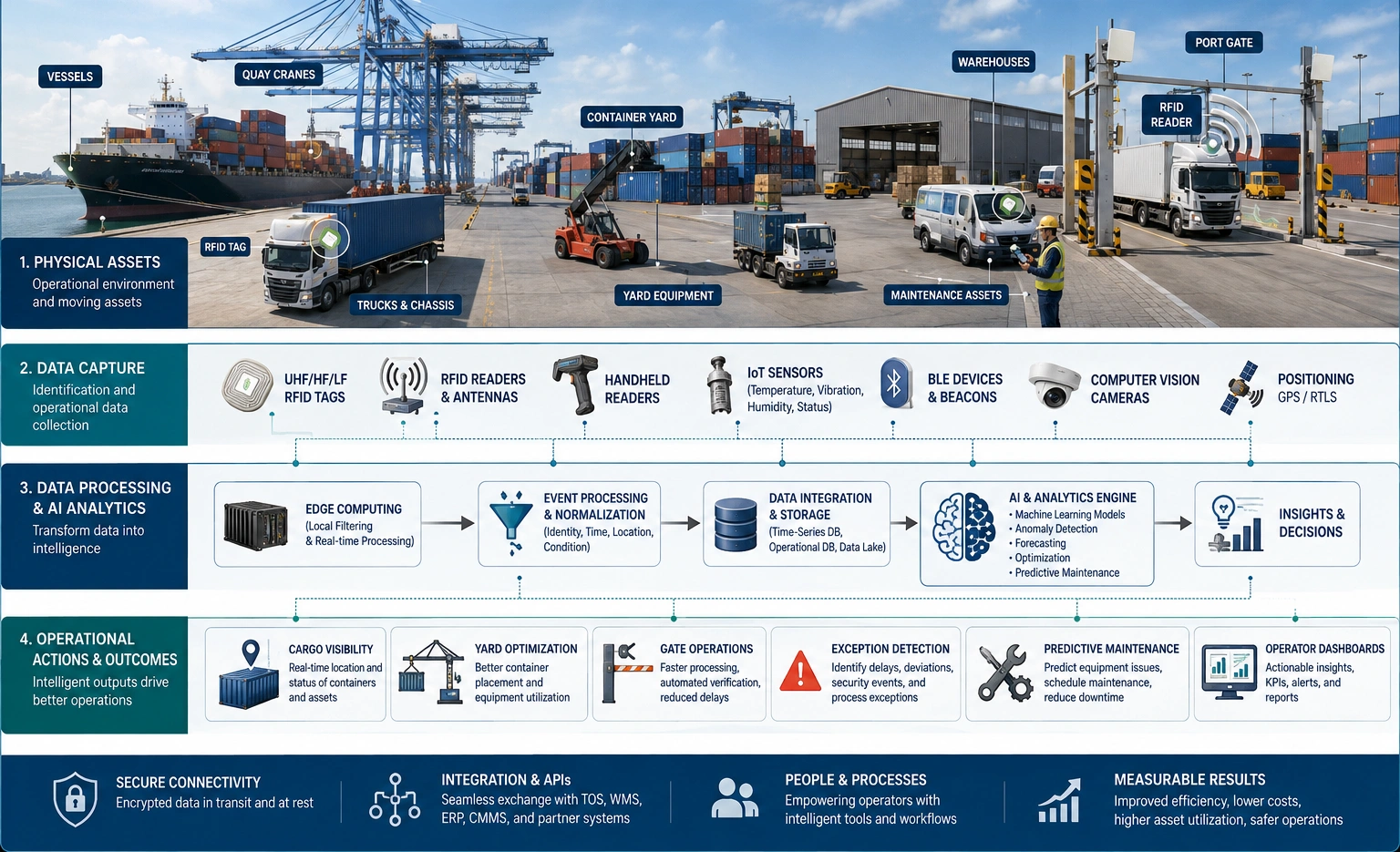
This infographic illustrates how AI, RFID, IoT sensors, edge computing, and analytics connect maritime shipping assets to operational decisions. It shows data flowing from vessels, containers, cranes, trucks, warehouses, and port gates through processing and AI analytics to cargo visibility, yard optimization, gate operations, exception detection, and predictive maintenance.
What AI-Enabled RFID Means for Maritime Shipping
AI-enabled RFID in maritime shipping is an operational data approach in which RFID identification events become inputs to software that detects patterns, predicts outcomes, identifies exceptions, or recommends actions. The RFID system does not replace the terminal operating system, transportation management system, warehouse management system, or vessel management software. Instead, it can provide additional real-time asset and movement data that those systems may not capture with sufficient granularity.
A practical implementation can associate an RFID identifier with a container, chassis, trailer, pallet, maintenance item, safety asset, or other physical object. Fixed RFID readers at gates, yard lanes, warehouse entrances, maintenance areas, or controlled zones capture tag observations. Handheld readers can support inspections, inventory checks, exception resolution, and maintenance activities.
AI then evaluates these events against operational context. For example, a machine learning model can identify an unusual dwell pattern by comparing a container’s observed movement sequence with historical terminal activity. An AI application can also detect missing movement events, identify likely process bottlenecks, or prioritize assets requiring human intervention.
The distinction between identification and intelligence is important:
- RFID identifies physical objects: A reader captures the unique identifier of a compatible RFID tag.
- IoT provides additional context: Sensors can report temperature, vibration, shock, location, equipment status, or other measurements where appropriate.
- Operational software provides business context: Terminal operating systems, warehouse systems, transportation systems, maintenance software, and databases associate physical events with jobs, orders, containers, equipment, and schedules.
- AI converts data into decisions: Machine learning, anomaly detection, forecasting, optimization, computer vision, and other AI methods can identify patterns and recommend or trigger operational actions.
- Human operators remain part of the control loop: Port operators, terminal supervisors, fleet personnel, maintenance teams, and logistics coordinators can validate exceptions and act on AI-generated recommendations.
GAO’s RFID hardware can therefore serve as part of the physical data-capture layer supporting maritime shipping applications rather than being treated as an isolated identification technology.
Maritime Shipping Use Cases for AI-Powered Asset Visibility
Maritime shipping has multiple operational environments where physical asset movements are difficult to observe continuously. Containers move through gates, yards, cranes, vessels, warehouses, inspection areas, and inland transportation networks. Equipment also moves between operating zones and maintenance facilities. AI becomes more useful when RFID events provide reliable identity and movement data.
Container and Cargo Visibility
AI-powered cargo visibility can combine RFID observations with shipment records, gate transactions, yard positions, transportation events, and other operational data. The resulting system can identify discrepancies between expected and observed movement.
Potential applications include:
- Detecting a container that has entered the wrong yard zone.
- Identifying an expected movement event that did not occur.
- Prioritizing containers approaching excessive dwell thresholds.
- Matching physical container observations with shipment records.
- Supporting faster container searches during terminal operations.
- Detecting unusual movement sequences that may require investigation.
- Improving handoff visibility between port, warehouse, and inland transportation operations.
RFID is particularly useful when a shipping organization needs reliable physical identification at controlled points. AI adds value by analyzing the sequence and timing of those observations rather than treating each scan as an isolated transaction.
Yard Operations and Container Movement
Container yards contain large numbers of similar-looking assets operating within a continuously changing environment. Manual status updates can become outdated quickly, particularly when containers are repositioned because of vessel schedules, customs holds, congestion, equipment availability, or operational priorities.
An AI-enabled yard visibility system can use RFID events alongside terminal data to detect movement patterns and operational exceptions. Historical data can also support forecasting of congestion and container dwell behavior.
Relevant applications include:
- Yard inventory reconciliation.
- Container movement verification.
- Detection of unexpected zone entry.
- Dwell-time analysis.
- Exception prioritization.
- Equipment utilization analysis.
- Support for yard reorganization decisions.
- Identification of recurring operational bottlenecks.
RFID does not independently determine the precise location of every container in an open yard. Reader placement, antenna orientation, tag mounting, radio-frequency propagation, metal interference, reader configuration, and operating conditions all affect read performance. A robust system therefore uses RFID where controlled identification points provide dependable events and combines those events with other positioning or operational data when continuous location is required.
Gate Automation and Truck Processing
Port gates are important control points because trucks, trailers, containers, drivers, and documentation converge in a relatively constrained operating environment. RFID can provide an automated identification event as an asset enters or exits a designated lane.
AI can use gate events to identify abnormal processing times, recurring congestion patterns, unexpected asset movements, or discrepancies between planned and observed transactions.
A gate solution can integrate:
- RFID readers and antennas.
- RFID tags attached to suitable assets.
- License plate recognition where appropriate.
- Optical character recognition for container identification.
- Gate control systems.
- Terminal operating systems.
- Appointment and truck scheduling data.
- Exception-management software.
- AI analytics and forecasting.
Combining RFID with computer vision can be particularly useful where visual container identification and electronic asset identity need to be correlated. The technologies should be selected according to the physical environment rather than assuming that one identification method is sufficient for every gate scenario.
Warehouse and Transshipment Operations
Cargo moving through maritime warehouses and consolidation facilities can experience multiple handoffs before reaching the vessel, inland carrier, or final destination. AI-supported RFID visibility can establish more reliable movement histories for tagged handling units.
Applications can include:
- Automated receiving and dispatch confirmation.
- Pallet and handling-unit identification.
- Cross-dock visibility.
- Exception detection during cargo handoffs.
- Inventory reconciliation.
- Search reduction for misplaced handling units.
- Identification of recurring processing delays.
For temperature-sensitive or otherwise condition-sensitive cargo, RFID can be combined with sensor-enabled devices where the tag or associated IoT device supports the required measurements. AI can then analyze condition data against shipment requirements and generate alerts when operational intervention is appropriate.
Maintenance Asset and Equipment Management
Maritime terminals depend on cranes, reach stackers, terminal tractors, chassis, forklifts, tools, safety equipment, spare parts, and other maintenance assets. Missing equipment and incomplete maintenance records can increase downtime and complicate work planning.
RFID can associate physical equipment or maintenance items with digital records. AI can then analyze usage histories, maintenance events, inspection results, and equipment status to identify patterns.
Potential applications include:
- Maintenance tool tracking.
- Spare-parts inventory visibility.
- Equipment utilization analysis.
- Inspection workflow verification.
- Predictive maintenance support.
- Identification of assets with unusual usage patterns.
- Maintenance work-order prioritization.
Predictive maintenance requires more than RFID identification. The strongest implementations combine identification events with machine telemetry, vibration or temperature measurements, operating hours, maintenance records, and failure history. RFID establishes asset identity and movement context, while other sensors provide the measurements required for condition-based models.
Maritime Shipping Operational Workflow: From Physical Events to AI Decisions
A practical AI-enabled maritime shipping solution normally begins with physical data acquisition and ends with an operational decision or automated business action. The complete workflow should be designed around the decisions that terminal and logistics personnel need to make.
Data Acquisition at the Physical Layer
RFID readers capture tag observations at defined operational points. Fixed readers are appropriate for controlled passages such as gates, warehouse doors, maintenance entrances, and selected yard lanes. Handheld RFID readers provide flexibility for inventory counts, inspections, asset searches, and exception handling.
Other data sources can include:
- Container identification and shipment records.
- Terminal operating system events.
- Crane and handling equipment telemetry.
- Truck appointment information.
- Vessel schedules.
- GPS or other positioning data.
- Computer vision systems.
- Environmental sensors.
- Maintenance records.
- Weather and operational-condition data.
Communication and Edge Processing
Reader data normally travels through a local communication network to edge computing resources, middleware, or a centralized software service. Maritime environments can require careful consideration of wired Ethernet, Wi-Fi, cellular connectivity, network segmentation, and intermittent connectivity.
Edge processing can filter duplicate reads, normalize RFID events, apply local business rules, and reduce unnecessary transmission of raw events. This is useful where a gate or operational zone needs immediate response even if connectivity to a central service is temporarily degraded.
RFID Middleware and Event Processing
Middleware translates device-level RFID observations into usable operational events. A single physical tag may be detected repeatedly while passing through a reader field. Software therefore needs event filtering, deduplication, timestamping, reader identification, zone association, and business-rule processing.
A useful event model may include:
Tag ID → Reader → Antenna/Zone → Timestamp → Direction → Asset Record → Operational Event
This event can then be correlated with a container booking, gate transaction, yard location, maintenance work order, or other business record.
Enterprise Software Integration
AI should not operate as a disconnected analytics application. Maritime shipping organizations generally need integration with the software already responsible for operational records and decisions.
Relevant systems can include:
- Terminal operating systems.
- Warehouse management systems.
- Transportation management systems.
- Enterprise resource planning software.
- Computerized maintenance management systems.
- Fleet management software.
- Port community or logistics information systems.
- Databases and data warehouses.
- Business intelligence systems.
APIs, message queues, database interfaces, and event-driven integration can connect RFID and IoT events with these systems. The appropriate integration method depends on the existing software environment, data volumes, latency requirements, and cybersecurity controls.
AI Analysis and Decision Support
After data normalization and contextualization, AI models can evaluate current and historical events.
Potential AI methods include:
- Anomaly detection for unexpected container or equipment movements.
- Time-series forecasting for dwell times, congestion, and demand.
- Classification models for operational exception categories.
- Optimization algorithms for resource allocation and scheduling.
- Predictive models for equipment maintenance.
- Computer vision for container, vehicle, and operational-condition analysis.
- Generative AI for querying operational records and producing operator-oriented summaries where appropriate.
AI outputs should be expressed as operationally meaningful results rather than unexplained model scores. A terminal supervisor may need to know that a container has an abnormal movement sequence and why the system flagged it, not simply that an algorithm produced a high anomaly score.
Business Action and Human Response
The final stage is an operational action. Depending on the application, the result may generate an alert, update a record, assign a work order, recommend a yard action, trigger an inspection, or initiate another controlled workflow.
Human validation remains important for high-impact decisions. False positives can disrupt cargo handling, create unnecessary inspections, or interfere with vessel and yard schedules. Model performance should therefore be monitored using operational KPIs rather than AI accuracy alone.
Engineering Considerations for RFID in Maritime Environments
RFID performance in maritime shipping depends heavily on physical deployment conditions. Containers, cranes, vehicles, steel structures, liquid cargo, stacked materials, and other conductive surfaces can affect radio-frequency propagation and tag readability. The correct RFID frequency and hardware configuration therefore depend on the specific asset and read zone.
UHF RFID is generally suited to longer-range automated identification applications where compatible tags and reader placement can support the required read distance. It can be useful for controlled container, pallet, equipment, and gate applications.
HF RFID is appropriate for shorter-range identification and controlled interactions. It can be useful where deliberate close-range reads are preferable, including selected maintenance, access, identification, and item-level workflows.
LF RFID provides shorter-range identification and can be considered for specialized applications where its propagation characteristics and read behavior match the operational requirement.
Tag selection is equally important. Maritime assets may experience rain, salt exposure, temperature changes, vibration, impact, UV exposure, metal surfaces, and repeated handling. Tags should therefore be selected according to mounting surface, environmental rating, expected read range, attachment method, and asset lifecycle.
Reader placement should be validated through a site survey and physical testing rather than relying only on nominal manufacturer read ranges. Antenna orientation, polarization, reader power, tag orientation, interference, lane geometry, and the movement speed of assets can materially affect results.
GAO can support maritime organizations by supplying RFID hardware and related IoT technologies while deployment teams evaluate the actual physical environment, operational workflow, and system integration requirements.
Security and Data Governance for Maritime RFID Systems
A maritime RFID deployment should be treated as an operational technology and information-system component rather than simply an identification installation. Reader networks, edge devices, middleware, APIs, databases, and AI services create multiple points requiring security controls.
Important considerations include:
- Network segmentation for RFID and IoT devices.
- Strong authentication for administrative access.
- Role-based access controls.
- Encryption for data transmitted between devices and services where supported and appropriate.
- Secure device configuration and credential management.
- Logging of reader, middleware, and administrative activity.
- Firmware and software update procedures.
- Asset inventories for connected devices.
- Monitoring for unexpected device behavior.
- Data retention policies aligned with operational and regulatory requirements.
- Controlled access to cargo and shipment information.
- Backup and recovery procedures for critical operational data.
The security design should also account for the distinction between operational availability and analytical workloads. A temporary failure of an AI service should not necessarily stop a gate or critical cargo-handling process. Systems should be designed with appropriate fallback procedures so core shipping operations can continue safely when analytics or network services are unavailable.
Cloud and Server Deployment Models for Maritime Shipping
AI-enabled maritime shipping solutions can be deployed using cloud-hosted software, privately hosted servers, or a hybrid approach. The appropriate model depends on terminal connectivity, data governance, latency requirements, existing IT infrastructure, cybersecurity policies, and the operational consequences of service interruption.
Cloud Version
A cloud-hosted deployment places application software, databases, AI services, dashboards, and analytics within managed cloud infrastructure. RFID readers and edge devices at the maritime facility transmit normalized events to the cloud through secured network connections.
Cloud deployment can be appropriate when shipping organizations need centralized visibility across multiple terminals, warehouses, distribution facilities, or logistics operations.
Typical characteristics include:
- Centralized storage of RFID and IoT events.
- Scalable computing resources for AI workloads.
- Remote access to dashboards and analytics.
- Centralized software updates and maintenance.
- Easier aggregation of data from multiple maritime facilities.
- Integration with cloud-based enterprise applications.
- Access to machine learning services and data-processing tools.
Cloud deployment does not eliminate the need for local processing. Gate operations, reader event filtering, and time-sensitive workflows may still benefit from edge computing. A disconnected terminal should have an appropriate fallback process rather than depending entirely on continuous cloud connectivity.
Server Version
A Server Version places application software and data processing on customer-managed infrastructure. This can include edge servers located within a terminal, privately managed servers, private data centers, or other customer-controlled infrastructure.
This model can be appropriate when maritime organizations have strict data-control requirements, existing private computing infrastructure, limited external connectivity, or operational applications that must remain within controlled networks.
Potential advantages include:
- Local processing of RFID events.
- Reduced dependence on external connectivity.
- Greater control over data storage.
- Integration with private operational networks.
- Local availability of selected operational applications.
- Ability to align deployment with existing IT and cybersecurity policies.
Server deployments require the customer or designated technology team to manage server capacity, operating systems, software updates, backups, monitoring, security controls, and disaster recovery.
Hybrid Deployment for Port and Terminal Operations
A hybrid model can combine local edge or server processing with cloud analytics. For example, an RFID reader at a port gate can send observations to local middleware for filtering and immediate transaction processing. Selected normalized events can then be transmitted to cloud services for historical analysis, machine learning, cross-terminal reporting, and long-term optimization.
Implementation Lifecycle for AI-Enabled Maritime Shipping
A successful implementation should begin with an operational problem rather than an RFID reader count or AI model selection. The technology should be engineered around measurable maritime shipping outcomes.
Requirements and Site Assessment
The first stage identifies the physical assets, workflows, decision points, and operational KPIs that the system must improve.
The assessment should document:
- Container and equipment movement patterns.
- Gate and yard layouts.
- Existing RFID or IoT infrastructure.
- Reader installation locations.
- Metal structures and potential RF interference.
- Network connectivity.
- Existing terminal and logistics software.
- Required read zones.
- Environmental exposure.
- Asset mounting constraints.
- Required latency and system availability.
- Security and data-governance requirements.
A physical site survey is particularly important because maritime facilities contain extensive metal infrastructure that can materially influence RFID performance.
Use-Case and RFID Technology Selection
The next stage prioritizes applications according to business impact, technical feasibility, and data availability.
A controlled gate identification workflow may be an appropriate initial application because the physical passage is predictable and the operational outcome is clear. An open-yard continuous-location requirement may require a combination of RFID with other positioning technologies instead of RFID alone.
UHF, HF, and LF RFID should be selected according to the physical use case rather than as interchangeable options.
Hardware and Software Engineering
Hardware selection should cover readers, antennas, tags, handheld devices, edge gateways, networking equipment, mounting hardware, and supporting power requirements.
Software engineering should address:
- Device management.
- RFID event processing.
- Asset identity management.
- API integration.
- Data storage.
- Operational dashboards.
- AI model execution.
- Alert management.
- User permissions.
- Audit logging.
GAO’s experience supplying RFID, BLE, and IoT hardware can support organizations evaluating the device layer and its relationship with the wider operational system.
Pilot Deployment
A pilot should reproduce the real operating environment rather than testing only on a laboratory bench.
A maritime pilot can measure:
- Read rate.
- Missed-read frequency.
- Duplicate-event frequency.
- Event latency.
- Tag durability.
- Reader reliability.
- Network availability.
- Data integration accuracy.
- AI alert precision.
- Operator response time.
Pilot results should determine whether reader placement, antenna configuration, tag selection, event filtering, or business rules need adjustment before wider deployment.
Commissioning and Integration
Commissioning validates the complete path from physical identification to business action.
Testing should include:
- RFID tag commissioning.
- Reader and antenna configuration.
- Network connectivity.
- Middleware event processing.
- API communication.
- Database transactions.
- Terminal-system integration.
- AI model inputs and outputs.
- User alerts.
- Failure and recovery behavior.
- Security controls.
End-to-end testing is essential because a high RFID read rate has limited operational value if the resulting event is not correctly associated with the relevant container or asset record.
Production Rollout and Optimization
After validation, deployment can expand to additional gates, yard zones, warehouses, equipment groups, or terminals.
Operational performance should be monitored continuously. Changes in yard configuration, equipment, container types, reader placement, software versions, or workflow rules can alter system behavior.
AI models should also be monitored for model drift. Historical shipping patterns can change because of seasonal demand, new vessel schedules, altered yard layouts, equipment changes, or changes in operating procedures.
Business and Operational Benefits of AI-Enabled Maritime Visibility
Combining AI with reliable physical asset data can improve maritime shipping operations because decisions are based on observed operational events rather than isolated manual updates.
Faster Cargo and Asset Identification
Automated identification reduces dependence on manual searches and repeated data entry at selected operational control points. When RFID events are associated with container or asset records, operators can use software to determine the most recent known observation and investigate exceptions more quickly.
Earlier Detection of Operational Exceptions
AI can identify patterns that are difficult to recognize manually across large event volumes. A missing movement event, abnormal dwell duration, unexpected zone transition, or unusual equipment-use pattern can be prioritized for human review.
Improved Yard and Equipment Utilization
Historical movement data can reveal recurring congestion and equipment utilization patterns. AI forecasting and optimization methods can then support decisions concerning resource allocation, yard organization, and maintenance priorities.
Better Maintenance Planning
RFID provides asset identity and movement context. When combined with telemetry and maintenance records, AI can help identify equipment exhibiting patterns associated with increased maintenance requirements.
This can support a shift from purely calendar-based maintenance toward more condition- and usage-informed maintenance strategies where sufficient sensor data exists.
Greater Operational Traceability
A reliable sequence of physical observations creates a more detailed history of where tagged assets were observed and when. This can strengthen investigations into missing assets, process exceptions, inventory discrepancies, and handoff failures.
Traceability should still be interpreted according to the coverage of the RFID deployment. An RFID system can document observations at instrumented locations; it does not automatically prove continuous location between those points.
Scalable Data Collection
Once an organization establishes standardized event processing, additional RFID readers, assets, facilities, and use cases can be added without redesigning every business workflow from the beginning.
Scalability depends on consistent asset identification, device management, network capacity, software integration, data quality, and operational governance.
Interoperability Across Maritime Shipping Systems
AI-enabled RFID solutions should be designed to coexist with existing maritime software rather than requiring replacement of systems that already manage core operations.
A practical integration approach can establish a common event model in which RFID observations are converted into standardized business events. Those events can then be consumed by terminal applications, maintenance software, logistics systems, analytics tools, and AI services.
For example:
RFID observation → Event middleware → Container/asset identity → Operational system → AI analysis → Exception or recommendation → Operator action
This separation makes it easier to change a reader, add another data source, or modify an AI model without redesigning the entire operational workflow.
Interoperability also requires careful treatment of identifiers. Container numbers, equipment IDs, RFID tag IDs, shipment references, work-order numbers, and vehicle identifiers should have clear relationships in the data model. Poor identity management can undermine otherwise reliable RFID infrastructure.
Scaling AI-Powered RFID Across Maritime Facilities
Scaling from one pilot area to multiple terminals requires standardization without ignoring local operating conditions.
A scalable program should establish common definitions for:
- Asset identifiers.
- RFID tag commissioning.
- Reader configuration.
- Event formats.
- Time synchronization.
- API interfaces.
- User roles.
- Security controls.
- KPI definitions.
- AI model monitoring.
- Device maintenance.
- Data retention.
The physical deployment can still be customized for individual facilities. A port with enclosed warehouse entrances may require a different RFID configuration from an open container yard. A maintenance facility may use handheld HF or UHF workflows while a vehicle gate may use fixed UHF readers.
Standardization should therefore focus on data, software interfaces, operational rules, security, and governance while allowing hardware configurations to reflect actual site conditions.
Maintenance and Lifecycle Management
RFID and AI systems in maritime shipping require continuing maintenance after commissioning.
Physical maintenance includes inspection of readers, antennas, cables, mounting structures, power supplies, tags, and protective enclosures. Environmental exposure can affect equipment and tag performance over time.
Software maintenance includes:
- Reader firmware updates.
- Middleware updates.
- Security patches.
- API maintenance.
- Database administration.
- AI model monitoring.
- Backup verification.
- Access-control reviews.
- Integration testing after system changes.
Tag lifecycle management is also important. Tags attached to reusable assets should remain associated with the correct asset record throughout their operational life. Damaged, replaced, or decommissioned tags require controlled reassignment procedures.
AI models require a separate lifecycle process. Performance should be evaluated against current operating conditions, and models should be retrained or recalibrated when data distributions change significantly.
Practical Engineering Recommendations for Maritime Shipping
Organizations planning AI-enabled RFID deployments should prioritize operational reliability and measurable outcomes over technology complexity.
- Start with a defined maritime shipping problem such as container visibility, gate processing, yard exceptions, equipment tracking, or maintenance asset management.
- Conduct an RF site survey before finalizing reader and antenna locations.
- Select RFID frequency and tag type according to asset material, mounting location, required read distance, and environmental conditions.
- Use edge processing where local filtering and low-latency response are operationally important.
- Establish a consistent asset and event data model before expanding AI applications.
- Integrate RFID events with existing terminal, warehouse, transportation, and maintenance systems.
- Validate AI models against operational KPIs, not only laboratory accuracy.
- Design fallback procedures for network, reader, middleware, and AI-service failures.
- Apply network segmentation, access controls, logging, patching, and other appropriate cybersecurity measures.
- Pilot the complete physical-to-digital workflow before scaling across additional gates or terminals.
- Monitor false alerts because excessive exceptions can reduce operator trust in AI.
- Treat tag commissioning and lifecycle management as controlled operational processes.
- Reassess RFID performance whenever yard layouts, reader positions, equipment, or workflows change.
- Scale standardized data and software interfaces while allowing RFID hardware configurations to reflect individual maritime environments.
GAO provides RFID, BLE, and IoT hardware products and systems that can support these deployment requirements. The appropriate solution depends on the physical environment, asset characteristics, operational workflow, software environment, and required performance.
Realistic RFID Deployment at a Maritime Container Terminal
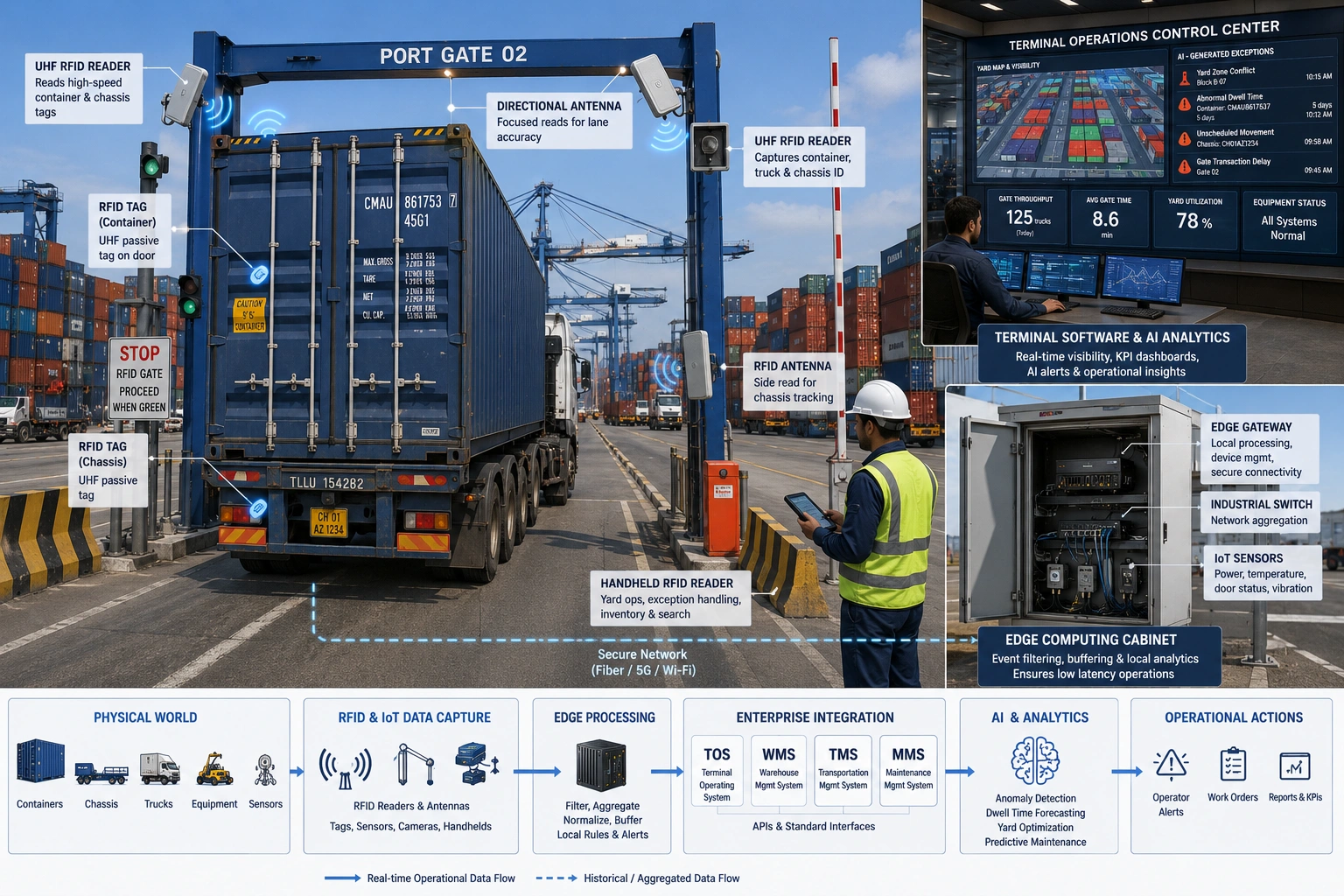
This realistic deployment illustration shows a container truck passing through a controlled port gate equipped with UHF RFID readers and directional antennas. It also depicts RFID-tagged containers and chassis, handheld RFID scanning, IoT sensors, an edge computing cabinet, secure connectivity, terminal software, and an operations control center using AI analytics for cargo visibility and exception detection.
Measuring Readiness for Production Deployment
Production readiness should be established before an AI-enabled RFID system is expanded across a maritime terminal. The objective is to demonstrate that the complete solution performs reliably under actual operating conditions and that personnel can use its outputs without creating additional operational risk.
A production-readiness review should examine:
- RFID read performance under normal and peak traffic.
- Performance during adverse weather and environmental conditions relevant to the facility.
- Reader and network availability.
- Correct association between RFID tag IDs and container or equipment records.
- Event-processing latency.
- Integration reliability with terminal and logistics software.
- AI alert quality and false-positive rates.
- Operator response procedures.
- Backup and recovery procedures.
- Cybersecurity controls.
- Hardware maintenance requirements.
- Data retention and access policies.
Acceptance criteria should be defined before the pilot begins. This prevents the project from being judged subjectively after deployment and provides a clear basis for deciding whether the system is ready for expansion.
AI Model Governance for Maritime Operations
AI systems used in maritime shipping should be governed according to the operational consequences of their outputs. A forecasting model used for planning does not have the same risk profile as an automated action that directly affects cargo handling.
Model governance should address:
- Training-data quality.
- Data lineage.
- Model version control.
- Input-data validation.
- Performance monitoring.
- False-positive and false-negative analysis.
- Model drift.
- Human review requirements.
- Change approval.
- Auditability.
- Retirement and replacement procedures.
Explainability is particularly useful for operational exception systems. When an AI system flags an unusual container movement, operators should have sufficient contextual information to understand the reason for the alert and determine whether an intervention is justified.
AI should support operational personnel rather than obscure the underlying evidence. RFID events, timestamps, reader zones, shipment information, and related operational records should remain accessible for investigation.
Combining RFID With Other Maritime IoT Technologies
RFID is only one source of operational data. Maritime shipping applications can become more useful when RFID is combined with other IoT technologies according to the requirements of each use case.
BLE can support selected equipment and personnel-location applications where its characteristics are suitable. IoT sensors can provide temperature, vibration, shock, pressure, humidity, or equipment-status information. GPS and other positioning technologies can provide location information over broader areas. Computer vision can provide visual information about containers, vehicles, equipment, and operational conditions.
The technologies should complement one another rather than duplicate the same function unnecessarily.
For example, an equipment-management solution may use RFID to establish the identity of a maintenance asset, BLE or another positioning technology to determine its approximate location, and sensor data to determine its operating condition. AI can correlate these data sources to produce a more complete operational assessment.
GAO supplies RFID, BLE, and other IoT technologies that can be incorporated according to the specific requirements of maritime shipping applications.
Multimodal IoT and AI Data Fusion for Maritime Shipping
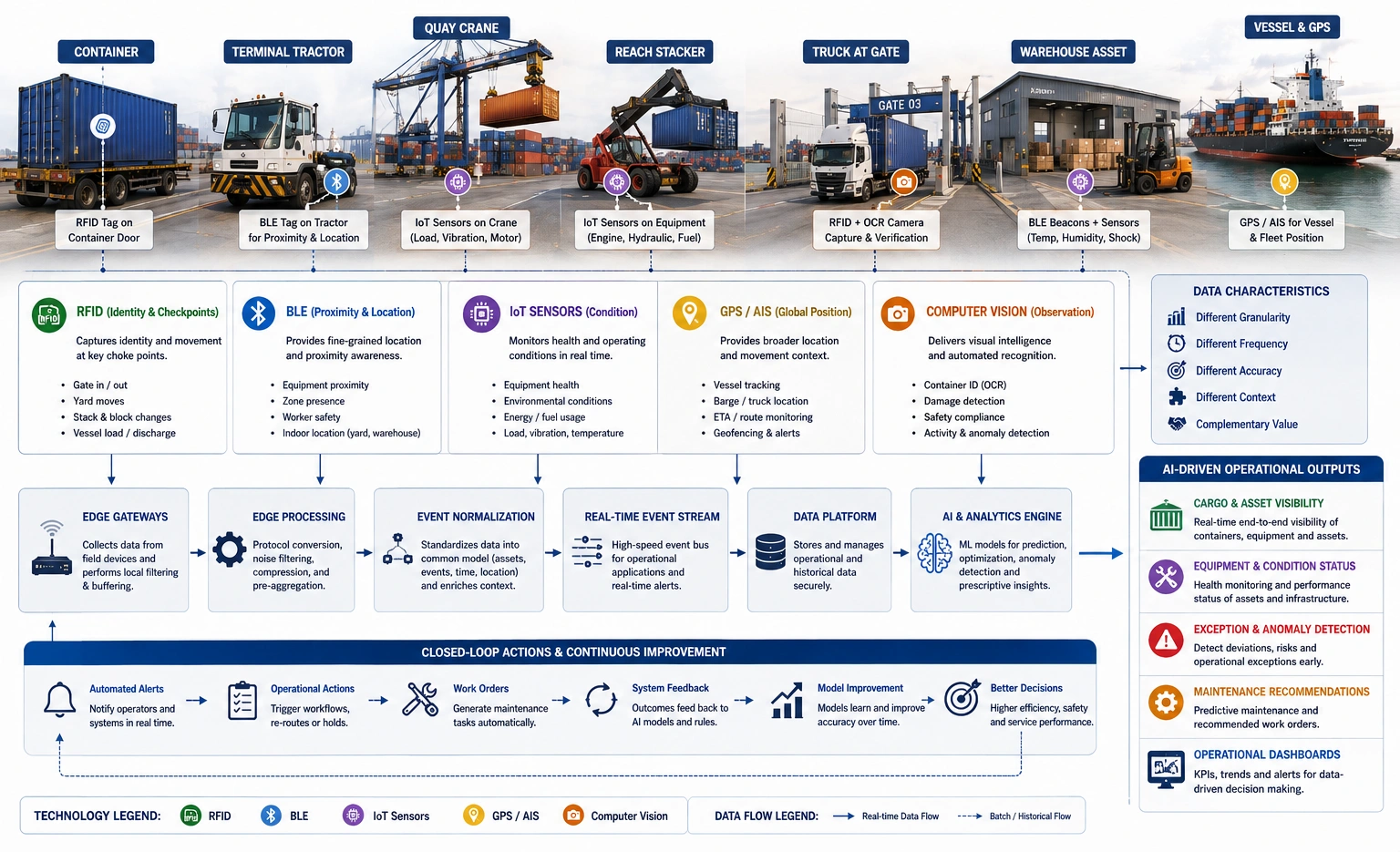
This infographic shows how RFID, BLE, IoT sensors, GPS/AIS, and computer vision provide complementary data across containers, terminal tractors, cranes, trucks, warehouses, and vessels. The data flows through edge processing, event normalization, real-time streams, storage, and AI analytics to support cargo visibility, equipment monitoring, anomaly detection, maintenance recommendations, and operational dashboards.
Reducing Operational Risk During Deployment
Technology deployment inside a functioning port or terminal must account for ongoing cargo operations. Installation activities should not unnecessarily interfere with vehicle traffic, crane operations, safety zones, or cargo-handling procedures.
Deployment planning should therefore consider:
- Installation windows.
- Traffic-management requirements.
- Electrical and network access.
- Equipment mounting locations.
- Worker safety.
- RF exposure and applicable site requirements.
- Weather conditions.
- Access to elevated structures.
- Maintenance accessibility.
- Temporary versus permanent installations.
- Procedures for replacing failed hardware.
A phased rollout can reduce operational disruption. A controlled gate or warehouse entrance can serve as an initial deployment area before extending the solution into more complex yard environments.
The physical design should also make maintenance practical. Readers and antennas installed in difficult-to-access locations can create unnecessary downtime if routine inspection or replacement requires specialized access equipment.
Data Quality as the Foundation for Maritime AI
AI performance depends directly on the quality and completeness of the operational data supplied to the models. RFID deployments therefore need data-quality controls from the beginning.
Common data problems include:
- Duplicate RFID observations.
- Incorrect asset-to-tag associations.
- Missing events.
- Incorrect timestamps.
- Reader-zone configuration errors.
- Decommissioned tags remaining active in software.
- Inconsistent asset identifiers.
- Network interruptions.
- Incomplete integration with operational systems.
Event-processing software should distinguish between a raw RFID observation and a meaningful operational event. Repeated reads from the same tag within a short period may represent one passage rather than dozens of separate business transactions.
Data validation should also identify impossible or contradictory sequences. For example, an asset appearing to move between geographically separated zones within an impossible time interval can indicate a configuration problem, a duplicated identifier, or an integration issue.
Improving data quality before increasing AI complexity generally produces greater operational value than adding increasingly sophisticated models to unreliable input data.
Cybersecurity and Operational Resilience
Maritime shipping organizations should evaluate RFID and AI systems as components of a broader connected operational environment. A compromise of a reader, edge gateway, integration service, or user account could affect data integrity even if the physical RFID hardware itself continues functioning.
A resilient deployment can include:
- Segmented device networks.
- Secure administrative interfaces.
- Least-privilege access.
- Centralized logging.
- Device inventory management.
- Controlled firmware updates.
- Credential rotation.
- Backup and recovery procedures.
- Monitoring of abnormal device behavior.
- Tested incident-response procedures.
- Separation between operational control functions and analytical workloads.
Resilience should also cover ordinary technical failures. Readers can fail, antennas can become damaged, network connections can be interrupted, and cloud services can become temporarily unavailable.
Critical gate and cargo workflows should have defined fallback procedures. Depending on the application, those procedures can include local event buffering, manual verification, delayed synchronization, redundant communication, or other controlled operating modes.
Selecting a Practical Starting Point
Organizations beginning an AI-enabled RFID program should avoid attempting to instrument every container, vehicle, warehouse, crane, and maintenance asset simultaneously.
A focused initial application is generally easier to validate because the organization can establish a clear relationship between:
Operational problem → Data requirement → RFID deployment → AI analysis → Human decision → Measurable KPI
Suitable starting points depend on the facility. A port with substantial gate congestion may prioritize automated gate identification and processing analysis. A terminal with persistent container-search problems may prioritize cargo visibility. A facility experiencing equipment downtime may prioritize maintenance asset identification combined with equipment telemetry.
The first deployment should produce measurable operational evidence that can guide subsequent investments.
Key Takeaways for AI in Maritime Shipping
AI-enabled maritime shipping solutions are most effective when artificial intelligence is connected to reliable physical-world data and existing operational processes.
The principal implementation lessons are:
- AI should begin with a defined maritime operational problem rather than technology selection alone.
- RFID provides valuable asset identity and event information at appropriately engineered read points.
- UHF, HF, and LF RFID should be selected according to the physical application and environmental conditions.
- AI can transform RFID events into anomaly detection, forecasting, optimization, predictive maintenance, and decision-support applications.
- Edge processing can support low-latency local workflows and reduce unnecessary data transmission.
- Cloud, Server, and hybrid deployments each have appropriate maritime shipping use cases.
- Integration with terminal, warehouse, transportation, and maintenance systems is essential for operational value.
- RFID performance must be validated in the actual maritime environment.
- Data quality, cybersecurity, and lifecycle management are as important as hardware selection.
- AI performance should be measured using operational KPIs as well as model-level metrics.
- A focused pilot provides a safer path to multi-zone and multi-terminal deployment.
- Long-term value comes from reliable physical data, useful AI outputs, and well-designed human workflows working together.
GAO supports organizations evaluating RFID, BLE, and IoT hardware products and systems for these types of connected operational applications. With its headquarters in New York City and Toronto, Canada, GAO has supplied technologies to organizations across the United States and Canada, including Fortune 500 companies, leading R&D organizations, universities, and government agencies.
Conclusion: Building More Intelligent Maritime Shipping Operations
AI can help maritime shipping organizations move from retrospective reporting toward more proactive operational management. The strongest results come from connecting AI methods with trustworthy observations from containers, equipment, gates, warehouses, yards, and other physical processes.
RFID can provide a practical identification layer at controlled operational points, while IoT sensors, computer vision, positioning technologies, and enterprise software add complementary context. AI can then analyze these combined data streams to identify exceptions, forecast operational conditions, improve maintenance planning, and support better decisions.
The implementation should remain grounded in engineering fundamentals: site assessment, appropriate RFID selection, reliable event processing, interoperability, cybersecurity, measurable KPIs, operator validation, and lifecycle management.
Organizations evaluating these technologies can work with GAO to identify suitable RFID, BLE, and IoT hardware products and system approaches for their maritime shipping requirements.
Building the Future of Industrial AI and IoT with Aperture Venture Studio and GAO RFID Inc.
For more than three decades, GAO Group of Companies has invested heavily in R&D involving industrial RFID, BLE, and IoT technologies. As generative AI became increasingly useful for industrial applications, we expanded our work into AI and IoT solutions, including systems that connect AI with RFID and BLE technologies.
For maritime shipping, this work is relevant to applications such as intelligent cargo visibility, asset tracking, terminal operations, predictive maintenance, and AI-assisted logistics decision-making.
Aperture Venture Studio brings together AI and IoT technical expertise, entrepreneurial and operational experience, investors, and industry participants. Through Aperture Ventures Summit and TekSummit, advanced AI and IoT topics are also explored with technical and business communities.
We welcome participation from:
- Advisors, co-founders, or employees.
- Investors.
- Customers.
AI, RFID and IoT Intelligence for Future-Ready Maritime Shipping
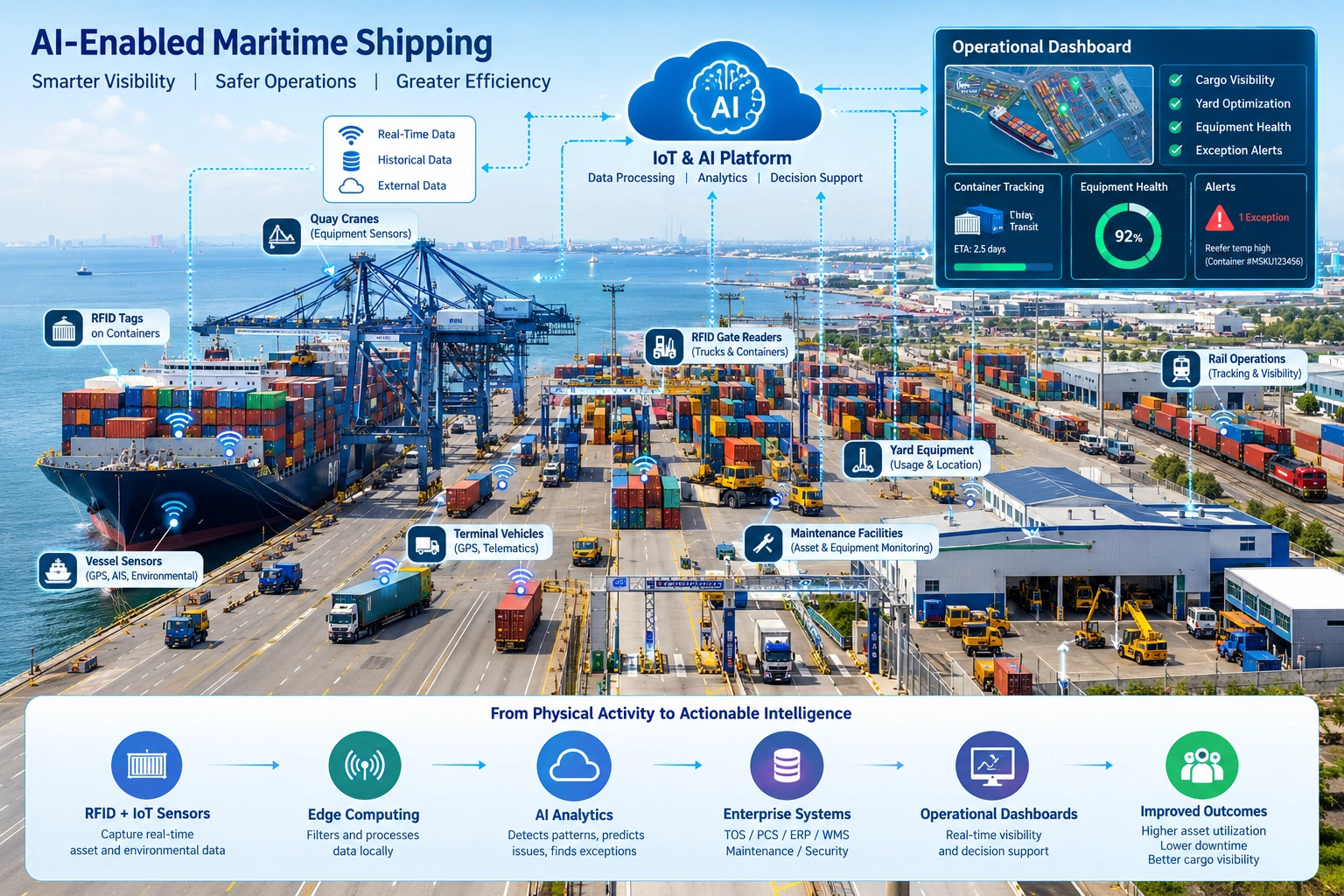
A realistic container terminal illustrates how RFID, IoT sensors, edge computing, AI analytics, enterprise systems, and operational dashboards support cargo visibility, yard optimization, equipment health, and exception management.