
AI and RFID for Petrochemical Plants
AI-Driven Asset Tracking and Operations in Petrochemical Plants
AI and RFID for petrochemical plants combine automated identification with AI-driven analysis to improve the visibility, control, and operational use of information associated with people, equipment, materials, maintenance activities, and plant assets. UHF RFID, HF RFID, and LF RFID can provide reliable identification at appropriate points in refinery and petrochemical operations, while AI converts identification events, operational records, work orders, inspection histories, location data, and process context into actionable recommendations.
For petrochemical plants, the value extends beyond knowing where an item is located. AI can identify abnormal asset movement, predict material availability issues, improve turnaround coordination, detect inconsistencies between field activity and maintenance plans, and help operations teams make faster decisions involving catalysts, drums, cylinders, mobile equipment, tools, spare parts, and critical process assets.
GAO supplies RFID hardware products and systems that support identification and tracking requirements across demanding industrial environments. Properly engineered AI-enabled RFID systems can connect field identification events with maintenance, inventory, safety, reliability, and operational workflows.
RFID Deployment in a Petrochemical Plant
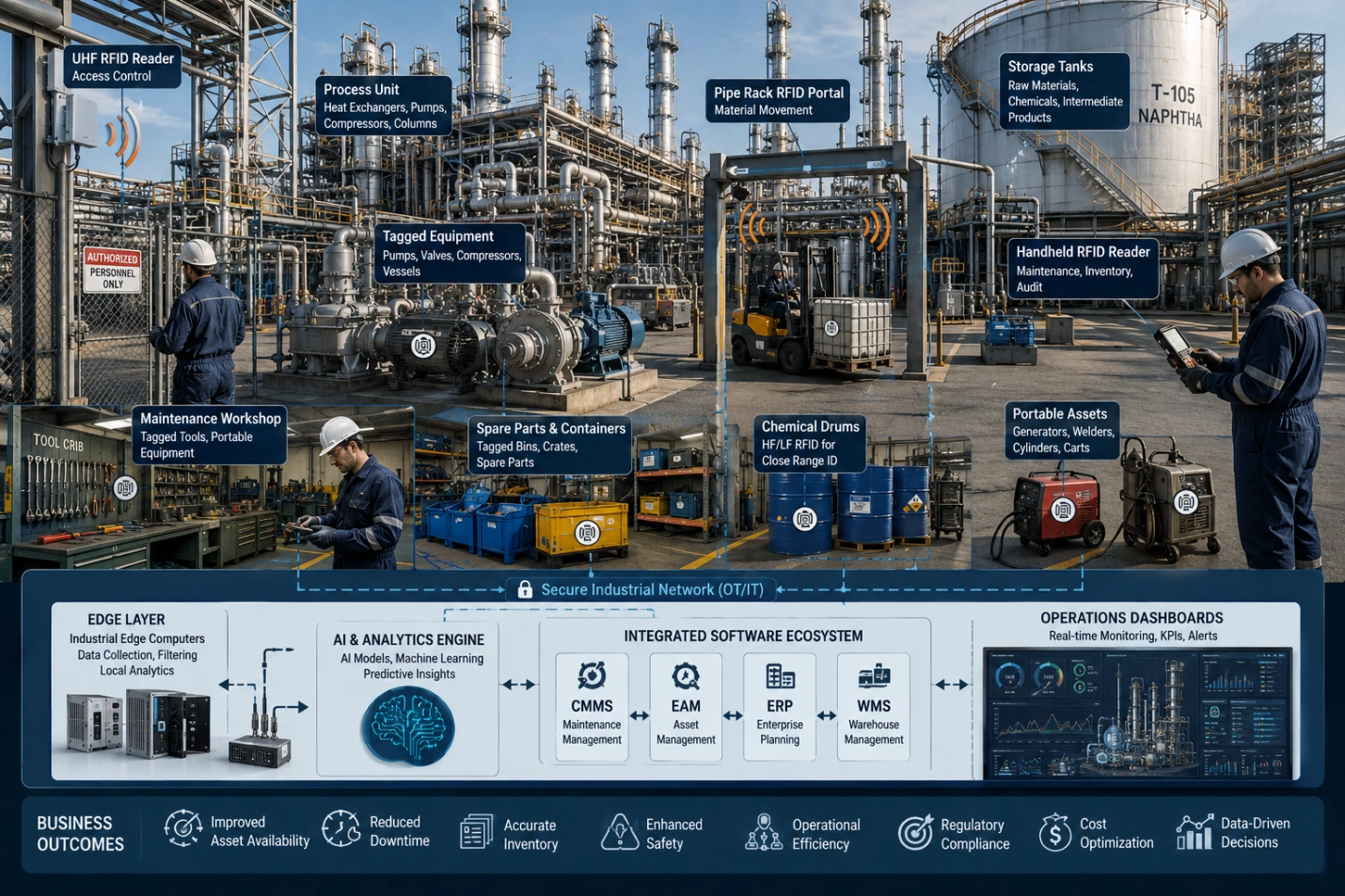
Why AI Is Transforming RFID-Based Petrochemical Plant Operations
Petrochemical plants operate through tightly connected production, maintenance, reliability, inspection, turnaround, warehousing, and safety processes. A single production train may involve furnaces, reactors, fractionation columns, compressors, pumps, heat exchangers, pressure relief devices, analyzers, pipelines, storage systems, and thousands of maintainable components. Supporting these assets are equally important operational resources, including calibrated instruments, lifting equipment, scaffolding components, specialist tools, spare parts, catalysts, cylinders, mobile generators, welding machines, and contractor resources.
Traditional identification systems can record that an RFID-tagged item was scanned, moved, issued, returned, or passed through a reader zone. AI changes the operational value of those events by correlating them with context.
For example, an AI system can examine RFID events alongside:
- CMMS work orders and maintenance notifications
- EAM asset hierarchies and equipment master data
- Preventive and predictive maintenance schedules
- Warehouse issue and return transactions
- Turnaround work packages
- Inspection and integrity management records
- Permit-to-work status
- Contractor and workforce authorization records
- Process unit operating conditions
- Production schedules and shutdown plans
- Equipment criticality classifications
- Failure history and maintenance backlog
- Spare-parts consumption patterns
- Calibration and certification records
This relationship enables a shift from isolated RFID reads toward operational decision support. Instead of simply reporting that a portable vibration analyzer entered a compressor area, AI can determine whether the equipment is associated with an active work order, assigned technician, approved maintenance activity, or overdue inspection task.
Artificial Intelligence of Things, commonly called AIoT or AI and IoT, combines artificial intelligence with IoT devices, sensors, connected equipment and industrial systems. AIoT solutions may also use Industrial AI, Edge AI, machine learning, computer vision and, in autonomous applications, Physical AI. Within petrochemical plants, RFID serves primarily as an identification layer that helps AI systems establish reliable associations between physical objects, digital records, operational events, and business processes.
GAO has supported organizations with identification and IoT hardware products and systems for demanding applications, helping technical teams evaluate reader placement, tag selection, environmental constraints, communication methods, and integration requirements.
Petrochemical Workflows Where AI-Enabled RFID Delivers the Greatest Value
Maintenance Tool and Mobile Equipment Control
Maintenance execution depends on the availability of specialized and calibrated equipment. During routine outages or major turnarounds, thousands of tools may move between central tool cribs, maintenance shops, process units, contractor staging areas, and temporary work locations.
RFID can identify the issue, transfer, return, and zone movement of selected equipment. AI can then analyze utilization patterns, identify abnormal retention periods, detect potential shortages, and predict where tool availability may constrain planned maintenance work.
Relevant assets can include:
- Torque wrenches
- Hydraulic torque tools
- Flange spreaders
- Pipe cutting equipment
- Welding machines
- Portable generators
- Gas detectors
- Confined-space equipment
- Calibration instruments
- Vibration analyzers
- Thermal imaging equipment
- Scaffolding equipment
- Rigging and lifting accessories
A practical engineering consideration is that RFID deployment should not attempt to track every item merely because it is technically possible. High-value, safety-critical, frequently misplaced, calibration-controlled, or turnaround-critical assets usually provide the strongest initial return.
Turnaround and Shutdown Material Coordination
Turnarounds introduce a temporary but highly complex operational environment. Equipment is taken out of service, isolated, inspected, repaired, retested, and returned to operation under compressed schedules. Delays involving a single missing gasket kit, valve component, exchanger bundle tool, specialized instrument, or critical spare can affect the critical path.
AI-assisted identification can help correlate material movement with:
- Turnaround work packages
- Equipment tag numbers
- Unit shutdown sequences
- Job readiness requirements
- Warehouse issue transactions
- Contractor assignments
- Maintenance progress
- Critical-path activities
AI models can identify patterns indicating that materials are arriving at a work zone too early, too late, or without an associated approved work package. Historical RFID event data can also support planning by identifying recurring staging bottlenecks and abnormal material dwell times during previous shutdowns.
RFID Identification Events to AI-Driven Turnaround Actions
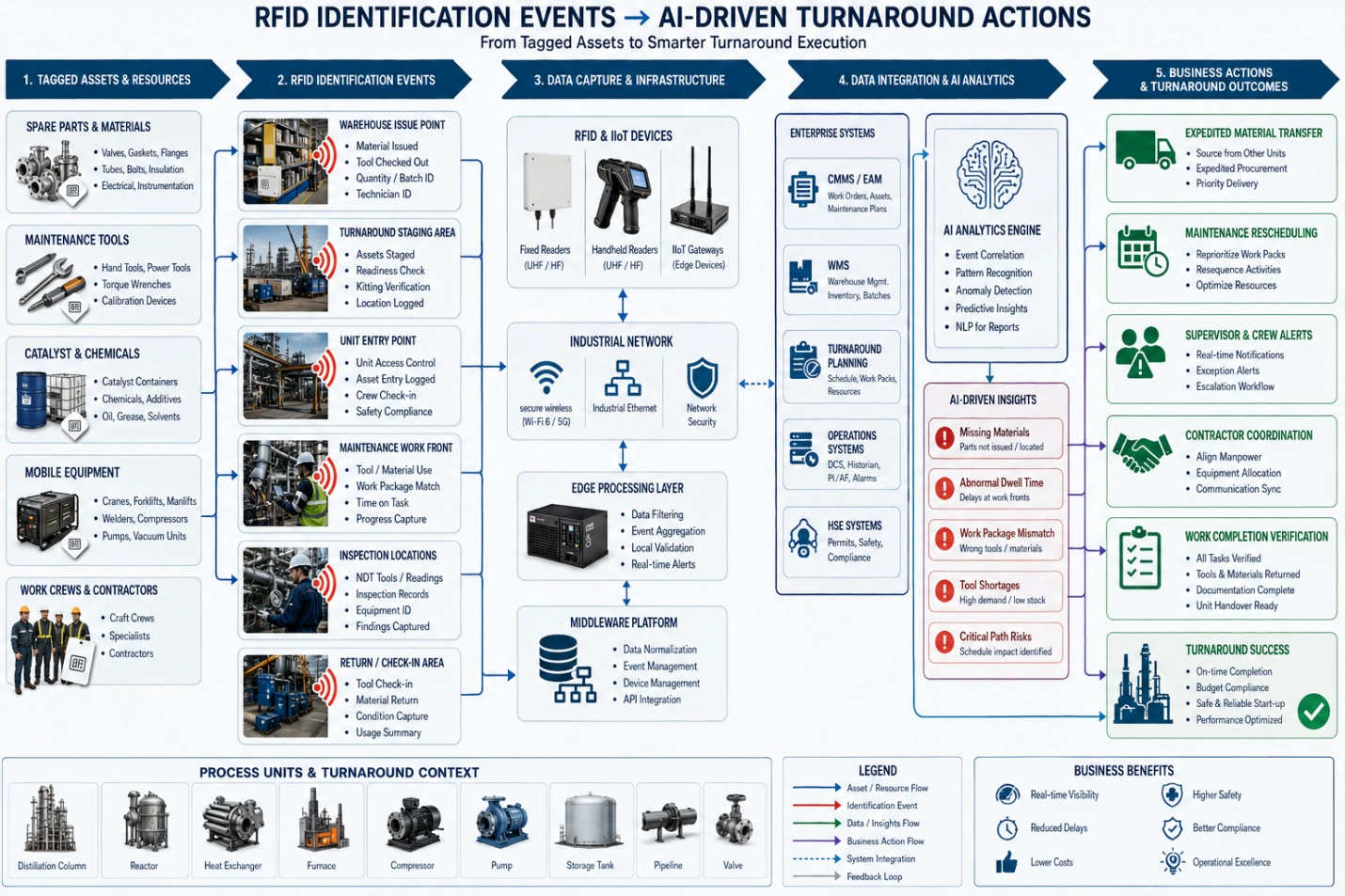
Spare Parts and MRO Inventory Management
Petrochemical maintenance stores contain items ranging from standard fasteners and gaskets to expensive compressor components, control valves, mechanical seals, bearings, instrumentation parts, and electrical assemblies.
The operational problem is rarely limited to inventory quantity. Technical teams must also manage:
- Correct part identification
- Approved manufacturer and specification matching
- Shelf-life constraints
- Lot and batch traceability
- Inspection status
- Preservation requirements
- Reserved stock for critical equipment
- Repairable spares
- Rotating-equipment components
- Emergency stock
- Obsolete materials
- Duplicate item records
AI can analyze RFID-based identification and material movement data with ERP and EAM records to identify inconsistent transactions, unusual consumption, dormant stock, potential shortages, and recurring material issues associated with specific equipment classes.
A practical example involves critical rotating equipment. If AI identifies repeated urgent withdrawals of particular seal assemblies or bearings for the same compressor family, the result may indicate an underlying reliability issue rather than simply increased inventory demand.
Catalyst, Chemical Container, and Material Traceability
Petrochemical operations can involve catalysts, additives, process chemicals, laboratory materials, treatment chemicals, and maintenance substances that require accurate identification and controlled handling.
RFID-based identification can support traceability for selected containers and materials when environmental conditions, container construction, tag attachment methods, and chemical compatibility have been evaluated. AI can associate movement history with batch records, approved storage zones, process campaigns, maintenance activities, or turnaround packages.
Engineering teams should evaluate:
- Tag resistance to chemicals and cleaning agents
- Temperature exposure
- Metal and liquid interference
- Required read distance
- Tag mounting orientation
- Intrinsically safe area requirements
- Attachment durability
- Read reliability around pipe racks and structural steel
- Container reuse and tag lifecycle
AI becomes particularly useful when material movement must be evaluated against expected operational sequences. A container appearing in an unauthorized storage area, remaining in a staging zone beyond an expected duration, or moving without an associated transaction can generate an exception for human review.
AI-Driven Workforce, Access, and Safety Coordination
Petrochemical plants require controlled movement around process units, restricted areas, laboratories, electrical rooms, maintenance workshops, loading facilities, tank farms, and turnaround work zones. Personnel access decisions may depend on role, training, permit status, contractor authorization, area classification, and current work activity.
RFID can support identification and access workflows where appropriate, while AI evaluates broader operational context. The objective should not be uncontrolled personnel surveillance. A properly designed solution should focus on legitimate safety, authorization, emergency response, and operational coordination requirements while applying data minimization and appropriate privacy controls.
AI can support:
- Detection of personnel entering restricted work zones without a corresponding authorized activity
- Correlation of contractor presence with approved work packages
- Identification of unexpected workforce concentration during turnarounds
- Analysis of access patterns around maintenance windows
- Emergency accountability support using recent identification events
- Verification that designated resources are present before work begins
- Identification of inconsistencies between permit requirements and observed access events
Read-zone design is critical. A reader positioned at a doorway does not necessarily prove that an individual performed a specific activity inside the area. Engineering teams should distinguish between presence detection, access confirmation, zone-level location, and precise location. Overstating the accuracy of RFID data can create safety and operational risks.
GAO can assist organizations with RFID hardware selection and system design considerations for applications where identification reliability, environmental conditions, and integration with existing plant processes are central requirements.
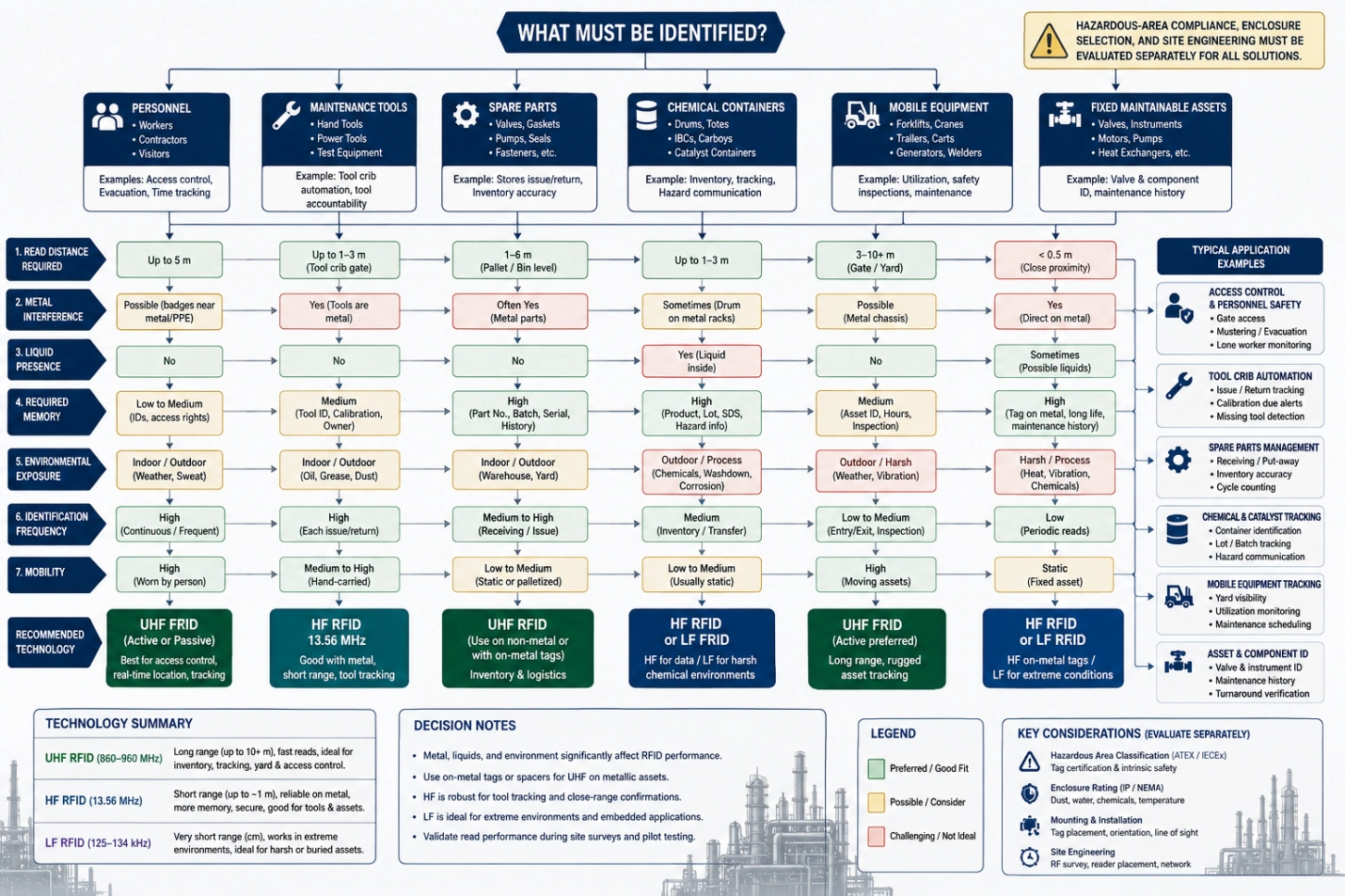
RFID Technology Selection Decision Tree for Petrochemical Plants
From RFID Events to AI-Driven Petrochemical Decisions
A useful AI and RFID system for petrochemical plants follows a controlled data lifecycle rather than sending every raw read directly into business software.
Physical Identification and Event Capture
The process begins with identification points designed around actual workflows. Fixed readers may be installed at maintenance stores, warehouse portals, controlled gates, tool cribs, turnaround staging areas, or selected transfer points. Handheld readers can support technicians who must identify components, tools, containers, or assets at specific work locations.
UHF RFID is often suitable for longer read ranges and bulk identification requirements. HF RFID can be useful where controlled close-range identification or specific tag characteristics are required. LF RFID may suit specialized short-range identification applications where its operating characteristics provide practical advantages.
The selection should be based on the specific petrochemical workflow rather than a universal preference for one RFID frequency.
Edge Filtering and Event Qualification
Raw RFID data can contain repeated reads, missed transitions, transient reads, and environmental effects. Industrial edge software can filter duplicate events, apply read confidence rules, define entry and exit logic, and temporarily store data when communication is interrupted.
For example, multiple reads from a tool located near a fixed reader should not automatically create multiple warehouse transactions. Edge rules can determine whether the sequence represents:
- A true asset movement
- Continued presence within a read zone
- A temporary read
- A failed transaction
- A movement requiring additional verification
This stage is particularly important in steel-dense petrochemical environments containing pipe racks, vessels, structural supports, equipment skids, and other sources of RF reflection.
Middleware and Context Enrichment
Qualified RFID events should be enriched with relevant operational context before AI analysis. Middleware can associate an EPC, tag identifier, or asset record with equipment numbers, material codes, maintenance status, work orders, storage locations, or personnel authorization records.
The resulting event may become more useful when expressed in an operational form such as:
“Critical compressor maintenance tool entered the ethylene compressor work zone while assigned to active work order.”
This contextual transformation provides AI models with information that is substantially more useful than an isolated reader event.
AI Analysis and Decision Support
AI methods can include anomaly detection, classification, forecasting, optimization, natural-language interfaces, and machine learning models trained on historical operational data.
Potential AI outputs include:
- Predicted shortages of turnaround-critical equipment
- Abnormal material dwell times
- Unexpected asset movement
- Maintenance resource conflicts
- Inventory consumption anomalies
- Potential work-package readiness issues
- Exceptions requiring supervisor review
- Recommended staging or replenishment actions
AI recommendations should be traceable to source data and should not automatically execute safety-critical actions without appropriate controls and human authorization.
Enterprise Integration and Business Action
The final step connects validated AI outputs with operational systems such as CMMS, EAM, ERP, warehouse software, maintenance planning systems, permit-to-work software, and selected control-room applications.
Actions may include creating an exception, alerting a supervisor, recommending a replenishment, updating material status, initiating a verification workflow, or prioritizing an inspection.
The most successful deployments treat AI-driven identification as part of a broader petrochemical operating workflow rather than as an isolated tracking project.
AI-Driven Identification Architecture for Petrochemical Plants
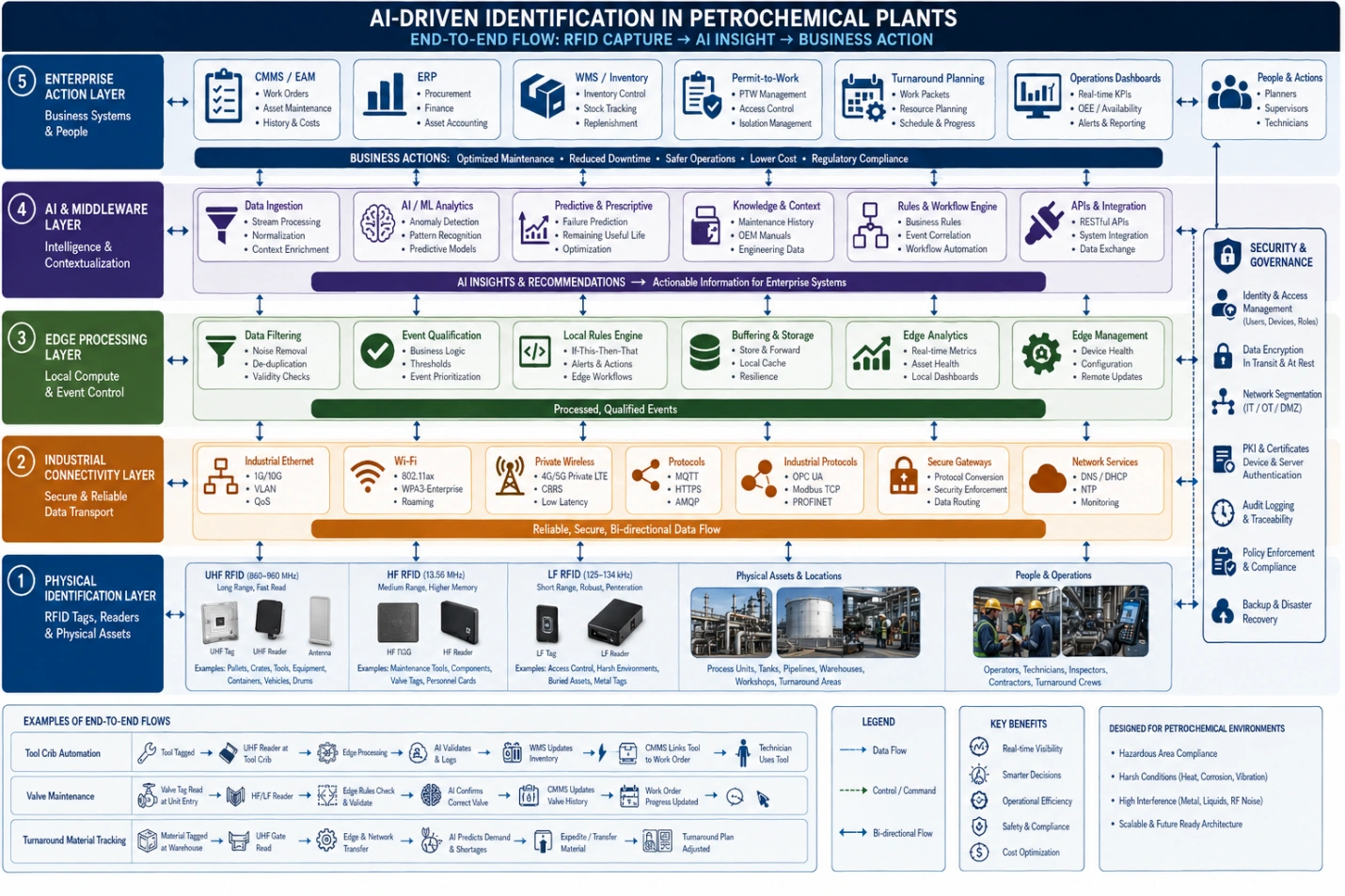
Technical Components of an AI-Enabled Petrochemical RFID System
An AI-enabled petrochemical identification solution requires coordinated hardware, software, communications, security, and operational integration. The RFID layer is only one component. Reliable results depend equally on engineering the data flow and connecting identification events to plant workflows.
RFID Hardware and Field Infrastructure
Field hardware can include:
- UHF fixed readers for portals, stores, staging areas, and controlled transfer points
- Handheld RFID readers for maintenance and inspection teams
- HF RFID readers for close-range workflows
- LF RFID readers for specialized identification applications
- Industrial antennas selected for coverage and environmental conditions
- Ruggedized RFID tags designed for metal, heat, chemicals, vibration, or repeated handling
- Industrial enclosures and mounting systems
- Edge gateways and local computing equipment
Petrochemical site conditions require more than standard laboratory testing. Reader locations should be surveyed for structural steel, process equipment, electrical noise, multipath effects, power availability, cable routing, maintenance access, and hazardous-area restrictions.
AI Software and Data Models
AI software can process RFID events alongside maintenance, inventory, reliability, and operational records. Suitable models depend on the problem.
Anomaly detection may identify unusual movement patterns. Forecasting models may estimate future demand for maintenance materials. Optimization algorithms can support staging and allocation decisions. Natural-language AI can help authorized users query maintenance and asset history using controlled access to validated records.
Model outputs should include confidence indicators, supporting evidence where practical, and clear escalation rules. Petrochemical operations should avoid treating AI output as unquestionable fact.
Communication and Integration Infrastructure
Common communication methods may include industrial Ethernet, Wi-Fi, private cellular or other approved wireless systems, MQTT, HTTPS, and OPC UA where integration requirements justify their use.
Network design should account for:
- Segmentation between operational and business networks
- Store-and-forward capability during outages
- Device authentication
- Certificate management
- Encryption of data in transit
- Firewall rules
- Remote access controls
- Audit logging
- Time synchronization
Integration can use APIs, message brokers, database connectors, middleware, or approved enterprise interfaces. Directly connecting field readers to critical control systems is generally unnecessary for most asset and workflow identification applications.
Cloud Version and Server Version
A Cloud Version can centralize AI processing, reporting, model management, and multi-site data analysis within cloud infrastructure. This approach may be appropriate for petrochemical companies operating multiple plants, centralized maintenance organizations, or geographically distributed warehouses where cross-site analysis is valuable.
A Server Version deploys software on customer-managed edge servers, private data centers, factory servers, or other privately hosted infrastructure. This model may be preferred where data residency, network isolation, latency, internal cybersecurity requirements, or intermittent external connectivity limit cloud use.
A hybrid model can also be practical. Event qualification and time-sensitive processing can remain close to the plant, while aggregated historical data supports broader AI analysis in centrally managed infrastructure.
GAO provides RFID and IoT hardware products and systems that can be incorporated into cloud-hosted, server-based, or hybrid petrochemical identification solutions.
Technical Capabilities and Operational Improvements
AI-enabled RFID systems create value in petrochemical plants when identification data is connected to specific operational decisions. The objective is not simply to increase the number of tagged assets. A well-designed solution improves the reliability and usefulness of information surrounding maintenance execution, material movement, asset availability, turnaround coordination, and operational compliance.
AI Asset Tracking for Maintenance and Reliability
Petrochemical plants depend on reliable availability of critical maintenance resources. AI can analyze RFID identification events to determine whether assets are being utilized as expected and whether their movement patterns indicate potential operational problems.
Relevant AI capabilities include:
- Detecting abnormal movement of maintenance tools and mobile equipment
- Identifying assets that remain in turnaround staging areas beyond expected periods
- Detecting equipment issued without a corresponding work order or assignment
- Predicting shortages of frequently used maintenance resources
- Identifying underutilized high-value equipment
- Correlating repeated spare-part withdrawals with recurring equipment failures
- Highlighting potential conflicts between resource availability and maintenance schedules
The operational improvement comes from connecting physical movement to the maintenance process. A missing torque tool, for example, becomes more significant when the AI system recognizes that it is required for a critical-path exchanger maintenance activity scheduled to begin within the next shift.
Material Availability and MRO Optimization
Maintenance, repair, and operations inventory in petrochemical plants is closely connected to equipment reliability. Stockouts involving mechanical seals, bearings, valve trim, transmitters, actuators, electrical components, or compressor spares can extend equipment downtime.
AI can combine identification events with material master records, equipment bills of materials, consumption history, maintenance schedules, and asset criticality.
Potential improvements include:
- Forecasting demand for critical spares
- Detecting abnormal consumption patterns
- Identifying dormant or slow-moving MRO inventory
- Supporting repairable-spares circulation
- Improving material staging before planned maintenance
- Identifying discrepancies between physical movement and recorded transactions
- Supporting replenishment decisions based on maintenance demand
An important engineering lesson is that AI forecasting should consider planned maintenance and turnaround schedules rather than relying only on historical consumption. Historical demand may not accurately predict a major planned shutdown involving large-scale exchanger, valve, compressor, or reactor maintenance.
Turnaround Readiness and Critical-Path Management
Major turnarounds can involve thousands of interconnected activities performed under strict safety and production constraints. AI-assisted RFID data can provide additional evidence about whether critical resources are physically available when required.
AI can compare expected and observed conditions, including:
- Planned material staging versus actual material arrival
- Tool requirements versus actual tool availability
- Contractor work assignments versus access events
- Equipment movement versus turnaround work progress
- Critical-path schedules versus resource constraints
- Return of temporary equipment versus closeout status
The result is improved exception management. Rather than requiring turnaround coordinators to manually review every movement event, AI can prioritize conditions that may affect the schedule.
Operational Scalability Across Process Units
A petrochemical RFID deployment should scale by workflow and asset class rather than by indiscriminately tagging the entire facility.
A practical implementation can begin with a defined problem, such as tool control during a turnaround or traceability of critical maintenance spares. Additional workflows can then be added after the initial deployment establishes reliable read performance, data quality, and integration processes.
Scalability depends on:
- Consistent asset identification policies
- Standardized tag encoding
- Reader configuration management
- Common event definitions
- Reusable middleware interfaces
- Asset master-data quality
- Network capacity
- Cybersecurity governance
- AI model monitoring
- Clear ownership of operational exceptions
GAO has helped organizations evaluate RFID hardware and related identification systems for applications where expansion must be based on demonstrated operational value rather than uncontrolled technology proliferation.
Security and Data Integrity Improvements
RFID identification should be treated as one source of operational evidence rather than an automatically trusted source.
A secure AI-enabled solution can apply controls such as:
- Unique device identities
- Mutual authentication
- Encrypted communications
- Certificate-based access where appropriate
- Network segmentation
- Role-based access control
- Reader configuration control
- Event validation
- Immutable or protected audit records where required
- AI model access restrictions
- Logging of AI recommendations and user actions
Data integrity is especially important when RFID events influence maintenance, inventory, safety, or compliance decisions. AI can also help identify suspicious patterns, such as improbable asset movement sequences, repeated identification failures, or activity inconsistent with the expected workflow.
Engineering Considerations for Petrochemical RFID Deployment
Successful implementation requires field engineering before large-scale procurement. Petrochemical facilities contain conditions that can significantly affect identification performance, including structural steel, large process vessels, pipe racks, rotating machinery, dense equipment arrangements, high temperatures, chemicals, vibration, electromagnetic interference, and hazardous locations.
Frequency and Tag Selection
UHF, HF, and LF RFID should be selected according to the application.
UHF RFID may be suitable for applications requiring longer read distances, portal identification, bulk reads, or movement through controlled zones.
HF RFID may be appropriate where closer and more deliberate identification is preferred.
LF RFID can support specialized short-range applications where its operational characteristics provide advantages.
Selection criteria should include:
- Required read range
- Number of tags that must be read simultaneously
- Presence of metal
- Presence of liquids
- Asset geometry
- Mounting surface
- Required memory
- Environmental exposure
- Tag durability
- Cleaning procedures
- Chemical compatibility
- Temperature range
- Hazardous-area requirements
A tag that performs well in a warehouse may perform poorly when mounted on a curved steel cylinder or placed near process equipment. Site testing should therefore use representative assets and realistic installation conditions.
Hazardous Areas and Site Safety
Many petrochemical facilities contain classified hazardous locations. RFID readers, antennas, gateways, power supplies, enclosures, and associated installation methods must be evaluated against applicable site requirements.
Engineering teams should assess:
- Area classification
- Applicable electrical protection requirements
- Equipment certification requirements
- Intrinsic safety requirements where applicable
- Cable and conduit requirements
- Grounding and bonding
- Environmental ingress protection
- Maintenance accessibility
- Emergency shutdown considerations
Technology teams should never assume that a standard commercial RFID device can be installed inside a classified area without appropriate engineering review.
Reader Placement and RF Site Testing
Reader placement should follow the physical workflow.
A portal at a maintenance store should be designed around actual movement paths rather than a theoretical coverage map. Temporary turnaround staging zones may require a different approach from permanent warehouse doors.
Site testing should evaluate:
- Read reliability
- False reads
- Missed reads
- Directional movement
- Multiple-tag performance
- Reflections from structural steel
- Effects of nearby liquids and containers
- Interference from adjacent equipment
- Antenna polarization
- Reader power settings
- Cable losses
Testing should also consider operational changes. A reader configuration that performs well during normal production may behave differently during a turnaround when temporary structures, scaffolding, containers, and large maintenance equipment alter the RF environment.
Data Quality Before AI Deployment
AI cannot compensate indefinitely for poorly defined identification events.
Before training or configuring AI models, teams should establish:
- Asset naming standards
- Equipment hierarchy alignment
- Consistent material master records
- Defined reader zones
- Event timestamps
- Time synchronization
- Rules for duplicate reads
- Rules for missing or incomplete transactions
- Ownership of data corrections
- Definitions for operational exceptions
Poor master-data quality can create misleading AI recommendations. For example, AI cannot reliably associate a tagged mechanical seal with compressor maintenance if material records, equipment associations, and work-order references are inconsistent.
AI Models for Petrochemical RFID Data
Different operational problems require different AI approaches.
Anomaly Detection
Anomaly detection can identify events that differ from expected operational patterns.
Examples include:
- A critical tool leaving an assigned work zone
- A repairable spare remaining outside the repair process
- A catalyst container entering an unexpected storage area
- A maintenance asset appearing at an unrelated process unit
- Repeated identification failures at a specific reader location
Unsupervised models can be useful when labeled examples of abnormal events are limited.
Forecasting
Forecasting models can estimate future resource requirements based on historical usage, maintenance schedules, turnaround plans, seasonal factors, equipment reliability history, and production conditions.
Potential applications include:
- Spare-parts demand forecasting
- Tool demand forecasting
- Maintenance resource planning
- Material replenishment
- Turnaround staging requirements
Forecasting should be continuously validated because changes in production configuration, maintenance strategy, or equipment population can reduce model accuracy.
Optimization
Optimization models can recommend how resources should be allocated.
Examples include:
- Assigning limited specialized tools to competing maintenance jobs
- Prioritizing movement of critical materials
- Optimizing staging locations
- Reducing unnecessary movement of mobile equipment
- Supporting turnaround logistics planning
Optimization models should operate within operational constraints defined by maintenance, safety, logistics, and production teams.
Natural-Language AI for Operational Queries
Natural-language AI can help authorized users query information across maintenance and identification systems.
A maintenance planner might ask:
- Which critical compressor spares are currently staged for the next shutdown activity?
- Which specialized tools have not been returned from Unit 4?
- What material movements are inconsistent with today’s active work orders?
- Which turnaround work packages have identified material availability risks?
The AI system should retrieve information from controlled, authorized data sources and provide traceability to the underlying records.
AI Use Case Matrix for RFID-Driven Petrochemical Operations
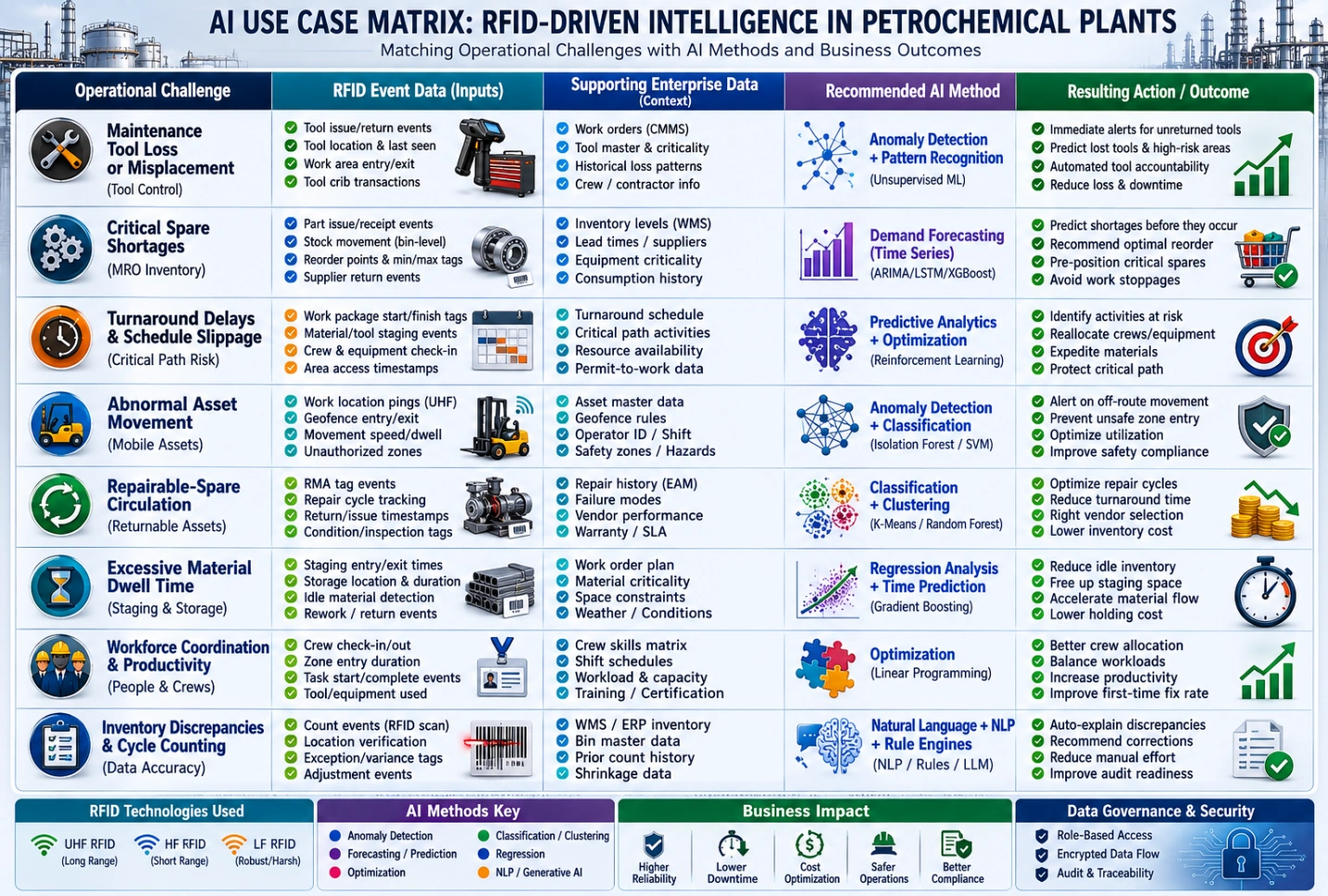
Integration with Petrochemical Plant Software
AI-enabled RFID systems become more useful when connected to established software systems.
Relevant integrations may include:
- Computerized Maintenance Management Systems
- Enterprise Asset Management systems
- Enterprise Resource Planning software
- Warehouse and inventory management software
- Turnaround planning and scheduling systems
- Permit-to-work systems
- Contractor management systems
- Inspection management software
- Asset integrity management systems
- Laboratory information systems
- Production planning software
- Industrial data historians
Integration should follow clear ownership boundaries. The RFID system may identify physical movement, while the CMMS remains the authoritative system for maintenance records and the ERP system remains authoritative for purchasing and financial inventory data.
This approach reduces duplication and prevents multiple systems from creating conflicting records.
Maintenance and EAM Integration
Connecting RFID events with equipment numbers, functional locations, work orders, notifications, maintenance plans, and equipment criticality can improve maintenance execution.
A useful implementation may allow the system to associate:
- A tagged tool with an assigned technician
- A spare part with a specific work order
- A mobile asset with a maintenance work zone
- A repairable component with its repair status
- A returned item with a maintenance closeout process
GAO provides hardware products and systems that can serve as part of these broader identification and integration solutions.
Warehouse and ERP Integration
Warehouse integration can help reconcile physical movement with inventory transactions.
AI can flag conditions such as:
- Physical movement without a corresponding transaction
- A material issued to an unexpected work order
- A critical item located outside its assigned storage or staging area
- Repeated urgent withdrawals from emergency stock
The goal is not necessarily full automation. Exception workflows may require verification by warehouse personnel before enterprise records are changed.
Measuring Performance and Business Value
Petrochemical organizations should define KPIs before deployment. RFID read counts alone are not meaningful business metrics.
Relevant performance indicators may include:
- Asset identification accuracy
- Read success rate
- False-read rate
- Tool search time
- Tool availability
- Material staging time
- MRO inventory accuracy
- Critical-spare availability
- Emergency stock usage
- Asset dwell time
- Turnaround schedule adherence
- Maintenance schedule compliance
- Work-package readiness
- Repairable-spare cycle time
- Maintenance labor productivity
- Number of manual inventory transactions
- Number of unresolved asset exceptions
- Mean time to locate critical equipment
- Number of delayed maintenance activities caused by material shortages
KPIs should establish a baseline before implementation. Benefits can then be measured against actual operating conditions rather than estimated from generic RFID benchmarks.
Practical Implementation Recommendations
The most effective AI-enabled RFID projects usually begin with a clearly defined petrochemical operating problem.
Recommended implementation practices include:
- Select a workflow with measurable operational consequences, such as turnaround material staging, maintenance tool control, or critical-spare traceability.
- Conduct an RF and environmental assessment using representative assets and actual plant conditions.
- Define the authoritative source for asset, material, maintenance, and inventory records.
- Standardize tag encoding, asset identifiers, event definitions, and reader-zone naming.
- Validate read performance before integrating large volumes of operational data.
- Implement edge filtering to reduce duplicate and irrelevant events.
- Establish cybersecurity requirements before connecting readers and middleware to plant networks.
- Use AI initially for recommendation, prioritization, and exception detection rather than uncontrolled automation.
- Include maintenance, reliability, warehouse, IT, OT, cybersecurity, and operations personnel in solution design.
- Measure business KPIs before and after deployment.
- Expand only after the initial workflow demonstrates reliable data quality and operational value.
GAO can support technical teams with RFID hardware products, identification systems, and engineering expertise for organizations evaluating how automated identification can contribute to petrochemical maintenance, asset control, material management, and AI-driven operational workflows.
Key Takeaways for AI-Driven RFID in Petrochemical Plants
AI and RFID can improve petrochemical plant operations by connecting physical identification with maintenance, reliability, inventory, turnaround, safety, and operational data. The strongest implementations focus on specific workflows where the absence of accurate asset or material information creates measurable operational risk.
Successful deployment depends on more than selecting UHF, HF, or LF RFID hardware. Teams must evaluate hazardous-area requirements, RF performance around metal and process equipment, tag durability, reader placement, data quality, cybersecurity, edge processing, enterprise integration, and AI model governance.
A phased approach provides the most practical path. Start with a measurable problem, validate the physical identification process, integrate it with authoritative plant systems, and then apply AI to identify exceptions, predict resource constraints, and support better decisions. GAO helps organizations evaluate and deploy RFID and IoT hardware products and systems for demanding industrial applications.
Building the Future of Industrial AI and IoT with Aperture Venture Studio and GAO RFID Inc.
For more than three decades, GAO Group of Companies has invested heavily in R&D involving industrial RFID, BLE, and IoT technologies. As generative AI demonstrated practical value for industrial applications, we expanded our work in AI and IoT, including RFID and BLE, and established Aperture Venture Studio to advance AI and IoT solutions for industries such as chemical manufacturing and petrochemical operations.
Aperture brings together experienced AI and IoT technical specialists, entrepreneurial and operational executives, influential investors, and leading organizations. We have also developed Aperture Ventures Summit and TekSummit to support discussions around advanced AI and IoT topics and technical collaboration.
We welcome engagement with us as:
- Advisors, co-founders, or employees
- Investors
- Customers
GAO, headquartered in New York City and Toronto, Canada, has served customers across the United States and Canada for three decades, including Fortune 500 companies, leading R&D organizations, prestigious universities, and U.S. and Canadian government agencies. Our continued investment in R&D, quality assurance, and remote or onsite technical support helps technical teams evaluate and implement identification and IoT systems for demanding operational environments.