
AI and RFID for Pharmaceutical Distribution
AI-Driven Pharmaceutical Distribution Using RFID Solutions
Artificial intelligence is transforming pharmaceutical distribution by enabling predictive inventory management, intelligent product traceability, automated compliance verification, and real-time supply chain visibility. When combined with RFID technologies, AI-powered pharmaceutical distribution systems provide continuous identification and monitoring of prescription drugs, vaccines, biologics, controlled substances, and temperature-sensitive medical products throughout warehouses, fulfillment centers, transportation networks, and healthcare delivery facilities.
Pharmaceutical distributors operate within one of the world’s most highly regulated supply chains. Every shipment must maintain product integrity, comply with serialization regulations, preserve cold chain conditions, prevent counterfeit medications, and ensure rapid product recalls when necessary. AI analyzes operational data collected from RFID readers, environmental sensors, warehouse management software, transportation systems, and enterprise applications to optimize inventory movements, predict shortages, detect anomalies, and automate decision-making across pharmaceutical logistics operations.
Organizations implementing AI-enabled RFID solutions benefit from improved inventory accuracy, enhanced patient safety, reduced product loss, greater regulatory compliance, and more efficient warehouse operations. Through decades of supplying RFID hardware and industrial IoT solutions, GAO has supported organizations seeking reliable identification technologies for complex healthcare logistics environments.
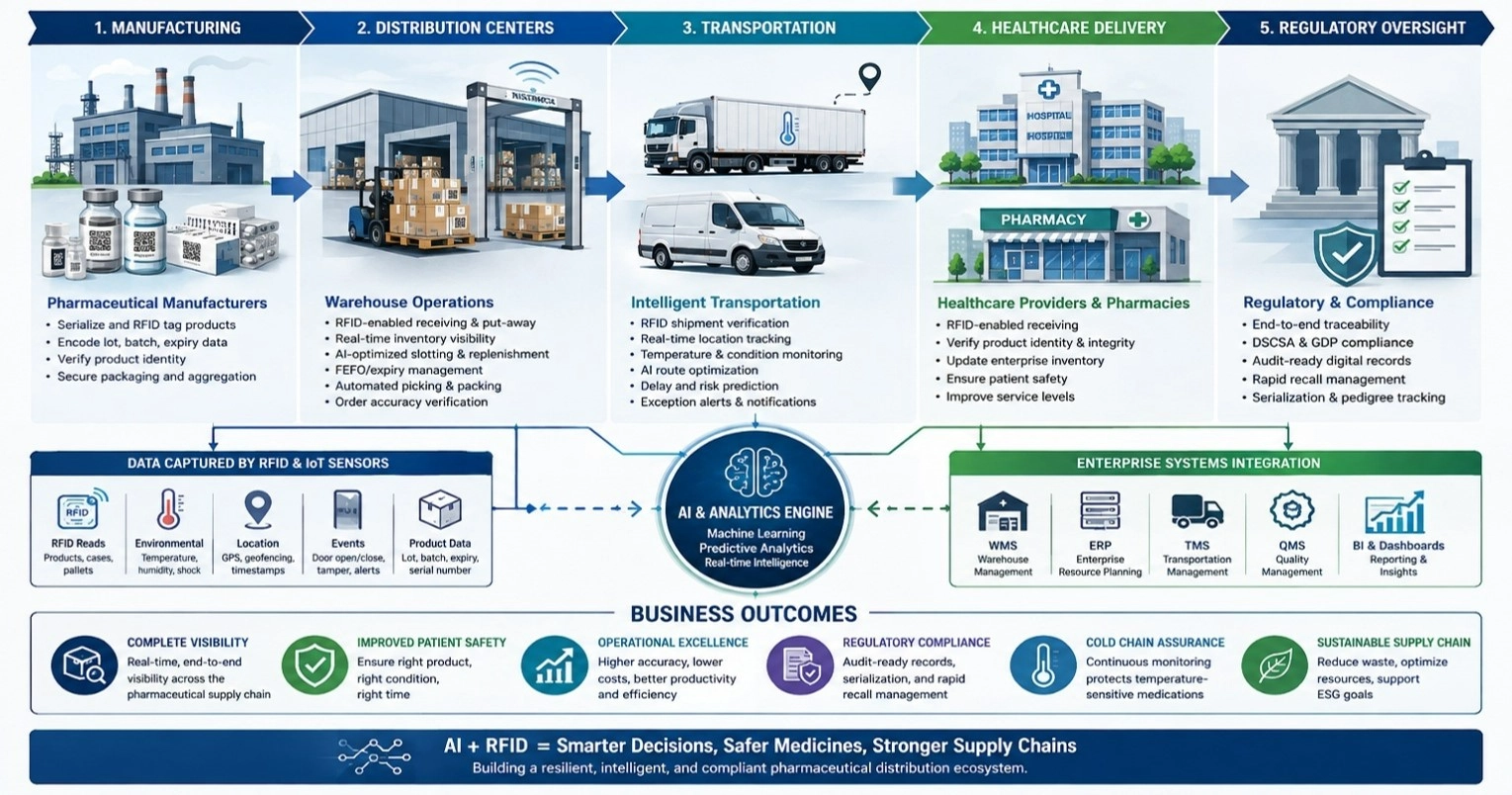
AI-Enabled RFID Pharmaceutical Distribution Workflow for End-to-End Supply Chain Visibility
Understanding AI-Powered Pharmaceutical Distribution
Modern pharmaceutical distribution involves much more than transporting medications from manufacturers to pharmacies or healthcare providers. Every product must be authenticated, serialized, stored under regulated environmental conditions, tracked across multiple custody transfers, and delivered within strict quality standards.
Artificial Intelligence enhances pharmaceutical logistics by continuously analyzing operational information generated throughout the supply chain. Machine learning models recognize demand patterns, optimize warehouse slotting, forecast replenishment requirements, prioritize order fulfillment, detect unusual inventory movements, and improve transportation scheduling.
RFID technologies serve as one of the primary automated data acquisition methods supporting these AI capabilities. Unlike barcode scanning, RFID enables rapid identification of multiple pharmaceutical products simultaneously without direct line-of-sight. UHF RFID is commonly deployed for pallet and case tracking within distribution centers, HF RFID supports item-level authentication where shorter read ranges are preferred, and LF RFID may be used in specialized identification scenarios involving reusable assets or medical equipment.
Rather than relying on periodic manual inventory counts, pharmaceutical distributors receive continuous visibility into inventory location, movement history, environmental status, and product availability. AI converts this operational data into actionable recommendations that improve supply chain responsiveness while reducing manual intervention.
Healthcare providers increasingly expect distributors to deliver medications accurately, quickly, and with complete traceability. AI-supported RFID systems help satisfy these expectations by maintaining synchronized inventory records, reducing fulfillment errors, and supporting regulatory documentation throughout the product lifecycle.
Why AI Is Transforming Pharmaceutical Distribution
Pharmaceutical distribution faces operational complexities that continue to grow due to expanding biologic therapies, personalized medicine, specialty pharmaceuticals, stricter regulatory oversight, and increasing customer service expectations.
Several industry challenges make AI particularly valuable:
Rapid demand fluctuations for critical medications
Temperature-sensitive biologics requiring uninterrupted cold chain monitoring
Drug Supply Chain Security Act (DSCSA) compliance requirements
Product serialization verification
Counterfeit medicine prevention
Expiration date management
Recall execution efficiency
Multi-site warehouse coordination
Controlled substance accountability
Labor shortages within distribution centers
AI addresses these challenges by identifying patterns that traditional rule-based systems often overlook. Predictive analytics forecast medication demand using historical sales, epidemiological trends, seasonal illnesses, healthcare utilization data, and regional consumption patterns. Intelligent inventory optimization reduces both stock shortages and excess inventory while minimizing product expiration.
Computer vision solutions integrated with warehouse automation verify packaging integrity during picking and packing operations. Natural language processing assists regulatory reporting by extracting relevant compliance information from operational records. Reinforcement learning continuously improves warehouse task allocation based on changing operational conditions.
GAO has observed increasing demand for intelligent identification technologies as pharmaceutical distributors modernize logistics operations to improve resilience, transparency, and operational efficiency.
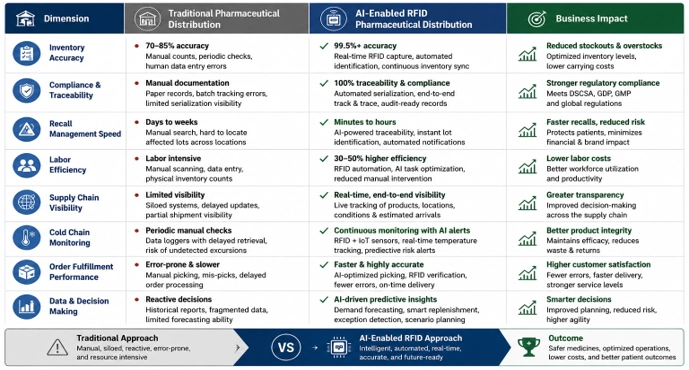
Traditional vs. AI-Enabled RFID Pharmaceutical Distribution Comparison for Intelligent Healthcare Supply Chains
Pharmaceutical Distribution Applications Enabled by AI and RFID
AI-supported RFID solutions improve nearly every operational function within pharmaceutical distribution facilities.
Intelligent Inventory Management
AI continuously evaluates warehouse inventory levels, product movement velocity, expiration schedules, and replenishment priorities. RFID readers automatically capture inventory movements without requiring manual scanning, allowing AI software to maintain highly accurate inventory records.
Benefits include:
Reduced inventory discrepancies
Improved cycle counting
Lower safety stock requirements
Higher warehouse productivity
Reduced expired pharmaceutical waste
Cold Chain Monitoring
Vaccines, biologics, insulin, cell therapies, and specialty pharmaceuticals require continuous environmental monitoring.
AI analyzes information collected from RFID-enabled environmental sensors measuring:
Temperature
Humidity
Shock exposure
Transit duration
Storage conditions
When abnormal conditions occur, AI automatically generates alerts before product quality is compromised.
Pharmaceutical Serialization Verification
Serialization has become mandatory across many healthcare markets.
AI validates serialized product identifiers against enterprise databases while RFID systems rapidly identify incoming shipments. Suspicious serial numbers, duplicate identifiers, or missing transaction histories are immediately flagged for investigation, helping distributors reduce counterfeit medication risks.
AI-Enabled Pharmaceutical Distribution Workflow from Data Capture to Intelligent Decision-Making
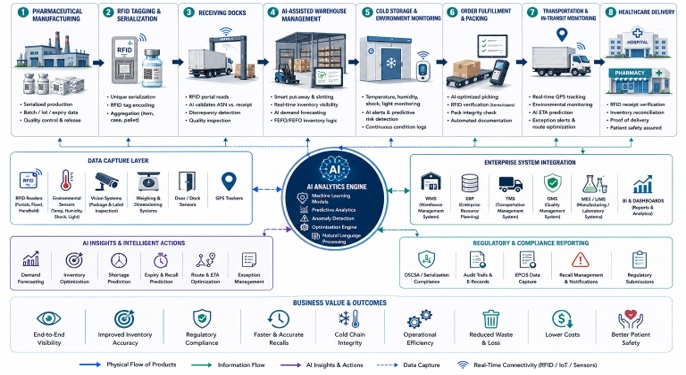
Successful AI-powered pharmaceutical distribution depends on a continuous flow of accurate operational data across warehouses, transportation networks, enterprise software, and regulatory systems. RFID technologies automate product identification while AI transforms collected information into operational intelligence that supports inventory optimization, compliance, and patient safety.
The operational workflow typically consists of the following stages:
Product Registration and Serialization
Every pharmaceutical product enters the distribution network with a unique identity. Serialized identifiers, batch numbers, lot numbers, manufacturing dates, expiration dates, and regulatory information are associated with RFID tags and enterprise databases.
AI validates incoming shipment information against manufacturer records before products are accepted into inventory. Any inconsistencies between shipment documentation and RFID identification records trigger immediate exception workflows for quality assurance personnel.
Automated Receiving Operations
As pallets, totes, or cartons pass through RFID-enabled receiving portals, multiple tagged products are identified simultaneously.
Collected information includes:
Product identifiers
Batch numbers
Shipment quantities
Receiving timestamps
Dock locations
Distribution center assignments
Machine learning algorithms compare expected shipment contents with actual received inventory, automatically identifying shortages, overages, damaged shipments, or unauthorized substitutions.
Instead of manually scanning every package, warehouse personnel receive AI-generated discrepancy reports that prioritize inspections requiring immediate attention.
Intelligent Warehouse Storage
Following receiving, AI determines optimal storage locations based on numerous operational variables, including:
Product demand frequency
Storage temperature requirements
Hazard classifications
Controlled substance restrictions
Product dimensions
Picking frequency
Remaining shelf life
RFID readers positioned throughout storage zones continuously monitor inventory movement, allowing warehouse management software to maintain real-time inventory visibility.
For cold storage environments, AI also correlates environmental sensor data with RFID product locations to ensure every temperature-sensitive medication remains within validated storage conditions.
Order Processing and Picking
Customer orders from hospitals, retail pharmacies, specialty pharmacies, and healthcare providers enter warehouse management software.
AI prioritizes fulfillment using factors such as:
Delivery urgency
Customer service agreements
Product expiration dates
Transportation schedules
Inventory availability
Warehouse workload
Rather than following static picking routes, AI dynamically optimizes picker travel paths, reducing walking distances while maintaining First-Expire-First-Out (FEFO) inventory practices.
RFID verification minimizes picking errors by confirming that selected medications match customer orders before packing begins.
Packaging and Shipment Verification
During packing operations, RFID portals automatically verify shipment contents.
AI confirms:
Correct medication selection
Proper quantities
Lot number accuracy
Serialization compliance
Packaging completeness
Cold-chain packaging requirements
Computer vision systems may supplement RFID by inspecting package integrity, tamper-evident seals, shipping labels, and packaging quality.
If discrepancies are detected, shipments are automatically diverted for inspection before leaving the distribution center.
Transportation Monitoring
Once shipments enter transportation networks, AI continues monitoring operational conditions using connected IoT sensors integrated with RFID-enabled logistics systems.
Operational information may include:
Vehicle location
Transit duration
Temperature profiles
Humidity conditions
Door opening events
Shock or vibration exposure
Delivery milestones
Machine learning models continuously predict delivery risks based on traffic conditions, weather disruptions, historical transportation performance, and environmental deviations.
Potential delays affecting temperature-sensitive medications can trigger proactive rerouting recommendations before product integrity is compromised.
Customer Receipt and Inventory Synchronization
Upon arrival at hospitals, clinics, or pharmacies, RFID readers verify delivered inventory within seconds.
AI compares received inventory with shipment records to automatically:
Confirm successful delivery
Update inventory databases
Reconcile shipping documentation
Detect missing products
Generate compliance records
Initiate replenishment forecasts
This automated synchronization significantly reduces administrative workload while improving inventory visibility across the pharmaceutical supply chain.
AI-Enabled RFID Pharmaceutical Distribution Workflow for End-to-End Supply Chain Intelligence
RFID Technologies, AI Software, Communication Infrastructure, and Deployment Considerations
Effective pharmaceutical distribution solutions combine RFID hardware, AI software, enterprise systems, networking technologies, and cybersecurity controls into a unified operational environment.
RFID Hardware Components
The RFID infrastructure typically includes:
UHF RFID readers for dock doors, warehouse portals, conveyor systems, and pallet tracking
HF RFID readers for authentication of individual pharmaceutical packages where short-range precision is required
LF RFID readers for specialized healthcare assets and reusable equipment
Fixed RFID gateways
Handheld RFID readers
RFID printer-encoders
Smart antennas
Environmental sensing devices integrated with RFID-enabled monitoring systems
Each component contributes to continuous product visibility while minimizing manual scanning activities.
Artificial Intelligence Software
AI capabilities commonly deployed within pharmaceutical distribution include:
Demand forecasting models
Predictive inventory optimization
Warehouse slotting optimization
Anomaly detection
Computer vision for package inspection
Predictive maintenance for automated material handling equipment
Transportation risk prediction
Intelligent replenishment planning
Recall prioritization
Compliance monitoring
These AI models continuously improve as additional operational data becomes available.
Enterprise Software Integration
AI-enabled RFID systems exchange information with numerous enterprise applications, including:
Warehouse Management Systems (WMS)
Enterprise Resource Planning (ERP)
Transportation Management Systems (TMS)
Manufacturing Execution Systems (MES)
Quality Management Systems (QMS)
Laboratory Information Management Systems (LIMS)
Regulatory compliance software
Supply chain planning software
Business intelligence dashboards
GAO has supplied RFID hardware compatible with widely adopted enterprise software environments, helping organizations integrate identification technologies into existing healthcare logistics operations without disrupting established workflows.
Cloud-Based and Server-Based Deployment Models for Pharmaceutical Distribution
Selecting the appropriate deployment model depends on regulatory requirements, cybersecurity policies, operational scale, latency requirements, and existing IT infrastructure. Pharmaceutical distributors frequently adopt hybrid deployments that combine cloud-hosted analytics with privately managed operational systems.
Cloud Deployment
Cloud-hosted AI software is particularly suitable for organizations operating multiple regional distribution centers or serving national healthcare networks.
Typical advantages include:
Centralized inventory visibility across multiple facilities
Elastic computing resources for AI model training
Simplified software updates
Disaster recovery capabilities
Enterprise-wide analytics dashboards
Faster deployment of predictive models
Secure remote access for authorized personnel
Cloud deployments are especially beneficial for analyzing demand forecasting, transportation optimization, nationwide inventory balancing, and executive reporting where large data volumes can be processed efficiently.
Server Deployment
Many pharmaceutical organizations prefer privately managed server deployments to maintain direct control over sensitive operational data and regulatory processes.
Server-based deployments commonly support:
Distribution center warehouse operations
Low-latency RFID processing
Local inventory databases
High-speed conveyor automation
Cold storage monitoring
Controlled substance management
Quality assurance workflows
Facility-specific compliance reporting
Because RFID readers continuously generate high volumes of operational data, local servers can process inventory events with minimal delay while synchronizing selected information with centralized enterprise software.
Communication Infrastructure Supporting AI-Enabled Pharmaceutical Distribution
Reliable communication networks ensure uninterrupted movement of operational information between RFID devices, warehouse equipment, enterprise software, and AI systems.
Common communication technologies include:
Ethernet
Industrial Wi-Fi
Private 5G
VPN-secured WAN connections
MQTT messaging
REST APIs
OPC UA (where warehouse automation equipment is integrated)
HTTPS-secured enterprise communications
TLS-encrypted application traffic
Edge gateways aggregate RFID events before forwarding validated information to warehouse software and AI applications. This reduces unnecessary network traffic while improving overall system responsiveness.
Cybersecurity and Regulatory Considerations
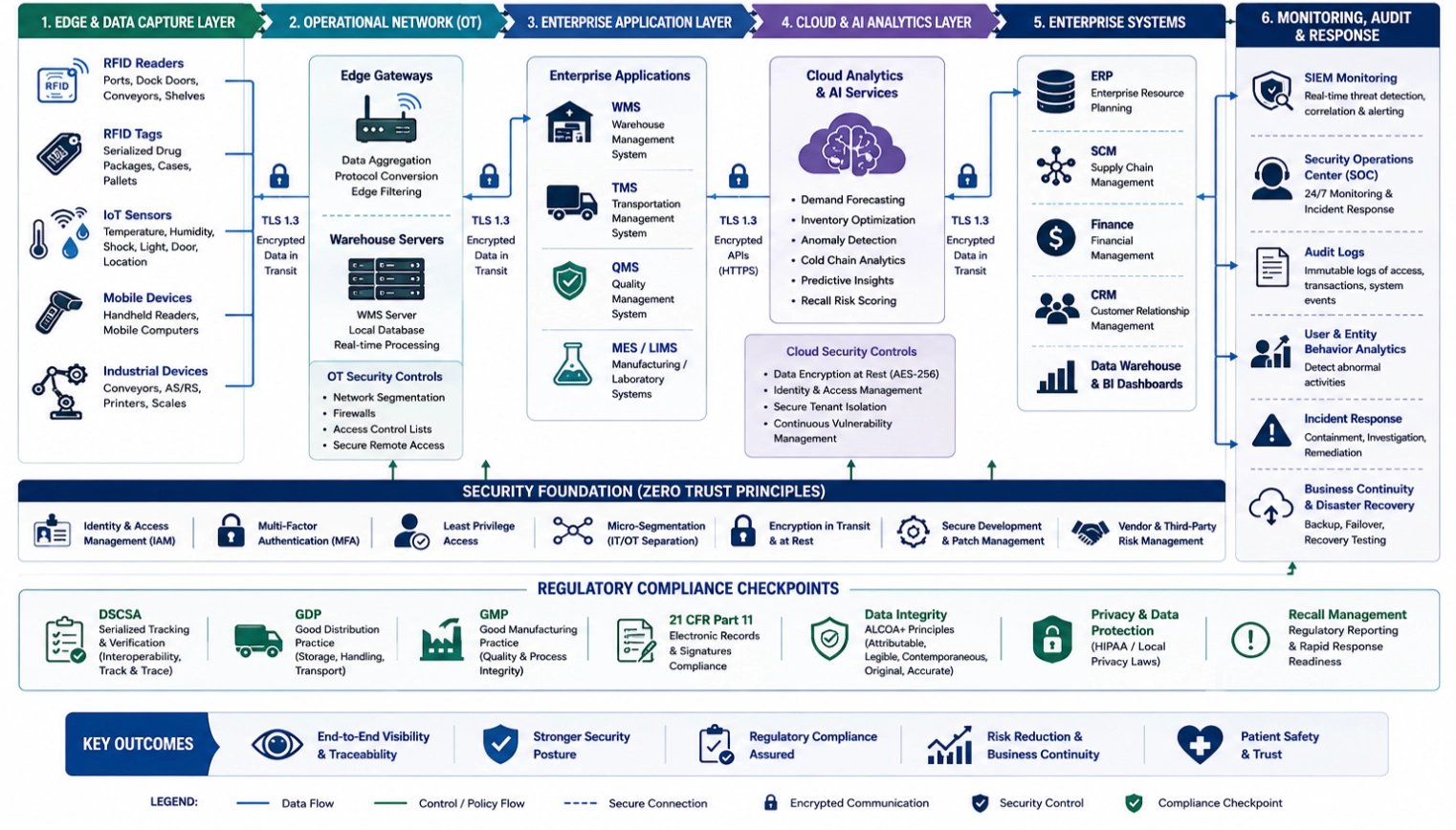
Pharmaceutical distribution systems manage highly sensitive operational information and must comply with stringent regulatory requirements. Security should therefore be integrated throughout the deployment lifecycle.
Key cybersecurity measures include:
Role-based access control (RBAC)
Multi-factor authentication (MFA)
Encryption of RFID and application data in transit and at rest
Digital certificate management for connected devices
Secure firmware updates
Continuous vulnerability monitoring
Network segmentation between operational technology (OT) and information technology (IT)
Security Information and Event Management (SIEM) integration
Comprehensive audit logging
Regulatory compliance is equally important. AI-enabled RFID systems should support:
U.S. Drug Supply Chain Security Act (DSCSA)
Good Distribution Practice (GDP)
Good Manufacturing Practice (GMP)
FDA recordkeeping requirements
Electronic pedigree and serialization standards
Controlled substance handling regulations
By automating traceability and maintaining detailed audit trails, AI-assisted RFID solutions help simplify inspections and accelerate recall investigations.
AI-Enabled Pharmaceutical Distribution Security and Compliance Framework with RFID
Business Benefits of AI-Powered Pharmaceutical Distribution
Combining AI with RFID technologies delivers measurable improvements across operational performance, regulatory compliance, and customer service.
Key benefits include:
Improved inventory accuracy through automated product identification
Reduced medication shortages using predictive demand forecasting
Faster product recalls with complete lot-level traceability
Better cold chain protection for temperature-sensitive pharmaceuticals
Lower operational costs by reducing manual inventory counts
Improved warehouse productivity through optimized picking and replenishment
Reduced pharmaceutical waste by prioritizing products nearing expiration
Enhanced counterfeit detection through serialization verification
Better transportation performance using AI-assisted route monitoring
Improved customer satisfaction through more accurate order fulfillment
Greater regulatory readiness with automated documentation and audit trails
Increased supply chain resilience through proactive risk detection
Organizations implementing these capabilities often experience shorter fulfillment cycles, reduced inventory losses, improved labor utilization, and greater confidence in regulatory compliance.
Engineering Best Practices for Implementation
Successful deployments require careful planning and cross-functional collaboration.
Recommended practices include:
Conduct a comprehensive assessment of warehouse workflows before selecting RFID hardware.
Perform RF site surveys to identify potential interference from shelving, refrigeration units, and metal storage systems.
Begin with a pilot deployment in a single distribution center before expanding to additional facilities.
Validate RFID tag performance on different pharmaceutical packaging materials.
Integrate AI solutions with existing ERP, WMS, TMS, and quality management software.
Establish governance policies for data quality, model performance, and cybersecurity.
Train warehouse personnel, quality teams, and IT administrators on operational procedures.
Continuously monitor KPIs and refine AI models using operational feedback.
Drawing on more than three decades of supplying RFID and IoT hardware, GAO supports organizations in selecting appropriate identification technologies and deployment strategies tailored to healthcare logistics requirements.
Advancing Pharmaceutical Distribution with AI and RFID
AI-driven pharmaceutical distribution, supported by RFID technologies, is reshaping healthcare logistics by delivering greater inventory visibility, predictive intelligence, and end-to-end product traceability. By automating data capture and applying advanced analytics, distributors can improve operational efficiency, safeguard temperature-sensitive medications, strengthen regulatory compliance, and reduce risks associated with counterfeit products and inventory shortages.
As pharmaceutical supply chains continue to evolve, organizations that combine AI with reliable RFID systems will be better positioned to meet growing healthcare demands while maintaining the accuracy, transparency, and resilience required in modern distribution networks. GAO remains committed to helping healthcare organizations implement dependable RFID and IoT solutions that support these objectives.
Building the Future of Industrial AI and IoT with Aperture Venture Studio and GAO RFID Inc.
For more than three decades, GAO Group of Companies has invested extensively in research and development of industrial RFID, BLE, and IoT technologies. As AI has become increasingly valuable for pharmaceutical distribution and healthcare logistics, we have expanded our focus on AI-enabled IoT solutions and established Aperture Venture Studio to accelerate the development and adoption of intelligent AI and IoT solutions across industries.
Together with our technical communities, engineering experts, industry partners, and innovation initiatives such as Aperture Ventures Summit and TekSummit, we continue advancing practical AI and RFID applications. We welcome collaboration from advisors, investors, customers, and technology professionals interested in shaping the future of intelligent healthcare supply chains and industrial AI solutions.