
AI and RFID for Pharmacies
AI-Driven Pharmacy Inventory and Medication Management
AI-driven pharmacy management combines artificial intelligence with real-time medication identification, inventory records, dispensing activity, storage conditions, purchasing data, and pharmacy workflow events. RFID can provide machine-readable identification and location events for tagged medication packages, totes, shelves, bins, carts, and other pharmacy assets, while AI analyzes these events to identify inventory discrepancies, replenishment requirements, unusual movement patterns, workflow delays, and operational exceptions. For pharmacies, the objective is not simply to automate item counting. The larger opportunity is to connect medication inventory with dispensing, receiving, returns, recalls, storage, fulfillment, and patient-service workflows so pharmacists and pharmacy technicians can make decisions using more complete operational data. This approach can support retail pharmacies, specialty pharmacies, mail-order operations, hospital-affiliated outpatient pharmacies, and pharmacy distribution environments. GAO supplies RFID hardware products and systems that can be incorporated into these pharmacy workflows, including identification and tracking components for inventory and operational applications.
AI-Driven Pharmacy Operations Overview
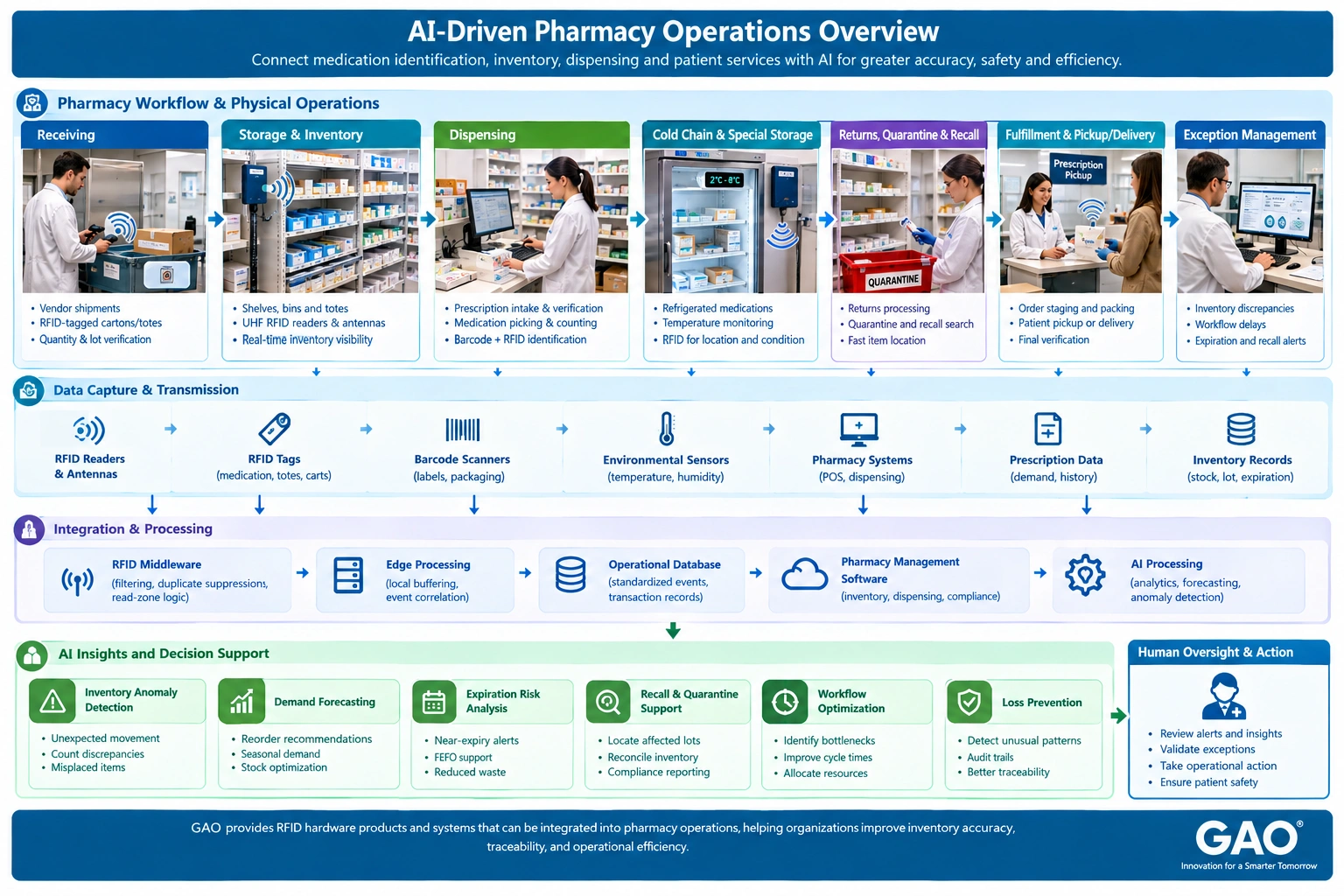
This diagram shows how RFID, barcode, sensor, pharmacy, and prescription data flow through middleware, AI processing, and human oversight across pharmacy operations. It highlights inventory anomaly detection, demand forecasting, expiration and recall support, workflow optimization, and loss prevention.
What AI-Enabled RFID Pharmacy Management Means
AI-enabled pharmacy management uses operational data to improve how medications and pharmacy assets are received, stored, located, dispensed, replenished, returned, quarantined, recalled, and reconciled. RFID acts as one source of machine-readable event data rather than serving as the complete solution by itself.
A pharmacy can associate an RFID identifier with a medication package, case, tote, bin, cart, or other controlled asset and record events such as receiving, movement between storage areas, dispensing preparation, cycle counting, return processing, or quarantine. AI can then correlate these events with pharmacy management system records, prescription demand, purchase orders, dispensing history, expiration information, and workflow timestamps.
The distinction between an RFID observation and a confirmed pharmacy transaction is important. A reader detecting a medication package near a dispensing station does not necessarily prove that the item was dispensed. Middleware should therefore filter duplicate reads, establish read zones, associate events with the relevant workflow, and allow the pharmacy system or authorized staff member to confirm the business transaction.
For regulated pharmaceutical distribution, electronic traceability is also an important consideration. The U.S. FDA describes the Drug Supply Chain Security Act as establishing requirements for interoperable, electronic identification and tracing of certain prescription drugs at the package level as they move through the supply chain. GS1 likewise describes EPCIS-based healthcare traceability around what product was involved, when an event occurred, where it occurred, and why the event was observed.
Pharmacy Workflows That Benefit from AI and RFID
Medication Receiving and Put-Away
Receiving is one of the most important points for establishing reliable medication identity and inventory status. Pharmacy staff may receive prescription drugs from wholesalers, manufacturers, distributors, or other approved supply sources. Manual receiving can require barcode scanning, quantity verification, lot and expiration recording, and physical placement into storage.
RFID can supplement these activities by identifying multiple tagged items or containers as they pass through a controlled receiving zone. AI can compare observed inventory events with purchase orders, expected quantities, historical receiving patterns, and storage assignments.
Potential pharmacy exceptions include:
- Expected medication not detected during receiving
- Quantity discrepancy between expected and observed items
- Medication detected in an unexpected storage area
- Repeated movement without an associated transaction
- Receiving activity that takes substantially longer than normal
- Inventory records that do not reconcile with physical observations
The resulting alerts should support pharmacist or inventory-manager investigation rather than automatically declaring an error, loss, or diversion.
Pharmacy Inventory Management and Replenishment
Pharmacies must balance medication availability against inventory carrying cost, expiration exposure, storage capacity, and demand variability. High-volume prescription medications may move rapidly, while specialty, seasonal, or low-volume medications can remain in inventory for longer periods.
AI inventory management can combine RFID observations with:
- Prescription dispensing history
- Stock-on-hand records
- Purchase orders and invoices
- Reorder points
- Medication expiration dates
- Lot and batch information
- Supplier lead times
- Seasonal demand
- Local prescription demand patterns
- Pharmacy-specific dispensing volumes
- Returned or quarantined inventory
A forecasting model can estimate future medication requirements, while anomaly detection can identify differences between expected and observed stock. RFID can provide additional physical evidence for these calculations by indicating whether inventory is actually present within designated storage zones.
GAO can support these deployments with RFID readers, antennas, tags, and related hardware systems selected according to the pharmacy’s item type, read distance, packaging characteristics, and operating environment.
Dispensing and Prescription Fulfillment
Prescription fulfillment introduces a different requirement from simple inventory counting. A medication may move through several operational stages between stock storage and final dispensing.
A pharmacy workflow can include:
- Prescription intake
- Clinical or pharmacist verification
- Medication selection
- Picking
- Counting or automated dispensing
- Labeling
- Pharmacist verification
- Staging
- Pickup or delivery
- Return-to-stock processing when applicable
AI can analyze timestamps and item movement to identify bottlenecks, repeated rework, unusual queue buildup, or discrepancies between physical medication movement and pharmacy management records.
Computer vision can complement RFID in selected environments by inspecting labels, packaging condition, shelf positions, or workstation activity. AI should not be treated as a substitute for pharmacist verification where professional judgment or regulatory controls are required.
Medication Expiration, Returns, Quarantine, and Recall Management
Expiration and recall workflows require strong item identity and location information. A pharmacy may need to locate affected stock quickly across dispensing shelves, storage rooms, refrigerators, return areas, and staging locations.
RFID can help establish the last known location or recent movement history of tagged inventory. AI can prioritize search and reconciliation activities by combining item identity, location events, expiration data, dispensing records, and recall information.
For example, a pharmacy inventory system could distinguish between:
- Active dispensing inventory
- Reserved medication
- Returned medication
- Quarantined medication
- Expired medication
- Recalled medication
- Damaged or compromised packaging
- Inventory awaiting pharmacist review
The value comes from connecting physical item observations with controlled pharmacy processes rather than relying on RFID reads alone.
Pharmacy AI Use Cases for Inventory, Safety, and Operations
AI becomes more useful when pharmacy data is converted into operational decisions. Rather than generating isolated analytics, the system can correlate physical inventory events with prescription demand, medication records, and workflow states.
AI Inventory Anomaly Detection
Anomaly detection can establish expected inventory behavior for a pharmacy and identify deviations requiring investigation. Examples include unexpected medication movement, repeated count discrepancies, inventory appearing in an incorrect zone, or a physical count that does not reconcile with the pharmacy management system.
Model inputs can include RFID events, barcode scans, dispensing transactions, receiving records, inventory adjustments, time of day, pharmacy location, medication category, and historical movement patterns.
A useful implementation should retain the underlying evidence for each alert. A pharmacist or inventory manager should be able to review the medication identifier, observed location, timestamp, related transaction, previous events, and relevant system records before taking action.
AI Demand Forecasting for Pharmacy Inventory
Demand forecasting can estimate future prescription requirements using historical dispensing activity and operational variables. RFID contributes physical inventory observations that can help distinguish between system-recorded stock and inventory actually observed in designated storage locations.
Forecasting can support decisions involving:
- Reorder thresholds
- Safety stock
- Supplier lead-time planning
- High-volume medication replenishment
- Seasonal demand
- Slow-moving inventory
- Expiration exposure
- Specialty medication availability
The model should be evaluated separately for medication categories because demand patterns can vary significantly between chronic therapies, acute prescriptions, specialty medications, and seasonal products.
AI-Assisted Pharmacy Workflow Optimization
Pharmacy managers can use AI to examine processing times across receiving, replenishment, picking, verification, staging, and pickup. RFID events can provide additional timestamps where tagged inventory passes defined read zones.
A workflow model might identify that medication replenishment consistently creates delays during certain periods, or that specific storage locations generate repeated picking exceptions. The appropriate operational response may involve changing shelf assignments, adjusting replenishment schedules, modifying staffing patterns, or revising workflow rules.
This is particularly valuable when the system explains why an exception occurred instead of presenting only a numerical score.
AI-Assisted Loss and Inventory Discrepancy Investigation
Medication inventory discrepancies can result from many causes, including data-entry errors, incorrect stocking, returns, misplaced inventory, damaged packaging, system timing differences, or unauthorized movement. AI can correlate physical and transactional events to narrow the investigation.
The system should avoid automatically interpreting an anomalous movement as theft or diversion. Instead, an alert can provide an evidence trail showing the relevant item, read events, workstation or storage location, transaction history, and timing.
Pharmacy Data Acquisition and Operational Workflow
A practical AI and RFID pharmacy solution begins with reliable data capture. The operational sequence can extend from medication receiving through storage, dispensing, reconciliation, and reporting.
Data Capture at Pharmacy Locations
Data can originate from RFID readers, barcode scanners, pharmacy dispensing equipment, refrigeration sensors, point-of-sale systems, prescription management software, ERP systems, warehouse systems, and manual staff confirmations.
RFID event records can contain:
- RFID tag identifier
- Reader identifier
- Antenna or read-zone identifier
- Timestamp
- Signal or read-confidence information where supported
- Pharmacy location
- Storage zone
- Workflow station
- Medication or asset association
- Customer or prescription context where appropriate
- Transaction identifier
- Event classification
- Exception status
The system should distinguish raw RFID observations from validated business events. Duplicate reads, reflected signals, adjacent-zone reads, and transient detections can otherwise produce false operational events.
Edge Processing and RFID Middleware
RFID middleware provides the operational layer between readers and pharmacy software. It can perform duplicate suppression, read-zone filtering, timing rules, device monitoring, event correlation, and local buffering.
A pharmacy with multiple readers may need zone logic so that an item passing between a receiving area and an adjacent storage location does not generate misleading movement records. Local buffering can also preserve events during temporary network interruptions.
The resulting event sequence might include:
- Medication received
- Medication identified
- Medication assigned to inventory
- Medication moved to storage
- Medication selected
- Medication staged
- Medication dispensed
- Medication returned
- Medication quarantined
- Medication recalled
- Inventory exception generated
Pharmacy Software Integration
The RFID and AI solution should integrate with the systems already responsible for pharmacy operations rather than creating an isolated inventory database.
Relevant integrations can include:
- Pharmacy management systems
- Medication inventory systems
- Prescription processing software
- Point-of-sale systems
- ERP and purchasing systems
- Warehouse management systems
- Automated dispensing systems
- Refrigeration and environmental monitoring
- CRM and patient-service systems
- Reporting databases
- Recall and compliance systems
REST APIs, webhooks, SQL interfaces, message queues, CSV exchange, and middleware APIs can be used according to the capabilities and security requirements of each system.
Cloud and Server Deployment for Pharmacy AI
A Cloud Version can host AI processing, databases, dashboards, and application services within managed cloud infrastructure. This approach can be useful for pharmacy organizations operating multiple locations that need centralized analytics, model management, and cross-location inventory visibility.
A Server Version can run software on pharmacy edge servers, customer-managed servers, private data centers, facility servers, or other privately hosted infrastructure. This can be appropriate when a pharmacy requires greater control over data residency, local processing, network independence, or integration with existing privately hosted systems.
A hybrid arrangement can place time-sensitive RFID event processing close to pharmacy operations while sending selected operational data to centralized AI services. This can reduce network dependency while retaining centralized analytics.
Pharmacy data containing patient or prescription information requires particular attention to access control, auditability, encryption, authentication, and data minimization. The HIPAA Security Rule establishes administrative, physical, and technical safeguards for electronic protected health information where HIPAA applies.
NIST’s AI Risk Management Framework provides a voluntary framework for managing AI risks and emphasizes characteristics including validity and reliability, security and resilience, accountability and transparency, explainability, privacy enhancement, and management of harmful bias.
RFID Hardware and AI Technologies for Pharmacy Operations
Pharmacy deployments require hardware selected around medication packaging, read-zone geometry, storage density, workflow speed, and the distinction between inventory identification and patient-facing processes. RFID should complement existing barcode and pharmacy information workflows rather than forcing every medication process into a single identification method.
UHF RFID for Pharmacy Inventory Visibility
UHF RFID is generally suited to applications where pharmacies need longer-range identification or simultaneous reading of multiple tagged items. Receiving areas, medication storage rooms, tote movement, replenishment zones, and controlled staging areas can use fixed readers and directional antennas to create defined read zones.
Engineering considerations include:
- Medication package material and dimensions
- Liquid content and conductive packaging
- Tag placement and orientation
- Shelf density
- Reader-to-reader interference
- Antenna polarization
- Read-zone boundaries
- Required read accuracy
- Movement speed through portals
- Metal shelving and equipment
- Adjacent pharmacy rooms that could create unintended reads
A site survey and controlled pilot are preferable to assuming that one reader configuration will perform consistently across every medication package.
HF and LF RFID for Specialized Pharmacy Identification
HF RFID can be appropriate for short-range identification where controlled proximity is desirable. LF RFID operates at shorter range and can be considered for specialized identification requirements where its characteristics fit the application.
The choice among UHF, HF, and LF should be driven by the pharmacy workflow rather than by frequency preference alone. UHF may be useful for bulk inventory movement, while HF or LF can serve specialized proximity-oriented identification scenarios.
Pharmacy RFID Tags and Readers
RFID tags should be selected according to the physical characteristics and intended lifecycle of the pharmacy asset. A tag applied to a medication tote may have very different requirements from one attached to a reusable pharmacy cart or storage container.
Fixed readers can monitor receiving portals, controlled storage entrances, dispensing support areas, or staging locations. Handheld readers can support cycle counts, discrepancy investigations, shelf audits, and targeted searches.
GAO provides RFID hardware and systems that can be configured for different identification and tracking requirements, allowing pharmacy operators to evaluate fixed, handheld, and integrated RFID approaches according to their workflows.
AI Models for Pharmacy Operations
Different pharmacy problems require different analytical methods.
- Anomaly detection: Identifies unusual medication movement, inventory discrepancies, or workflow behavior.
- Time-series forecasting: Estimates future prescription demand and replenishment requirements.
- Classification: Categorizes operational exceptions, inventory conditions, or workflow events.
- Optimization: Supports inventory allocation, replenishment scheduling, and workload decisions subject to defined operational constraints.
- Computer vision: Can assist with package, label, shelf, or workstation inspection where image capture is appropriate.
- Predictive maintenance: Uses equipment telemetry and maintenance history to anticipate issues involving automated dispensing, refrigeration, conveyors, or other connected equipment.
- Natural-language analytics: Allows authorized pharmacy personnel to query operational information using controlled natural-language interfaces.
AI recommendations should remain traceable to underlying records. A pharmacy manager should be able to understand which inventory events, dispensing records, demand observations, or workflow measurements contributed to a recommendation.
Security, Interoperability, and Reliability
Pharmacy AI and RFID systems must protect operational information while maintaining reliable access to inventory and workflow data. Security controls should be designed around the actual data flows and responsibilities of the pharmacy organization.
Identity and Access Control
Role-based access can limit system capabilities according to responsibilities. A pharmacy technician may require inventory and workflow access, while a pharmacist or pharmacy manager may require additional reconciliation and exception-review privileges.
Important controls include:
- Strong user authentication
- Role-based authorization
- Least-privilege access
- Service-account controls
- Device authentication
- Credential rotation
- Audit logging
- Session management
- Administrative activity monitoring
RFID readers and edge computers should also be treated as managed network devices rather than unmanaged peripherals.
Network and Data Security
A typical deployment can use Ethernet for fixed readers and secure wireless connectivity for handheld devices. Segmented network zones can separate RFID equipment, pharmacy applications, administrative systems, and other connected devices according to organizational security requirements.
Data should be protected during transmission and storage using appropriate encryption and key-management practices. Logs should capture configuration changes, administrative actions, system errors, and relevant transaction activity.
Pharmacy organizations should also establish retention policies that distinguish operational RFID records from protected health information and other regulated data.
Interoperability and Data Quality
Interoperability is often more difficult than reader installation. Medication identifiers, product master data, lot numbers, expiration information, inventory records, and prescription transactions must use consistent mappings.
A robust implementation should establish:
- A controlled medication master
- Consistent identifier mapping
- Standard event definitions
- Time synchronization
- Location identifiers
- Transaction correlation rules
- Error-handling procedures
- API version management
- Data validation rules
- Reconciliation procedures
Healthcare supply-chain interoperability can also involve GS1 standards and EPCIS event models, particularly when traceability extends across organizational boundaries. (gs1.org)
Pharmacy Deployment Lifecycle
Successful deployment requires more than installing RFID readers and connecting an AI model. Pharmacy workflows, physical environments, software interfaces, data quality, and human review procedures should be validated together.
Planning and Site Survey
The initial assessment should document medication flows, storage zones, receiving points, dispensing areas, refrigeration, controlled-access locations, returns, quarantine areas, and high-value inventory.
The site survey should also measure:
- Reader mounting locations
- Antenna orientation
- Shelf and cabinet construction
- Metal surfaces
- Liquid-heavy medication areas
- Network availability
- Power requirements
- Existing barcode infrastructure
- Pharmacy software interfaces
- Expected tag read density
The objective is to define controlled RFID read zones that correspond to actual pharmacy workflows.
Tag and Reader Selection
A pilot should evaluate representative medication packaging instead of testing only an idealized tag sample. Packaging variation can significantly affect RFID performance.
Testing should include different:
- Bottle materials
- Liquid volumes
- Blister packs
- Cartons
- Foil-containing packages
- Refrigerated products
- Tote configurations
- Shelf arrangements
UHF, HF, or LF should be selected according to the resulting read requirements.
Commissioning and Integration
Commissioning establishes the relationship between physical RFID identifiers and pharmacy records. Each tag should be associated with the appropriate inventory object through a controlled process.
Reader configuration should then be tested against real workflow events. Middleware should filter raw observations before validated events reach the pharmacy management or inventory system.
AI models should initially operate using historical and pilot data where possible. Baseline performance should be established before automated recommendations influence operational processes.
Testing and Optimization
Testing should cover both normal operation and exception conditions.
Examples include:
- Medication entering the wrong read zone
- Multiple packages arriving simultaneously
- Reader communication failure
- Network interruption
- Duplicate reads
- Missing tags
- Incorrect tag association
- Inventory adjustments
- Returned medication
- Quarantined medication
- Recalled inventory
- Expired medication
- Software integration failure
False-positive and false-negative rates should be measured for each important AI use case. Pharmacy staff should participate in validation because a technically correct event may still be operationally ambiguous.
Scaling Across Pharmacy Locations
A multi-location deployment should standardize core identifiers, event definitions, integration interfaces, security controls, and monitoring while allowing physical reader configurations to vary by site.
A pharmacy with a small inventory room may require only a few controlled read zones. A larger centralized fulfillment operation may require numerous readers across receiving, storage, picking, packing, staging, and returns.
GAO’s experience supplying RFID hardware products and systems can support organizations evaluating these different deployment patterns, including remote technical assistance and, where applicable, onsite support.
Pharmacy KPIs for AI-Enabled RFID Operations
AI and RFID projects should be measured against pharmacy operating outcomes rather than reader counts alone. Useful KPIs can combine inventory accuracy, workflow performance, service levels, and exception-management quality.
Relevant measures include:
- Medication inventory accuracy
- Inventory reconciliation rate
- Stockout frequency
- Replenishment cycle time
- Prescription fulfillment time
- Order staging time
- Receiving cycle time
- Picking accuracy
- Return-to-stock processing time
- Recall search and reconciliation time
- Expiration-related inventory loss
- Inventory adjustment frequency
- RFID read accuracy
- RFID false-read rate
- Exception alert precision
- Exception resolution time
- Forecast accuracy
- Service-level attainment
- Equipment availability
- System integration error rate
These KPIs should be established before deployment so that pilot results can be compared with an operational baseline.
Practical Benefits of AI-Enabled Pharmacy Inventory Management
The combined approach can provide benefits when each technology addresses a specific part of the pharmacy problem.
More Accurate Physical Inventory Visibility
RFID can reduce dependence on manual item-by-item identification in suitable workflows, while AI can reconcile physical observations against expected inventory states. This combination can help pharmacy personnel identify discrepancies sooner.
Faster Exception Investigation
Instead of searching through disconnected records, staff can receive an event history showing where an item was observed, when it moved, and which transactions occurred around the same period.
Better Replenishment Decisions
Forecasting models can analyze dispensing patterns and inventory observations to identify future stock requirements. This can help pharmacy managers distinguish urgent replenishment needs from temporary fluctuations.
Improved Recall and Quarantine Response
Known RFID identities and location events can narrow the physical search for affected medication. The pharmacy can then reconcile the identified items against inventory and transaction records.
Scalable Multi-Location Visibility
Centralized analytics can compare inventory and workflow patterns across pharmacy locations while maintaining location-specific operating rules. This can help identify unusual differences in stock levels, processing times, or exception rates.
Stronger Operational Traceability
An event history linking medication identifiers, locations, timestamps, transactions, and staff-confirmed actions can provide a more structured operational record than isolated manual counts.
Implementing AI and RFID in Pharmacy Operations
A practical implementation should begin with a defined pharmacy problem rather than technology selection alone. Medication inventory accuracy, receiving reconciliation, recall management, replenishment, or workflow analysis can each require different RFID configurations and AI models.
A phased implementation can follow these principles:
- Define the pharmacy workflow and measurable business problem.
- Establish baseline inventory and workflow KPIs.
- Identify the medication and pharmacy assets suitable for RFID.
- Survey shelves, cabinets, refrigerators, receiving zones, and dispensing areas.
- Select UHF, HF, or LF RFID according to the physical use case.
- Test representative medication packaging.
- Establish identifier and event-data standards.
- Integrate RFID middleware with pharmacy management and inventory software.
- Validate raw reads against confirmed pharmacy transactions.
- Develop AI models using relevant historical and operational data.
- Establish human review procedures for AI-generated exceptions.
- Test cybersecurity, network resilience, integration failures, and device outages.
- Run a controlled pharmacy pilot.
- Measure false positives, missed events, workflow improvements, and KPI changes.
- Optimize reader placement, tag selection, event rules, and model thresholds.
- Scale only after operational and security requirements have been validated.
GAO can help organizations evaluate RFID readers, antennas, tags, handheld devices, software interfaces, and related IoT hardware for pharmacy identification and tracking requirements. GAO Group companies are headquartered in New York City and Toronto, Canada, and have served customers across the United States and Canada for three decades, including Fortune 500 companies, research and development organizations, universities, and government agencies. GAO maintains stringent quality assurance processes and provides technical support remotely or onsite.
Key Takeaways for AI and RFID in Pharmacies
AI-enabled pharmacy operations are most effective when physical inventory data, pharmacy transactions, prescription demand, and workflow events are treated as connected operational information. RFID can provide additional identification and location evidence, while AI converts that information into forecasts, anomaly detection, workflow analysis, and decision support.
The engineering priorities are reliable read zones, representative tag testing, clean event data, strong software integration, appropriate security controls, explainable AI outputs, and human validation of important exceptions. Cloud and privately hosted Server Versions can both be appropriate, depending on pharmacy scale, connectivity, data-control requirements, and existing IT infrastructure.
Organizations evaluating pharmacy inventory tracking, medication traceability, automated reconciliation, or AI-driven pharmacy operations can explore GAO’s RFID hardware products and systems and work with our technical specialists to determine suitable identification, data-capture, integration, and deployment approaches.
Pharmacy AI and RFID Implementation Lifecycle
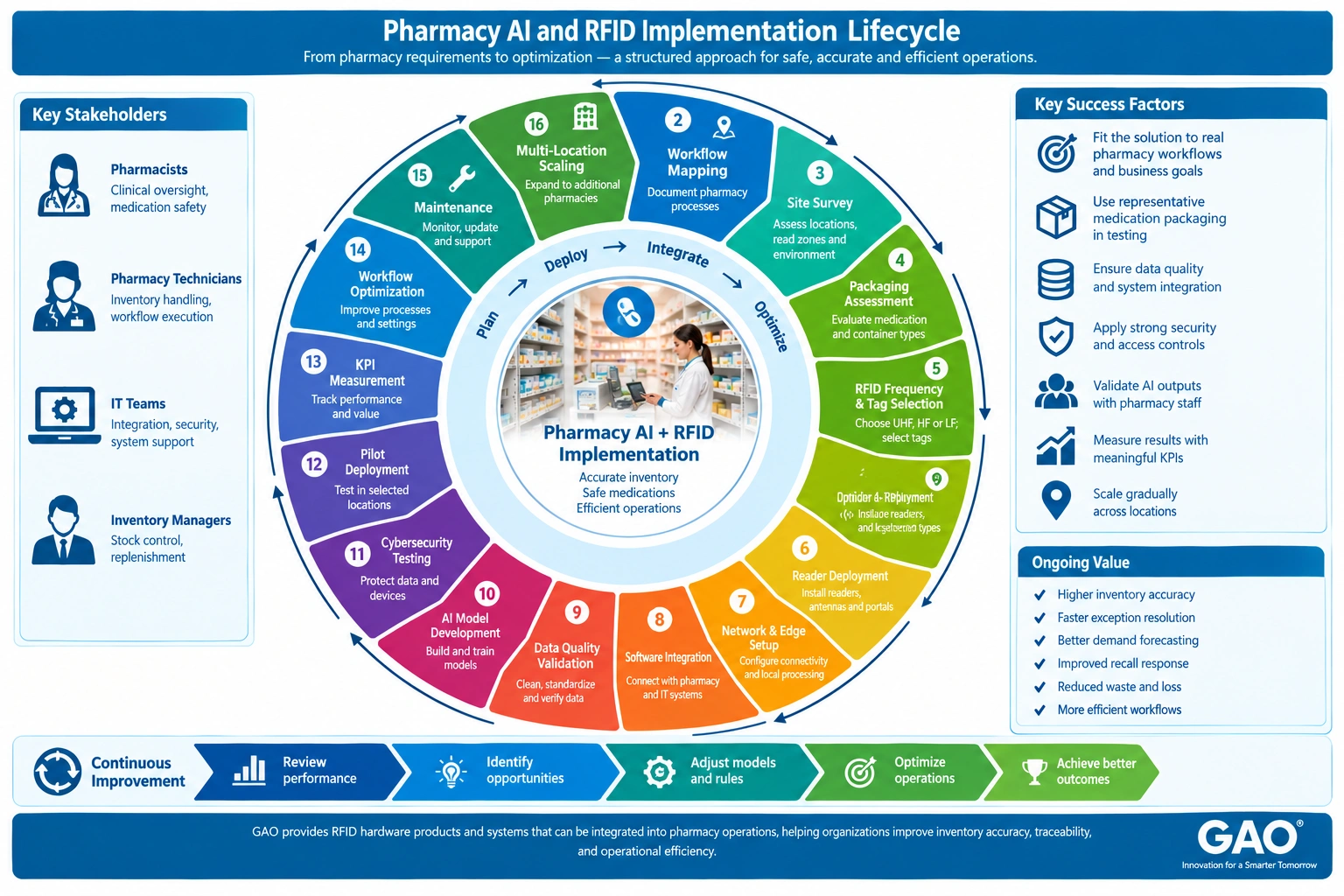
This lifecycle diagram illustrates the structured deployment of AI and RFID across pharmacy operations, from workflow mapping and site surveys through integration, pilot testing, KPI measurement, optimization, maintenance, and multi-location scaling. It also highlights key stakeholders, implementation success factors, and continuous improvement.
Building the Future of Industrial AI and IoT with Aperture Venture Studio and GAO RFID Inc.
For more than three decades, GAO Group of Companies has invested heavily in R&D of industrial RFID, BLE, and IoT. As AI has become increasingly useful for pharmacy inventory, traceability, and connected operational workflows, we have expanded our work in AI and IoT technologies and founded Aperture Venture Studio to build, launch, and scale next-generation AI and IoT companies for applications such as pharmacy operations and healthcare supply chains.
Aperture has attracted AI and IoT technical experts, operational executives, investors, and leading companies. We have also developed Aperture Ventures Summit and TekSummit to discuss advanced AI and IoT topics.
These activities have helped build technical communities around AI and IoT. We welcome participation as advisors, co-founders or employees, investors, or customers.