
AI and RFID for Physical Security
AI-Driven RFID Asset Tracking for Physical Security
AI is transforming RFID asset tracking in physical security by turning identification data into actionable intelligence for protecting security equipment, controlled assets, credentials, and sensitive facilities. UHF RFID supports longer-range identification for tagged equipment moving through controlled areas, while HF and LF RFID can address more localized identification requirements. AI adds pattern recognition, anomaly detection, forecasting, classification, and decision support to these identification workflows. A physical security team can therefore move beyond simply asking where an asset was last detected and instead assess whether its movement, location, access history, or utilization is consistent with expected behavior. This approach supports security operations centers, guard forces, facility managers, security equipment administrators, and loss-prevention teams. Properly implemented, AI-driven RFID asset tracking can improve chain-of-custody visibility, reduce manual reconciliation, identify unusual asset movements, and provide auditable information for security investigations.
Physical Security AI-RFID Asset Tracking: From RFID Data to Actionable Intelligence
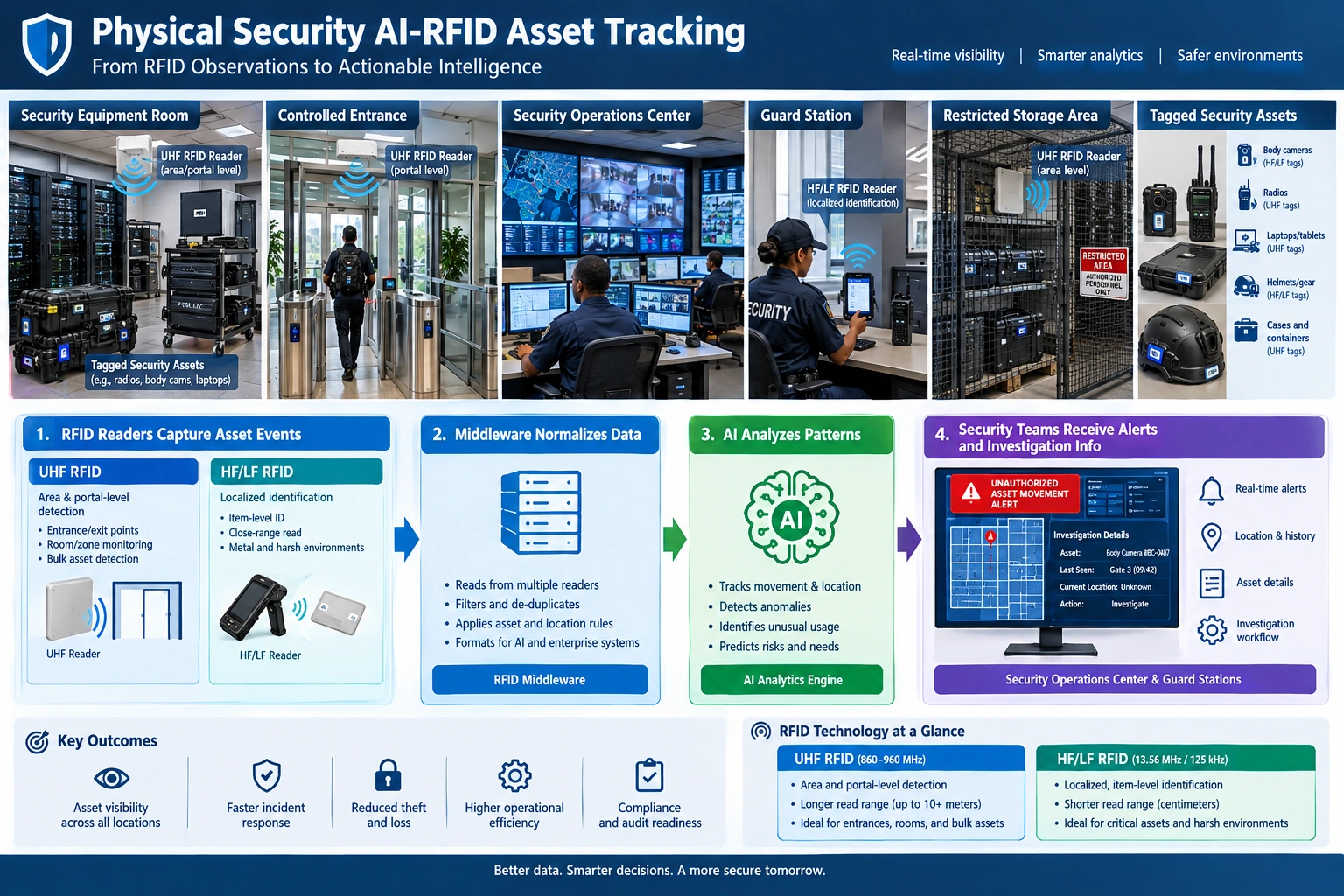
This enterprise infographic illustrates how RFID readers capture security-asset events, middleware normalizes the data, and AI analyzes movement and usage patterns. It shows how UHF RFID supports area and portal-level detection while HF/LF RFID enables localized identification, ultimately delivering real-time alerts and investigation intelligence to security teams.
What AI-Powered RFID Asset Tracking Means for Physical Security
Physical security asset tracking concerns more than inventory accuracy. Security organizations must establish accountability for equipment and materials that support access control, surveillance, emergency response, patrol operations, and restricted-area protection. Examples include portable radios, body-worn cameras, access-control components, surveillance equipment, electronic keys, security barriers, inspection devices, evidence-handling containers, protective equipment, and specialized response equipment.
Traditional asset registers frequently depend on barcode scans, spreadsheets, manual inspections, or individual custody records. Those methods can establish ownership and basic status, but they may provide limited visibility into continuous movement. RFID introduces machine-readable identification events, while AI can analyze those events against operational rules and historical patterns.
For physical security, the important transition is from asset identification to asset intelligence.
AI can correlate RFID observations with:
- Authorized location and movement rules
- Security-zone boundaries
- Custody assignments
- Access-control events
- Shift schedules
- Equipment check-in and check-out records
- Maintenance history
- Asset utilization patterns
- Incident and exception records
- Facility operating schedules
A useful implementation does not treat every RFID read as an incident. Instead, the system establishes expected behavior and identifies meaningful deviations. For example, a security camera removed from an authorized equipment room during an approved deployment should produce a normal operational event. The same movement outside an approved window, without a corresponding work order or custody record, may warrant investigation.
Why AI Changes the Physical Security Asset Management Model
The operational value of AI comes from analyzing relationships between events rather than merely collecting more identification records.
A physical security organization may generate thousands of RFID observations across equipment rooms, security checkpoints, restricted storage areas, maintenance locations, and facility entrances. Reviewing every event manually is inefficient. AI can classify event sequences, detect unusual patterns, prioritize exceptions, and help personnel focus on events with greater operational significance.
Common AI capabilities include:
- Anomaly detection: Identifies unusual asset movement, unexpected location changes, repeated failed handoffs, or abnormal usage patterns.
- Predictive analytics: Uses historical utilization and maintenance information to identify equipment likely to require servicing or replacement.
- Classification models: Categorize asset events according to normal movement, authorized deployment, return, maintenance, exception, or investigation status.
- Time-series analysis: Evaluates movement and utilization patterns across shifts, facilities, and operating periods.
- Rules plus machine learning: Combines deterministic security policies with statistical detection rather than relying exclusively on one method.
- Computer vision integration: Correlates RFID events with visual observations where cameras and video analytics are already deployed.
- Natural-language analytics: Allows authorized personnel to query structured asset information using operational questions such as which equipment entered a restricted room during a specified period.
This combination is particularly useful where physical security teams must maintain accountability without creating excessive manual inspection work.
AI-RFID Physical Security Asset Exception Decision Flow
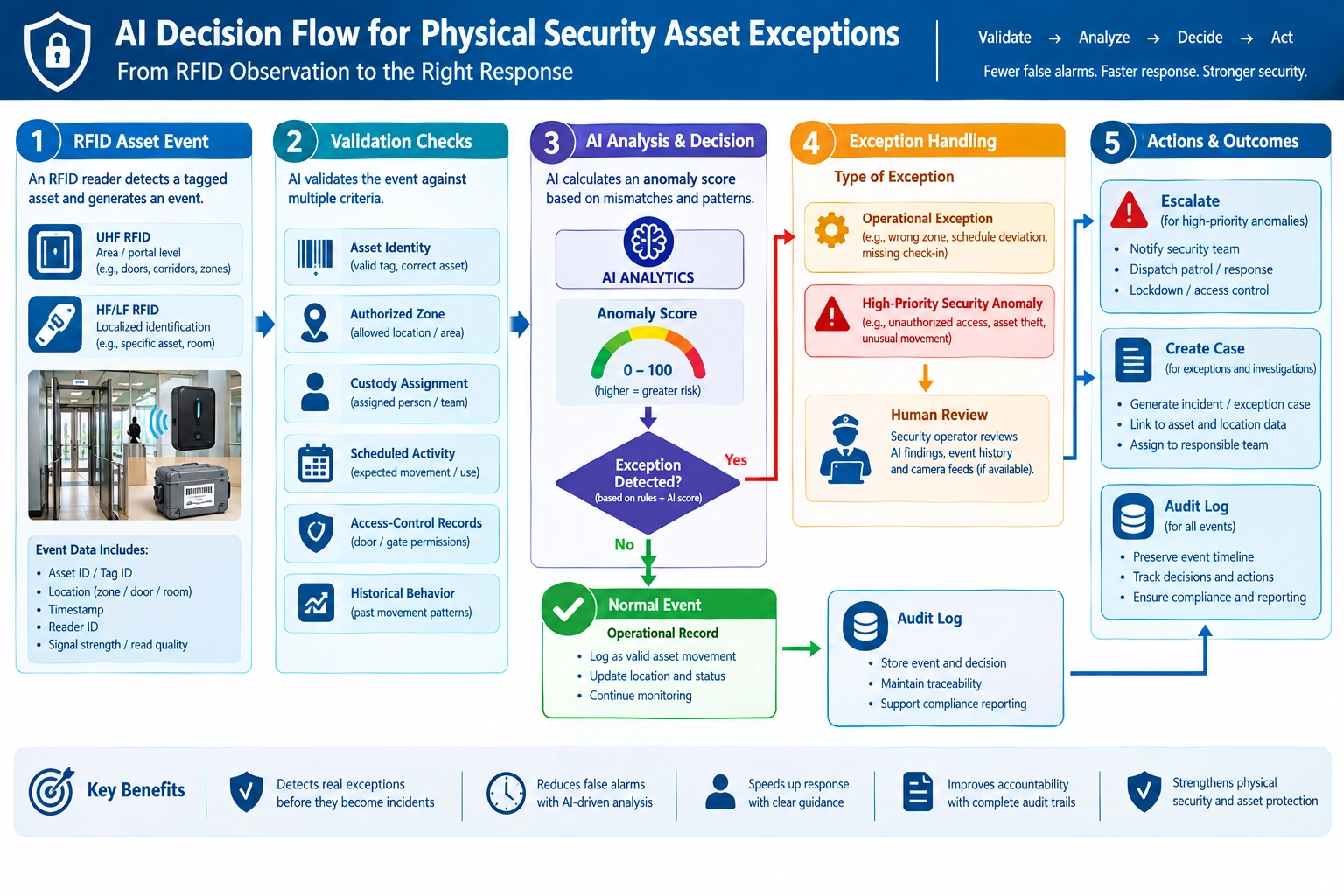
This infographic shows how an RFID asset event is validated against identity, authorized zones, custody, schedules, access records, and historical behavior. AI assigns an anomaly score and routes events into normal operations, operational exceptions, or high-priority security anomalies, with human review, escalation, case creation, and audit logging supporting the final response.
Physical Security Workflows Where AI Asset Tracking Adds Value
AI-powered RFID asset tracking is most useful when it is connected to an existing physical security workflow rather than deployed as an isolated identification system.
Security Equipment Check-In and Check-Out
Security departments routinely issue equipment to guards, technicians, investigators, emergency-response teams, and other authorized personnel. RFID can automatically record equipment entering or leaving designated areas. AI can compare these movements with custody assignments and scheduled activities.
The resulting workflow can identify:
- Equipment issued without a corresponding assignment
- Equipment not returned at the expected time
- Assets repeatedly transferred between personnel
- Unusual equipment utilization
- Missing equipment after shift changes
- Assets detected in unauthorized zones
This provides a stronger basis for accountability than relying solely on handwritten or manually entered equipment logs.
Restricted Storage and Security Equipment Rooms
Controlled storage areas may contain high-value surveillance devices, access-control components, radios, electronic keys, protective equipment, and other security resources. RFID readers positioned at controlled entrances or storage points can capture asset movement.
AI can establish normal movement patterns and identify unusual behavior, such as an asset repeatedly leaving a secure room outside normal operating periods.
Physical security personnel can then correlate the asset event with access-control logs, work orders, visitor records, or video footage before deciding whether escalation is necessary.
Mobile Security and Patrol Equipment
Mobile security teams may move equipment across buildings, campuses, transportation facilities, or other protected areas. Continuous manual inventory checks can be difficult when equipment is distributed among multiple patrol teams.
RFID event histories provide a digital trail of asset movement. AI can identify inconsistencies between expected patrol operations and equipment locations, helping supervisors prioritize reconciliation.
Surveillance Equipment Deployment
Temporary surveillance deployments can involve cameras, recording devices, mounts, power equipment, communication accessories, and other components. RFID asset tracking can record equipment leaving a secure store, arriving at a deployment location, returning for maintenance, and being reassigned.
AI can compare these events against deployment schedules and asset histories, helping security teams detect missing components or abnormal equipment turnover.
Access-Control Equipment and Electronic Credentials
Physical security operations may also involve electronic locks, access-control hardware, credential-management equipment, readers, controllers, and related components. RFID tracking can help maintain physical accountability for these assets while access-control software maintains authorization records.
The two data sources answer different questions: RFID helps determine where physical equipment was observed, while access-control systems determine who or what was authorized to access a protected location.
From RFID Events to AI-Assisted Security Decisions
A practical deployment begins with reliable data acquisition. RFID tags are assigned to assets according to an asset identification policy, with tag selection based on material composition, read distance, mounting location, environmental conditions, and expected interaction with readers.
UHF RFID is generally suited to physical security scenarios requiring longer read ranges and portal-style detection. HF RFID can support shorter-range identification and controlled proximity interactions, while LF RFID can be appropriate for specific low-frequency identification environments where its operating characteristics match the application.
Readers and antennas capture identification events and transmit them through the communications network to RFID middleware or an asset-tracking application. Middleware filters duplicate reads, associates observations with reader locations, timestamps events, and applies business rules before forwarding useful information to downstream systems.
AI services can then analyze the normalized event stream alongside contextual information from physical security systems. This is where asset tracking becomes operational intelligence.
A simplified workflow is:
- RFID tag identifies a physical security asset.
- Reader captures the tag event.
- Edge equipment or middleware validates and filters the event.
- The event is associated with a known security zone and timestamp.
- Asset management software updates the asset’s location history.
- AI evaluates the event against rules, historical behavior, and related operational data.
- A normal event is recorded without unnecessary intervention.
- An anomalous event is scored and prioritized.
- Security personnel review the exception.
- Relevant access-control, video, work-order, or custody records are correlated.
- The organization records the resolution and maintains an auditable event history.
GAO supplies RFID and related IoT hardware products and systems that can support this type of physical security deployment, with implementation considerations extending from identification hardware to system integration and technical support.
End-to-End Physical Security RFID and AI Workflow
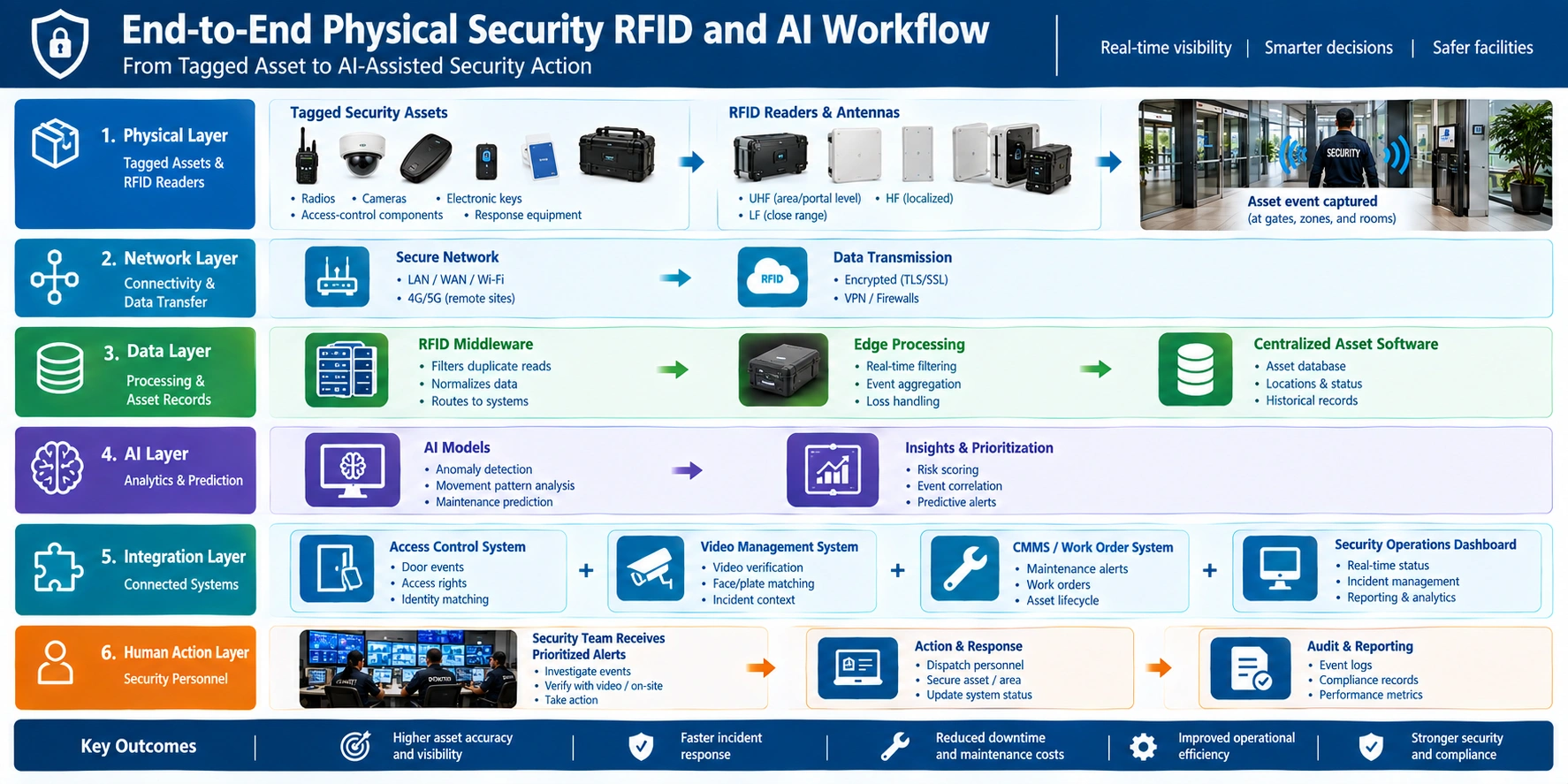
This workflow diagram illustrates how tagged security assets move from RFID detection through secure networking, middleware, edge processing, centralized asset software, and AI analytics. It also shows integrations with access control, video management, CMMS, and security dashboards before prioritized alerts reach security personnel for investigation and response.
AI and RFID Deployment Scenarios in Physical Security
A realistic physical security deployment often combines several identification points rather than relying on a single reader.
For example, a large controlled facility may establish RFID detection points at the security equipment room, maintenance area, restricted loading entrance, guard equipment checkpoint, and selected internal zones. Security equipment receives durable tags appropriate to the asset material and operating environment.
A guard checks out a body-worn camera and radio before a shift. The RFID system records the equipment leaving the controlled storage area and associates the event with the relevant operational process. When the equipment returns, another RFID observation closes the movement cycle. If an asset does not return within the expected operational period, the system can flag the exception.
A more advanced implementation can correlate the RFID event with access-control activity and the security schedule. AI can prioritize the exception when multiple contextual signals indicate unusual behavior, while authorized personnel retain responsibility for determining whether an event represents a genuine security concern.
Realistic RFID Asset Tracking Deployment in a Physical Security Facility
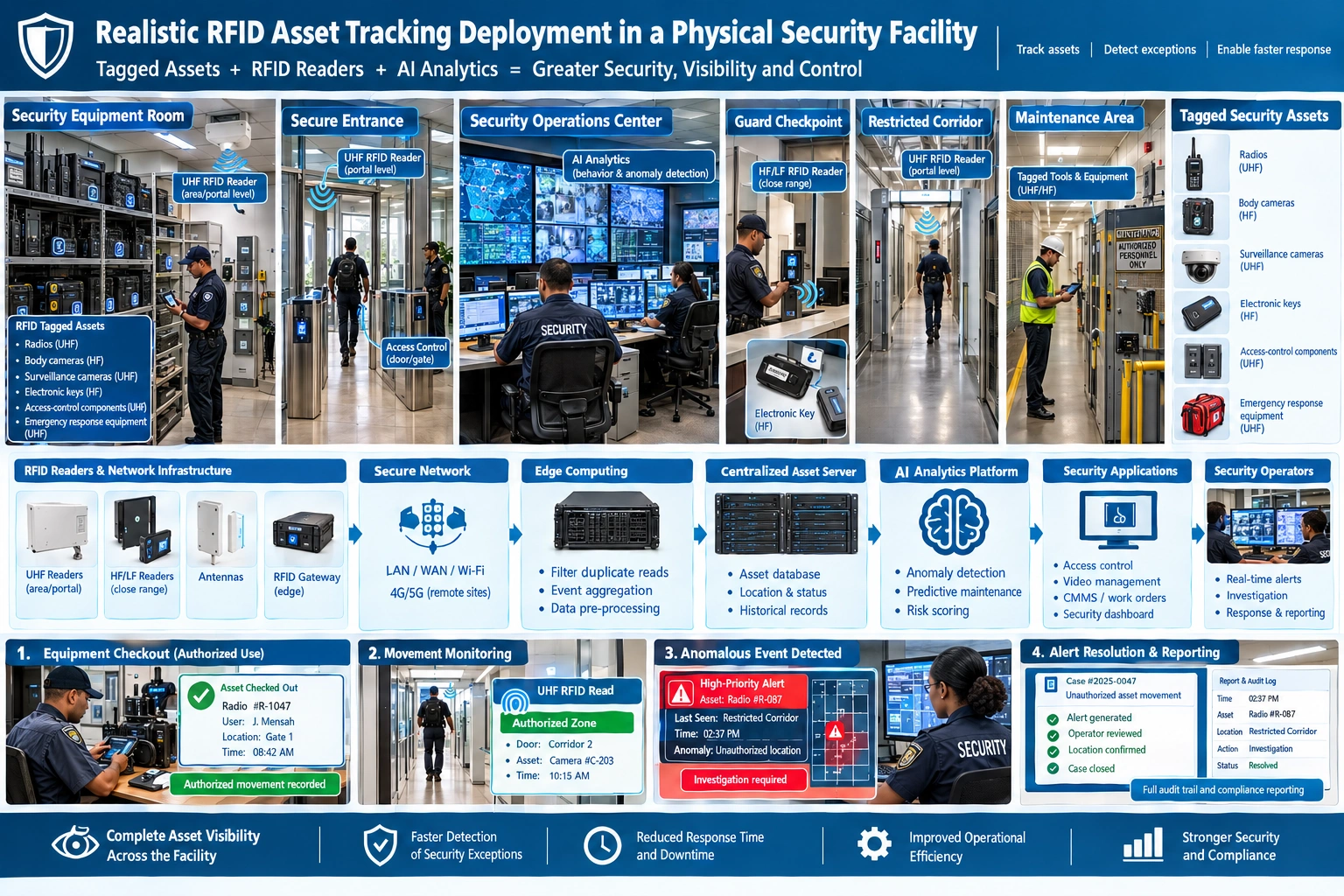
This infographic depicts a realistic physical security facility where RFID-tagged equipment is tracked across secure entrances, equipment rooms, restricted corridors, guard checkpoints, and maintenance areas. It illustrates how UHF and HF/LF RFID readers connect through gateways, edge computing, centralized asset servers, and AI analytics to support authorized movement tracking, anomaly detection, security alerts, investigation, and audit reporting.
Technical Components for AI-Driven Physical Security Asset Tracking
A production-grade physical security asset-tracking system requires coordinated hardware, software, connectivity, data processing, and security controls. The correct design depends on asset density, facility layout, read-zone requirements, environmental conditions, privacy requirements, and the operational consequences of missed or false detections.
RFID Hardware and Asset Identification
RFID tag selection should begin with the physical asset rather than the reader. Metal equipment, liquid-containing devices, compact electronics, and irregular surfaces can affect RF performance, so tag construction and mounting location should be validated through site testing.
- UHF RFID: Appropriate for longer-range asset detection, portal monitoring, equipment-room movement, and selected zone-level tracking.
- HF RFID: Useful for controlled short-range interactions where proximity identification is desirable.
- LF RFID: Applicable to specialized low-frequency identification requirements where its propagation characteristics and read behavior suit the physical security workflow.
- Fixed RFID readers: Suitable for controlled entrances, equipment rooms, restricted corridors, and other defined detection points.
- RFID antennas: Require careful placement to establish useful read zones while minimizing unintended reads from adjacent areas.
- Handheld RFID readers: Support physical security audits, investigations, reconciliation, and locations where fixed readers are impractical.
- RFID tags: Should be selected for attachment method, environmental exposure, asset material, required read distance, and expected service life.
GAO provides RFID hardware and systems that can be configured around these physical security requirements, with selection driven by the intended workflow rather than by reader specifications alone.
Edge Processing, Middleware, and Asset Software
Raw RFID reads should not be sent directly into AI models without normalization. Middleware can remove duplicate observations, apply reader-location context, associate tags with asset records, and transform low-level reads into meaningful movement events.
A typical software chain includes:
- RFID reader software and device management
- Edge processing for local event filtering
- RFID middleware for event normalization
- Asset database containing identity, ownership, location, and lifecycle information
- AI services for anomaly detection and predictive analysis
- Dashboards for security supervisors and asset administrators
- Integration interfaces for access-control, video management, CMMS, ticketing, and security management software
AI Models for Physical Security Asset Intelligence
AI model selection should correspond to the security problem. An anomaly-detection model can identify unusual movement patterns, while a forecasting model may be more appropriate for maintenance planning. Rule-based logic remains valuable where security policies require deterministic responses.
A hybrid approach can therefore combine:
- Deterministic zone and custody rules
- Statistical anomaly detection
- Time-series forecasting
- Classification models
- Risk scoring
- Event correlation
- Human review and approval
This design reduces the risk of treating an unusual but legitimate security operation as a confirmed security incident.
Cloud Version and Server Version
A Cloud Version can host asset-tracking software and AI processing within managed cloud infrastructure. This model can be appropriate for organizations operating multiple facilities that need centralized reporting, remote administration, and scalable computing resources.
A Server Version can run on customer-managed edge servers, private data centers, facility servers, or other privately hosted infrastructure. This approach can be preferable where physical security data must remain within controlled environments, where connectivity to external services is constrained, or where local processing is required for operational continuity.
A hybrid deployment is also practical. RFID event filtering can occur locally while selected normalized data is synchronized with centralized software for analytics and reporting. The appropriate choice depends on security policy, network availability, data governance, latency requirements, and IT operating capabilities.
Integrating RFID Asset Intelligence with Physical Security Systems
RFID becomes considerably more useful when its events are correlated with systems that already govern physical security operations.
Access-control software can provide information about authorized entry into a protected room. Video management software can provide visual evidence surrounding an asset movement. Computerized maintenance management systems can indicate whether equipment was legitimately removed for servicing. Security incident-management software can preserve investigation records.
A correlation workflow could therefore evaluate:
| Data Source | Physical Security Relevance | AI/RFID Contribution |
|---|---|---|
| RFID events | Physical asset location and movement | Establishes asset event history |
| Access control | Authorized personnel and entry events | Validates whether movement occurred during authorized access |
| Video management | Visual evidence | Supports investigation and event verification |
| CMMS/work orders | Maintenance activity | Distinguishes legitimate servicing from unexplained movement |
| Asset management | Ownership and lifecycle status | Establishes custody and asset context |
| Security incident software | Investigation and resolution | Preserves evidence and response history |
| Scheduling systems | Planned deployments and shifts | Provides operational context for anomaly detection |
The integration layer should also preserve timestamps and source identifiers so investigators can reconstruct what happened without losing the relationship between the original event and the AI-generated interpretation.
Key Technical and Operational Benefits of AI Asset Tracking
AI-driven physical security asset tracking provides value when improved data quality translates into better operational decisions.
- Faster asset reconciliation: Automated identification reduces dependence on manual equipment counts and periodic spreadsheet updates.
- Improved chain-of-custody visibility: Time-stamped RFID observations create a more consistent record of where tagged equipment was observed.
- Earlier anomaly detection: AI can identify movement patterns that differ from established operational behavior.
- Better security equipment availability: Utilization analysis helps supervisors understand whether critical equipment is available, deployed, undergoing maintenance, or missing.
- Reduced investigation time: Correlating RFID events with access-control and video records can narrow the period and location requiring investigation.
- More effective maintenance planning: Historical movement and utilization data can help identify heavily used equipment requiring inspection or servicing.
- Scalable multi-site monitoring: Centralized software can provide consistent asset visibility across facilities when the network and security model support it.
- Reduced unnecessary alerts: Combining AI scoring with deterministic security rules can prioritize events instead of treating every RFID observation as suspicious.
- Improved auditability: Structured event records provide evidence for internal reviews, security audits, equipment accountability, and operational investigations.
The important performance improvement is therefore not simply a higher number of RFID reads. The objective is a higher proportion of useful, contextualized security events that personnel can act upon.
Security, Privacy, and Reliability Considerations
Physical security systems themselves require strong cybersecurity controls because asset-location information can reveal operational patterns, equipment deployments, restricted areas, and security procedures.
Recommended controls include:
- Role-based access control for asset and security data
- Strong authentication for administrative users
- Encryption for data transmitted between readers, gateways, servers, and cloud services
- Network segmentation for RFID infrastructure and security systems
- Secure device configuration and credential management
- Audit logging for administrative and investigation activities
- Controlled API access between RFID software and physical security systems
- Data retention policies appropriate to operational and regulatory requirements
- Backup and recovery procedures for asset databases
- Monitoring for unauthorized changes to reader configurations
- Firmware and software lifecycle management
- Fail-safe procedures when network connectivity or centralized software becomes unavailable
AI also requires governance. A model’s anomaly score should generally be treated as decision support rather than automatic proof of unauthorized activity. Physical security personnel should be able to review the underlying RFID observations and supporting access-control or video evidence.
Implementation Roadmap for Physical Security Organizations
Successful implementation usually starts with the operational problem rather than with hardware procurement.
Define the Security Asset Use Case
Establish which assets require tracking and why. A project focused on high-value electronic keys has different detection requirements from one tracking thousands of radios or surveillance components.
Define:
- Asset categories
- Custody requirements
- Security zones
- Expected movement paths
- Required detection points
- Investigation requirements
- Retention requirements
- Required response times
Survey the Physical Environment
RF conditions should be tested before final reader placement. Metal cabinets, reinforced doors, equipment racks, dense storage, electrical infrastructure, and adjacent detection zones can influence RFID performance.
A site survey should evaluate:
- Reader locations
- Antenna orientation
- Tag mounting positions
- Expected read zones
- Interference sources
- Network availability
- Power availability
- Environmental conditions
- Unauthorized-read risks
- Areas requiring handheld rather than fixed detection
Pilot Before Scaling
A controlled pilot should measure actual physical security workflows rather than simply confirming that tags can be read.
Useful pilot measurements include:
- Detection rate
- False-read rate
- Missed-event rate
- Event latency
- Asset-location accuracy
- Check-in/check-out completion
- Alert precision
- Investigation time
- Reader uptime
- User adoption
AI models should normally be introduced after sufficient operational data exists to characterize expected behavior. Otherwise, a model may have insufficient context for reliable anomaly detection.
Commission, Test, and Optimize
Commissioning should verify the complete chain from physical asset to business action. A successful reader test alone does not demonstrate that the security workflow works.
Testing should include:
- Correct tag-to-asset association
- Reader-zone validation
- Duplicate-read filtering
- Network interruption scenarios
- Server or cloud service interruptions
- Unauthorized movement simulations
- Authorized movement scenarios
- Access-control correlation
- Alert generation
- Audit-log integrity
- User permissions
- Recovery procedures
GAO’s experience supplying RFID hardware products and systems can support organizations evaluating equipment selection, deployment requirements, and technical implementation considerations.
Physical Security RFID Implementation Lifecycle: From Requirements to Optimization
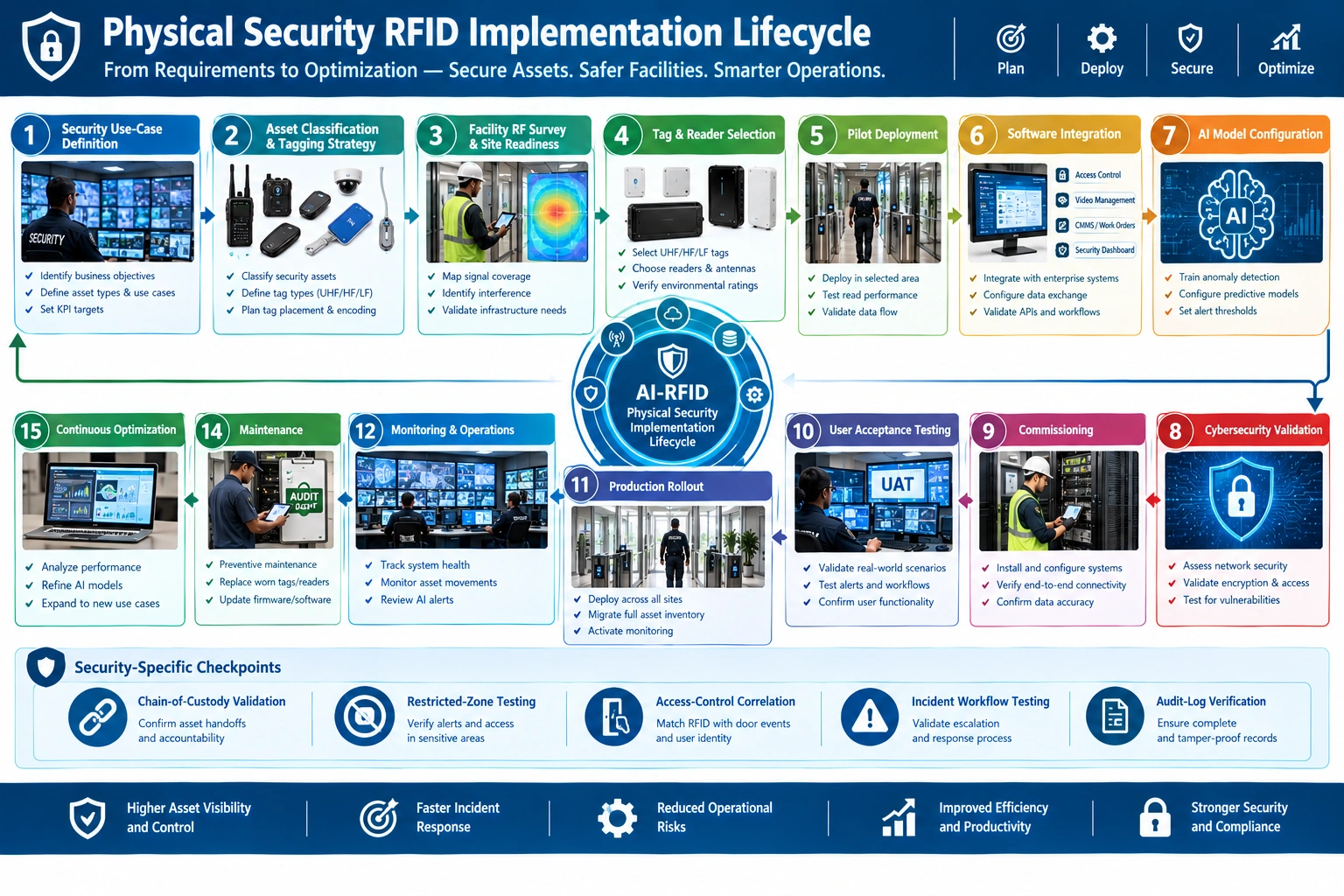
This lifecycle infographic maps the implementation of AI-driven RFID asset tracking from security use-case definition and facility RF surveys through pilot deployment, integration, cybersecurity validation, commissioning, and production rollout. It highlights critical security checkpoints—including chain-of-custody validation, restricted-zone testing, access-control correlation, incident workflow testing, and audit-log verification—before moving into monitoring, maintenance, and continuous optimization.
KPIs for AI-Powered RFID Asset Tracking in Physical Security
Performance should be evaluated using security and operational measures rather than RFID read counts alone.
Relevant KPIs include:
- Asset detection accuracy
- Missing-asset detection time
- Unauthorized movement detection time
- Asset reconciliation time
- Equipment check-in/check-out compliance
- False-alert rate
- Anomaly investigation time
- Asset-location accuracy
- Critical equipment availability
- Asset utilization rate
- Maintenance response time
- RFID reader uptime
- Data synchronization latency
- System availability
- Audit-record completeness
- Mean time to resolve asset exceptions
A useful measurement program should establish baseline performance before deployment. This allows the security organization to determine whether automation is actually reducing reconciliation effort, improving accountability, or accelerating investigations.
Engineering Recommendations for Long-Term Physical Security Deployment
AI-driven RFID asset tracking should be treated as an operational security capability rather than simply an RFID installation.
Key engineering recommendations include:
- Start with a clearly defined physical security workflow and measurable business problem.
- Select RFID tags based on the asset’s material and mounting conditions.
- Validate read zones through physical testing before permanent installation.
- Separate raw RFID events from business-level asset events through appropriate middleware.
- Combine deterministic security rules with AI-based anomaly detection.
- Correlate RFID information with access-control, video, maintenance, and custody data where justified.
- Keep humans involved in high-consequence security decisions.
- Protect asset-location data using access control, encryption, network segmentation, and audit logging.
- Design for temporary network or server outages rather than assuming continuous connectivity.
- Establish baseline KPIs before introducing AI optimization.
- Recalibrate AI models when physical layouts, operating procedures, asset populations, or security policies change.
- Use modular deployment practices so additional facilities, asset categories, and detection points can be added without redesigning the entire system.
GAO’s Role in RFID-Based Physical Security Solutions
Headquartered in New York City and Toronto, Canada, GAO is ranked among the world’s top 10 leading B2B and B2G suppliers of BLE and RFID technologies. GAO, GAO Research Inc., and GAO Tek Inc. form GAO Group, with operations based in New York City and Toronto.
For three decades, GAO Group has served organizations across the United States and Canada, including Fortune 500 companies, leading research and development organizations, prestigious universities, and U.S. and Canadian government agencies. This experience is relevant to physical security deployments where RFID hardware must operate reliably alongside established IT and security infrastructure.
GAO has invested heavily in research and development and maintains stringent quality assurance processes. Technical support can be provided remotely or onsite, helping organizations address equipment selection, integration, deployment, troubleshooting, and system-support requirements.
Key Takeaways for AI-Driven Physical Security Asset Tracking
AI is transforming RFID asset tracking in physical security by connecting physical asset observations with operational context and intelligent analysis. RFID supplies the identification events, while AI helps interpret patterns, prioritize anomalies, support maintenance decisions, and improve asset accountability.
A practical deployment should focus on defined security workflows, validated RF performance, reliable event processing, appropriate AI models, cybersecurity, and measurable operational outcomes. UHF, HF, and LF RFID should be selected according to the physical security use case rather than treated as interchangeable technologies.
Organizations evaluating AI-driven asset tracking can explore GAO’s RFID hardware products and systems, technical resources, and support capabilities to determine which approach best fits their physical security environment.
Building the Future of Industrial AI and IoT with Aperture Venture Studio and GAO RFID Inc.
For more than three decades, GAO Group of Companies has invested heavily in R&D of industrial RFID, BLE, and IoT. As generative AI became increasingly useful in industrial applications, we expanded our work in AI and IoT, including RFID and BLE, and founded Aperture Venture Studio to support the development and scaling of AI and IoT solutions relevant to areas such as physical security and intelligent asset tracking.
Aperture has attracted AI and IoT technical experts, entrepreneurial and operational executives, influential investors, and leading companies. We have also developed the Aperture Ventures Summit and TekSummit to discuss advanced AI and IoT topics.
We welcome you to join us as:
- Advisors, co-founders, or employees
- Investors
- Customers