
AI and RFID for Plastics Manufacturing
AI and RFID Are Transforming Plastics Manufacturing Operations
Plastics manufacturing is evolving from conventional production monitoring toward intelligent, data-driven operations where every raw material, mold, machine, finished product, and production activity can be identified, analyzed, and optimized. AI and RFID are becoming fundamental technologies for plastics manufacturers seeking greater visibility across resin handling, compounding, injection molding, extrusion, blow molding, thermoforming, rotational molding, finishing, warehousing, and shipping. By combining RFID-based identification with AI-driven analytics, manufacturers gain real-time operational intelligence that supports higher production efficiency, improved product quality, reduced material waste, enhanced traceability, and faster decision-making.
AI and RFID work together by transforming RFID-generated operational data into actionable insights. RFID automatically identifies and tracks resin lots, molds, tooling, work-in-process components, returnable containers, finished goods, maintenance assets, and production equipment, while AI analyzes production trends, machine utilization, quality deviations, process variability, and inventory movement. This combination enables predictive maintenance, intelligent production scheduling, automated inventory reconciliation, process optimization, and improved Overall Equipment Effectiveness (OEE).
For plastics manufacturers operating highly automated facilities, AI and RFID support digital manufacturing initiatives by connecting physical production assets with intelligent software systems. These technologies help improve production consistency, regulatory compliance, operational resilience, and supply chain visibility. Organizations implementing AI and RFID also benefit from stronger integration with Manufacturing Execution Systems (MES), Enterprise Resource Planning (ERP), Warehouse Management Systems (WMS), Quality Management Systems (QMS), and Industrial Internet of Things (IIoT) infrastructures.
Drawing on more than three decades of experience supplying RFID and IoT technologies throughout North America, GAO has supported manufacturers, research organizations, universities, and government agencies with industrial RFID hardware, engineering expertise, and technical support for production automation and asset visibility initiatives.
AI and RFID-Enabled Plastics Manufacturing Facility
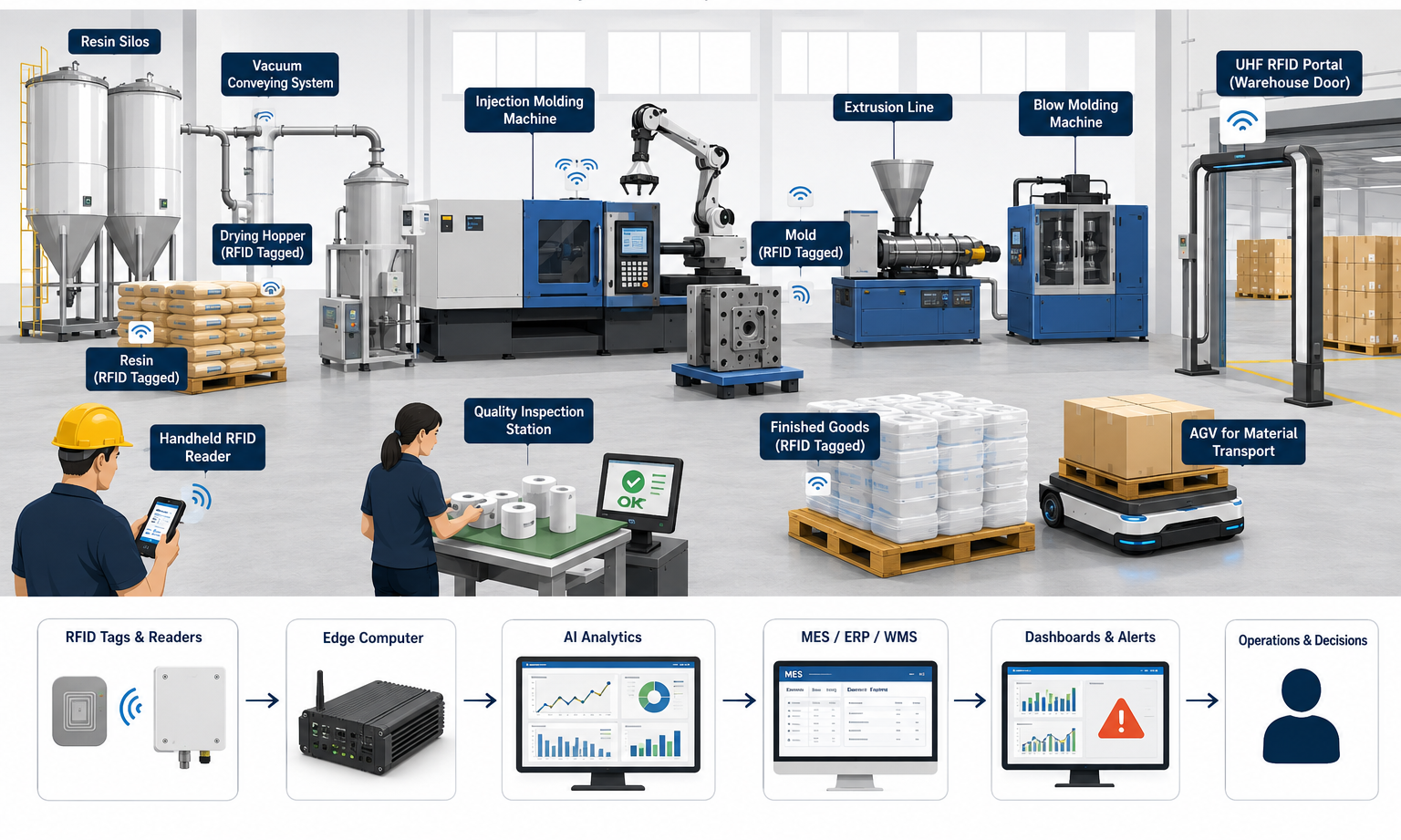
A simplified AI and RFID-enabled plastics manufacturing facility showing how RFID tracks raw materials, molds, and finished products throughout production. AI analytics integrate with MES, ERP, and WMS software to improve production visibility, quality control, inventory management, and operational decision-making.
Understanding AI and RFID in Plastics Manufacturing
Plastic product manufacturing depends on maintaining precise control over raw materials, production parameters, tooling, quality inspections, inventory movement, and logistics. Every production stage generates operational information that influences product quality, production efficiency, and manufacturing costs. Traditional barcode systems often require manual scanning and line-of-sight operation, limiting their effectiveness in high-speed manufacturing environments where thousands of components move continuously through automated production cells.
RFID overcomes these limitations by enabling non-contact identification of tagged assets. UHF RFID supports long-range identification of pallets, finished goods, returnable transport items, warehouse inventory, and shipping containers. HF RFID is commonly used for work-in-process tracking, reusable production fixtures, and controlled manufacturing environments requiring moderate read distances. LF RFID performs reliably in applications where metal tooling, liquids, or harsh industrial conditions may affect higher-frequency technologies.
Artificial intelligence enhances RFID deployments by continuously analyzing identification events alongside production data collected from programmable logic controllers (PLCs), industrial sensors, machine controllers, supervisory control and data acquisition (SCADA) software, vision inspection systems, and quality measurement equipment. AI algorithms detect production bottlenecks, predict equipment failures, optimize resin consumption, identify abnormal process conditions, and recommend operational adjustments before quality defects occur.
Rather than functioning as isolated technologies, AI and RFID become integral components of intelligent manufacturing systems where operational decisions increasingly rely on real-time production intelligence instead of historical reports.
- Modern plastics manufacturers increasingly deploy AI and RFID across:
- Resin receiving and warehouse operations
- Resin lot traceability
- Batch management
- Material handling automation
- Drying hopper management
- Injection molding production
- Extrusion process monitoring
- Blow molding operations
- Thermoforming production
- Mold lifecycle management
- Tool maintenance scheduling
- Robotic manufacturing cells
- Quality inspection
- Scrap tracking
- Regrind material management
- Finished goods inventory
- Distribution centers
- Shipping verification
- Returnable packaging management
- Spare parts inventory
This combination enables manufacturers to establish continuous visibility across production while reducing manual data collection and improving operational consistency.
AI and RFID Applications Across Plastics Manufacturing Operations
Each plastics manufacturing process presents unique production challenges, equipment requirements, and traceability objectives. AI and RFID deliver measurable value when deployed according to the operational characteristics of each manufacturing area rather than as a generic tracking solution.
Resin Receiving and Raw Material Traceability
Plastic manufacturing begins with accurate identification of incoming raw materials, including polymer pellets, additives, pigments, stabilizers, fillers, flame retardants, plasticizers, masterbatches, and recycled resin. RFID-tagged containers enable automated receiving while AI validates supplier deliveries, compares expected and actual inventory, identifies material shortages, and predicts future procurement requirements based on production schedules.
Typical tracked assets include:
- Resin supersacks
- Gaylords
- Bulk storage silos
- Intermediate bulk containers (IBCs)
- Drums
- Additive containers
- Color concentrate containers
- Receiving pallets
AI also identifies unusual inventory consumption patterns that may indicate material losses, production inefficiencies, or inaccurate inventory records.
Injection Molding Production
Injection molding operations depend on consistent mold utilization, machine availability, process stability, and material traceability. RFID tags permanently attached to molds enable automatic identification whenever tooling enters or leaves production machines.
AI analyzes RFID events together with machine operating parameters such as:
- Injection pressure
- Melt temperature
- Mold temperature
- Cooling time
- Cycle time
- Clamp force
- Screw position
- Shot weight
- Reject rates
- Machine downtime
Correlating these variables enables predictive optimization of molding processes while improving mold scheduling and preventive maintenance planning. Production supervisors gain visibility into mold utilization, idle tooling, setup efficiency, and production throughput across multiple manufacturing cells.
Extrusion and Compounding
Continuous extrusion processes require stable material flow and consistent process conditions. RFID identifies resin batches entering extrusion lines while AI continuously evaluates production performance.
Operational improvements include:
- Resin batch traceability
- Additive verification
- Extruder utilization analysis
- Die change optimization
- Production scheduling
- Quality trend analysis
- Material yield improvement
- Waste reduction
- Predictive maintenance of screw assemblies
- Production throughput forecasting
These capabilities are particularly valuable for manufacturers producing pipes, profiles, films, sheets, cables, medical tubing, and packaging materials.
Blow Molding and Thermoforming
Manufacturers producing bottles, containers, automotive components, industrial tanks, and food packaging require continuous product traceability across high-volume production environments.
RFID supports identification of:
- Production molds
- Product carriers
- Finished pallets
- Packaging materials
- Returnable containers
- Shipping units
AI evaluates production rates, machine utilization, quality inspection results, and production interruptions to improve operational efficiency while reducing product defects caused by inconsistent forming conditions.
Mold, Tooling, and Maintenance Management
Injection molds often represent some of the highest-value assets within plastics manufacturing facilities. Poor visibility into mold locations, maintenance history, and production utilization can result in unnecessary downtime and reduced equipment availability.
RFID enables automatic lifecycle tracking for:
- Injection molds
- Blow molds
- Extrusion dies
- Thermoforming tools
- Cooling fixtures
- Robotic end-of-arm tooling
- Maintenance carts
- Calibration equipment
AI evaluates accumulated production cycles, maintenance intervals, repair frequency, tooling performance, and historical downtime to recommend predictive maintenance activities before failures interrupt production schedules.
AI and RFID Workflow for Plastics Manufacturing
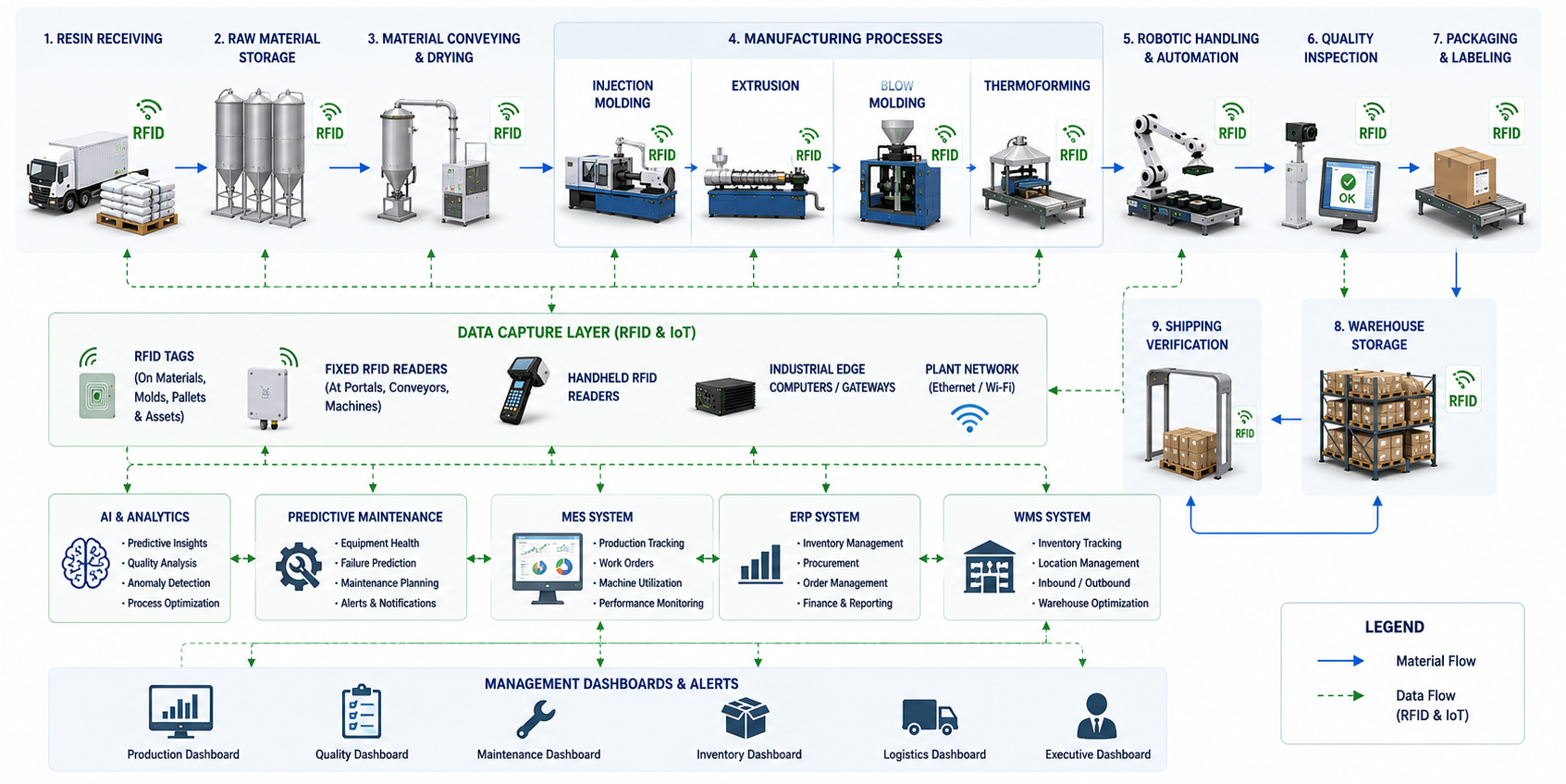
Shows how AI and RFID support plastics manufacturing from resin receiving and production to quality inspection, warehousing, and shipping. RFID data is analyzed by AI and integrated with MES, ERP, and WMS software to improve traceability, production efficiency, inventory visibility, and operational decision-making.
Warehouse and Finished Goods Visibility
Finished plastic products frequently move through automated warehouses before shipment. RFID portals automatically record pallet movements between production, quality control, finished goods storage, staging, and shipping areas without requiring manual scanning.
AI uses this continuous stream of RFID data to optimize warehouse slotting, identify slow-moving inventory, improve forklift routing, forecast warehouse capacity, and reduce shipping delays. Combined with warehouse automation systems, RFID supports highly accurate inventory reconciliation and shipping verification while minimizing human error.
Manufacturers producing consumer packaging, medical plastics, automotive components, industrial containers, electrical products, and construction materials particularly benefit from improved inventory accuracy and outbound logistics visibility.
Traditional vs. AI and RFID-Enabled Plastics Manufacturing Operations
| Traditional Plastics Manufacturing | AI & RFID-Enabled Plastics Manufacturing |
| Manual resin lot tracking using paper records or barcodes | Automatic RFID-based resin lot traceability with AI-driven validation |
| Manual mold location and maintenance records | Real-time RFID mold tracking with AI-based lifecycle and maintenance insights |
| Limited visibility into production status | Real-time production monitoring with AI analytics dashboards |
| Periodic inventory counts with manual updates | Continuous RFID inventory tracking with automated reconciliation |
| Reactive equipment maintenance after failures | AI-powered predictive maintenance based on equipment and RFID data |
| Manual quality inspections with delayed defect analysis | AI-assisted quality monitoring linked to RFID product genealogy |
| Warehouse inventory managed through manual scanning | Automated warehouse visibility using RFID portals and AI optimization |
| Manual shipping verification and documentation | Automated shipment verification through RFID-enabled dock portals |
| High dependence on manual labor for tracking and data entry | Reduced manual effort through automated identification and data capture |
| Historical reporting with limited operational insights | Real-time analytics, trend analysis, and predictive recommendations |
| Decisions based on delayed or incomplete operational data | Data-driven decision-making using AI-powered operational intelligence |
AI and RFID System Components for Plastics Manufacturing
A successful AI and RFID deployment in plastics manufacturing requires more than installing RFID readers and attaching tags to production assets. Reliable operation depends on selecting appropriate RFID technologies, industrial hardware, AI software, communication infrastructure, cybersecurity controls, and enterprise software integration based on production processes, environmental conditions, throughput requirements, and traceability objectives.
Plastics manufacturing environments introduce engineering challenges such as high temperatures near molding machines, electrically noisy production equipment, metallic tooling, moving conveyors, robotic cells, resin dust, moisture, and high-speed material handling. Each factor influences RFID read performance, network reliability, AI model accuracy, and overall system performance.
GAO has supplied industrial RFID hardware and IoT technologies to manufacturing organizations across North America, helping engineering teams select components appropriate for demanding production environments while supporting reliable identification and long-term operational performance.
RFID Technologies Used Throughout Plastics Manufacturing
Different manufacturing processes require different RFID frequencies because read distance, environmental conditions, asset type, and identification speed vary considerably across production and warehouse operations.
UHF RFID
Ultra High Frequency RFID is widely deployed where long read ranges and rapid identification of multiple assets are required.
Typical plastics manufacturing applications include:
- Finished goods pallet tracking
- Warehouse inventory management
- Automated storage and retrieval systems (AS/RS)
- Shipping verification
- Loading dock portals
- Returnable transport item tracking
- Forklift-mounted RFID systems
- Automated Guided Vehicle (AGV) identification
- Resin pallet management
- Distribution center operations
Typical read distances range from several feet to over 30 feet depending on antenna configuration, tag design, environmental conditions, and regulatory power limits.
HF RFID
High Frequency RFID is commonly selected where controlled read zones and moderate reading distances improve operational accuracy.
Common applications include:
- Work-in-process identification
- Production fixture tracking
- Manufacturing cell verification
- Tool checkout
- Batch identification
- Laboratory sample tracking
- Maintenance documentation
- Operator authorization
HF RFID performs well when products move through controlled manufacturing stations requiring reliable single-item identification.
LF RFID
Low Frequency RFID remains valuable for specialized industrial applications where metal components, moisture, or harsh operating conditions can reduce higher-frequency performance.
Representative applications include:
- Mold identification
- Heavy tooling management
- Maintenance equipment
- Industrial containers
- Machine setup verification
- Calibration asset management
Although LF RFID supports shorter read distances, its resistance to environmental interference makes it suitable for many production assets.
Industrial RFID Hardware Supporting AI-Based Manufacturing Intelligence
Reliable identification begins with properly selected industrial hardware. Every hardware component contributes to accurate data collection, which directly affects AI model performance.
RFID Tags
Tag selection depends on operating temperature, chemical exposure, mounting surface, expected lifespan, and cleaning procedures.
Typical RFID-tagged assets include:
- Injection molds
- Blow molds
- Extrusion dies
- Resin containers
- Drying hoppers
- Material carts
- Work-in-process trays
- Finished product pallets
- Returnable containers
- Maintenance tools
- Calibration instruments
- Production fixtures
- Forklift attachments
- Packaging containers
- Scrap collection bins
Industrial tags may be embedded within tooling, mechanically fastened, encapsulated in rugged housings, or attached using specialized industrial adhesives depending on operational requirements.
Fixed RFID Readers
Fixed readers continuously monitor production activities without requiring operator involvement.
Typical installation locations include:
- Receiving docks
- Resin storage areas
- Material transfer points
- Conveyor intersections
- Injection molding cells
- Extrusion lines
- Blow molding lines
- Thermoforming stations
- Warehouse entrances
- Shipping doors
- Maintenance rooms
- Finished goods staging areas
Multiple antennas can be connected to a single reader to monitor several production zones simultaneously while reducing infrastructure costs.
Handheld RFID Readers
Portable readers remain important despite increasing automation.
Maintenance technicians, quality engineers, warehouse personnel, and production supervisors use handheld readers for:
- Tool identification
- Mold verification
- Cycle counting
- Inventory audits
- Asset location
- Maintenance history retrieval
- Shipment verification
- Exception handling
- Manual inspections
- Production investigations
These devices often include integrated barcode scanners, cameras, wireless networking, and ruggedized industrial enclosures suitable for factory environments.
RFID Antennas
Proper antenna design significantly influences read accuracy.
Engineering considerations include:
- Circular versus linear polarization
- Read-zone size
- Mounting height
- Conveyor speed
- Metallic surroundings
- Reflection management
- Dense reader environments
- Environmental sealing
- Temperature rating
- Cable routing
Careful antenna placement minimizes missed reads and false detections while improving AI data quality.
Industrial Edge Computers
Edge computers perform local processing close to production equipment.
Typical responsibilities include:
- RFID event filtering
- Device management
- Temporary data storage
- AI inference
- Production monitoring
- Local dashboards
- Alarm generation
- Machine communication
- Buffering during network interruptions
- Data synchronization
Running AI inference locally reduces latency and enables immediate operational responses without depending exclusively on cloud connectivity.
Layered AI and RFID System for Plastics Manufacturing
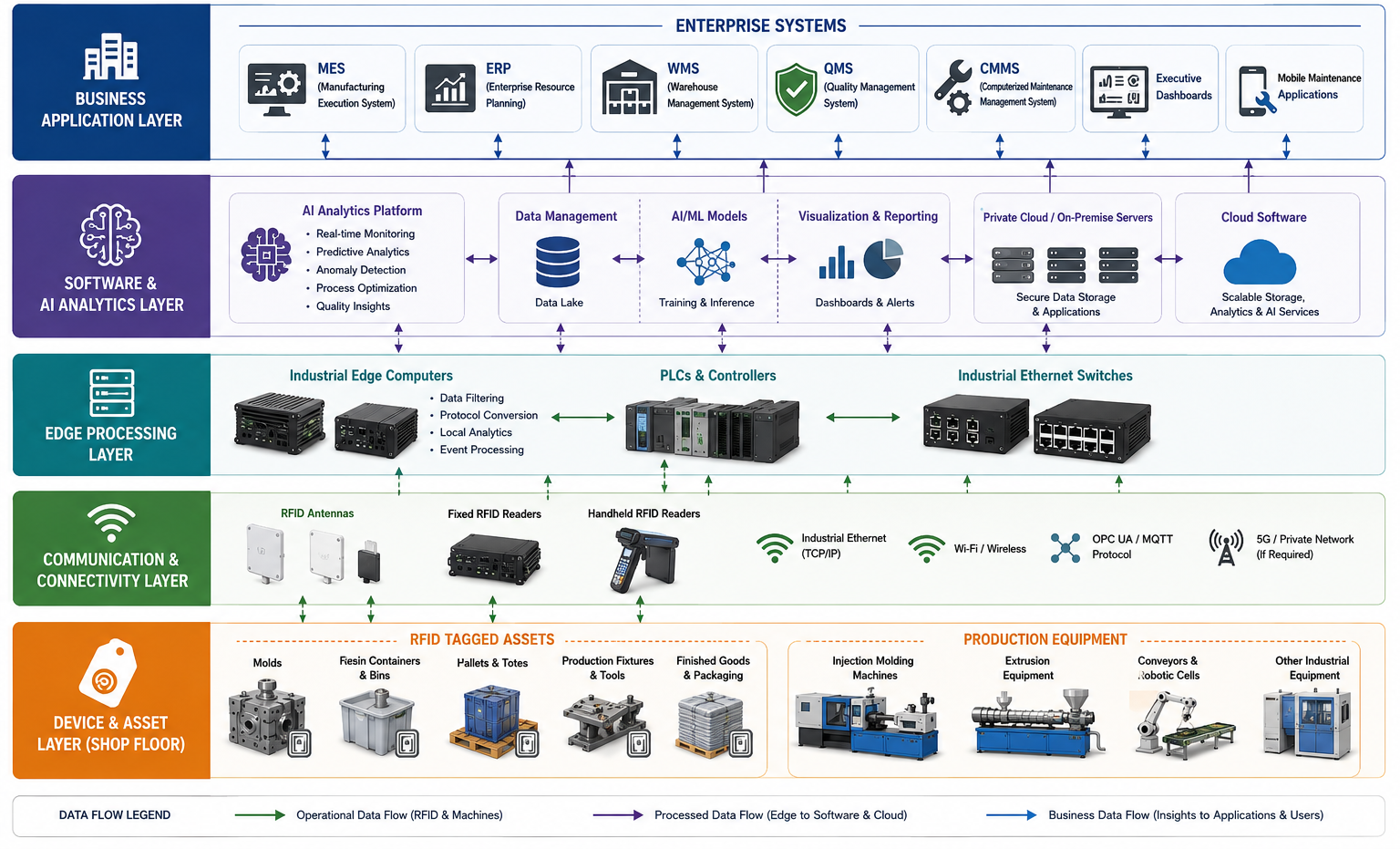
Shows how RFID devices, industrial equipment, AI analytics, edge computing, communication networks, and enterprise software work together in a layered system for plastics manufacturing. The diagram illustrates the flow of operational data from RFID-tagged assets through AI processing to MES, ERP, WMS, QMS, CMMS, and management dashboards for real-time monitoring and decision-making.
AI Software Driving Intelligent Plastics Manufacturing
Artificial intelligence transforms RFID event streams into operational intelligence by correlating identification data with production, maintenance, quality, and inventory information.
Depending on manufacturing objectives, organizations may deploy several complementary AI methods.
Machine Learning
Machine learning identifies relationships hidden within production data.
Applications include:
- Production forecasting
- Cycle time prediction
- Inventory optimization
- Mold utilization analysis
- Scrap prediction
- Resin consumption forecasting
- Maintenance planning
- Quality trend analysis
- Equipment performance benchmarking
Computer Vision
Vision systems complement RFID by inspecting products that cannot be evaluated through identification data alone.
Typical applications include:
- Flash detection
- Short-shot identification
- Surface defect inspection
- Dimensional verification
- Label inspection
- Packaging verification
- Robotic guidance
- Color consistency monitoring
RFID provides product identity while computer vision evaluates physical quality, allowing AI to associate inspection results with specific production batches and tooling.
Predictive Analytics
Predictive models analyze historical and real-time production information to estimate future operational conditions.
Common predictions include:
- Machine failures
- Mold maintenance schedules
- Resin shortages
- Warehouse congestion
- Production delays
- Quality deviations
- Spare parts consumption
- Shipping demand
Anomaly Detection
Industrial AI continuously monitors operations for unusual conditions.
Detected anomalies may include:
- Unexpected mold movement
- Unauthorized asset removal
- Missing production batches
- Abnormal inventory consumption
- Excessive machine downtime
- Temperature deviations
- Unexpected production interruptions
- Repeated quality failures
Early detection enables corrective action before disruptions become costly.
Communication Infrastructure Supporting AI and RFID
Reliable communication ensures RFID information reaches AI software with minimal delay while maintaining data integrity.
Frequently used communication technologies include:
- Industrial Ethernet
- Gigabit Ethernet
- Wi-Fi
- Wi-Fi 6
- Private 5G
- Ethernet/IP
- PROFINET
- Modbus TCP
- OPC UA
- MQTT
- HTTPS
- REST APIs
- TCP/IP
- UDP
- SNMP
- Network Time Protocol (NTP)
Communication technologies are selected according to equipment compatibility, latency requirements, cybersecurity policies, production speed, and factory network design.
Industrial gateways often translate proprietary machine protocols into standardized formats that AI software can analyze efficiently.
Cloud Software and Server Software Deployment
Selecting the appropriate deployment model depends on operational priorities, cybersecurity requirements, regulatory obligations, latency expectations, and available IT resources. Both cloud-hosted software and privately managed server deployments can support AI and RFID in plastics manufacturing, provided they are designed to align with production workflows and business objectives.
Cloud Software Deployment
Cloud-hosted software is well suited for manufacturers operating multiple plants, geographically distributed warehouses, contract manufacturing networks, or global supply chains that require centralized visibility. Cloud deployments simplify software maintenance, enable rapid scalability, and support collaboration across production, quality, procurement, logistics, and executive teams.
Common advantages include:
- Centralized production dashboards
- Multi-site inventory visibility
- Simplified software updates
- Remote performance monitoring
- Cross-facility analytics
- Centralized AI model management
- Business continuity through redundant cloud infrastructure
- Secure access for authorized users from multiple locations
This deployment model is often selected when organizations prioritize enterprise-wide reporting, centralized analytics, and rapid expansion without maintaining extensive private server infrastructure.
Server Software Deployment
Many plastics manufacturers prefer software deployed on customer-managed servers located within factory networks, private data centers, regional hosting facilities, or other privately controlled computing environments. This approach offers greater control over production data, cybersecurity policies, integration with legacy systems, and operational continuity.
Server-based deployments are commonly chosen when manufacturing operations require:
- Low-latency decision making close to production equipment
- Compliance with internal data governance policies
- Integration with existing MES, ERP, SCADA, or historian systems
- Support for facilities with limited or intermittent internet connectivity
- Custom software configurations tailored to specialized production processes
- Greater control over software updates and maintenance schedules
Hybrid deployments are also common, where edge servers process time-sensitive production data locally while selected information is synchronized with cloud software for enterprise reporting, long-term analytics, and executive decision support. This approach combines the responsiveness of local processing with the scalability and centralized visibility of cloud-based systems.
Technical Capabilities and Operational Benefits of AI and RFID for Plastics Manufacturing
Combining AI and RFID enables plastics manufacturers to move beyond simple asset identification toward intelligent production management. RFID provides accurate, real-time visibility into materials, tooling, inventory, and production assets, while AI continuously interprets operational data to identify inefficiencies, predict future conditions, and recommend corrective actions. Together, these technologies improve production consistency, optimize resource utilization, and support informed decision-making throughout the manufacturing lifecycle.
Organizations implementing AI and RFID typically realize the greatest value when the solution is aligned with specific production objectives, such as reducing scrap, increasing mold utilization, improving inventory accuracy, strengthening batch traceability, or enhancing production scheduling. Rather than generating isolated operational reports, AI continuously analyzes production data to support proactive manufacturing decisions.
Enhanced Raw Material Traceability
Resin traceability is critical for maintaining product quality, regulatory compliance, and efficient recall management. RFID enables automatic identification of polymer batches, additives, masterbatches, recycled materials, and processing aids as they move through receiving, storage, blending, production, packaging, and shipping.
AI correlates RFID events with production schedules, machine settings, quality inspection records, and finished product genealogy to create complete digital traceability records.
Operational advantages include:
- Complete resin lot genealogy
- Automated batch verification
- Improved supplier quality analysis
- Faster root cause investigations
- Reduced recall scope
- Improved regulatory documentation
- Better material accountability
- Accurate production history
Manufacturers producing food packaging, pharmaceutical packaging, medical components, automotive plastics, and electrical insulation materials particularly benefit from detailed material traceability.
Intelligent Mold and Tool Lifecycle Management
Injection molds, extrusion dies, thermoforming tools, and blow molds represent significant capital investments that directly influence production capacity and product quality.
RFID automatically records tooling movement between maintenance workshops, storage locations, production machines, and cleaning stations. AI analyzes production cycles, maintenance records, repair frequency, downtime history, and tooling performance to optimize lifecycle management.
Operational improvements include:
- Higher mold utilization
- Reduced tooling loss
- Predictive preventive maintenance
- Improved production planning
- Faster mold changeovers
- Reduced unplanned downtime
- Better maintenance scheduling
- Improved spare tool availability
Production engineers gain greater visibility into tooling performance, allowing maintenance activities to be scheduled before failures affect production output.
Improved Production Scheduling
Production scheduling within plastics manufacturing requires balancing machine availability, tooling constraints, resin availability, customer demand, operator resources, maintenance activities, and quality requirements.
AI continuously analyzes RFID-generated production status together with machine utilization, inventory levels, and customer orders to recommend optimized production sequences.
Benefits include:
- Reduced machine idle time
- Improved production throughput
- Better mold utilization
- Shorter setup times
- Lower changeover frequency
- Improved delivery performance
- Better resource allocation
- Higher production flexibility
Dynamic scheduling enables manufacturers to respond more effectively to changing production priorities without disrupting overall manufacturing efficiency.
Automated Inventory Management
Manual inventory counting remains one of the most labor-intensive activities within plastics manufacturing warehouses.
RFID continuously captures inventory movements while AI reconciles physical inventory with ERP, MES, and WMS records.
Typical improvements include:
- Increased inventory accuracy
- Faster cycle counts
- Reduced manual labor
- Improved warehouse visibility
- Better pallet tracking
- Lower inventory shrinkage
- Improved material availability
- Reduced production interruptions
Warehouse personnel spend less time locating materials and more time supporting production activities.
Predictive Maintenance
Unexpected equipment failures can interrupt production schedules, increase scrap, delay customer shipments, and reduce Overall Equipment Effectiveness.
RFID identifies maintenance assets while AI evaluates equipment operating history using production cycles, vibration sensors, temperature sensors, maintenance logs, energy consumption, lubrication schedules, and historical repair records.
Common predictive maintenance targets include:
- Injection molding machines
- Extruders
- Blow molding equipment
- Hydraulic systems
- Servo motors
- Vacuum pumps
- Cooling systems
- Chillers
- Compressors
- Material dryers
- Robotic systems
- Conveyors
Maintenance teams receive early warnings before failures occur, enabling planned interventions during scheduled maintenance windows.
Higher Product Quality
Product quality depends on maintaining stable manufacturing conditions throughout production.
RFID associates every finished product with:
- Resin lot
- Machine
- Mold
- Operator
- Production shift
- Process parameters
- Inspection records
- Packaging information
AI identifies relationships between production conditions and product quality, allowing engineers to detect process drift before large numbers of defective products are produced.
Quality improvements often include:
- Lower reject rates
- Reduced scrap generation
- Better dimensional consistency
- Improved process capability
- Reduced customer complaints
- Faster quality investigations
- Improved statistical process control
- Better first-pass yield
Benefits of AI and RFID in Plastics Manufacturing
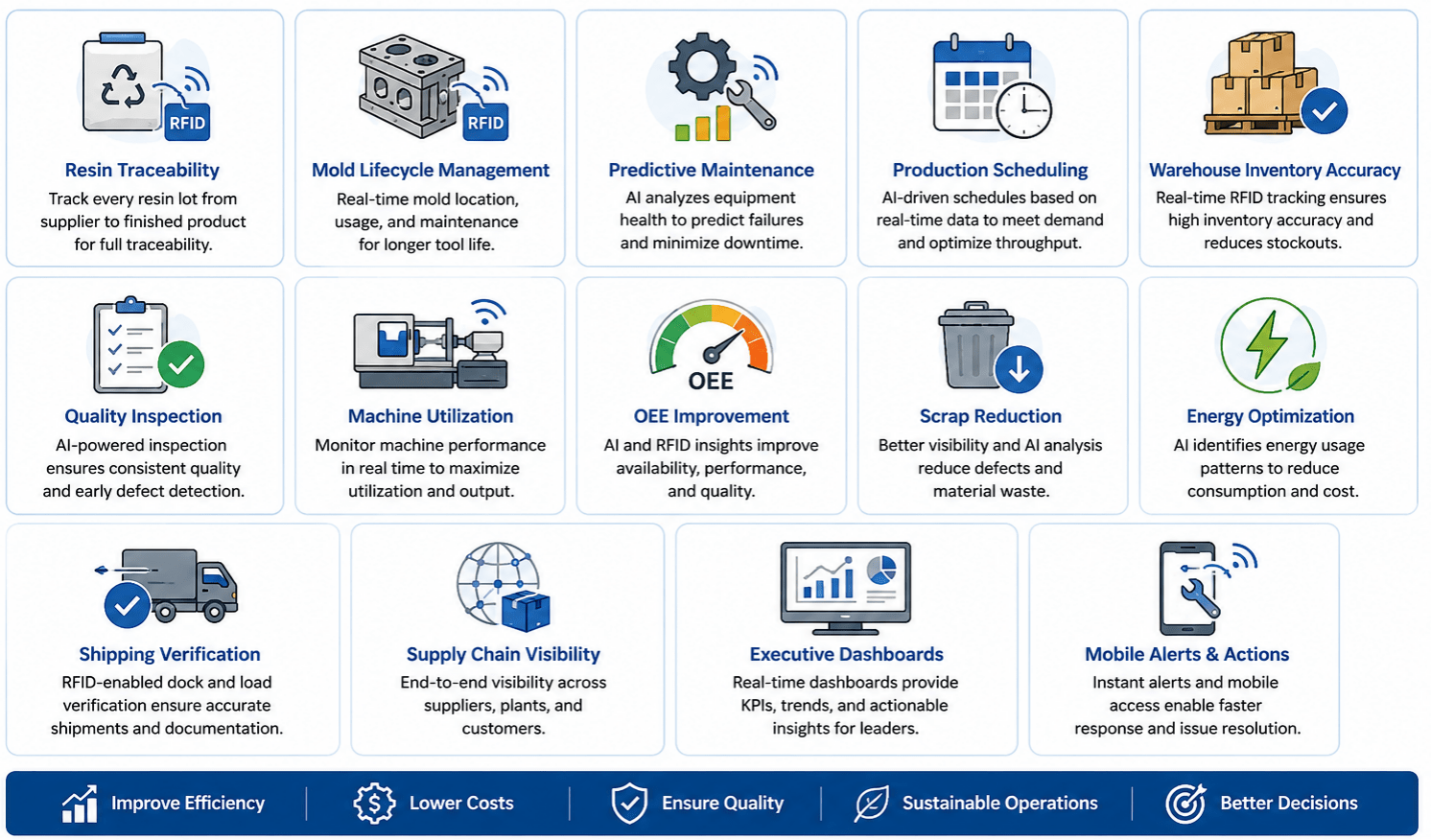
Highlights the key operational and business benefits of AI and RFID across plastics manufacturing, including resin traceability, mold lifecycle management, predictive maintenance, production scheduling, inventory accuracy, quality inspection, OEE improvement, scrap reduction, energy optimization, shipping verification, supply chain visibility, and executive dashboards.
Enterprise Software Integration Across Plastics Manufacturing
AI and RFID deliver maximum value when production data is exchanged with operational software used throughout the manufacturing organization. Integrating RFID-generated identification events with production, maintenance, quality, warehouse, and business applications enables consistent data flow, reduces manual entry, and improves operational visibility.
Depending on production complexity, AI and RFID solutions commonly integrate with:
- Manufacturing Execution Systems (MES)
- Enterprise Resource Planning (ERP)
- Warehouse Management Systems (WMS)
- Quality Management Systems (QMS)
- Computerized Maintenance Management Systems (CMMS)
- Supervisory Control and Data Acquisition (SCADA)
- Product Lifecycle Management (PLM)
- Manufacturing Operations Management (MOM)
- Laboratory Information Management Systems (LIMS)
- Product Information Management (PIM)
- Industrial historians
- Business Intelligence (BI) software
- Supply Chain Management (SCM) software
- Transportation Management Systems (TMS)
- Customer Relationship Management (CRM) software
This integrated information flow enables production managers, maintenance engineers, warehouse supervisors, procurement teams, quality personnel, and executive leadership to make decisions using consistent operational data.
GAO supports organizations by supplying RFID hardware and related technologies that can be integrated into existing manufacturing software environments while minimizing disruption to ongoing production.
Engineering Design Considerations for Successful Deployment
Planning AI and RFID deployments requires careful engineering analysis before hardware installation. A well-designed solution considers production workflows, environmental conditions, system scalability, and long-term maintenance requirements to ensure reliable performance and measurable operational improvements.
Facility Assessment
Engineering teams should evaluate:
- Production layout
- Material flow
- Equipment locations
- Conveyor configurations
- Warehouse operations
- RF interference sources
- Metallic structures
- Environmental conditions
- Existing automation systems
- Available network infrastructure
A comprehensive site assessment helps determine reader placement, antenna orientation, network topology, and data collection strategies.
RFID Tag Selection
Selecting appropriate RFID tags depends on:
- Mounting surface material
- Operating temperature
- Exposure to chemicals
- Mechanical vibration
- Cleaning procedures
- Read distance requirements
- Expected service life
- Asset value
- Production speed
- Environmental sealing requirements
Testing representative tags under actual production conditions is recommended before large-scale deployment.
Reader and Antenna Optimization
Reliable read performance depends on careful system tuning.
Engineering best practices include:
- Defining controlled read zones
- Minimizing overlapping antenna coverage
- Optimizing antenna polarization
- Verifying conveyor read accuracy
- Managing reflected RF signals
- Performing production validation tests
- Monitoring read-rate performance
- Periodically recalibrating equipment
Pilot testing under peak production conditions helps validate long-term reliability before expanding the deployment.
AI Model Development and Continuous Improvement
AI performance depends on the quality, consistency, and completeness of operational data. Successful implementations establish a structured lifecycle for developing, validating, and maintaining AI models.
Recommended practices include:
- Collecting representative production data across multiple operating conditions
- Cleaning and normalizing RFID and machine data before model training
- Validating predictions against actual production outcomes
- Monitoring model accuracy over time
- Retraining models when production processes, materials, or equipment change
- Maintaining version control for AI models
- Documenting assumptions, performance metrics, and decision thresholds
Continuous monitoring ensures AI recommendations remain reliable as manufacturing conditions evolve.
Scalability and Future Expansion
Many plastics manufacturers begin with a focused deployment, such as mold tracking or warehouse inventory management, before expanding AI and RFID capabilities across additional production lines and facilities.
Scalable system design should support:
- Additional RFID readers and antennas
- Increased asset volumes
- New production lines
- Multi-site manufacturing operations
- Expanded AI analytics
- Integration with additional business software
- Higher transaction volumes
- Future automation initiatives
Designing for scalability reduces future implementation costs and simplifies the adoption of emerging manufacturing technologies.
AI and RFID Deployment Workflow for Plastics Manufacturing
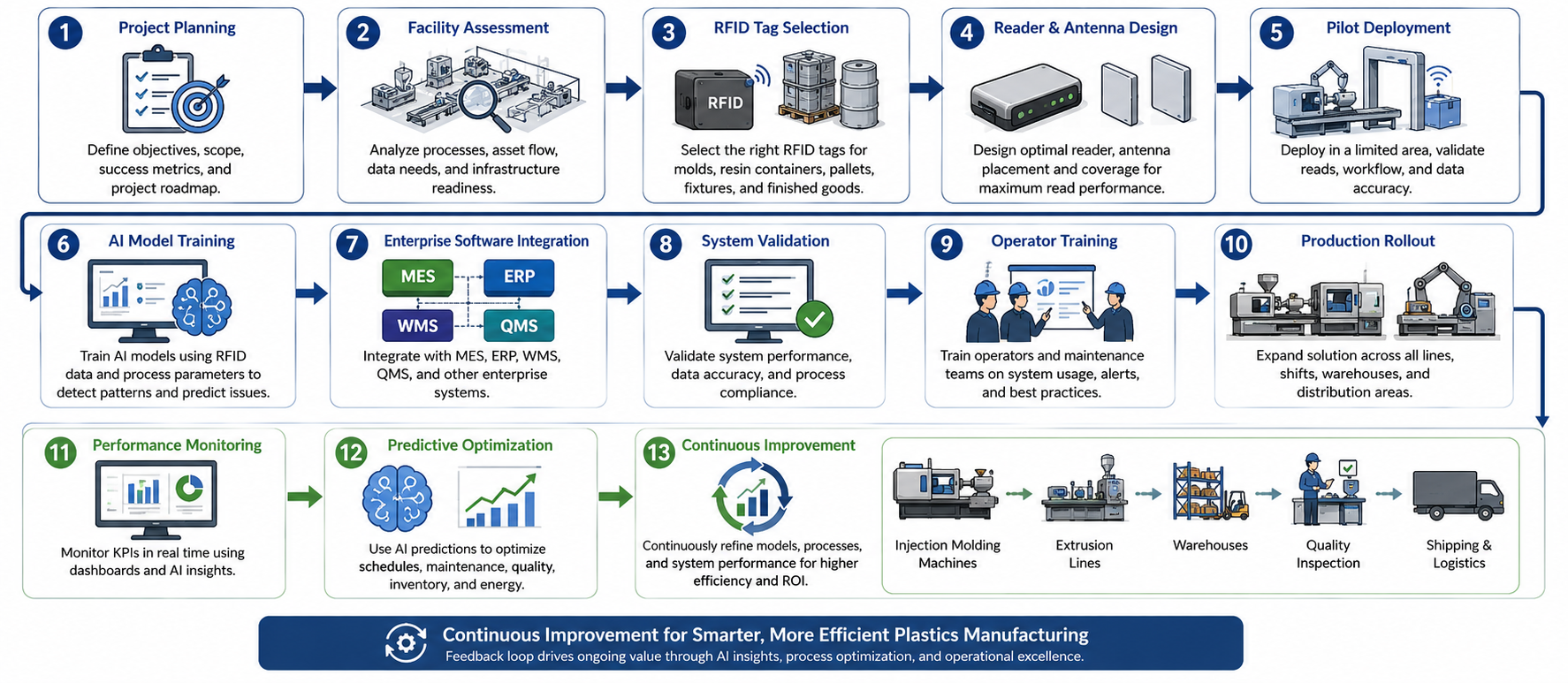
End-to-end implementation workflow for deploying AI and RFID in plastics manufacturing, from project planning and RFID hardware selection to AI model training, enterprise software integration, production rollout, performance monitoring, and continuous improvement.
Implementation Recommendations for AI and RFID in Plastics Manufacturing
Successful AI and RFID initiatives typically begin with clearly defined operational objectives rather than organization-wide deployments. Identifying measurable business goals enables engineering teams to prioritize high-value use cases, establish realistic performance targets, and validate return on investment before expanding to additional production areas.
Recommended implementation practices include:
- Identify production processes with the highest operational impact, such as resin traceability, mold management, warehouse inventory, or finished goods tracking.
- Establish baseline KPIs including Overall Equipment Effectiveness (OEE), inventory accuracy, scrap rate, first-pass yield, mold utilization, production throughput, and order fulfillment accuracy.
- Conduct an RF site survey to evaluate potential interference from metallic equipment, conveyors, robotic cells, and production machinery.
- Select RFID tags designed for the operating environment, considering temperature, vibration, chemicals, washdown procedures, and mounting surfaces.
- Design controlled RFID read zones that minimize missed reads and duplicate events.
- Integrate RFID event data with existing MES, ERP, WMS, QMS, CMMS, and SCADA software where appropriate.
- Validate AI models using representative production data collected across different shifts, product types, and operating conditions.
- Train operators, maintenance personnel, warehouse teams, and production supervisors on RFID workflows and AI-assisted decision making.
- Implement continuous monitoring to evaluate system performance, reader health, AI model accuracy, and network reliability.
- Expand deployments incrementally based on measured operational improvements and evolving production requirements.
Organizations that follow a phased implementation strategy generally achieve faster adoption, reduced project risk, and improved long-term operational performance.
Key Technical Insights and Business Value
AI and RFID are enabling plastics manufacturers to transition from reactive operations to data-driven manufacturing where production decisions are supported by continuously updated operational intelligence. RFID provides accurate identification of materials, tooling, production assets, and finished goods, while AI transforms this information into predictive insights that improve manufacturing efficiency and operational control.
Key technical and operational outcomes include:
- Improved raw material and batch traceability across production workflows.
- Increased mold utilization and better lifecycle management.
- More accurate inventory visibility throughout warehouses and production facilities.
- Reduced manual data collection and fewer transcription errors.
- Earlier detection of equipment degradation through predictive maintenance.
- Improved production scheduling using real-time operational information.
- Lower scrap generation and improved first-pass yield.
- Better quality assurance through complete product genealogy.
- Faster root cause analysis during quality investigations.
- Enhanced decision-making supported by AI-driven production analytics.
- Greater scalability for multi-site plastics manufacturing operations.
- Stronger integration between production equipment and business software.
For manufacturers producing packaging, automotive components, consumer products, medical devices, industrial containers, construction materials, and engineered plastics, AI and RFID provide a practical foundation for improving operational visibility, manufacturing consistency, and supply chain resilience.
As organizations continue modernizing production facilities, AI and RFID are expected to play an increasingly important role in supporting intelligent manufacturing, digital traceability, and continuous process optimization.
End-to-End AI and RFID Solution for Plastics Manufacturing
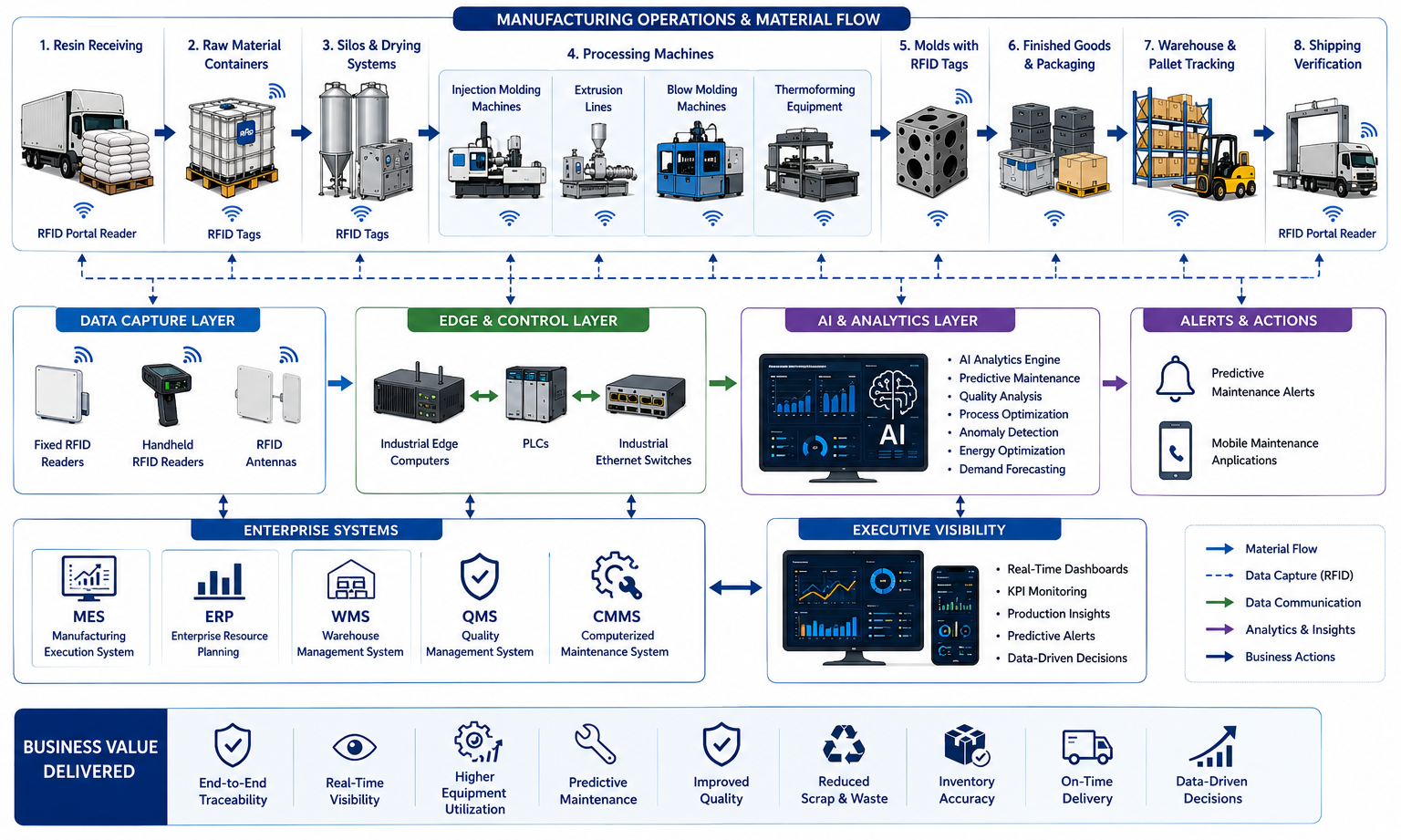
Complete AI and RFID solution for plastics manufacturing, from raw material receiving and production to warehouse operations and shipping. It also illustrates how RFID data integrates with AI analytics, enterprise software, and management dashboards to improve traceability, production efficiency, quality, and operational visibility.
Advancing Plastics Manufacturing with AI and RFID
AI and RFID are redefining how plastics manufacturers manage production assets, materials, tooling, inventory, and quality throughout the manufacturing lifecycle. By combining automated RFID identification with AI-driven analytics, organizations gain continuous visibility into production operations while improving traceability, reducing waste, optimizing equipment utilization, and strengthening operational decision-making.
A carefully engineered solution that integrates RFID hardware, AI software, industrial communication technologies, and manufacturing software enables plastics manufacturers to improve productivity without disrupting existing production processes. Whether deployed for resin traceability, mold management, warehouse automation, predictive maintenance, or production scheduling, AI and RFID provide measurable operational improvements that support long-term manufacturing excellence.
Headquartered in New York City and Toronto, Canada, GAO is recognized among the world’s leading B2B RFID and BLE technology suppliers. Together with its sister companies, GAO Research and GAO Tek, GAO has served Fortune 500 companies, leading research institutions, universities, and government organizations throughout the United States and Canada for more than three decades. Through ongoing investment in research and development, stringent quality assurance processes, and expert remote and onsite technical support, we continue helping organizations deploy reliable RFID and AIoT solutions tailored to demanding manufacturing environments.
Building the Future of Industrial AI and IoT with Aperture Venture Studio and GAO RFID Inc.
For more than three decades, GAO Group of Companies has invested extensively in research and development of industrial RFID, BLE, and IoT technologies. As generative AI has demonstrated significant value in manufacturing, logistics, and industrial automation, we have expanded our development of AI and IoT solutions, including AI and RFID technologies for plastics manufacturing and other industrial applications. To accelerate innovation across these sectors, we established Aperture Venture Studio to help advance and scale practical AI and IoT solutions for diverse industries.
Aperture has attracted leading AI and IoT technical experts, experienced operational executives, influential investors, and established industry organizations. We have also developed the highly successful Aperture Ventures Summit and TekSummit, creating vibrant technical communities dedicated to advancing industrial AI and IoT knowledge and collaboration.
We welcome you to engage with us as:
- Advisors, co-founders, or employees
- Investors
- Customers seeking AI, RFID, BLE, and IoT expertise, products, and engineering support
Future of AI and RFID in Plastics Manufacturing
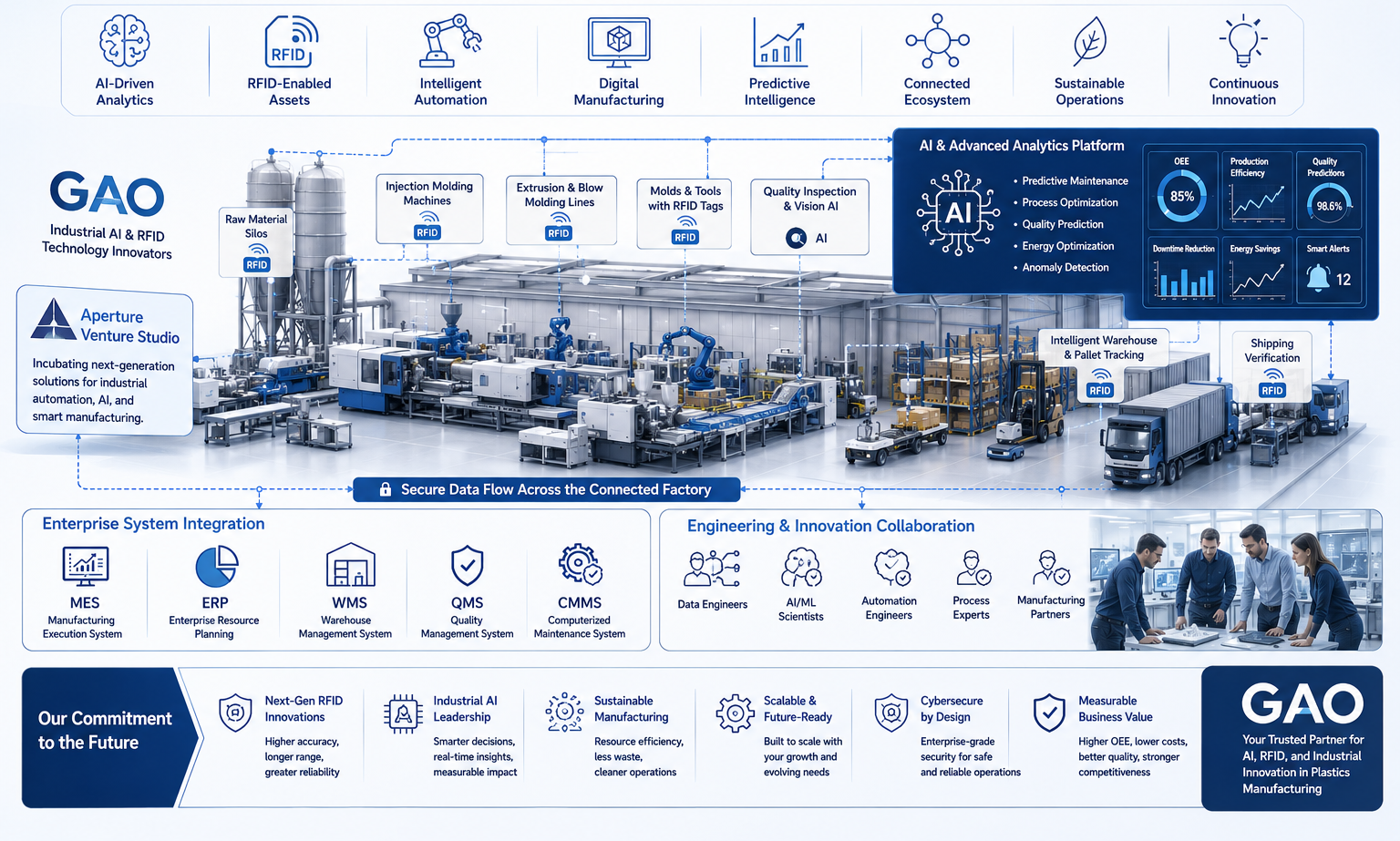
Highlights the future of plastics manufacturing through AI and RFID by connecting intelligent production, industrial automation, predictive analytics, enterprise software, engineering collaboration, and digital manufacturing to support continuous innovation and operational excellence.