
AI and RFID for Ports and Marine Terminal Operations
AI-Driven Port Operations with RFID Asset and Cargo Tracking
Ports are complex intermodal operating environments where containers, chassis, trucks, trailers, cargo-handling equipment, maintenance assets, personnel, and documentation move through tightly scheduled processes. AI can analyze operational data from terminal systems, equipment, cameras, IoT devices, and RFID identification points to improve yard planning, cargo visibility, equipment utilization, gate operations, and exception management. RFID provides a practical identification and location-data layer for selected port assets and material flows, particularly at controlled gates, warehouses, maintenance facilities, container handling areas, and equipment staging points.
For port operators, the value comes from connecting physical movements with operational decisions. RFID events can establish when an asset enters or leaves a defined zone, while AI can evaluate those events alongside terminal operating system data, equipment status, work orders, vessel schedules, and historical operating patterns. This combination can help port teams reduce search time, identify inventory discrepancies, improve equipment dispatch, prioritize exceptions, and support more predictable vessel and truck turnaround.
Why AI Is Transforming Port Operations
Port performance depends on coordination among marine terminals, vessel operators, terminal operators, truckers, rail operators, customs-related processes, maintenance teams, warehouse personnel, security teams, and cargo owners. A disruption in one process can propagate through the yard, gate, berth, or intermodal connection.
AI is increasingly useful because port operations generate large volumes of time-dependent data. The challenge is not simply collecting more data. The objective is to convert operational events into decisions that improve throughput, safety, asset utilization, and schedule adherence.
AI for Container Yard Planning
Container movement is influenced by vessel discharge plans, export receiving windows, transshipment requirements, reefer requirements, customs status, chassis availability, yard density, and planned truck or rail movements.
AI models can evaluate these variables to identify yard-placement conflicts and predict congestion. Historical dwell times can also be used to estimate which containers are likely to remain in the yard longer than expected.
RFID can supplement existing container identification methods where tagged containers, pallets, cargo units, or handling assets require automated identification at defined locations. Rather than replacing container numbers, OCR, terminal operating systems, or other established identification methods, RFID can provide another machine-readable event source.
AI for Port Equipment Utilization
Quay cranes, rubber-tired gantry cranes, rail-mounted gantry cranes, reach stackers, forklifts, terminal tractors, straddle carriers, mobile harbor cranes, and other equipment represent significant operational capacity.
AI can compare equipment availability, utilization, location, workload, maintenance status, and historical performance. This allows dispatch teams to identify underutilized equipment, anticipate maintenance-related constraints, and allocate equipment according to expected workload.
RFID can support identification of selected mobile equipment, attachments, maintenance tools, spare parts, and support assets. A controlled RFID read point can confirm movement between maintenance areas, equipment yards, workshops, and operational zones.
AI for Gate and Truck Turnaround
Truck congestion at port gates can result from appointment timing, documentation problems, container availability, chassis shortages, inspection requirements, traffic conditions, and yard congestion.
AI can analyze historical gate transactions and current operating conditions to forecast periods of increased truck demand. Port operators can use these predictions to adjust staffing, gate capacity, inspection resources, or appointment policies.
RFID can contribute automated identification events for tagged equipment, chassis, cargo-handling assets, or other authorized objects moving through controlled gate locations. Combining RFID events with gate systems can help establish a more consistent movement history.
AI for Port Maintenance
Port maintenance teams support cranes, conveyors, pumps, generators, electrical equipment, hydraulic systems, terminal vehicles, reefer infrastructure, lighting, security equipment, and other critical assets.
AI can analyze work orders, equipment operating data, maintenance history, spare-parts consumption, inspection results, and failure patterns to prioritize maintenance activities. Predictive maintenance models can identify equipment conditions associated with increased failure probability.
RFID can help maintenance personnel locate tools, calibration equipment, spare parts, replacement assemblies, and maintenance kits. This is particularly valuable when tools and parts are shared across workshops or maintenance teams.
AI for Cargo and Warehouse Operations
Port warehouses and distribution areas handle spare parts, breakbulk cargo, project cargo, packaging materials, maintenance supplies, consumables, and other inventory.
AI can forecast material demand, detect unusual inventory movements, identify likely stockouts, and prioritize replenishment. RFID can automate receiving, staging, put-away, picking, dispatch, and inventory verification for suitable tagged items.
GAO has supplied RFID and IoT hardware products and systems that organizations can use to capture asset and material events at operational points. Port-specific deployment should be designed around the actual movement of cargo, equipment, and personnel rather than around RFID hardware alone.
Port AI and RFID Operations Overview
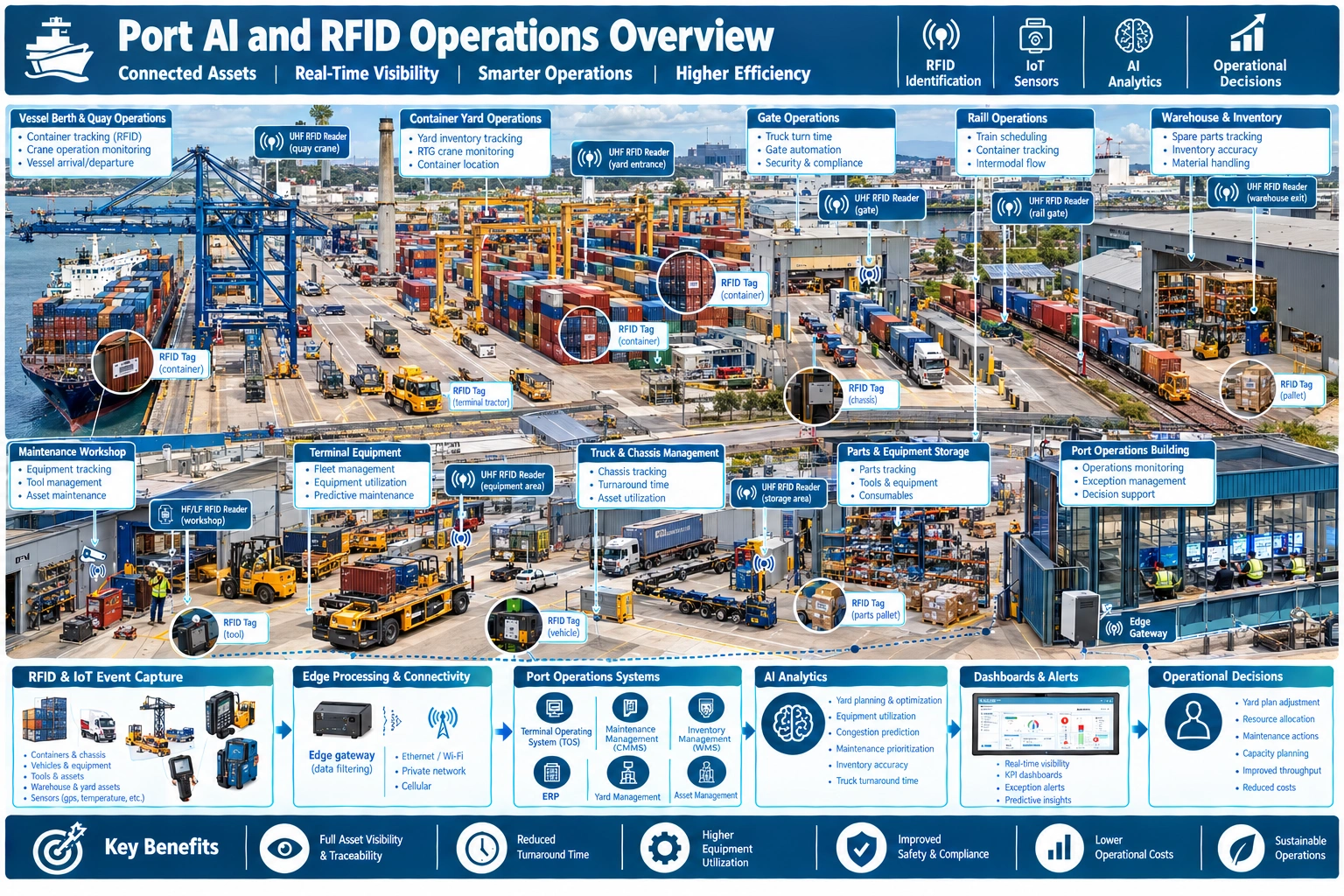
This infographic shows RFID-tagged containers, chassis, equipment, tools, and port assets moving through vessel berths, container yards, gates, rail connections, warehouses, and maintenance areas. RFID and IoT events flow through edge processing and port systems into AI analytics, dashboards, and operational decisions.
Port Applications for AI and RFID
The strongest deployments begin with operational problems where reliable identification and event history can improve a measurable port workflow. RFID should be assigned to assets or material flows where automated identification provides a meaningful advantage over manual scanning or existing identification methods.
Container and Cargo Movement
RFID can be applied to selected containers, cargo units, pallets, project cargo, or handling assets where automated movement events are operationally useful.
Controlled read zones can be positioned at warehouse doors, cargo staging areas, transfer points, or other locations where the movement of tagged objects needs to be recorded.
AI can use these events with terminal operating system data to identify unexpected movement sequences, prolonged dwell times, or inconsistencies between planned and observed cargo status.
Chassis and Terminal Asset Tracking
Chassis availability has a direct effect on truck operations and container interchange. RFID can help identify tagged chassis and other transport assets as they move through defined port locations.
AI can analyze movement history to estimate asset availability, identify unusually long dwell periods, and highlight potential shortages.
Port operations teams can use these insights to improve chassis allocation and reduce time spent searching for available assets.
Tool Crib and Maintenance Asset Management
Port maintenance organizations often maintain large inventories of specialized tools and equipment. Hydraulic tools, torque tools, electrical test equipment, lifting accessories, welding equipment, calibration instruments, portable generators, pumps, and other assets may move between workshops and field maintenance locations.
RFID-enabled tool cribs can record issue and return events. Handheld RFID readers can support exception searches when a maintenance technician needs to locate a particular asset.
AI can analyze tool demand, utilization, overdue returns, and maintenance history to identify tools likely to become unavailable during planned maintenance activities.
Spare Parts and Maintenance Kits
Port maintenance schedules depend on the availability of bearings, motors, gear components, hydraulic parts, electrical components, cables, valves, filters, fasteners, lubricants, and other replacement materials.
RFID can provide automated receiving and movement records for tagged spare parts and maintenance kits. AI can combine these records with work orders and historical consumption to improve spare-parts demand forecasting.
The result is not simply better inventory visibility. Maintenance planners can determine whether the material required for a planned work package is physically available and appropriately staged before equipment downtime begins.
Port Warehouse and Staging Operations
Warehouses supporting port operations may serve several maintenance teams, terminal functions, and equipment groups. Material can be received, inspected, stored, kitted, staged, issued, returned, or transferred between locations.
RFID can establish event records at selected warehouse transitions. AI can then analyze inventory movement against expected workflows.
A discrepancy between an issued maintenance kit and its expected destination can become an exception for warehouse personnel rather than remaining unnoticed until a technician reports a missing part.
High-Value and Specialized Equipment
Ports may operate expensive equipment that is shared among maintenance teams or deployed across multiple operational zones. Examples include portable power units, inspection equipment, lifting equipment, specialized maintenance machinery, and calibration devices.
RFID can provide automated identification at storage and transfer locations. AI can evaluate utilization patterns and identify assets that are repeatedly unavailable, underutilized, or moved outside expected workflows.
Realistic Port RFID Deployment in Container Terminal Operations
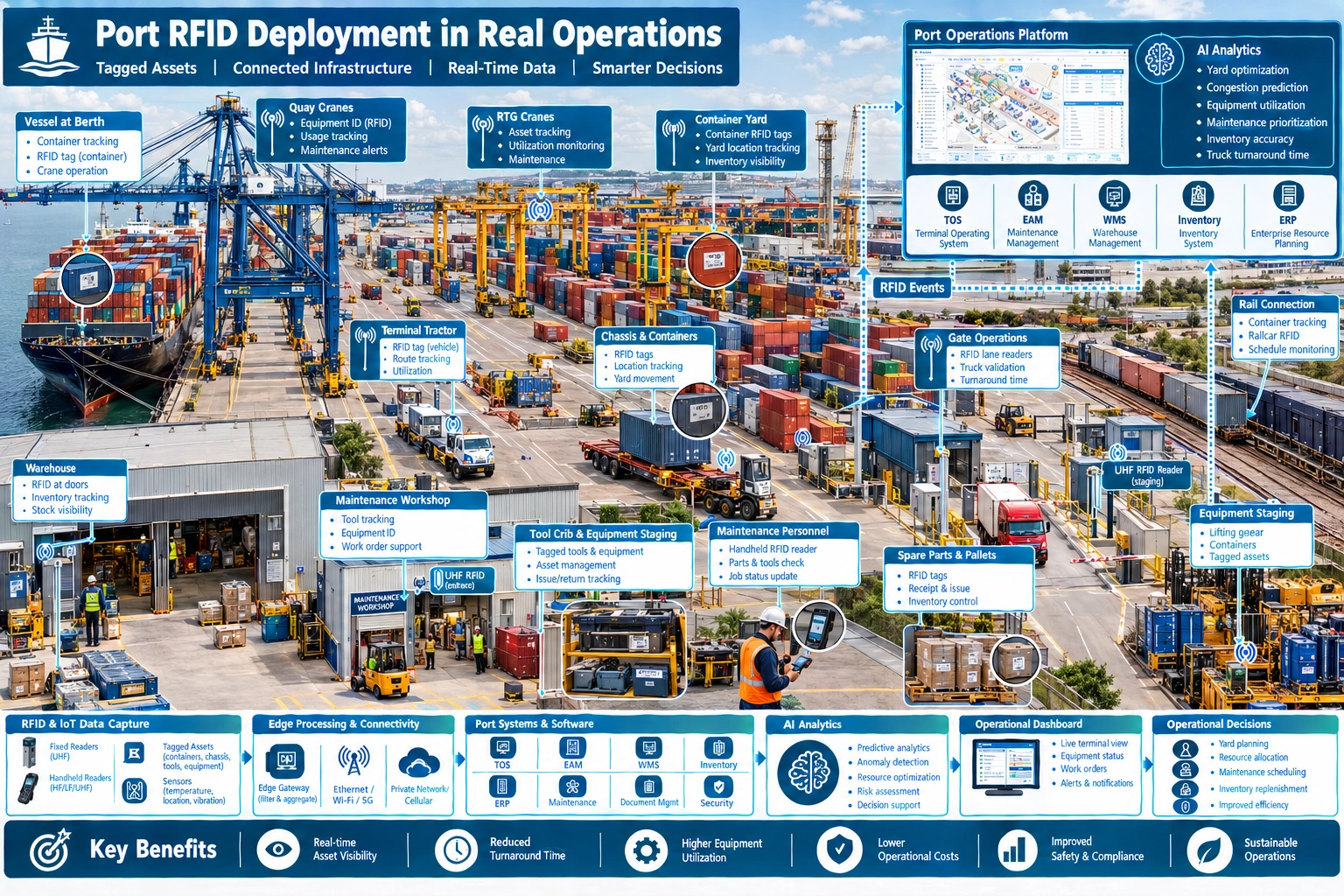
This visual demonstrates RFID deployment across a working container terminal, including vessel berths, container yards, warehouses, truck gates, maintenance areas, and equipment staging zones. RFID events flow through edge systems into port software and AI analytics to support asset visibility, maintenance, inventory, and operational decisions.
Port Operational Challenges Addressed by AI-Enabled RFID
Uncertain Asset Location
Terminal equipment, maintenance tools, chassis, cargo units, and support assets can move through many operational areas. Manual records may not provide sufficiently current location information.
RFID event capture can provide timestamped movement evidence at selected transition points. AI can identify assets whose observed movement differs from expected operational patterns.
Yard Congestion
Yard congestion can emerge from high container density, inefficient container positioning, equipment availability, vessel schedule changes, truck arrival patterns, or unexpected dwell times.
AI can evaluate multiple variables to identify congestion risk. RFID movement events can provide additional evidence about physical asset transitions where tagged objects are involved.
Equipment Downtime
Unexpected crane, vehicle, conveyor, power, or hydraulic-system failures can affect cargo handling and vessel operations.
AI-based maintenance analysis can prioritize equipment requiring inspection or intervention. RFID can help ensure that required tools, spare parts, and maintenance kits are available at the correct workshop or field location.
Inventory Discrepancies
Port warehouses may contain thousands of maintenance parts and consumables. Manual inventory transactions can create discrepancies between system records and physical stock.
RFID can automate selected inventory events, while AI can detect unusual consumption, unexpected movement, duplicate records, or potential stockout conditions.
Fragmented Operational Records
Port operations commonly involve terminal operating systems, enterprise resource planning software, warehouse management systems, transportation systems, maintenance applications, access-control systems, equipment monitoring software, and document repositories.
AI becomes more useful when relevant information can be correlated across these systems. RFID provides physical-world events that can be linked to digital records through asset IDs, container IDs, work-order numbers, location identifiers, and timestamps.
Port Workflow from Physical Events to AI Decisions
An effective AI and RFID solution for ports should be designed as an operational workflow rather than as an isolated RFID installation.
Data Acquisition at Port Operating Locations
Data originates from RFID readers, handheld RFID devices, IoT devices, equipment controllers, cameras, gate systems, terminal operating systems, maintenance applications, inventory systems, and other operational sources.
RFID tags may be attached to selected containers, chassis, tools, pallets, equipment, spare-parts containers, or maintenance assets. UHF RFID is generally useful for longer-range controlled identification, while HF RFID can support short-range identification at appropriate stations. LF RFID can be considered where short-range identification and specific tag-reader characteristics suit the application.
Metal-rich port equipment requires careful tag selection. On-metal RFID tags are often appropriate for steel equipment, tool cases, containers, and other conductive surfaces. Read performance should be validated using the actual tagged object rather than relying solely on laboratory specifications.
RFID Event Capture
Fixed readers can capture movement at controlled locations such as warehouse doors, maintenance entrances, staging areas, and equipment transition points. Handheld readers can support inventory verification and exception handling.
A useful RFID event should normally include the asset identifier, reader or location identifier, timestamp, and relevant event context. Filtering and duplicate suppression are important because a reader may detect the same tag repeatedly while it remains within a read zone.
Edge Processing and Communications
Port environments can include large outdoor yards, metal structures, equipment shelters, maintenance buildings, warehouses, and areas with variable wireless coverage.
Ethernet, Wi-Fi, private wireless, and cellular connectivity can transport RFID and IoT events depending on the location and operational requirements. Edge processing can temporarily buffer events during communication interruptions and forward them when connectivity is restored.
Reader health monitoring is also important. A port operations team should be able to distinguish between “asset not present” and “reader not operating.”
Middleware and Port Software Integration
Middleware can normalize RFID events and connect physical identification data with operational software.
Potential integration points include terminal operating systems, enterprise resource planning systems, warehouse management systems, transportation management systems, computerized maintenance management systems, enterprise asset management systems, yard management software, access-control systems, and document management systems.
The integration model should preserve the existing master records for assets, containers, equipment, work orders, and locations rather than creating unnecessary parallel databases.
AI Analytics and Operational Decisions
AI models can evaluate RFID events together with operational records to identify patterns that are difficult to detect through individual transactions.
Examples include:
- Predicting equipment maintenance demand from work history and utilization.
- Forecasting spare-parts consumption for terminal equipment.
- Identifying abnormal asset movement.
- Predicting yard congestion.
- Estimating truck gate workload.
- Detecting inventory anomalies.
- Prioritizing maintenance work orders.
- Forecasting equipment availability.
- Identifying prolonged asset dwell.
- Supporting vessel and terminal schedule planning.
The final step is an operational action. A prediction should result in a dispatch change, maintenance review, inventory investigation, staffing adjustment, material transfer, or other defined decision.
RFID, AI Software, and Port Infrastructure
UHF RFID for Port Operations
UHF RFID is well suited to controlled longer-range identification points where tagged assets pass through a defined area. Typical applications include warehouse receiving, maintenance asset movement, equipment staging, selected gate processes, and inventory verification.
Port environments require special attention to RF reflections caused by containers, cranes, steel structures, vehicles, and other conductive surfaces. Reader antenna orientation, tag placement, shielding, power levels, and read-zone geometry should be validated during a physical site survey.
HF RFID for Port Workstations
HF RFID generally supports shorter-range identification and can be appropriate for controlled workstation applications such as maintenance stations, equipment identification, access-related workflows, or specific inventory processes.
The short operating distance can be advantageous when accidental reads from nearby assets would create unwanted events.
LF RFID for Short-Range Port Identification
LF RFID can support specialized short-range identification scenarios where its operating characteristics match the physical workflow. Port deployments should select LF, HF, or UHF according to read distance, tag environment, object material, throughput, reader geometry, and required integration behavior.
Technology selection should therefore begin with the operational transaction rather than a preference for a particular RFID frequency.
AI Models for Port Operations
Different port problems require different AI methods.
Time-series models can support equipment utilization and workload forecasting. Classification models can prioritize maintenance conditions or operational exceptions. Anomaly-detection models can identify unusual inventory or asset movement. Optimization methods can support yard planning, equipment allocation, and resource scheduling.
Computer vision may complement RFID for container identification, safety monitoring, crane operations, or gate processes. Edge AI can be useful where decisions must be made close to equipment or where connectivity is intermittent.
Cloud Version for Multi-Site Port Operations
A cloud-hosted SaaS deployment can centralize data and analytics across multiple terminals, warehouses, maintenance facilities, or geographically distributed port operations.
This model can be useful when corporate IT teams need centralized dashboards, common AI models, consolidated asset records, and multi-site performance analysis. Connectivity, cybersecurity, data residency, integration latency, and operational continuity still require engineering review.
Server Version for Controlled Port Infrastructure
A Server Version can run on edge servers, customer-managed servers, private data centers, privately hosted infrastructure, or other controlled enterprise computing environments.
This approach can be appropriate when a port operator requires greater control over sensitive operational data, restricted network connectivity, integration with private systems, or local processing for time-critical workflows.
A hybrid arrangement can also place event processing close to the port while transferring selected historical data to centralized analytics.
RFID Hardware for Port Environments
Port deployments may use fixed RFID readers, directional antennas, handheld readers, vehicle-mounted readers, RFID tags, on-metal tags, industrial enclosures, network equipment, edge gateways, and supporting power infrastructure.
Hardware selection should account for weather exposure, temperature, vibration, mechanical impact, mounting location, tag attachment method, cleaning procedures, and proximity to metal.
GAO can support organizations by supplying RFID readers, tags, antennas, handheld equipment, and related IoT hardware products and systems for evaluation and deployment. Practical commissioning should still validate read performance using the actual port assets and operating conditions.
RFID Site Survey and Read-Zone Engineering
RFID should not be installed solely according to theoretical maximum read distance. A port requires controlled read zones that correspond to real operational transitions.
A site survey should examine:
- Container stacks and steel structures that can create RF reflections.
- Vehicle and equipment movement patterns.
- Reader antenna orientation and mounting height.
- Required read-zone boundaries.
- Tag attachment location.
- Potential interference and radio-frequency constraints.
- Weather and environmental exposure.
- Network and power availability.
- Expected tag density.
- Required event latency.
- Reader maintenance access.
The objective is reliable event capture without generating excessive false reads from assets passing near the intended transaction point.
Part 2 continues directly from the RFID site-survey and read-zone engineering section in Part 1, without repeating the earlier applications and workflow content.
Security and Data Governance for AI-Enabled Port Operations
AI-enabled port systems connect physical identification events with operational records that can influence cargo handling, equipment maintenance, yard planning, access control, and terminal performance. Security therefore has to cover RFID devices, edge gateways, communications networks, enterprise software, user accounts, APIs, and AI data pipelines.
RFID and Network Security
RFID readers should be placed on appropriately segmented operational networks with controlled access to management interfaces. Reader credentials, gateway authentication, firmware management, and administrative access should follow the port operator’s cybersecurity policies.
Encrypted communications should be used where supported and appropriate. Network segmentation can limit the effect of a compromised field device and separate RFID infrastructure from sensitive terminal operating systems and corporate networks.
Port operators should also maintain an inventory of readers, gateways, handheld devices, and other connected equipment. Firmware versions, configuration changes, reader health, and network connectivity should be monitored as part of routine operational support.
AI Data Quality and Model Governance
AI predictions are only as reliable as the operational data supplied to the models. Duplicate RFID events, missing reads, incorrect asset identifiers, stale location records, clock synchronization errors, and improperly configured read zones can produce misleading conclusions.
Data-quality controls should therefore validate:
- RFID event timestamps and location identifiers.
- Asset-to-tag associations.
- Reader health and connectivity.
- Duplicate-event filtering.
- Container, chassis, and equipment master data.
- Work-order and maintenance records.
- Inventory transactions.
- Equipment operating history.
- AI model input completeness.
Human review remains important when AI recommendations could affect safety-critical maintenance, cargo handling, security decisions, or other high-consequence port activities.
Integration with Port Enterprise Systems
RFID should normally complement existing port software instead of creating an isolated operational record. The most useful integration identifies how physical events correspond to existing business transactions.
Terminal Operating System Integration
Terminal operating systems manage many core container-terminal transactions, including vessel operations, container movement, yard activity, and equipment workflows.
RFID events can supplement these records by providing additional evidence that a tagged object passed a defined location. An integration layer can map RFID identifiers to container, chassis, equipment, or asset records.
CMMS and EAM Integration
Maintenance teams can associate tools, spare parts, equipment, and maintenance kits with work orders in a CMMS or EAM system.
RFID can provide issue, return, movement, and staging events. AI can then compare maintenance requirements with actual material and tool availability before scheduled work begins.
WMS and ERP Integration
Warehouse management systems can manage receiving, put-away, picking, replenishment, and dispatch. ERP systems may manage purchasing, financial transactions, supplier records, and inventory valuation.
RFID can automate selected physical inventory events while the WMS or ERP remains the system of record for applicable transactions.
API and Middleware Integration
Middleware can normalize data from RFID readers and other IoT devices before sending it to enterprise applications.
Useful functions include:
- Event filtering and duplicate suppression.
- Asset and location mapping.
- Timestamp normalization.
- Reader-health monitoring.
- API transformation.
- Exception generation.
- Data buffering during connectivity loss.
- Audit logging.
GAO can help organizations evaluate RFID hardware and system integration requirements so that identification events support existing port workflows instead of requiring unnecessary changes to established software.
Technical Capabilities for Port Operations
The combination of AI analytics and RFID event data creates several operational capabilities that are difficult to achieve through periodic manual inventory checks alone.
Automated Asset and Inventory Reconciliation
RFID events can be compared with expected inventory records to identify discrepancies between physical and digital status.
For example, a maintenance kit recorded as stored in a warehouse location but repeatedly detected at a different staging area can trigger an investigation. Similar logic can identify equipment that has not returned to its expected location.
Container and Equipment Dwell Analysis
Dwell time is a critical port performance variable. AI can evaluate RFID movement events together with terminal records to identify prolonged dwell or unusual movement sequences for selected tagged assets.
This can help distinguish normal operational delays from conditions requiring intervention.
Predictive Equipment Availability
AI can combine maintenance history, utilization, operating hours, work orders, and equipment movement information to estimate future equipment availability.
Maintenance supervisors can use the result when scheduling crane inspections, vehicle maintenance, workshop work, or spare-parts requirements.
Material Staging Verification
Port maintenance work can be delayed when a required part has been ordered but has not physically reached the correct staging location.
RFID events can establish whether a material kit has been received, picked, staged, or transferred. AI can compare these events with planned work orders and identify jobs at risk because of missing materials.
Exception Management
AI should not attempt to automate every port decision. A more practical approach is to identify exceptions that require human attention.
Examples include:
- A high-priority maintenance work order without the required parts.
- A tagged asset detected outside its expected operating zone.
- An unusual inventory withdrawal.
- A maintenance tool not returned after a defined period.
- A chassis remaining inactive beyond an expected dwell threshold.
- A reader repeatedly producing abnormal event volumes.
- A predicted equipment availability problem before a high-workload period.
This approach helps port personnel focus on exceptions rather than manually reviewing every transaction.
Port Performance Metrics and KPIs
Port operators should establish baseline measurements before deployment and compare them with post-implementation results. RFID read counts alone are not sufficient measures of business value.
Asset and RFID Performance KPIs
Useful measures include:
- Asset-location accuracy.
- RFID read success rate.
- Reader uptime.
- Tag association accuracy.
- False-read rate.
- Duplicate-event rate.
- Tool search time.
- Tool availability.
- Inventory reconciliation accuracy.
- Asset movement visibility.
Terminal and Yard KPIs
Relevant operational measures can include:
- Container dwell time.
- Yard utilization.
- Yard rehandling frequency.
- Equipment utilization.
- Equipment availability.
- Truck turnaround time.
- Gate transaction time.
- Vessel turnaround time.
- Container movement productivity.
- Material staging time.
Maintenance KPIs
Maintenance performance can be measured through:
- Maintenance backlog.
- Mean time between failures.
- Mean time to repair.
- Planned-versus-unplanned maintenance.
- Parts availability at job start.
- Work-order cycle time.
- First-time completion.
- Rework rate.
- Equipment downtime.
- Preventive-maintenance compliance.
AI Performance KPIs
AI models should also have measurable technical performance indicators:
- Forecast accuracy.
- Prediction lead time.
- Alert precision.
- False-alert rate.
- Model drift.
- Data completeness.
- Exception resolution time.
- Human override frequency.
These measures help determine whether AI is actually improving port decisions rather than simply generating additional dashboards.
Port Regulations, Standards, and Compliance Considerations
RFID and AI deployments at ports must be evaluated within the regulatory environment applicable to the location, cargo, equipment, radio operation, and operational activity. Requirements can vary by country, port authority, terminal type, and cargo classification.
Radio-Frequency Compliance
RFID equipment must operate within applicable radio-frequency requirements. In the United States, FCC requirements can apply to RFID equipment, while Canadian deployments may require consideration of ISED requirements. Other jurisdictions have their own spectrum regulations.
Port engineering teams should confirm permitted frequencies, power levels, equipment certifications, installation requirements, and applicable electromagnetic compatibility considerations before commissioning fixed RFID readers.
Maritime, Port, and Occupational Requirements
Depending on the specific port operation, compliance considerations may include requirements or guidance associated with:
- U.S. Coast Guard requirements.
- OSHA requirements.
- EPA environmental requirements.
- DOT requirements.
- Port authority operating rules.
- Customs and cargo-security procedures.
- Hazardous-material handling.
- Dangerous-goods requirements.
- Hot-work procedures.
- Confined-space procedures.
- Electrical safety.
- Crane and lifting requirements.
- Environmental discharge controls.
- Classification requirements where applicable to marine equipment or vessel operations.
A port is not automatically a hazardous location simply because it handles marine cargo or operates near vessels. If a particular zone is classified as hazardous, the RFID readers, tags, handhelds, power equipment, and other electrical equipment selected for that area must meet the applicable certification and installation requirements.
Implementing AI and RFID for Port Operations
A successful deployment should begin with a measurable operational problem and proceed through controlled engineering validation.
Phase 1: Map the Port Workflow
Document the movement of containers, chassis, terminal equipment, tools, spare parts, maintenance kits, and other target assets.
Identify where the current process loses time or creates uncertainty. Typical candidates include tool search, warehouse reconciliation, maintenance material staging, equipment availability, chassis visibility, and controlled asset transfers.
Phase 2: Select High-Value RFID Tracking Points
Choose locations where an RFID event corresponds to a meaningful operational transaction.
Potential locations include:
- Warehouse receiving doors.
- Maintenance workshop entrances.
- Tool crib issue and return points.
- Spare-parts staging areas.
- Equipment transfer locations.
- Controlled gate lanes.
- Chassis yards.
- Cargo staging areas.
- Maintenance-kit dispatch points.
The goal is not maximum reader coverage. The goal is reliable event capture at operationally significant transitions.
Phase 3: Conduct a Physical RFID Pilot
A pilot should use actual port assets and operating conditions. Test metal containers, steel equipment, vehicles, tool cases, pallets, and other representative objects.
Measure read reliability, unwanted reads, tag durability, antenna positioning, reader performance, network connectivity, and operator acceptance.
GAO can support this evaluation by supplying RFID readers, antennas, tags, handheld equipment, and related IoT hardware for practical port testing.
Phase 4: Prepare AI Data
Historical maintenance records, inventory transactions, equipment utilization, yard activity, gate events, and RFID records should be normalized before model development.
Data preparation should address missing values, duplicate records, inconsistent asset identifiers, location naming, timestamps, and changes in operational procedures.
Phase 5: Integrate and Commission
Connect validated RFID events with the appropriate port software. Test normal workflows and exception conditions.
Commissioning should verify:
- Tag identification.
- Read-zone behavior.
- Network communication.
- Event timestamps.
- Asset association.
- Duplicate suppression.
- API transactions.
- User permissions.
- Alarm and exception handling.
- Data recovery after connectivity interruptions.
Phase 6: Optimize and Scale
After the initial deployment demonstrates measurable value, additional assets, locations, and workflows can be added.
Scaling should be based on operational return rather than reader count. A second deployment should use lessons from the first site’s RF behavior, tag selection, integration model, operator workflow, and maintenance requirements.
Practical Engineering Considerations for Port RFID Deployment
Metal-Rich Port Environments
Containers, cranes, terminal tractors, chassis, warehouse structures, steel racks, and marine infrastructure create challenging RF conditions.
On-metal UHF RFID tags can improve performance when tags are mounted directly to conductive surfaces. However, tag performance varies considerably by tag construction and mounting configuration.
Testing should use the actual asset geometry and attachment method.
Read-Zone Control
Longer read range is not always better. A gate or warehouse reader that detects tags from an adjacent lane can create incorrect transactions.
Directional antennas, shielding, reader power adjustment, antenna placement, and physical lane design can help constrain the read zone.
Environmental Conditions
Outdoor port equipment can be exposed to rain, salt air, temperature changes, vibration, mechanical impact, dust, cleaning chemicals, and repeated handling.
Tag housings and mounting methods should therefore be selected for the actual environment. Adhesive performance should also be evaluated against the surface material and expected service life.
Connectivity and Edge Buffering
Port yards can contain locations with inconsistent wireless connectivity. Edge gateways can buffer events locally so temporary network outages do not automatically result in lost operational history.
Time synchronization is also important because AI models and event-sequence analysis depend on reliable timestamps.
Handheld RFID for Exceptions
Fixed readers are effective at controlled transition points, but they cannot provide complete visibility across every port location.
Handheld RFID readers can help maintenance personnel search for tools, warehouse personnel conduct inventory verification, and supervisors investigate exceptions.
A practical system therefore combines fixed and handheld RFID according to workflow requirements rather than attempting to use one reader type everywhere.
Business Value of AI-Enabled Port Tracking
Faster Asset Location
Automated movement events reduce the time personnel spend searching for tools, maintenance assets, spare parts, chassis, and selected equipment.
AI adds value by identifying assets that are likely to become unavailable before the shortage affects a planned operation.
Better Maintenance Readiness
Maintenance planners can compare work requirements with physical material and tool availability.
This can reduce situations where a crane or terminal vehicle is taken out of service but the required maintenance kit or specialized tool has not reached the work location.
Improved Yard and Equipment Utilization
AI can use asset movement, equipment status, workload, and historical activity to identify opportunities for improved equipment allocation.
Better visibility can support decisions involving terminal tractors, cranes, chassis, maintenance equipment, and other operational resources.
Improved Inventory Accuracy
RFID can automate selected inventory and material-movement events. AI can then identify discrepancies and unusual consumption patterns.
The combination can reduce the dependence on periodic manual reconciliation for appropriate classes of tagged inventory.
Better Operational Traceability
Timestamped physical events can create a more complete history of where selected assets and materials moved.
This can support maintenance records, inventory investigations, operational audits, and workflow analysis when the RFID event is properly associated with the relevant business transaction.
Faster Exception Resolution
The strongest operational benefit may be the ability to identify exceptions earlier.
Instead of discovering a missing tool, unavailable spare part, or unexpected asset location only after a task is delayed, the system can identify the condition while there is still time for a corrective action.
Scaling AI and RFID Across Port Operations
Port operators should scale deployments by workflow and asset class. A useful progression may begin with maintenance tools and spare parts, expand into equipment tracking, and then address selected cargo, chassis, warehouse, or gate workflows where RFID adds measurable value.
Multi-terminal operations can use common asset identifiers, event schemas, and AI performance measures while allowing each terminal to maintain location-specific configurations.
GAO’s experience supplying RFID, BLE, and IoT hardware products and systems can support organizations evaluating deployments across warehouses, maintenance facilities, yards, and other port operating areas.
How GAO Supports Port RFID and AI Solutions
GAO provides RFID readers, tags, antennas, handheld devices, BLE and IoT hardware, and related systems that can be incorporated into port asset tracking, inventory management, maintenance workflows, and operational monitoring.
Our approach is to match hardware selection with the physical transaction. A warehouse door, maintenance tool crib, outdoor equipment yard, chassis area, and cargo staging zone can require different tag types, reader configurations, antenna arrangements, and installation methods.
Headquartered in New York City and Toronto, Canada, GAO is ranked among the top 10 leading B2B and B2G, and to a lesser degree B2B2C and B2D, BLE and RFID suppliers in the world.
GAO can also assist organizations with deployment considerations involving RF site testing, hardware selection, system integration, data capture, and technical support. Remote or onsite expert assistance can be considered according to project requirements.
GAO Experience Serving North American Organizations
GAO and its sister companies GAO Research Inc. and GAO Tek Inc. form GAO Group, with operations based in New York City and Toronto, Canada. For three decades, GAO Group has served U.S. and Canadian customers, including many Fortune 500 companies, leading R&D firms, prestigious universities, and U.S. and Canadian government agencies.
That experience is relevant to port deployments because RFID projects often require coordination between operational users, engineering teams, IT groups, procurement personnel, and system integrators.
GAO Group has invested heavily in product and system R&D, maintains stringent quality assurance processes, and provides expert support remotely or onsite. These capabilities can help port organizations evaluate hardware and system requirements against actual operating conditions.
Key Takeaways for AI and RFID in Ports
AI and RFID can provide practical value when they are connected to specific port workflows rather than deployed as standalone technologies.
The key engineering principles are:
- Start with measurable port problems such as equipment downtime, inventory discrepancies, asset search time, yard congestion, or material staging delays.
- Use UHF, HF, or LF RFID according to the required read distance, object characteristics, transaction geometry, and operating environment.
- Validate RFID performance using actual port equipment, containers, vehicles, warehouse materials, and mounting conditions.
- Integrate RFID events with terminal operating systems, CMMS/EAM, WMS, ERP, and other established port software where appropriate.
- Use AI to forecast demand, prioritize maintenance, identify anomalies, predict congestion, and support resource allocation.
- Apply edge processing and buffering where port connectivity is intermittent.
- Measure business outcomes such as equipment availability, truck turnaround, inventory accuracy, maintenance readiness, and vessel turnaround.
- Keep human oversight for safety-critical and high-consequence operational decisions.
Port operators evaluating these technologies can begin with a limited workflow, establish a baseline, conduct a physical pilot, integrate validated data, and expand only after measurable operational improvement has been demonstrated.
Building the Future of Industrial AI and IoT with Aperture Venture Studio and GAO RFID Inc.
For more than three decades, GAO Group of Companies has invested heavily in R&D for industrial RFID, BLE, and IoT. As AI became increasingly useful for industrial applications, we expanded our work in AI and IoT, including RFID and BLE, and established Aperture Venture Studio to advance practical AI and IoT solutions for applications such as port operations, asset tracking, maintenance, logistics, and industrial workflows.
Aperture brings together technical experts, operational leaders, investors, and industry participants, while its summits and technical communities encourage discussion of advanced AI and IoT applications. We welcome organizations and professionals interested in contributing as advisors, employees, investors, or customers.