
AI and RFID for Precision Agriculture
AI-Driven Precision Agriculture with RFID-Based Data Capture
Precision agriculture uses artificial intelligence to turn field, crop, livestock, equipment, and supply-chain data into timely operational decisions. RFID provides a practical identification and tracking layer for agricultural assets such as seed containers, chemical supplies, tools, irrigation components, livestock identification tags, harvested produce, and storage units. When RFID data is combined with sensor measurements, weather information, satellite imagery, farm management records, and AI models, agricultural organizations can move from manual recordkeeping toward data-driven crop and resource management. UHF RFID is particularly useful for longer-range identification of tagged assets, while HF and LF RFID can support shorter-range or livestock-oriented applications. GAO supplies RFID, BLE, and IoT hardware and systems that can support these connected agricultural workflows.
AI-Enabled RFID System for Precision Agriculture
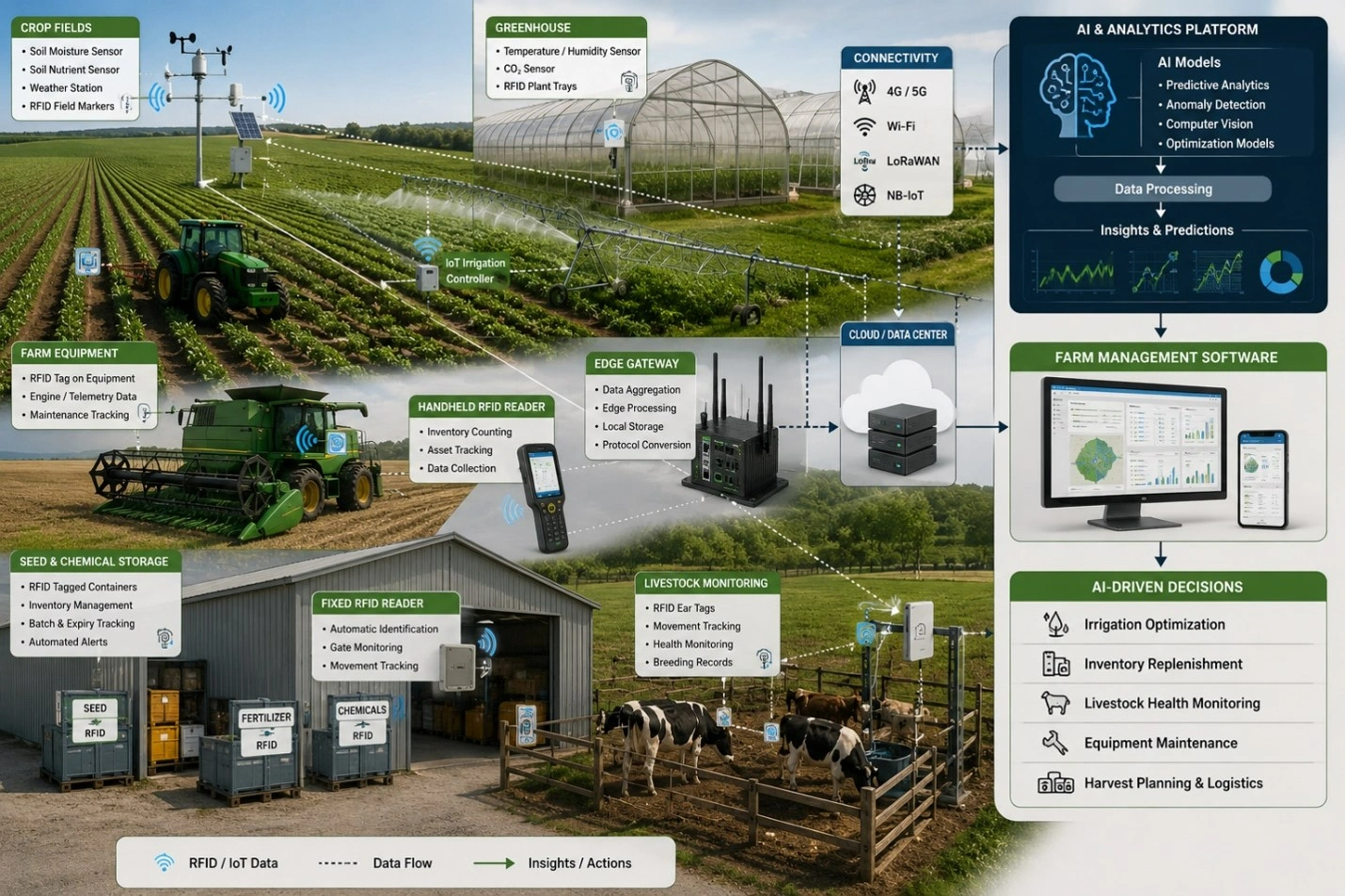
This visual illustrates how RFID tags, IoT sensors, edge computing, connectivity, and AI analytics work together across crop fields, greenhouses, farm equipment, agricultural storage, and livestock operations. The system converts real-time agricultural data into decisions for irrigation optimization, inventory replenishment, livestock monitoring, equipment maintenance, and harvest planning.
What AI and RFID Mean for Modern Precision Agriculture
AI in precision agriculture refers to machine learning, computer vision, predictive analytics, anomaly detection, optimization algorithms, and related AI methods used to improve agricultural decisions. These methods can process information from soil sensors, weather stations, drones, cameras, machinery, farm management systems, RFID readers, and historical production records.
RFID contributes a different type of information. It provides machine-readable identification and location or movement events for tagged physical objects. A seed container can be associated with a particular seed variety and lot. A chemical container can be linked to a product, batch, quantity, and storage location. A livestock RFID tag can associate an animal with its identification record. Farm equipment can be connected to maintenance and utilization records.
The value emerges when these identification events are correlated with other agricultural data.
For example:
- An RFID event can confirm that a particular seed lot entered a field operation.
- Soil sensors can provide moisture and nutrient measurements associated with that field.
- Weather data can provide temperature, rainfall, humidity, and forecast information.
- Computer vision can analyze crop imagery for visible disease, weed pressure, or growth anomalies.
- AI models can combine these data sources to identify patterns and recommend operational actions.
- Farm management software can record the resulting action and provide traceability for later analysis.
This creates a data chain connecting physical agricultural assets, field activities, environmental conditions, AI analysis, and management decisions.
Key Precision Agriculture Applications for AI-Enabled RFID Systems
Crop Input and Seed Lot Tracking
Seed management is a major application because seed varieties, lots, quantities, treatment information, and planting records affect crop traceability and production analysis. RFID-tagged containers can provide automatic identification when seed inventory moves through warehouses, loading areas, farm vehicles, or field operations.
AI can use these records together with planting dates, weather conditions, soil measurements, field history, and crop performance to support seed utilization analysis and planting decisions.
GAO RFID hardware can be incorporated into fixed points such as storage entrances or processing areas, while handheld RFID readers can support mobile field and warehouse operations.
Agricultural Inventory Management
Precision agriculture depends on the availability of inputs including:
- Seeds and seed treatments
- Fertilizers
- Crop protection chemicals
- Irrigation components
- Spare parts
- Animal feed
- Veterinary supplies
- Packaging materials
- Harvest containers
- Maintenance tools
RFID can automatically identify tagged inventory as it enters or leaves designated areas. AI can analyze historical consumption, seasonal demand, planting schedules, weather conditions, and operational requirements to improve replenishment planning.
A practical system can flag unusual consumption, identify frequently used supplies, predict potential shortages, and help managers coordinate inventory with upcoming field activities.
Farm Equipment Identification and Maintenance
Tractors, harvesters, sprayers, planters, irrigation equipment, trailers, implements, and specialized tools represent significant agricultural assets. RFID can associate physical equipment or components with digital maintenance records.
AI can combine RFID identification events with engine telemetry, operating hours, maintenance history, environmental conditions, and utilization patterns. This can support predictive maintenance and reduce the risk of equipment failure during time-sensitive operations such as planting and harvesting.
RFID should not replace machine telemetry where real-time equipment measurements are already available. Instead, it can provide reliable asset identity and movement information that complements telemetry systems.
Livestock Identification and Monitoring
LF RFID is particularly relevant to livestock identification because low-frequency animal identification systems are commonly designed for close-range identification applications. RFID events can associate an animal with feeding, veterinary, breeding, movement, and production records.
AI can analyze animal identification data alongside weight measurements, feeding patterns, environmental conditions, and other available sensor data to identify unusual behavior or changes that may require attention.
This approach is especially valuable where individual-animal traceability is necessary rather than relying only on herd-level records.
Harvest and Post-Harvest Traceability
Harvested crops may move through multiple stages, including collection, temporary storage, grading, processing, packaging, cold storage, and transportation. RFID can provide identification events for containers, pallets, bins, batches, and other reusable assets.
AI can analyze movement records and production information to identify delays, unusual handling patterns, inventory discrepancies, and process bottlenecks. Linking RFID records with batch and quality information also strengthens traceability from field operations toward downstream agricultural processing.
AI-Enabled Agricultural Asset and Inventory Tracking Workflow
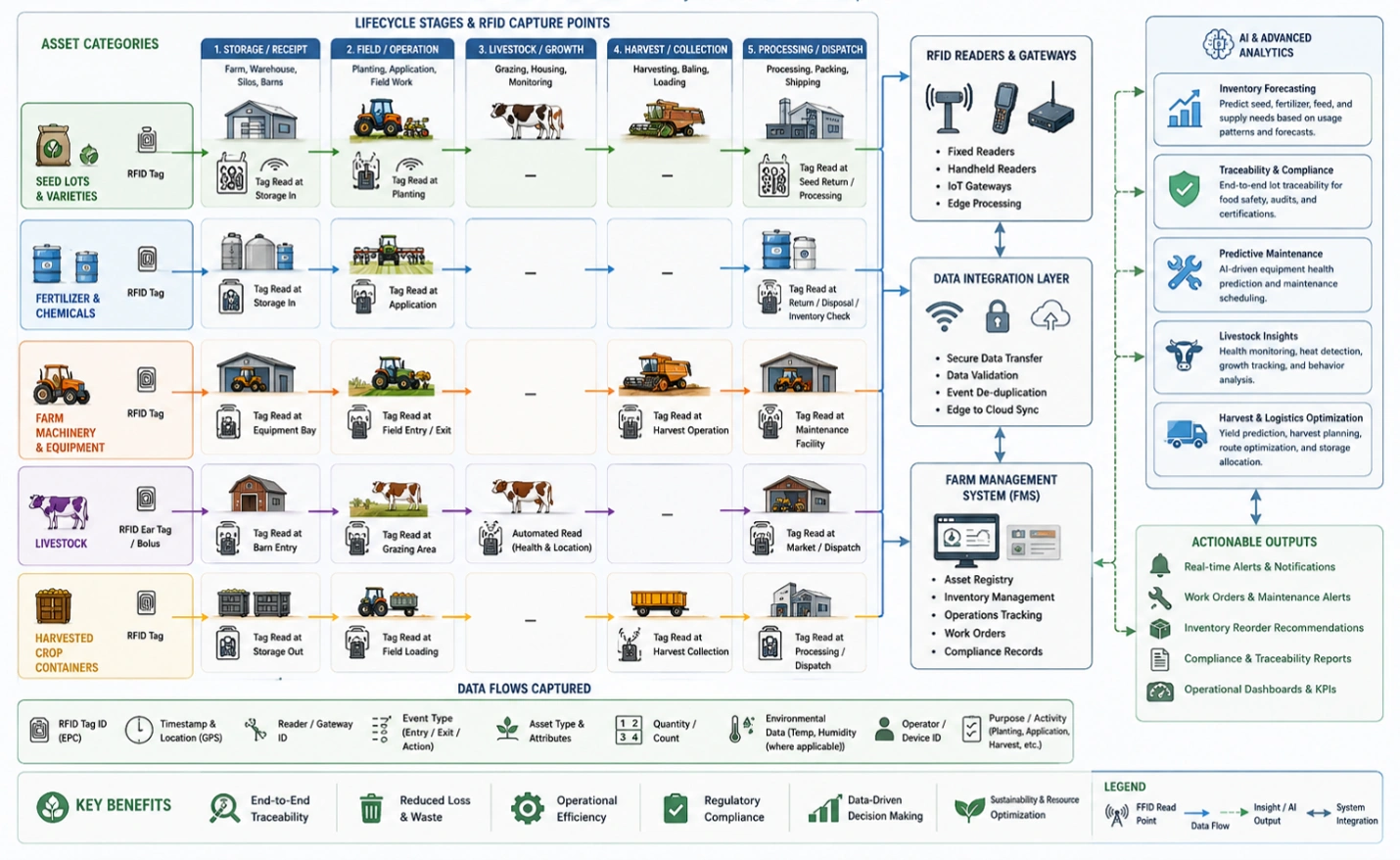
A professional precision-agriculture workflow showing how RFID tags and readers track seed lots, fertilizers, machinery, livestock, and harvested crop containers across storage, field, livestock, harvest, and processing stages. The captured data flows through integration and farm management systems into AI analytics for inventory forecasting, traceability, predictive maintenance, livestock insights, and harvest logistics optimization.
Precision Agriculture Operational Workflow from RFID Data to AI Decisions
A production-grade solution should be designed around the actual agricultural workflow rather than treating RFID as an isolated identification technology.
Data Acquisition
RFID readers capture tag identifiers when tagged objects pass through defined read zones. Depending on the application, the deployment may use fixed UHF readers, handheld UHF readers, HF readers, or LF livestock identification equipment.
Other data sources can include:
- Soil moisture and temperature sensors
- Weather stations
- Irrigation controllers
- Agricultural machinery telemetry
- GPS and positioning systems
- Drone imagery
- Satellite imagery
- Field cameras
- Livestock sensors
- Warehouse and cold-storage sensors
- Farm management records
Communication and Edge Processing
RFID readers and IoT devices transmit events through wired Ethernet, Wi-Fi, cellular networks, or other appropriate communication infrastructure. Edge computing can be used where connectivity is intermittent or where agricultural operations require local processing.
Edge software can filter duplicate RFID reads, normalize device messages, validate tag identifiers, associate events with locations, and temporarily store data during network outages.
This is important for farms distributed across large geographic areas. A field deployment should not assume continuous high-bandwidth connectivity to a remote cloud service.
AI Processing and Data Correlation
After data quality and identity validation, agricultural information can be stored in databases or farm management systems. AI models can then correlate RFID events with environmental, operational, and historical information.
Potential AI methods include:
- Time-series forecasting for agricultural inventory and resource demand
- Anomaly detection for unusual asset movement or consumption
- Predictive maintenance models for agricultural machinery
- Computer vision for crop and livestock observations
- Classification models for agricultural conditions
- Optimization algorithms for irrigation, field operations, and logistics
- Predictive models for yield and harvest planning
The AI output should be expressed as an actionable agricultural decision rather than simply a model score.
For example, instead of reporting that an anomaly probability is high, the system could identify an unusual consumption pattern for a particular fertilizer lot and request an inventory verification.
Business and Field Actions
AI-generated recommendations can be delivered to farm managers, agronomists, equipment supervisors, warehouse personnel, livestock operators, or other authorized users.
Actions may include:
- Replenishing a critical agricultural input
- Inspecting an equipment asset
- Verifying a seed or chemical lot
- Reviewing livestock activity
- Investigating an unexpected inventory movement
- Adjusting an irrigation schedule
- Prioritizing a harvesting activity
- Reviewing a cold-storage or transportation event
AI and RFID Data Flow for Precision Agriculture
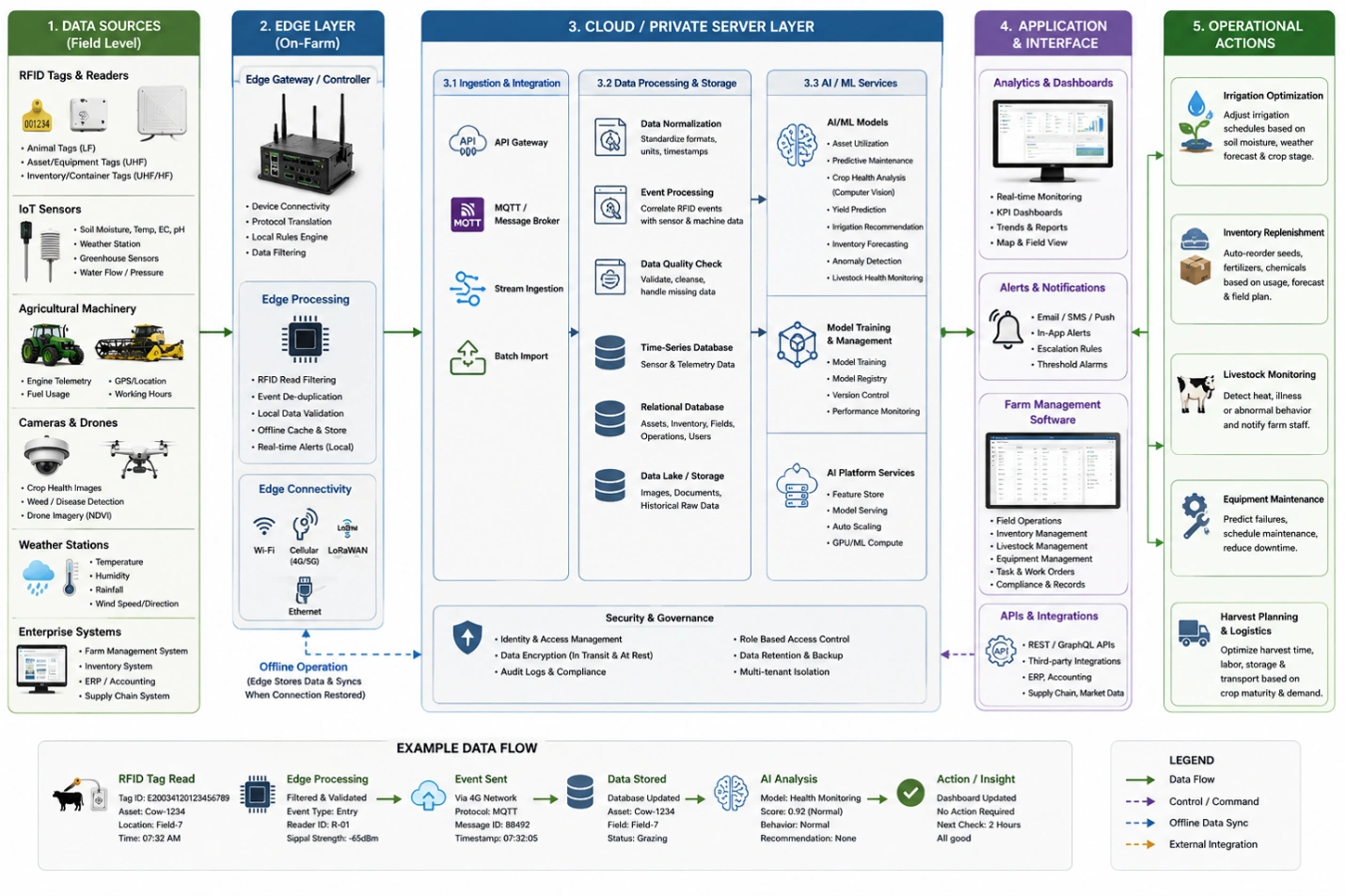
This diagram shows how RFID tags, IoT sensors, agricultural machinery, cameras, drones, and weather stations feed data into edge processing and cloud or private-server systems. AI/ML services analyze the data and deliver insights through farm management software, dashboards, alerts, and operational actions such as irrigation optimization, inventory replenishment, livestock monitoring, equipment maintenance, and harvest logistics.
RFID Hardware, AI Software, and Deployment Options for Precision Agriculture
A precision agriculture solution normally combines identification hardware, IoT connectivity, data-processing software, AI services, databases, and agricultural applications. The appropriate configuration depends on field size, environmental conditions, connectivity, data volume, security requirements, and whether operations require local decision-making.
RFID hardware may include fixed readers, handheld readers, antennas, RFID tags, and specialized livestock identification equipment. UHF RFID is useful for longer-range identification of tagged agricultural assets, while HF RFID supports shorter-range applications and LF RFID is particularly relevant to animal identification scenarios.
Edge computing provides a local processing point between field devices and centralized software. It can reduce unnecessary network traffic, perform RFID event filtering, maintain local operation during connectivity interruptions, and support time-sensitive agricultural workflows.
AI software can run on cloud infrastructure, private servers, or edge computing equipment depending on the computational requirements and data governance model. Computer vision workloads may require GPU resources, while simpler forecasting, classification, and anomaly-detection models may operate efficiently on CPU-based infrastructure.
Farm management software can provide the operational interface for crop planning, field records, inventory, equipment management, livestock records, and production reporting. APIs and middleware can connect RFID event data with these existing systems rather than forcing agricultural organizations to replace established software.
Real-World RFID and AIoT Deployment Across a Precision Farm
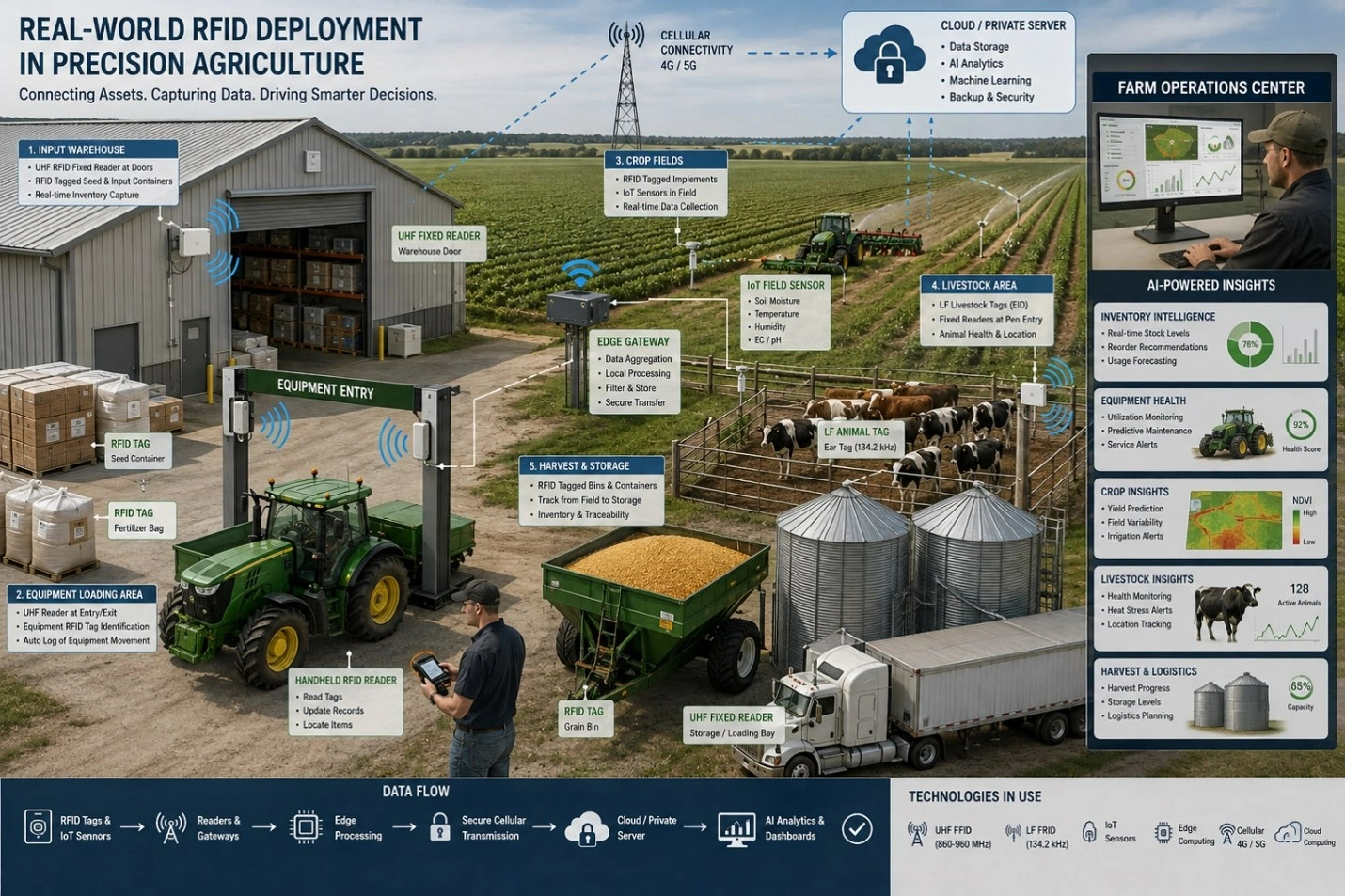
This visual depicts a commercial precision agriculture operation with RFID readers, tagged inputs and equipment, livestock identification, IoT field sensors, edge gateways, cellular connectivity, and cloud or private-server infrastructure. Farm data is transformed by AI analytics into actionable insights for inventory management, equipment health, crop monitoring, livestock management, and harvest logistics.
Cloud Version
A cloud-hosted deployment is appropriate when agricultural organizations need centralized access across multiple farms, warehouses, processing sites, or geographic regions. RFID and IoT events can be transmitted to cloud services where centralized databases, AI models, dashboards, APIs, and analytics are maintained.
Cloud deployment can simplify centralized software updates and provide scalable computing resources for large AI workloads. It also introduces dependency on network availability, cloud connectivity, data-transfer costs, and cloud security controls.
Server Version
A privately hosted server deployment can be appropriate where agricultural operations require greater control over data processing, connectivity, or system configuration. The server may operate at a farm facility, agricultural processing site, private data center, or other customer-managed location.
A server-based deployment can keep selected agricultural data within controlled infrastructure and can support local processing where wide-area connectivity is limited. However, the organization becomes more responsible for server maintenance, backups, software updates, monitoring, cybersecurity, and hardware capacity.
A hybrid approach can combine edge processing at farms with centralized private servers or cloud services. This can be useful when RFID event processing needs to continue locally while AI model training, historical analytics, or multi-site reporting occurs centrally.
Precision Agriculture RFID, AI and IoT Technology Stack
A production deployment combines identification hardware, agricultural sensing, communications, data processing, AI models, and operational software. Each layer should have a defined responsibility so that a failure in one component does not corrupt the entire decision process.
RFID Hardware for Agricultural Assets
UHF RFID is often the practical choice for agricultural equipment yards, warehouses, maintenance facilities, and staging areas because readers can identify multiple tagged assets without requiring a technician to scan every item individually. Ruggedized tags should be selected for tractors, implements, trailers, pumps, irrigation assemblies, tools, and reusable containers according to the mounting surface and environmental exposure.
HF RFID can support controlled short-range interactions, such as identifying an item at a workstation, while LF RFID can serve selected proximity-oriented applications. Frequency selection should be driven by the required read distance, asset construction, tag mounting location, reader density, interference environment, and transaction workflow.
Reader antennas require particular attention. A farm equipment doorway, for example, may require a read zone that captures an implement crossing the threshold without repeatedly detecting equipment parked several meters away. Antenna polarization, mounting height, orientation, reader transmit power, shielding, and software filtering should therefore be validated during commissioning.
Edge Computing and Agricultural Connectivity
An edge gateway can receive RFID events and sensor data, filter duplicate observations, temporarily buffer records, and forward validated events when connectivity is available. This is particularly useful for remote farms where cellular coverage or broadband connectivity may fluctuate.
The connectivity layer can include Ethernet, Wi-Fi, cellular networks, Bluetooth Low Energy, LPWAN technologies, and other field communications selected according to distance, power consumption, bandwidth, and availability requirements.
Edge processing is also useful when an agricultural operation cannot depend on continuous cloud connectivity. A local system can continue recording equipment movements and maintenance events and synchronize them later.
AI and Machine Learning
The appropriate AI method depends on the agricultural decision being addressed.
Time-series machine learning can analyze equipment telemetry, irrigation measurements, environmental conditions, and historical operating patterns.
Anomaly detection can identify unusual equipment movement, unexpected inventory consumption, abnormal sensor behavior, or deviations from normal operating conditions.
Predictive models can estimate equipment maintenance risk, input demand, or resource requirements.
Computer vision can evaluate crop imagery, equipment imagery, plant growth, weeds, disease indicators, and harvesting conditions.
Optimization algorithms can support equipment assignment, field scheduling, irrigation planning, maintenance prioritization, and resource allocation.
Generative AI can help summarize field events, maintenance records, exception reports, and operational data for managers, provided that generated recommendations remain grounded in validated source data.
Edge AI can process selected imagery or sensor data locally when latency, connectivity, bandwidth, or privacy requirements make centralized processing impractical.
AI should not be introduced simply because large quantities of data exist. A clearly defined agricultural decision, measurable KPI, adequate historical data, and an operational response should precede model development.
Integrating RFID Events with Agricultural Software
RFID should not become another isolated database. Its operational value increases when tag identity is connected with systems already responsible for agricultural planning and execution.
Relevant software can include:
- Farm management information systems
- GIS and field-mapping software
- Agricultural ERP systems
- Inventory and warehouse management software
- Computerized maintenance management systems
- Equipment telematics systems
- Fleet management software
- Irrigation management software
- Greenhouse management systems
- Laboratory and crop-quality systems
- Procurement and purchasing software
- Work-order management applications
- Data lakes and analytical databases
- Business intelligence software
- Weather and agronomic data services
Integration can use REST APIs, MQTT, message brokers, webhooks, database interfaces, file exchange, or manufacturer-specific telematics interfaces. The correct mechanism depends on the existing system and its supported interfaces.
A useful integration principle is to keep the RFID layer responsible for reliable physical identification and event generation while allowing the agricultural application to determine the business meaning of those events.
Cybersecurity and Data Integrity for Connected Agriculture
Connected agricultural equipment introduces cybersecurity considerations extending beyond conventional IT systems. A compromise of credentials, gateways, RFID middleware, telematics interfaces, or control systems can affect operational data and potentially physical processes.
Security controls should include:
- Unique identities for readers, gateways, servers, and users
- Role-based access for agronomists, mechanics, operators, warehouse staff, and administrators
- Encryption for data transmitted between field systems and servers
- Secure credential and certificate management
- Network segmentation between agricultural control equipment and general business systems
- Signed or controlled software updates
- Audit logging for asset, inventory, maintenance, and configuration changes
- Monitoring for abnormal device behavior
- Backup and recovery procedures
- Data validation before AI training or automated action
- Explicit authorization for AI recommendations that can trigger physical operations
RFID security should also be considered according to the application. Not every agricultural asset requires cryptographic tag capabilities, but higher-risk applications may justify stronger authentication or protected data exchange.
The broader cybersecurity program should align with established industrial cybersecurity practices. NIST’s Cybersecurity Framework and ISA/IEC 62443 principles can provide useful reference points when connected agricultural systems interact with operational technology.
Engineering Trade-Offs Before Deployment
A precision-agriculture RFID project should be tested under actual agricultural conditions rather than evaluated solely from laboratory specifications.
Important trade-offs include:
| Engineering consideration | Practical precision-agriculture implication |
|---|---|
| Read range | Longer range is useful for equipment movement but can increase unwanted reads |
| Tag durability | Outdoor equipment requires resistance to water, mud, vibration, chemicals, and temperature variation |
| Metal surfaces | Tractor frames and implements may require specialized on-metal tags |
| Reader placement | Poor antenna geometry can create missed reads or excessive read zones |
| Tag density | Warehouses and maintenance areas may require collision management and event filtering |
| Connectivity | Remote fields may require local buffering and delayed synchronization |
| Battery operation | Mobile sensors and BLE devices require careful power-budget analysis |
| AI latency | Real-time equipment or safety decisions may require edge processing |
| Data volume | Continuous imagery and telemetry can make centralized transmission expensive |
| Integration | Existing farm software may impose API, data-model, or vendor-specific constraints |
| Seasonal demand | Systems must accommodate significant changes in equipment and labor utilization |
| Environmental exposure | Outdoor hardware requires appropriate IP ratings and mechanical protection |
A pilot should represent the hardest operational conditions, not the easiest. Testing a reader in a clean warehouse does not demonstrate that the same reader will reliably identify a muddy implement moving through an outdoor equipment yard.
Measuring AI-Driven RFID Performance in Precision Agriculture
Performance should be measured against agricultural outcomes rather than RFID read counts alone.
Useful KPIs include:
- Asset identification accuracy
- RFID read success rate
- False-read rate
- Duplicate-event rate
- Equipment search time
- Equipment utilization
- Equipment idle time
- Preventive-maintenance compliance
- Unplanned equipment downtime
- Mean time to repair
- Spare-parts availability
- Inventory accuracy
- Input reconciliation accuracy
- Material consumption variance
- Irrigation equipment availability
- Irrigation fault detection time
- Field-operation schedule adherence
- Equipment dispatch time
- Labor hours spent locating assets
- AI anomaly-detection precision
- AI false-positive rate
- Predictive-maintenance accuracy
- Forecast error
- AI recommendation acceptance rate
- Time from detection to corrective action
- Network availability
- Edge synchronization success rate
- Data completeness
- Model drift
- Return on operational investment
For example, an agricultural equipment tracking project should not be judged solely by the percentage of RFID tags detected. The more meaningful measurement may be the reduction in time required to locate a planter before a planting window, the decrease in duplicate equipment purchases, or the reduction in maintenance delays.
Similarly, predictive maintenance should be evaluated against actual downtime, inspection efficiency, false alarms, maintenance costs, and equipment availability rather than model accuracy in isolation.
A Practical Implementation Path for Precision Agriculture
A phased deployment generally reduces technical and operational risk.
Define the decision: Identify the agricultural problem, such as equipment availability, maintenance readiness, inventory accuracy, or irrigation-equipment reliability.
Map the workflow: Document how assets, materials, operators, machines, and records move through the actual farm operation.
Establish identities: Create authoritative identifiers for equipment, implements, materials, locations, fields, and relevant maintenance objects.
Select RFID hardware: Evaluate UHF, HF, or LF according to physical operating requirements rather than applying one RFID type universally.
Conduct a site survey: Test reader placement, antenna orientation, tag mounting, interference, network coverage, power availability, and environmental exposure.
Integrate source systems: Connect RFID events with GIS, farm management, maintenance, inventory, telematics, or other relevant applications.
Implement event processing: Deduplicate reads, validate transitions, timestamp events, and handle offline synchronization.
Establish the data foundation: Normalize identifiers and historical records before developing AI models.
Pilot AI use cases: Start with a measurable problem such as anomaly detection, maintenance prioritization, inventory forecasting, or equipment allocation.
Validate against field operations: Compare AI recommendations with agronomist, farm manager, mechanic, and operator decisions.
Commission the complete workflow: Test detection, communications, processing, AI inference, software integration, alerts, and resulting business actions.
Monitor continuously: Track RFID performance, data quality, AI model drift, cybersecurity events, and operational KPIs.
Scale selectively: Extend the system to additional farms, equipment classes, warehouses, irrigation zones, greenhouses, or crop operations only after the initial workflow is stable.
GAO can support organizations at the hardware and system level by supplying RFID, BLE, and IoT products and by providing technical support remotely or onsite. GAO’s sister companies, GAO Research and GAO Tek, form the broader GAO Group, with operations based in New York City and Toronto, Canada. The group has served U.S. and Canadian customers for three decades, including Fortune 500 companies, leading R&D organizations, universities, and government agencies, supported by substantial product and systems R&D and stringent quality-assurance processes.
Advancing Reliable AI and RFID Foundation for Precision Agriculture
AI-driven precision agriculture works best when technology deployment begins with operational discipline. Farms should establish authoritative asset identities, reliable field and equipment data, appropriate RFID installation practices, robust communications, secure integration, and measurable business processes before scaling sophisticated AI models.
The practical starting point is usually a high-value operational problem: locating critical equipment, maintaining machinery before seasonal demand peaks, reconciling agricultural inputs, managing irrigation equipment, or connecting physical assets with field records. Once the data is trustworthy, AI can progressively support prediction, anomaly detection, optimization, and decision assistance.
GAO provides RFID, BLE, and IoT hardware products and systems that can serve as part of this connected agricultural infrastructure, with engineering support for organizations evaluating appropriate components, deployment configurations, and system requirements. Organizations planning precision-agriculture deployments can learn more about GAO’s technical capabilities, products, and support resources through GAO.
Building the Future of Industrial AI and IoT with Aperture Venture Studio and GAO RFID Inc.
For more than three decades, GAO Group of Companies has invested heavily in R&D for industrial RFID, BLE, and IoT. As generative AI became increasingly useful for industrial applications, we expanded our work across AI and IoT technologies, including RFID and BLE, and founded Aperture Venture Studio to advance practical AI and IoT solutions for applications such as precision agriculture. Aperture brings together AI and IoT technical experts, entrepreneurial and operational executives, investors, and leading companies. We have also developed the Aperture Ventures Summit and TekSummit to examine advanced AI and IoT topics. We welcome you to participate as advisors, co-founders or employees, investors, or customers.