
AI and RFID for Rail Freight
AI and RFID for Rail Freight Operations
How AI and RFID Improve Rail Freight Visibility and Decision-Making
AI for rail freight uses operational data to improve railcar visibility, yard throughput, asset utilization, maintenance planning, cargo verification, and network performance. RFID supports these AI applications by providing identifiable, time-stamped events when railcars, locomotives, containers, intermodal equipment, or maintenance assets pass known locations such as yard entrances, classification tracks, inspection points, loading terminals, and repair facilities.
For rail freight operators, the value is not simply knowing where an asset was last detected. AI can combine RFID events with GPS, wayside detector data, positive train control-related operational information where available, maintenance records, train consists, terminal management data, and transportation management systems to identify dwell-time anomalies, predict congestion, detect missing assets, and prioritize operational actions.
This combination is increasingly important as rail networks manage large fleets, long asset cycles, complex interchange operations, and constrained terminal capacity. GAO has helped organizations source and deploy RFID and IoT hardware products and systems that provide the physical data layer required for rail freight visibility and AI-driven operational improvement.
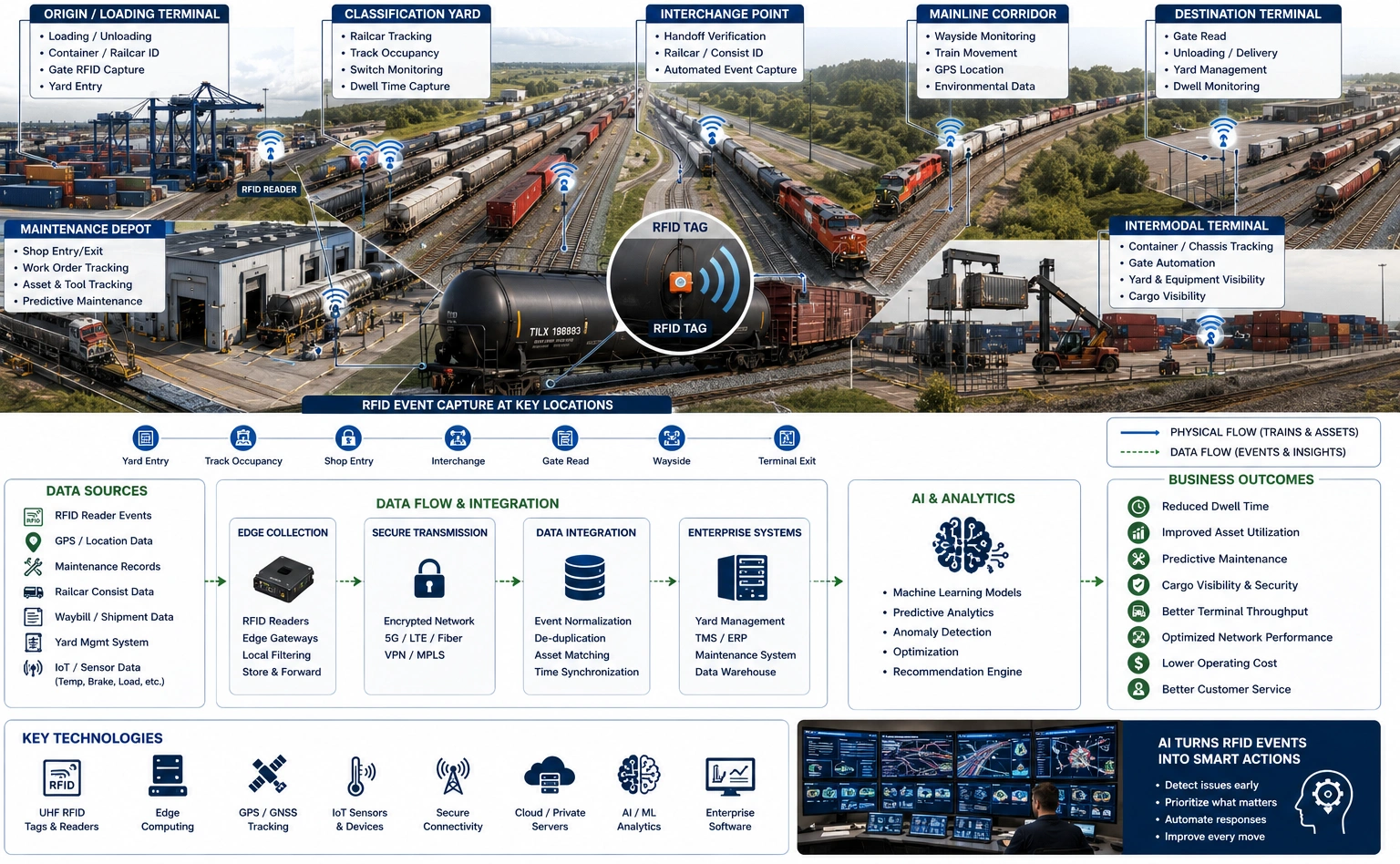
AI-Enabled Rail Freight Operations & Asset Intelligence Diagram
A professional technical infographic illustrating how AI-enabled rail freight operations use RFID events, GPS, maintenance records, railcar data, and enterprise systems to improve asset visibility, reduce dwell time, optimize terminal throughput, support predictive maintenance, and strengthen network performance.
Understanding AI-Enabled Rail Freight and RFID Data Capture
Rail freight is a highly event-driven operating environment. A single loaded railcar may move through an origin terminal, classification yard, mainline corridor, interchange location, destination terminal, unloading facility, and maintenance area before its next assignment. Each movement can create operational events that affect service reliability, asset availability, demurrage exposure, crew planning, and terminal capacity.
RFID provides a structured method for associating a physical identity with a rail freight asset. Depending on the deployment objective, tags may identify:
- Freight railcars and railcar classes
- Locomotives and selected mobile equipment
- Intermodal containers and chassis
- Tank cars and specialized cargo equipment
- Maintenance tools and mobile workshop assets
- Seal or cargo-security devices
- Employee credentials for controlled-access areas
AI converts these and other operational events into predictions, classifications, recommendations, and automated actions. Machine learning models can analyze historical dwell patterns, detect unusual railcar movements, forecast terminal congestion, estimate asset availability, or identify maintenance conditions associated with future failures.
The relationship between AI and RFID is therefore practical rather than theoretical. RFID contributes reliable physical-event data at selected read points, while AI evaluates those events alongside broader rail operating information.
Why Rail Freight Operations Require More Than Location Tracking
GPS is valuable for many rail assets, but it does not replace fixed identification events. GPS may provide approximate or periodic location information, while RFID can confirm that a specifically identified asset passed a defined physical point such as a yard gate, shop entrance, loading track, or inspection lane.
For example, a railcar entering a repair facility can generate an RFID event that is automatically compared with its maintenance status, defect history, and work order. AI can then prioritize the car according to safety, repair urgency, expected shop duration, and downstream operational requirements.
This distinction is important for rail freight operations because many decisions depend on verified events rather than estimated positions.
Rail Freight Applications and Operational Challenges
AI applications supported by RFID data are most valuable where rail operations involve repeated asset movements, constrained infrastructure, complex handoffs, or high consequences from delayed information.
AI Railcar Tracking and Asset Visibility
Railcar fleets can spend significant time waiting for interchange, classification, loading, unloading, inspection, or maintenance. AI-assisted railcar tracking combines RFID read events with train consists, waybill information, GPS, yard events, and historical movement patterns.
Relevant use cases include:
- Railcar location confirmation at key terminals
- Empty and loaded railcar visibility
- Interchange handoff verification
- Railcar dwell-time monitoring
- Missing or unexpected asset detection
- Fleet utilization analysis
- Assignment forecasting
A practical engineering consideration is reader placement. Installing readers at every track is often unnecessary and may produce excessive infrastructure costs. High-value deployments usually begin with operational choke points where a confirmed read changes a decision, such as arrival gates, classification zones, shop entrances, loading tracks, and interchange boundaries.
AI Yard Management and Classification Optimization
Classification yards and rail terminals must coordinate arrivals, departures, switching activities, track occupancy, locomotive assignments, inspections, and cargo handling. AI can analyze movement patterns to identify bottlenecks and recommend sequencing decisions.
RFID events can support:
- Railcar arrival confirmation
- Track-entry and track-exit events
- Maintenance-area access monitoring
- Equipment identification
- Loading and unloading status verification
Supporting data may include yard management system records, switch schedules, train manifests, locomotive availability, weather data, track occupancy information, and historical dwell records.
AI methods can include time-series forecasting, anomaly detection, optimization algorithms, and graph-based analysis of rail network dependencies.
RFID & AI-Driven Rail Asset Workflow Diagram
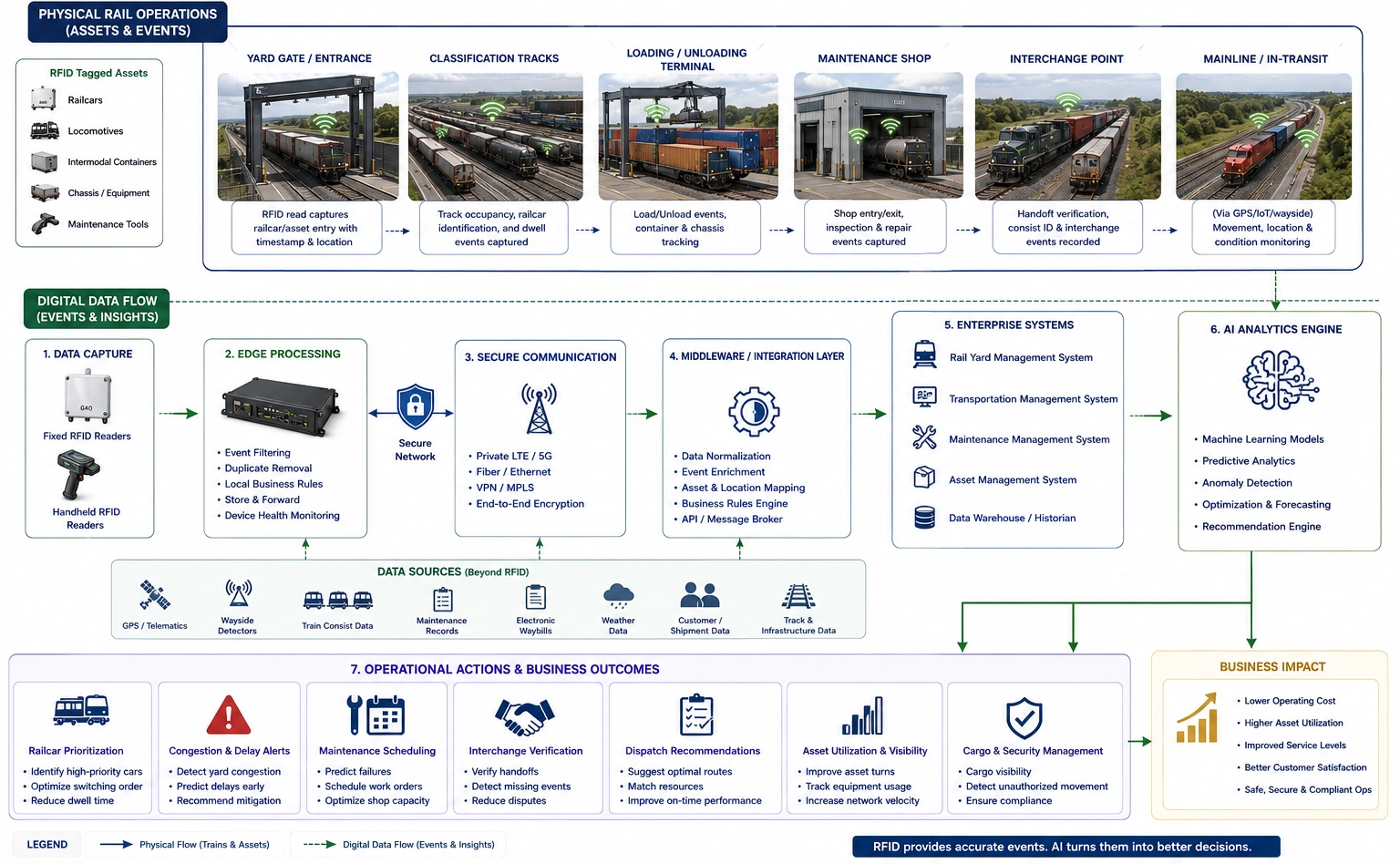
This workflow diagram illustrates how RFID-tagged rail assets generate operational data that flows through edge processing, secure communications, enterprise software, and AI analytics to improve railcar prioritization, congestion management, maintenance scheduling, interchange verification, and dispatch decisions.
Cargo Verification and Intermodal Operations
Rail freight operations frequently involve multiple custody transitions between terminals, rail operators, ports, warehouses, and customers. AI can evaluate RFID and related event histories to identify missing scans, unexpected route sequences, delayed containers, or inconsistencies between physical movement and shipment records.
For intermodal freight, relevant assets may include:
- Containers
- Rail-mounted or terminal-handling equipment
- Chassis
- Railcars
- Cargo seals
- High-value freight units
The supporting software commonly includes transportation management systems, warehouse management systems, terminal operating systems, electronic waybill systems, and cargo-tracking applications.
Predictive Maintenance for Rail Assets
Maintenance planning is another important application because railcar and locomotive availability directly affects network capacity. AI can analyze RFID-confirmed shop entry events together with inspection records, work orders, vibration data, temperature data, brake-system information, wheel-condition measurements, and historical repairs.
Potential outcomes include:
- Earlier identification of recurring failure patterns
- Better prioritization of maintenance work
- Reduced unplanned asset downtime
- Improved spare-parts planning
- More accurate maintenance-shop capacity forecasting
RFID should not be treated as a substitute for condition-monitoring sensors. Its primary role in this use case is to provide dependable asset identity and workflow events that connect sensor data and maintenance records to the correct rail asset.
From Rail RFID Events to AI-Driven Operational Decisions
An effective rail freight solution follows a data chain from physical identification to operational action. The implementation should be designed around decisions that need better information rather than around the technology alone.
Data Acquisition at Rail Freight Read Points
The process begins with asset identification. UHF RFID is commonly considered where longer read ranges and non-line-of-sight identification are operationally appropriate, although the final technology selection depends on metal environments, mounting locations, required read distance, train speed, environmental exposure, and regional frequency regulations.
Typical read points include:
- Yard entrances and exits
- Interchange boundaries
- Classification tracks
- Loading and unloading areas
- Maintenance-shop entrances
- Inspection lanes
- Intermodal terminal gates
- Controlled-access areas
A site survey should evaluate antenna polarization, read-zone geometry, metal reflections, multipath effects, tag orientation, reader mounting height, cable routing, power availability, and the possibility of unintended reads from adjacent tracks.
Communication and Edge Processing
Reader events are usually transmitted over Ethernet, Wi-Fi, cellular, private LTE, or other approved rail communications. Edge processing can filter duplicate reads, validate timestamps, apply local business rules, and retain events during temporary network outages.
This is particularly useful in large rail yards and remote freight terminals where continuous connectivity cannot always be assumed.
Edge systems can perform functions such as:
- Reader health monitoring
- Event filtering and aggregation
- Local asset lookup
- Store-and-forward buffering
- Device authentication
- Preliminary anomaly detection
Middleware and Rail Software Integration
Middleware converts device-level events into records that operational software can understand. A railcar read event may be enriched with train identification, waybill data, cargo status, maintenance history, and terminal location before being delivered to downstream systems.
Integration may involve:
- Rail yard management software
- Transportation management systems
- Fleet management software
- Maintenance management systems
- Computerized maintenance management systems
- Warehouse and terminal systems
- Data warehouses and operational databases
- Business intelligence software
API-based integration is generally preferable where supported because it enables near-real-time event exchange and clearer error handling. Legacy rail systems may require database connectors, message queues, flat-file exchange, or integration middleware.
Rail Freight RFID, AI, Software, and Deployment Components
A complete AI-enabled rail freight solution includes several coordinated technical components. Hardware selection should follow the operating environment and use case, especially because rail yards expose equipment to vibration, temperature variation, dust, moisture, electromagnetic interference, and long cable runs.
RFID hardware can include fixed readers, directional or circularly polarized antennas, ruggedized tags, handheld readers, edge gateways, industrial enclosures, and power or network protection equipment. GAO supplies RFID and IoT hardware products and systems that can be evaluated against rail freight read-range, environmental, integration, and deployment requirements.
AI software may use supervised machine learning for delay prediction, unsupervised learning for anomaly detection, time-series models for terminal forecasting, optimization methods for asset allocation, computer vision where visual inspection is required, and rules engines for deterministic operational controls.
Security mechanisms should include device authentication, encrypted communications, role-based access control, network segmentation, audit logging, secure credential management, and controlled software updates. Reader and gateway systems should be treated as managed operational technology endpoints rather than isolated devices.
Cloud Version for Multi-Terminal Rail Freight Operations
A Cloud Version is appropriate when rail operators need centralized visibility across multiple yards, terminals, maintenance facilities, or interchange locations. Cloud-hosted software can simplify cross-site analytics, centralized model management, historical data retention, and remote support.
This model is often useful for:
- Multi-terminal railcar tracking
- Fleet-wide performance analysis
- Centralized AI model deployment
- Long-term dwell-time analysis
- Network-level capacity forecasting
Reliable connectivity and clear data-governance requirements remain important considerations.
Server Version for Controlled Rail Environments
A Server Version places software on customer-managed edge servers, private data centers, or other privately hosted infrastructure. This approach can support local processing requirements, restricted network environments, lower-latency decisions, or organizational policies requiring greater control over operational data.
A Server Version can be particularly suitable for:
- Major classification yards
- Security-sensitive freight facilities
- Remote terminals with intermittent connectivity
- Maintenance depots requiring local data processing
Hybrid deployments can combine local event processing with centralized analytics. In practice, this approach often provides a balanced model for geographically distributed rail freight operations because critical identification events can continue locally while historical analysis is consolidated across the network.
Engineering Integration Considerations for Rail Freight Systems
Successful rail RFID and AI projects require commissioning and integration discipline. The most common implementation mistake is measuring read accuracy only during a controlled demonstration rather than during real train movements, switching operations, adverse weather, and peak terminal activity.
Testing should include tag readability across different railcar types, reader performance during simultaneous movements, duplicate-event behavior, missed-read recovery procedures, network interruption handling, and integration latency.
GAO’s broader technical experience includes supplying hardware products and systems to organizations across the United States and Canada, where engineering support, quality assurance, and deployment requirements can vary significantly by operating environment.
Practical Rail Freight Deployment Lessons
- Start with a limited operational objective that has measurable baseline data.
- Select read points based on decisions and workflows, not simply physical coverage.
- Test tags on representative railcar materials and mounting configurations.
- Design for temporary communications outages and event buffering.
- Define ownership for reader maintenance, tag replacement, and data-quality review.
- Validate AI recommendations against experienced yard, maintenance, and operations personnel.
- Expand only after demonstrating measurable improvement in dwell time, utilization, throughput, maintenance performance, or another defined rail KPI.
AI Applications for Rail Freight Operations
AI applications should begin with a clearly defined rail freight problem rather than a technology-first deployment. The highest-value use cases typically address railcar dwell, terminal congestion, asset availability, maintenance delays, cargo exceptions, or security risks. RFID acts as one of several physical data sources that can provide verified asset and workflow events.
AI Railcar Dwell-Time and Delay Analysis
Railcar dwell is influenced by interchange delays, track congestion, loading capacity, mechanical inspections, switching priorities, crew availability, and customer readiness. AI models can analyze historical RFID events, arrival times, train consists, waybill status, terminal activity, and operational exceptions to identify unusual dwell patterns.
The system can support:
- Expected dwell-time forecasting
- Identification of railcars approaching operational thresholds
- Root-cause analysis of recurring delays
- Prioritization of railcars requiring intervention
- Terminal and customer performance comparisons
RFID events are particularly useful when they establish verified timestamps at arrival, classification, loading, maintenance, or departure points. These events provide a stronger operational record than manually entered timestamps alone.
AI Rail Yard Congestion and Capacity Management
Rail yards operate as interconnected systems in which delays on one track, loading area, or maintenance zone can affect downstream movements. AI optimization can evaluate track occupancy, planned arrivals, railcar priorities, switching requirements, locomotive availability, and historical throughput.
Potential recommendations include:
- Reprioritizing railcar movements
- Identifying emerging classification bottlenecks
- Forecasting track-capacity constraints
- Adjusting sequencing for loading and unloading
- Allocating equipment to high-priority movements
The engineering challenge is data synchronization. AI recommendations are only useful when the system receives sufficiently current information from operational systems and verified physical events.
AI Interchange and Handoff Verification
Interchange operations involve transfers of responsibility and physical custody between rail operators, terminals, ports, or other transportation organizations. Missing or delayed information can create disputes, inefficient asset searches, and inaccurate dwell calculations.
AI can compare expected movement sequences with actual RFID events and identify:
- Assets that have not appeared at an expected handoff point
- Unexpected railcar sequences
- Delayed interchange processing
- Possible data discrepancies between physical and software records
- Exceptions requiring manual investigation
This use case is particularly valuable when combined with electronic waybill information, train consist records, customer shipment data, and terminal operating records.
AI Maintenance Management and Asset Health
Rail freight maintenance involves locomotives, freight railcars, braking systems, wheelsets, couplers, bearings, doors, specialized cargo equipment, and workshop tools. AI can improve maintenance prioritization by combining condition data with operational context.
Relevant inputs can include:
- RFID-confirmed maintenance workflow events
- Work orders
- Inspection records
- Wayside detector events
- Temperature and vibration measurements
- Historical failure records
- Parts usage
- Asset utilization history
Machine learning can estimate failure probability or identify patterns associated with repeated defects. Optimization software can also help maintenance managers balance repair urgency, shop capacity, parts availability, and expected return-to-service requirements.
A practical limitation should be recognized: predictive models require sufficient historical data quality. During early deployments, rule-based alerts and descriptive analytics may provide more reliable value than attempting to deploy complex predictive models immediately.
AI Cargo Tracking and Shipment Exception Management
Rail freight customers often require better visibility into shipment milestones, particularly for intermodal containers, hazardous materials, high-value cargo, and time-sensitive commodities.
AI can identify potential shipment exceptions by analyzing:
- Expected versus actual movement sequences
- RFID and gate events
- GPS and telematics data
- Waybill milestones
- Terminal dwell
- Historical route performance
- Weather and disruption information
The result can be an operational priority queue rather than an overwhelming stream of alerts. AI should rank exceptions according to likely business impact, allowing dispatchers and customer-service teams to focus on the shipments requiring action.
AI Asset Security and Unauthorized Movement Detection
Rail yards contain valuable equipment and cargo that may remain unattended for extended periods. RFID-supported security systems can establish expected asset locations and movement patterns.
AI-based anomaly detection can identify:
- Unexpected railcar movement
- Asset presence in restricted areas
- Missing security events
- Unusual maintenance-equipment movement
- Repeated access anomalies
- Activity outside normal operating schedules
Security decisions should remain connected to physical procedures. A digital anomaly does not automatically prove unauthorized activity, so alerts should support investigation through access records, cameras, operational logs, and authorized personnel.
Technical and Business Value of AI-Enabled Rail Freight
Combining AI with verified physical-event data can improve rail freight operations because decisions are based on a more accurate representation of asset movement and workflow status.
Improved Railcar Utilization
AI can identify railcars spending excessive time in low-value states, including avoidable waiting, unnecessary repositioning, or delayed release. Better visibility into these states supports improved assignment and fleet planning.
Reduced Terminal and Interchange Delays
Delay prediction allows operations teams to act before a dwell threshold is exceeded. The improvement comes from earlier prioritization rather than from the prediction itself.
Better Maintenance Planning
Maintenance teams can associate asset identity, inspection history, shop events, and condition information more consistently. This improves work prioritization and reduces the risk that operationally critical assets remain unavailable longer than necessary.
Stronger Data Quality
Physical identification events can reduce dependence on manual status updates. Data quality improves when timestamps and asset identities are captured automatically at meaningful workflow points.
Scalable Multi-Terminal Visibility
Once data models, integration methods, cybersecurity controls, and operational procedures are standardized, the solution can be extended from a pilot yard to additional terminals. Expansion should still account for local differences in track layouts, communications, workflows, and equipment.
Security and Compliance Improvements
Rail freight systems can improve accountability by recording asset movements, reader activity, user actions, and security exceptions. Audit logs and controlled access help support investigations and operational governance.
Business benefits should be evaluated against the cost of infrastructure, integration, ongoing maintenance, tag replacement, communications, and operational change management. Not every rail movement requires an RFID read point. A focused design generally provides a better return than attempting to instrument every possible location.
RFID Deployment, Cybersecurity, and Reliability in Rail Freight
Rail environments require attention to cybersecurity and physical reliability from the initial design stage. Readers, gateways, servers, and connected sensors can become entry points into operational networks if they are not properly managed.
Recommended controls include:
- Separate operational device networks from general business networks where appropriate.
- Encrypt communications between readers, gateways, servers, and cloud services.
- Use unique device identities and strong credential management.
- Apply role-based access controls.
- Maintain audit records for administrative actions.
- Establish approved firmware and software update procedures.
- Monitor reader, gateway, and communication health.
- Restrict remote administration to authorized personnel.
- Test backup and recovery procedures.
- Define incident-response responsibilities before production deployment.
Environmental reliability also matters. Equipment selection should consider temperature, moisture, dust, vibration, electrical protection, enclosure ratings, and maintenance accessibility.
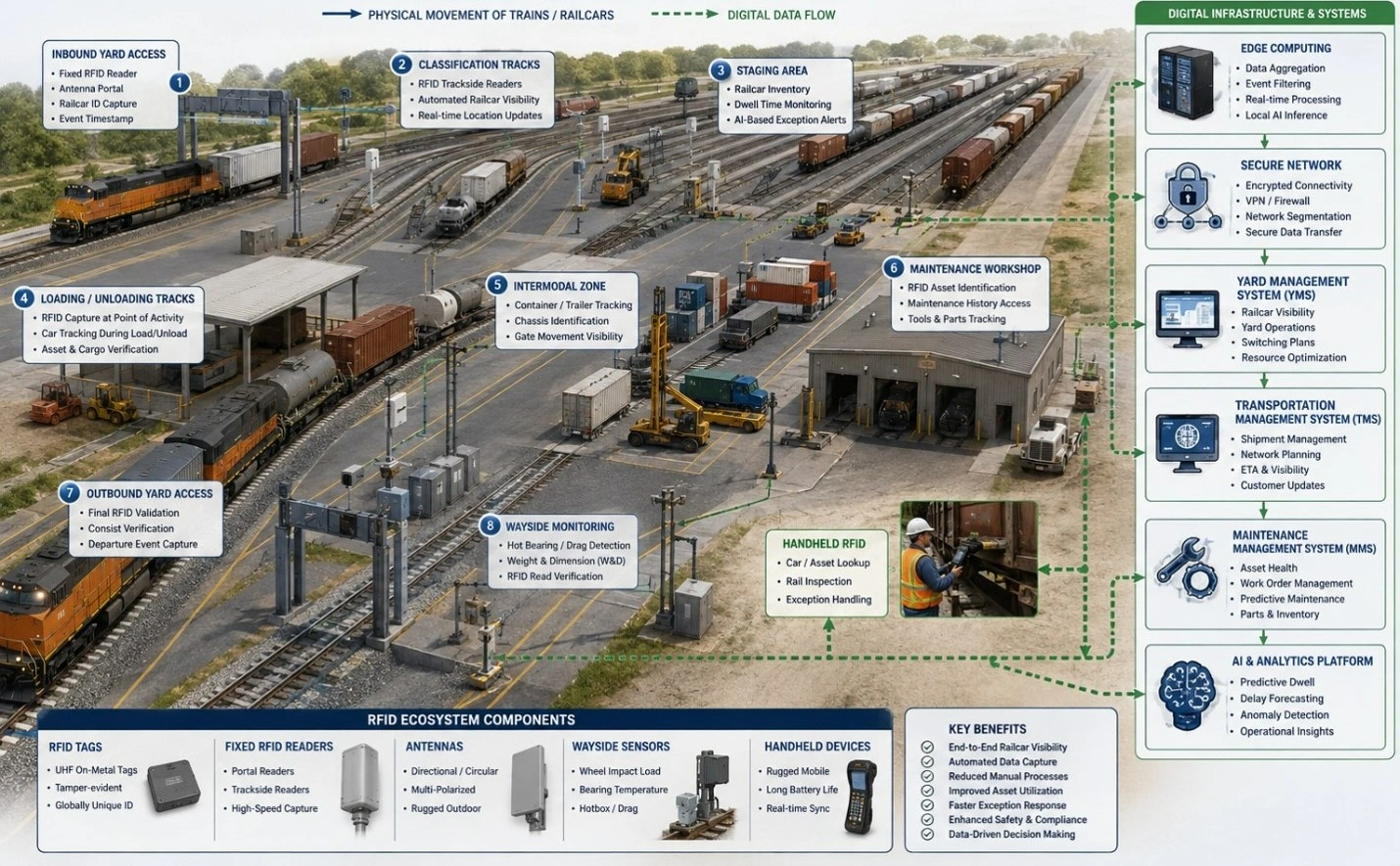
AI-Enabled RFID Solution for Rail Freight Operations Diagram
A comprehensive rail yard operations diagram illustrating physical deployment zones and digital integration. It maps RFID portals, trackside sensors, and handheld readers across eight operational zones—including inbound tracks, classification yards, intermodal hubs, and maintenance workshops—and traces data through edge computing and secure networks into YMS, TMS, and AI analytics.
Recommended Implementation Approach for AI and RFID in Rail Freight
A disciplined implementation reduces technical and operational risk.
Define the Operational Decision
Begin by identifying the decision that currently lacks reliable information. Examples include railcar prioritization, dwell-time intervention, interchange verification, maintenance scheduling, or terminal congestion management.
Select the Pilot Scope
A pilot should be operationally meaningful but limited enough to troubleshoot effectively. Suitable scopes can include one terminal entrance, a maintenance workflow, selected classification tracks, an interchange process, or a defined railcar fleet segment.
Complete the Site Survey and Hardware Design
Evaluate read zones, track geometry, train speed, metal interference, antenna placement, power, communications, environmental conditions, and maintenance access.
Integrate Before Scaling
Validate event formats, timestamps, asset identifiers, error handling, and reconciliation procedures with the relevant rail software before adding additional locations.
Test Under Real Operating Conditions
Commissioning should include representative railcar types, normal and peak traffic, adverse environmental conditions where possible, temporary network loss, simultaneous reads, and operational exceptions.
Establish the AI Baseline
Collect enough reliable historical data to establish current dwell, throughput, maintenance, or utilization performance. Compare AI recommendations against actual outcomes before allowing high levels of automation.
Optimize and Expand
Expansion should follow demonstrated KPI improvement. Standardized device configurations, integration templates, cybersecurity policies, and maintenance procedures can reduce the effort required to add new terminals.
Key Takeaways for Rail Freight Decision-Makers
AI and RFID for rail freight deliver the greatest value when the solution is designed around measurable operational decisions. RFID can provide verified railcar and asset events at critical workflow points, while AI can identify patterns, predict exceptions, prioritize work, and support better allocation of constrained rail resources.
Successful projects require more than readers and tags. Rail operators should plan for site surveys, integration, edge processing, cybersecurity, commissioning, data governance, operational ownership, and KPI validation. GAO, headquartered in New York City and Toronto, has supported customers with RFID, BLE, and IoT technologies through hardware products, systems, technical expertise, stringent quality processes, and remote or onsite support.
For organizations evaluating railcar visibility, yard automation, maintenance intelligence, or AI-driven terminal optimization, GAO can help assess the appropriate technology and deployment approach for specific rail freight requirements.
Building the Future of Industrial AI and IoT with Aperture Venture Studio and GAO RFID Inc.
For more than three decades, GAO has invested heavily in R&D for industrial RFID, BLE, and IoT. As AI became increasingly useful in industrial applications, we expanded our work in AI and IoT technologies, including RFID and BLE, and founded Aperture Venture Studio to develop AI and IoT solutions relevant to applications such as intelligent container tracking.
Aperture has attracted AI and IoT technical experts, entrepreneurial and operational executives, investors, and leading companies. We have also developed Aperture Ventures Summit and TekSummit to explore advanced AI and IoT topics.
We welcome you to participate as:
- Advisors, Co-founders, or Employees
- Investors
- Customers