
AI and RFID for Rail Yards
AI-Driven Rail Yard Operations with RFID Asset Visibility
Rail yards coordinate railcars, locomotives, containers, maintenance equipment, spare parts, track assets, and personnel across large outdoor operating areas where asset location and status can change continuously. AI-driven rail yard management uses data from RFID identification, yard management systems, locomotive and railcar telemetry, inspection records, cameras, and operational databases to improve visibility and decision-making. RFID provides machine-readable identification for tagged assets, while AI analyzes movement patterns, dwell times, maintenance information, inventory conditions, and operational events. The resulting system can support railcar tracking, automated inventory reconciliation, predictive maintenance, yard congestion analysis, exception detection, and more informed dispatching decisions. GAO supplies RFID, BLE, and IoT hardware products and systems that can serve as data-capture components within these rail-yard solutions, helping organizations connect physical assets with software-based operational analysis.
AI-Enabled Rail Yard Operations Overview
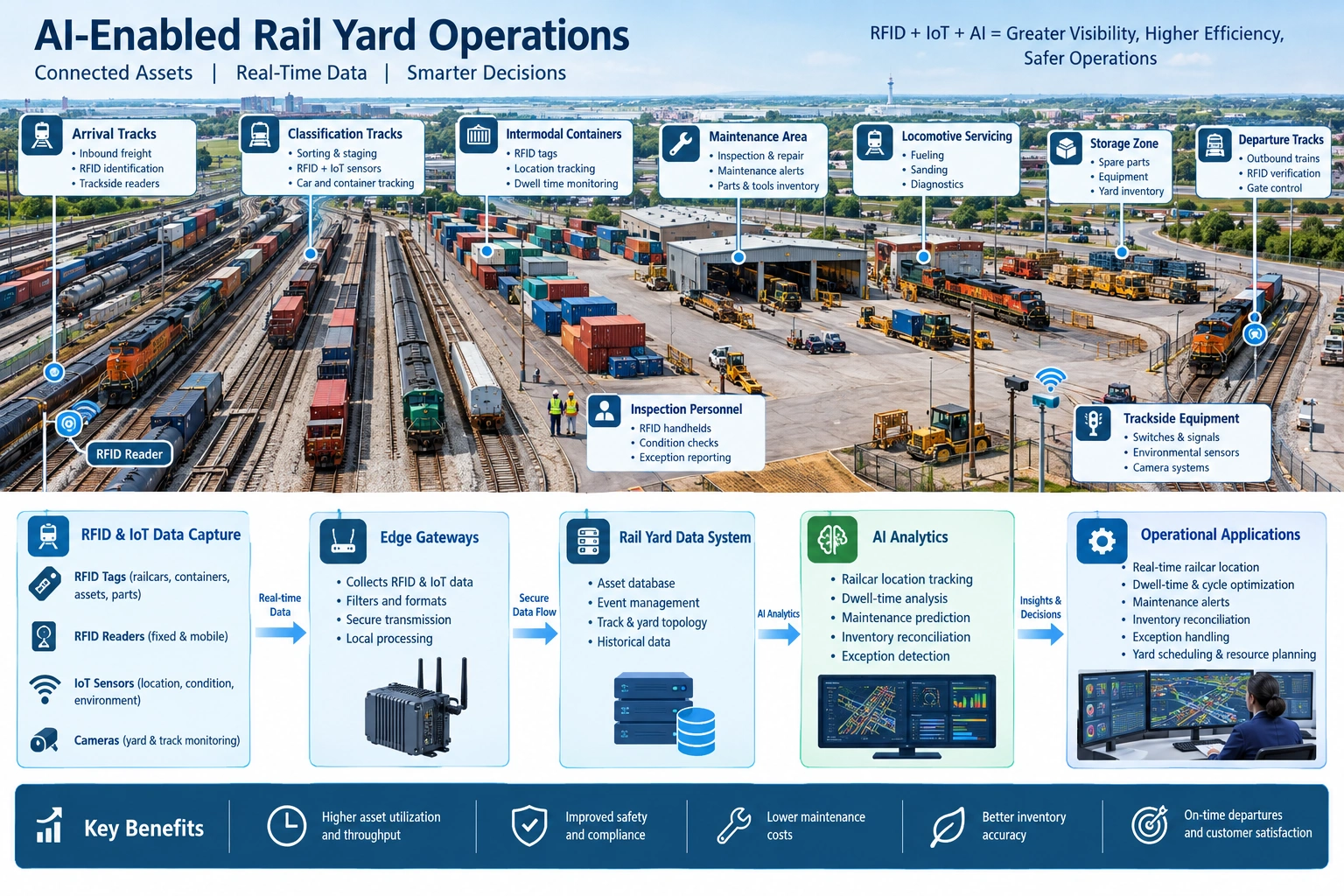
An enterprise infographic illustrating how RFID, IoT sensors, edge gateways, rail-yard data systems, and AI analytics work together across modern North American rail-yard operations. It shows data flows from locomotives, railcars, containers, maintenance areas, and trackside equipment to applications supporting location tracking, dwell-time analysis, maintenance, inventory, exception detection, and yard scheduling.
What AI Means for Modern Rail Yard Management
AI for rail yards refers to the use of machine learning, computer vision, predictive analytics, optimization models, and related Industrial AI methods to interpret operational data and support decisions involving railcars, locomotives, maintenance, inventory, safety, and yard movements.
RFID functions as one of several data acquisition technologies. UHF RFID is particularly useful for longer-range identification of tagged rail-yard assets, tools, containers, spare parts, and equipment moving through defined read zones. HF RFID can support shorter-range identification tasks where controlled proximity is useful, while LF RFID can be considered for specialized identification requirements involving specific equipment or environmental conditions.
The value comes from combining identification events with operational context. A single RFID read can establish that an asset passed a particular checkpoint. AI becomes more useful when that event is combined with timestamps, track assignments, railcar status, work orders, inspection results, historical dwell time, maintenance history, and yard capacity.
For example, a railcar repeatedly detected in a maintenance area can be correlated with inspection and repair records. An AI model can identify abnormal dwell patterns or predict that a component requires attention based on historical maintenance behavior. Similarly, inventory software can compare RFID-generated movement records with expected quantities and identify discrepancies before they affect locomotive servicing or railcar repair activities.
GAO’s role can include supplying RFID readers, tags, antennas, gateways, and related IoT hardware used to capture physical asset information for these systems. The software layer can then process those events alongside existing rail-yard data.
Rail Yard Applications for AI and RFID
Railcar Location and Movement Tracking
Rail yards often contain large numbers of railcars distributed across classification tracks, storage tracks, repair tracks, and interchange areas. Manual location updates can become outdated when cars are moved between tracks or repositioned during switching operations.
AI-assisted railcar tracking can correlate RFID reads with yard maps, track assignments, switch events, and movement records to maintain a more current asset picture.
Relevant applications include:
- Railcar identification at yard entry and exit points
- Automated confirmation of railcar movements
- Track occupancy monitoring
- Railcar location reconciliation
- Dwell-time analysis by car, track, customer, or route
- Detection of unexpected railcar movement
- Identification of railcars remaining in a location beyond an operational threshold
- Automated movement history for audit and operational analysis
The engineering challenge is not simply reading an RFID tag. Reader placement, antenna orientation, metal interference, read-zone definition, tag mounting, and locomotive or railcar geometry all influence identification reliability.
AI-Based Railcar Dwell-Time Analysis
Railcar dwell time is a major operational indicator because excessive time in classification, inspection, repair, loading, unloading, or storage areas can affect yard throughput.
AI models can analyze historical dwell records and identify patterns associated with delays. Variables can include car type, track location, maintenance status, destination, inspection requirements, work-order state, time of day, seasonal conditions, and congestion.
The system can produce operational alerts such as:
- Railcars approaching an expected dwell-time threshold
- Cars with abnormal dwell compared with similar historical movements
- Maintenance cars awaiting work for unusually long periods
- Cars blocked by track capacity or downstream processing
- Repeated delays associated with specific yard processes
RFID events strengthen these models by providing objective asset-presence timestamps rather than relying exclusively on manual status updates.
Predictive Maintenance for Locomotives and Rail Yard Equipment
Rail yards maintain locomotives, railcars, inspection equipment, cranes, forklifts, service vehicles, tools, and other equipment. AI can combine maintenance history, inspection results, operating hours, sensor readings, and asset movement records to identify maintenance risks.
Potential applications include:
- Predicting locomotive component maintenance requirements
- Identifying recurring railcar repair patterns
- Monitoring maintenance-tool utilization
- Detecting abnormal equipment usage
- Prioritizing inspection work orders
- Forecasting spare-parts requirements
- Identifying assets repeatedly sent to repair areas
RFID can identify the physical asset associated with a maintenance event, while AI interprets the accumulated operational history. This combination reduces dependence on isolated spreadsheets or manually reconciled asset lists.
RFID-Enabled Maintenance Inventory Management
Railcar and locomotive maintenance operations depend on reliable access to bearings, brake components, couplers, electrical components, fasteners, lubricants, tools, inspection equipment, and other maintenance materials.
RFID-enabled inventory management can record when tagged items enter storage, move to a maintenance area, are issued to technicians, or return to inventory. AI can analyze consumption patterns and forecast demand based on repair schedules, fleet activity, historical usage, and seasonal maintenance requirements.
This can help maintenance teams address problems such as:
- Unaccounted tools and equipment
- Incorrect inventory quantities
- Stockouts of frequently used components
- Excess inventory of low-use parts
- Delayed replenishment
- Manual inventory reconciliation
- Poor visibility into tool utilization
The system should distinguish between inventory identity and inventory condition. Knowing that a tagged component is physically present does not by itself establish whether it is serviceable, inspected, calibrated, damaged, or ready for installation. Those states should remain associated with maintenance and quality records.
Rail Yard Equipment and Tool Tracking
Portable tools, diagnostic equipment, lifting equipment, inspection devices, and service equipment can move between locomotives, railcars, maintenance bays, tracks, and storage locations.
AI-assisted asset tracking can use RFID movement events to understand utilization patterns and identify unusual behavior.
Operational use cases include:
- Tool checkout and return monitoring
- Maintenance equipment location tracking
- Calibration-equipment identification
- Detection of equipment left outside assigned zones
- Utilization analysis
- Maintenance-equipment availability monitoring
- Automated asset inventory reconciliation
GAO can support these deployments by providing RFID hardware used to identify and locate physical assets across controlled rail-yard areas.
Rail Yard Safety and Exception Detection
Rail yards combine heavy rolling stock, locomotives, switching operations, maintenance activities, moving vehicles, and personnel working across changing operational zones. Safety systems therefore need accurate information about physical assets and operating conditions.
AI can support safety-related analysis by correlating RFID identification with other data sources such as access-control records, yard equipment telemetry, geofencing systems, cameras, and operational schedules.
Potential applications include:
- Detecting assets entering restricted maintenance zones
- Identifying unexpected equipment movement
- Supporting separation of maintenance activities from active switching areas
- Monitoring access to controlled equipment
- Correlating asset movements with work-order status
- Generating exceptions when physical activity conflicts with planned operations
Computer vision may provide an additional layer for detecting people, locomotives, railcars, vehicles, or unsafe conditions. RFID should not be treated as a substitute for safety-critical signaling, interlocking, positive train control, or other systems specifically designed for railway safety functions. Instead, it can provide supplementary asset-identification data for operational systems.
How AI and RFID Data Move Through a Rail Yard System
A practical rail-yard deployment typically begins with physical identification and ends with an operational action. The complete data flow can involve several technical layers.
Data Acquisition at Rail Yard Locations
RFID readers capture tag identifiers when railcars, containers, tools, equipment, or inventory items pass defined read zones. Reader locations may include:
- Yard entry and exit points
- Classification-track access points
- Maintenance shop entrances
- Locomotive servicing areas
- Parts warehouses
- Tool rooms
- Inspection areas
- Controlled storage locations
UHF RFID is generally suited to applications requiring longer read distances, although actual range depends on tag design, reader power, antenna configuration, mounting surface, interference, and the physical environment.
Edge Processing and Event Filtering
Raw reader events should not automatically become business transactions. A rail-yard system may receive repeated reads from the same tag while an asset remains within a reader’s field.
Edge gateways can filter duplicate reads, apply time windows, validate reader health, normalize timestamps, and transform raw observations into higher-level events such as “railcar entered maintenance area” or “tool returned to tool room.”
This processing reduces unnecessary data transmission and gives operations teams cleaner event information.
Communication and Data Transport
Rail yards can contain large outdoor areas with variable connectivity. Depending on site conditions, RFID readers and gateways may communicate through Ethernet, Wi-Fi, cellular connectivity, private wireless networks, or other industrial networking methods.
Network design should account for:
- Outdoor coverage
- Electromagnetic interference
- Weather exposure
- Network redundancy
- Bandwidth requirements
- Latency
- Device authentication
- Secure remote management
- Connectivity failures
Store-and-forward processing can be important where temporary network outages should not result in lost asset events.
Middleware and Rail-Yard Software Integration
Middleware converts device-level events into information that business applications can use. It may handle device management, tag-event normalization, asset identity mapping, duplicate suppression, API communication, and message routing.
The rail-yard system can then exchange information with:
- Railcar management systems
- Yard management software
- Transportation management systems
- Enterprise asset management systems
- Computerized maintenance management systems
- Warehouse management systems
- ERP software
- Inventory databases
- Work-order systems
- Access-control software
- Analytics and reporting systems
Integration should use well-defined APIs, event schemas, asset identifiers, timestamps, and location references rather than relying on manual data transfers.
Real-World RFID Deployment Design for Rail Yards
A realistic deployment should begin with the physical operating process rather than with the RFID reader specification. Engineers first determine which rail-yard events need reliable identification and where those events occur.
A deployment could use fixed UHF RFID readers at selected yard access points to identify tagged railcars or equipment. Additional readers could be installed around maintenance-shop entrances and parts-storage locations. Handheld RFID readers can support technicians performing inventory checks or locating tagged tools.
The system can associate each reader with a known yard location. When a tag is detected, the event can be timestamped and transmitted to an edge gateway. The gateway can suppress duplicate reads and forward validated events to the rail-yard software. AI services can then analyze movement histories, dwell patterns, maintenance records, and inventory activity.
A critical engineering consideration is tag selection. Railcars and metal equipment can detune poorly selected RFID tags, while outdoor installations introduce water, temperature, mechanical impact, and contamination concerns. Ruggedized tags designed for metal surfaces and the expected environmental conditions are therefore preferable where applicable.
Reader placement also requires field testing. A theoretical read range does not guarantee reliable performance across a rail yard containing metal structures, railcars, locomotives, containers, electrical equipment, and changing vehicle positions.
Engineering Considerations Before Rail Yard Deployment
Successful AI-assisted rail-yard tracking depends on both physical deployment quality and software integration. Several engineering decisions should be addressed during requirements analysis and site surveys.
- Define the operational event that each RFID read is expected to represent.
- Map rail-yard tracks, maintenance areas, warehouses, gates, and other relevant locations before reader installation.
- Select tags based on railcar, metal, environmental, temperature, impact, and mounting conditions.
- Conduct an RF site survey before finalizing reader and antenna locations.
- Establish read zones that minimize unintended identification of adjacent tracks.
- Use edge filtering to prevent repeated reads from becoming false movement events.
- Maintain consistent asset identifiers across RFID software and rail-yard business systems.
- Establish time synchronization across readers, gateways, servers, and AI services.
- Validate RFID events against known railcar movements before using them for automated decisions.
- Design network redundancy for areas where connectivity interruptions could affect operational visibility.
- Separate operational decision-support software from railway safety-critical control systems.
- Apply role-based access controls to maintenance, inventory, yard operations, and administrative functions.
- Encrypt device-to-server communications and protect APIs used for system integration.
- Maintain audit logs for asset events, configuration changes, user actions, and system exceptions.
- Establish procedures for replacing damaged tags, failed readers, defective antennas, and disconnected gateways.
- Test the complete workflow under actual rail-yard conditions before expanding deployment.
The most reliable implementation approach is usually incremental. A rail yard can begin with a clearly defined process such as railcar entry and exit tracking or maintenance-tool management, establish data quality, validate operational value, and then expand to additional tracks, maintenance processes, inventory categories, and AI use cases.
Rail Yard RFID Deployment Decision Tree
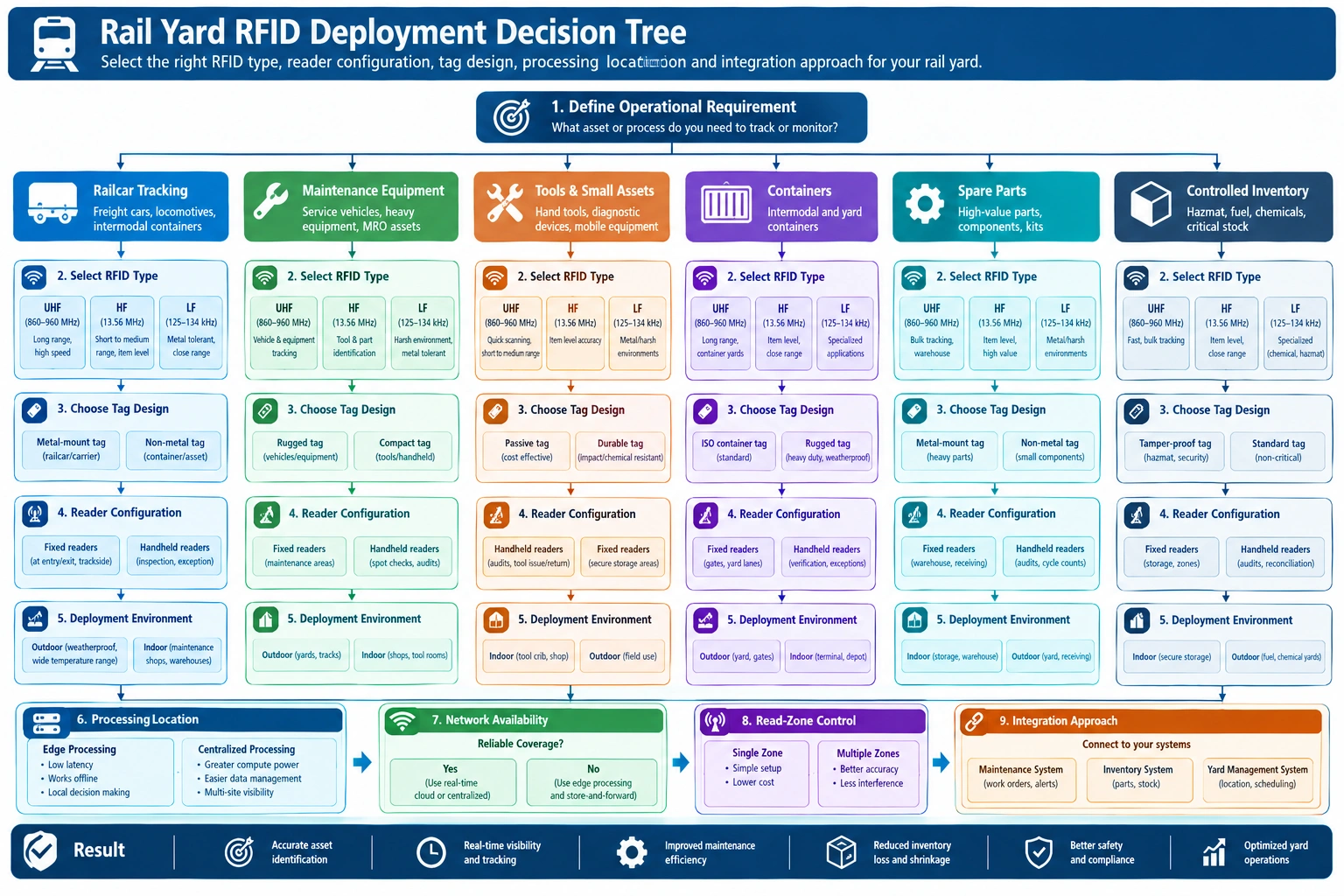
An engineering decision tree that guides rail-yard RFID deployment from operational requirements through RFID type, tag design, reader configuration, deployment environment, processing location, network availability, read-zone control, and system integration. It covers railcars, maintenance equipment, tools, containers, spare parts, and controlled inventory.
From Rail Yard Visibility to AI-Based Operational Decisions
RFID establishes a reliable identity and location signal for selected physical assets, but the greater operational value comes from combining those observations with rail-yard business data. AI can use this combined information to recognize abnormal dwell patterns, forecast maintenance requirements, identify inventory discrepancies, prioritize exceptions, and support more efficient use of tracks, equipment, and maintenance resources.
The next stage of a rail-yard deployment is therefore the selection of RFID hardware, AI methods, communication technologies, software components, security controls, and deployment models that fit the physical and operational conditions of the yard.
RFID, AI, and Software Components for Rail Yard Solutions
A rail-yard AI solution combines physical identification hardware, communication infrastructure, operational software, and analytical models. Each component should be selected according to the rail yard’s physical environment, required event accuracy, integration requirements, and operational objectives.
RFID Hardware for Rail Yard Asset Identification
RFID hardware provides the physical data capture layer for selected rail-yard assets and processes.
- UHF RFID readers and antennas can identify tagged railcars, containers, maintenance equipment, tools, and inventory as they pass defined read zones. UHF is generally appropriate for applications requiring longer read distances.
- HF RFID readers and tags can support controlled short-range identification, such as technician interactions with maintenance records, tool stations, or specific equipment.
- LF RFID systems can be considered for specialized short-range identification applications where the operating environment and asset characteristics make LF appropriate.
- Fixed RFID readers support automated identification at gates, maintenance entrances, inventory areas, and other controlled locations.
- Handheld RFID readers allow maintenance and inventory personnel to perform mobile asset searches, cycle counts, and reconciliation.
- Rugged RFID tags are important for outdoor rail-yard environments where tags may experience rain, temperature variation, vibration, abrasion, dirt, oil, and repeated mechanical exposure.
- Industrial gateways collect RFID events and may also integrate data from other IoT devices before forwarding information to centralized software.
GAO provides RFID and IoT hardware products that can be incorporated into these rail-yard data-capture requirements. Hardware selection should be based on tested read performance, environmental requirements, installation constraints, and interoperability rather than nominal read distance alone.
AI Models for Rail Yard Operations
Different rail-yard problems require different AI approaches. A single model should not be expected to manage every operational decision.
- Time-series forecasting can estimate railcar dwell, inventory consumption, maintenance demand, or equipment utilization.
- Classification models can categorize rail-yard events or identify conditions associated with delays and maintenance requirements.
- Anomaly detection can identify unusual asset movement, unexpected dwell, abnormal equipment behavior, or inventory discrepancies.
- Clustering can reveal groups of railcars, maintenance activities, or operational conditions with similar behavior.
- Optimization algorithms can support track allocation, resource scheduling, maintenance prioritization, and movement planning when sufficient operational constraints are available.
- Computer vision models can analyze camera feeds for vehicles, personnel, equipment, and selected operational conditions, providing information that complements RFID identification.
- Generative AI can assist with natural-language summaries, maintenance documentation, operational queries, and retrieval of information from approved rail-yard records, provided appropriate data governance is applied.
AI outputs should be treated according to their operational risk. A model predicting excessive dwell can generate a recommendation for a dispatcher or yard manager, while safety-critical railway control functions require appropriately certified and separately governed systems.
Communication and Edge Computing
Rail yards frequently cover extensive outdoor areas, making network design an important part of system reliability. Ethernet can serve fixed installations where wired connectivity is practical. Wi-Fi or cellular connectivity can support mobile or geographically distributed equipment, while industrial gateways can buffer events during temporary communication failures.
Edge computing is useful when event processing should occur close to RFID readers. Duplicate filtering, local validation, device-health monitoring, and temporary event storage can reduce unnecessary traffic and maintain continuity during network interruptions.
A centralized server or cloud environment can perform more computationally intensive analytics, historical analysis, model training, reporting, and cross-yard comparisons.
Cloud Version and Server Version
A Cloud Version can host rail-yard software and AI services within cloud infrastructure. This approach is useful when organizations need centralized access across multiple yards, remote system administration, elastic computing resources, and centralized analytics.
A Server Version can run on customer-managed servers, private data centers, edge servers, factory or facility servers, or other privately hosted infrastructure. This model can be appropriate where operational data must remain within controlled infrastructure, connectivity is limited, integration requires local processing, or organizational policies favor private hosting.
A hybrid implementation can also place time-sensitive RFID event processing at the rail yard while sending validated information to centralized software for long-term analytics. The correct model depends on connectivity, cybersecurity requirements, data-governance policies, latency requirements, IT resources, and the operational consequences of service interruption.
Integrating AI-Generated Rail Yard Insights with Existing Systems
AI should augment established rail-yard workflows rather than create isolated operational information. Integration determines whether an identified exception can actually lead to an operational response.
RFID and AI data may be exchanged with:
- Yard management systems
- Railcar management software
- Transportation management systems
- Enterprise asset management systems
- Computerized maintenance management systems
- Warehouse management systems
- ERP and procurement systems
- Work-order databases
- Inventory management software
- Access-control systems
- Video management systems
- Business intelligence and reporting tools
API-based integration can allow RFID events and AI results to be exchanged without replacing existing software. For example, a validated RFID event can update an asset’s location in a maintenance system, while a maintenance work order can provide context for AI analysis of the same asset.
Data models should preserve the relationship between an asset identifier, location, timestamp, event type, source device, and operational state. This becomes particularly important when the same railcar, locomotive, tool, or component appears in several software systems.
Cybersecurity for AI and RFID Rail Yard Systems
Connected rail-yard equipment expands the number of devices, network endpoints, APIs, and software services that must be protected. Cybersecurity should therefore be incorporated during system design rather than added after deployment.
Key controls include:
- Unique credentials for RFID readers, gateways, servers, and administrative users
- Encrypted communication between devices, gateways, servers, and cloud services
- Network segmentation for RFID and IoT devices
- Role-based access control for maintenance, inventory, yard operations, and IT personnel
- Secure API authentication
- Centralized logging of system and administrative events
- Device firmware and software patch management
- Configuration backups
- Monitoring for unexpected device behavior
- Controlled remote administration
- Data retention policies
- Regular vulnerability assessment
- Incident response procedures
AI systems introduce additional concerns. Training data should be governed, model inputs should be validated, and access to operational data should be restricted according to organizational requirements. Generative AI applications should not automatically expose confidential rail-yard records or allow unverified AI-generated instructions to control safety-sensitive operations.
GAO’s broader RFID, BLE, and IoT engineering work can support organizations that require hardware and system components for connected asset-management deployments, while final cybersecurity controls should be designed around the customer’s IT and operational technology policies.
Measuring AI and RFID Performance in Rail Yards
A deployment should be evaluated using measurable operational and technical KPIs rather than RFID read counts alone.
Useful rail-yard measurements include:
- Railcar identification accuracy
- RFID event capture rate
- False-read rate
- Asset location accuracy
- Average railcar dwell time
- Percentage of railcars exceeding dwell thresholds
- Track utilization
- Yard throughput
- Time required for inventory reconciliation
- Maintenance-tool availability
- Spare-parts stockout frequency
- Maintenance turnaround time
- Preventive maintenance compliance
- Unplanned equipment downtime
- Inventory accuracy
- Asset search time
- RFID reader availability
- Gateway uptime
- Network availability
- AI alert precision
- AI false-positive rate
- Mean time to acknowledge operational exceptions
- Mean time to resolve identified exceptions
- Percentage of automated versus manually reconciled asset records
- Cost per tracked asset or operational event
Performance baselines should be recorded before deployment whenever practical. Comparing post-deployment results against those baselines makes it easier to determine whether the system has improved the specific rail-yard process it was intended to address.
Implementation Roadmap for AI-Assisted Rail Yard Operations
A phased deployment reduces technical and operational risk while creating opportunities to validate data quality before introducing more advanced AI functions.
Requirements and Site Assessment
The first stage should identify the rail-yard processes where better visibility has measurable value. Engineers should document asset categories, movement paths, operating zones, existing systems, network coverage, environmental conditions, and required data-retention policies.
A physical site survey should evaluate metal structures, track spacing, reader mounting locations, antenna orientation, electrical power, network access, weather exposure, and potential sources of RF interference.
RFID Pilot and Data Validation
A pilot can focus on a defined area such as a maintenance shop, selected classification tracks, a tool room, or a parts warehouse.
Testing should measure:
- Tag read reliability
- Read-zone boundaries
- Duplicate-event behavior
- Asset identification accuracy
- Network reliability
- Gateway buffering
- Integration latency
- Reader and antenna performance
- Tag durability
Known asset movements should be compared against captured events before AI models are trained on the resulting data.
AI Model Development and Validation
AI development should begin after sufficient operational data has been collected. Historical rail-yard records can be cleaned, labeled, and evaluated for missing values, inconsistent identifiers, abnormal records, and changes in operating conditions.
Models should be tested using data that was not used during training. Operational users should also validate whether model outputs are understandable and actionable.
A technically accurate model that produces alerts no dispatcher or maintenance supervisor can use effectively has limited operational value.
Integration, Commissioning, and Scale-Up
After validation, RFID events and AI outputs can be integrated into production systems. Commissioning should verify the complete chain from physical asset identification through network transmission, event processing, database storage, AI analysis, user notification, and operational action.
Expansion can then proceed to additional tracks, maintenance areas, inventory locations, equipment categories, or rail yards.
Practical Engineering Lessons for Rail Yard Deployments
Several implementation lessons consistently matter when AI and RFID are introduced into physically complex rail-yard environments.
- Treat RFID events as observations, not automatic truth. A reader detecting a tag does not necessarily mean that the asset completed a specific business process. Event logic should account for location, timing, direction, and operational context.
- Design around the rail-yard workflow. Reader locations should correspond to meaningful operational events such as entering a maintenance area, passing a controlled gate, or moving into a storage zone.
- Validate tags on actual assets. Metal railcars, containers, tools, and equipment can produce substantially different RFID behavior from laboratory test objects.
- Control read zones. Antenna placement and RF tuning should minimize unintended reads from neighboring tracks or nearby equipment.
- Build data quality controls before AI. Poor asset identifiers, duplicate events, missing timestamps, and inconsistent location records can undermine otherwise sophisticated models.
- Keep humans involved in consequential decisions. AI recommendations should be reviewable, particularly when they could influence maintenance priorities, operational scheduling, or safety-related actions.
- Plan for equipment failure. Reader outages, damaged tags, disconnected gateways, and network interruptions should generate detectable system exceptions rather than silently reducing visibility.
- Separate safety-critical control from analytics. AI and RFID analytics can provide operational decision support but should not be represented as replacements for certified railway safety systems.
- Design for maintainability. Readers, antennas, tags, gateways, software services, and network equipment all require inspection, firmware management, replacement procedures, and performance monitoring.
- Start with measurable operational value. Railcar dwell reduction, inventory accuracy, maintenance efficiency, or asset search time can provide clearer deployment objectives than a broad goal of “digital transformation.”
GAO has served customers in the United States and Canada for three decades, supplying RFID, BLE, and IoT products and systems to organizations including Fortune 500 companies, R&D organizations, universities, and government agencies. GAO’s product and engineering work is supported by stringent quality-assurance processes and technical support available remotely or onsite.
Why AI-Assisted Rail Yard Visibility Matters
AI-assisted rail-yard management is most effective when it connects physical asset events with the operational information already used by yard, maintenance, inventory, and transportation teams. RFID can provide a practical identification mechanism for selected assets, while AI transforms accumulated event data into forecasts, anomaly detection, prioritization, and operational insight.
The strongest deployments do not attempt to automate every rail-yard decision immediately. They establish reliable asset identity and event data, integrate that information with existing software, measure operational performance, and then introduce AI models where historical data can support useful predictions or recommendations.
GAO, headquartered in New York City and Toronto, Canada, is ranked among the top 10 leading B2B and B2G RFID and BLE suppliers globally. GAO can support rail-yard projects with RFID, BLE, and IoT hardware products and systems selected around the physical and operational requirements of the deployment.
Building the Future of Industrial AI and IoT with Aperture Venture Studio and GAO RFID Inc.
For more than three decades, GAO has invested heavily in R&D for industrial RFID, BLE, and IoT technologies and systems. As generative AI has become useful for industrial applications, we have expanded our work across AI and IoT, including solutions relevant to rail-yard asset visibility, maintenance, inventory, and operational intelligence. We have also founded Aperture Venture Studio to develop practical AI and IoT solutions for industries such as rail and connected asset management.
Aperture has attracted AI and IoT technical experts, entrepreneurial and operational executives, investors, and leading companies. We have also developed Aperture Ventures Summit and TekSummit to discuss advanced AI and IoT topics and strengthen technical communities.
GAO Group companies, including GAO, GAO Research Inc., and GAO Tek Inc., are based in New York City and Toronto. We welcome you to join us as:
- Advisors, Co-founders or Employees
- Investors
- Customers