
AI and RFID for Research Laboratories
AI-Driven Research Laboratory Operations with RFID
AI for Research Laboratories combines artificial intelligence, connected laboratory equipment, digital records, and RFID-based identification to improve how laboratories track samples, manage equipment, control inventory, and coordinate research workflows. RFID provides machine-readable identity and location data for tagged laboratory assets, while AI analyzes that operational data to identify patterns, predict requirements, detect anomalies, and support decisions.
Research laboratories can apply these capabilities to biological samples, chemical containers, reagents, laboratory instruments, consumables, freezers, storage locations, and mobile equipment. UHF RFID can support longer-range identification around storage and movement areas, while HF RFID is useful for shorter-range item-level identification and controlled read points. LF RFID can be appropriate for specialized applications where its propagation characteristics and established identification methods fit the laboratory environment.
The value of AI is not simply automating RFID reads. The larger opportunity is converting laboratory events into operational intelligence. A research laboratory can use AI to recognize unusual sample movements, identify inventory discrepancies, predict consumable requirements, improve equipment utilization, and provide researchers and laboratory managers with more reliable operational information.
AI and RFID Use Cases for Research Laboratories
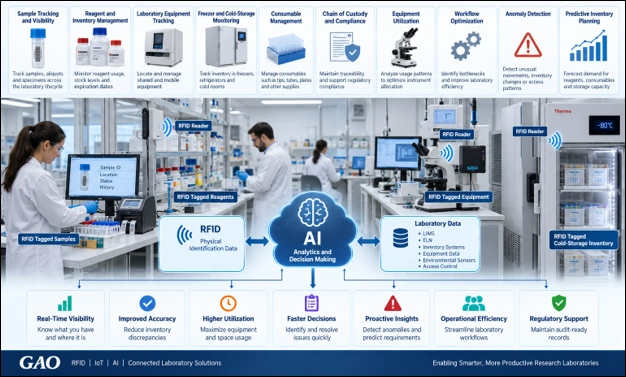
This infographic illustrates how AI and RFID support research laboratory operations, including sample tracking, reagent inventory, equipment management, cold-storage monitoring, anomaly detection, and predictive inventory planning. It shows how RFID identification data and laboratory systems feed AI analytics to improve visibility, accuracy, utilization, and operational decision-making.
Why AI Matters for Research Laboratory Management
Research laboratories generate large volumes of operational data through sample access, instrument usage, storage transactions, inventory changes, environmental monitoring, experiment scheduling, and laboratory information systems. Much of this information is distributed across laboratory information management systems, electronic laboratory notebooks, inventory databases, instrument software, spreadsheets, access-control systems, and manual records.
AI can connect these operational signals into more useful decisions.
Key applications include:
- AI sample tracking: Correlates RFID identification events with sample records, storage locations, transfers, and authorized workflows to improve sample visibility.
- AI laboratory inventory management: Analyzes consumption patterns, stock levels, reorder history, lead times, and experimental schedules to reduce stockouts and excess inventory.
- AI asset tracking: Uses RFID event data to determine where laboratory instruments, mobile equipment, containers, and other tagged assets are located and how frequently they are used.
- AI anomaly detection: Identifies unexpected sample movements, unusual inventory changes, repeated failed transactions, or asset movements that differ from established laboratory workflows.
- AI equipment utilization analysis: Combines identification and usage data to reveal underused instruments, scheduling bottlenecks, and opportunities for better equipment allocation.
- AI workflow optimization: Examines movement and transaction patterns to identify unnecessary handling, repeated searches, inefficient storage arrangements, and process delays.
- AI demand forecasting: Predicts future requirements for reagents, consumables, sample-storage capacity, and other laboratory resources using historical and operational data.
- AI-assisted compliance monitoring: Helps laboratory managers identify missing records, unusual access patterns, or workflow exceptions that require human review.
GAO supplies RFID, BLE, and other IoT hardware products and systems that can provide the physical-world data required by these applications. The appropriate design depends on laboratory layout, item composition, read distance, storage conditions, interference sources, and the required identification granularity.
Research Laboratory Applications and Deployment Scenarios
AI Sample Tracking and Chain-of-Custody Visibility
Sample management is one of the strongest use cases for AI-enabled identification. Research laboratories may handle specimens, aliquots, assay plates, tissue samples, chemical samples, biological materials, and other research objects through receiving, preparation, analysis, temporary storage, transfer, and long-term archiving.
RFID can associate a physical container with a unique identifier, while AI can interpret movement events against expected laboratory workflows. A system can flag a sample that appears in an unexpected storage area, detect an unusual transfer sequence, or identify missing events requiring investigation.
Engineering design should consider tag attachment, container material, liquids, metallic surfaces, freezer conditions, reader placement, and the required read reliability. RFID identification should complement, rather than replace, laboratory controls and validated procedures where regulated or safety-critical workflows require them.
AI Laboratory Inventory and Reagent Management
Reagents, solvents, media, assay consumables, pipette tips, tubes, plates, filters, and other supplies can create significant inventory-management workloads. Manual counting is particularly difficult when materials are distributed among laboratories, preparation rooms, refrigerators, freezers, cabinets, and shared storage areas.
AI inventory management can use RFID events together with inventory records and historical consumption to estimate actual usage and future requirements. The resulting system can help identify slow-moving materials, unusual consumption, approaching shortages, and discrepancies between recorded and observed inventory.
The objective is not simply to automate counting. The higher-value application is connecting inventory visibility with purchasing, experimental planning, storage capacity, and laboratory scheduling.
AI Laboratory Equipment Tracking and Utilization
Research laboratories frequently share centrifuges, microscopes, spectrometers, analyzers, thermal cyclers, incubators, balances, pumps, and other specialized equipment. Mobile instruments can move between rooms or research groups, making manual location records unreliable.
RFID identification can provide equipment movement events, while AI can analyze those events with scheduling and usage information. Laboratory managers can use the resulting intelligence to identify equipment that is frequently relocated, underutilized, heavily constrained, or repeatedly unavailable when needed.
GAO’s RFID and IoT hardware can be incorporated into equipment identification and location workflows, with reader placement selected according to laboratory traffic patterns and required coverage.
AI Cold Storage and Freezer Inventory
Ultra-low-temperature freezers, laboratory refrigerators, cold rooms, and other storage environments require careful inventory control. Researchers may spend substantial time locating samples inside storage units, while managers need confidence that sample records correspond to physical locations.
An RFID-enabled system can record identification events at appropriate storage and access points. AI can then analyze access and movement history to identify unusual patterns, frequently accessed storage areas, inventory discrepancies, and potential capacity constraints.
Environmental sensors can provide complementary temperature and humidity information where required. AI can correlate environmental events with inventory and access records, giving laboratory personnel a broader operational view rather than treating identification, environmental monitoring, and inventory records as unrelated datasets.
RFID Deployment in Research Laboratories: AI-Driven Laboratory Intelligence
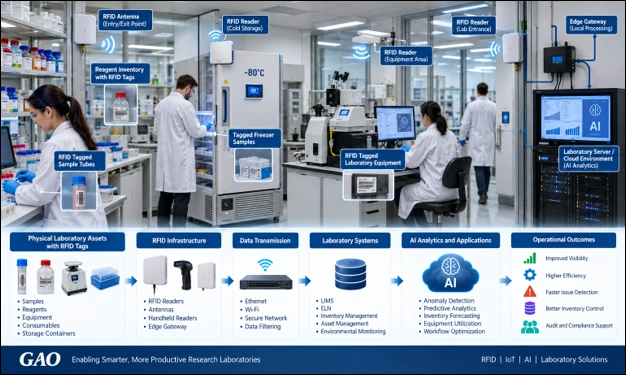
This visual shows a realistic RFID deployment across a modern research laboratory, connecting tagged samples, reagents, equipment, and freezer inventory with RFID readers, an edge gateway, laboratory systems, and AI analytics. It illustrates how physical identification data supports sample management, inventory control, anomaly detection, equipment utilization, and laboratory decision-making.
From RFID Events to AI-Driven Laboratory Decisions
A practical AI solution for Research Laboratories typically follows a data path from physical identification to an operational decision.
- Data acquisition: RFID readers capture tag identifiers and associated read events from laboratory samples, containers, equipment, storage locations, or controlled movement points.
- Context capture: The system associates identification events with timestamps, reader locations, user transactions, laboratory rooms, storage zones, and relevant environmental or equipment data.
- Communication: Ethernet, Wi-Fi, cellular connectivity, or other appropriate laboratory network infrastructure transports event data to processing systems.
- Edge processing: An edge gateway or local server can filter duplicate reads, normalize events, apply basic business rules, and reduce unnecessary data transmission.
- Middleware: RFID middleware converts low-level reader events into meaningful laboratory transactions such as sample movement, equipment relocation, or inventory changes.
- Enterprise integration: APIs or other integration mechanisms connect the RFID system with LIMS, ELN, laboratory inventory software, ERP, procurement systems, asset-management software, scheduling applications, or databases.
- AI processing: Machine-learning models and analytical services evaluate historical and real-time information to detect anomalies, forecast demand, identify workflow patterns, or generate operational recommendations.
- Human decision-making: Laboratory managers, researchers, inventory personnel, facilities teams, or quality personnel review relevant alerts and recommendations.
- Business action: Approved decisions can trigger inventory replenishment, sample-location updates, workflow investigation, equipment allocation, maintenance planning, or other laboratory actions.
The quality of the AI output depends heavily on the quality of the underlying laboratory data. RFID deployments therefore need disciplined tag commissioning, reader tuning, event filtering, identifier management, integration testing, and exception handling.
Research Laboratory AI and RFID Data Flow Workflow
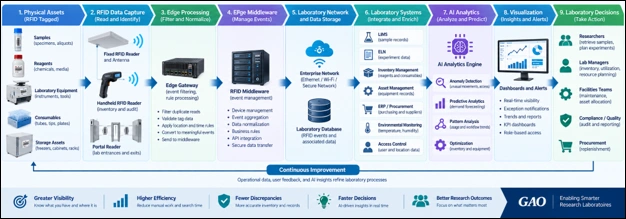
This workflow diagram shows how RFID-tagged laboratory samples, reagents, equipment, and storage assets move from physical data capture through edge processing, middleware, laboratory systems, and AI analytics. It connects anomaly detection, predictive analytics, dashboards, and alerts to operational decisions by researchers, laboratory managers, facilities teams, compliance personnel, and procurement teams.
RFID, AI, and Connected Laboratory Infrastructure
RFID should be selected according to the laboratory workflow rather than treated as a universal identification technology. UHF, HF, and LF RFID have different operating characteristics, and tag performance can change substantially around liquids, metals, dense sample storage, and specialized laboratory containers.
A complete solution can include:
- RFID tags selected for sample containers, equipment, cabinets, trays, or other laboratory assets
- Fixed or integrated RFID readers positioned at controlled movement points
- Antennas configured for the required read zones
- Handheld RFID readers for inventory audits and exception handling
- Edge gateways for local event processing
- Ethernet or Wi-Fi connectivity for laboratory networks
- Databases for identification and transaction records
- APIs connecting laboratory software and business systems
- AI services for forecasting, classification, anomaly detection, and optimization
- Dashboards and alerting interfaces for laboratory personnel
- Identity and access controls protecting sensitive operational information
- Logging and audit mechanisms supporting investigation and accountability
The next design question is where these components should run and how the laboratory should balance cloud services with privately hosted processing.
Cloud and Server Deployment for Research Laboratories
Research laboratories should select the deployment model according to data governance, connectivity, integration requirements, laboratory scale, and the operational sensitivity of the information being processed.
Cloud Version uses cloud-hosted software and services to process RFID events, inventory records, analytics, and AI workloads. This model can simplify centralized management across multiple research facilities and make it easier to scale computational resources for forecasting, anomaly detection, and analytics. It is particularly useful when laboratories need centralized visibility across geographically distributed locations and have reliable connectivity to approved cloud services.
Server Version deploys software on customer-managed edge servers, private data centers, laboratory servers, or other privately hosted infrastructure. This approach can be preferable when research organizations require tighter control over data location, network connectivity, system dependencies, or integration with laboratory systems that are difficult to expose externally. Local processing can also reduce latency for workflows requiring rapid responses to RFID events.
A hybrid design can combine both approaches. RFID events may first be processed locally, with selected normalized data transferred to cloud services for broader analytics and AI model processing. This arrangement can reduce bandwidth requirements while keeping operational functions available if external connectivity is interrupted.
For Research Laboratories, deployment planning should address:
- Data governance: Determine which sample, research, inventory, user, and operational data may be processed outside privately controlled infrastructure.
- Network resilience: Design local processing and buffering so temporary network failures do not result in lost RFID events.
- Integration: Define interfaces with LIMS, ELN, laboratory inventory, ERP, procurement, CMMS, and identity-management systems before selecting the final software configuration.
- AI workload: Determine whether inference can run at the edge or requires server/cloud computing resources.
- System availability: Identify which laboratory workflows require continuous operation and which can tolerate delayed synchronization.
- Cybersecurity: Apply network segmentation, authentication, encryption, access controls, logging, patch management, and secure device configuration.
- Lifecycle management: Establish procedures for reader configuration, tag commissioning, software updates, AI model monitoring, and hardware replacement.
GAO can provide RFID and connected-device hardware suitable for integration into these laboratory workflows, while deployment decisions should be based on the customer’s technical, operational, and data-management requirements.
AI Models and Software Integration for Research Laboratories
AI does not need to be a single large model. Research Laboratory applications can use different analytical techniques according to the decision being supported.
- Anomaly detection models can identify RFID movement patterns that differ from expected sample, reagent, or equipment workflows.
- Time-series forecasting can estimate future consumption of reagents and consumables from historical usage, seasonality, project schedules, and replenishment data.
- Classification models can categorize inventory or operational events according to predefined laboratory conditions.
- Clustering methods can reveal groups of equipment, samples, or workflows with similar operational characteristics.
- Predictive models can estimate equipment utilization or identify conditions associated with recurring operational delays.
- Computer vision can complement RFID when laboratories need visual confirmation of labels, storage locations, equipment states, or physical conditions.
- Generative AI can provide natural-language access to approved operational information, such as answering questions about inventory status, recent equipment movements, or identified exceptions. Its outputs should remain grounded in authoritative laboratory data rather than being treated as an independent source of experimental truth.
Integration is equally important. RFID data becomes substantially more useful when the identification event is associated with the correct laboratory record.
Typical software integration targets include:
| Laboratory system | Potential AI and RFID interaction |
| LIMS | Sample identity, location, movement, and workflow events |
| ELN | Research workflow context and experiment-related records |
| Laboratory inventory software | Stock levels, consumption, replenishment, and discrepancies |
| ERP | Purchasing, suppliers, financial records, and replenishment workflows |
| CMMS | Equipment identity, maintenance history, service scheduling, and utilization |
| Scheduling software | Instrument availability and resource planning |
| Identity and access management | User authentication and authorization |
| Environmental monitoring | Temperature, humidity, freezer, and storage-condition data |
| Data warehouse | Historical operational data for analytics and AI |
| BI software | Dashboards, KPIs, trends, and management reporting |
APIs, message queues, database interfaces, and event-based integration can be used according to the existing software environment. A key engineering principle is to maintain a stable identifier relationship between the physical RFID tag, the laboratory object, and its authoritative software record.
Security, Privacy, and Data Integrity
Research laboratories may handle sensitive research information, proprietary experimental programs, valuable biological materials, and controlled substances or chemicals. RFID and AI systems therefore need security controls appropriate to the laboratory’s information and operational risk.
Security considerations include:
- Use authenticated access for RFID management software and administrative interfaces.
- Separate RFID devices and gateways from general-purpose laboratory networks where appropriate.
- Encrypt communications between readers, gateways, servers, and cloud services.
- Apply role-based access controls so researchers, inventory personnel, laboratory managers, IT administrators, and other users receive only the permissions they require.
- Maintain audit logs for important inventory, sample, equipment, and administrative events.
- Protect RFID identifiers from unauthorized modification or reassignment.
- Establish procedures for lost, damaged, replaced, or decommissioned tags.
- Monitor unusual authentication, device, and data-access activity.
- Apply secure configuration and patch-management procedures to connected readers, gateways, servers, and supporting software.
- Maintain backup and recovery procedures for databases and configuration information.
- Validate data mappings so an RFID identifier cannot accidentally become associated with the wrong laboratory record.
AI introduces additional considerations. Models should be evaluated for false positives and false negatives, and laboratory personnel should understand when an AI recommendation represents a prediction rather than a verified physical event. For high-consequence laboratory workflows, human review should remain part of the operational control process.
Engineering Considerations for RFID in Research Laboratories
RFID performance in Research Laboratories is strongly influenced by the physical environment. Laboratory containers may contain liquids, biological materials, chemicals, or metallic components that affect radio-frequency behavior. Freezers and metal storage structures can also create challenging read environments.
A deployment assessment should examine:
- Tag material compatibility with the sample container
- Liquid content and container geometry
- Metal surfaces and laboratory equipment
- Required read distance
- Required read accuracy
- Orientation of tagged objects
- Density of items within storage locations
- Freezer and cold-storage conditions
- Reader and antenna placement
- Potential RF interference
- Human traffic and movement patterns
- Required audit frequency
- Whether item-level or container-level identification is needed
UHF RFID can be advantageous when laboratories need longer-range identification and rapid reading of multiple tagged items. HF RFID can be appropriate for shorter-range controlled interactions where proximity is desirable. LF RFID may fit specialized applications where its characteristics align with the laboratory’s physical environment and identification requirements.
Testing should occur with representative laboratory containers and actual storage conditions rather than relying only on theoretical tag specifications. A tag that performs well on an empty plastic container may behave differently when attached to a liquid-filled vial, metal instrument, freezer rack, or densely packed storage tray.
RFID Tag Selection Guide for Research Laboratory Containers
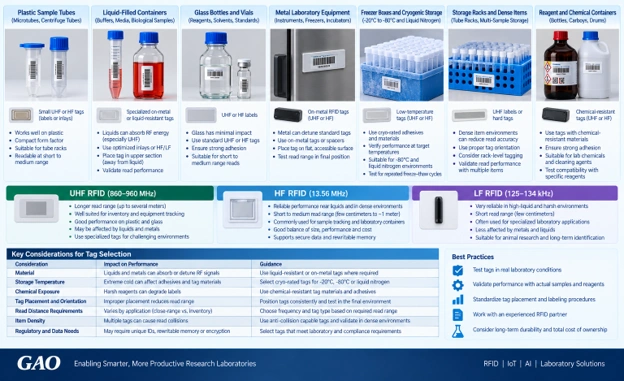
This infographic compares RFID tag selection considerations for laboratory containers and equipment across plastic, liquid-filled, glass, metal, cryogenic, dense-storage, and chemical environments. It also compares UHF, HF, and LF RFID based on read range, material compatibility, temperature, chemical exposure, tag placement, and laboratory deployment requirements.
Operational Benefits of AI-Enabled Laboratory Visibility
The combination of physical identification data and AI can improve Research Laboratory operations in several measurable ways.
Better Sample and Asset Visibility
Automated identification reduces dependence on manually updated location records. AI can further interpret movement history to identify exceptions and operational patterns that are difficult to recognize from individual transactions.
More Accurate Laboratory Inventory
RFID can automate portions of inventory identification, while AI can estimate consumption and future requirements. Together, these capabilities can reduce discrepancies and improve replenishment planning.
Improved Equipment Utilization
Equipment movement and identification data can reveal how frequently instruments are used, relocated, or left idle. Laboratory managers can use these findings when planning shared-resource allocation and procurement.
Faster Exception Detection
AI can compare observed events with expected workflows. An unexpected sample movement, unusual inventory reduction, or abnormal equipment-location pattern can be surfaced for investigation rather than discovered during a later manual audit.
Scalable Multi-Laboratory Visibility
A standardized identification model can support multiple laboratories, storage rooms, research groups, or facilities. Cloud or centralized server deployments can aggregate selected operational information while maintaining local processing where required.
Reduced Manual Searching
Researchers and laboratory personnel can spend significant time locating samples, reagents, equipment, and consumables. Better identification and location information can reduce unnecessary searches and allow personnel to focus on laboratory work.
Research Laboratory KPIs for AI and RFID Programs
Technology deployment should be evaluated using operational metrics rather than RFID read counts alone. Useful KPIs include:
- Sample location accuracy
- Inventory record accuracy
- Sample retrieval time
- Equipment search time
- Inventory audit time
- Reagent stockout frequency
- Inventory discrepancy rate
- Equipment utilization
- Equipment idle time
- Equipment relocation frequency
- RFID read success rate
- False-positive event rate
- False-negative event rate
- Inventory carrying value
- Emergency procurement frequency
- Replenishment lead time
- Storage capacity utilization
- Sample handling exceptions
- Workflow cycle time
- AI alert precision
- AI alert response time
- Percentage of automated inventory transactions
Baseline measurements should be collected before deployment where practical. This allows laboratory managers to distinguish improvements attributable to the new system from normal operational variation.
Implementation Roadmap for Research Laboratories
A successful deployment should begin with the laboratory workflow rather than with RFID hardware selection.
- Define the operational problem: Select a measurable problem such as sample retrieval, inventory discrepancy, equipment location, or reagent stockouts.
- Map the physical workflow: Document receiving, labeling, storage, transfer, use, return, disposal, and archival processes.
- Identify authoritative records: Determine which system owns sample, equipment, inventory, and user information.
- Select representative objects: Test tags on actual laboratory containers and equipment before large-scale deployment.
- Design reader locations: Position readers around controlled movement points and storage areas where identification provides meaningful operational value.
- Establish identifier management: Define how RFID identifiers map to laboratory records and how replacements are handled.
- Integrate software: Connect RFID events to relevant LIMS, ELN, inventory, ERP, CMMS, or database systems.
- Establish AI objectives: Define the specific predictions, classifications, anomaly detections, or optimization decisions the AI system must support.
- Pilot the workflow: Run a controlled pilot with representative researchers, laboratory personnel, equipment, and storage conditions.
- Validate performance: Measure read reliability, event accuracy, integration correctness, AI performance, and user workflow impact.
- Harden cybersecurity: Apply network segmentation, authentication, authorization, encryption, logging, backup, and update procedures.
- Train laboratory personnel: Ensure users understand automated events, exception workflows, and appropriate responses to AI-generated recommendations.
- Scale selectively: Expand to additional sample types, laboratories, equipment groups, or storage areas only after the initial workflow is stable.
GAO’s experience supplying RFID, BLE, and IoT hardware products and systems can support organizations evaluating the physical identification layer, reader configuration, and deployment requirements for laboratory applications.
Research Laboratory AI and RFID Implementation Roadmap
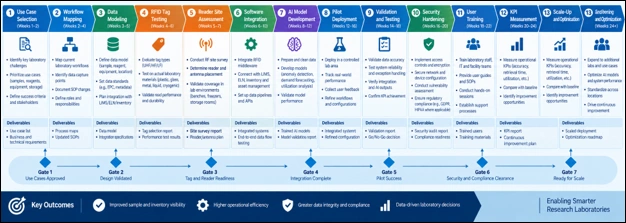
This roadmap presents a practical 13-stage approach for deploying AI and RFID in research laboratories, from use-case selection and workflow mapping through RFID testing, system integration, AI model development, pilot validation, cybersecurity, training, KPI measurement, and scale-up. Engineering gates highlight key approval points before progressing to broader deployment..
Practical Recommendations for Research Laboratory Deployment
AI-enabled RFID projects deliver the strongest results when the physical identification layer, laboratory workflow, and AI objectives are designed together. Laboratories should avoid starting with a broad requirement to “add AI” and instead define the operational decision that needs improvement.
Recommended priorities include:
- Start with one high-value workflow such as sample location, reagent inventory, or shared-equipment tracking.
- Validate RFID performance using the actual containers, instruments, storage structures, and environmental conditions involved.
- Treat RFID events as operational data that require filtering, validation, and contextualization before AI analysis.
- Integrate with authoritative laboratory systems rather than creating parallel records wherever possible.
- Keep human review in workflows where an incorrect AI recommendation could affect research materials, laboratory operations, or compliance activities.
- Establish measurable KPIs before deployment.
- Design cybersecurity and data governance into the system from the beginning.
- Use edge processing when low latency, local availability, or network constraints justify it.
- Select cloud or privately hosted server deployment according to laboratory data governance, integration, scalability, and operational requirements.
- Expand the system only after the pilot demonstrates reliable physical identification and useful AI outcomes.
AI and RFID for Research Laboratories: Key Takeaways
AI for Research Laboratories becomes most valuable when it turns reliable physical-world data into actionable laboratory intelligence. RFID can identify samples, containers, reagents, equipment, and storage assets, while AI can interpret their movement and usage patterns for inventory forecasting, anomaly detection, equipment utilization, workflow optimization, and operational planning.
The technical foundation is a reliable chain from tag and reader performance through event processing, laboratory software integration, secure data management, and appropriately selected AI models. Research organizations should evaluate the entire workflow rather than measuring success only by RFID read rates or AI model accuracy.
GAO provides RFID, BLE, and IoT hardware products and systems that organizations can evaluate as part of these laboratory identification and connectivity requirements. Organizations planning an AI-enabled Research Laboratory initiative can learn more about GAO’s technology solutions, engineering capabilities, product options, and technical support to determine an appropriate deployment approach.
Building the Future of Industrial AI and IoT with Aperture Venture Studio and GAO RFID Inc.
For more than three decades, GAO Group of Companies has invested heavily in R&D of industrial RFID, BLE, and IoT. As generative AI became increasingly useful for industrial applications, we expanded our work across AI and IoT technologies, including RFID and BLE, and founded Aperture Venture Studio to support the development and scaling of AI and IoT solutions relevant to areas such as research laboratory operations.
Aperture has attracted AI and IoT technical experts, entrepreneurial and operational executives, influential investors, and leading companies. We have also developed the Aperture Ventures Summit and TekSummit to discuss advanced AI and IoT topics.
GAO RFID Inc., headquartered in New York City and Toronto, Canada, is ranked among the top 10 leading B2B and B2G BLE and RFID suppliers globally. Together with GAO Research Inc. and GAO Tek Inc., we serve customers across the U.S. and Canada, including Fortune 500 companies, leading R&D firms, prestigious universities, and government agencies, supported by substantial R&D investment, stringent quality assurance, and expert remote and onsite support.
We welcome you as:
- Advisors, co-founders, or employees
- Investors
- Customers