
AI and RFID for Resorts
AI Asset Tracking and RFID Solutions for Resort Operations
AI-driven asset tracking and RFID identification are redefining how resorts manage guest wristband access, pool and beach towel tracking, waterpark and marina equipment identification, housekeeping workflows, F&B cashless payments, spa service delivery, and recreational equipment lending across large multi-amenity resort properties. By integrating machine learning with UHF RFID, HF RFID, and LF RFID identification, resort operators gain real-time operational visibility across villa clusters, aquatic facilities, golf courses, beach clubs, activity centers, and F&B outlets spread across properties where physical distances make manual tracking and radio communication dependent workflows impractical.
GAO supplies RFID hardware products and systems that resorts deploy to automate guest identification, enforce amenity access compliance, track high-volume towel and recreational equipment inventories, and feed operational data into AI-powered analytics engines. The connected resort environment that results allows AI models to convert raw RFID event data into actionable intelligence that reduces towel and equipment loss rates, improves amenity capacity utilization, personalizes guest service delivery, and tightens F&B revenue capture across sprawling resort campuses that traditional hospitality management approaches cannot efficiently operate.
AI and RFID Architecture for Resort Operations
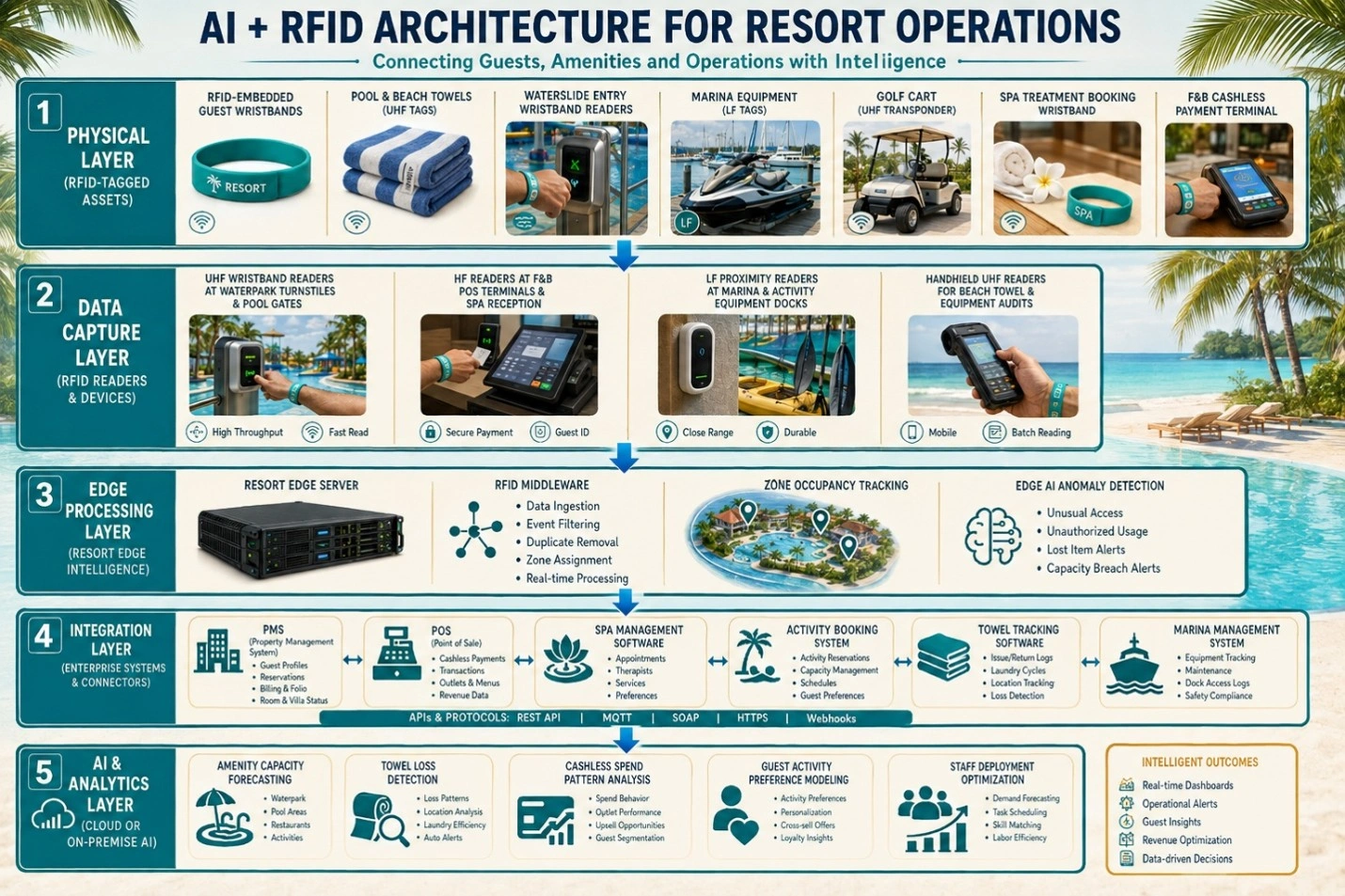
RFID and AI Fundamentals in Resort Operations
Resorts operate across a fundamentally different physical and operational scale than traditional city hotels. A full-service beach, island, or mountain resort may spread across dozens to hundreds of acres, with guest accommodations ranging from rooms and suites in a central lodge to dispersed villa clusters, bungalows, overwater accommodations, and branded residences. Amenity facilities including multiple swimming pools, waterparks with slides and lazy rivers, private beach clubs, marinas with kayak and paddleboard equipment fleets, golf courses, tennis centers, multiple F&B outlets, signature spa and wellness centers, kids clubs, and activity centers generate thousands of daily guest interaction events that are impossible to manage accurately through manual check-in sheets, paper logs, and radio communication between scattered staff teams.
RFID identification in resort operations centers on the guest wristband as the primary credential and tracking device.
AI models including supervised classification, anomaly detection, time-series forecasting, and reinforcement learning process the RFID event streams generated across resort operations. Integrated with Property Management Systems such as Oracle OPERA, Infor HMS, or Agilysys identify guest activity preference patterns to support personalized upsell recommendations, and forecast F&B revenue by outlet based on wristband spending transaction data.
The deployment of AI with RFID across resort operations represents a practical application of AIoT in the hospitality industry. AIoT in resort environments may incorporate Edge AI running on property servers for real-time amenity capacity alerts and towel loss detection, machine vision for pool safety monitoring and beach chair occupancy tracking, and computer vision at activity center equipment check-out stations.
Resort Applications and AI-RFID Deployment Scenarios
Guest Wristband Access Control and Cashless Payment
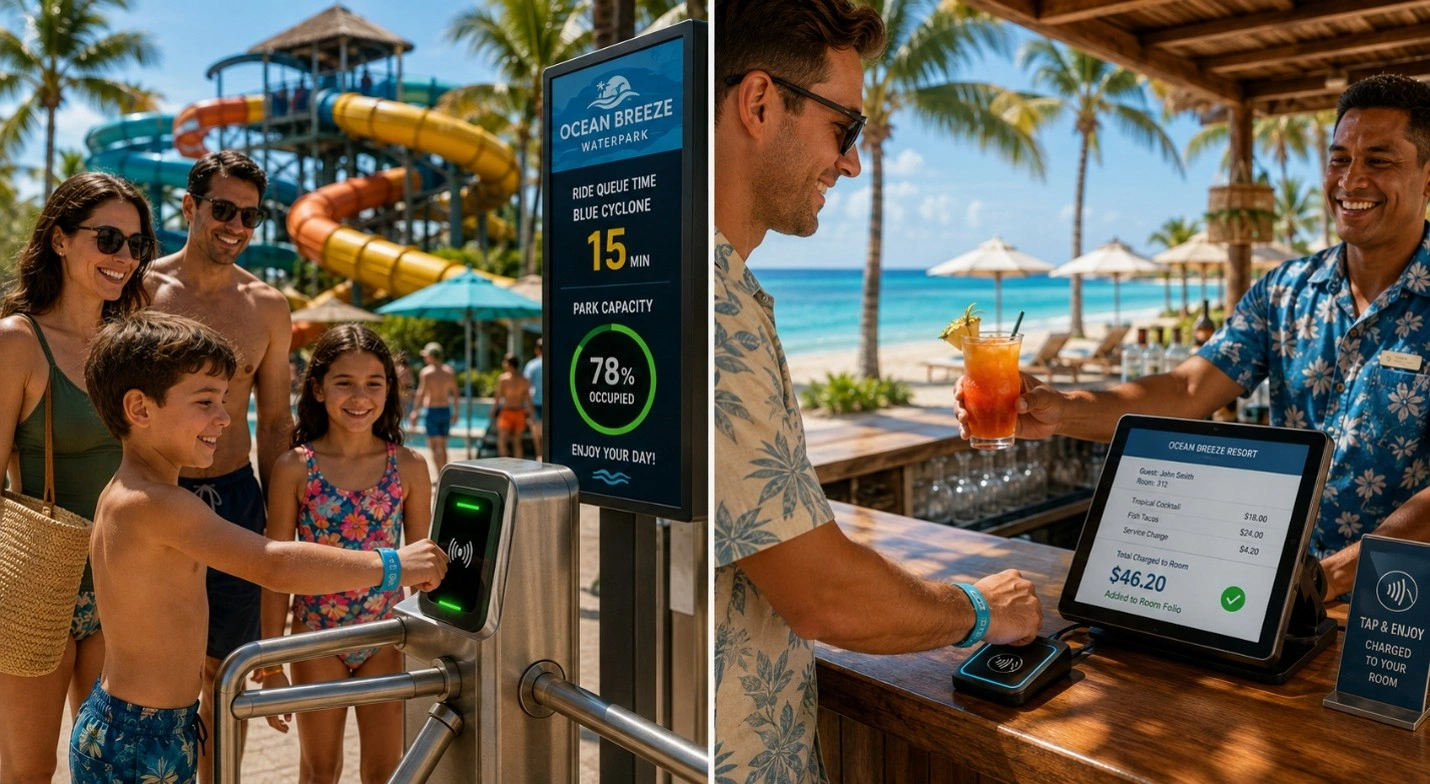
The RFID guest wristband is the defining technology deployment in modern resort operations, replacing paper vouchers, plastic keycards, and cash for all-inclusive and partially inclusive resort experiences. UHF wristbands allow waterpark turnstiles, pool access gates, beach club entry kiosks, and activity center check-in points to validate guest entitlements without contact, enabling hands-free access for guests arriving directly from pools or beaches. HF-compatible wristbands with NFC capability allow guests to charge F&B purchases, spa treatments, retail items, and activity bookings directly to their room folio at POS terminals, creating a fully cashless resort experience that increases average per-guest spending by removing payment friction at the point of purchase decision. AI spending pattern models analyze wristband transaction data to identify guests whose spending behavior suggests interest in premium dining, spa treatments, or guided excursions, generating personalized upsell recommendations delivered through in-resort digital signage or the resort’s mobile application before the guest’s departure date.
GAO supplies UHF and HF RFID wristband reader hardware and POS-integrated readers that resort F&B, activity, and amenity teams use to validate guest access entitlements and process cashless transactions across multi-outlet resort campuses.
Pool, Beach, and Spa Towel Tracking
Towel management is the most universally cited operational challenge at beach and pool resorts, where the combination of high guest volumes, dispersed towel exchange locations, limited staff accountability, and guest removal of towels from the property creates annual replacement costs that frequently exceed budgeted par levels by 30 to 50 percent. UHF RFID tags sewn into individual pool, beach, and spa towels allow reader-equipped towel exchange kiosks, beach attendant stations, and pool deck carts to record every towel issuance against a specific guest wristband, maintain a real-time count of towels in circulation by location, and flag towels not returned by a specified departure window for charge processing against the guest folio. AI towel management models analyze RFID-tracked issuance and return data to identify peak towel demand periods by day of week and resort occupancy level, predict daily towel par requirements by beach club zone and pool area, detect systematic return shortfalls indicating removal from the property, and generate automated late-return alerts to beach and pool attendants without supervisor intervention.
Waterpark and Aquatic Facility Capacity Management
Waterpark and aquatic facility operations at large resorts require continuous monitoring of rider counts, slide queue lengths, pool zone occupancy, and lazy river capacity to maintain guest safety compliance, optimize the guest experience, and prevent dangerous overcrowding at peak times. UHF wristband readers at waterpark turnstiles and pool zone entry gates automatically record guest entry and exit times, enabling real-time zone occupancy calculations that feed AI capacity management models. AI models analyze RFID-tracked zone occupancy data against maximum safe capacity thresholds, historical guest flow patterns by time of day, and the resort’s real-time check-in count to predict which zones are approaching capacity and recommend proactive crowd management interventions, including temporary attraction closures, activity relocation to lower-demand areas, and F&B promotion deployment to redistribute guest flow away from congested zones during peak periods.
GAO RFID wristband reader hardware configured for outdoor waterpark environments provides the continuous occupancy data that AI capacity management models require to maintain safe and enjoyable conditions across resort aquatic facilities during high-occupancy periods.
Marina, Watersports, and Recreational Equipment Lending
Resort marina and watersports operations managing fleets of kayaks, paddleboards, snorkeling sets, sailing dinghies, pedal boats, and motorized watercraft face daily inventory reconciliation challenges where equipment returned to the wrong dock or not returned before sunset creates cascading availability problems for the following day’s bookings. LF RFID tags on individual equipment items and UHF-compatible wristband readers at marina equipment check-out docks allow staff to record equipment issue and return events per guest wristband without manual log sheets. AI inventory models analyze RFID-tracked equipment utilization data to predict which equipment categories will reach availability constraints on high-demand days based on advance activity bookings and resort occupancy forecasts, enabling activity center managers to arrange equipment transfers between dock locations or implement waitlist management before guests arrive for their scheduled activity time.
Spa and Wellness Center Service Delivery and Booking Compliance
Resort spa and wellness centers managing treatment room schedules, hydrotherapy circuit access, relaxation lounge occupancy, and retail product recommendations face service delivery failures when guests arrive for treatments without confirmed bookings, overstay hydrotherapy circuit access allocations, or are directed to incorrect treatment rooms by front desk staff without a reliable guest identity verification mechanism. HF RFID wristband readers at spa reception check-in kiosks automatically retrieve the arriving guest’s treatment booking from the spa management software upon wristband tap, confirming the service appointment, the assigned therapist, and the treatment room assignment without requiring the guest to present a paper confirmation or state their name. AI scheduling models analyze RFID-tracked spa guest arrival and treatment duration data to predict therapist schedule adherence, identify treatment rooms running behind schedule, and recommend waitlisted guest upgrades or rebooking options proactively rather than reacting to guest complaints at the end of a delayed treatment.
Kids Club Access Control and Child Safety Tracking
Resort kids clubs providing supervised children’s programming face strict duty of care obligations where unauthorized collection of a child by an adult not registered as an authorized guardian creates both child safety risk and significant legal liability. HF RFID wristbands assigned to children at kids club check-in allow door readers at kids club entry and exit points to verify that adults collecting children are presenting a matching guardian wristband or authorized collection credential before the child is released. AI anomaly detection models monitor kids club RFID door access events to identify unauthorized collection attempts, collection outside scheduled session times, and instances where a child’s wristband has not been detected within the kids club zone for an unexpected period during a supervised session, generating immediate alerts to kids club supervisors.
Activity Scheduling, Golf Cart Tracking, and Course Operations
Golf and recreational activity operations at large resort properties require accurate tracking of golf cart utilization, tee time compliance, on-course guest location visibility, and activity booking fulfillment across multi-course or multi-venue resort facilities. UHF RFID transponders on golf carts combined with wristband readers at cart staging areas allow golf operations software to track cart utilization by round, guest group, and tee time, generating accurate cart turn data for maintenance scheduling and revenue analysis. AI golf operations models analyze RFID-tracked cart utilization patterns alongside tee time booking data to predict course throughput rates, identify tee time pacing issues that create on-course backups, and optimize cart fleet deployment across multiple course starts during peak weekend operations.
End-to-End Operational Workflow: RFID Data Capture to AI-Driven Resort Operations
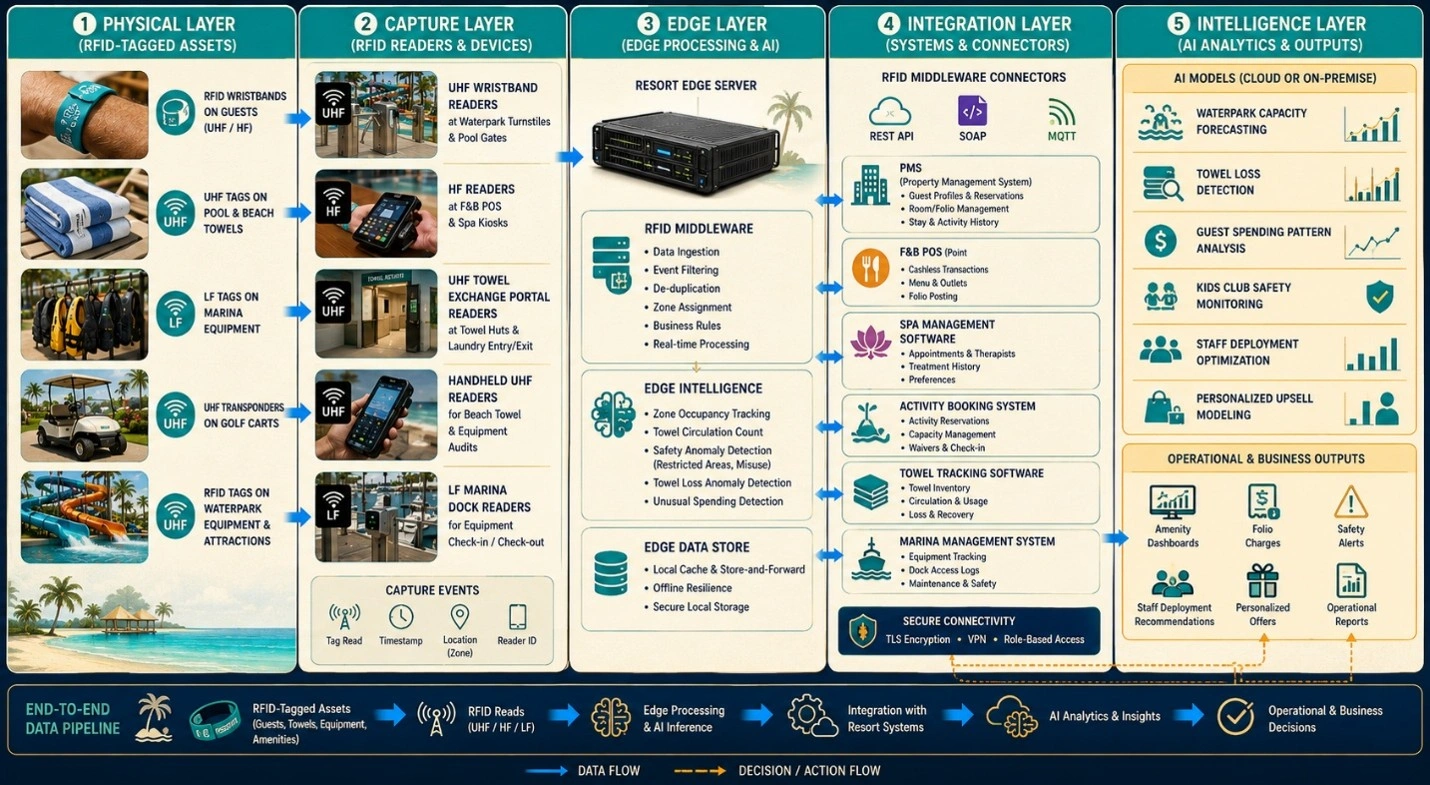
The operational data pipeline in an AI-enabled resort flows from guest wristband identification and asset tag reads across dispersed resort amenity locations through AI-driven decision output covering access control, capacity management, revenue capture, and staff deployment across the full resort campus.
Data Acquisition and RFID Event Capture
Fixed UHF wristband readers at waterpark turnstiles, pool and beach club entry gates, activity center check-in points, and golf cart staging areas continuously identify guest wristbands and equipment transponders as guests move through the resort. HF wristband readers at F&B POS terminals, spa reception kiosks, and retail checkout points capture wristband identity and transaction data in real time. UHF portal readers at towel exchange stations record towel issuance and return events linked to specific guest wristbands. Handheld UHF readers allow beach and pool attendants, activity staff, and equipment managers to conduct rapid inventory audits of towels, sports equipment, and rental items across dispersed outdoor locations. LF RFID readers at marina equipment docks confirm equipment identification for issue and return logging.
Edge Processing and Local Alert Generation
Resort edge servers deployed within the property network aggregate raw RFID wristband and asset tag events from readers distributed across the resort campus and apply zone assignment, occupancy calculation, and towel circulation tracking before forwarding structured data to resort management and AI analytics systems. Edge processing ensures that time-critical operational alerts, such as a waterpark zone approaching maximum safe capacity, a towel issue count exceeding the property’s end-of-day balance threshold, or a kids club unauthorized collection attempt, are generated with sub-second latency without requiring connectivity to cloud infrastructure. Edge AI models executing on property servers perform initial anomaly detection on wristband access event streams and towel circulation data, ensuring safety and security alerts reach supervisors even during periods of network connectivity interruption on large outdoor resort campuses.
Middleware Integration and PMS Connectivity
RFID middleware aggregates wristband reader events from amenity gates, F&B POS terminals, spa kiosks, towel exchange stations, and activity check-in points, mapping wristband identifiers to guest folios within the PMS. Standard integration protocols including REST APIs, SOAP web services, and MQTT synchronize wristband transaction events with Oracle OPERA, Infor HMS, Agilysys Stay, and other resort PMS environments. F&B wristband charges are posted to the guest folio in real time through the POS integration, eliminating end-of-stay reconciliation discrepancies that previously generated guest disputes at checkout. Activity booking system integration allows wristband check-in events at kids clubs, activity centers, and spa reception to automatically update booking fulfillment records, providing the activity revenue reporting data that resort operations managers require for daily yield analysis. Marina management software integration maps wristband equipment issue events to guest reservation records for activity billing and equipment accountability tracking.
AI Analytics and Resort Operations Decision Output
Structured RFID wristband and asset event data from middleware feeds AI analytics models deployed on cloud infrastructure or the resort’s privately hosted server environment. Time-series forecasting models predict waterpark zone occupancy trajectories and beach club towel demand by hour based on real-time check-in counts and historical guest flow patterns. Anomaly detection models monitor wristband access events for kids club unauthorized collection attempts and towel non-return patterns. Spending pattern analysis models identify guest cohorts with high F&B and activity transaction rates to support personalized upsell offer delivery. Staff deployment optimization models analyze amenity occupancy and transaction volume forecasts to recommend staffing adjustments at F&B outlets, towel exchange stations, and activity centers before demand peaks create service quality shortfalls. AI outputs are delivered as amenity capacity dashboards, guest folio alerts, staff deployment recommendations, and personalized guest communications within existing PMS, activity booking, and resort operations software interfaces.
AI and RFID Data Pipeline Workflow for Resort Operations
RFID Hardware, AI Software, and Deployment Infrastructure for Resorts
A complete AI and RFID solution for resort operations integrates purpose-selected hardware designed for outdoor, high-humidity, and high-UV environments, layered software, communication protocols, and deployment models. Component selection is driven by the outdoor physical environment of resort amenity areas, the high-throughput access validation requirements of waterpark and beach club entry points, guest comfort and wearability requirements for wristband devices, and the IT governance policies of the resort ownership or management company.
RFID Hardware for Resort Environments
UHF wristband readers for waterpark turnstiles and pool gate kiosks must be rated for continuous outdoor exposure, with IP67 or IP68 waterproof ratings appropriate for splash zone environments adjacent to pools and waterslide landing areas. UHF wristband antenna configurations at turnstile entry points are typically designed for a read range of 0.5 to 1.5 meters to balance reliable wristband detection with zone containment, preventing reads of guests in adjacent queue lanes or outside the intended gate zone. Resort guest wristbands embedding UHF RFID inlays must meet wearability requirements for multi-day outdoor wear, swimming pool chemical exposure (typically chlorinated or salt water), UV degradation resistance, and hypoallergenic silicone or fabric construction for guest comfort across age groups from young children to elderly guests. UHF RFID towel tags used in resort operations are typically heat-bonded or sewn-in flexible inlay constructions rated for 200 or more wash cycles at commercial laundry temperatures, compatible with the tunnel washer and flatwork ironer processing used in high-volume resort linen operations.
HF RFID readers at F&B POS terminals, spa reception kiosks, and retail checkout points typically use short-range ISO 14443A readers with NFC compatibility to support both dedicated RFID wristbands and guest smartphones with digital wallet wristband credentials. LF RFID readers at marina equipment docks and activity center equipment storage areas provide reliable identification of metal-bodied kayak paddles, diving tanks, and watercraft equipment where UHF signal absorption by water or metal content of the equipment makes UHF unreliable. GAO supplies UHF RFID wristband reader hardware, IP67-rated outdoor fixed readers, wash-rated towel tag products, and HF POS-integrated reader modules for resort operations, supporting properties from boutique eco-resorts through large all-inclusive convention resort complexes.
AI Models and Software for Resort Operational Intelligence
AI models deployed in resort operations include time-series forecasting models for waterpark and pool zone occupancy prediction trained on RFID wristband entry/exit data correlated with PMS check-in counts and historical weather patterns, supervised classification models for towel loss detection trained on wristband issuance and return records segmented by beach club zone and guest category, anomaly detection algorithms for kids club unauthorized access monitoring, guest spending pattern analysis models that identify upsell opportunity cohorts from F&B and activity wristband transaction streams, and staff deployment optimization models that correlate amenity occupancy forecasts with staffing schedules to recommend reallocation before demand peaks create service quality shortfalls. Resort AI models are trained on property-specific data reflecting the actual guest mix, amenity configuration, seasonal occupancy patterns, and F&B outlet layout of the specific resort or branded portfolio.
Supporting AI software includes RFID event normalization pipelines that reconcile wristband reads from outdoor readers operating in variable weather and RF conditions, feature engineering modules deriving guest movement and spending variables from raw wristband event streams, model retraining pipelines that update occupancy forecasting models seasonally as guest mix and occupancy patterns shift between peak, shoulder, and off-peak periods, and inference engines delivering predictions within PMS and resort operations dashboards.
Communication Protocols and Network Infrastructure
Fixed UHF wristband readers at waterpark and pool entry gates connect to the resort edge server via wired Ethernet or industrial Wi-Fi 6 access points, with cable routing that accounts for the trenching and weatherproofing requirements of outdoor pool and beach environments. Outdoor Wi-Fi 6 access points with IP67 enclosures and corrosion-resistant mounting hardware provide connectivity for handheld UHF readers used by beach and pool staff conducting towel audits and equipment checks across open outdoor areas. MQTT protocol streams wristband and towel event data from the resort edge server to cloud analytics environments. REST APIs provide the standard integration interface between RFID middleware and PMS, F&B POS, spa management, and activity booking software. For large island or beachfront resorts where wired infrastructure is impractical across the full property footprint, private LTE or 5G networks provide the wireless backhaul for RFID reader nodes in remote villa clusters, beach club outposts, and marina facilities.
Cloud and Server Deployment Models for Resort AI Solutions
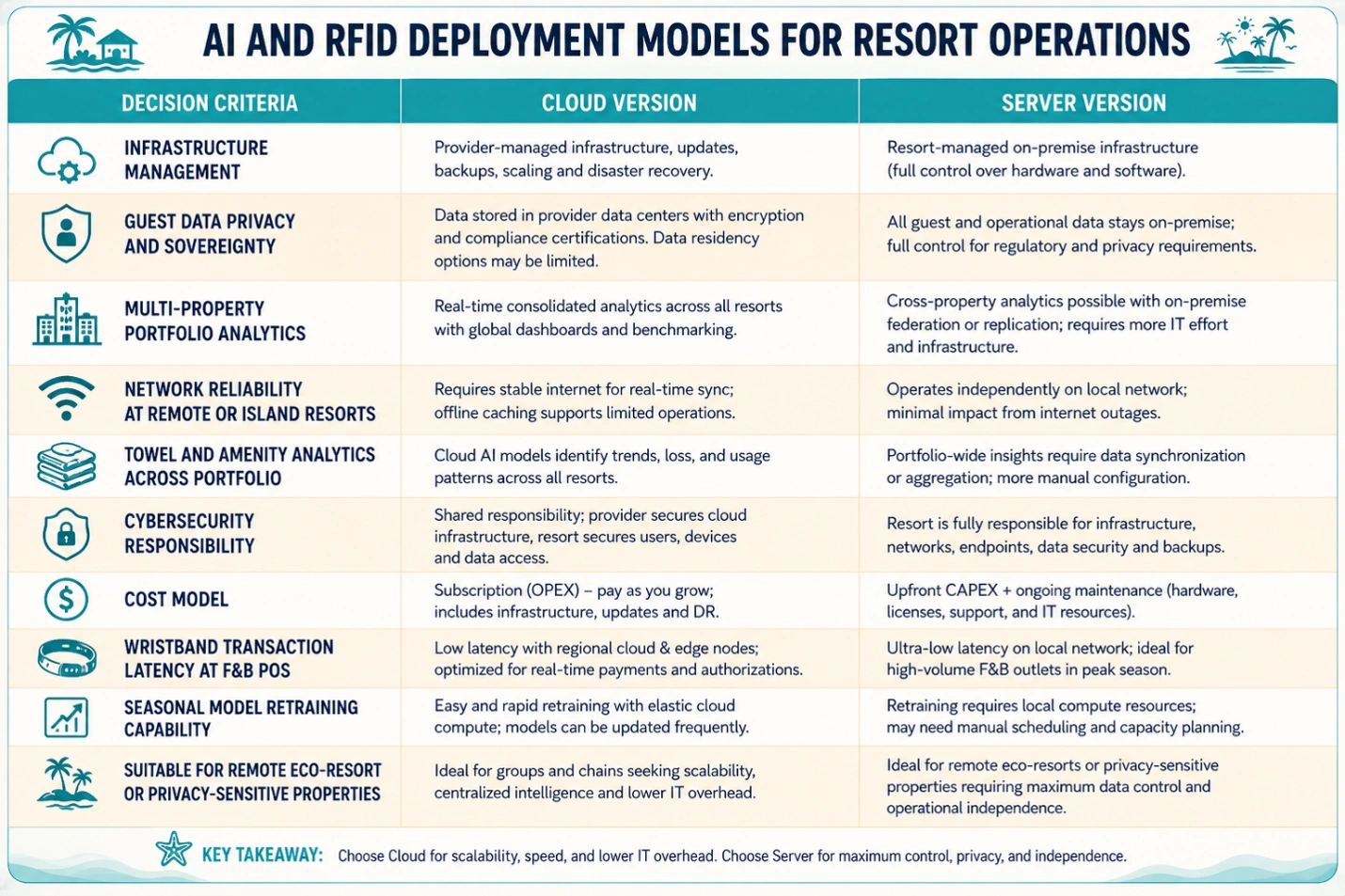
Resort AI and RFID solutions are deployed in two primary models based on the resort ownership structure, brand affiliation requirements, and network connectivity available across the property footprint.
The Cloud Version hosts AI analytics, towel lifecycle management, amenity capacity forecasting, guest spending analysis, and staff deployment optimization within cloud provider infrastructure such as AWS, Microsoft Azure, or Google Cloud. Cloud deployment is well suited to resort management companies and branded portfolio operators managing multiple properties across different geographies, where consolidated cross-property towel analytics, shared AI model training on aggregated wristband occupancy and spending datasets from dozens of resorts, and multi-property guest behavior pattern insights deliver operational intelligence that single-property deployments cannot achieve. Cloud-hosted AI models particularly benefit resort groups that operate properties across multiple seasonal markets, as aggregated wristband spending and activity data from a global resort portfolio provides the training dataset scale required for accurate personalized upsell recommendation models.
The Server Version deploys AI analytics and RFID middleware on privately hosted server infrastructure managed by the resort or its IT service provider. This includes on-property edge servers, resort group data center environments, and customer-managed virtual server deployments. Server deployment is preferred by independent luxury and eco-resort operators that manage guest data under strict privacy policies, by island and remote resorts where satellite internet connectivity cannot support reliable cloud data synchronization across the property, and by resort operators in jurisdictions with local data residency requirements for guest transaction and movement records. GAO supplies RFID hardware products and systems compatible with both cloud-connected and server-hosted AI environments, including outdoor-rated hardware configurations for remote island and beachfront resort deployments where weatherproofing and corrosion resistance are critical selection criteria.
AI and RFID Deployment Models for Resort Operations
Cybersecurity and Guest Data Protection in Resort Operations
RFID wristband systems in resort operations handle guest movement records, cashless spending transaction histories, kids club access logs, and amenity usage data that are subject to GDPR and CCPA guest data privacy obligations, PCI DSS compliance requirements for wristband-linked payment processing, and brand standard security audit requirements for access control systems. NFC-compatible wristband credentials using ISO 14443A with AES encryption provide secure tap-to-pay interactions that protect against wristband cloning attacks at F&B and retail POS terminals. Kids club wristband access control systems require audit-grade logging of all entry and exit events with timestamp, wristband identity, and staff authorization records retained for duty of care compliance documentation. Network segmentation separates the wristband access control and F&B payment network from the resort’s guest Wi-Fi network to prevent cross-network intrusion.
Key Benefits of AI and RFID Integration in Resort Operations
Combining AI with RFID identification across resort guest wristband management, towel tracking, amenity capacity management, F&B revenue capture, and activity operations delivers measurable improvements in towel cost control, guest spending, amenity safety compliance, staff efficiency, and guest experience quality. Each benefit reflects the operational scale and complexity specific to resort management rather than standard hotel outcomes.
Towel Loss Reduction and Beach Club Operational Cost Control
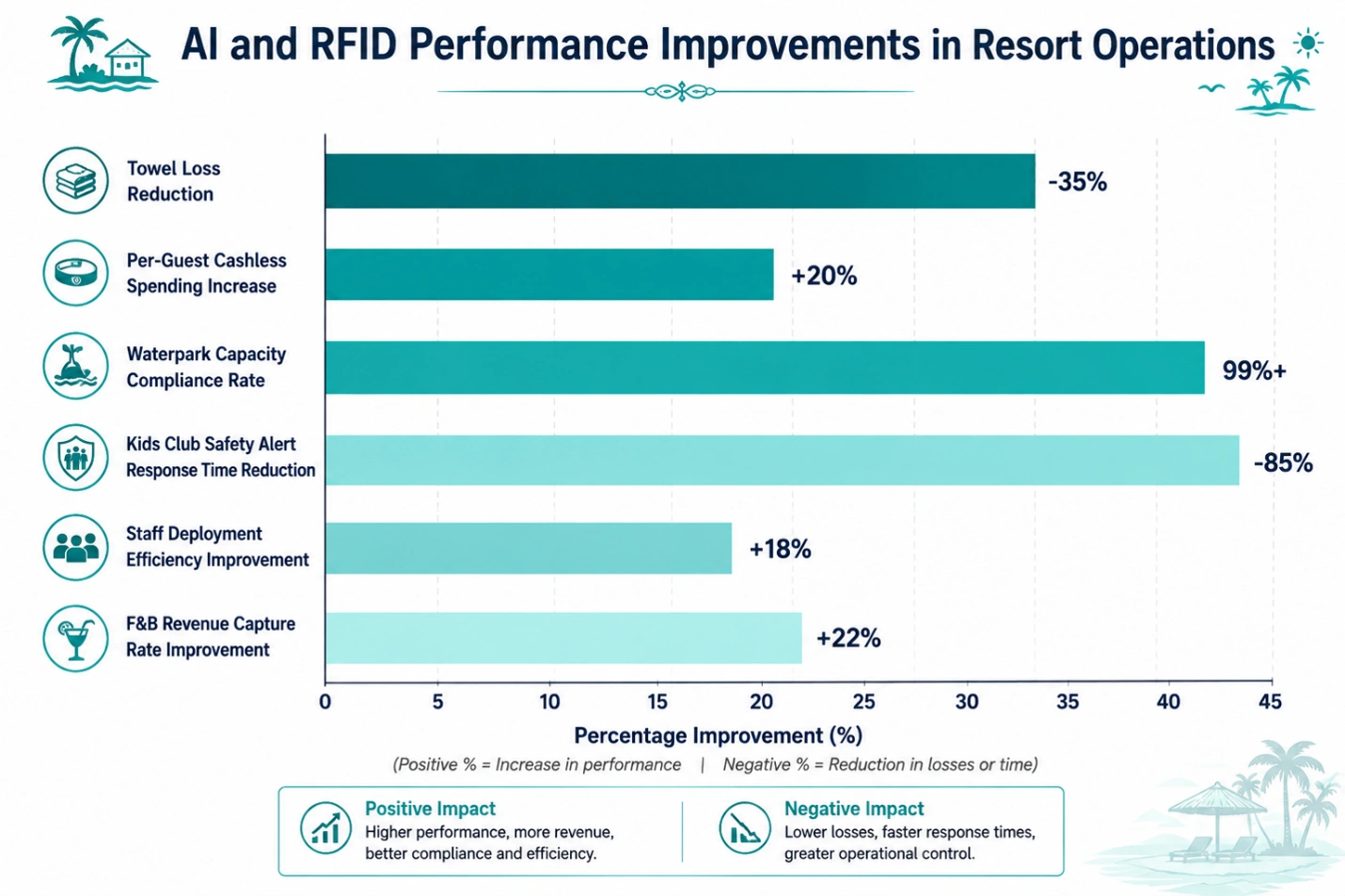
AI towel management models that analyze RFID-tracked wristband issuance and return event data can identify the specific beach zones, time windows, and guest departure patterns through which towels exit the resort without return, enabling targeted late-return charge enforcement and staff collection campaigns that address the actual loss pattern rather than blanket towel deposit policies that generate guest friction. Resorts implementing RFID-enabled towel tracking consistently report towel loss reductions of 25 to 40 percent compared with pre-implementation levels, directly reducing annual towel replacement expenditure that represents a significant variable cost at high-volume beach and pool resorts. AI daily par prediction models that forecast towel demand by beach club zone and time of day allow housekeeping and laundry operations to stage the right quantity of clean towels at each location before the morning rush, reducing the mid-morning stockout events that damage guest satisfaction scores.
Cashless Spending Uplift and F&B Revenue Capture
RFID wristband-enabled cashless F&B and activity payment removes the payment friction that causes guests at all-inclusive and resort properties to forgo discretionary purchases when they have not carried cash or a credit card to the pool or beach. Resorts that implement wristband cashless payment consistently report increases in average per-guest discretionary spending of 15 to 25 percent compared with cash or card-only payment environments, as the reduced effort of a wristband tap at the point of purchase decision increases impulse purchase conversion rates for beverages, snacks, and activity add-ons. AI guest spending pattern models that analyze wristband transaction histories can identify guests approaching their departure date who have not purchased premium dining or spa experiences, triggering personalized same-day promotional offers through the resort mobile app that convert at measurably higher rates than mass promotional messaging.
Waterpark and Amenity Capacity Safety Compliance
AI capacity management models that process RFID wristband zone entry and exit events in real time can generate automated capacity alerts when waterpark zones, pool decks, or beach club areas approach maximum safe occupancy thresholds, enabling operations supervisors to redirect guest flow before dangerous overcrowding conditions develop without relying on visual observation alone. Proactive capacity management driven by AI wristband occupancy data allows resort safety managers to maintain compliance with local bathing facility maximum capacity regulations and brand standard safety protocols during peak demand periods without the guest experience degradation caused by reactive queue closures and capacity enforcement interventions.
Kids Club Safety and Duty of Care Compliance
RFID wristband-based child identity verification at kids club entry and collection points provides an auditable electronic record of every child entry, session participation, and authorized guardian collection event that supports duty of care compliance documentation requirements and responds to parental inquiries about their child’s activity participation with accurate timestamped records. AI anomaly detection models that monitor kids club wristband access events can identify unauthorized collection attempts and out-of-schedule access events within seconds of occurrence, reducing the response time from potential breach to supervisor alert compared with manual headcount and register-based attendance tracking.
Staff Deployment Efficiency Across Dispersed Resort Amenities
AI staff deployment optimization models that combine RFID wristband amenity occupancy forecasts with activity booking data and F&B transaction volume predictions can recommend staffing adjustments at beach club towel stations, pool bar outlets, activity centers, and kids clubs before demand peaks create understaffing situations that drive negative guest experience scores. Resort operators that implement AI-driven staff deployment recommendations report reductions in overtime expenditure caused by reactive staffing responses to unexpected demand peaks, and improvements in guest satisfaction scores at amenity outlets where staff availability previously fluctuated based on supervisor intuition rather than data-driven demand forecasting.
AI and RFID Performance Improvements in Resort Operations
Implementing AI and RFID in Resort Operations: Technical Summary and Recommendations
AI and RFID solutions for resort operations address towel and equipment loss, waterpark and amenity capacity safety management, cashless revenue capture, kids club duty of care compliance, and staff deployment efficiency challenges that manual processes and paper-based tracking cannot resolve across the physical scale and operational complexity of a full-service resort property. The combination of UHF wristband access management, HF cashless payment, UHF towel tracking, and AI analytics creates a connected resort operations layer that gives property and portfolio managers the data accuracy needed to reduce towel and equipment replacement costs, increase per-guest cashless spending, maintain safety compliance at aquatic facilities, protect children in supervised programs, and optimize staff deployment across dispersed outdoor amenities.
Successful deployment begins with wristband selection that balances UHF read performance for high-throughput gate access, HF NFC compatibility for F&B cashless payment, guest wearability for multi-day outdoor use, chemical resistance for pool and ocean exposure, and size range compatibility across adult and child guests. Outdoor UHF reader hardware selection must account for IP67 or IP68 waterproof ratings, UV-stable enclosures, corrosion-resistant mounting hardware for beachfront environments, and cable routing appropriate for the trenching and conduit requirements of pool deck and beach club installations. PMS integration through a certified middleware connector should be validated to ensure wristband F&B charges post to guest folios in real time, towel late-return charges are applied accurately at checkout, and activity booking fulfillment records update automatically from wristband check-in events.
Resort operators should establish KPIs before implementation, including target towel loss percentage reduction, per-guest cashless spending increase, waterpark zone capacity compliance rate, kids club unauthorized collection alert response time, and staff deployment efficiency improvement targets. AI model training for occupancy forecasting, towel demand prediction, and spending pattern analysis requires three to six months of wristband event data collection before recommendation accuracy is sufficient to support operational decisions. Phased deployment starting with the main pool and beach towel tracking operation and the primary waterpark access control gate typically delivers the fastest measurable return on investment, as towel loss reduction and cashless spending uplift generate immediate and easily quantifiable financial improvements.
GAO supplies UHF and HF RFID wristband reader hardware, outdoor-rated fixed reader products, wash-rated towel tag systems, and POS-integrated HF reader modules for resort operators across the U.S. and Canada. With three decades of RFID product R&D investment and stringent quality assurance processes, GAO provides hardware selection guidance, outdoor site survey support, and deployment engineering expertise both remotely and onsite. To learn more about RFID hardware products, wristband reader configurations, and technical support for resort operations, contact GAO’s engineering team or explore the product catalog on gaorfid.com.
Building the Future of Hospitality AI and IoT with Aperture Venture Studio and GAO RFID Inc.
For more than three decades, GAO Group of Companies has invested heavily in R&D of industrial RFID, BLE, and IoT technologies, including the hardware products and systems that power AI guest wristband management, towel tracking, amenity capacity intelligence, cashless resort payment, and operational analytics for resort operations. Since generative AI was proven useful in hospitality and resort applications, we have been developing AI and IoT (including RFID and BLE) technologies, and we have founded Aperture Venture Studio to build, launch, and scale next-generation AI and IoT companies for resort operators and the broader hospitality industry.
Aperture has attracted top AI and IoT technical experts, entrepreneurial and operational executives, influential investors, and leading hospitality technology and resort management companies. We have also developed the Aperture Ventures Summit and TekSummit to advance discussions on AI and IoT in resort operations and guest experience management, building diversified technical communities for AI and IoT innovation across the global resort and hospitality industry.
We welcome you to join us as:
- Advisors, Co-founders, or Employees
- Investors, or
- Customers.