
AI and RFID for Rubber Manufacturing
Transforming Rubber Manufacturing with AI-Driven RFID Data
AI and RFID for rubber manufacturing combine automatic identification with AI-driven analysis to improve material traceability, batch control, work-in-process visibility, mold and tooling management, and production decision-making. UHF RFID, HF RFID, and LF RFID can identify bales, containers, reusable carriers, molds, tooling, curing assets, and selected production materials as they move through rubber mixing, compounding, extrusion, calendaring, molding, curing, finishing, inspection, and warehousing.
Artificial Intelligence of Things, commonly called AIoT or AI and IoT, combines artificial intelligence with IoT devices, connected equipment, and industrial systems. Within rubber manufacturing, RFID supplies reliable identity and movement events that AI can combine with production records, formulation data, machine status, quality results, maintenance history, and enterprise software. The result is a more complete operational record that supports anomaly detection, production optimization, genealogy analysis, predictive maintenance, and faster root-cause investigation.
For rubber manufacturers, the value is not simply knowing where an item is located. The larger objective is connecting the physical identity of a compound batch, carrier, mold, or finished lot with its production history so that decisions can be based on verified operational events rather than manual assumptions.
GAO has helped organizations deploy RFID and IoT hardware and systems for demanding identification and tracking requirements, bringing practical experience in selecting technologies for complex industrial environments.
AI-Driven RFID Identification Across the Rubber Manufacturing Enterprise
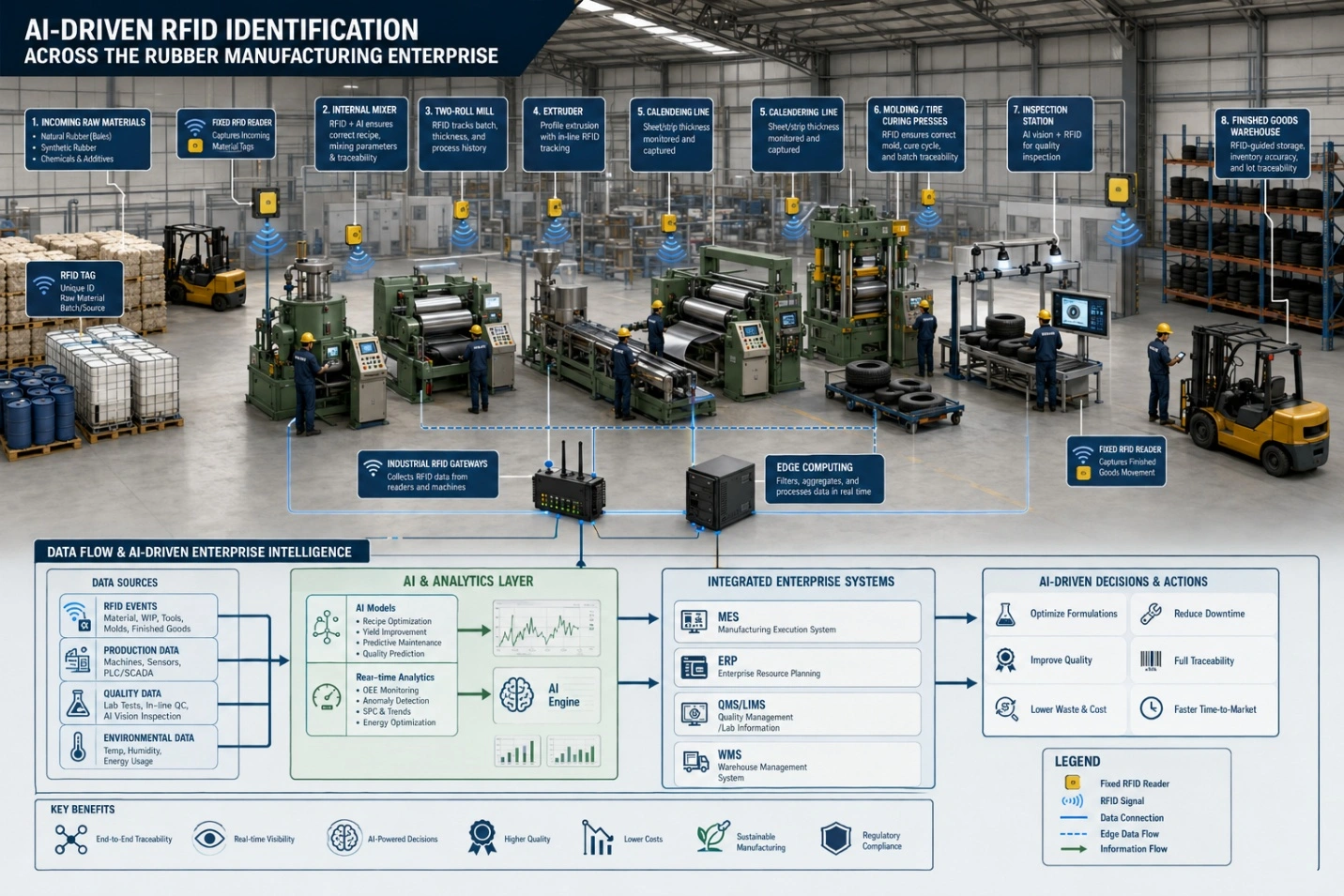
Why Rubber Manufacturing Needs Better Material Identity and Production Genealogy
Rubber manufacturing depends heavily on controlling the relationship between raw materials, compound formulations, process conditions, production lots, and finished products. A typical production problem can originate well before final inspection. Incorrect material selection, an unverified compound batch, a carrier assigned to the wrong work order, excessive dwell time before curing, or a tooling history gap can later appear as a quality issue without an obvious cause.
Rubber plants must manage materials and processes such as:
- Natural rubber and synthetic rubber bales
- Carbon black, silica, oils, resins, sulfur, accelerators, and other compounding ingredients
- Masterbatch and final compound lots
- Banbury or internal mixer batches
- Batch-off operations and cooling conveyors
- Two-roll milling and compound preparation
- Extrusion and profile production
- Calendaring and rubber sheet processing
- Compression, transfer, or injection molding
- Vulcanization and curing
- Tire, hose, belt, seal, gasket, and technical rubber production
- Flash removal, trimming, finishing, and visual inspection
- Laboratory testing and quality release
- Rework, scrap, quarantine, and material disposition
- Finished-goods staging and shipment
Manual labels and disconnected records can make it difficult to reconstruct the complete history of a defective lot. Barcode systems can remain useful, particularly where line-of-sight scanning is practical, but RFID can automate identification events when materials, carriers, or assets pass known control points.
The most valuable AI applications emerge when these identity events are connected to the manufacturing context. An AI model can analyze whether a specific compound lot experienced unusual routing, excessive queue time, repeated rework, abnormal press utilization, or correlations with particular molds, production shifts, or quality measurements.
The Difference Between Tracking and Manufacturing Context
A rubber manufacturer does not gain meaningful AI value merely by generating a large volume of tag reads. Raw RFID data often contains duplicate reads, missed reads, overlapping read zones, and events that require operational interpretation.
A useful system converts reads into business events such as:
- Compound batch entered the extrusion line.
- Material carrier arrived at the assigned molding cell.
- Mold was associated with a specific production lot.
- Finished lot completed inspection.
- Reusable carrier entered quarantine.
- Tooling exceeded its defined production cycle threshold.
AI can then evaluate sequences, patterns, and deviations across these events. This distinction is important because the AI system should work with meaningful production states rather than an uncontrolled stream of reader transactions.
How AI Uses RFID Data Across Rubber Manufacturing Operations
AI-driven identification systems can support different stages of rubber manufacturing, from incoming materials through finished-goods release. Each application should begin with a defined operational question and a measurable outcome rather than deploying RFID everywhere.
RFID-Driven Workflow: From Raw Materials to AI-Optimized Rubber Manufacturing
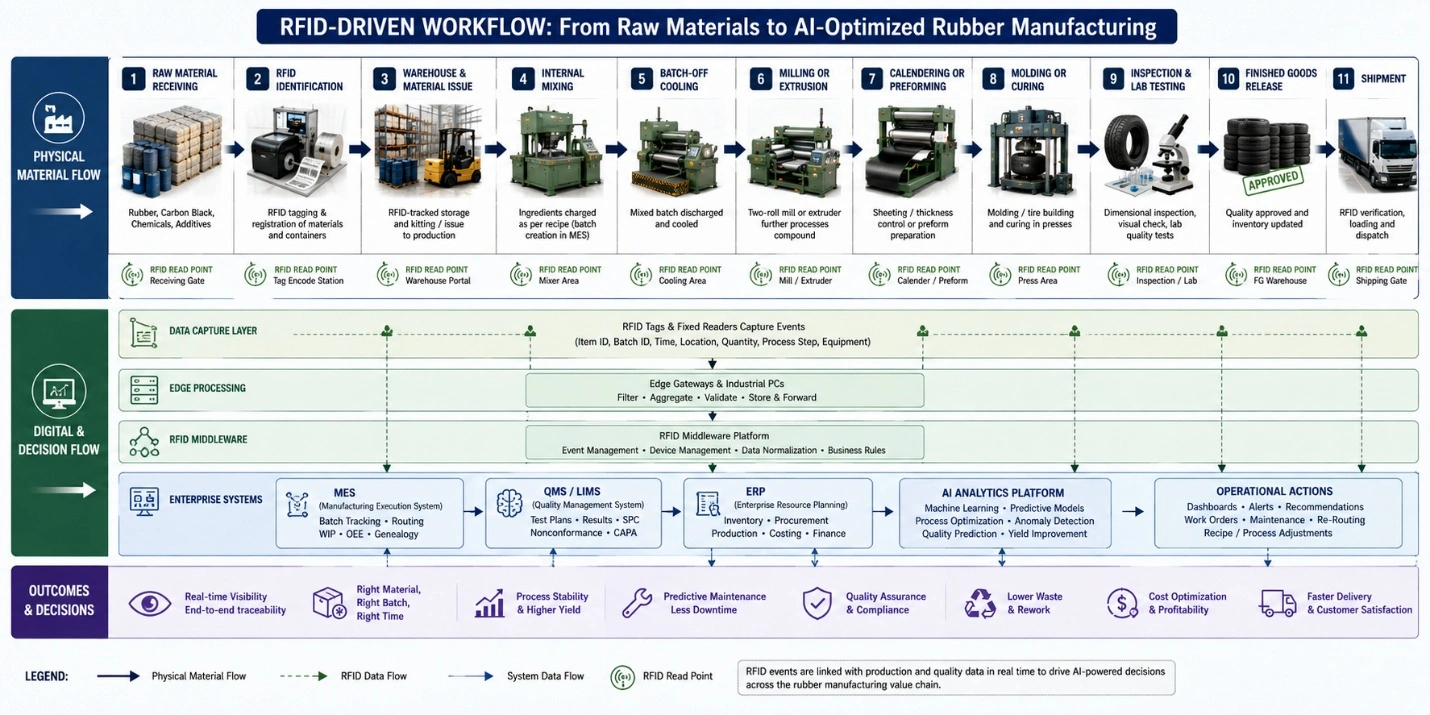
Raw Material and Compound Batch Traceability
Raw material traceability is especially important when manufacturers handle multiple rubber polymers, grades, compound formulations, additives, and supplier lots. RFID identification can associate a physical bale, container, gaylord, tote, or other material carrier with receiving records and internal batch information.
AI can analyze the resulting material genealogy to identify patterns associated with:
- Supplier-lot variation
- Compound batch deviations
- Material substitution errors
- Unusual storage or queue duration
- Repeated quality exceptions
- Higher scrap associated with particular material combinations
- Production sequences that correlate with defects
The practical objective is to make investigation faster. When a quality laboratory identifies an abnormality, production and quality teams can retrieve the relevant chain of material and process events rather than manually collecting information from paper records, spreadsheets, and separate software systems.
Work-in-Process Control Between Mixing, Forming, and Curing
Work-in-process control is a significant application because rubber compound and semi-finished components may move through multiple staging areas before the next process. Depending on the product, manufacturers may manage compound strips, sheets, extruded profiles, green components, uncured parts, trays, racks, or reusable carriers.
RFID events can establish when a work item entered, exited, or remained within a defined production zone. AI can use those events to estimate bottlenecks, identify abnormal dwell patterns, predict congestion, and detect routing deviations.
For example, an AI model may determine that a particular molding cell repeatedly receives work late because upstream extrusion output and carrier availability are interacting in a specific pattern. Operations personnel can investigate the actual constraint instead of responding only after schedule adherence has already deteriorated.
Mold, Tooling, and Production Asset Management
Molds and specialized tooling can represent critical production assets. Their condition, maintenance history, cycle count, location, and association with production lots may influence both equipment availability and product quality.
LF or HF RFID may be appropriate in applications where close-range identification and specific tag form factors are needed, while UHF RFID can support broader-area automated identification of larger tagged assets. Selection depends on the physical environment, read range, materials, tag placement, interference, and required process.
AI can combine tooling identity with:
- Cycle counts
- Press operating history
- Maintenance work orders
- Product and compound records
- Defect classifications
- Dimensional inspection results
- Tool change history
- Unplanned downtime records
This creates an opportunity for condition-based analysis. A manufacturer may discover, for example, that a defect pattern becomes more probable after a specific combination of production cycles and maintenance conditions. The purpose is not to replace engineering judgment but to prioritize investigation using evidence across many production records.
Finished-Lot Traceability and Quality Containment
Finished rubber products can require lot-level traceability for customer requirements, quality systems, warranty analysis, and controlled recall procedures. RFID identification can improve automated association between finished lots, inspection status, packaging units, and warehouse movements.
AI can support containment decisions by identifying related production populations when a quality issue is discovered. Instead of defining the affected population only by production date, the analysis can consider shared material lots, equipment, molds, shifts, process routes, and other verified production relationships.
GAO supplies RFID hardware and related IoT technologies that can support these identification requirements, with engineering teams able to help evaluate readers, tags, antennas, integration requirements, and deployment constraints.
Rubber Manufacturing Data Flow: From RFID Capture to AI-Driven Action
A successful AI and RFID implementation should treat RFID as part of a complete data flow rather than an isolated identification layer. The process begins with physical events and ends with an operational action.
AI-Enabled RFID System Architecture for Rubber Manufacturing
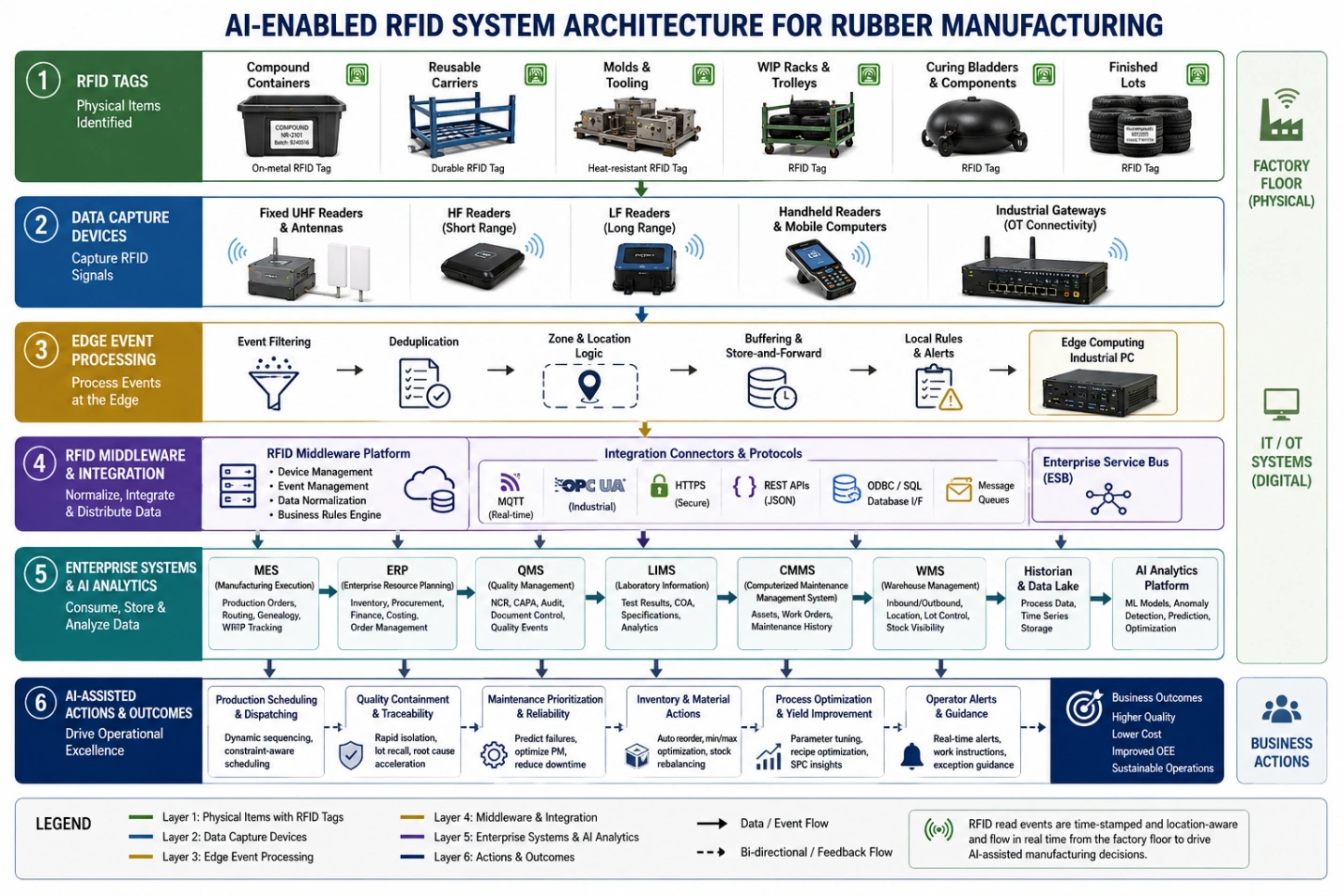
Data Acquisition at the Production Floor
Fixed readers can be positioned at receiving portals, warehouse transition points, mixer discharge areas, WIP transfer locations, molding-cell entrances, curing areas, inspection stations, and finished-goods movement points. Handheld readers may support exception handling, cycle counts, maintenance, quality investigation, and locations where fixed infrastructure is not justified.
Tag selection requires careful engineering. Rubber, carbon black, metal molds, press structures, moisture, high temperatures, and densely packed materials can affect read performance. Site testing should therefore precede final hardware selection.
Important commissioning activities include:
- Determining the required read zone rather than maximizing reader power.
- Testing tag orientation across actual production movements.
- Measuring read reliability under real conveyor speeds and handling conditions.
- Evaluating metallic tooling and machine interference.
- Testing tags against expected temperature, abrasion, chemicals, washing, and handling cycles.
- Preventing adjacent reader zones from producing ambiguous events.
- Establishing a process for tag replacement and asset reassignment.
Communication, Edge Processing, and Event Interpretation
Readers and industrial gateways can communicate through Ethernet, Wi-Fi, cellular connections, or other suitable industrial communication infrastructure. RFID data may be delivered using interfaces and protocols such as MQTT, HTTPS, REST APIs, OPC UA, or database connectors, depending on the equipment and software environment.
Edge processing is particularly useful when a rubber plant requires low-latency event handling or needs to continue essential identification functions during temporary external connectivity interruptions. Edge software can filter duplicate reads, apply read-zone rules, associate readers with production areas, and convert raw transactions into operational events.
For example, repeated reads of a tagged carrier near a curing press should not necessarily generate dozens of independent production events. Edge logic can determine whether the carrier has entered a defined zone, remained there, or exited it.
Middleware and Enterprise Software Integration
RFID middleware acts as the operational translation layer between identification hardware and manufacturing software. It can manage device connectivity, tag identities, event filtering, exception handling, and data normalization.
Relevant integrations in rubber manufacturing can include:
- Manufacturing execution systems for work-order and routing status
- ERP software for materials, inventory, purchasing, and production records
- Quality management systems for inspection and nonconformance records
- Laboratory information systems for compound and finished-product test results
- Computerized maintenance management systems for molds, presses, mixers, and tooling
- Warehouse management systems for raw material and finished-goods movements
- Industrial data historians for process and equipment records
- Production scheduling software for batch and work-order sequencing
The integration model should establish a consistent identity key. A tag identifier alone is rarely sufficient for business analysis. The system must know whether that identifier currently represents a compound container, reusable carrier, mold, production lot, inspection fixture, or another controlled asset.
AI Analytics and Operational Decisions
AI models can process RFID-derived events alongside manufacturing data using machine learning, anomaly detection, time-series analysis, optimization algorithms, and, where appropriate, computer vision or generative AI interfaces.
Potential decision outputs include:
- Flagging a routing deviation before a batch reaches the next process.
- Predicting WIP congestion based on current movement patterns.
- Identifying compound lots requiring additional quality review.
- Recommending investigation of molds associated with elevated defect rates.
- Detecting unusual carrier circulation times.
- Prioritizing maintenance based on asset usage and production history.
- Identifying possible genealogy relationships during a quality containment event.
Generative AI can also provide a natural-language interface to approved manufacturing data, allowing authorized engineers to investigate questions such as which production lots used a specific compound batch or which molds were associated with a defined defect classification. Access controls and validation remain essential because generated responses should not bypass controlled manufacturing records.
RFID, AI Models, and Deployment Components for Rubber Manufacturing
The technical solution should be designed around the specific rubber production workflow, product mix, identification object, and required decision latency. A tire component operation, industrial hose plant, molded gasket facility, and technical rubber compounder may use similar RFID principles while requiring different read zones, tag durability, software integration, and AI analysis.
RFID Hardware for Harsh Rubber Processing Conditions
UHF RFID is generally useful where longer read ranges and automated portal, conveyor, rack, or zone identification are required. It can support movement tracking of tagged carriers, containers, pallets, racks, and other suitable production objects.
HF RFID can be appropriate where controlled proximity reads and shorter read ranges are preferred. LF RFID can remain relevant for specialized identification applications requiring close coupling or where the physical characteristics of the application make other frequency ranges less suitable.
Hardware selection should consider:
- Rubber compound composition and surrounding materials
- Carbon black and conductive additives
- Metal molds, presses, racks, and tooling
- Required read distance and object orientation
- Process temperature and exposure duration
- Mechanical abrasion and repeated cleaning
- Tag attachment method
- Reader-zone density
- Conveyor or forklift movement speed
- Required identification accuracy
GAO can assist organizations with evaluating RFID tags, readers, antennas, handheld equipment, and supporting hardware for specific rubber manufacturing environments rather than relying solely on nominal laboratory specifications.
AI Methods for Production and Traceability Analysis
Different AI methods solve different manufacturing problems. Anomaly detection can identify unusual material movement or process sequences. Classification models can estimate the probability that a production population requires additional inspection. Time-series analysis can examine relationships between process timing, equipment utilization, and quality outcomes. Optimization methods can support sequencing and WIP decisions.
The strongest models usually depend on well-defined data preparation. RFID events should be timestamped, associated with reliable business identifiers, and synchronized with MES, quality, maintenance, and production records. Poor identity mapping can cause an apparently sophisticated model to produce unreliable recommendations.
A practical implementation should therefore begin with data quality rules, baseline KPIs, and human review before moving toward higher levels of automated decision-making.
Cloud Version and Server Version Deployment
A Cloud Version can host AI applications, analytics, dashboards, RFID middleware services, and integration components within managed cloud infrastructure. This model can be useful when a rubber manufacturer operates multiple facilities and needs centralized access to cross-site traceability and aggregated AI analysis.
A cloud-hosted deployment is often appropriate for:
- Multi-site compound and production networks
- Centralized quality and genealogy analysis
- Remote engineering access with controlled security
- Scalable storage of historical identification events
- Corporate reporting across multiple manufacturing locations
A Server Version places software on edge servers, customer-managed servers, private data centers, factory servers, or other privately hosted infrastructure. This model can be appropriate where local processing, controlled data residency, low-latency response, or restricted connectivity is important.
Hybrid deployment is frequently practical for rubber manufacturing. Edge or factory servers can continue processing critical RFID events locally, while selected historical and aggregated data is transmitted to centrally managed AI and reporting software.
Security should include role-based access control, authentication between devices and services, encrypted communications, network segmentation, audit logging, software patch management, backup procedures, and controlled integration accounts. Reader devices and gateways should not be treated as isolated equipment. They are part of the connected manufacturing environment and require the same lifecycle management discipline applied to other industrial computing assets.
Practical Deployment Scenario: RFID-Enabled Compound and Mold Genealogy
A realistic deployment may begin with RFID-tagged compound containers and reusable production carriers. Receiving personnel associate each container with approved material and lot records. As materials move to mixing and downstream production, fixed readers create verified transition events.
A mixer batch can then be associated with its production order, formulation, material lots, and subsequent WIP carrier. When the compound reaches molding or curing operations, the system can associate the work with the responsible production cell and, where operationally appropriate, the mold or tooling identity.
Quality inspection results become another part of the record. AI analysis can subsequently search for relationships among:
- Material lots and compound batches
- Production sequence and dwell time
- Specific molds and tooling histories
- Production cells and shifts
- Rework and scrap events
- Laboratory or inspection outcomes
- Finished-lot disposition
The deployment does not require every object in the factory to carry an RFID tag. A stronger engineering approach identifies the control points where automatic identification removes an important uncertainty. High-value starting points often include material handoffs, reusable carriers, molds, quarantine areas, and finished-lot release points.
RFID Deployment in Rubber Manufacturing: Physical & Digital Integration
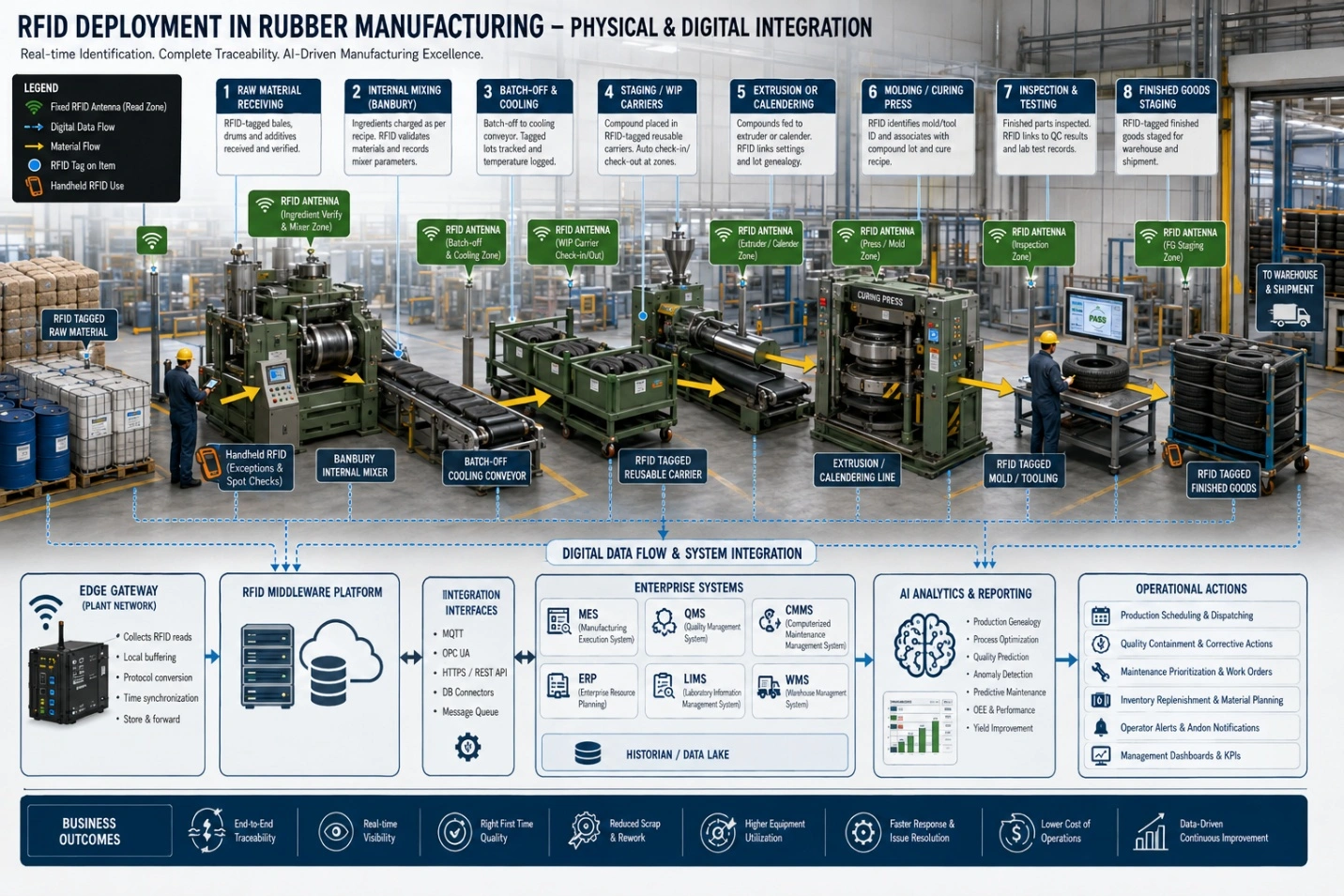
Key Technical Capabilities of AI-Driven RFID in Rubber Manufacturing
Combining AI with RFID identification improves rubber manufacturing because verified physical events can be analyzed together with production, quality, maintenance, and inventory records. The resulting system can move beyond basic identification toward operational analysis and evidence-based decision support.
Automated Production Genealogy
Rubber manufacturing genealogy can be difficult to reconstruct when information is distributed among receiving records, batch tickets, production logs, quality systems, laboratory results, maintenance records, and warehouse transactions.
RFID can automatically establish selected physical relationships as materials and production assets move through the plant. AI can then analyze those relationships across larger volumes of historical data.
A well-designed genealogy model can connect:
- Supplier and incoming material lots
- Rubber polymer and compounding ingredient records
- Masterbatch and final compound batches
- Internal mixer or Banbury batch records
- Batch-off and staging events
- Extrusion, calendaring, or preforming operations
- Molds, tooling, and production equipment
- Curing and vulcanization records
- Inspection and laboratory results
- Rework, scrap, and nonconformance events
- Finished lots and shipment records
The technical benefit is faster reconstruction of manufacturing history. Quality engineers can investigate a defined product population using verified identity relationships rather than depending entirely on manually entered production records.
AI-Based Routing and WIP Anomaly Detection
Rubber manufacturing often involves staging between processes. Compound batches and semi-finished products may wait for available equipment, tooling, operators, inspection, or downstream production capacity.
RFID-derived movement data can help an AI model establish normal operating patterns. The model can identify deviations such as a carrier appearing in an unexpected zone, excessive dwell time, repeated movement between staging locations, or a work item bypassing an expected process control point.
The value comes from recognizing operational deviation early.
Examples include:
- A compound carrier remains in a staging area significantly longer than comparable production batches.
- A green rubber component arrives at an unexpected curing or molding cell.
- A reusable carrier circulates repeatedly without completing the expected production route.
- Material assigned to a work order appears in an unauthorized production area.
- A finished lot reaches a shipping area before an expected quality release event.
These exceptions can be delivered to production supervisors, quality personnel, or automated workflow software depending on the criticality of the event.
Quality Correlation and Root-Cause Investigation
AI can examine relationships that are difficult to identify through manual spreadsheet analysis. A quality problem may not result from a single variable. It may be associated with combinations of material lots, compound age, tooling history, production sequence, process routing, or repeated rework.
Machine learning and statistical analysis can help prioritize possible relationships, although engineering validation remains essential.
A useful investigation may start with a defect population and compare it against verified manufacturing history. The analysis can examine whether affected products share:
- A specific rubber compound batch
- A supplier material lot
- A mold or tooling asset
- A curing press or production cell
- An unusual production sequence
- Extended WIP dwell time
- Repeated handling or rework events
- A common shift or production period
AI should support root-cause investigation rather than automatically declaring causation. Correlation must still be reviewed against process engineering knowledge, laboratory data, Statistical Process Control, Failure Mode and Effects Analysis, and controlled validation procedures.
GAO has supplied RFID and related identification technologies to organizations that require dependable physical identification in complex operating environments, helping technical teams evaluate how hardware data can support broader operational systems.
Operational and Business Benefits for Rubber Manufacturers
The benefits of AI-enabled RFID depend on the quality of implementation, the selected control points, and the availability of connected production data. Rubber manufacturers should define measurable outcomes before installation.
AI-Enabled RFID: Measurable Improvements Across Rubber Manufacturing Operations
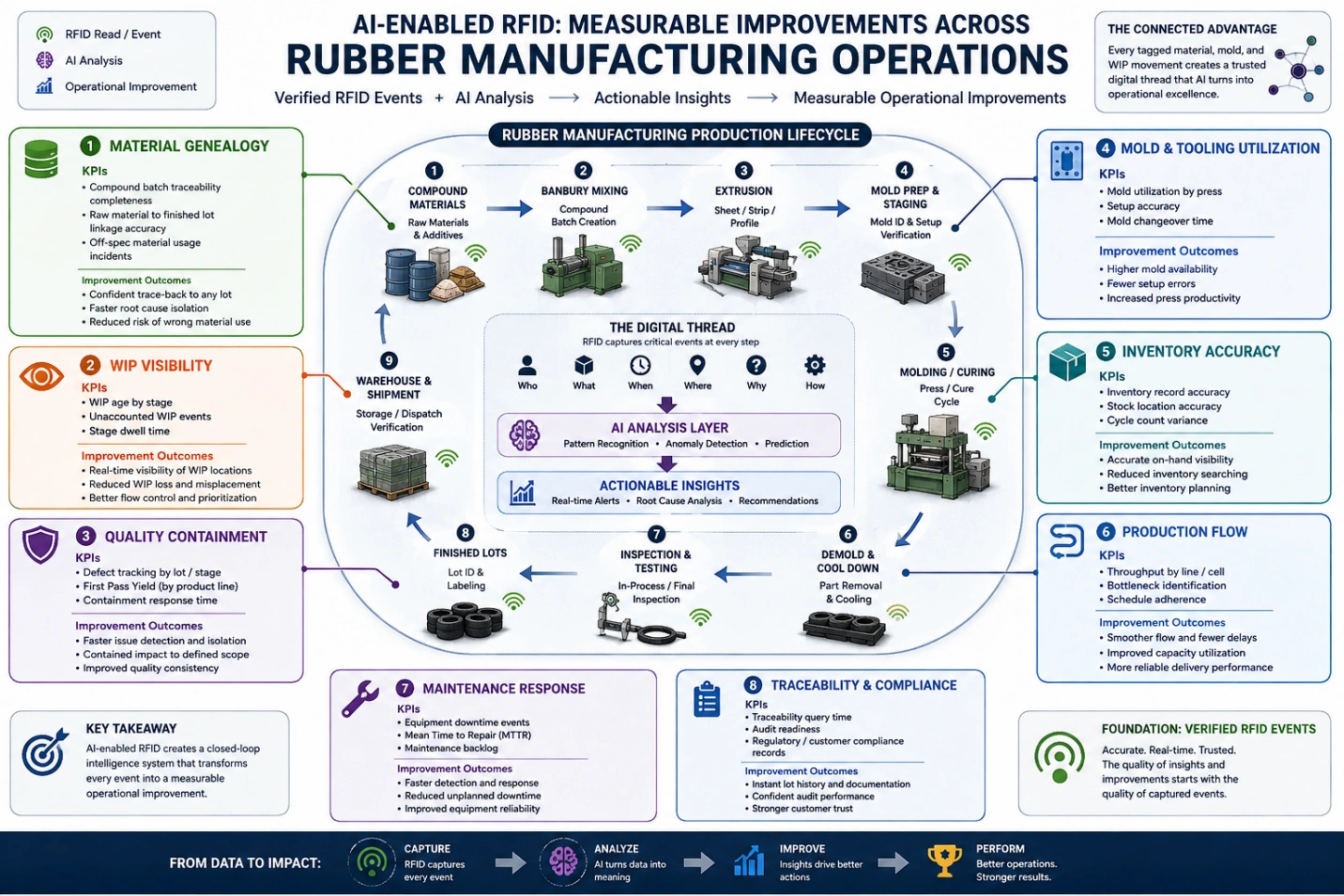
Faster Quality Containment
When a defect or nonconformance is discovered, the affected population must often be identified quickly. Traditional containment can require extensive manual investigation across production and material records.
A connected genealogy record can reduce the time required to determine which materials, batches, work orders, production assets, and finished lots may be related to the event.
The system can support more precise containment by separating:
- Confirmed affected production populations
- Potentially related lots requiring investigation
- Production populations with no verified relationship
- Material and finished-goods inventory requiring temporary hold
- Assets or tooling requiring inspection
More precise containment can reduce unnecessary production disruption while improving traceability discipline.
Improved WIP Visibility and Production Flow
AI analysis of RFID movement events can reveal where work accumulates, how long materials remain in intermediate stages, and whether carrier availability contributes to production constraints.
Useful KPIs can include:
- WIP dwell time
- Queue duration by production area
- Work-order cycle time
- Routing compliance
- Carrier circulation time
- Production throughput
- Schedule adherence
- Bottleneck duration
- Rework rate
- Scrap rate
The objective is to identify process constraints using actual movement records rather than relying only on planned routing or periodic manual observations.
Better Mold and Tooling Utilization
RFID identification can provide a more reliable operational history for molds, dies, fixtures, and other reusable production assets. When combined with maintenance and production records, AI can help identify assets that may require engineering review.
Potential improvements include:
- More accurate cycle and usage history
- Faster location of misplaced molds or fixtures
- Better maintenance scheduling
- Improved analysis of defects associated with particular tools
- Reduced production delays caused by unavailable tooling
- Better coordination between maintenance and production teams
The value is particularly significant where a specialized mold set or tooling configuration can become a production constraint.
Reduced Manual Identification Work
Operators, material handlers, quality inspectors, and maintenance teams often spend time searching for assets, confirming lot identities, recording movements, or reconciling discrepancies.
Automated identification can reduce selected manual transactions while preserving human verification for exceptions and critical quality decisions.
The appropriate design principle is not to automate every activity. The strongest business case usually targets identification points where manual data entry creates delays, errors, or traceability gaps.
Scalable Multi-Plant Traceability
A consistent identification and data model can support expansion across multiple rubber manufacturing facilities. Common definitions for batches, production events, carrier states, tooling identity, and quality status can make cross-site analysis more practical.
Cloud-hosted AI software may support centralized analysis, while local readers, gateways, and servers continue handling plant-level operations. GAO can support organizations evaluating RFID hardware and system components for deployments ranging from individual production cells to broader manufacturing operations.
Engineering Considerations for Reliable Rubber Manufacturing RFID
Reliable RFID deployment in rubber manufacturing requires field validation. A reader and tag combination that performs well in a laboratory may produce inconsistent results near metal presses, moving machinery, densely packed carriers, or high-temperature production processes.
Select the Identification Object Before Selecting the Frequency
Technology selection should begin with the object and workflow.
Questions that engineering teams should answer include:
- What physical object requires identification?
- Is the object a raw material container, reusable carrier, mold, pallet, rack, tool, or finished unit?
- What read distance is required?
- Will the object pass through a controlled portal or move unpredictably?
- Is a unique read event required at a specific process step?
- Is line-of-sight scanning acceptable?
- Will the tag experience heat, abrasion, chemicals, washing, compression, or repeated reuse?
- Does nearby metal create a detuning or reflection concern?
- Could multiple tagged objects create read ambiguity?
UHF, HF, and LF RFID should therefore be evaluated according to the actual manufacturing requirement rather than treated as interchangeable options.
Design Controlled Read Zones
Excessive reader power does not necessarily improve identification accuracy. In a dense production environment, an oversized read zone can create false associations.
A controlled read zone may require:
- Antenna placement based on actual object orientation
- RF shielding or physical separation where appropriate
- Directional movement logic
- Photoelectric or machine-state triggers
- Reader timing controls
- Software filtering and event deduplication
- Exception handling for missed or ambiguous reads
Commissioning should include testing during normal production conditions, not only during a demonstration with a single tagged object.
Establish a Tag and Asset Lifecycle
A tag identifier must remain correctly associated with the physical and business object it represents.
For reusable assets, procedures should define:
- Initial commissioning
- Association with the master asset record
- Reassignment controls
- Tag damage reporting
- Replacement procedures
- Decommissioning
- Historical record retention
Without lifecycle controls, the digital record can become unreliable even when RFID read performance is technically strong.
Measure Baseline Performance Before AI Deployment
AI projects should establish baseline operational data before attempting optimization. Recommended baseline measurements can include current WIP dwell time, inventory discrepancies, genealogy investigation time, routing exceptions, mold search time, scrap rate, rework rate, and production cycle variability.
This allows engineering teams to determine whether the solution is producing measurable improvement rather than simply generating additional data.
Cybersecurity and Data Governance for Connected Rubber Production
RFID readers, gateways, edge servers, middleware, and AI software become part of the connected manufacturing environment. Security must address both device-level and data-level risks.
A practical security program should include:
- Unique authentication for readers, gateways, and software services
- Encrypted communications where supported
- Segmented OT and IT network zones
- Role-based access to production and quality data
- Controlled API and database credentials
- Audit logging for critical configuration and data changes
- Firmware and software patch management
- Secure backup and recovery procedures
- Monitoring of abnormal device or integration behavior
- Formal procedures for reader replacement and decommissioning
Data governance is equally important. AI models should use defined and validated sources for production decisions. A discrepancy between RFID events and MES records should be visible as an exception rather than silently overwritten.
For regulated, customer-controlled, or highly confidential rubber products, organizations may also need to evaluate data retention, private hosting, cross-border data transfer, customer contractual requirements, and access segregation between plants or business units.
A Practical Implementation Roadmap for AI and RFID in Rubber Manufacturing
A phased approach can reduce technical risk and provide evidence for broader deployment.
AI-Enabled RFID Deployment Decision Tree for Rubber Manufacturers
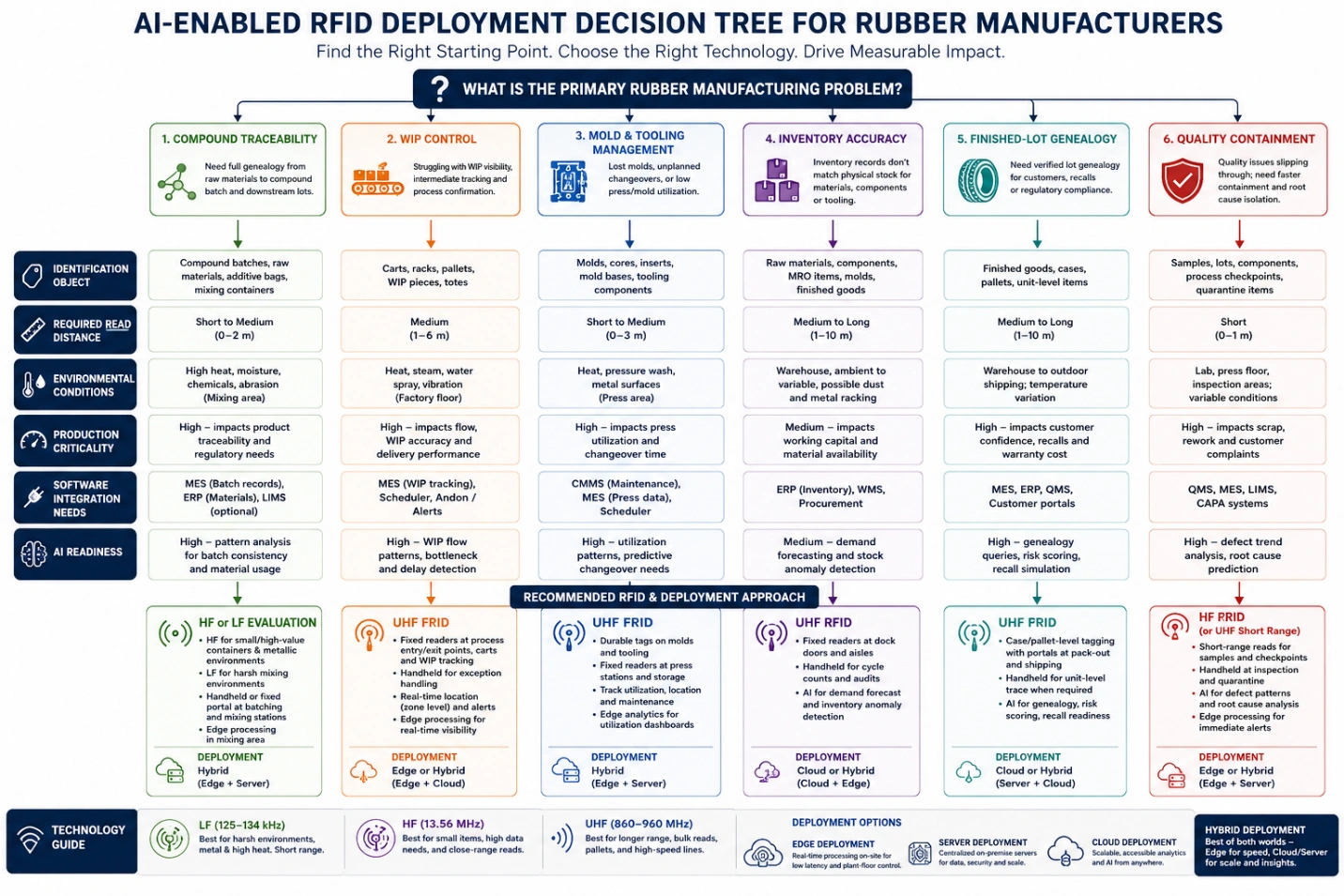
Start with a Defined Operational Problem
The first deployment should focus on a measurable issue such as compound genealogy, WIP routing, mold utilization, carrier circulation, or finished-lot traceability.
A strong initial scope identifies:
- The physical objects to be identified
- Required business events
- Existing software sources
- Expected users of the information
- Baseline KPIs
- Exception scenarios
- Security and access requirements
Conduct a Site and RF Assessment
Engineering teams should inspect the actual production environment and test representative objects.
The assessment should consider:
- Production equipment layout
- Metal surfaces and structures
- Object movement paths
- Material density
- Tag orientation
- Conveyor and forklift speeds
- Temperature exposure
- Potential RF interference
- Available power and network connections
- Maintenance accessibility
GAO can provide RFID hardware products and technical support to help organizations evaluate readers, antennas, tags, and supporting components against these practical deployment conditions.
Build the Data and Integration Layer
The next stage connects RFID events with manufacturing records. Integration should prioritize systems that provide essential production context, often including MES, ERP, QMS, LIMS, CMMS, WMS, and industrial data historians.
Data models should define:
- Asset identity
- Material and compound identity
- Production batch and work-order identity
- Location or read-zone identity
- Event timestamps
- Process state
- Quality status
- Exception codes
This structure creates a dependable foundation for AI analysis.
Validate AI Recommendations with Domain Experts
Initial AI recommendations should normally remain subject to human review. Process engineers, quality managers, production supervisors, maintenance specialists, and data teams should validate whether identified patterns are operationally meaningful.
This approach helps prevent a common failure mode in industrial AI projects: a statistically interesting result that does not represent a valid manufacturing cause.
Expand Based on Proven KPIs
Once a deployment demonstrates reliable identification and measurable improvement, the same design principles can be extended to additional production areas or facilities.
Scaling should preserve:
- Standardized identity definitions
- Repeatable commissioning procedures
- Documented reader-zone designs
- Consistent event models
- Cybersecurity controls
- Integration standards
- Hardware lifecycle management
- KPI measurement methods
Key Insights for AI and RFID in Rubber Manufacturing
AI and RFID can provide the greatest value when automatic identification is designed around the real control points of rubber production. Material genealogy, compound movement, WIP flow, mold history, tooling utilization, quality containment, and finished-lot traceability all depend on establishing reliable relationships between physical objects and manufacturing records.
Successful implementation requires more than installing readers. Engineering teams should validate RF performance around actual rubber processing equipment, create controlled read zones, maintain accurate identity mapping, integrate RFID events with production and quality software, and establish measurable KPIs before introducing advanced AI models.
The most effective projects usually begin with a specific operational uncertainty. Once reliable data is available, AI can analyze patterns across materials, production routes, equipment, tooling, quality outcomes, and operational timing. GAO can help organizations evaluate RFID products, identification systems, and technical deployment approaches for rubber manufacturing environments and broader chemical manufacturing operations.
Building the Future of Industrial AI and IoT with Aperture Venture Studio and GAO
For more than three decades, GAO Group of Companies has invested heavily in the R&D of industrial RFID, BLE, and IoT technologies. As AI became increasingly useful for industrial identification, traceability, and operational applications, we expanded our work in AI and IoT, including technologies relevant to RFID-enabled manufacturing, and founded Aperture Venture Studio to help advance AI and IoT solutions for industries such as rubber manufacturing and chemical production.
Aperture has attracted experienced AI and IoT technical experts, entrepreneurial and operational executives, influential investors, and leading companies. We have also developed the Aperture Ventures Summit and TekSummit to explore advanced AI and IoT topics and strengthen technical communities around these technologies.
We welcome participation as:
- Advisors, co-founders, or employees
- Investors
- Customers