
AI and RFID for Semiconductor Fabrication
AI-Driven Semiconductor Fabrication with Connected Asset and Material Intelligence
AI is changing semiconductor fabrication by turning large volumes of manufacturing, equipment, material, and traceability data into operational decisions. In a modern fab, AI can analyze information associated with wafers, FOUPs, reticles, chemicals, gases, spare parts, carriers, process tools, environmental conditions, and production workflows to identify abnormal conditions, predict operational risks, and improve scheduling and quality control. RFID provides one practical source of identity and location data, particularly for reusable carriers, containers, tools, maintenance assets, and materials where radio-based identification can complement existing factory automation systems. Combined with IoT sensors, manufacturing execution systems (MES), equipment data, computer vision, and edge or cloud analytics, these technologies support AIoT solutions for semiconductor manufacturing. The objective is not simply to tag fab assets. It is to establish reliable operational data that helps engineering and production teams reduce search time, strengthen traceability, improve material flow, detect exceptions earlier, and make better decisions without compromising contamination control, process integrity, or fab automation requirements.
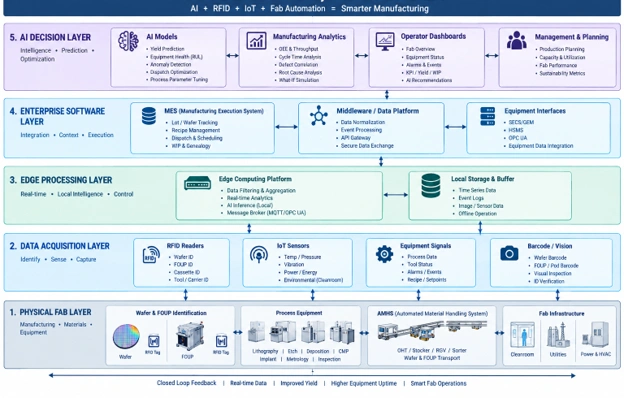
Semiconductor Fab AIoT System Architecture: AI, RFID, IoT & Smart Manufacturing
Why AI Matters in Semiconductor Fabrication
Semiconductor fabrication generates tightly coupled operational data across wafer processing, equipment engineering, facilities, material handling, quality management, and production planning. A single production lot can pass through numerous process steps involving lithography, deposition, etch, ion implantation, diffusion, cleaning, metrology, inspection, and other specialized operations. Each transition creates opportunities for delay, misidentification, equipment-induced variation, or process deviation.
AI becomes valuable when these data streams can be correlated rather than evaluated independently. Machine learning models can identify relationships between equipment states, process parameters, material movements, maintenance events, environmental conditions, and historical production outcomes. Computer vision can support inspection and anomaly detection, while time-series models can analyze equipment behavior for predictive maintenance. Generative AI can assist engineering teams with retrieval and interpretation of manufacturing records, maintenance documentation, alarms, standard operating procedures, and technical knowledge, subject to appropriate access controls and validation.
RFID contributes primarily by establishing machine-readable identity and movement information. Depending on the fab environment and asset type, UHF RFID, HF RFID, or LF RFID can be selected according to read range, operating environment, tag characteristics, interference conditions, and deployment constraints. RFID should complement rather than replace semiconductor-specific automation, equipment interfaces, barcode systems, sensor networks, and MES data.
From Asset Identification to Manufacturing Intelligence
The central engineering principle is to connect physical events with trustworthy digital records. A tagged FOUP, reticle container, maintenance tool, chemical container, or spare part can provide an identity that is associated with production context, location, custody, status, and relevant manufacturing transactions.
AI can then use this contextual data for applications such as:
- Predicting material-flow bottlenecks around critical process areas
- Identifying unusual movement patterns for production carriers
- Improving visibility into maintenance tools and spare parts
- Detecting potential inventory discrepancies
- Supporting genealogy and traceability investigations
- Correlating equipment downtime with material-handling events
- Prioritizing operational exceptions for engineering personnel
- Improving dispatching and production-flow decisions
- Identifying recurring causes of process interruptions
- Supporting facility and equipment utilization analysis
The highest-value applications generally occur where identification data is combined with existing manufacturing data rather than treated as an isolated RFID deployment.
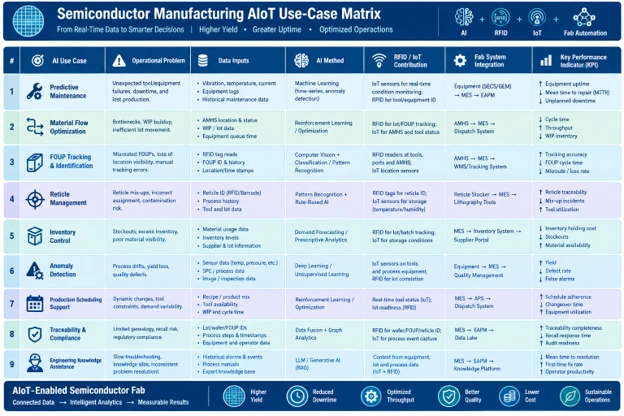
Semiconductor Manufacturing AIoT Use-Case Matrix: AI, RFID, IoT & Fab Automation
Semiconductor Fabrication Processes That Benefit from AI-Enabled Traceability
AI and connected identification can support several interconnected fab processes, but the implementation approach should reflect the physical and process characteristics of each area.
Wafer and FOUP Movement
Automated material handling systems move FOUPs between process equipment, stockers, load ports, and transportation routes. Accurate carrier identity and movement history can help manufacturing teams investigate delays, dwell-time anomalies, route deviations, and equipment starvation or blocking.
RFID can provide an additional identification mechanism for reusable carriers where tag placement, reader positioning, materials, and electromagnetic conditions are validated for the intended application. The resulting events can be passed through middleware and associated with MES transactions or material-control records.
AI models can use historical movement events to identify abnormal dwell times or recurring congestion patterns. This can help engineers distinguish isolated transport events from systemic flow problems.
Reticle and Photomask Control
Reticles are high-value production assets requiring strict identification, custody, storage, and handling controls. AI-assisted traceability can correlate reticle movement and utilization history with manufacturing schedules, equipment activity, and maintenance or handling events.
The engineering challenge is that identification hardware must not introduce contamination, interfere with handling equipment, or violate established reticle-storage and transportation requirements. RFID is therefore a candidate technology only where its physical implementation is compatible with the specific container and fab process.
Process Equipment and Tool Management
Semiconductor fabs contain extensive inventories of process tools, test instruments, calibration equipment, maintenance equipment, fixtures, and specialized engineering resources. Unplanned searches for equipment or tools can increase maintenance response time and prolong equipment downtime.
AI-driven asset management can analyze location histories, utilization, maintenance events, and work orders to identify underutilized assets, recurring shortages, and abnormal movement patterns. RFID can provide automated identification events at designated locations, reducing reliance on manual asset searches.
Spare Parts and Maintenance Operations
Equipment availability depends on timely access to qualified spare parts and maintenance resources. AI can analyze equipment failure histories, preventive-maintenance schedules, parts consumption, lead times, and inventory records to forecast potential requirements.
RFID-enabled identification can strengthen the physical-to-digital connection for selected spare parts, maintenance kits, calibration equipment, and reusable service assets. The objective is not simply to locate a component but to provide reliable information about what it is, where it is, its status, and whether it is available for the intended maintenance activity.
Chemical, Gas, and Controlled Material Visibility
Chemical and gas handling requires controls that go well beyond ordinary inventory tracking. Containers and associated handling equipment may require identification, status monitoring, authorization checks, environmental monitoring, and detailed audit records.
Where appropriate and permitted by site safety and process requirements, connected identification can supplement existing chemical management systems. AI can analyze consumption patterns, delivery schedules, abnormal usage, and inventory conditions. Safety-critical control decisions should remain subject to validated process controls and established fab procedures rather than relying solely on probabilistic AI output.
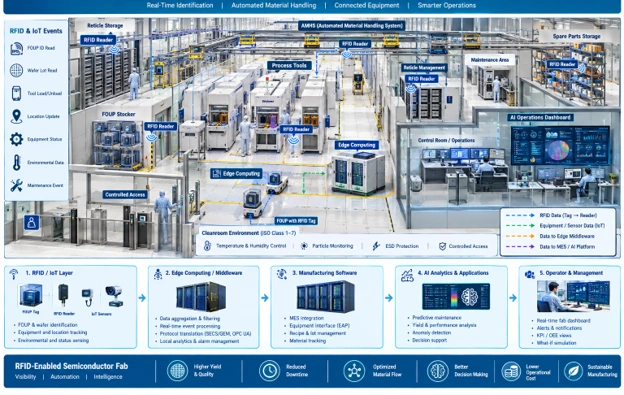
RFID Deployment in a Semiconductor Fabrication Facility: AIoT, Automation & Smart Operations
The Semiconductor Fabrication Data Workflow
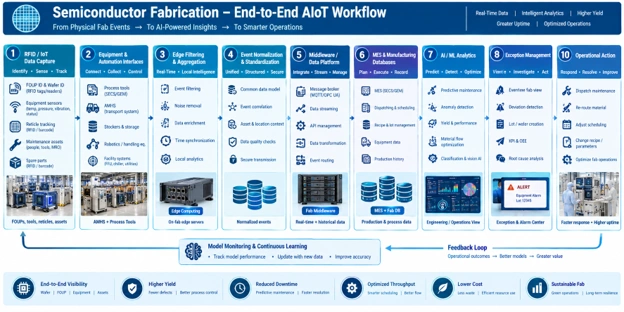
A useful AIoT solution begins with physical data acquisition and ends with an operational decision. Each layer should have a defined responsibility so that the system remains observable, testable, and maintainable.
Data Acquisition at the Fab Floor
The first layer consists of RFID readers, RFID tags, IoT sensors, equipment interfaces, barcode scanners, machine vision systems, and existing automation systems. RFID events may include tag identity, reader location, timestamp, direction, and read confidence. Sensor and equipment data can include temperature, vibration, pressure, power consumption, equipment states, alarms, and process-related measurements.
The data model should distinguish between an observed event and a confirmed business transaction. A reader detecting a tag does not automatically mean that a material transfer, process completion, or inventory transaction has been completed. Event validation and business rules are therefore important.
Edge Processing and Event Validation
Edge computing can filter duplicate reads, normalize timestamps, validate reader events, associate device identifiers with physical locations, and perform preliminary anomaly detection before information is sent to centralized systems.
This is particularly useful in semiconductor fabs where operational continuity, network resilience, low latency, and controlled data flows can matter more than sending every raw event directly to a cloud service.
Middleware and Data Normalization
Middleware converts heterogeneous device events into consistent operational records. It can manage RFID reader connections, device health, event filtering, tag-to-asset relationships, location mappings, APIs, message queues, and integration with manufacturing applications.
A well-designed data model should preserve event provenance. Engineering teams need to know when an event occurred, which device generated it, what asset identity was observed, and how the event was transformed before reaching an AI model.
MES and Manufacturing-System Integration
The manufacturing execution system remains central to production control and traceability. RFID and IoT events can supplement MES information by providing physical movement and asset-state context.
Depending on the fab’s existing systems, integrations may involve APIs, message brokers, database interfaces, equipment communication standards, industrial Ethernet, OPC-based interfaces, or other approved integration mechanisms. Integration should be designed around the fab’s established controls rather than creating an independent data silo.
AI Analytics and Operational Decisions
Once validated data is available, AI models can analyze patterns across time and across operational systems. A predictive-maintenance model might combine equipment telemetry, maintenance history, alarm sequences, and utilization. A material-flow model could combine carrier movement, equipment states, queue conditions, and production priorities.
AI output should be expressed as an actionable engineering signal, such as an anomaly score, predicted failure risk, congestion warning, inventory exception, or recommended investigation. Human engineers and established manufacturing controls remain important for validating decisions that can affect production.
Semiconductor Fabrication End-to-End AIoT Workflow: From RFID Data to Operational Action
AI Methods for Semiconductor Manufacturing Operations
Different fab problems require different AI methods. Selecting a model should follow the operational decision and available data rather than starting with a preferred AI technology.
Predictive Maintenance
Time-series machine learning can identify changes in equipment behavior that precede known failure conditions. Relevant inputs may include vibration, temperature, pressure, power signatures, alarm sequences, maintenance records, and utilization.
The practical value comes from earlier intervention and better maintenance planning, not simply from producing a prediction. Model performance should therefore be evaluated against maintenance lead time, false-positive rates, missed failures, equipment availability, and the operational cost of unnecessary intervention.
Anomaly Detection
Unsupervised or semi-supervised methods can identify unusual equipment, material-flow, or asset-movement behavior when labeled failure data is limited. This approach can be useful for identifying deviations from established operating patterns.
Fab engineers should still investigate whether an anomaly represents a genuine production issue, a sensor fault, a reader-placement problem, a software integration error, or an expected process change.
Computer Vision
Computer vision can support visual inspection, equipment-condition assessment, PPE verification, and selected material-handling or access-control applications. Vision systems should be evaluated for lighting, camera placement, contamination constraints, privacy requirements, latency, false positives, and integration with fab procedures.
Generative AI for Engineering Knowledge
Generative AI can assist engineers in searching maintenance records, equipment manuals, troubleshooting procedures, alarm histories, and internal technical documentation. Retrieval-augmented approaches can constrain responses to approved information sources.
Such systems should not be treated as autonomous process-control authorities. Access controls, source attribution, model evaluation, and human review are important when AI-generated recommendations could influence semiconductor manufacturing decisions.
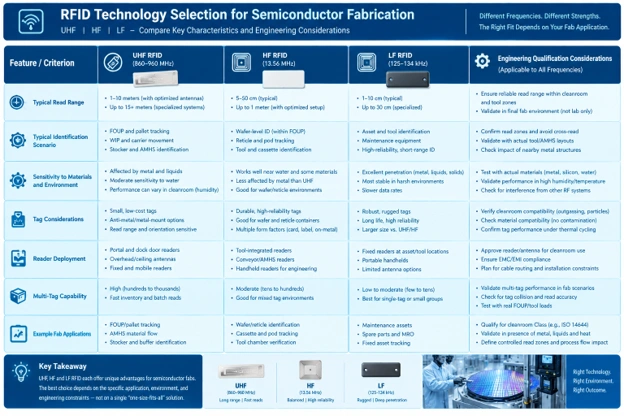
RFID Selection for Semiconductor Fabrication
RFID selection should be driven by the physical deployment point rather than by a blanket preference for one frequency band.
- UHF RFID can be considered where longer read ranges and multi-tag identification are useful, subject to the effects of metal, liquids, equipment structures, shielding, and reader placement.
- HF RFID can be appropriate for shorter-range controlled identification scenarios where the read zone can be deliberately defined.
- LF RFID can serve specialized short-range identification applications where its propagation characteristics and tag availability match the operational requirement.
- RFID tag construction, encapsulation, mounting method, thermal tolerance, chemical exposure, cleanroom compatibility, and durability should be evaluated as part of qualification.
- Reader antenna placement should be engineered to produce a controlled read zone and minimize unintended reads.
- RFID events should be correlated with asset identity and manufacturing context rather than treated as standalone location records.
GAO supplies RFID, BLE, and IoT hardware products and systems that can be evaluated for these types of industrial identification and monitoring requirements. For semiconductor fabrication, product selection should be based on the specific cleanroom environment, asset material, read-zone geometry, integration requirements, and validation criteria rather than on nominal reader specifications alone.
RFID Technology Selection for Semiconductor Fabrication: UHF vs HF vs LF
Semiconductor Fabrication Deployment Models and Technical Integration
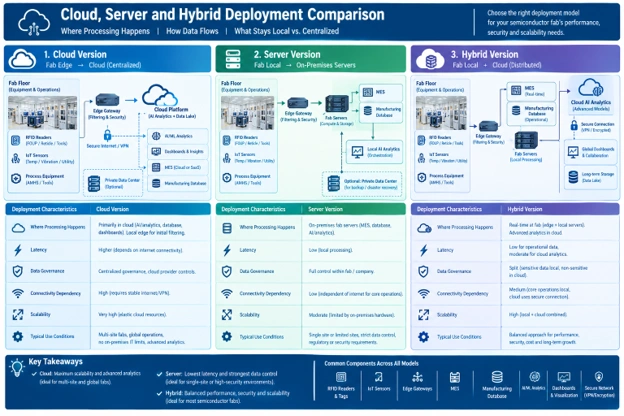
A semiconductor fabrication AIoT solution can be deployed using cloud-hosted software, privately hosted servers, or a hybrid arrangement. The appropriate model depends on fab connectivity, data-governance requirements, latency, cybersecurity controls, existing IT infrastructure, and the sensitivity of manufacturing information.
Cloud Version
A cloud-hosted deployment can centralize AI analytics, dashboards, historical data, model management, and cross-site reporting. This approach can be useful for organizations operating multiple fabs or requiring centralized engineering analytics.
Cloud deployment should not imply that every raw fab event must leave the manufacturing environment. Edge processing can filter, aggregate, and validate operational data before selected information is transmitted to cloud services.
Typical cloud functions include:
- Centralized historical data storage
- Fleet-level equipment analytics
- AI model training and evaluation
- Cross-fab KPI comparison
- Engineering dashboards
- Long-term trend analysis
- Controlled access to operational reports
- Remote technical support and system administration
Cloud services should be connected through approved security controls, identity management, encryption, network segmentation, and data-transfer policies.
Server Version
A server deployment places software on customer-managed edge servers, fab servers, private data centers, or other privately hosted infrastructure. This approach can be appropriate where manufacturing data must remain within controlled facilities or where existing operational technology networks restrict external connectivity.
A server-based solution can support local RFID event processing, database services, middleware, dashboards, and AI inference. Local deployment can also reduce dependence on wide-area connectivity for operational functions.
GAO can support customers evaluating RFID and IoT hardware and associated system requirements for either deployment model. The final configuration should be determined through a site survey and technical review covering network topology, reader locations, equipment interfaces, data ownership, cybersecurity requirements, and operational workflows.
Hybrid Deployment
Hybrid deployment is often practical for semiconductor fabrication. Real-time event collection and critical operational processing can remain close to the fab, while selected historical data and AI analytics can be transferred to centralized infrastructure.
A representative arrangement includes RFID readers and sensors connected to edge gateways, local event processing connected to MES and manufacturing databases, and controlled synchronization with cloud or private analytical services. This separates time-sensitive manufacturing operations from computationally intensive analytics without requiring a single processing location for every workload.
Cybersecurity and Data Integrity
Security must be designed across the physical, network, software, and AI layers.
Important controls include:
- Network segmentation between operational technology and corporate networks
- Role-based access control for manufacturing and engineering applications
- Device authentication and credential management
- Encryption for data in transit and at rest
- Secure configuration of RFID readers, gateways, and servers
- Audit logging for configuration and data changes
- Software patch and vulnerability management
- Controlled API access between RFID middleware and MES
- Backup and recovery procedures
- Monitoring for abnormal device or network behavior
- Data-quality validation before information reaches AI models
AI security also requires protection against contaminated training data, unauthorized model changes, inappropriate access to manufacturing records, and unvalidated automated recommendations.
Cloud, Server, and Hybrid AIoT Deployment for Semiconductor Fabrication
Integrating RFID with Semiconductor Manufacturing Systems
RFID becomes operationally useful when its events are integrated into existing manufacturing processes. A standalone RFID dashboard can show where tagged assets were observed, but it cannot necessarily explain whether the asset is available, authorized, associated with the correct lot, or ready for a specific manufacturing operation.
Integration should therefore establish relationships between physical identities and manufacturing records.
Relevant systems can include:
- Manufacturing Execution Systems (MES)
- Manufacturing Operations Management (MOM) software
- Equipment management systems
- Automated Material Handling Systems (AMHS)
- Stocker control systems
- Warehouse or spare-parts inventory software
- Computerized Maintenance Management Systems (CMMS)
- Enterprise Resource Planning (ERP) systems
- Laboratory Information Management Systems (LIMS)
- Quality management software
- Building and facility management systems
- Data historians
- Industrial IoT gateways
- Engineering data repositories
- AI and machine-learning services
The integration layer should normalize RFID observations and connect them to identifiers used by existing systems. Depending on the implementation, integration can use REST APIs, message queues, database interfaces, industrial protocols, or approved manufacturing-system interfaces.
Event Quality Is a Manufacturing Requirement
RFID systems can generate duplicate observations, missed reads, unexpected reads, and ambiguous location events. Semiconductor fabrication applications should therefore define measurable data-quality requirements.
Examples include:
- Read accuracy at designated transfer points
- Event timestamp accuracy
- Reader availability
- Duplicate-event filtering rate
- False-read rate
- Tag association accuracy
- Location-event confidence
- Message delivery reliability
- Integration transaction success rate
- Data synchronization latency
A useful commissioning process should test these parameters under realistic operating conditions rather than relying exclusively on laboratory measurements.
Engineering Considerations for Fab RFID Deployment
Semiconductor facilities create environmental and operational constraints that must be considered before installation.
Cleanroom and Contamination Requirements
RFID tags, mounting materials, reader housings, cables, adhesives, and other components may need evaluation for cleanroom compatibility. The correct specification depends on the particular fab environment and the location of the equipment.
A tag that works effectively in an ordinary industrial warehouse may not be suitable for a cleanroom or controlled manufacturing area. Material selection, surface cleanliness, particle generation, outgassing, chemical exposure, and maintenance procedures should therefore be included in qualification.
Electromagnetic and Physical Constraints
Metal equipment, enclosed process tools, liquids, shielding structures, and narrow transfer paths can affect RFID performance. Antenna orientation and reader placement can be more important than nominal reader range.
Site surveys should examine:
- Reader-to-tag distance
- Tag orientation
- Equipment materials
- Metal structures
- Liquids and chemical containers
- Interference sources
- Required read zones
- AMHS movement paths
- Operator access
- Maintenance access
- Cable routing
- Network availability
Tag Placement and Asset Qualification
The tag should be mounted where it can be reliably read without interfering with the asset’s intended function. For reusable semiconductor carriers and specialized containers, the mounting location may require engineering validation.
Tag durability should also be assessed against the actual lifecycle of the asset, including cleaning, handling, temperature exposure, chemical exposure, vibration, and repeated transport.
AI and RFID Applications Across Fab Operations
The strongest business cases typically combine an operational problem, a reliable source of physical data, an appropriate AI method, and a measurable KPI.
| Semiconductor fabrication application | AI contribution | RFID contribution | Example KPI |
|---|---|---|---|
| FOUP movement analysis | Detect abnormal dwell and routing patterns | Carrier identity and movement events | Average dwell time |
| Material-flow optimization | Predict congestion and bottlenecks | Physical movement context | Cycle time |
| Equipment maintenance | Predict failure risk | Maintenance-tool and spare-part visibility | MTBF / MTTR |
| Reticle control | Detect unusual handling or custody patterns | Container identification | Traceability accuracy |
| Spare-parts management | Forecast demand | Automated asset identification | Stockout rate |
| Tool utilization | Analyze usage patterns | Tool location and movement | Utilization rate |
| Inventory reconciliation | Identify discrepancies | Automated identity events | Inventory accuracy |
| Engineering investigations | Correlate physical events with process history | Event timestamps and locations | Investigation time |
| Production scheduling support | Estimate flow constraints | Material-location context | Schedule adherence |
| Exception management | Prioritize abnormal conditions | Physical event evidence | Response time |
Semiconductor Fab AIoT KPI Dashboard: RFID, Equipment, Material Flow & Production Analytics
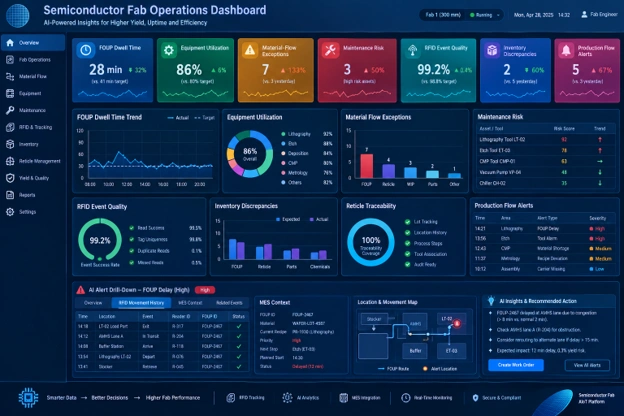
Business and Operational Value of AI-Enabled Fab Visibility
AI-supported traceability can create value by improving the quality and timeliness of information available to manufacturing and engineering teams.
Faster Exception Investigation
When asset movement, equipment states, and manufacturing transactions share consistent timestamps and identifiers, engineers can reconstruct operational events more quickly. This can reduce the manual effort required to determine whether a delay originated in transportation, equipment availability, material handling, or another part of the manufacturing workflow.
Better Equipment Availability
Predictive analytics can identify equipment conditions associated with future failures or maintenance requirements. Combining equipment telemetry with maintenance-asset and spare-part information can make the resulting workflow more actionable.
The benefit should be measured using operational outcomes such as mean time between failures, mean time to repair, unplanned downtime, maintenance response time, and production availability.
Improved Material Traceability
Automated identification reduces dependence on manual recording at selected transfer points. Better traceability can strengthen investigations involving carrier movement, inventory discrepancies, material custody, or production interruptions.
Reduced Search and Handling Time
Engineers and technicians can spend substantial time locating specialized maintenance equipment, calibration resources, fixtures, and spare parts. Automated identification and location history can reduce unnecessary searches and help teams determine the last known operational location.
Improved Manufacturing Decision Support
AI can combine multiple sources of operational information to prioritize exceptions and reveal relationships that are difficult to identify manually. The practical objective is decision support that is explainable enough for engineers to validate and act upon.
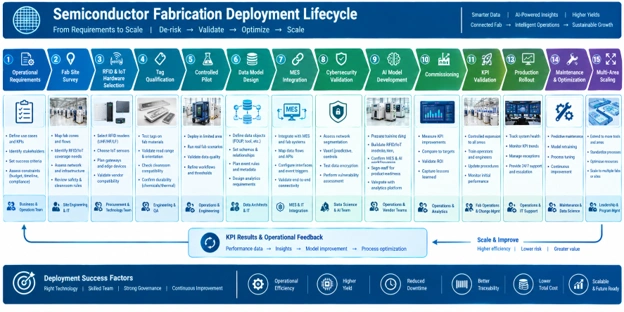
Implementation Recommendations for Semiconductor Fabrication
A successful deployment should begin with an operational problem rather than a decision to install RFID or AI independently.
Define the Manufacturing Use Case
Select a measurable problem such as excessive FOUP dwell time, maintenance-tool search time, spare-parts discrepancies, equipment downtime, or traceability gaps. Establish the baseline KPI before selecting hardware or AI models.
Perform a Site Survey
Document fab layouts, material routes, equipment locations, tag mounting points, reader locations, network connectivity, environmental conditions, cleanroom requirements, and existing identification technologies.
GAO’s RFID and IoT hardware expertise can support this engineering stage by helping evaluate appropriate readers, tags, antennas, gateways, and associated equipment for the intended operating conditions.
Build a Controlled Pilot
A pilot should cover a limited physical area and a clearly defined workflow. Testing should occur with actual operating equipment and representative assets whenever possible.
The pilot should measure:
- RFID read performance
- Data completeness
- Reader and gateway availability
- Integration latency
- False and duplicate events
- Asset-location accuracy
- Operator acceptance
- AI model precision and recall where applicable
- Impact on the selected manufacturing KPI
Integrate Before Scaling
Scaling a poorly integrated identification system can create a larger data-quality problem. The pilot should therefore establish the data model, API interfaces, event-processing rules, cybersecurity controls, device-management procedures, and operational ownership before expansion.
Validate AI Against Manufacturing Outcomes
AI models should be evaluated using manufacturing metrics rather than model accuracy alone. A predictive-maintenance model with strong statistical performance may still have limited operational value if its warnings arrive too late or generate too many false alarms.
Establish Lifecycle Management
Production deployments require ongoing management of RFID tags, readers, antennas, gateways, software, databases, AI models, and integration interfaces. Maintenance procedures should include device health monitoring, firmware and software updates, calibration where required, spare hardware, backup procedures, and model-performance monitoring.
Semiconductor Fabrication Deployment Lifecycle: From RFID/IoT Requirements to Scalable Production
Key KPIs for AI and RFID Semiconductor Fabrication Projects
A deployment should have a balanced KPI framework covering manufacturing performance, data quality, equipment reliability, and financial or operational impact.
Useful measures include:
- FOUP or carrier dwell time
- Material transport cycle time
- Equipment utilization
- Equipment availability
- Mean time between failures (MTBF)
- Mean time to repair (MTTR)
- Unplanned equipment downtime
- Maintenance response time
- Spare-parts stockout rate
- Inventory accuracy
- Asset-location accuracy
- RFID read accuracy
- False-read rate
- Duplicate-event rate
- Event-processing latency
- MES transaction success rate
- Production schedule adherence
- Lot cycle time
- Engineering investigation time
- Exception response time
- AI false-positive rate
- AI false-negative rate
- Predictive-maintenance lead time
- Model drift indicators
The most meaningful KPI is usually the one tied directly to the original manufacturing constraint. RFID read accuracy, for example, is important, but a high read rate has limited business value if the resulting events are not correctly associated with manufacturing transactions.
Practical Recommendations for GAO Customers
Semiconductor fabrication projects benefit from a staged approach that combines manufacturing engineering, automation, IT, cybersecurity, and operational expertise.
- Start with one high-value manufacturing workflow rather than attempting fab-wide deployment immediately.
- Establish a baseline KPI before introducing AI or automated identification.
- Treat RFID events as operational data that must be validated and contextualized.
- Select UHF, HF, or LF RFID according to the physical use case and environmental constraints.
- Test tag materials and mounting methods against actual fab conditions.
- Use edge processing where low latency, resilience, or local data governance is important.
- Integrate with MES and existing manufacturing systems instead of creating an isolated tracking database.
- Keep safety-critical and process-control decisions under validated manufacturing controls.
- Monitor AI model performance after production deployment rather than treating model validation as a one-time task.
- Design cybersecurity, device management, backup, and recovery procedures before scaling.
- Measure business outcomes such as downtime, cycle time, investigation effort, inventory accuracy, and maintenance performance.
GAO has supplied RFID, BLE, and IoT hardware products and systems to organizations across the United States and Canada, including Fortune 500 companies, leading research and development organizations, universities, and government agencies. Headquartered in New York City and Toronto, Canada, GAO is recognized among the leading global B2B and B2G RFID and BLE suppliers. Its engineering-oriented approach combines product R&D, quality assurance, remote technical support, and onsite support where required.
Building the Future of Industrial AI and IoT with Aperture Venture Studio and GAO RFID Inc.
For more than three decades, GAO Group of Companies has invested heavily in R&D for industrial RFID, BLE, and IoT technologies. As generative AI became increasingly useful for industrial applications, we expanded our work across AI and IoT, including RFID and BLE, and founded Aperture Venture Studio to develop and scale AI and IoT solutions relevant to manufacturing, semiconductor fabrication, and other industries.
Aperture has attracted AI and IoT technical experts, entrepreneurial and operational executives, investors, and leading companies. We have also developed the Aperture Ventures Summit and TekSummit to discuss advanced AI and IoT topics. These activities have helped build technical communities around industrial AI and IoT. We welcome semiconductor manufacturers, technology partners, advisors, investors, and customers interested in advancing practical AIoT solutions to connect with us.
Advancing Semiconductor Fabrication with AI-Driven Manufacturing Intelligence
AI and RFID can contribute to semiconductor fabrication when they are applied to clearly defined manufacturing problems and integrated with existing fab systems. The greatest value comes from connecting physical identities and movement events with MES records, equipment data, maintenance information, and AI analytics.
A successful implementation should emphasize cleanroom suitability, electromagnetic performance, reliable event processing, cybersecurity, interoperability, AI validation, and measurable manufacturing outcomes. GAO can help organizations evaluate RFID, BLE, IoT hardware, and related system requirements as they design and deploy connected semiconductor manufacturing solutions. Readers can learn more about GAO’s technology products, engineering capabilities, and technical support when evaluating an AI-enabled traceability or manufacturing-visibility project.