AI and RFID for Senior Living Communities
AI-Driven Senior Living Operations with RFID Visibility
AI and RFID for Senior Living Communities combines AI-based analytics with UHF RFID, HF RFID, and LF RFID to improve resident safety, asset visibility, inventory control, staff workflows, and facility operations. The practical objective is not simply to identify tagged objects or people, but to convert location, movement, utilization, and operational events into decisions that senior living teams can act upon. RFID readers, tags, gateways, mobile devices, access points, and facility systems provide event data, while AI models can identify unusual movement patterns, predict replenishment needs, detect process deviations, and prioritize operational responses. Applications can extend across assisted living, memory care, independent living, skilled nursing areas where applicable, dining services, housekeeping, maintenance, laundry, medication-support workflows, and emergency preparedness. Properly designed solutions also separate resident-identifiable information from ordinary asset telemetry and apply role-based access, audit controls, and appropriate data retention.
AI and RFID in Senior Living Communities
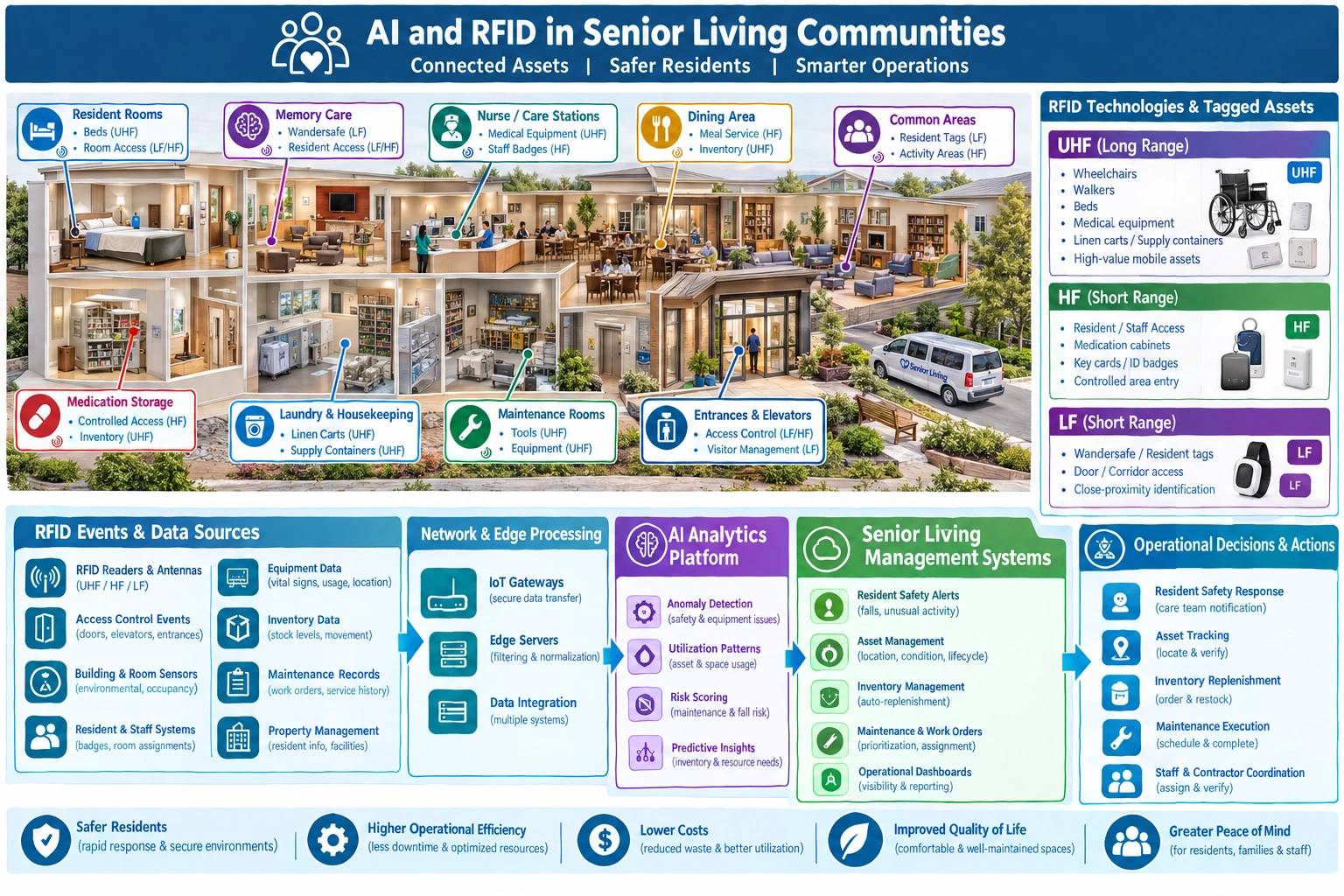
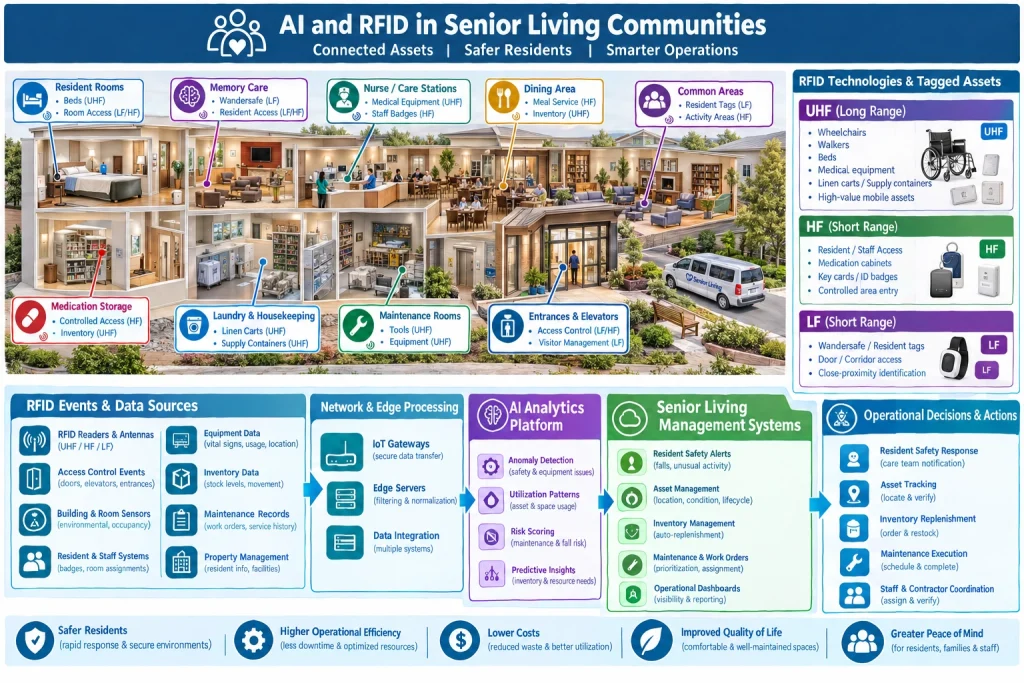
AI and RFID connect senior living assets, resident safety, maintenance, inventory, and operational systems through real-time data processing and analytics, enabling faster responses and smarter management decisions.
What AI and RFID Mean for Senior Living Communities
Senior living communities operate a hybrid environment that combines residential real estate, hospitality, healthcare-support activities, dining, facilities management, transportation, security, housekeeping, and resident services. That combination creates a large number of physical assets and time-sensitive workflows that are difficult to manage through manual records alone.
RFID provides a machine-readable identity for selected physical items or controlled events. AI adds a decision layer that can evaluate those events against schedules, historical utilization, room or zone context, maintenance records, inventory levels, staffing patterns, and operating rules.
A practical senior living deployment can therefore answer questions such as:
- Where is a wheelchair, lift, infusion-related equipment item, emergency cart, linen cart, or other tagged asset?
- Which equipment remains unused for unusually long periods?
- Which supplies are approaching replenishment thresholds?
- Which equipment has moved outside its permitted zone?
- Which operational events differ from normal movement patterns?
- Which maintenance assets or equipment require attention based on usage history?
- Which housekeeping, laundry, or dining workflows are experiencing recurring delays?
- Where are tagged assets accumulating rather than returning to designated storage locations?
AI does not replace resident-care judgment. Its role is to prioritize information, identify patterns, reduce manual searching, and support staff decisions.
The distinction is important because senior living facilities contain both residential and care-related environments. A resident-facing application should therefore be designed around privacy, consent, operational necessity, and appropriate data governance rather than treating every person as a trackable asset.
Senior Living Applications for AI-Enabled RFID Operations
Resident Safety and Controlled-Zone Monitoring
Senior living communities may use RFID-supported systems to monitor designated movement events around entrances, exits, elevators, memory care zones, medication-related areas, or other controlled locations. LF RFID can support short-range identification applications, while UHF RFID can provide broader-area visibility when the physical deployment and tag design are appropriate.
AI can analyze event sequences instead of reacting to every individual RFID read. For example, a solution can distinguish routine movement from an unusual sequence involving a tagged device or authorized identifier crossing multiple zones in an unexpected order.
Such systems require careful engineering. RFID is not inherently a person-location technology, and read behavior depends on antenna placement, tag orientation, radio-frequency interference, building materials, furniture, metal equipment, and the selected frequency band. Resident-safety workflows should therefore use RFID as one source of evidence rather than assuming that every read represents an exact real-time location.
Wheelchair, Walker, Lift, and Mobility Equipment Tracking
Mobility equipment is frequently shared across rooms, therapy areas, corridors, dining spaces, and storage locations. Staff may spend significant time locating equipment rather than performing resident-support activities.
RFID can associate an equipment identifier with defined zones or storage points. AI can then analyze utilization frequency, dwell time, movement history, and demand by area.
This enables operational questions such as:
- Which equipment types are most heavily used?
- Which units are frequently unavailable?
- Which assets remain outside designated storage areas?
- Which equipment appears underutilized?
- Where should additional equipment be positioned based on historical demand?
The resulting information can support equipment allocation and purchasing decisions without requiring staff to manually search every floor.
Medical and Care-Support Equipment Visibility
Senior living environments may contain vital-sign equipment, emergency carts, diagnostic devices, treatment equipment, portable lifts, oxygen-related equipment, and other care-support assets, depending on the community’s services.
RFID can provide identification and movement events for selected equipment. AI can correlate these events with maintenance schedules, service history, utilization records, and location information to identify operational exceptions.
A practical implementation should distinguish equipment tracking from clinical documentation. RFID event data should not automatically be treated as a clinical record. Where information becomes associated with protected health information, the applicable privacy and security requirements must be evaluated.
Inventory and Supply Management
AI-assisted inventory management is particularly useful for consumables that move between central storage, housekeeping closets, care stations, dining operations, and resident-support areas.
RFID can identify tagged cases, containers, bins, or reusable supply assets. AI can estimate consumption patterns, identify abnormal depletion, and support replenishment planning.
Typical inventory categories include:
- Personal protective equipment
- Incontinence-care supplies
- Housekeeping chemicals and consumables
- Bedding and resident linens
- Dining supplies
- Maintenance parts
- Food-service inventory where item-level RFID economics are justified
- Emergency supplies
- Reusable care equipment
The engineering trade-off is important. Item-level RFID is not economically justified for every low-cost consumable. Tagging should be concentrated on items where shrinkage, stockouts, search time, expiration risk, accountability, or replenishment effort produces a measurable operational benefit.
Senior Living AI Use-Case Matrix
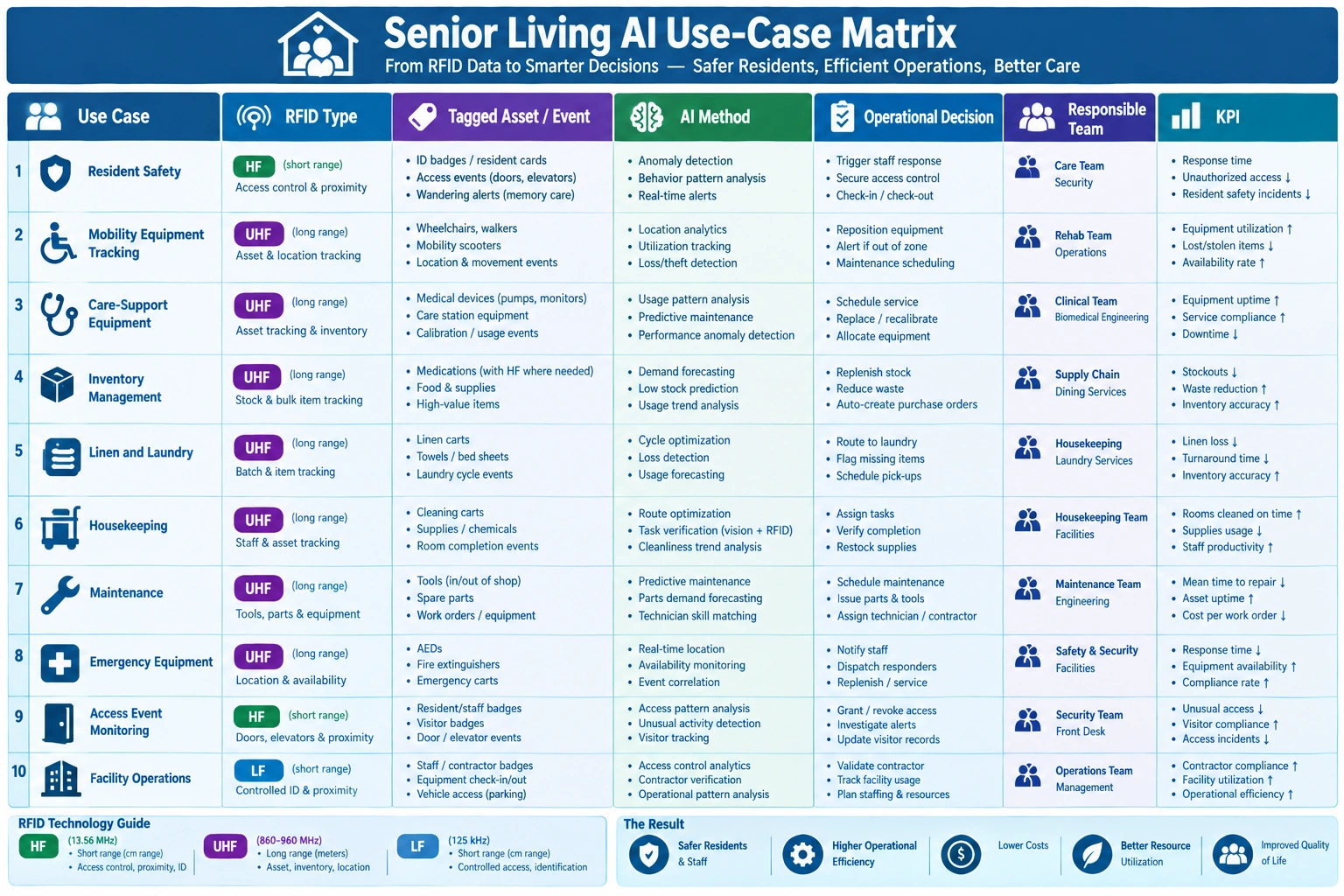
A comparison of senior living workflows showing RFID inputs, AI methods, operational decisions, responsible teams, and performance KPIs.
Linen, Laundry, and Housekeeping Operations
Linen management is a strong RFID candidate because reusable linens repeatedly move between resident rooms, laundry operations, storage rooms, carts, and external laundry services.
Tagged linen carts or selected reusable textile categories can create movement records that help identify turnaround delays, missing inventory, abnormal losses, and storage imbalances. AI can analyze historical movement and demand to help housekeeping managers determine whether shortages are caused by consumption, delayed laundry processing, distribution problems, or inventory misallocation.
The same operational model can extend to housekeeping equipment and reusable cleaning assets. AI can highlight recurring delays between room turnover, cleaning completion, inspection, and readiness for occupancy.
Preventive Maintenance and Facility Operations
Senior living facilities depend on HVAC equipment, elevators, generators, pumps, fire-safety equipment, electrical distribution, plumbing systems, kitchen equipment, laundry machines, access-control equipment, and building automation systems.
RFID can identify maintenance tools, portable equipment, replacement components, inspection kits, and selected facility assets. AI can combine RFID movement records with work orders, inspection schedules, runtime information, and maintenance history.
This supports maintenance teams by identifying assets that are repeatedly relocated, difficult to find, or associated with recurring service activity. RFID does not replace building management systems or computerized maintenance management systems. It provides an additional physical-world data source.
From RFID Events to AI-Driven Senior Living Decisions
A useful senior living deployment begins with operational events rather than with the RFID hardware itself.
Data Acquisition
RFID readers capture tag observations through fixed readers, portal installations, ceiling or wall-mounted antennas, handheld readers, or purpose-built read points. The appropriate configuration depends on the workflow.
For example, an equipment-return workflow may need zone-level detection, whereas a controlled doorway may require a more narrowly defined read field. A laundry workflow may benefit from portal-based reads as carts enter and leave processing areas.
Connectivity and Edge Processing
Reader data can move through Ethernet, Wi-Fi, cellular connectivity, or other site-specific networking arrangements. Edge processing can filter duplicate reads, normalize timestamps, apply zone logic, and discard events that do not contribute to the business workflow.
This filtering is particularly important because RFID readers can generate multiple observations for the same tag. Sending every raw read directly into an analytics database can create unnecessary data volume and make downstream event interpretation more difficult.
Middleware and Event Normalization
Middleware converts raw RFID observations into business events such as:
- Asset entered equipment storage
- Wheelchair moved from rehabilitation area to resident wing
- Linen cart departed laundry room
- Tagged supply bin reached replenishment threshold
- Maintenance asset remained outside its assigned zone
- Equipment returned to a designated charging or storage area
This event layer is where facility-specific rules become operationally useful.
AI Analytics and Decision Support
AI models can evaluate normalized events using anomaly detection, time-series analysis, classification, forecasting, clustering, and rule-assisted machine learning.
For example, an AI model may learn normal equipment circulation by building zone and time of day. A significant deviation can be surfaced for staff review rather than generating an alert for every movement.
AI can also forecast demand for reusable equipment or supplies based on historical utilization, occupancy patterns, seasonal behavior, service schedules, and operational history.
Enterprise Software Integration
Senior living communities may already use electronic health record systems where applicable, electronic medication administration systems, resident management software, property management software, computerized maintenance management systems, inventory software, access-control systems, building automation systems, laundry management software, staffing systems, and business intelligence tools.
RFID events should integrate with these systems through documented APIs, databases, message queues, middleware, or other approved interfaces rather than creating another isolated information source.
A strong integration design also establishes ownership of the master record. For example, an equipment management system may remain the authoritative source for asset attributes, while the RFID solution supplies physical movement events.
Operational Action
The final stage is the most important. AI-generated findings should lead to an operational response such as dispatching staff, locating equipment, replenishing supplies, initiating a maintenance work order, investigating an exception, changing asset allocation, or adjusting storage capacity.
This creates the practical AIoT loop:
Physical event → RFID identification → network transmission → event normalization → AI analysis → operational recommendation → staff action → recorded outcome
RFID Technologies and Supporting Systems for Senior Living
UHF, HF, and LF RFID should be selected according to the physical workflow rather than treated as interchangeable technologies.
UHF RFID for Area-Level Asset Visibility
UHF RFID is generally useful where senior living operators need longer-range identification of tagged equipment, carts, reusable assets, and inventory as items pass through defined read zones.
Deployment quality depends heavily on antenna placement, reader power configuration, tag selection, metal and liquid interaction, doorway geometry, and the required read zone. Medical equipment containing substantial metal can require specialized tag placement and site testing.
HF RFID for Short-Range Identification
HF RFID is suited to shorter-range interactions where controlled proximity is desirable. It can support identification at workstations, check-in points, equipment cabinets, or other applications where deliberate presentation of a tag is preferable to broad-area detection.
LF RFID for Specialized Proximity Applications
LF RFID can be appropriate for selected low-frequency proximity and identification workflows, especially where short-range behavior and environmental characteristics make it preferable to UHF or HF.
The frequency choice should follow the required read distance, asset construction, environmental conditions, throughput, tag cost, and acceptable false-read behavior.
RFID Readers, Antennas, Tags, and Handheld Devices
A senior living RFID solution can include fixed readers, antennas, handheld readers, RFID tags, gateways, network switches, edge computers, and operator workstations.
Tag engineering is often more important than reader selection. A tag that performs well on plastic may perform poorly when attached directly to metal equipment or near liquids. Pilot testing should therefore use representative wheelchairs, beds, carts, cabinets, equipment housings, linen materials, and storage configurations before procurement is finalized.
GAO supplies RFID, BLE, and IoT hardware products and systems that can be evaluated for applications such as asset identification, inventory visibility, facility operations, and connected senior living workflows. GAO’s engineering support can also help organizations evaluate device selection, deployment constraints, integration requirements, and operating environments.
AI Methods for Senior Living Operations
AI methods should be selected according to the operational question.
- Anomaly detection: Identifies unusual equipment movement, dwell time, or workflow sequences.
- Time-series forecasting: Estimates equipment, supply, or linen demand.
- Classification: Categorizes operational events according to predefined workflow conditions.
- Clustering: Identifies recurring utilization patterns across rooms, wings, equipment types, or operating periods.
- Computer vision: Can complement RFID where visual confirmation is required, subject to privacy and facility policies.
- Edge AI: Supports local analysis when rapid response, network resilience, or data minimization is important.
- Generative AI: Can summarize operational events or maintenance information for authorized personnel, but should not be treated as an authoritative clinical record without appropriate validation.
Security and Data Governance
Security design becomes especially important when RFID events are associated with residents, employees, care activities, or electronic protected health information.
The HIPAA Security Rule requires covered entities and business associates to implement appropriate administrative, physical, and technical safeguards for ePHI, including access control, audit controls, authentication, and transmission security. Whether a particular senior living organization or RFID deployment falls under HIPAA depends on its functions and relationships, so compliance should be determined from the actual data flows and organizational role rather than assumed from the use of RFID alone. (HHS.gov)
A sound implementation should use role-based access, strong authentication, network segmentation, encryption where appropriate, audit logging, least-privilege permissions, controlled administrative access, device hardening, and defined retention policies. HHS also emphasizes risk analysis and ongoing review of safeguards, making security an operational lifecycle activity rather than a one-time installation task. (HHS.gov)
RFID identifiers should also be separated from resident identity data wherever practical. A tag ID can identify an asset without placing personally identifiable information directly on the RFID tag. Linking an identifier to a resident or employee should occur within controlled software with appropriate authorization.
Cloud and Server Deployment Models for Senior Living Communities
Senior living organizations can deploy AI and RFID software through either a cloud-hosted model or a privately hosted server model. The appropriate choice depends on community connectivity, IT staffing, privacy requirements, integration constraints, latency requirements, and the organization’s existing computing environment.
Cloud Version for Multi-Community Operations
A cloud-hosted deployment is appropriate when an operator needs centralized visibility across multiple senior living communities. RFID events can be collected locally and securely transmitted to cloud infrastructure for storage, analytics, dashboards, reporting, and AI processing.
A multi-community operator can use this model to compare equipment utilization, linen circulation, inventory consumption, maintenance activity, and operational exceptions across properties without maintaining separate analytics installations at every location.
Cloud deployment can simplify software updates, centralized configuration, disaster recovery, and expansion to additional communities. However, the local facility still requires reliable networking and an edge layer capable of continuing essential RFID event processing during temporary connectivity interruptions.
Server Version for Privately Hosted Operations
A Server Version can run on an edge server, customer-managed server, private data center, or other privately hosted enterprise infrastructure. This model is useful when a senior living organization requires greater control over data location, network connectivity, integration boundaries, or local processing.
Local processing can also reduce dependence on wide-area connectivity for workflows requiring rapid event interpretation. A facility may retain RFID events locally and synchronize selected information with central systems according to its security and data-governance policies.
The Server Version is particularly relevant when the organization already operates private infrastructure for facility management, access control, building automation, maintenance, or other operational software.
Hybrid Processing for Resilient Senior Living Operations
A hybrid deployment is often practical. RFID readers can feed an edge server that performs event filtering, zone logic, buffering, and selected AI inference while centralized cloud or private servers handle long-term analytics, reporting, model management, and multi-property comparisons.
The critical engineering principle is to define which functions must continue when the external connection is unavailable. Doorway event capture, local alarms, buffering, and essential workflow logic may require local processing, while historical trend analysis can tolerate delayed synchronization.
Integrating AI and RFID with Senior Living Software
RFID should become part of existing senior living workflows rather than creating a disconnected asset-tracking application.
Property and Resident Management Systems
Resident-management and property-management systems can provide authorized contextual information such as building, unit, occupancy status, or service location. RFID events can then provide physical-world information about selected assets or operational activities.
Integration should minimize unnecessary transfer of resident information. A system can often perform useful asset analytics without exposing resident-identifying information to the RFID application.
Maintenance and Work Order Systems
Integration with a computerized maintenance management system can associate equipment identification and movement with preventive-maintenance schedules, service records, inspections, and work orders.
For example, when a tagged facility asset enters a maintenance area, the RFID event can provide context for a work order. AI can then identify recurring service patterns or equipment that generates unusually high maintenance activity.
Inventory and Procurement Software
RFID-generated inventory events can supplement stock records and support replenishment forecasting. AI can evaluate historical consumption, seasonal patterns, occupancy-related demand, supplier lead times, and minimum stock levels.
Procurement teams can use this information to reduce emergency purchasing and improve stock positioning across wings, storage rooms, and service areas.
Building Management and Security Systems
Senior living facilities commonly operate HVAC, access control, fire and life-safety, elevator, electrical, and other building systems. RFID data can complement these systems when an operational workflow depends on physical asset movement.
Integration should use controlled interfaces and clearly defined ownership of event data. RFID should not override life-safety controls or established access-control mechanisms without a separately engineered and validated control process.
Engineering Design and Commissioning for Senior Living RFID
A successful deployment begins with workflow engineering rather than reader installation.
Site Survey and RF Characterization
The implementation team should document floor plans, corridors, entrances, elevators, equipment rooms, storage areas, resident-room configurations, metal structures, electrical equipment, network availability, and potential sources of RF interference.
Testing should use the actual tag types and representative assets. A laboratory demonstration cannot reliably predict performance around metal beds, wheelchairs, lift equipment, refrigerators, linen carts, or dense shelving.
Read-Zone Engineering
A read zone should have a clearly defined business purpose. A doorway application may need controlled detection at a specific transition point, while an equipment room may require broader zone visibility.
Overlapping read fields can produce ambiguous location events. Excessive reader power can increase unwanted reads from adjacent areas. Insufficient coverage can create missing events. Antenna orientation, mounting height, polarization, tag placement, shielding, and reader configuration therefore require site-specific commissioning.
Tag Selection and Attachment
Tag selection should account for the physical characteristics of the asset.
Metal equipment may require on-metal RFID tags. Plastic containers can often use general-purpose tags. Textile applications require tags designed for repeated washing and drying cycles when appropriate.
Tag attachment should also withstand cleaning chemicals, abrasion, handling, temperature changes, and routine maintenance. A tag that detaches during housekeeping or laundry operations creates a data-quality problem rather than merely a hardware problem.
Commissioning and Acceptance Testing
Acceptance testing should evaluate actual workflows rather than simply confirming that readers power on.
Useful tests include:
- Read accuracy for representative tagged assets
- False-read rate between adjacent zones
- Detection performance at normal walking or cart speeds
- Performance around metal and liquid-containing objects
- Reader behavior during network interruption
- Duplicate-event filtering
- Timestamp accuracy
- Edge buffering and recovery
- Integration-message delivery
- AI alert precision
- User permissions and audit logging
- Battery or power resilience where applicable
- Tag durability after cleaning and handling
A pilot should establish baseline performance before expanding to additional wings or communities.
AI-Enabled Operational Improvements in Senior Living Communities
Combining AI with RFID-derived operational data produces value when the resulting information changes how senior living teams allocate resources and respond to exceptions.
Faster Asset Location
Staff can spend less time searching for wheelchairs, walkers, portable equipment, carts, emergency equipment, and other shared assets. AI can prioritize likely locations based on recent movement rather than displaying an undifferentiated list of historical reads.
Better Equipment Utilization
Utilization analysis can identify equipment that is heavily demanded in one wing while remaining underused elsewhere. Managers can use this information to rebalance existing inventory before purchasing additional units.
More Predictable Inventory Replenishment
AI forecasting can identify recurring consumption patterns and potential stockout conditions. RFID provides physical movement evidence that can improve the quality of inventory records where manual counts are unreliable.
Reduced Workflow Delays
Laundry, housekeeping, equipment return, maintenance, and supply distribution all contain measurable movement intervals. AI can identify where cycle times consistently exceed expected operating ranges.
The benefit comes from identifying the process bottleneck rather than merely reporting another timestamp.
Maintenance Prioritization
Combining equipment identity, movement frequency, service records, and maintenance history can help prioritize inspection and maintenance activities. AI can identify unusual patterns, but maintenance personnel should validate the condition before corrective work is authorized.
Improved Emergency Readiness
Selected emergency equipment can be tagged and assigned to defined storage locations. RFID events can help verify whether equipment is present, while AI can identify recurring deviations from expected storage or inspection patterns.
Life-safety compliance should remain governed by applicable codes, inspection procedures, and qualified personnel. RFID can support accountability but should not be treated as a substitute for required inspections.
Senior Living KPIs for AI and RFID Programs
A measurable deployment should establish baseline performance before implementation.
Relevant KPIs include:
- Average time to locate shared mobility equipment
- Equipment utilization rate
- Asset idle time
- Asset misplacement rate
- Equipment return compliance
- Inventory record accuracy
- Inventory stockout frequency
- Emergency replenishment frequency
- Linen loss rate
- Linen turnaround time
- Housekeeping asset availability
- Room turnover cycle time
- Maintenance response time
- Preventive-maintenance completion rate
- Mean time between equipment failures
- Mean time to repair
- Maintenance asset search time
- RFID read accuracy
- RFID false-read rate
- RFID event processing latency
- AI alert precision
- AI alert response time
- Percentage of actionable alerts
- Network uptime
- Edge processing availability
- Integration transaction success rate
- Staff time saved on asset searches
- Cost per tracked asset
- Tag replacement rate
- Return on RFID-enabled workflow investment
The most useful KPI is usually the one tied to a measurable operating problem. Installing RFID without establishing a baseline makes it difficult to determine whether the deployment has actually improved senior living operations.
Scalability, Cybersecurity, and Long-Term Operations
Scaling from one senior living building to multiple communities changes the engineering problem. Reader configurations, tag inventories, network requirements, integrations, user permissions, and AI models must be managed consistently without assuming that every property has identical construction or workflows.
A multi-property rollout should maintain standardized device naming, asset identifiers, event schemas, configuration management, software versions, and cybersecurity policies while allowing site-specific RF parameters.
Cybersecurity should cover the complete chain from RFID readers and edge gateways through network infrastructure, middleware, databases, AI services, and connected enterprise systems. Device credentials should be unique where supported, administrative interfaces should be restricted, unnecessary services should be disabled, and firmware and software should follow controlled update procedures.
AI governance should also address model drift. Equipment utilization, occupancy patterns, staffing models, and facility layouts can change over time. An anomaly-detection model trained against historical behavior may therefore require periodic validation.
Operational teams should retain authority over decisions that affect resident services, safety, maintenance, or access. AI recommendations should be explainable enough for authorized personnel to understand why an exception was surfaced.
Practical Implementation Recommendations for Senior Living Communities
The strongest implementations typically begin with a narrowly defined workflow where the cost of poor visibility is already measurable.
Recommended practices include:
- Select a high-value workflow such as mobility-equipment location, linen circulation, maintenance asset tracking, or supply inventory rather than attempting community-wide tagging immediately.
- Establish baseline KPIs before installing RFID equipment.
- Conduct an RF site survey using representative building materials and actual tagged assets.
- Test UHF, HF, and LF options against the required read distance and physical environment.
- Use specialized tags for metal equipment, textiles, and difficult operating environments where required.
- Define the business event generated from each RFID observation.
- Filter duplicate reads at the edge or middleware layer.
- Keep resident identity information separate from ordinary asset telemetry whenever practical.
- Integrate with existing inventory, maintenance, property, access-control, and facility-management software instead of creating isolated records.
- Validate AI recommendations with operations personnel before automating responses.
- Establish cybersecurity controls before production deployment.
- Measure false positives as carefully as missed events.
- Design local buffering and recovery for network outages.
- Document reader locations, antenna orientation, tag placement, network addresses, firmware, and configuration parameters.
- Create a maintenance process for damaged or missing tags.
- Revalidate performance after major renovations, furniture changes, equipment replacements, or changes to workflow.
- Expand only after the initial workflow demonstrates measurable operational value.
GAO has supplied RFID, BLE, and IoT hardware products and systems to organizations requiring physical asset identification, monitoring, and connected operational workflows. Our engineering-oriented approach can support organizations evaluating hardware, deployment requirements, integration considerations, and technical support for senior living applications.
AIoT and RFID Outlook for Senior Living Communities
AI and IoT increasingly connect physical facilities with software-based decision support. Within senior living communities, the practical opportunity is to create a reliable operational data layer around equipment, supplies, facilities, and selected controlled events while preserving the distinction between operational telemetry and resident-sensitive information.
RFID is particularly valuable when physical identification is difficult to maintain manually. AI becomes valuable when the resulting event volume is large enough that people cannot efficiently identify patterns themselves.
The strongest deployments will therefore combine disciplined workflow design, appropriate RFID frequency selection, reliable network and edge processing, secure integration, validated AI models, and measurable operational outcomes.
Conclusion: Building Measurable AI and RFID Value in Senior Living
AI and RFID for Senior Living Communities is most effective when deployed against specific operational problems such as equipment search time, inventory inaccuracies, linen losses, maintenance delays, or controlled-zone events. UHF, HF, and LF RFID provide different physical identification capabilities, while AI converts accumulated operational events into forecasts, anomaly detection, prioritization, and decision support.
A successful program requires more than RFID readers and tags. Site engineering, tag selection, network resilience, middleware, software integration, cybersecurity, AI validation, KPI baselines, commissioning, and lifecycle maintenance all influence the result.
Senior living operators should begin with a measurable workflow, validate performance in the actual facility, and scale only after the technical and operational results are demonstrated. GAO can help organizations evaluate RFID, BLE, and IoT hardware products and systems for these connected workflows and provide technical support during solution planning and deployment.
Building the Future of Industrial AI and IoT with Aperture Venture Studio and GAO RFID Inc.
For more than three decades, GAO Group of Companies has invested heavily in R&D involving industrial RFID, BLE, and IoT. As generative AI became useful for industrial applications, we expanded our work in AI and IoT, including RFID and BLE, and founded Aperture Venture Studio to develop AI and IoT solutions relevant to areas such as connected senior living operations.
Aperture brings together AI and IoT technical experts, entrepreneurial and operational executives, investors, and leading companies. We also developed Aperture Ventures Summit and TekSummit to discuss advanced AI and IoT topics and foster technical communities.
We welcome you to join us as:
- Advisors, co-founders, or employees
- Investors
- Customers