
AI and RFID for Ship Repair Operations and Marine Maintenance
AI-Driven Ship Repair with RFID Asset and Workflow Tracking
AI and RFID can improve ship-repair operations by connecting physical assets, maintenance activities, materials, tools, work orders, and vessel locations with actionable operational data. Shipyards and marine maintenance organizations manage complex workflows involving dry-docking, berth operations, hull repair, propulsion maintenance, electrical work, piping, welding, coating, inspection, spare-parts logistics, tooling, and vessel turnaround. RFID can identify tools, parts, material containers, equipment, and other assets as they move between workshops, warehouses, staging areas, vessels, and work zones. AI can then analyze movement histories, work-order data, inventory records, maintenance schedules, labor information, and equipment conditions to forecast material demand, identify workflow bottlenecks, prioritize work, and detect operational anomalies. The result is a more connected ship-repair operation in which maintenance personnel, planners, logistics teams, and supervisors can make decisions using current physical and digital information. GAO supplies RFID hardware and systems that organizations can integrate with shipyard and marine maintenance workflows.
AI and RFID for Ship Repair Operations
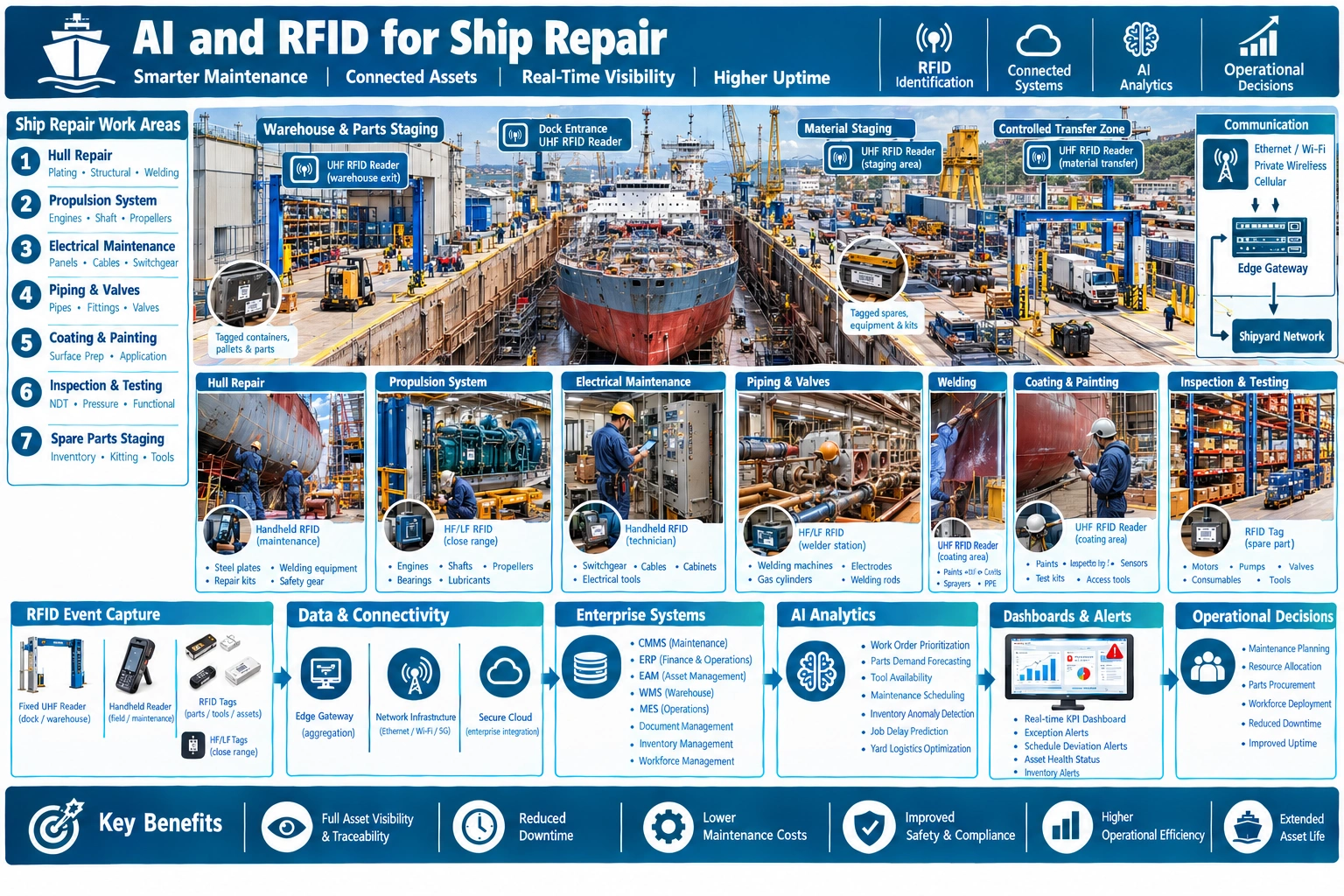
This diagram shows RFID-tagged tools, spare parts, equipment, and materials supporting ship repair activities across dry docks, warehouses, staging areas, and maintenance zones. RFID data flows through connected enterprise systems and AI analytics to improve work-order prioritization, parts planning, maintenance scheduling, logistics, and operational decisions.
Why AI Is Transforming Ship Repair Operations
Ship repair differs from repetitive manufacturing because each vessel can present different equipment configurations, repair histories, material requirements, access constraints, and work packages. A single dry-dock period may involve thousands of individual tasks across hull structures, propulsion systems, electrical equipment, HVAC, piping, valves, pumps, navigation equipment, safety systems, and accommodation spaces.
AI becomes valuable when it can analyze these changing conditions alongside maintenance records, work orders, inventory transactions, inspection findings, schedules, and physical asset movements. RFID strengthens this process by giving the software a reliable identity for selected physical assets.
AI for Ship Repair Work Planning
Ship-repair planning frequently depends on inspection findings, vessel drawings, maintenance history, technical specifications, parts availability, labor requirements, contractor schedules, and dock availability.
AI can analyze historical work orders and current job conditions to identify tasks that are likely to require additional time, materials, specialized tooling, or external support. Predictive models can estimate task duration and identify relationships between particular maintenance activities and schedule overruns.
For example, if propulsion-system maintenance historically requires specific lifting equipment, calibrated tools, replacement seals, and specialist labor, an AI model can flag those dependencies during planning.
Human planners remain responsible for approving maintenance sequences, engineering changes, safety controls, and class or regulatory requirements.
AI for Spare Parts and Material Demand
Ship repair can involve highly variable demand for bearings, gaskets, valves, fasteners, electrical components, cables, welding consumables, coatings, filters, pumps, seals, and other maintenance materials.
AI can forecast parts demand using vessel maintenance histories, work packages, planned inspections, failure patterns, current inventory, supplier lead times, and previous repair campaigns.
RFID can identify selected parts, bins, pallets, material kits, and returnable containers as they move between warehouse storage and vessel work areas.
The combination can reduce uncertainty about whether a required component is physically available and where it is located.
AI for Predictive Maintenance
Condition-based and predictive maintenance can be particularly valuable for high-value marine equipment such as propulsion machinery, generators, pumps, compressors, motors, HVAC equipment, and auxiliary systems.
AI can analyze vibration, temperature, pressure, current, runtime, alarm history, maintenance records, and other available equipment data to identify patterns associated with developing faults.
RFID provides an additional identity layer by associating tools, replacement components, maintenance kits, and equipment records with the appropriate work order or vessel location.
AI for Shipyard Logistics
Ship repair creates substantial internal movement. Parts, tools, scaffolding components, welding equipment, hoses, cables, portable power equipment, gas cylinders, pumps, inspection equipment, and work packages may move between warehouses, fabrication shops, dockside staging areas, vessels, and temporary work locations.
AI can analyze movement histories and work schedules to identify staging bottlenecks, unnecessary travel, material shortages, and resource conflicts.
RFID can provide the location events needed to understand these movements without requiring workers to manually record every transfer.
AI for Maintenance Inspection and Quality Control
Ship repair requires inspection and verification across welding, coating, structural repair, machinery maintenance, electrical work, piping, pressure testing, alignment, and other activities.
AI can assist with inspection prioritization, document analysis, anomaly detection, image-based examination support, and quality-record review where appropriate.
Computer vision may help identify visible coating defects, weld-surface anomalies, missing components, or other conditions in controlled inspection applications. Such systems should support qualified inspectors rather than replace required examination procedures or engineering judgment.
Ship Repair Applications for AI and RFID
Dry-Dock Material and Asset Management
Dry-dock operations concentrate large quantities of equipment and material around a vessel within a limited physical area. Parts may be received from multiple suppliers and staged according to work packages.
RFID can identify material kits, pallets, tool containers, and selected components at warehouse dispatch, dock entry, staging, and vessel delivery points.
AI can compare the actual material flow with the repair schedule and identify jobs that are likely to be delayed because required resources have not reached the work area.
Tool Tracking and Tool Crib Management
Ship-repair organizations often maintain specialized tooling such as torque wrenches, hydraulic tools, electrical test equipment, welding equipment, alignment instruments, pipe tools, lifting accessories, and calibrated inspection devices.
RFID can associate tools with tool-crib transactions, workers, work orders, vessels, or designated storage zones.
AI can identify unusual tool demand, repeated shortages, extended checkout periods, and potential scheduling conflicts. This can improve tool availability while reducing time spent searching for equipment.
Spare-Parts Warehouse and Kitting
A shipyard warehouse may contain thousands of stock-keeping units with different dimensions, values, criticality levels, and storage requirements.
RFID can provide automated identification during receiving, put-away, picking, staging, and issue transactions. AI can forecast demand and help warehouse personnel prioritize replenishment and kit preparation.
A maintenance kit can also be associated with a specific vessel, work package, compartment, machinery system, or work order, improving traceability as the kit moves toward the ship.
Vessel-to-Warehouse Material Movement
A critical operational challenge occurs when parts or tools leave a warehouse but do not arrive at the expected vessel location or work area.
RFID transition points can record movement events, while handheld readers can support confirmation in areas where fixed coverage is impractical.
AI can compare planned transfers against actual events and generate exceptions when material remains in staging, appears at an unexpected location, or is associated with the wrong work package.
Maintenance Work Packages
Ship-repair work packages can contain many interconnected activities. A propulsion repair, for example, may require parts, lifting equipment, specialist tools, inspection equipment, drawings, permits, and qualified personnel.
AI can analyze these dependencies and identify resource conflicts or likely schedule risks.
RFID can associate physical tools, material kits, and equipment with the work package, giving supervisors better visibility into whether critical resources are physically available.
Shipboard Equipment and Component Identification
Shipboard environments can contain visually similar valves, pumps, electrical panels, motors, cables, instruments, and mechanical components. Identification errors can cause rework or delays.
RFID can supplement existing equipment labels and asset identifiers by providing machine-readable identities for selected maintainable assets and components.
The RFID identity can link to equipment specifications, maintenance history, inspection records, spare-parts information, and work-order data.
Realistic RFID Deployment for Ship Repair Operations
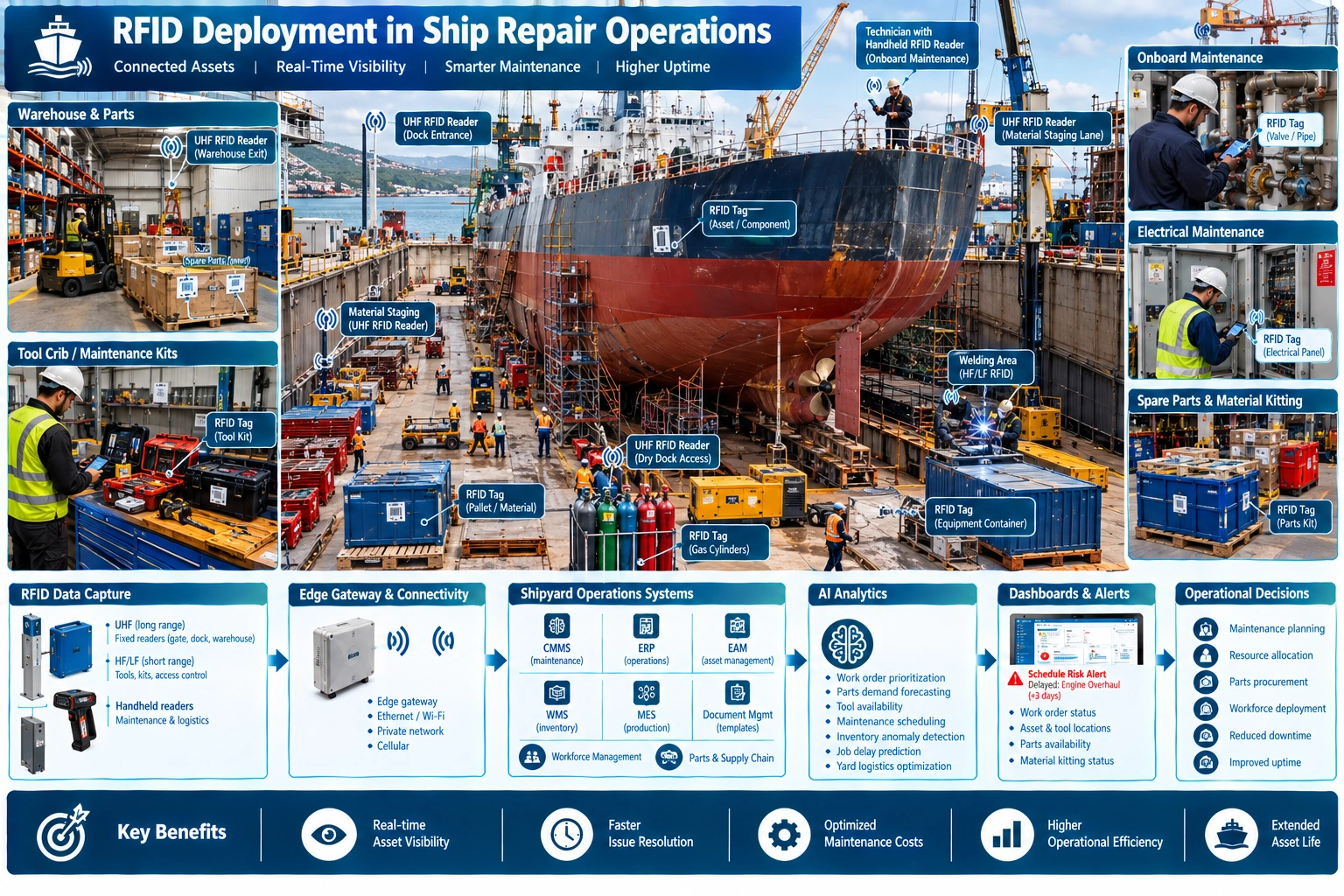
This visual demonstrates RFID deployment across a working ship-repair facility, including a dry-docked vessel, parts warehouse, tool crib, material staging zones, and onboard maintenance activities. Tagged assets and RFID events connect through edge gateways to shipyard systems and AI analytics for improved work-order visibility, parts availability, tool tracking, and schedule-risk management.
Ship Repair Challenges Addressed by AI-Enabled RFID Tracking
Lost or Misplaced Tools
Tools frequently move between workshops, tool cribs, vessel compartments, and dockside work areas. Manual sign-out systems may not provide sufficient visibility when tools are transferred between teams.
RFID can create location events at defined transition points, while AI can identify tools with unusually long checkout periods or repeated movement exceptions.
This can reduce search time and improve tool utilization without requiring continuous location tracking of every item.
Parts Availability and Work Delays
A repair job can be delayed even when the part technically exists in the shipyard inventory because the part is stored in the wrong location, allocated to another work package, awaiting inspection, or still in staging.
AI can compare work-order requirements against inventory and movement information. RFID can help establish whether the required material has physically reached the expected staging area.
Uncontrolled Material Movement
Ship-repair projects involve frequent transfers between warehouse locations, fabrication shops, dockside areas, vessels, and temporary staging zones.
Without reliable movement records, supervisors may not know whether material is awaiting transport, already aboard the vessel, held for inspection, or incorrectly staged.
RFID event capture provides a physical transaction history that can be reconciled against planned material movements.
Schedule Uncertainty
Repair schedules can change as inspection findings emerge. Additional work may be discovered after access panels are opened or machinery is disassembled.
AI can analyze historical repair patterns and current resource status to identify work packages likely to experience schedule pressure.
The model can consider parts availability, tool availability, labor requirements, predecessor tasks, inspection requirements, and equipment dependencies.
Asset and Equipment Utilization
Shipyards often own or lease high-value equipment such as cranes, forklifts, welding machines, generators, compressors, hydraulic power units, pumps, and specialized maintenance tools.
AI can analyze utilization and maintenance records to identify underused equipment, resource conflicts, abnormal usage, or upcoming maintenance requirements.
RFID can associate selected equipment with work zones and usage transactions, improving asset accountability.
Documentation and Maintenance History
Ship repair generates substantial technical documentation, including work orders, inspection reports, drawings, certificates, test results, material certificates, maintenance records, and completion documentation.
AI can extract structured information from documents and compare records for missing or inconsistent information.
RFID can connect the physical asset or component identity to the relevant digital record, making it easier for authorized personnel to retrieve the correct documentation.
Ship Repair Workflow from Data Capture to AI Decision-Making
A practical AI and RFID solution begins with physical work rather than with the analytics software. The system should follow the actual movement of material, tools, equipment, and maintenance work through the shipyard.
Data Acquisition at Ship Repair Worksites
Relevant data can originate from RFID readers, handheld devices, machine telemetry, equipment controllers, CMMS work orders, ERP transactions, warehouse records, inspection systems, workforce applications, procurement systems, and vessel maintenance databases.
Examples include:
- Tool identity and checkout status.
- Spare-part identity and warehouse location.
- Material-kit identity and work-package assignment.
- Vessel and compartment information.
- Equipment operating condition.
- Work-order status.
- Inspection results.
- Parts consumption.
- Maintenance completion.
- Supplier delivery status.
- Dock and staging-zone movements.
Data quality should be addressed before advanced AI is introduced. Incorrect equipment IDs or inconsistent work-order references can undermine otherwise sophisticated analytics.
RFID Event Capture
UHF RFID is well suited to shipyard applications where tools, material containers, pallets, and equipment need to be identified at controlled movement points. Warehouse doors, dock access points, staging lanes, and material-transfer locations are practical candidates for fixed readers.
HF RFID can be useful for controlled close-range identification, particularly where workers intentionally present an item to a reader.
LF RFID can support selected short-range applications where its physical operating characteristics are appropriate to the asset and workflow.
RF performance requires special consideration in marine environments. Ship structures contain substantial metal, while machinery spaces can include dense equipment, cables, pipes, and other reflective surfaces. Liquid-filled containers and metal tool cases can also affect UHF performance.
Tag construction, mounting position, reader antenna orientation, read-zone geometry, and expected item presentation should therefore be validated through a site survey and pilot.
Edge Processing and Communications
RFID readers can send events through Ethernet, Wi-Fi, private wireless, or cellular communications depending on shipyard infrastructure and operational requirements.
An edge gateway can perform local buffering, event filtering, timestamp normalization, duplicate suppression, device-health monitoring, and temporary storage during network interruptions.
Edge processing is useful for dry docks, remote berths, outdoor staging areas, and shipboard locations where network availability can vary.
Middleware and Enterprise Software
RFID middleware can convert raw reader events into business events that shipyard applications can understand.
For example, multiple RFID reads at a warehouse doorway should not necessarily generate multiple inventory transactions. Middleware can consolidate these reads into a meaningful “material kit dispatched” event.
Integration can connect RFID data with:
- CMMS and EAM software for maintenance work orders and asset histories.
- ERP software for purchasing, inventory, vendors, and financial transactions.
- WMS software for warehouse locations, receiving, picking, and staging.
- MES software where ship-repair fabrication or production workflows require it.
- Document-management systems for drawings, inspection records, certificates, and technical documentation.
- Procurement systems for supplier and purchase-order information.
- Workforce-management software for task and labor coordination.
- LIMS where material testing or laboratory processes are part of the repair workflow.
- GIS or yard-management software for facility and outdoor-location information.
AI Analytics and Operational Decisions
AI analytics can combine RFID events with maintenance, inventory, equipment, scheduling, and documentation data.
Useful outputs include predicted work delays, parts-demand forecasts, inventory anomalies, tool-availability alerts, equipment-maintenance recommendations, material-staging priorities, and work-package risk scores.
The AI system should return these outputs to the teams responsible for the corresponding decisions. A planner may receive a predicted schedule risk, a warehouse supervisor may receive a missing-material alert, and a maintenance manager may receive a predictive-equipment warning.
Human engineering judgment remains necessary for maintenance authorization, vessel safety, structural decisions, machinery acceptance, class requirements, and other high-consequence activities.
RFID, AI Software, and Ship Repair Infrastructure
Cloud Version for Multi-Site Ship Repair Operations
A cloud-hosted software version can support ship-repair organizations operating multiple shipyards, repair facilities, warehouses, or marine service locations. RFID events from different facilities can be consolidated into a central system for inventory visibility, tool management, maintenance analytics, and management reporting.
Cloud deployment can be useful when corporate engineering, procurement, maintenance, and operations teams need access to information across geographically distributed marine facilities. It can also provide a practical environment for aggregating historical data used by AI forecasting and anomaly-detection models.
Reliable connectivity remains important. Edge gateways should retain critical RFID events locally when a dock, berth, workshop, or vessel temporarily loses network connectivity.
Security should include authenticated users, role-based access, encryption, API controls, audit logs, controlled data retention, and appropriate separation between business systems and operational networks.
Server Version for Shipyard and Marine Maintenance Operations
A server version can run on an edge server, customer-managed server, private data center, shipyard server room, or other privately hosted enterprise infrastructure.
This deployment model can suit shipyards with strict IT policies, restricted connectivity, sensitive vessel information, private-network requirements, or operational environments where data must remain under direct organizational control.
Server deployments require defined responsibilities for patching, backups, disaster recovery, cybersecurity monitoring, software updates, and hardware lifecycle management unless these services are provided under a managed arrangement.
A hybrid configuration can also be appropriate. For example, RFID events and essential operational logic can remain locally available while selected historical data and enterprise analytics are synchronized with centralized infrastructure.
AI Models for Ship Repair
Different ship-repair problems require different analytical approaches.
Time-series models can forecast equipment conditions and spare-parts demand. Classification models can categorize maintenance records and documents. Anomaly-detection models can identify unusual inventory movements, tool transactions, equipment behavior, or schedule patterns.
Optimization models can support material staging, equipment allocation, maintenance sequencing, and yard logistics.
Computer vision can support selected visual inspection applications when suitable imagery, controlled inspection conditions, and qualified human review are available.
Model performance should be measured against actual shipyard outcomes rather than theoretical accuracy alone.
RFID Hardware for Marine Environments
RFID hardware should be selected according to the physical environment and asset characteristics.
Shipyards expose equipment to vibration, moisture, temperature variation, dust, outdoor weather, metal structures, machinery interference, and demanding material-handling conditions. Tags and readers therefore need appropriate environmental protection and mounting methods.
Metal toolboxes, steel components, machinery, and metal containers can require specialized on-metal RFID tags. Read zones should be designed around actual workflow rather than simply maximizing read range.
Handheld RFID readers remain important for shipboard inspections, tool inventories, compartment-level searches,