
AI and RFID for Shipbuilding Operations
AI and RFID for Shipbuilding Operations
AI-driven shipbuilding combines production data, engineering information, material records, equipment status, workforce activities, inspection results, and AI analytics to improve how shipyards plan, construct, outfit, test, and deliver vessels. RFID provides a machine-readable identity layer for steel components, pipe assemblies, electrical materials, tools, welding equipment, production fixtures, containers, pallets, and other shipyard assets. UHF RFID is particularly useful for longer-range identification across material receiving areas, fabrication shops, warehouses, staging zones, and controlled production routes, while HF and LF RFID can support deliberate short-range identification at workstations and controlled handoff points. AI can correlate RFID events with production schedules, bills of material, work orders, drawings, quality records, inventory status, and inspection data to identify material shortages, workflow delays, abnormal production patterns, and asset utilization issues. For shipyards managing complex vessel programs, the combination can improve traceability, production visibility, material availability, quality workflows, and maintenance planning. GAO provides RFID and IoT hardware products and systems that can support these connected shipbuilding workflows.
AI and RFID Shipbuilding Operations Overview
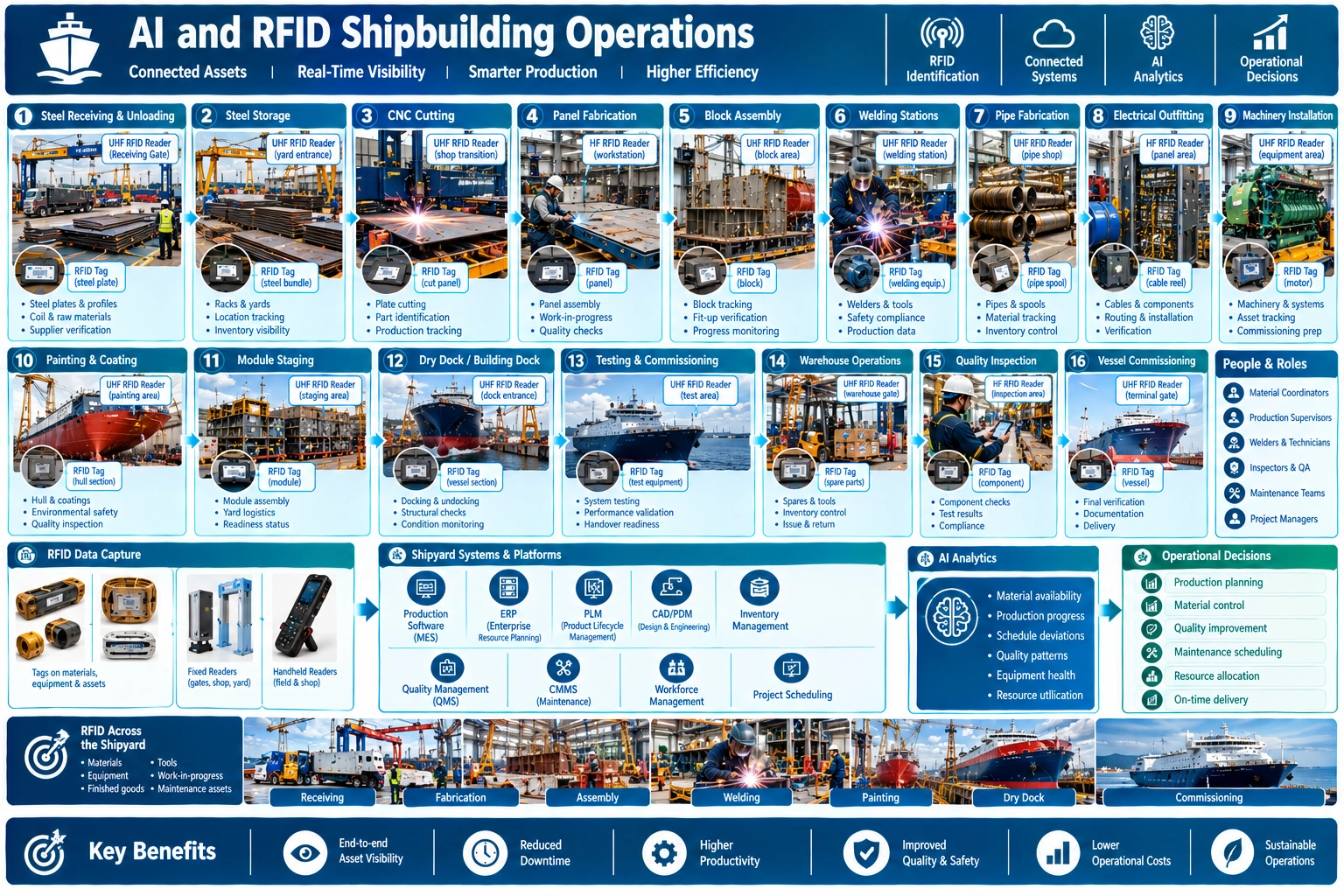
This diagram illustrates how RFID-tagged materials, equipment, and production assets move through shipyard operations from steel receiving to vessel commissioning. Connected shipyard systems and AI analytics support material availability, production progress, quality, maintenance, scheduling, and operational decision-making.
Why AI Matters for Modern Shipbuilding
Shipbuilding involves long production cycles, complex bills of material, thousands of components, specialized trades, large work packages, changing production priorities, and strict quality requirements. A single vessel can contain extensive quantities of steel, piping, electrical equipment, machinery, valves, fasteners, coatings, outfitting components, and custom-fabricated assemblies.
AI can help shipyards analyze these interconnected production variables faster than manual review alone. The greatest value usually comes from applying AI to specific production and engineering problems such as schedule prediction, material availability, quality anomaly detection, equipment maintenance, and work-package prioritization.
RFID provides useful physical context because production software may know that a component is required, while RFID can help establish where the physical component has been received, staged, moved, or issued.
AI for Shipbuilding Production Planning
Production planning must account for hull blocks, panels, modules, material availability, workforce capacity, equipment availability, crane utilization, work-cell capacity, engineering releases, and downstream dependencies.
AI can analyze historical production performance and current shop-floor conditions to identify probable schedule conflicts.
Potential applications include:
- Predicting work-package completion times.
- Identifying production bottlenecks.
- Estimating material-related schedule risk.
- Prioritizing delayed work packages.
- Detecting recurring production constraints.
- Evaluating resource conflicts.
- Forecasting block or module completion.
- Supporting schedule recovery decisions.
RFID events can provide additional evidence about the physical progress of materials and assemblies.
AI for Material Traceability and Availability
Material control is a major operational concern because shipbuilding requires large quantities of uniquely identified materials and fabricated components.
AI can compare planned material requirements with inventory records, production schedules, fabrication status, and historical consumption patterns.
RFID can strengthen this process by identifying physical materials as they move through receiving, storage, fabrication, staging, and installation areas.
This is particularly useful for items such as:
- Steel plates and profiles.
- Pipe spools.
- Valves.
- Pumps.
- Motors.
- Cable reels.
- Electrical panels.
- HVAC components.
- Machinery components.
- Outfitting materials.
- Production tools.
- Specialized fixtures.
The objective is not simply to locate material. The more important goal is to connect physical material movement with the correct vessel, block, work package, drawing, purchase order, and production operation.
AI for Shipyard Quality Control
Shipbuilding quality processes can include welding inspection, dimensional inspection, coating inspection, material certification, non-destructive testing, pressure testing, electrical testing, and installation verification.
AI can identify unusual quality patterns by analyzing inspection records, production conditions, defect histories, work locations, equipment information, and rework records.
For example, repeated welding defects associated with a particular production area, material condition, work process, or equipment condition can become a candidate for engineering investigation.
RFID can associate a physical component or production asset with the relevant inspection workflow, helping inspectors and quality engineers establish a stronger traceability chain.
AI for Predictive Maintenance of Shipyard Equipment
Shipyards depend on cranes, forklifts, welding machines, cutting equipment, compressors, generators, lifting equipment, transporters, machine tools, pumps, and other production assets.
AI can evaluate operating hours, maintenance history, alarms, utilization, failure patterns, and equipment condition to estimate maintenance risk.
RFID can identify equipment as it moves through maintenance shops, production areas, storage facilities, or inspection stations.
This combination can help maintenance teams move from purely calendar-based servicing toward condition-informed maintenance while preserving required inspection intervals.
Shipbuilding Workflows Where AI and RFID Deliver the Most Value
Material Receiving and Identification
Material receiving establishes the initial physical record for components entering the shipyard. Personnel may need to verify purchase orders, heat numbers, material certificates, quantities, dimensions, and vessel allocation.
RFID can identify tagged materials after receiving inspection and connect subsequent movements with the material record.
AI can identify receiving discrepancies, unusual lead times, inventory inconsistencies, and potential material shortages affecting production schedules.
Steel Plate and Profile Management
Steel plate and profile handling can involve storage yards, nesting plans, CNC cutting, marking, staging, and movement to fabrication areas.
RFID can identify selected steel bundles, plates, or handling units. AI can analyze consumption, cutting schedules, inventory levels, and production requirements to identify potential shortages or excess staging.
Where direct tagging of individual steel items is impractical, RFID can be applied to bundles, carriers, pallets, containers, or production travelers.
Block and Panel Production
Block construction requires coordinated steel fabrication, welding, outfitting, inspection, and movement. Production status can change as work progresses through multiple shops.
RFID can establish identification at controlled transitions between fabrication and staging areas.
AI can compare physical movement events with planned work sequences and identify blocks that may be falling behind schedule.
Pipe Fabrication and Installation
Pipe spools can pass through material preparation, cutting, bending, welding, inspection, coating, staging, and installation.
Each spool can have a relationship with drawings, specifications, weld records, inspection results, and vessel location.
RFID can support physical spool identification at appropriate production and staging points. AI can identify missing spools, schedule conflicts, repeated rework patterns, or downstream installation risks.
Electrical and Cable Outfitting
Ship electrical systems can include cable reels, cable trays, junction boxes, switchboards, distribution panels, lighting equipment, navigation systems, control equipment, and communications equipment.
RFID can support traceability for cable reels and selected electrical components. AI can correlate material availability with installation sequences and work-package status.
This can help reduce situations where an electrical work package is released but required components have not reached the installation area.
Machinery and Mechanical Outfitting
Main engines, auxiliary engines, pumps, compressors, valves, motors, heat exchangers, ventilation equipment, and other machinery require controlled handling and installation.
RFID can provide physical identity during receiving, staging, installation, inspection, and maintenance.
AI can combine component status with installation schedules and inspection requirements to identify potential commissioning delays.
Shipyard Tool and Equipment Management
Specialized tools can be shared across trades and production areas. Tool availability can become a constraint when large numbers of workers require the same equipment.
RFID can identify selected tools, welding equipment, inspection equipment, lifting accessories, and production fixtures.
AI can analyze utilization patterns to identify frequently unavailable assets, underused equipment, and maintenance requirements.
Quality Inspection and Rework
Quality records are often associated with specific blocks, welds, components, systems, or production work packages.
AI can identify recurring defect patterns and rework concentrations. RFID can provide additional physical identity for components and production assets participating in inspection workflows.
The resulting data can help quality teams investigate whether recurring defects relate to material, equipment, work location, process conditions, or production sequencing.
Dry Dock, Launch, and Commissioning Activities
Late-stage shipbuilding introduces extensive coordination among mechanical, electrical, piping, safety, testing, and commissioning teams.
RFID can support identification of selected equipment, test instruments, temporary assets, and components moving between staging and vessel areas.
AI can analyze incomplete work packages, outstanding inspections, test results, equipment readiness, and dependency relationships to prioritize commissioning activities.
Realistic RFID Deployment in Shipbuilding Operations
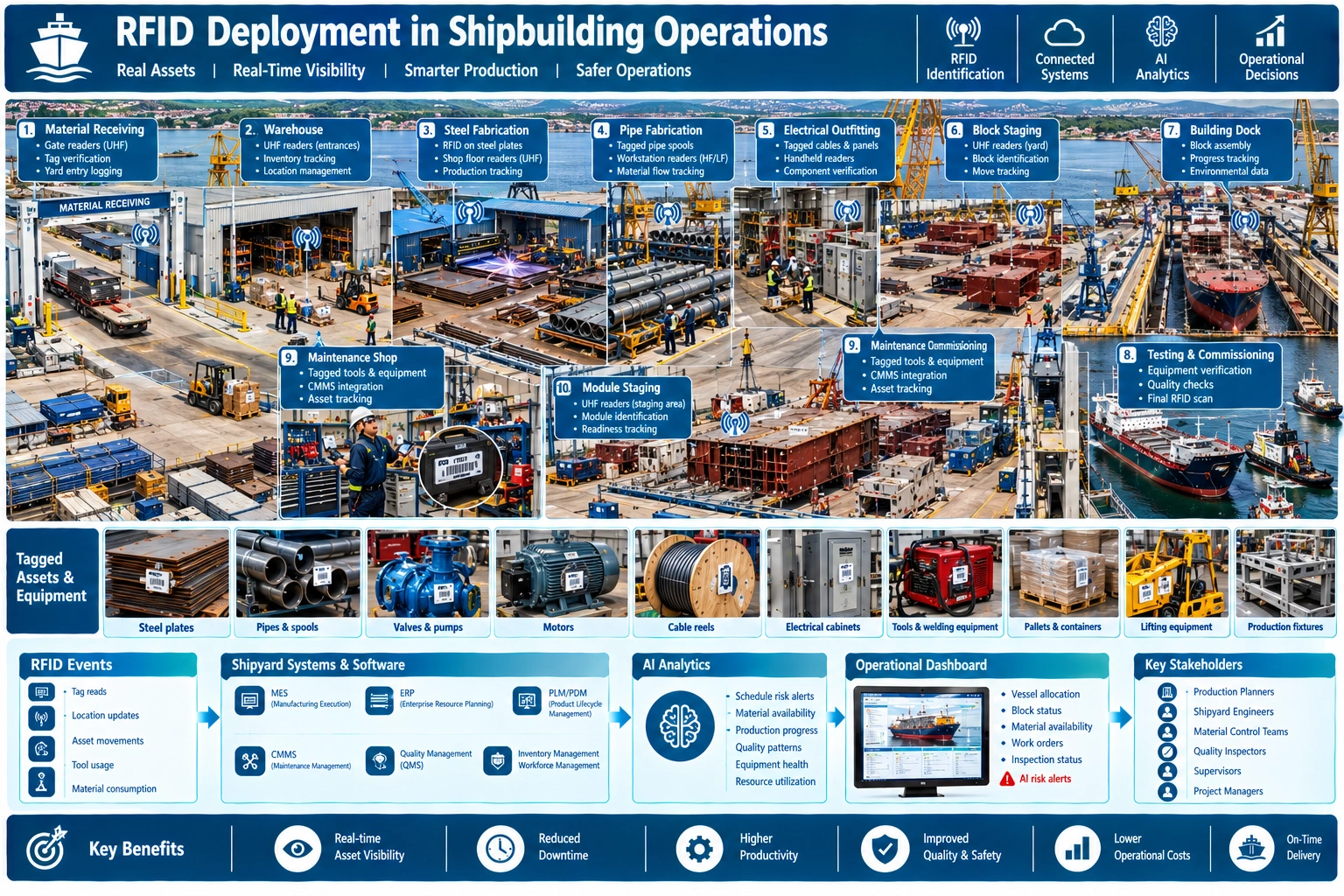
This visual shows RFID deployment across material receiving, warehouses, fabrication, outfitting, block staging, and vessel construction. Physical RFID events connect with MES, ERP, PLM, CMMS, quality systems, AI analytics, and operational dashboards to support production and material decisions.
Shipbuilding Challenges Addressed by AI-Enabled Asset and Material Tracking
Material Location Uncertainty
Large shipyards contain storage yards, fabrication shops, warehouses, staging areas, docks, temporary storage zones, and vessel compartments. Materials can move several times before installation.
RFID can capture selected controlled movement events, while AI can combine those events with production requirements to identify materials that may become constraints.
Production Schedule Deviation
Shipbuilding schedules depend on many interrelated activities. A delay in steel fabrication can affect block assembly, outfitting, testing, and commissioning.
AI can identify dependencies and estimate schedule risk using historical production performance and current work status.
RFID provides additional physical evidence by showing whether required materials or assemblies have reached the appropriate production stage.
Excessive Material Staging
Materials staged too early can consume valuable production space and increase handling requirements. Materials staged too late can delay work.
AI can analyze staging duration, planned installation dates, work-package status, and material movement patterns to identify potential staging problems.
Tool and Equipment Availability
Shared production tools and equipment can be difficult to manage across large shipyards.
RFID can establish equipment identity at controlled points, while AI can analyze usage patterns and upcoming production demand to support allocation and maintenance planning.
Rework and Quality Defects
Rework can consume labor hours and create downstream schedule impacts. Historical quality records can contain useful information about recurring defects.
AI can identify correlations among defects, production areas, work packages, equipment, materials, and inspection results.
RFID can strengthen the physical traceability of selected components and production equipment associated with those records.
Disconnected Production Data
Shipyards commonly operate multiple information systems covering engineering, procurement, production, inventory, quality, maintenance, and project management.
A physical material may exist in one system while its production status exists in another. RFID can provide a common physical identity, while integration software connects that identity to the relevant digital records.
GAO has helped organizations implement RFID and IoT hardware products and systems where physical asset identification must connect with operational software and existing enterprise information systems.
Shipbuilding Data Flow from Material Movement to AI Decision
AI-driven shipbuilding requires more than collecting production data. The system must preserve relationships among physical components, vessel structures, work packages, engineering documents, production operations, quality records, and equipment.
Data Acquisition from Shipyard Operations
Data can originate from:
- RFID readers and handheld RFID devices.
- ERP material records.
- MES production status.
- PLM and PDM systems.
- CAD and engineering databases.
- Bills of material.
- Work orders.
- Production schedules.
- Quality inspection systems.
- Welding records.
- Non-destructive testing records.
- Inventory systems.
- CMMS maintenance records.
- Equipment telemetry.
- Crane and material-handling systems.
- Workforce management systems.
- Procurement and supplier records.
Each source provides different information. RFID primarily establishes physical identity and movement events, while production and engineering systems provide the business and technical context.
RFID Event Capture
A tagged pipe spool, cable reel, production tool, equipment case, or material handling unit can generate an RFID event when it passes a controlled reader location or is intentionally scanned using a handheld reader.
The event should normally include an identifier, timestamp, reader location, and relevant transaction context.
The integration system can then associate the event with the vessel, block, work package, material record, or asset record.
Communications and Edge Processing
Shipyards can combine Ethernet, Wi-Fi, private wireless networks, cellular connectivity, and other appropriate communications depending on site conditions.
Edge gateways can collect RFID events and production information close to the operational area. Local buffering can prevent temporary network interruptions from causing data loss.
Edge processing can perform:
- Event filtering.
- Duplicate-read suppression.
- Timestamp normalization.
- Reader health monitoring.
- Local data buffering.
- Asset identity validation.
- Basic event correlation.
- Forwarding to central systems.
Shipyard Enterprise Software Integration
Middleware can connect RFID events with ERP, MES, PLM/PDM, CMMS, inventory, quality, project scheduling, and engineering systems.
For example, an RFID event identifying a pipe spool entering a block staging area can be associated with its vessel allocation, drawing reference, fabrication status, inspection record, and installation work package.
This creates a more useful production record than an RFID event stored independently from shipyard software.
AI Analytics and Production Decisions
AI can evaluate the combined information for schedule prediction, material risk, quality anomalies, equipment health, production bottlenecks, and resource utilization.
Potential outputs include:
- Material shortage warnings.
- Work-package delay predictions.
- Block completion forecasts.
- Equipment maintenance recommendations.
- Quality investigation priorities.
- Rework risk indicators.
- Tool allocation recommendations.
- Production bottleneck alerts.
- Commissioning priorities.
Production planners and shipyard engineers should retain control over consequential scheduling and quality decisions unless automated decision logic has been specifically validated and approved.
RFID, AI Software, and Shipbuilding Infrastructure
Shipyard deployments must accommodate large physical areas, harsh working conditions, moving equipment, metallic structures, cranes, vehicles, temporary staging zones, and changing production layouts. RFID hardware, connected devices, communications, and software therefore need to be selected around actual shipbuilding workflows.
Cloud Version for Multi-Site Shipbuilding Operations
A cloud-hosted solution can consolidate production and asset information from multiple shipyards, fabrication facilities, warehouses, suppliers, and engineering locations.
This deployment model can be appropriate when shipbuilding organizations need centralized analytics, cross-site reporting, scalable data storage, remote access, and centralized AI model management.
Cloud-based capabilities may include:
- Centralized RFID event management.
- Multi-yard material visibility.
- AI model execution and management.
- Production analytics.
- Cross-vessel reporting.
- Equipment and tool traceability.
- Integration APIs.
- Centralized dashboards.
- Historical production-data analysis.
Shipyards with intermittent connectivity should retain appropriate local buffering and operational continuity capabilities rather than depending entirely on persistent network access.
Server Version for Privately Hosted Shipbuilding Systems
A server deployment can operate on customer-managed servers, private data centers, shipyard server infrastructure, edge servers, or other privately hosted computing environments.
This approach may be appropriate where shipyards require tighter control over production data, integration with existing manufacturing networks, or internal cybersecurity policies.
Privately hosted systems can also be useful where production operations must continue even when external connectivity is limited. The organization, however, assumes responsibility for server maintenance, cybersecurity, backups, redundancy, software updates, monitoring, and disaster recovery.
AI Methods for Shipbuilding Operations
AI methods should match the production problem, data quality, and decision requirements.
Relevant approaches include:
- Time-series forecasting for production completion and equipment behavior.
- Anomaly detection for unusual production, quality, or equipment conditions.
- Regression models for production-duration estimation.
- Classification for quality and workflow conditions.
- Clustering for identifying recurring production patterns.
- Optimization models for resource and work-package allocation.
- Predictive maintenance models for cranes, welding equipment, machine tools, and material-handling equipment.
- Computer vision for selected inspection and production-monitoring applications.
- Edge AI where rapid local analysis is beneficial.
- Natural-language AI for controlled retrieval and analysis of engineering or production documentation where security and validation requirements permit.
AI models should be validated against representative shipbuilding data and tested across different vessels, production stages, equipment types, and operating conditions.
Continuing directly from Part 1 with the remaining sections.
Shipbuilding Deployment and Integration Considerations
Successful AI and RFID deployment in shipbuilding depends less on installing readers everywhere and more on selecting the right identification points, integrating physical events with production records, and validating performance under real shipyard conditions. Steel structures, metallic components, welding operations, outdoor storage, cranes, containers, paint processes, and constantly changing work locations create RF and operational conditions that differ substantially from conventional warehouse deployments.
RFID Tag Selection for Shipyard Materials and Assets
RFID tags should be selected according to the material, attachment surface, environmental exposure, read distance, and production process associated with each shipbuilding asset. A tag that performs well on cardboard packaging may perform poorly when attached directly to steel plate, pipe, machinery, or a welding fixture.
UHF RFID is generally useful when shipyards require longer-range identification of materials and assets moving through receiving, warehouses, fabrication areas, staging zones, and controlled production routes. On-metal UHF tags can be appropriate for steel components, machinery, tools, containers, fixtures, and other metallic assets.
HF RFID can support deliberate short-range identification at workstations, inspection points, controlled handoffs, tool cabinets, and verification stations. LF RFID can be considered for specialized short-range identification requirements where its operating characteristics fit the application.
Tag selection should consider:
- Steel and other metallic surfaces that can detune conventional RFID tags
- Heat exposure from welding, cutting, grinding, and other fabrication operations
- Paint, coating, solvents, moisture, dust, and outdoor weather exposure
- Mechanical impacts, abrasion, vibration, and repeated handling
- Attachment method and the possibility of tags being removed or damaged
- Required read distance and reader antenna orientation
- Whether the tag must support read-only identification or additional memory
- Tag survivability throughout the component’s complete production lifecycle
- Whether tags remain attached during painting, outfitting, transportation, and commissioning
Tag trials should therefore occur using representative shipbuilding materials rather than laboratory-only samples.
Reader Placement and RF Coverage
Reader placement should follow actual shipyard workflows. Common locations include receiving gates, material identification stations, warehouse entrances, fabrication-shop transitions, tool rooms, maintenance areas, staging zones, and controlled access points.
Fixed UHF readers can automate identification where materials pass through predictable locations. Handheld RFID readers remain valuable where blocks, pipe spools, machinery, tools, and other assets move through large open production areas without a fixed choke point.
Shipyard RF surveys should evaluate:
- Steel structures and large metallic assemblies
- Cranes and suspended loads
- Containers and temporary storage areas
- Multipath reflections from steel surfaces
- RF shadowing around blocks and machinery
- Antenna mounting height and orientation
- Worker and vehicle movement
- Outdoor environmental conditions
- Reader-to-reader interference
- Wireless network availability
- Areas where manual verification is required as a fallback
Not every movement should be captured automatically. Excessive reader deployment can increase cost and generate unnecessary events. Controlled identification points combined with handheld verification can provide a more practical solution.
Integration with Shipbuilding Software
RFID events become operationally valuable when they are connected to the shipyard’s existing information systems. The objective is to associate a physical item with the correct vessel, hull, block, zone, drawing, bill of materials, purchase order, work package, production operation, inspection record, and installation status.
Potential integration targets include:
- ERP software for procurement, inventory, purchasing, and financial records
- MES software for production execution and work-package status
- PLM and PDM systems for engineering information and product records
- CAD systems for drawings and engineering references
- CMMS software for equipment maintenance
- QMS software for inspection, nonconformance, and corrective actions
- Warehouse and inventory systems
- Workforce and labor-management systems
- Production scheduling and project-management software
- Digital work instructions and electronic inspection systems
Stable identifiers are essential. RFID tag IDs should be associated with controlled master records rather than being treated as the complete business identity of an item. A material record may require relationships among part number, serial number, heat number, supplier, vessel, block, work package, location, inspection status, and installation status.
Middleware or integration services can normalize RFID events, remove duplicates, validate identities, enrich events with production context, and transmit usable information to enterprise software. This reduces the risk of flooding MES or ERP systems with raw reader events.
Security and Data Governance for AI-Enabled Shipbuilding
Shipyards manage commercially sensitive engineering information, production schedules, supplier data, quality records, equipment information, and potentially controlled vessel or defense-related information. AI and RFID systems should therefore be incorporated into established cybersecurity and information-governance programs rather than treated as isolated operational technology.
Important controls include:
- Network segmentation between RFID devices, operational technology, enterprise IT, and external services
- Least-privilege access for readers, gateways, applications, and users
- Multi-factor authentication for administrative access
- Secure provisioning of RFID gateways and connected equipment
- Encryption for communications where supported and appropriate
- Certificate and credential management
- Reader and gateway hardening
- Controlled firmware and software updates
- Audit logging for administrative and operational events
- Backup and disaster-recovery procedures
- Vulnerability and patch management
- Security monitoring and SIEM integration where appropriate
- Controlled API access between production and enterprise systems
AI governance requires additional controls. Training datasets should have known lineage, model versions should be controlled, and production models should be validated against representative shipyard data. Model drift can occur when production methods, vessels, equipment, suppliers, schedules, or workforce conditions change.
AI-generated recommendations should also have appropriate human oversight. Schedule changes, quality dispositions, maintenance actions, and commissioning decisions can have significant operational consequences and should not be automated without suitable validation.
GAO has supplied RFID, BLE, and IoT hardware products and systems to organizations requiring controlled identification and connected operational deployments, supported by engineering assistance for deployment and integration requirements.
AI-Enabled Operational Improvements for Shipbuilding
AI and RFID can produce measurable improvements when physical identification is connected to the production decisions that matter. The strongest implementations focus on reducing uncertainty, improving workflow verification, identifying production risk earlier, and providing reliable information to planners, supervisors, quality teams, maintenance personnel, and commissioning teams.
Higher Material and Component Traceability
RFID provides a machine-readable identity for materials and assets while AI can analyze their movement, status, and relationship to production requirements. Shipyards can use this combination to determine whether required steel, pipe spools, valves, cable reels, electrical cabinets, machinery, or other components are available for the correct work package.
Better traceability can reduce time spent searching for materials and improve confidence in production-readiness information.
Faster Work-Package Verification
Work packages frequently depend on multiple materials, tools, drawings, inspections, and prerequisite operations. RFID events can provide evidence that required items have reached a designated production area, while AI can identify missing prerequisites and prioritize packages that are likely to affect downstream work.
Supervisors can therefore spend less time manually reconciling material-location information and more time resolving actual production constraints.
Better Production Flow
AI can analyze movement history, work-package completion, staging dwell time, resource availability, and schedule dependencies to identify production bottlenecks.
RFID contributes physical movement information that helps distinguish between a material shortage, an incorrect staging location, delayed fabrication, unavailable equipment, or an administrative status problem.
Improved Quality and Rework Control
Quality records can be associated with identified components, blocks, assemblies, tools, and production operations. AI can then examine recurring defect patterns, inspection delays, rework relationships, and process conditions.
For example, repeated quality issues associated with a particular production sequence or equipment type can become candidates for engineering or process review.
Predictive Shipyard Equipment Maintenance
RFID can identify equipment at operational locations while maintenance systems provide service history, inspection status, runtime, and failure records. AI can combine these data sources to estimate maintenance risk and prioritize equipment requiring attention.
Potential targets include cranes, forklifts, welding machines, compressors, generators, cutting machines, transporters, pumps, and machine tools.
More Effective Tool and Fixture Utilization
Shipyards often maintain large inventories of specialized tools, fixtures, welding equipment, lifting devices, calibration equipment, and production aids. RFID can provide location and movement information, while AI can analyze utilization patterns.
This can help identify frequently searched tools, underutilized equipment, recurring shortages, excessive staging, and maintenance or calibration bottlenecks.
Stronger Commissioning Readiness
Commissioning requires verification of equipment, systems, documentation, testing, inspections, and installation status. RFID can provide physical identification for equipment and components, while AI can identify incomplete prerequisites and prioritize activities based on dependencies.
This can help commissioning teams focus on unresolved items that could delay system testing, harbor trials, delivery, or final acceptance.
Shipbuilding KPIs for AI and RFID Programs
A shipyard should establish baseline measurements before deployment so improvements can be evaluated against actual operational performance.
| KPI | What to Measure | AI/RFID Contribution |
|---|---|---|
| Material traceability rate | Percentage of targeted materials with verified identity and status | RFID identification and event correlation |
| RFID read success rate | Successful reads under production conditions | Reader and tag optimization |
| Material search time | Time required to locate targeted items | Location visibility |
| Material shortage incidents | Production interruptions caused by unavailable materials | AI shortage prediction |
| Work-package schedule adherence | Planned versus actual completion | RFID status evidence and AI prediction |
| Block completion variance | Planned versus actual block completion | Schedule analytics |
| First-pass yield | Work completed without rework | Quality analysis |
| Rework hours | Labor spent correcting defects | AI defect and recurrence analysis |
| Inspection cycle time | Time from inspection request to disposition | Workflow visibility |
| Tool utilization | Productive use of tracked tools | RFID movement and AI utilization analysis |
| Equipment availability | Percentage of time equipment is available | Maintenance analytics |
| Unplanned downtime | Unexpected equipment outage | Predictive maintenance |
| Staging dwell time | Time materials remain in staging | Movement analysis |
| Inventory accuracy | System records versus physical inventory | RFID verification |
| Installation verification rate | Components physically verified against work packages | RFID and workflow integration |
| Commissioning readiness | Percentage of prerequisites completed | AI dependency analysis |
| Data reconciliation rate | Agreement among production and enterprise records | Event validation |
| Reader and gateway uptime | Availability of identification infrastructure | Infrastructure monitoring |
| AI alert precision | Percentage of alerts judged operationally useful | AI validation |
| AI prediction error | Difference between predicted and actual outcomes | Model performance monitoring |
KPIs should be segmented by vessel, block, production area, material class, equipment type, and workflow where practical. A shipyard-wide average can conceal problems affecting a particular fabrication shop or vessel program.
Standards, Regulations, and Engineering Governance for Shipbuilding
Shipbuilding projects operate under requirements that vary according to vessel type, flag state, classification society, customer contract, operating region, and intended service. AI and RFID deployments should therefore be reviewed against the requirements applicable to the specific shipyard and vessel program.
Relevant areas can include:
- International Maritime Organization requirements, including SOLAS, MARPOL, the ISM Code, and the ISPS Code where applicable
- Flag-state requirements and maritime authority requirements
- Classification society rules from organizations such as ABS, DNV, Lloyd’s Register, Bureau Veritas, ClassNK, or RINA, as applicable
- U.S. Coast Guard requirements for applicable U.S.-related vessels and operations
- Transport Canada requirements for applicable Canadian activities
- OSHA requirements affecting U.S. shipyard workplace safety
- Environmental requirements applicable to coatings, chemicals, waste, emissions, and industrial operations
- FCC requirements for applicable U.S. RFID radio equipment
- ISED requirements for applicable Canadian radio equipment
- ETSI and European radio requirements where equipment is deployed in applicable European markets
- ISO/IEC 18000 RFID air-interface standards where applicable
- ISO/IEC 29167 security services for applicable RFID implementations
- ISO 9001 quality-management practices where adopted
- ISO 14001 environmental-management practices where adopted
- ISO 45001 occupational health and safety practices where adopted
- IEC 62443 industrial cybersecurity practices where relevant
- NIST cybersecurity guidance where appropriate
- AWS welding requirements where applicable
- ASME and ASTM requirements where applicable to materials, fabrication, testing, or pressure-related work
The applicability of a specific standard should be confirmed by the shipyard’s engineering, quality, regulatory, classification, cybersecurity, and legal teams. RFID deployment should not interfere with required safety systems, instrumentation, navigation equipment, production controls, inspection procedures, or vessel certification requirements.
Practical AI and RFID Implementation Roadmap for Shipbuilding
A phased deployment reduces technical risk and provides measurable evidence before expanding across an entire shipyard.
Assess Current Shipyard Workflows
Document how steel, pipe, electrical materials, machinery, tools, fixtures, and production equipment currently move through receiving, fabrication, staging, installation, inspection, and commissioning.
Identify manual searches, spreadsheet-based reconciliation, repeated data entry, material shortages, schedule disruptions, and equipment-location problems.
Define Material and Asset Identity
Create a controlled identity model for each tracked category. Determine which attributes must be associated with each item, such as part number, serial number, heat number, vessel, block, work package, location, inspection status, or installation status.
Avoid tagging every object simply because RFID is available. Prioritize items where traceability or location uncertainty creates measurable operational cost.
Survey RFID Locations
Perform an RF survey using representative shipbuilding materials and equipment. Test UHF RFID around steel structures, fabrication areas, warehouses, staging zones, and outdoor environments.
Test HF or LF where controlled short-range identification provides a better operational fit.
Integrate Production Systems
Connect RFID events to the systems already used by production and engineering teams. Establish master-data ownership, event schemas, APIs, data validation rules, and error-handling procedures before scaling the deployment.
Pilot a High-Value Workflow
Suitable pilots can include pipe-spool tracking, cable-reel management, tool tracking, material receiving, staging verification, or equipment identification.
Define baseline KPIs and compare pilot results against the previous workflow. Test actual production conditions rather than relying on controlled demonstrations.
Validate AI Outputs
AI models should be tested against representative historical and current shipyard data. Prediction accuracy, false alerts, missing alerts, and operational usefulness should be measured.
Production personnel should review recommendations before automated actions are introduced.
Commission and Optimize
Commission readers, gateways, integrations, dashboards, and AI models as a complete operational solution. Validate tag attachment, RF performance, network connectivity, event processing, enterprise integration, user permissions, alert handling, and fallback procedures.
Post-commissioning optimization should address dead zones, duplicate events, incorrect identities, excessive alerts, workflow exceptions, and user adoption issues.
Scale Across Vessels and Facilities
Once a pilot demonstrates measurable value, expand by production workflow, vessel program, fabrication shop, or facility. Maintain common data standards while allowing RF configurations and workflows to reflect the physical characteristics of each location.
Key Takeaways for AI and RFID in Shipbuilding
AI and RFID are most effective when they address specific shipbuilding constraints rather than being deployed as isolated technology projects.
- AI can improve production scheduling, material-readiness prediction, quality analysis, maintenance planning, and commissioning prioritization.
- RFID can establish reliable physical identities for materials, components, tools, equipment, blocks, fixtures, and other operational assets.
- UHF RFID is useful for longer-range identification, while HF and LF RFID can support controlled short-range workflows where their characteristics are appropriate.
- Integration with ERP, MES, PLM, PDM, CAD, CMMS, QMS, inventory, scheduling, and workforce systems is essential for turning identification events into useful production information.
- RF performance must be validated around steel, blocks, cranes, machinery, containers, and other shipyard structures.
- AI models should be validated with representative shipbuilding data and monitored for prediction accuracy, false alerts, and model drift.
- Cybersecurity controls should cover RFID devices, gateways, networks, enterprise integrations, AI systems, identities, logs, and backups.
- Implementation should begin with a measurable workflow where material or asset uncertainty creates a clear operational cost.
GAO RFID Inc. is headquartered in New York City and Toronto, Canada, and is ranked among the top 10 leading B2B and B2G, and to a lesser degree B2B2C and B2D, BLE and RFID suppliers in the world. GAO RFID Inc., GAO Research Inc., and GAO Tek Inc. form GAO Group, with operations based in New York City and Toronto.
For three decades, GAO Group has served U.S. and Canadian customers, including many Fortune 500 companies, leading R&D firms, prestigious universities, and U.S. and Canadian government agencies. Our company has invested heavily in R&D, maintains stringent quality assurance practices, and provides expert remote or onsite support for demanding technical deployments.
Building the Future of Industrial AI and IoT with Aperture Venture Studio and GAO RFID Inc.
For more than three decades, GAO Group of Companies has invested heavily in R&D of industrial RFID, BLE, and IoT. Since generative AI proved useful in industrial applications, we have been developing AI and IoT technologies, including RFID and BLE, and we have founded Aperture Venture Studio to support the development and scaling of practical AI and IoT solutions for complex industries such as shipbuilding. Aperture has attracted AI and IoT technical experts, operational executives, investors, and leading companies. We also developed the Aperture Ventures Summit and TekSummit to discuss advanced AI and IoT applications. We welcome Advisors, technical contributors, Employees, Investors, and Customers.
AI and RFID for Shipbuilding Operations
AI-driven shipbuilding combines production data, engineering information, material records, equipment status, workforce activities, inspection results, and AI analytics to improve how shipyards plan, construct, outfit, test, and deliver vessels. RFID provides a machine-readable identity layer for steel components, pipe assemblies, electrical materials, tools, welding equipment, production fixtures, containers, pallets, and other shipyard assets. UHF RFID is particularly useful for longer-range identification across material receiving areas, fabrication shops, warehouses, staging zones, and controlled production routes, while HF and LF RFID can support deliberate short-range identification at workstations and controlled handoff points. AI can correlate RFID events with production schedules, bills of material, work orders, drawings, quality records, inventory status, and inspection data to identify material shortages, workflow delays, abnormal production patterns, and asset utilization issues. For shipyards managing complex vessel programs, the combination can improve traceability, production visibility, material availability, quality workflows, and maintenance planning. GAO provides RFID and IoT hardware products and systems that can support these connected shipbuilding workflows.
Why AI Matters for Modern Shipbuilding
Shipbuilding involves long production cycles, complex bills of material, thousands of components, specialized trades, large work packages, changing production priorities, and strict quality requirements. A single vessel can contain extensive quantities of steel, piping, electrical equipment, machinery, valves, fasteners, coatings, outfitting components, and custom-fabricated assemblies.
AI can help shipyards analyze these interconnected production variables faster than manual review alone. The greatest value usually comes from applying AI to specific production and engineering problems such as schedule prediction, material availability, quality anomaly detection, equipment maintenance, and work-package prioritization.
RFID provides useful physical context because production software may know that a component is required, while RFID can help establish where the physical component has been received, staged, moved, or issued.
AI for Shipbuilding Production Planning
Production planning must account for hull blocks, panels, modules, material availability, workforce capacity, equipment availability, crane utilization, work-cell capacity, engineering releases, and downstream dependencies.
AI can analyze historical production performance and current shop-floor conditions to identify probable schedule conflicts.
Potential applications include:
- Predicting work-package completion times.
- Identifying production bottlenecks.
- Estimating material-related schedule risk.
- Prioritizing delayed work packages.
- Detecting recurring production constraints.
- Evaluating resource conflicts.
- Forecasting block or module completion.
- Supporting schedule recovery decisions.
RFID events can provide additional evidence about the physical progress of materials and assemblies.
AI for Material Traceability and Availability
Material control is a major operational concern because shipbuilding requires large quantities of uniquely identified materials and fabricated components.
AI can compare planned material requirements with inventory records, production schedules, fabrication status, and historical consumption patterns.
RFID can strengthen this process by identifying physical materials as they move through receiving, storage, fabrication, staging, and installation areas.
This is particularly useful for items such as:
- Steel plates and profiles.
- Pipe spools.
- Valves.
- Pumps.
- Motors.
- Cable reels.
- Electrical panels.
- HVAC components.
- Machinery components.
- Outfitting materials.
- Production tools.
- Specialized fixtures.
The objective is not simply to locate material. The more important goal is to connect physical material movement with the correct vessel, block, work package, drawing, purchase order, and production operation.
AI for Shipyard Quality Control
Shipbuilding quality processes can include welding inspection, dimensional inspection, coating inspection, material certification, non-destructive testing, pressure testing, electrical testing, and installation verification.
AI can identify unusual quality patterns by analyzing inspection records, production conditions, defect histories, work locations, equipment information, and rework records.
For example, repeated welding defects associated with a particular production area, material condition, work process, or equipment condition can become a candidate for engineering investigation.
RFID can associate a physical component or production asset with the relevant inspection workflow, helping inspectors and quality engineers establish a stronger traceability chain.
AI for Predictive Maintenance of Shipyard Equipment
Shipyards depend on cranes, forklifts, welding machines, cutting equipment, compressors, generators, lifting equipment, transporters, machine tools, pumps, and other production assets.
AI can evaluate operating hours, maintenance history, alarms, utilization, failure patterns, and equipment condition to estimate maintenance risk.
RFID can identify equipment as it moves through maintenance shops, production areas, storage facilities, or inspection stations.
This combination can help maintenance teams move from purely calendar-based servicing toward condition-informed maintenance while preserving required inspection intervals.
Shipbuilding Workflows Where AI and RFID Deliver the Most Value
Material Receiving and Identification
Material receiving establishes the initial physical record for components entering the shipyard. Personnel may need to verify purchase orders, heat numbers, material certificates, quantities, dimensions, and vessel allocation.
RFID can identify tagged materials after receiving inspection and connect subsequent movements with the material record.
AI can identify receiving discrepancies, unusual lead times, inventory inconsistencies, and potential material shortages affecting production schedules.
Steel Plate and Profile Management
Steel plate and profile handling can involve storage yards, nesting plans, CNC cutting, marking, staging, and movement to fabrication areas.
RFID can identify selected steel bundles, plates, or handling units. AI can analyze consumption, cutting schedules, inventory levels, and production requirements to identify potential shortages or excess staging.
Where direct tagging of individual steel items is impractical, RFID can be applied to bundles, carriers, pallets, containers, or production travelers.
Block and Panel Production
Block construction requires coordinated steel fabrication, welding, outfitting, inspection, and movement. Production status can change as work progresses through multiple shops.
RFID can establish identification at controlled transitions between fabrication and staging areas.
AI can compare physical movement events with planned work sequences and identify blocks that may be falling behind schedule.
Pipe Fabrication and Installation
Pipe spools can pass through material preparation, cutting, bending, welding, inspection, coating, staging, and installation.
Each spool can have a relationship with drawings, specifications, weld records, inspection results, and vessel location.
RFID can support physical spool identification at appropriate production and staging points. AI can identify missing spools, schedule conflicts, repeated rework patterns, or downstream installation risks.
Electrical and Cable Outfitting
Ship electrical systems can include cable reels, cable trays, junction boxes, switchboards, distribution panels, lighting equipment, navigation systems, control equipment, and communications equipment.
RFID can support traceability for cable reels and selected electrical components. AI can correlate material availability with installation sequences and work-package status.
This can help reduce situations where an electrical work package is released but required components have not reached the installation area.
Machinery and Mechanical Outfitting
Main engines, auxiliary engines, pumps, compressors, valves, motors, heat exchangers, ventilation equipment, and other machinery require controlled handling and installation.
RFID can provide physical identity during receiving, staging, installation, inspection, and maintenance.
AI can combine component status with installation schedules and inspection requirements to identify potential commissioning delays.
Shipyard Tool and Equipment Management
Specialized tools can be shared across trades and production areas. Tool availability can become a constraint when large numbers of workers require the same equipment.
RFID can identify selected tools, welding equipment, inspection equipment, lifting accessories, and production fixtures.
AI can analyze utilization patterns to identify frequently unavailable assets, underused equipment, and maintenance requirements.
Quality Inspection and Rework
Quality records are often associated with specific blocks, welds, components, systems, or production work packages.
AI can identify recurring defect patterns and rework concentrations. RFID can provide additional physical identity for components and production assets participating in inspection workflows.
The resulting data can help quality teams investigate whether recurring defects relate to material, equipment, work location, process conditions, or production sequencing.
Dry Dock, Launch, and Commissioning Activities
Late-stage shipbuilding introduces extensive coordination among mechanical, electrical, piping, safety, testing, and commissioning teams.
RFID can support identification of selected equipment, test instruments, temporary assets, and components moving between staging and vessel areas.
AI can analyze incomplete work packages, outstanding inspections, test results, equipment readiness, and dependency relationships to prioritize commissioning activities.
Shipbuilding Challenges Addressed by AI-Enabled Asset and Material Tracking
Material Location Uncertainty
Large shipyards contain storage yards, fabrication shops, warehouses, staging areas, docks, temporary storage zones, and vessel compartments. Materials can move several times before installation.
RFID can capture selected controlled movement events, while AI can combine those events with production requirements to identify materials that may become constraints.
Production Schedule Deviation
Shipbuilding schedules depend on many interrelated activities. A delay in steel fabrication can affect block assembly, outfitting, testing, and commissioning.
AI can identify dependencies and estimate schedule risk using historical production performance and current work status.
RFID provides additional physical evidence by showing whether required materials or assemblies have reached the appropriate production stage.
Excessive Material Staging
Materials staged too early can consume valuable production space and increase handling requirements. Materials staged too late can delay work.
AI can analyze staging duration, planned installation dates, work-package status, and material movement patterns to identify potential staging problems.
Tool and Equipment Availability
Shared production tools and equipment can be difficult to manage across large shipyards.
RFID can establish equipment identity at controlled points, while AI can analyze usage patterns and upcoming production demand to support allocation and maintenance planning.
Rework and Quality Defects
Rework can consume labor hours and create downstream schedule impacts. Historical quality records can contain useful information about recurring defects.
AI can identify correlations among defects, production areas, work packages, equipment, materials, and inspection results.
RFID can strengthen the physical traceability of selected components and production equipment associated with those records.
Disconnected Production Data
Shipyards commonly operate multiple information systems covering engineering, procurement, production, inventory, quality, maintenance, and project management.
A physical material may exist in one system while its production status exists in another. RFID can provide a common physical identity, while integration software connects that identity to the relevant digital records.
GAO has helped organizations implement RFID and IoT hardware products and systems where physical asset identification must connect with operational software and existing enterprise information systems.
Shipbuilding Data Flow from Material Movement to AI Decision
AI-driven shipbuilding requires more than collecting production data. The system must preserve relationships among physical components, vessel structures, work packages, engineering documents, production operations, quality records, and equipment.
Data Acquisition from Shipyard Operations
Data can originate from:
- RFID readers and handheld RFID devices.
- ERP material records.
- MES production status.
- PLM and PDM systems.
- CAD and engineering databases.
- Bills of material.
- Work orders.
- Production schedules.
- Quality inspection systems.
- Welding records.
- Non-destructive testing records.
- Inventory systems.
- CMMS maintenance records.
- Equipment telemetry.
- Crane and material-handling systems.
- Workforce management systems.
- Procurement and supplier records.
Each source provides different information. RFID primarily establishes physical identity and movement events, while production and engineering systems provide the business and technical context.
RFID Event Capture
A tagged pipe spool, cable reel, production tool, equipment case, or material handling unit can generate an RFID event when it passes a controlled reader location or is intentionally scanned using a handheld reader.
The event should normally include an identifier, timestamp, reader location, and relevant transaction context.
The integration system can then associate the event with the vessel, block, work package, material record, or asset record.
Communications and Edge Processing
Shipyards can combine Ethernet, Wi-Fi, private wireless networks, cellular connectivity, and other appropriate communications depending on site conditions.
Edge gateways can collect RFID events and production information close to the operational area. Local buffering can prevent temporary network interruptions from causing data loss.
Edge processing can perform:
- Event filtering.
- Duplicate-read suppression.
- Timestamp normalization.
- Reader health monitoring.
- Local data buffering.
- Asset identity validation.
- Basic event correlation.
- Forwarding to central systems.
Shipyard Enterprise Software Integration
Middleware can connect RFID events with ERP, MES, PLM/PDM, CMMS, inventory, quality, project scheduling, and engineering systems.
For example, an RFID event identifying a pipe spool entering a block staging area can be associated with its vessel allocation, drawing reference, fabrication status, inspection record, and installation work package.
This creates a more useful production record than an RFID event stored independently from shipyard software.
AI Analytics and Production Decisions
AI can evaluate the combined information for schedule prediction, material risk, quality anomalies, equipment health, production bottlenecks, and resource utilization.
Potential outputs include:
- Material shortage warnings.
- Work-package delay predictions.
- Block completion forecasts.
- Equipment maintenance recommendations.
- Quality investigation priorities.
- Rework risk indicators.
- Tool allocation recommendations.
- Production bottleneck alerts.
- Commissioning priorities.
Production planners and shipyard engineers should retain control over consequential scheduling and quality decisions unless automated decision logic has been specifically validated and approved.
RFID, AI Software, and Shipbuilding Infrastructure
Shipyard deployments must accommodate large physical areas, harsh working conditions, moving equipment, metallic structures, cranes, vehicles, temporary staging zones, and changing production layouts. RFID hardware, connected devices, communications, and software therefore need to be selected around actual shipbuilding workflows.
Cloud Version for Multi-Site Shipbuilding Operations
A cloud-hosted solution can consolidate production and asset information from multiple shipyards, fabrication facilities, warehouses, suppliers, and engineering locations.
This deployment model can be appropriate when shipbuilding organizations need centralized analytics, cross-site reporting, scalable data storage, remote access, and centralized AI model management.
Cloud-based capabilities may include:
- Centralized RFID event management.
- Multi-yard material visibility.
- AI model execution and management.
- Production analytics.
- Cross-vessel reporting.
- Equipment and tool traceability.
- Integration APIs.
- Centralized dashboards.
- Historical production-data analysis.
Shipyards with intermittent connectivity should retain appropriate local buffering and operational continuity capabilities rather than depending entirely on persistent network access.
Server Version for Privately Hosted Shipbuilding Systems
A server deployment can operate on customer-managed servers, private data centers, shipyard server infrastructure, edge servers, or other privately hosted computing environments.
This approach may be appropriate where shipyards require tighter control over production data, integration with existing manufacturing networks, or internal cybersecurity policies.
Privately hosted systems can also be useful where production operations must continue even when external connectivity is limited. The organization, however, assumes responsibility for server maintenance, cybersecurity, backups, redundancy, software updates, monitoring, and disaster recovery.
AI Methods for Shipbuilding Operations
AI methods should match the production problem, data quality, and decision requirements.
Relevant approaches include:
- Time-series forecasting for production completion and equipment behavior.
- Anomaly detection for unusual production, quality, or equipment conditions.
- Regression models for production-duration estimation.
- Classification for quality and workflow conditions.
- Clustering for identifying recurring production patterns.
- Optimization models for resource and work-package allocation.
- Predictive maintenance models for cranes, welding equipment, machine tools, and material-handling equipment.
- Computer vision for selected inspection and production-monitoring applications.
- Edge AI where rapid local analysis is beneficial.
- Natural-language AI for controlled retrieval and analysis of engineering or production documentation where security and validation requirements permit.
AI models should be validated against representative shipbuilding data and tested across different vessels, production stages, equipment types, and operating conditions.
GAO RFID Inc. is headquartered in New York City and Toronto, Canada, and is ranked among the top 10 leading B2B and B2G, and to a lesser degree B2B2C and B2D, BLE and RFID suppliers in the world. GAO RFID Inc., GAO Research Inc., and GAO Tek Inc. form GAO Group, with operations based in New York City and Toronto.
For three decades, GAO Group has served U.S. and Canadian customers, including many Fortune 500 companies, leading R&D firms, prestigious universities, and U.S. and Canadian government agencies. Our company has invested heavily in R&D, maintains stringent quality assurance practices, and provides expert remote or onsite support for demanding technical deployments.
Building the Future of Industrial AI and IoT with Aperture Venture Studio and GAO RFID Inc.
For more than three decades, GAO Group of Companies has invested heavily in R&D of industrial RFID, BLE, and IoT. Since generative AI proved useful in industrial applications, we have been developing AI and IoT technologies, including RFID and BLE, and we have founded Aperture Venture Studio to support the development and scaling of practical AI and IoT solutions for complex industries such as shipbuilding. Aperture has attracted AI and IoT technical experts, operational executives, investors, and leading companies. We also developed the Aperture Ventures Summit and TekSummit to discuss advanced AI and IoT applications. We welcome Advisors, technical contributors, Employees, Investors, and Customers.