
AI and RFID for Smart Grid Operations
AI-Driven Asset Intelligence for Smart Grid Operations
AI and RFID for Smart Grid Operations combines artificial intelligence, connected field equipment, utility asset data, and identification technologies to improve how electric utilities track, inspect, maintain, and manage grid infrastructure. AIoT systems can correlate RFID-based asset identity with inspection records, work orders, location information, sensor measurements, outage events, and maintenance history to support faster operational decisions. UHF RFID is particularly useful for identifying equipment and maintenance items across substations, warehouses, service vehicles, and field locations, while HF and LF RFID can address shorter-range identification requirements in controlled environments. The resulting system can support asset visibility, inventory accuracy, maintenance prioritization, field-service verification, and anomaly detection without replacing existing utility control systems. For utilities operating increasingly distributed and data-intensive grids, the practical value is not simply automated identification. It is the ability to connect physical equipment identity with operational context and AI-assisted decisions.
AI-Driven Asset Intelligence for Smart Grid Operations
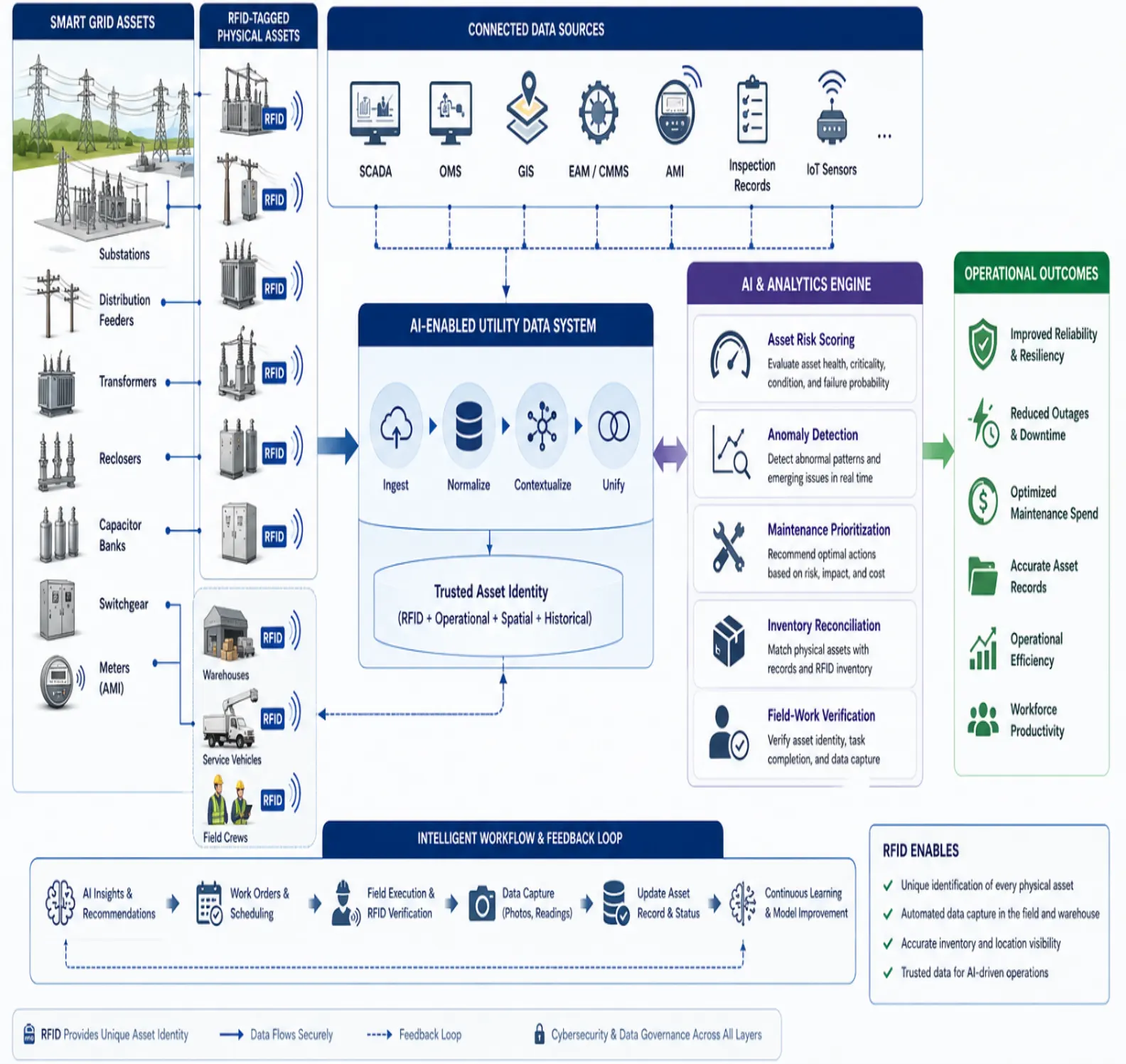
Enterprise infographic showing how RFID-tagged utility assets integrate with SCADA, OMS, GIS, EAM/CMMS, AMI, inspection records, and IoT sensors to create trusted asset intelligence. AI capabilities transform this data into asset risk scoring, anomaly detection, maintenance prioritization, inventory reconciliation, and field-work verification.
What AI Changes in Smart Grid Asset Operations
Traditional utility asset management depends on equipment registers, inspection programs, maintenance records, SCADA telemetry, geographic information systems, warehouse transactions, and technician knowledge. Those sources are valuable but frequently represent different views of the same physical asset.
AI creates additional value by correlating these data sources and identifying patterns that are difficult to detect through individual records. RFID contributes a reliable physical identity layer, allowing a utility to associate an equipment identifier with a transformer, circuit breaker, relay cabinet, instrument transformer, cable accessory, portable test instrument, spare component, or other managed item.
The important distinction is that RFID does not itself provide predictive intelligence. It provides machine-readable identity and presence information. AI uses that information alongside operational and historical data to infer conditions, prioritize actions, identify inconsistencies, and assist personnel.
For Smart Grid Operations, this combination is relevant to:
- Asset identification during substation inspections and maintenance
- Verification of equipment installed against engineering records
- Transformer and switchgear maintenance history
- Spare-parts and critical-component inventory control
- Field-service verification before and after work orders
- Portable test equipment and tool accountability
- Asset movement between warehouses, substations, workshops, and service vehicles
- Inspection scheduling based on asset condition and operational risk
- Detection of inconsistent asset records across GIS, EAM, and physical locations
- Identification of missing, misplaced, or incorrectly recorded equipment
- Correlation of asset identity with outage and maintenance events
- AI-assisted prioritization of field inspections
- Evidence collection for maintenance and compliance workflows
GAO supplies RFID, BLE, and IoT hardware products and systems that can support these identification and connected-asset workflows. The engineering objective is to integrate physical asset identity into existing utility processes rather than create a separate information silo.
Priority Smart Grid Operations Use Cases
AI-Assisted Utility Asset Tracking
Asset tracking is one of the most direct applications because utilities maintain large populations of geographically distributed equipment. A tagged transformer, switchgear assembly, relay enclosure, portable diagnostic instrument, or spare component can be associated with its asset record and operational location.
AI can compare expected asset locations with captured identification events and highlight exceptions. For example, if a critical spare is recorded in a warehouse but RFID events indicate movement to another facility without a corresponding work order, the system can flag the discrepancy for review.
The same approach can support mobile maintenance operations by associating equipment, technicians, tools, and work orders during field activity.
Predictive Maintenance and Condition-Based Inspection
Predictive maintenance depends on trustworthy asset history. AI models can analyze transformer temperature, dissolved gas analysis results, breaker operation counts, inspection findings, vibration measurements, load conditions, fault history, and maintenance records to estimate deterioration or maintenance priority.
RFID strengthens this process by helping ensure that the observations are attached to the correct physical asset.
A practical deployment should not allow an AI recommendation to bypass utility engineering procedures. The model should produce a risk score, anomaly indication, or recommended inspection priority, while qualified personnel remain responsible for maintenance decisions and switching or protection activities.
Substation Asset Verification
Substations contain dense collections of equipment with similar physical appearances and different electrical functions. Identification errors can create serious operational and maintenance problems.
RFID tags can provide machine-readable identification for selected assets, cabinets, panels, tools, and replaceable components. A technician can use a handheld reader to verify an asset before performing an inspection or work-order task.
AI can then compare the captured identity, asset record, inspection history, work-order status, and expected location. Exceptions can be routed to maintenance personnel rather than requiring manual reconciliation across multiple systems.
Distribution Equipment and Field-Service Verification
Distribution operations involve equipment spread across feeders, poles, cabinets, pad-mounted installations, switching locations, and other field environments. Asset records can become inaccurate after replacement, emergency repair, relocation, or partial upgrades.
AI-assisted reconciliation can compare field observations with GIS, EAM, work-order, and inspection records. RFID can provide a physical identity signal where tags can be installed and reliably read.
For outdoor distribution assets, tag selection must account for metal surfaces, environmental exposure, mounting geometry, read distance, temperature, moisture, chemicals, and mechanical impact. A tag that performs well on a warehouse carton should not automatically be assumed suitable for a metal transformer enclosure exposed to weather.
Utility Warehouse and Critical Spare Management
Critical spares require stronger controls than ordinary inventory because stockouts can extend restoration times while unnecessary inventory ties up capital.
RFID can automate identification at receiving, staging, issuing, return, and transfer points. AI can use historical consumption, failure rates, asset criticality, lead times, seasonal demand, outage patterns, and maintenance schedules to improve replenishment and staging decisions.
The most useful implementation connects RFID events to the inventory and maintenance systems already used by the utility. Replacing those systems solely to introduce RFID is usually unnecessary.
RFID Deployment in Smart Grid Operations
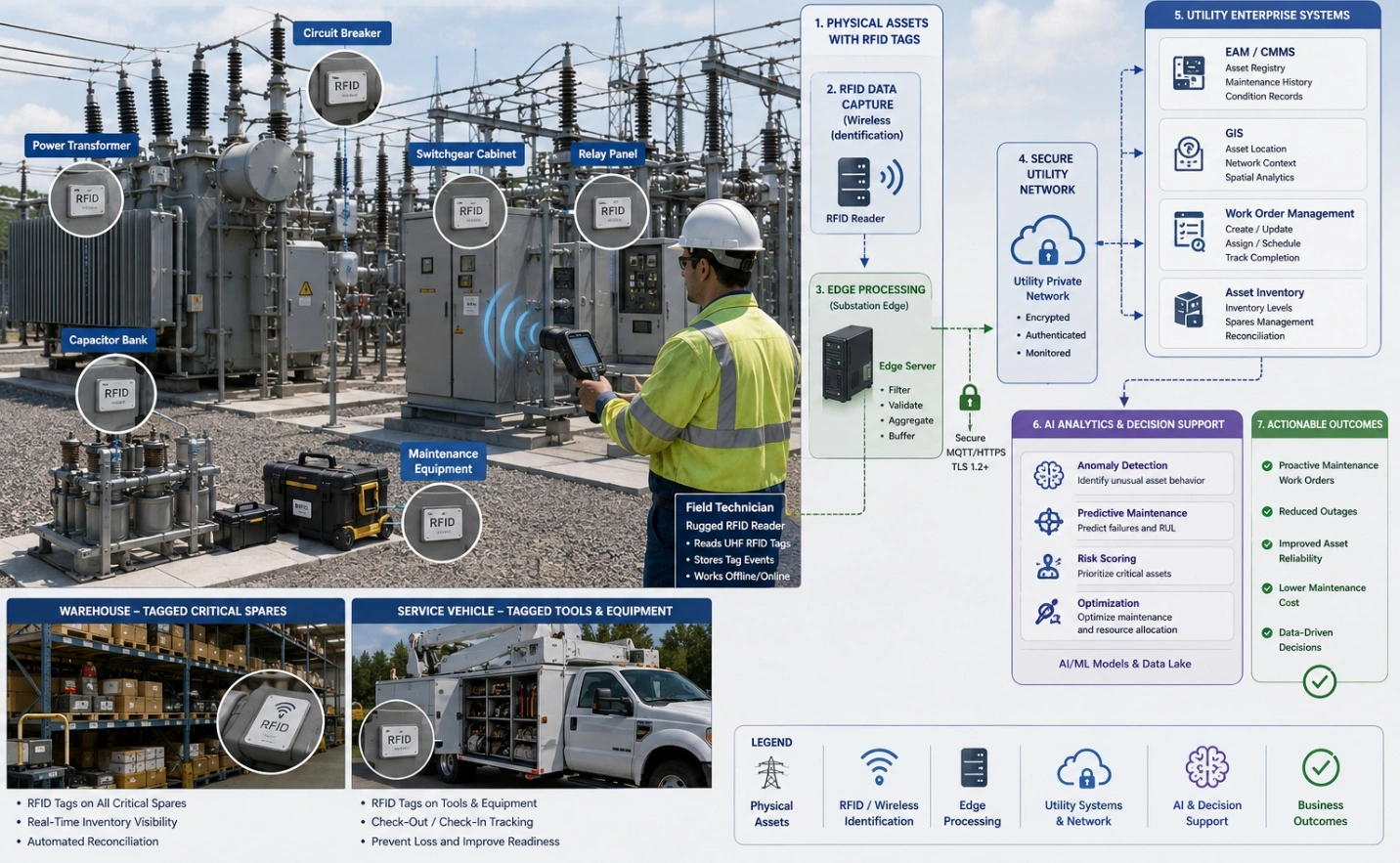
Realistic utility substation deployment showing UHF RFID-tagged equipment, handheld RFID inspection, edge processing, secure utility networks, enterprise systems, warehouse inventory, service vehicles, and AI-driven decision support.
Smart Grid Operational Workflows Enabled by AI and RFID
A practical implementation should follow the utility’s existing asset lifecycle rather than treating RFID capture as an isolated project.
Asset Registration and Tag Association
The process begins with a controlled asset master. Each selected asset receives a unique identifier associated with its existing utility asset ID, equipment class, location, manufacturer information, serial number, commissioning status, and relevant maintenance attributes.
The RFID identifier should not become an uncontrolled replacement for the utility’s authoritative asset ID. Instead, it should provide a machine-readable association with that record.
Field Data Capture
Technicians use fixed readers, handheld readers, vehicle-mounted readers, or other appropriate RFID equipment depending on the operating environment.
Read events can contain:
- RFID tag identifier
- Timestamp
- Reader identifier
- Location or zone
- Read confidence or signal characteristics where supported
- Associated work order
- Technician or authorized device identity
- Asset identifier
- Inspection or maintenance context
The system should filter duplicate reads and account for the physical characteristics of the installation. Metal equipment, RF reflections, tag orientation, shielding, nearby structures, and reader placement can materially affect performance.
Edge Processing and Data Normalization
An edge computing layer can receive RFID events near the operational environment and perform filtering, deduplication, validation, buffering, and local rule execution before forwarding selected data to centralized software.
This is useful where substations or field facilities have constrained connectivity or where operational workflows require local processing. Edge processing also reduces unnecessary transmission of repetitive raw reader events.
Utility networks commonly combine technologies such as Ethernet, fiber, cellular connectivity, private wireless networks, VPNs, MQTT, HTTPS, OPC UA, Modbus, DNP3, IEC 60870-5-104, and IEC 61850 depending on the system boundary and application. RFID data should be integrated without interfering with protection, control, or other safety-critical traffic.
IEC 61850 is particularly relevant to power utility automation and defines communication requirements and information models for intelligent electronic devices and utility automation systems. The current IEC technical report IEC TR 61850-1-1:2026 provides an updated introduction and overview of the series.
Integration With Utility Software
RFID events become operationally useful when they are connected to systems such as:
- Enterprise Asset Management (EAM)
- Computerized Maintenance Management Systems (CMMS)
- Geographic Information Systems (GIS)
- Supervisory Control and Data Acquisition (SCADA)
- Outage Management Systems (OMS)
- Distribution Management Systems (DMS)
- Advanced Distribution Management Systems (ADMS)
- Advanced Metering Infrastructure (AMI)
- Warehouse Management Systems (WMS)
- Enterprise Resource Planning (ERP)
- Mobile Workforce Management systems
- Laboratory and diagnostic information systems
- Document and inspection management systems
Integration can use APIs, message brokers, middleware, database interfaces, or standardized utility communication mechanisms. The appropriate method depends on the existing software landscape and the required latency.
GAO’s role in such deployments can include supplying RFID readers, tags, antennas, handheld equipment, and related IoT hardware while supporting the technical requirements needed to connect physical identification with customer-managed software systems.
AI Analysis and Operational Decision Support
Once asset identity is connected with operational history, AI models can evaluate relationships across multiple data sources.
Useful methods include:
- Supervised machine learning for failure-risk classification
- Time-series models for equipment condition trends
- Anomaly detection for unusual asset behavior
- Natural language processing for maintenance notes and inspection reports
- Computer vision for visual inspection where images are available
- Predictive models for spare-parts demand
- Graph-based analysis for relationships between assets, feeders, substations, and maintenance events
- Optimization models for inspection and maintenance prioritization
- AI-assisted retrieval of historical asset and maintenance information
The AI output should be traceable. A maintenance planner should be able to understand which asset, measurements, events, inspection findings, or historical patterns contributed to an alert or recommendation.
Human Review and Field Action
The final stage is operational action. Depending on the use case, the result may create an inspection task, update an inventory record, trigger an exception, prioritize a work order, notify a supervisor, or recommend further diagnostic testing.
For safety-critical utility operations, AI should normally support decision-making rather than independently execute protection, switching, or other actions unless the specific system has been engineered, validated, authorized, and governed for autonomous control.
Engineering Considerations for Utility Deployments
RFID deployment quality depends more on site engineering than on reader specifications alone. Utility environments contain conductive surfaces, electrical equipment, cabinets, cable trays, structural steel, electromagnetic sources, outdoor exposure, and restricted maintenance areas.
A deployment assessment should therefore consider:
- Asset material and mounting surface
- Required read distance
- Tag orientation and placement
- Reader antenna polarization
- RF interference and multipath effects
- Environmental temperature and moisture
- UV exposure and chemical resistance
- Mechanical impact and vibration
- Maintenance access
- Reader power availability
- Network connectivity
- Zone boundaries and read-event filtering
- Cybersecurity segmentation
- Existing asset identifiers
- EAM, GIS, CMMS, and work-order integration
- Data retention requirements
- Reader and tag lifecycle management
Tagging every physical object is rarely the optimal starting point. A better approach is to select assets where reliable identification produces measurable operational value, such as critical spares, high-value maintenance equipment, frequently serviced assets, inspection targets, or assets with historically poor record accuracy.
RFID Use-Case Selection Decision Tree for Smart Grid Operations
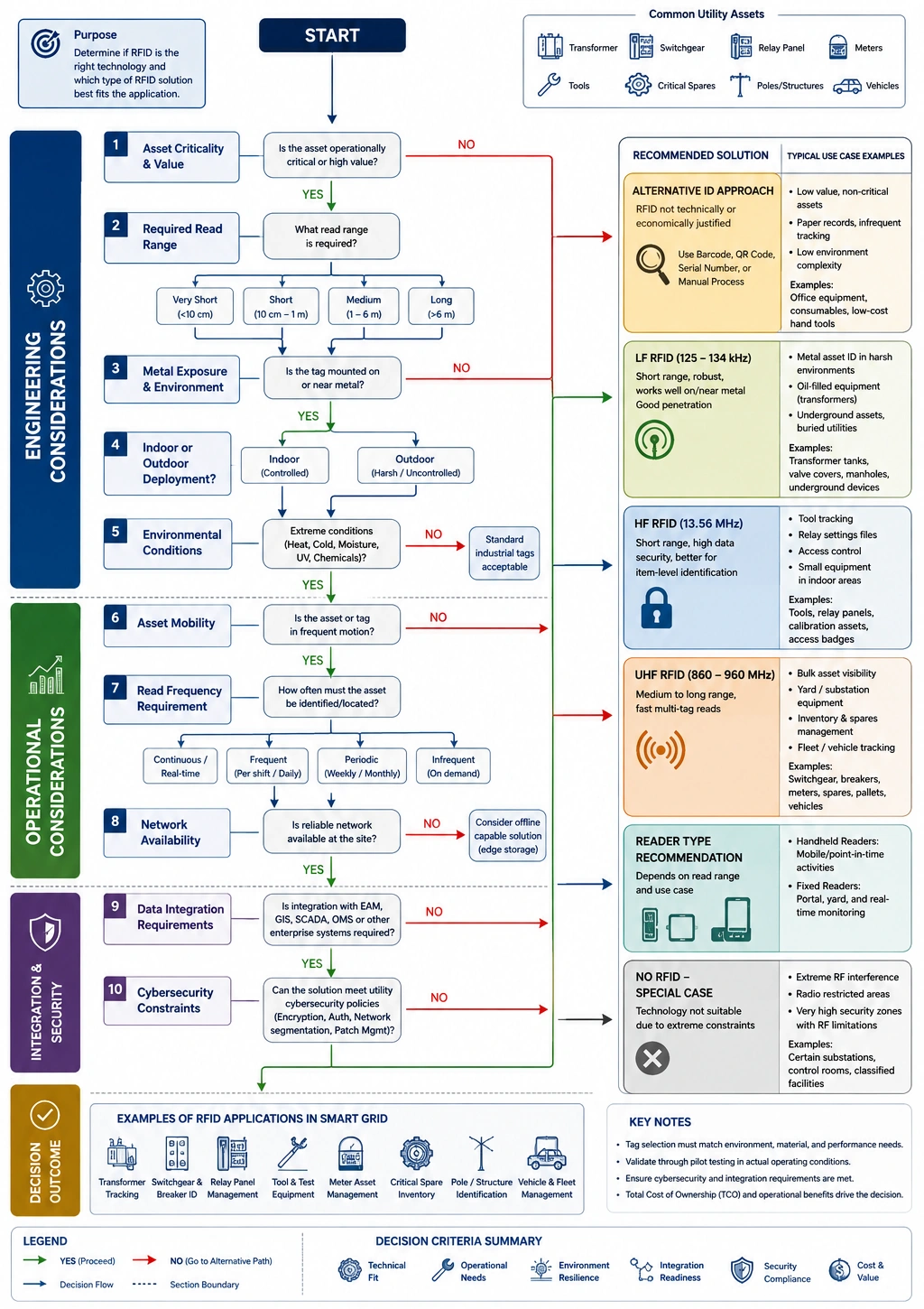
This decision tree guides utility engineering and procurement teams through the technical evaluation of RFID for smart grid asset management. It considers asset criticality, read range, metal exposure, environmental conditions, mobility, read frequency, network availability, data integration, and cybersecurity requirements. The workflow recommends suitable LF, HF, or UHF RFID technologies, handheld or fixed readers, or alternative identification methods when RFID is not justified.
Utility Cybersecurity and Data Governance
Smart Grid Operations require cybersecurity controls that reflect the distinction between operational technology and business or analytics systems. NIST’s Smart Grid Cybersecurity guidance emphasizes risk assessment and security requirements across interconnected smart grid environments.
For utilities subject to applicable NERC Critical Infrastructure Protection requirements, RFID and AI components should be assessed according to their relationship with protected systems rather than assuming that every RFID device is itself a Bulk Electric System Cyber System. NERC requirements include controls covering areas such as BES Cyber System categorization, electronic security perimeters, system security management, incident response, recovery, configuration management, and information protection.
A robust deployment should therefore use:
- Role-based access control
- Device authentication
- Encrypted communications where appropriate
- Network segmentation
- Secure credential management
- Firmware and software lifecycle controls
- Audit logging
- Configuration management
- Asset inventory for connected devices
- Secure API authentication
- Data integrity checks
- Controlled remote access
- Incident response procedures
- AI model monitoring and change control
AI systems introduce additional concerns, including training-data quality, model drift, false positives, explainability, access control for analytical data, and governance of model updates.
AI and RFID for Smart Grid Operations
AI, RFID, and the Smart Grid Technology Stack
A practical AI-enabled Smart Grid Operations solution typically consists of several coordinated layers rather than a single product. Each layer should have a defined operational responsibility and a controlled interface with adjacent systems.
RFID Identification Hardware
RFID hardware provides physical asset identification and movement events.
- UHF RFID:Appropriate for longer-range identification of utility assets, warehouse inventory, maintenance tools, service equipment, and selected substation applications. UHF deployments require careful consideration of metal surfaces, antenna placement, tag orientation, and RF reflections.
- HF RFID:Useful for shorter-range controlled identification, access-related workflows, component identification, and applications where close-range reading is preferable.
- LF RFID:Suitable for specialized short-range identification scenarios where lower-frequency characteristics provide an operational advantage.
- Fixed RFID readers:Used at controlled gateways, warehouse doors, staging areas, or defined inspection points.
- Handheld RFID readers:Useful for field technicians conducting asset verification, inspections, inventory checks, and work-order validation.
- RFID tags:Selection should consider substrate, mounting surface, read range, environmental exposure, mechanical stress, temperature, and required service life.
- Antennas and reader gateways:Determine how reliably physical identification events are captured and should be engineered for the actual utility environment rather than selected solely from nominal specifications.
IoT Sensors and Edge Computing
RFID establishes identity, while IoT sensors can provide operational measurements. Depending on the asset, these measurements may include temperature, vibration, humidity, current, voltage, acoustic characteristics, partial-discharge indicators, battery status, or other condition variables.
An edge computing device can normalize sensor and RFID data, execute local rules, buffer events during connectivity interruptions, and forward relevant information to centralized systems.
This division is important. A utility does not necessarily need to send every raw RFID read or high-frequency sensor measurement to a cloud service. Filtering close to the source can reduce network traffic and improve operational responsiveness.
AI and Machine Learning
The AI layer can combine RFID events with asset history and operational data.
Relevant techniques include:
- Anomaly detection for unusual equipment or maintenance patterns
- Classification models for asset condition or failure risk
- Time-series analysis for degradation trends
- Natural language processing for technician notes and inspection reports
- Computer vision for inspection imagery
- Demand forecasting for critical spare parts
- Optimization for maintenance scheduling
- Retrieval-augmented AI for searching approved utility documentation and asset records
- Graph analytics for relationships between equipment, substations, feeders, work orders, and failures
AI model selection should follow the operational problem. A simple statistical threshold may be more appropriate than a complex neural network when the dataset is small, the decision is well understood, or explainability is essential.
Cloud Version and Server Version for Smart Grid Operations
A Cloud Version places application software, databases, analytics services, and AI processing within managed cloud infrastructure. This model can be appropriate when a utility needs centralized access across warehouses, service regions, engineering teams, and distributed operational locations.
Cloud deployment can simplify infrastructure scaling and provide centralized software management. However, connectivity, data residency, cybersecurity requirements, integration latency, and organizational policies must be evaluated before sensitive utility data is transferred outside controlled environments.
A Server Version places the software on customer-managed edge servers, private data centers, utility facilities, factory servers, or other privately hosted infrastructure. It is not restricted to a traditional on-premises data center. This approach can be preferable where utilities require tighter control over data, integration with restricted networks, local processing, or operation during intermittent external connectivity.
A hybrid implementation is also practical. RFID readers and edge computers can operate locally while selected asset data, analytics results, or reporting information are synchronized with centralized cloud or private-server software.
The correct deployment model depends on:
- Utility cybersecurity policy
- Regulatory requirements
- Network availability
- Data classification
- Required response time
- Existing IT and OT infrastructure
- Integration with EAM, GIS, OMS, DMS, ADMS, SCADA, and other systems
- Number and geographical distribution of facilities
- Internal infrastructure management capabilities
- AI processing requirements
GAO can provide RFID and IoT hardware and related systems for deployments where customers require either centralized software integration or privately hosted operational environments.
AI-Enabled Smart Grid RFID Deployment: Cloud, Server, and Hybrid Comparison
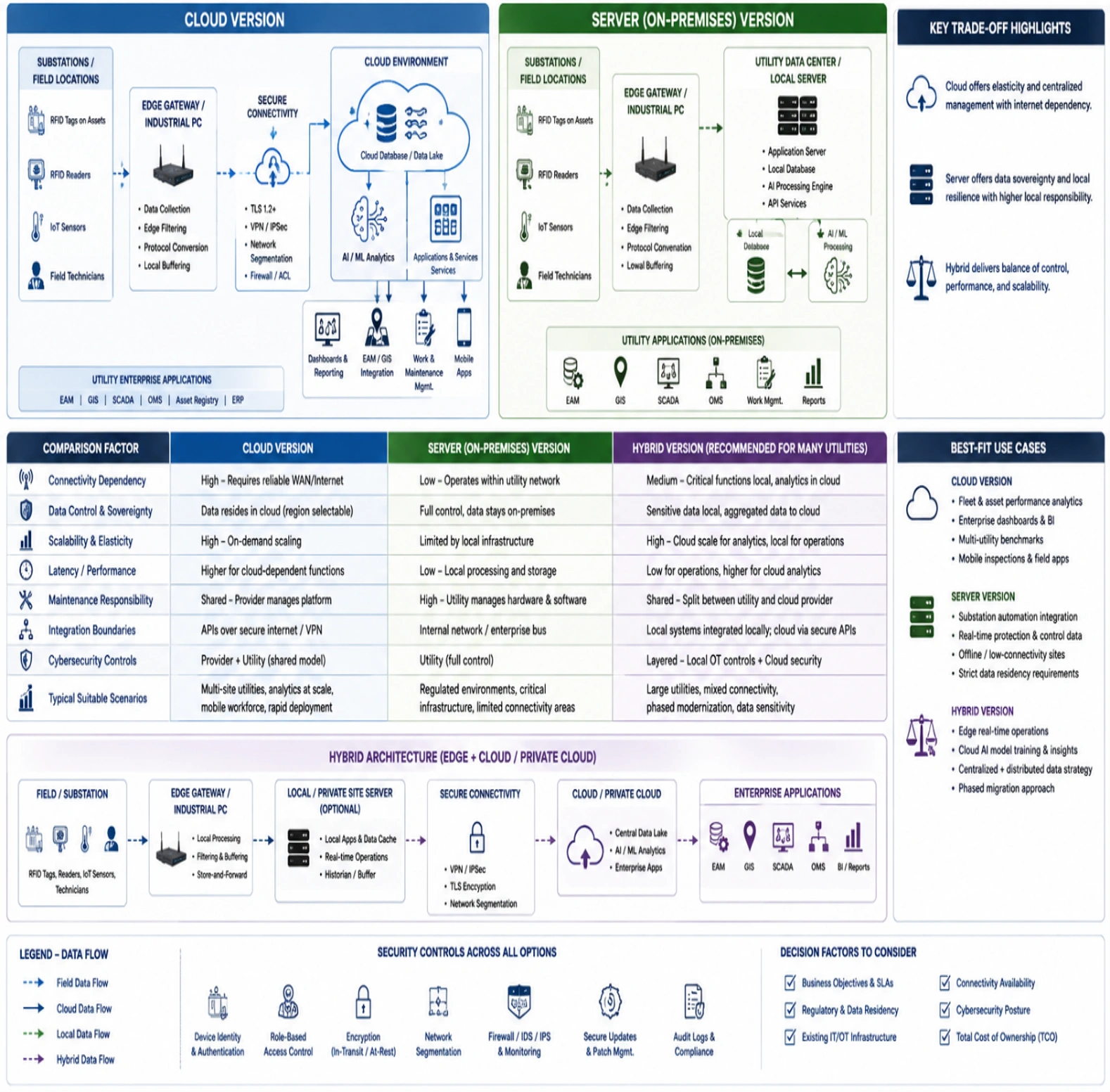
This comparison diagram presents cloud, on-premises server, and hybrid deployment architectures for RFID-enabled AI smart grid operations. It compares connectivity dependency, data control, scalability, latency, maintenance responsibility, integration boundaries, cybersecurity controls, and suitable utility scenarios. The hybrid architecture highlights edge processing with cloud or private-cloud analytics as a flexible option for many utility environments.
Operational Benefits of AI-Enabled Smart Grid Asset Management
Higher Asset Record Accuracy
AI-assisted reconciliation can identify differences between physical asset observations and digital records. RFID provides an additional physical verification signal, reducing dependence on manual transcription.
The result can be a more reliable relationship between equipment in substations and field locations and the corresponding records in EAM, GIS, CMMS, and inventory systems.
Faster Field Verification
Technicians can identify an asset without manually searching through long equipment lists or relying solely on visual labels. The captured identifier can retrieve the appropriate asset record and associated work instructions.
This can reduce administrative effort during inspections while helping prevent work being performed against the wrong asset record.
Better Maintenance Prioritization
AI can combine asset criticality, age, failure history, operating conditions, inspection findings, and maintenance events to rank assets requiring attention.
RFID does not create the risk score itself. Its contribution is maintaining a dependable connection between the physical equipment and the digital information used by the model.
Improved Critical-Spare Availability
AI forecasting can estimate future demand for transformers, breakers, relays, fuses, connectors, meters, and other critical components using historical consumption and maintenance requirements.
RFID can improve inventory accuracy by recording physical movement and reducing discrepancies between warehouse records and actual stock.
Reduced Asset Search Time
A field technician or warehouse operator can locate a tagged item through RFID-assisted identification rather than relying exclusively on manual inventory searches.
This is especially useful when critical equipment or test instruments must be located quickly during maintenance or outage restoration.
Better Maintenance Traceability
Associating RFID events with work orders can create a stronger audit trail showing which physical asset was inspected, when it was handled, where the event occurred, and which maintenance activity was associated with it.
That traceability can support maintenance quality, engineering review, inventory reconciliation, and operational reporting.
Scalable Asset Intelligence
Once the identification and integration process is standardized, additional asset classes can be introduced without redesigning the entire operational workflow.
A utility might begin with warehouse spares and portable equipment, then expand to substation assets, distribution equipment, inspection workflows, and condition-monitoring applications based on measured value.
Smart Grid KPIs for AI and RFID Deployments
Technology adoption should be evaluated through operational measurements rather than reader counts or tag volumes alone.
Useful KPIs include:
- Asset record accuracy
- Physical-to-digital asset match rate
- RFID read success rate
- Asset-location discrepancy rate
- Inventory accuracy
- Critical-spare availability
- Mean time to locate equipment
- Work-order asset verification rate
- Inspection completion rate
- Preventive-maintenance compliance
- Corrective-maintenance response time
- Mean time to repair
- Asset-related outage duration
- Unplanned equipment failure rate
- False-positive rate for AI alerts
- False-negative rate for critical anomaly detection
- Maintenance-risk prediction accuracy
- Technician time spent on asset identification
- Inventory reconciliation time
- Work-order data completeness
- Reader uptime
- Edge gateway availability
- Data synchronization success rate
- AI model drift indicators
- Cybersecurity incident rate
- Unauthorized device connection attempts
- System integration error rate
- Data latency from field capture to application
- Cost per tracked asset
- Return on operational investment
KPIs should be established before deployment. Otherwise, a utility may successfully install RFID hardware without being able to demonstrate whether the implementation improved maintenance, inventory, field productivity, or asset-data quality.
Implementation Lifecycle for Smart Grid Operations
Planning and Use-Case Selection
Begin with a specific operational problem rather than a technology purchase.
A suitable first use case should have measurable pain points, accessible asset data, defined users, and a manageable deployment boundary. Critical spare management, substation inspection verification, and portable-equipment tracking are often easier to validate than a utility-wide rollout.
Asset and Data Preparation
Before tagging assets, reconcile asset IDs, serial numbers, locations, equipment classes, and ownership records.
Poor master data can undermine an otherwise technically successful RFID deployment. AI models will also inherit errors from inconsistent source data.
RFID Site Survey and Hardware Selection
Conduct physical testing at representative utility locations.
Testing should examine:
- Metal and non-metal mounting surfaces
- Required read distances
- Antenna placement
- Reader power
- RF interference
- Environmental conditions
- Network connectivity
- Reader density
- Expected simultaneous reads
- Tag durability
- Installation and maintenance access
Pilot testing should occur on representative assets, not only in a laboratory or warehouse environment.
Software Integration
Connect RFID events to the systems that already govern the relevant workflow.
An asset verification deployment may need EAM and mobile workforce integration, while a warehouse deployment may require WMS and ERP integration. A condition-monitoring application may additionally require sensor databases, time-series storage, and AI analytics.
Commissioning and Validation
Validate the complete transaction rather than merely checking whether a reader detects a tag.
A commissioning test should confirm that:
- The correct physical asset is identified
- The correct asset record is retrieved
- Duplicate reads are filtered appropriately
- Events receive accurate timestamps
- Location information is correct
- Work-order associations are preserved
- Data reaches the intended application
- Unauthorized devices cannot inject events
- Connectivity failures are handled correctly
- AI outputs can be traced to relevant data
Optimization and Expansion
After the pilot, measure actual operational performance and adjust tag placement, reader configuration, event filtering, software workflows, and AI models.
Expansion should follow evidence. A successful substation pilot does not automatically prove that the same tag and antenna configuration will perform reliably at outdoor distribution equipment.
Practical Recommendations for Utility Engineering Teams
A technically sound deployment should follow several principles.
- Start with a measurable Smart Grid Operations problem rather than RFID hardware availability.
- Treat the utility asset master as a controlled source of truth and associate RFID identifiers with existing records.
- Select tags based on actual mounting conditions, particularly for metal utility equipment.
- Test UHF RFID performance at representative substations and outdoor locations before procurement at scale.
- Keep RFID identification, IoT sensing, AI analytics, and control functions logically separated according to operational risk.
- Integrate with EAM, GIS, CMMS, WMS, OMS, DMS, ADMS, or other existing systems rather than creating duplicate asset records.
- Use edge processing where connectivity, latency, or operational resilience requires local processing.
- Establish cybersecurity requirements before connecting readers and gateways to utility networks.
- Validate AI recommendations against historical maintenance outcomes before using them to influence operational priorities.
- Keep human engineering review in the loop for safety-critical maintenance and grid-control decisions.
- Define measurable KPIs before the pilot begins.
- Expand by asset class and operational value instead of tagging everything simultaneously.
- Maintain a lifecycle plan for RFID readers, tags, gateways, firmware, credentials, software, and AI models.
- Document installation standards so that future field teams can reproduce successful configurations.
GAO Expertise in RFID and Connected Utility Systems
Headquartered in New York City and Toronto, Canada, GAO is ranked among the world’s leading B2B and B2G suppliers of BLE and RFID technologies. GAO, GAO Research, and GAO Tek form the GAO Group, with operations based in New York City and Toronto.
For three decades, the GAO Group has served organizations across the United States and Canada, including Fortune 500 companies, leading research and development organizations, universities, and government agencies. This experience is relevant to Smart Grid Operations because utility deployments frequently require more than an individual RFID reader or tag. They require dependable hardware, integration considerations, quality controls, documentation, and technical support.
GAO has invested substantially in research and development and maintains stringent quality assurance processes. Our support can be provided remotely or onsite depending on project requirements, helping customers evaluate RFID readers, tags, antennas, gateways, BLE devices, and other IoT hardware for specific operational environments.
Key Takeaways for AI and RFID in Smart Grid Operations
AI-enabled Smart Grid Operations become more effective when physical asset identity, operational data, maintenance history, and engineering knowledge can be connected reliably.
RFID provides a practical identification mechanism for selected utility assets and equipment. AI adds value by analyzing that identification data alongside condition measurements, work orders, inventory records, inspection reports, outage information, and other utility datasets.
The strongest implementations are not technology-first. They begin with measurable operational problems such as asset-record discrepancies, maintenance prioritization, critical-spare visibility, field verification, and inventory accuracy.
Utilities considering deployment should validate RFID performance in representative environments, define integration boundaries, establish cybersecurity controls, measure operational KPIs, and introduce AI only where data quality supports dependable analysis.
GAO can help organizations evaluate RFID and IoT hardware requirements and develop technically appropriate identification solutions for Smart Grid Operations.
Building the Future of Industrial AI and IoT with Aperture Venture Studio and GAO RFID Inc.
For more than three decades, GAO Group of Companies has invested heavily in R&D for industrial RFID, BLE, and IoT. As generative AI became increasingly useful in industrial applications, we expanded our work across AI and IoT technologies and founded Aperture Venture Studio to support the development and scaling of AI and IoT solutions relevant to areas such as smart grid asset intelligence and connected industrial operations.
Aperture has attracted AI and IoT technical experts, entrepreneurial and operational executives, influential investors, and leading companies. We have also developed Aperture Ventures Summit and TekSummit to discuss advanced AI and IoT topics.
These efforts have helped build technical communities around industrial AI and IoT. We welcome participation as:
- Advisors, co-founders, or employees
- Investors
- Customers