
AI and RFID for Snack Foods
AI-Powered Snack Food Traceability and Production Control
AI-powered inventory management, production traceability, quality monitoring, and warehouse control can help snack food manufacturers connect material movements with production conditions and business decisions. RFID provides machine-readable identification for ingredients, packaging materials, work-in-process containers, finished cases, pallets, reusable assets, and selected equipment, while AI converts accumulated operational data into forecasts, anomaly detection, quality insights, and recommended actions.
Snack food production involves high-volume flows of ingredients such as potatoes, corn, grains, nuts, oils, seasonings, salt, sugar, and flavoring compounds, together with films, cartons, labels, trays, and other packaging materials. AI and RFID can help manufacturers track these materials through receiving, storage, batching, processing, frying or baking, seasoning, packaging, palletizing, finished-goods storage, and shipment. The resulting data can support lot traceability, inventory accuracy, production scheduling, waste reduction, recall readiness, and more responsive supply-chain decisions.
Snack Food Manufacturing AI-RFID Operational Flow Diagram
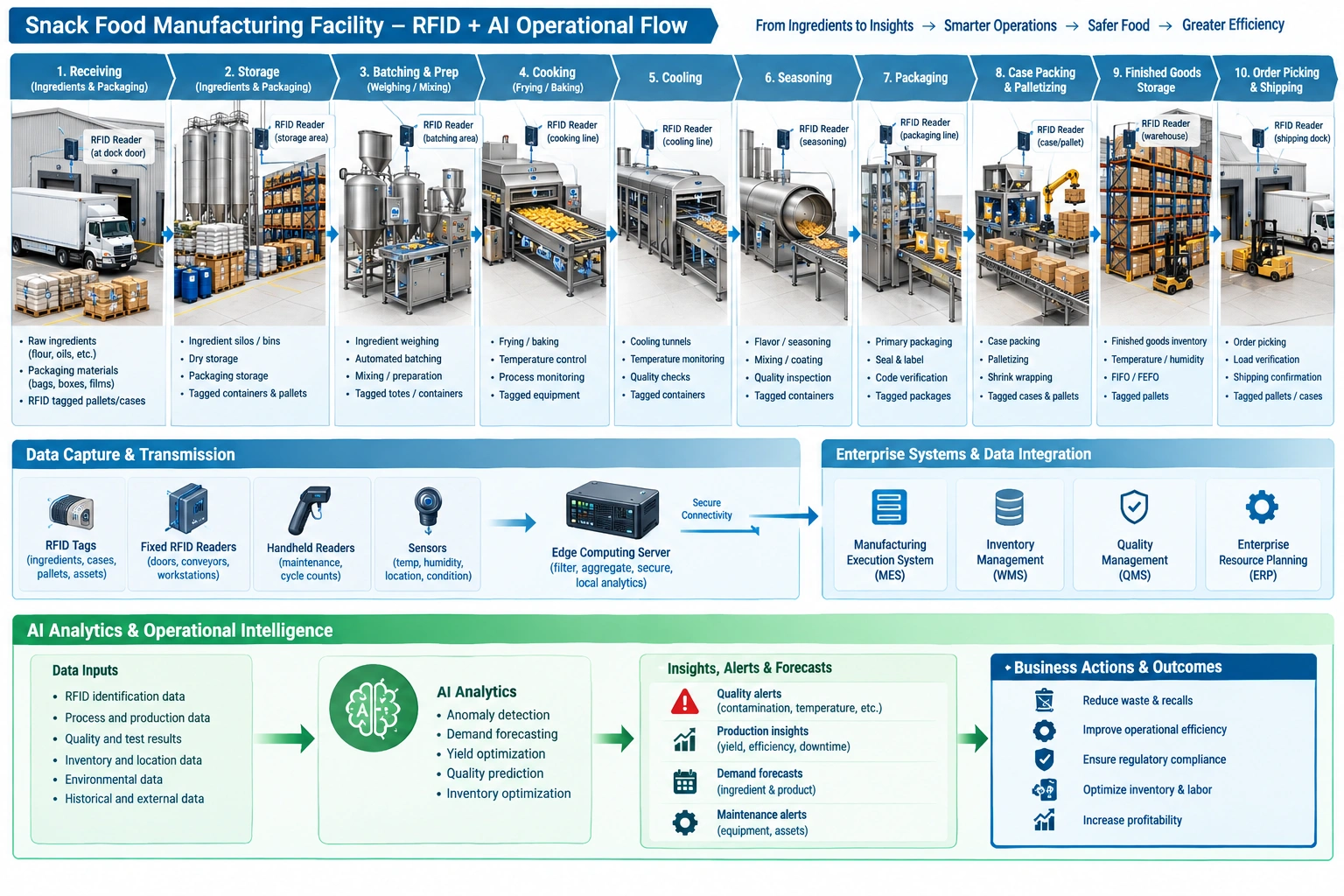
What AI-Powered RFID Management Means for Snack Foods
Snack food manufacturing generates large volumes of operational events. A single production day can involve multiple ingredient lots, seasoning batches, packaging-material changes, production orders, sanitation activities, quality checks, finished-product lots, pallets, and customer shipments. Manual recording can make it difficult to maintain a complete relationship between material identity, production activity, inventory status, and finished-product disposition.
RFID supplies an automated identification layer. Depending on the operating environment, manufacturers can use UHF RFID for longer-range identification of cases, pallets, containers, and warehouse inventory; HF RFID for shorter-range identification and controlled workstation interactions; and LF RFID where low-frequency identification is appropriate for specialized industrial assets or operating conditions.
AI adds interpretation and decision support to these identification events. Rather than treating an RFID read as an isolated transaction, an AI-enabled system can correlate identification data with production schedules, material consumption, quality measurements, equipment conditions, warehouse transactions, order requirements, and historical demand.
For snack food manufacturers, this combination can support applications such as:
- AI inventory management for ingredients and packaging materials
- AI-assisted lot and batch traceability
- AI demand forecasting for finished snack products
- AI production planning based on material availability and historical consumption
- AI anomaly detection for unusual material movements
- AI-supported replenishment recommendations
- AI analysis of production and warehouse transaction patterns
- AI-assisted recall and genealogy investigations
- AI monitoring of reusable production containers and handling equipment
- AI-supported finished-goods order fulfillment
- AI analysis of inventory discrepancies and transaction exceptions
- AI-assisted maintenance planning for RFID-enabled material-handling assets
The value depends on the quality of the underlying operational data. RFID cannot compensate for poorly defined item masters, inconsistent lot identifiers, incorrect production-order data, or uncontrolled material-handling procedures. Successful deployments therefore treat identification, data governance, process discipline, and AI modeling as connected engineering requirements.
Snack Food Operations Where AI Creates the Most Value
Ingredient and Packaging Inventory
Snack food plants must maintain sufficient supplies of raw materials and packaging components without creating excessive inventory. Production interruptions can occur when critical materials such as cooking oil, seasoning ingredients, film, labels, cartons, or corrugated cases are unavailable at the required production location.
RFID can automatically record movements into storage areas and production staging zones. AI can then evaluate historical consumption, production schedules, supplier lead times, safety-stock policies, seasonal demand, and inventory transactions to identify potential shortages or abnormal consumption.
GAO can provide RFID hardware products and systems that support identification and data capture across material-handling operations, with deployment choices determined by read distance, item density, packaging materials, environmental conditions, and required transaction speed.
Batch and Lot Traceability
Traceability is particularly important when snack food production combines multiple ingredient lots into a production batch. A traceability system should establish relationships among received ingredients, storage locations, production orders, seasoning batches, packaging lots, finished-product lots, pallets, and shipments.
RFID events can strengthen these relationships by recording where identified materials move and when they enter designated process areas. AI can help detect missing relationships, unusual material sequences, duplicate transactions, or discrepancies between expected and observed material consumption.
Such analysis can make genealogy investigations more efficient because personnel can begin with a specific lot, production order, pallet, or shipment and work backward or forward through associated records.
Production Staging and Line Supply
Snack food production depends on timely delivery of ingredients and packaging materials to the correct line. Production staging may involve multiple lines operating different products, package sizes, flavors, and production orders.
RFID-enabled identification can help confirm whether the correct material has reached the intended staging area. AI can compare material movements with production schedules and identify situations such as an unexpected material allocation, excessive staging duration, or repeated replenishment exceptions.
The practical objective is not simply to count tagged items. It is to connect material identity with the production order and operational context in which that material is consumed.
Finished Goods and Warehouse Operations
Finished snack foods may be stored as cases, pallets, or other logistics units before shipment. High transaction volumes can make manual inventory reconciliation difficult, particularly when products are frequently moved between production, quality hold, finished-goods storage, picking areas, and shipping docks.
RFID can capture movement events at dock doors, storage locations, conveyor interfaces, and other controlled points. AI can use these events with warehouse and order data to identify inventory discrepancies, predict replenishment requirements, prioritize exceptions, and improve order allocation.
AI-RFID Snack Food Warehouse: Real-Time Inventory and Operational Intelligence
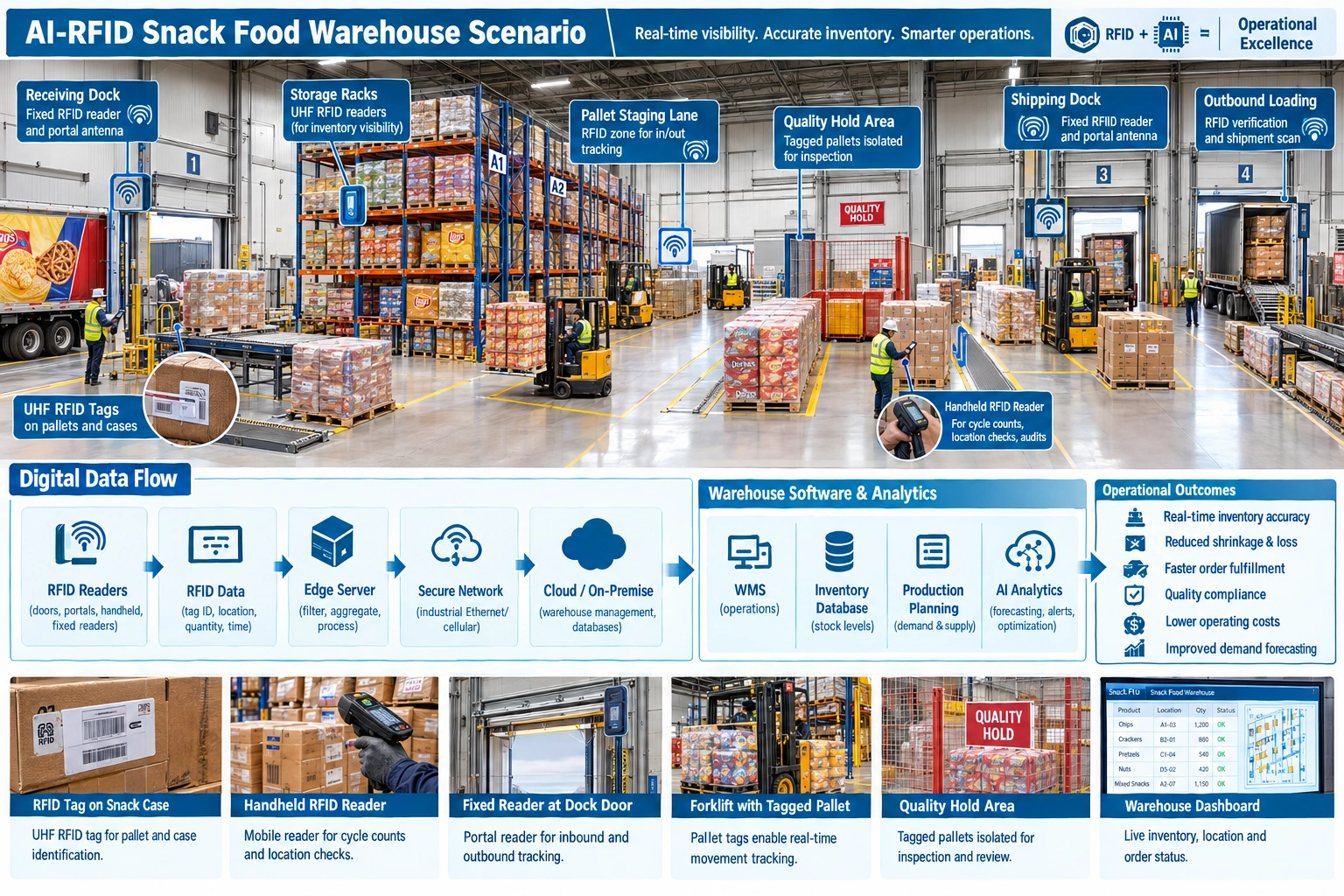
From RFID Events to AI-Driven Snack Food Decisions
A practical AI and RFID deployment begins with physical operations and ends with an operational decision. The data path should be designed around the way snack food materials actually move through the plant.
Data Acquisition at the Plant
RFID readers capture tag identifiers as ingredients, packaging materials, containers, cases, pallets, or assets pass designated read zones. Fixed readers can monitor controlled transitions such as receiving and shipping, while handheld readers can support cycle counts, exception investigation, quality holds, and location verification.
RFID tag selection requires attention to the material being identified. Metalized packaging, liquids, dense product stacks, foil-based materials, and tightly packed cartons can affect UHF RFID performance. Read-zone testing should therefore be performed with representative snack food packaging rather than relying solely on laboratory specifications.
Communication and Edge Processing
Reader data can be transmitted through Ethernet or industrial wireless networks to local processing services. An edge server can filter duplicate reads, apply business rules, associate reads with locations, and normalize events before forwarding validated information to higher-level software.
Edge processing is useful where the plant requires rapid event handling or continued operation during temporary loss of external connectivity. It can also reduce unnecessary transmission of repetitive raw RFID observations.
Enterprise Software Integration
Normalized RFID events become more valuable when correlated with existing manufacturing and business records. Depending on the facility, integration may involve:
- Manufacturing execution systems
- Enterprise resource planning software
- Warehouse management systems
- Inventory management software
- Quality management systems
- Laboratory information systems
- Maintenance management software
- Production scheduling systems
- Transportation and logistics software
- Procurement systems
- Supplier and customer order systems
Integration should preserve identifiers such as SKU, ingredient code, lot number, production order, batch number, pallet ID, storage location, and shipment reference.
AI Analysis and Business Actions
AI models can operate on historical and real-time operational data to identify patterns that conventional transaction rules may miss. Time-series models can support demand and material-consumption forecasting. Classification models can help prioritize exceptions. Anomaly-detection techniques can identify unusual inventory movements or consumption patterns. Computer vision can complement RFID where visual inspection of packaging, labels, seals, or product presentation is required.
The resulting recommendation should lead to a defined operational action. Examples include creating a replenishment request, investigating a material discrepancy, reviewing a production-order allocation, checking a suspected traceability gap, prioritizing an inventory count, or escalating an unusual warehouse event.
AI-RFID Decision Pipeline for Snack Food Traceability
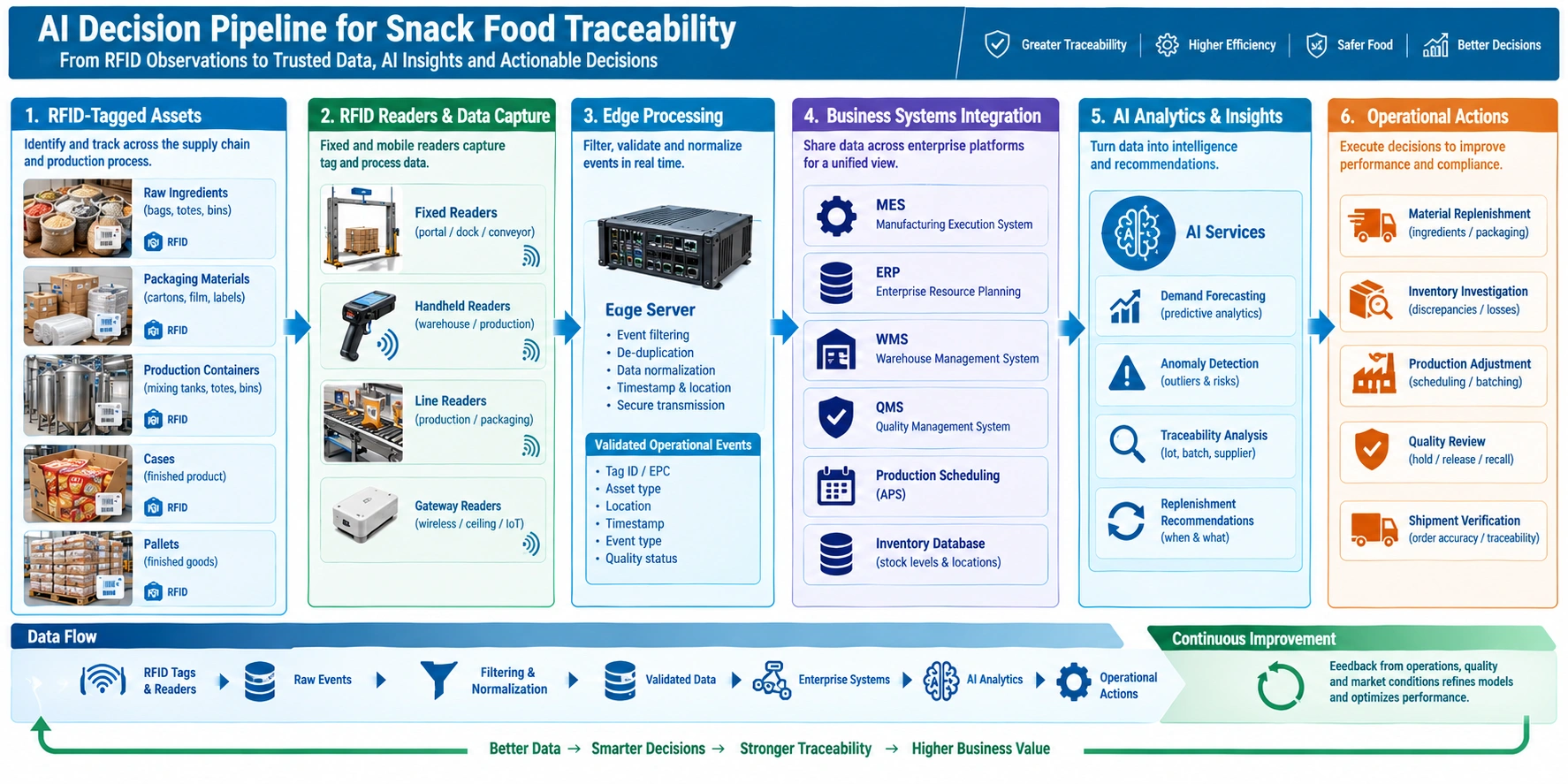
RFID Hardware, AI Software, and Deployment Design for Snack Foods
A snack food deployment normally combines RFID identification hardware, edge computing, networking, application software, enterprise integrations, databases, and AI services. The correct configuration depends on the plant layout, product packaging, read-zone density, production speed, sanitation requirements, warehouse configuration, and existing software.
UHF RFID is generally suited to longer-range identification of pallets, cases, containers, and warehouse inventory. Reader antennas can be positioned at receiving docks, shipping portals, conveyor transitions, or controlled material-transfer points. Handheld UHF readers can complement fixed installations for inventory verification and exception handling.
HF RFID can be appropriate for shorter-range controlled interactions where a reader and tagged object are deliberately brought into proximity. Such configurations can support selected workstation, container, identification, or verification processes where longer read distance is unnecessary.
LF RFID can be considered for specialized identification requirements where its operating characteristics fit the physical environment and asset type. Technology selection should be based on measured performance rather than assuming that one RFID frequency is suitable for every snack food operation.
Cloud Version
A cloud-hosted software deployment can centralize RFID event processing, analytics, reporting, AI models, and information across multiple snack food facilities. This approach can be useful for manufacturers operating geographically distributed plants that need consolidated inventory, production, traceability, or demand information.
The plant should still retain appropriate local controls for time-sensitive processes. Edge services can continue collecting and validating events before transmitting them to cloud applications. Connectivity loss should have defined buffering and synchronization behavior so that temporary network interruptions do not create unexplained inventory gaps.
Server Version
A Server Version can run on customer-managed edge servers, factory servers, private data centers, or other privately hosted enterprise infrastructure. This model can be appropriate when a snack food manufacturer requires greater control over data location, network dependency, integration boundaries, or plant-level processing.
Local deployment can also reduce latency for applications requiring rapid event validation. The trade-off is that the customer assumes greater responsibility for server capacity, operating-system maintenance, backup procedures, cybersecurity controls, software updates, and disaster recovery.
AI Models and Supporting Systems
AI implementation should match the operational decision rather than being selected simply because a particular model is available. Common methods include:
- Time-series forecasting for finished-product demand and ingredient consumption
- Anomaly detection for unexpected inventory and material movements
- Classification models for prioritizing operational exceptions
- Regression models for estimating consumption or process-related outcomes
- Optimization methods for replenishment and production planning
- Computer vision for complementary inspection of labels, packaging, product appearance, or seal conditions
- Natural-language interfaces for querying traceability and inventory records where appropriate
Cybersecurity should cover RFID readers, edge servers, APIs, databases, user authentication, network segmentation, logging, backups, and administrative access. Role-based permissions can restrict who may alter inventory records, release quality holds, modify AI parameters, or access traceability information.
GAO’s experience supplying RFID and related IoT hardware products and systems can support organizations evaluating reader configurations, tags, antennas, deployment environments, and integration requirements. GAO has served U.S. and Canadian organizations for three decades, including Fortune 500 companies, R&D organizations, universities, and government agencies, with remote and onsite technical support.
Commissioning and Integration for Snack Food RFID Systems
Successful commissioning starts with the physical production environment rather than the software interface. RFID read zones should be tested under actual snack food operating conditions, including representative cases, pallets, ingredient containers, packaging materials, forklifts, conveyors, metal structures, and production traffic.
Site Survey and Read-Zone Design
A site survey should document receiving docks, ingredient warehouses, packaging-material storage, production staging areas, line-side supermarkets, finished-goods warehouses, quality-hold areas, and shipping docks. Engineers should identify potential sources of RF interference and reflections, including metal racks, motors, conveyors, electrical equipment, liquid-containing products, foil-based packaging, and closely spaced pallets.
Reader antenna placement should be based on the required read direction and transaction boundary. A shipping portal, for example, should distinguish products crossing the outbound dock from products remaining in a staging lane. Overlapping read zones can create duplicate or false movement events if they are not carefully designed.
RFID Commissioning and Acceptance Testing
Commissioning should validate both RFID performance and the resulting business transaction. A technically successful tag read is not sufficient if the event is associated with the wrong SKU, production order, lot, pallet, or warehouse location.
Testing should include:
- Read-rate testing with representative snack food packaging
- False-read and stray-read testing between adjacent zones
- Tag orientation and pallet-position testing
- Reader and antenna configuration verification
- Handheld reader performance testing
- Network connectivity and event-delivery testing
- Duplicate-event filtering
- Location and transaction association
- Lot and batch genealogy validation
- Quality-hold transaction testing
- Receiving and shipping reconciliation
- Failure and recovery testing
- User-permission and audit-log testing
Acceptance criteria should be established before production deployment. Metrics can include successful identification rate, false-read frequency, event-processing latency, inventory reconciliation accuracy, and recovery time following network or reader failures.
Snack Food RFID Commissioning Test Plan: From Site Survey to Production Approval
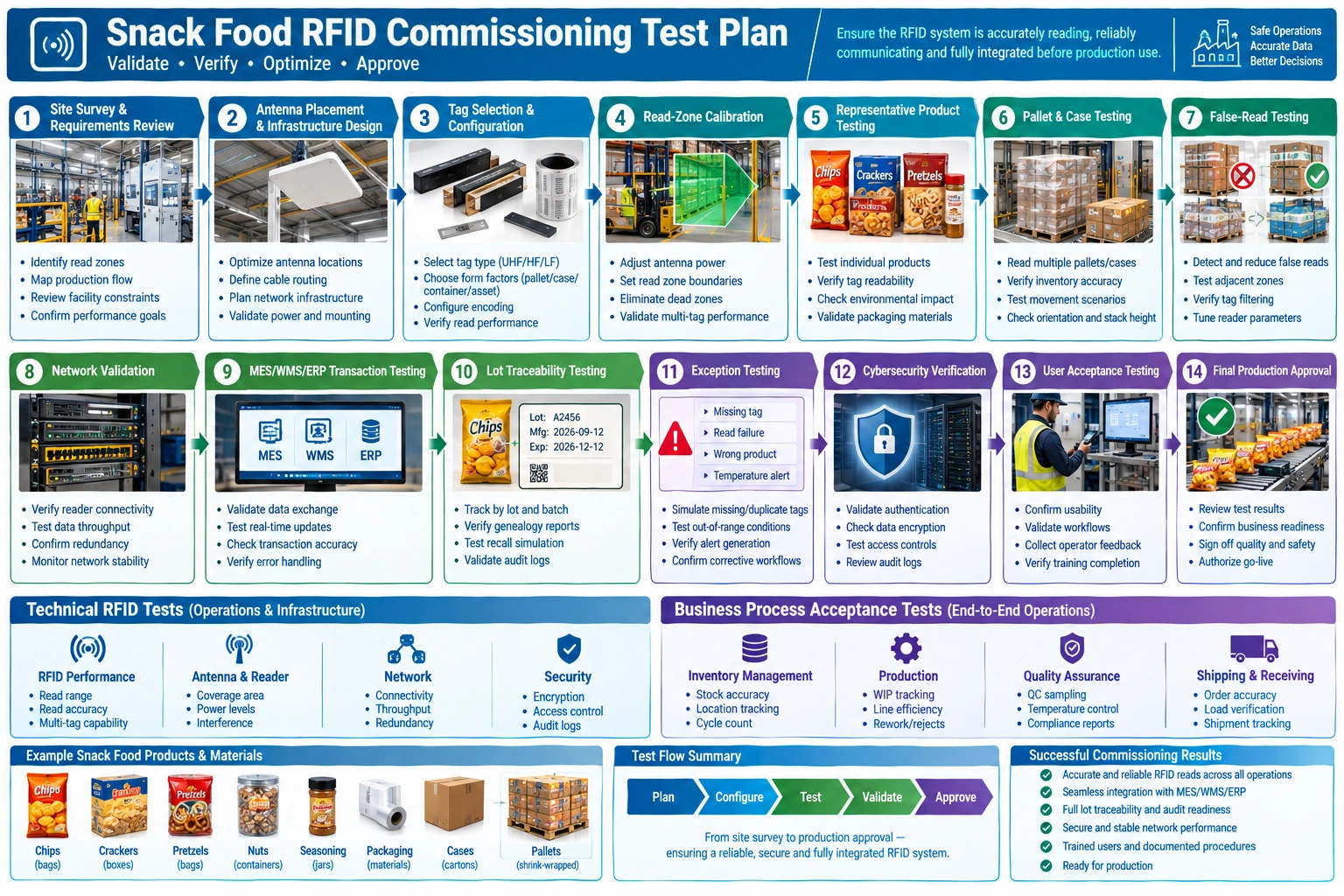
Integration with Manufacturing and Business Software
Integration should establish a controlled relationship between RFID events and existing snack food manufacturing records. An RFID system may identify a pallet, while the warehouse management system determines its location and inventory status. The MES may associate the material with a production order, while the ERP system provides item, purchasing, and order information.
Integration interfaces can use APIs, message queues, database interfaces, web services, or other approved enterprise integration methods. Event schemas should define fields such as tag identifier, item identifier, lot number, location, timestamp, reader location, event type, production order, pallet ID, and transaction status.
A key engineering principle is to avoid allowing raw RFID reads to directly overwrite critical production or inventory records without validation. Middleware or edge software should apply business rules before an event becomes an inventory, production, or shipping transaction.
Testing AI Models Against Snack Food Production Data
AI should be validated against real operating conditions before its recommendations influence production or inventory decisions. Historical data should be examined for missing transactions, inconsistent SKU identifiers, discontinued products, unusual seasonal demand, inventory adjustments, and changes in production schedules.
Forecasting and Inventory Models
A demand-forecasting model for snack foods should distinguish between different product families, package sizes, flavors, customer channels, geographic markets, and promotional patterns where those variables materially affect demand.
Ingredient forecasting requires a different approach. Consumption depends on production volume, recipes, yield, waste, formulation changes, and production losses. Packaging-material requirements depend on package configuration and production schedules rather than finished-product demand alone.
Model performance should therefore be measured using metrics appropriate to the decision. Forecast error, inventory-service performance, stockout frequency, excess inventory, and replenishment accuracy can provide more operational value than a generic AI accuracy score.
Anomaly Detection
AI-based anomaly detection can compare expected RFID movement patterns with observed events. Examples include:
- A pallet appearing in a shipping area without the expected warehouse transaction
- An ingredient container moving to a production area without an associated production order
- Repeated movements between storage locations that do not correspond to normal operations
- Unusual consumption of seasoning or packaging materials
- A sudden increase in inventory adjustments for a particular SKU
- A traceability chain containing missing or inconsistent events
Personnel should be able to review the underlying RFID events behind an alert. Explainability is particularly important when AI recommendations affect quality investigations, production scheduling, or inventory disposition.
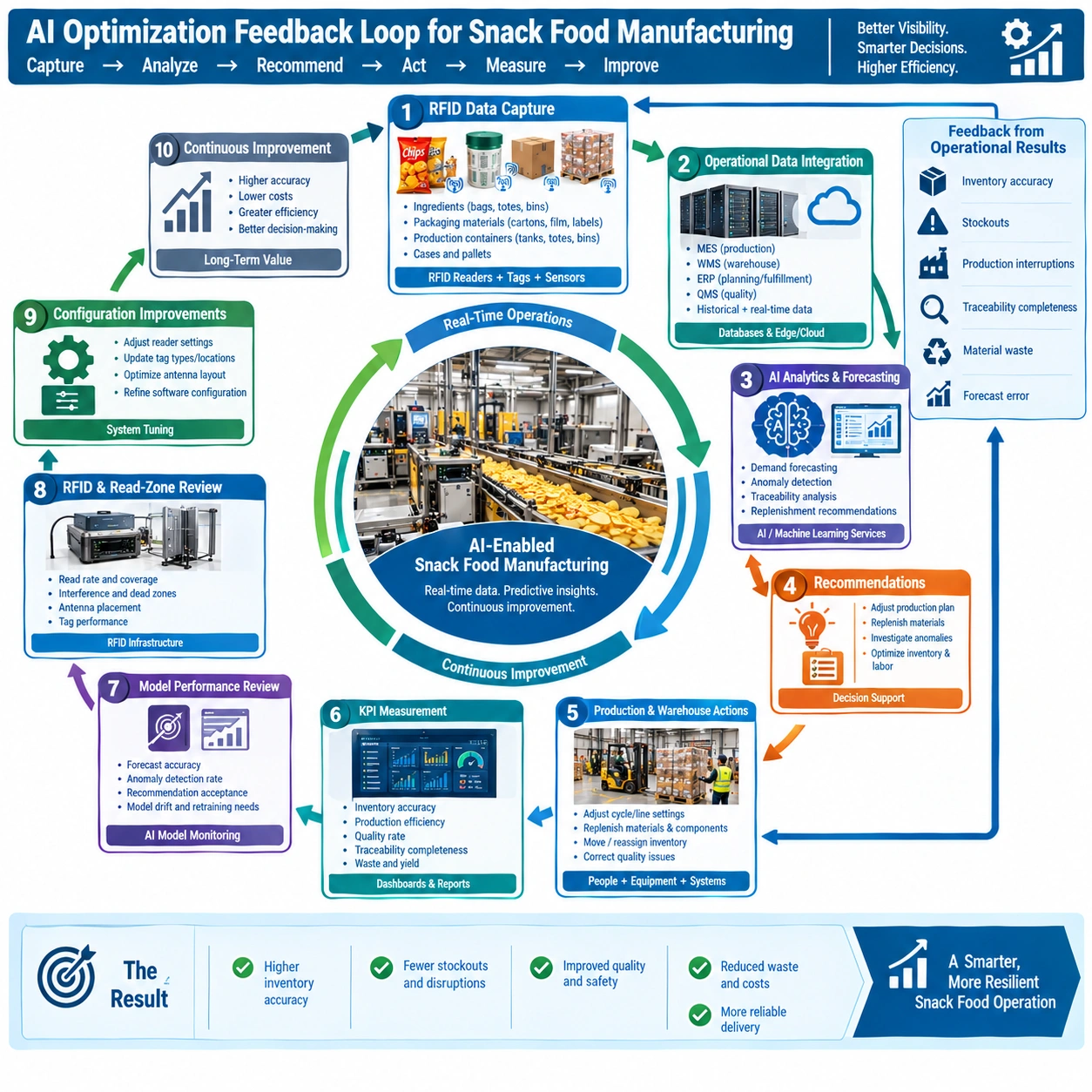
Optimization After Production Deployment
Production deployment should be treated as an iterative engineering process. Snack food operations change continuously as manufacturers introduce new flavors, package sizes, recipes, suppliers, production lines, and distribution requirements.
RFID performance can decline when plant layouts change or new materials are introduced. A new foil-lined package, for example, may behave differently from the packaging used during initial commissioning. Reader zones should therefore be reviewed following significant process or layout changes.
AI models also require monitoring. Demand patterns can shift because of seasonality, promotions, customer changes, new products, or discontinued SKUs. Ingredient consumption can change after recipe modifications or process improvements.
Operational optimization can focus on:
- Reducing unnecessary RFID reads and duplicate transactions
- Improving tag placement and encoding procedures
- Refining replenishment thresholds
- Adjusting AI forecast horizons
- Improving exception-prioritization rules
- Reducing manual inventory counts
- Improving production-line material staging
- Increasing traceability-event completeness
- Improving warehouse transaction accuracy
- Comparing predicted and actual material consumption
- Reviewing model drift and forecast errors
GAO can support organizations evaluating RFID hardware configurations and system requirements as operating conditions evolve, helping engineering teams align identification hardware with actual plant requirements.
AI-RFID Optimization Feedback Loop for Snack Food Manufacturing
Maintenance and Lifecycle Management
RFID equipment should be incorporated into the plant’s normal maintenance program. Fixed readers, antennas, cables, connectors, network equipment, edge servers, and handheld readers can all affect system availability.
Preventive maintenance can include antenna inspection, cable and connector checks, reader diagnostics, network monitoring, firmware management, backup verification, and inspection of physical equipment exposed to production or warehouse conditions.
Snack food plants also require attention to sanitation and environmental exposure. RFID equipment installed near processing areas should be selected and mounted according to the applicable environmental conditions. Equipment placement should avoid unnecessary exposure to washdown activity, heat, moisture, dust, oils, and mechanical impact.
Tag lifecycle management is equally important. Reusable bins, ingredient containers, carts, and other assets may require replacement tags when labels become damaged or unreadable. Tag replacement procedures should preserve the relationship between the physical asset and its digital identity.
A maintenance program should maintain records of:
- Reader and antenna locations
- RFID tag specifications
- Firmware versions
- Network addresses and configuration
- Equipment replacement history
- Read-zone performance
- System alarms
- Maintenance activities
- Software and AI model versions
- Integration dependencies
- Backup and recovery procedures
Cybersecurity for AI and RFID in Snack Food Plants
RFID deployments should be incorporated into the broader cybersecurity controls of the manufacturing environment. The security boundary can include readers, handheld devices, edge servers, application servers, databases, APIs, wireless networks, Ethernet networks, cloud services, and user accounts.
Network segmentation can limit communication between RFID equipment and unrelated plant systems. Access controls should restrict administrative functions, while authentication and authorization should be applied to software interfaces and management consoles.
Security controls should address:
- Role-based access to inventory and traceability records
- Strong authentication for administrators
- Encryption for sensitive communications where appropriate
- Secure API authentication
- Network segmentation
- Firewall policies
- Audit logging
- Backup and recovery
- Vulnerability and patch management
- Device inventory
- Configuration management
- Monitoring for unauthorized changes
- Controlled remote support access
AI introduces additional considerations. Training datasets, model configurations, business rules, and prediction outputs should be governed so that unauthorized users cannot manipulate critical decision inputs. Production personnel should also be able to distinguish an AI recommendation from a confirmed operational transaction.
Cybersecurity should not be treated as a separate activity completed after installation. It should be considered during network design, hardware selection, software integration, commissioning, maintenance, and system expansion.
Interoperability and Data Governance
Snack food manufacturers rarely operate a single software system. RFID information may need to move among warehouse management, manufacturing execution, ERP, quality, maintenance, production scheduling, laboratory, procurement, and logistics applications.
Interoperability depends on consistent identifiers and well-defined data ownership. A pallet ID should not represent one object in the warehouse system and another object in the production database. Similarly, lot identifiers should be governed consistently across receiving, production, quality, inventory, and shipment records.
A practical data-governance framework should define:
- Item and SKU identifiers
- Ingredient and packaging-material codes
- Lot and batch identifiers
- Production-order identifiers
- Pallet and case identifiers
- Storage-location identifiers
- RFID tag IDs
- Reader and location identifiers
- Event timestamps
- Quality status
- Inventory status
- Data-retention requirements
- System ownership
Standardized data structures reduce integration complexity and make AI models more reliable because the algorithms receive consistent operational information.
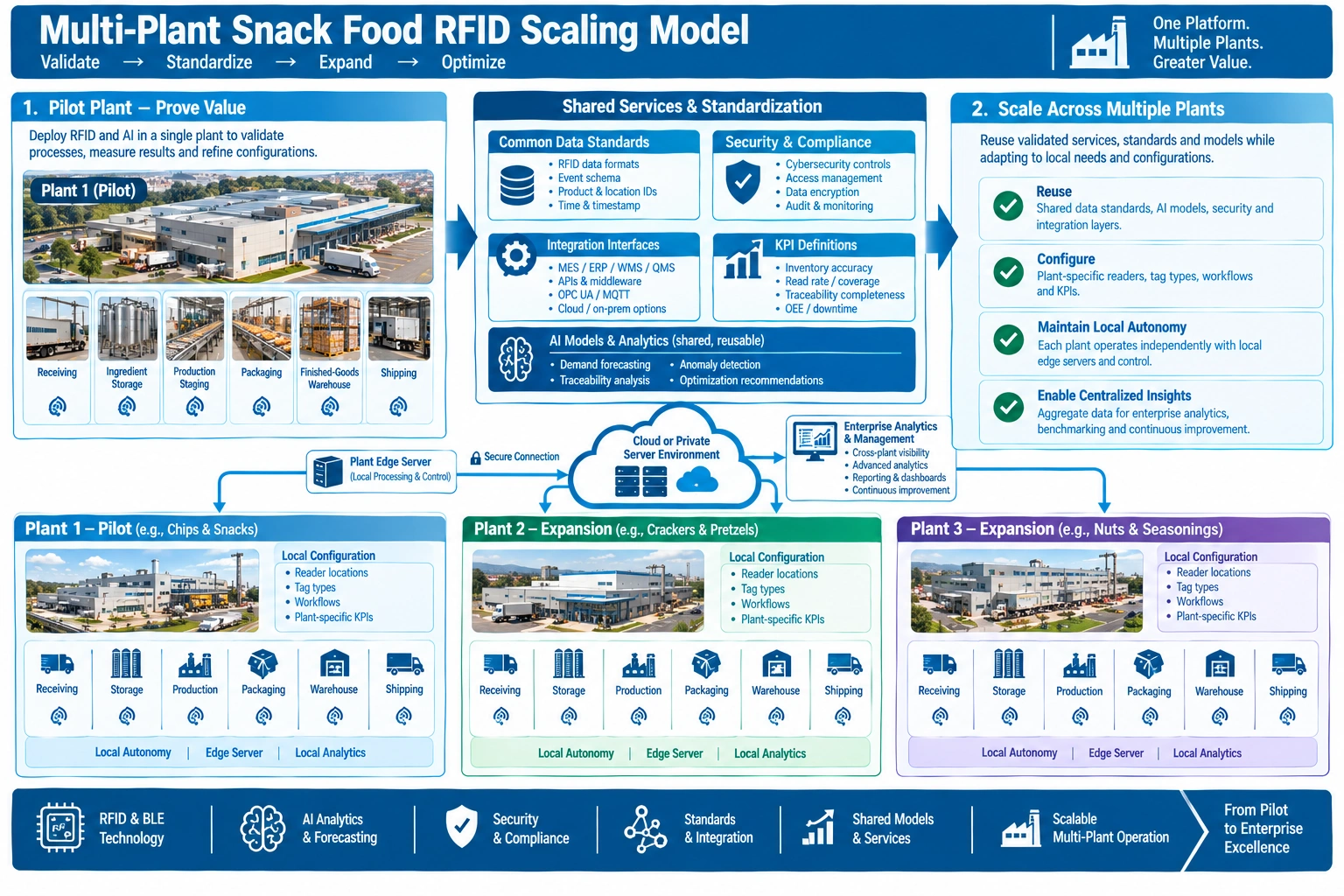
Scaling from One Snack Food Plant to Multiple Facilities
A successful pilot should establish reusable engineering standards before additional plants are connected. Different facilities may have different building layouts, production equipment, warehouse designs, network configurations, product mixes, and operating procedures.
The reusable elements can include RFID tag-selection rules, reader configuration standards, event schemas, cybersecurity requirements, integration specifications, testing procedures, KPI definitions, and AI model-governance processes.
A phased expansion can prioritize high-value processes such as finished-pallet tracking, ingredient traceability, packaging-material inventory, or shipping verification before extending identification to additional assets and workflows.
Multi-site deployments should avoid assuming that identical hardware settings will work everywhere. Read-zone performance must be validated locally because rack construction, conveyor arrangement, product composition, tag placement, and RF conditions can vary substantially between plants.
Multi-Plant Snack Food RFID and AI Scaling Model
KPIs for AI-Powered Snack Food Inventory and Traceability
Performance measurement should connect technology activity with manufacturing outcomes. Counting RFID reads alone does not demonstrate business value.
Relevant KPIs include:
- Ingredient inventory accuracy
- Packaging-material inventory accuracy
- Finished-goods inventory accuracy
- Lot traceability completeness
- Time required to locate a lot or pallet
- Inventory discrepancy rate
- Stockout frequency
- Production interruptions caused by material shortages
- Material staging accuracy
- Warehouse transaction accuracy
- Order fulfillment accuracy
- Inventory turnover
- Excess inventory
- Forecast error
- Replenishment accuracy
- Production schedule adherence
- Material consumption variance
- Waste and yield variance
- Quality-hold resolution time
- Recall investigation time
- RFID read success rate
- False-read frequency
- RFID event-processing latency
- System availability
- AI alert precision
- AI recommendation acceptance rate
- Manual inventory-count labor
- Unplanned RFID equipment downtime
- Traceability data completeness
- Time from receiving to inventory availability
The most useful KPI set should reflect the original business problem. A plant implementing RFID primarily for ingredient traceability should not judge success using warehouse productivity metrics alone.
Engineering Trade-Offs and Implementation Lessons
RFID and AI deliver the strongest results when the deployment is designed around actual snack food workflows rather than installed as an isolated identification project.
Automation Versus Controlled Human Verification
Full automation is attractive for high-volume pallet and case movement, but some transactions still benefit from deliberate human verification. Quality holds, unusual inventory adjustments, damaged packaging, and exception handling may require a worker to confirm the physical condition of a product before a digital transaction is completed.
Read Coverage Versus Read Precision
More antennas do not automatically produce a better RFID system. Excessive coverage can increase stray reads and make location determination more difficult. Controlled read zones with clearly defined transaction boundaries are often preferable to attempting to detect every RFID tag everywhere.
AI Automation Versus Human Oversight
AI forecasting and anomaly detection can reduce manual analysis, but critical decisions should retain appropriate human review. A model can recommend that a replenishment quantity be increased, for example, while procurement or production personnel verify supplier constraints, formulation changes, or unusual customer orders.
Cloud Centralization Versus Local Processing
Centralized cloud processing can simplify multi-site analytics, while local edge or server deployment can provide greater control over plant-level operations and connectivity dependencies. A hybrid arrangement can combine local event processing with centralized analytics where appropriate.
RFID Coverage Versus Deployment Cost
Not every item requires an RFID tag. High-value or high-impact identification points should generally receive priority. A manufacturer may obtain greater operational value by tagging pallets, reusable containers, critical ingredient lots, and packaging-material units than by attempting to tag every individual snack food package.
Recommended Implementation Approach for Snack Food Manufacturers
A practical implementation should begin with a defined operational problem and measurable baseline.
- Map the ingredient, packaging, production, warehouse, quality, and shipping workflows.
- Identify the transactions where manual identification creates the greatest operational risk.
- Establish item, lot, batch, pallet, and location identifiers.
- Select RFID frequency, tags, readers, and antennas based on measured environmental requirements.
- Conduct an RF site survey and physical read-zone assessment.
- Build a controlled pilot around a high-value workflow such as pallet tracking or ingredient traceability.
- Integrate validated RFID events with the relevant manufacturing and warehouse software.
- Establish data-quality rules before training AI models.
- Validate forecasting and anomaly-detection models using representative historical data.
- Define human approval requirements for high-impact AI recommendations.
- Perform technical, operational, cybersecurity, and failure-recovery testing.
- Establish KPI baselines and post-deployment measurement.
- Document equipment configurations, software interfaces, security controls, and maintenance procedures.
- Expand only after the pilot demonstrates reliable performance under normal production conditions.
GAO’s role can include supplying RFID hardware products and systems suited to the identified operating environment and providing technical assistance remotely or onsite during evaluation and deployment.
Key Takeaways for AI-Powered Snack Food Manufacturing
AI-powered RFID systems can connect physical snack food movements with production, inventory, quality, warehouse, and supply-chain decisions. RFID provides reliable identification events, while AI can interpret those events alongside historical and operational data to forecast requirements, detect anomalies, improve traceability, and support better decisions.
The most important implementation lesson is that technology selection should follow the process. Tag type, reader placement, edge processing, enterprise integration, AI model selection, cybersecurity, and maintenance procedures should all be designed around specific snack food workflows.
GAO supports organizations evaluating RFID, BLE, and IoT hardware products and systems for demanding identification and tracking requirements. With headquarters in New York City and Toronto, Canada, GAO is among the top 10 leading B2B and B2G RFID and BLE suppliers globally. Its broader organization has invested substantially in research and development and maintains quality-assurance processes intended to support reliable technology deployment.
Manufacturers evaluating AI-powered inventory, production traceability, warehouse management, or material-flow solutions can learn more about GAO’s RFID technologies, technical capabilities, and engineering support when defining their next deployment.
Building the Future of Industrial AI and IoT with Aperture Venture Studio and GAO
For more than three decades, GAO Group of Companies has invested heavily in R&D covering industrial RFID, BLE, and IoT. As generative AI became increasingly useful for industrial applications, we expanded our work across AI and IoT, including RFID and BLE, and founded Aperture Venture Studio to build, launch, and scale AI and IoT solutions relevant to industries such as snack food manufacturing.
Aperture has attracted AI and IoT technical experts, entrepreneurial and operational executives, influential investors, and leading companies. We have also developed the Aperture Ventures Summit and TekSummit to discuss advanced AI and IoT topics. We welcome advisors, co-founders, employees, investors, and customers interested in advancing practical industrial AI and IoT applications.