
AI-Powered RFID Solutions for Stadium Operations, Fan Experience, and Venue Intelligence
How AI-Powered RFID Is Transforming Modern Stadium Operations
Artificial Intelligence integrated with RFID-enabled stadium systems is transforming how sports venues, concert arenas, and multipurpose entertainment facilities manage operations, security, fan engagement, and business intelligence. Rather than simply identifying people or assets, AI continuously analyzes RFID-generated operational data to predict congestion and optimize venue performance throughout every event.
Modern stadiums generate enormous volumes of operational data from ticket holders, concessions, merchandise, maintenance activities, security checkpoints, equipment movement, hospitality services, parking facilities, premium suites, and workforce operations. AI converts this continuous stream of RFID-generated information into actionable operational intelligence that supports real-time decision-making while improving efficiency and visitor satisfaction.
As a trusted supplier of RFID, BLE, and IoT technologies, GAO has helped organizations deploy reliable identification and tracking systems that integrate with modern AI software, enabling scalable digital transformation projects across North America. Headquartered in New York City and Toronto, GAO serves Fortune 500 companies, government organizations, research institutions, and universities through decades of engineering expertise and technical support.
AI-Powered RFID Stadium Operations and Intelligent Venue Management
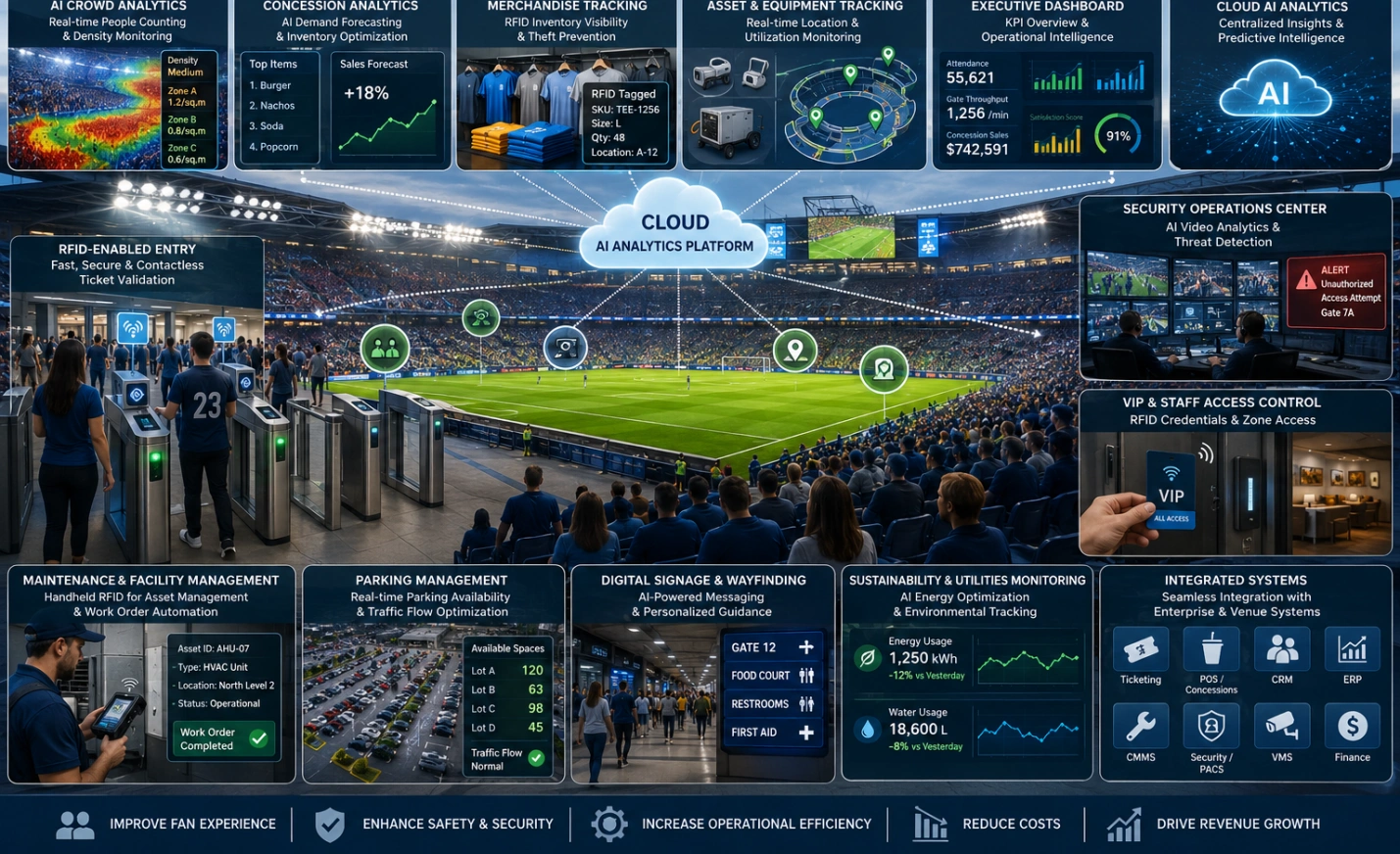
This illustration depicts a modern sports stadium using AI-powered RFID solutions for ticket validation, crowd monitoring, merchandise tracking, concession analytics, VIP access control, parking management, and real-time operational dashboards. It demonstrates how connected technologies improve operational efficiency, security, and the fan experience.
Why AI-Driven RFID Systems Have Become Essential for Stadiums
Large stadiums operate as highly complex facilities where thousands of simultaneous operational activities occur before, during, and after every event. These activities involve multiple departments including:
- Ticketing operations
- Venue security
- Crowd management
- Hospitality services
- Merchandise operations
- Food and beverage concessions
- Facility maintenance
- Parking management
- Broadcast operations
- VIP guest services
- Event logistics
- Equipment inventory
- Cleaning services
- Emergency response
- Vendor management
Traditional manual tracking methods cannot provide the real-time operational visibility required to coordinate these activities effectively.
RFID technology supplies continuous identification and location data for tagged assets, credentials, inventory, and equipment. AI software analyzes historical patterns together with live operational information to identify abnormal conditions, predict future events, automate responses, and improve operational decision-making.
Instead of reacting to operational problems after they occur, stadium management teams can proactively prevent congestion, equipment shortages, staffing gaps, concession stockouts, or security risks before they impact spectators.
Core Concepts of AI-Enabled RFID for Stadium Management
AI-driven stadium intelligence combines several complementary technologies that work together throughout venue operations.
RFID Data Collection
UHF RFID tags identify equipment, uniforms, merchandise, concession inventory, reusable containers, maintenance tools, medical equipment, credentials, parking permits, and various operational assets moving throughout the venue.
HF RFID supports secure credential verification, access cards, VIP authentication, season tickets, and cashless payment applications.
LF RFID is used where short-range identification and durable tag performance are appropriate, particularly for specialized maintenance or equipment identification.
Artificial Intelligence
AI processes RFID event streams using:
- Machine learning
- Predictive analytics
- Pattern recognition
- Operational optimization
- Anomaly detection
- Demand forecasting
- Computer vision integration
- Workforce optimization
- Resource scheduling
Instead of processing isolated RFID reads, AI evaluates complete operational patterns across the stadium.
AIoT Within Stadium Operations
Artificial Intelligence of Things (AIoT) combines RFID infrastructure, connected sensors, edge computing, intelligent software, and operational systems into an integrated solution that continuously monitors stadium activities.
Examples include:
- Predicting concession demand before halftime
- Forecasting restroom occupancy
- Identifying abnormal crowd movement
- Predicting maintenance requirements
- Optimizing gate staffing
- Detecting unauthorized equipment movement
- Improving parking utilization
- Forecasting merchandise demand
Stadium Applications That Benefit Most from AI-Powered RFID
Intelligent Ticket Validation
AI analyzes RFID ticket scans to identify:
- Unexpected gate congestion
- Suspicious entry patterns
- Duplicate credentials
- Counterfeit ticket attempts
- Peak arrival periods
- Security anomalies
Operations personnel can immediately redirect visitors toward alternative entrances while adjusting staffing dynamically.
Crowd Flow Optimization
RFID credential activity combined with AI analytics enables stadium management to monitor:
- Entrance utilization
- Exit congestion
- Corridor density
- Escalator utilization
- Elevator demand
- VIP lounge occupancy
- Restroom traffic
- Concession queue formation
Machine learning predicts congestion before bottlenecks become critical.
Merchandise Inventory Intelligence
Retail operations benefit from RFID-tagged merchandise throughout:
- Team stores
- Pop-up shops
- Mobile vendors
- Premium lounges
- Event kiosks
AI forecasts:
- Fast-selling products
- Inventory shortages
- Restocking priorities
- Event-specific purchasing trends
- Product placement optimization
This improves inventory turnover while minimizing lost sales opportunities.
Food and Beverage Operations
AI evaluates RFID inventory movement together with sales information to improve:
- Beverage replenishment
- Ingredient availability
- Vendor logistics
- Cold storage utilization
- Waste reduction
- Restocking schedules
- Mobile ordering fulfillment
Food service managers receive operational recommendations before inventory shortages occur.
Stadium Asset Tracking
Thousands of valuable assets circulate across large stadiums, including:
- Broadcast equipment
- Audio systems
- Medical devices
- Security equipment
- Maintenance tools
- Cleaning equipment
- Portable barriers
- IT hardware
- Lighting equipment
- Electrical testing instruments
RFID continuously records equipment movement while AI identifies:
- Missing assets
- Unauthorized relocation
- Utilization trends
- Maintenance schedules
- Equipment availability
- Lifecycle replacement planning
Workforce Coordination
AI analyzes RFID staff credentials together with scheduling systems to optimize:
- Security personnel deployment
- Cleaning crews
- Maintenance technicians
- Hospitality staff
- Emergency responders
- Vendor access
- Broadcast teams
- Event contractors
Managers receive staffing recommendations based on predicted operational demand.
AI-Powered RFID Stadium Operations Workflow
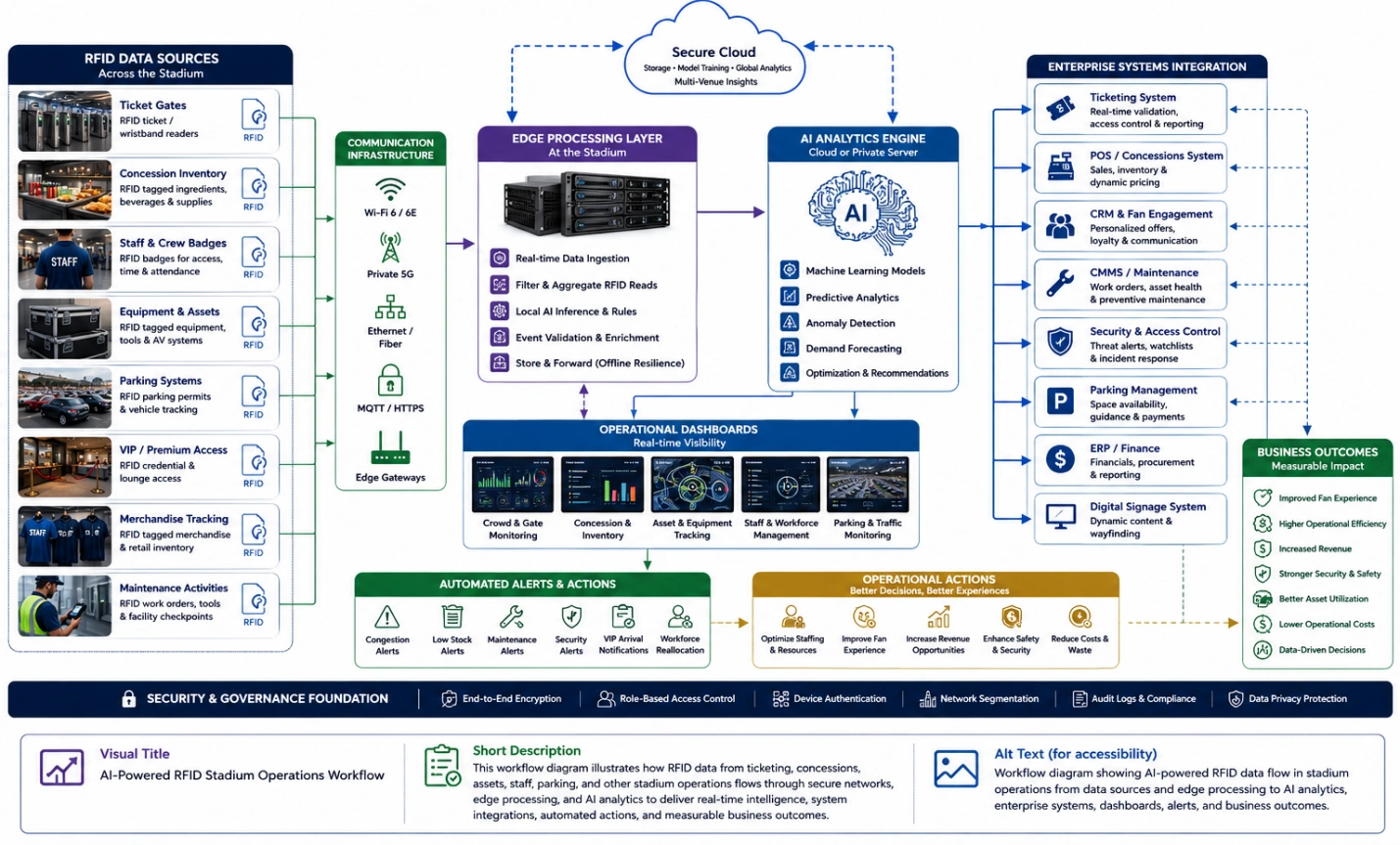
This workflow diagram illustrates how AI-powered RFID solutions transform stadium operations by collecting RFID data from ticketing, concessions, staff, parking, and assets, processing it through secure communication networks and edge computing, analyzing it with AI, integrating with enterprise software, and delivering real-time dashboards, automated alerts, and intelligent operational decisions.
End-to-End Operational Workflow for AI-Powered RFID Stadium Solutions
AI-enabled stadium management depends on a continuous operational workflow that transforms RFID events into intelligent business actions.
RFID Data Acquisition
Information is collected from multiple operational sources including:
- Entry gate readers
- Fixed RFID portals
- Handheld RFID readers
- Mobile maintenance devices
- Parking checkpoints
- Merchandise readers
- Concession inventory readers
- Staff access readers
- VIP entrance systems
- Equipment storage locations
Every RFID event becomes part of a continuously updated operational dataset.
Communication Infrastructure
Collected information is securely transmitted through venue communication networks using technologies such as:
- Ethernet
- Industrial Wi-Fi
- Private 5G
- Fiber networks
- Secure VPN connections
- MQTT
- HTTPS
- REST APIs
Reliable communications ensure minimal latency during major sporting events and concerts.
Edge Processing
Edge servers positioned within the stadium perform immediate processing of RFID events by:
- Filtering duplicate reads
- Validating credentials
- Aggregating tag events
- Detecting abnormal movement
- Supporting local AI inference
- Reducing cloud bandwidth requirements
Local processing enables rapid operational responses even during peak attendance periods.
AI Analytics and Decision-Making
After RFID events are processed at the edge, AI software continuously evaluates operational conditions using historical trends, live event data, weather forecasts, ticket sales, concession demand, staffing schedules, parking occupancy, and maintenance records. Rather than simply displaying data, AI identifies patterns that support operational decisions throughout the venue.
Common AI capabilities include:
- Predictive analytics for attendance forecasting
- Machine learning for crowd movement prediction
- Anomaly detection for unusual equipment movement
- Workforce scheduling optimization
- Inventory demand forecasting
- Predictive maintenance modeling
- Event risk assessment
- Queue optimization
- Revenue forecasting
- Operational KPI analysis
These insights enable venue managers to make informed decisions before operational issues affect spectators.
Enterprise Software Integration
AI-powered RFID solutions deliver maximum value when integrated with existing stadium business systems.
Typical integrations include:
- Ticketing management systems
- Point-of-sale (POS) software
- Customer Relationship Management (CRM)
- Enterprise Resource Planning (ERP)
- Computerized Maintenance Management Systems (CMMS)
- Building Management Systems (BMS)
- Physical Access Control Systems (PACS)
- Video Management Systems (VMS)
- Security Information and Event Management (SIEM)
- Workforce Management (WFM)
- Digital signage software
- Parking management systems
- Financial reporting software
- Business intelligence dashboards
These integrations eliminate isolated data silos and provide venue operators with a unified operational view.
RFID Infrastructure, AI Software, and Deployment Components for Stadiums
An AI-enabled RFID solution combines multiple hardware and software components that work together to support stadium operations.
RFID Hardware
Typical hardware includes:
- UHF RFID fixed readers at entry gates, loading docks, and storage areas
- Handheld RFID readers for inventory audits and maintenance teams
- RFID antennas designed for indoor and outdoor venue environments
- Passive UHF RFID tags for merchandise, assets, and equipment
- HF RFID cards and wristbands for secure access and cashless payments
- LF RFID tags for specialized identification applications
- RFID-enabled kiosks and self-service terminals
Each device contributes to accurate identification while supporting high-throughput operations during major events.
AI Software
AI software typically provides:
- Real-time analytics dashboards
- Predictive forecasting
- Operational reporting
- Machine learning model management
- Alert generation
- Automated workflow rules
- KPI visualization
- AI-assisted decision support
These capabilities help operations teams respond quickly while continuously improving long-term venue performance.
Communication Technologies
Reliable communication is essential for maintaining continuous data flow between RFID devices and AI software.
Common technologies include:
- Ethernet
- Fiber optic backbones
- Industrial Wi-Fi
- Private 5G
- LTE backup connectivity
- MQTT
- HTTPS
- TCP/IP
- REST APIs
- OPC UA where facility automation systems require interoperability
Network redundancy helps maintain service continuity during high-attendance events.
Security Mechanisms
Because stadium systems manage operational and visitor information, security should be incorporated throughout the solution.
Recommended practices include:
- Role-based access control (RBAC)
- Multi-factor authentication (MFA)
- TLS encryption for data in transit
- AES encryption for stored data
- Network segmentation
- Device authentication
- Secure API gateways
- Continuous audit logging
- Security monitoring
- Regular software updates and vulnerability assessments
These measures help protect operational systems while supporting compliance with organizational security policies.
Cloud Version
Cloud-hosted deployments are well suited for organizations that operate multiple venues or require centralized management.
Benefits include:
- Simplified software updates
- Centralized reporting across stadiums
- Elastic computing resources for large events
- Reduced local infrastructure requirements
- Remote administration
- Faster deployment of AI model improvements
Cloud deployments are particularly appropriate for sports franchises, venue management companies, and organizations coordinating multiple entertainment facilities.
Server Version
Server-based deployments place software on customer-managed infrastructure such as private data centers, regional facilities, or edge servers located within the venue.
Advantages include:
- Greater control over operational data
- Lower latency for time-sensitive processing
- Compliance with internal IT governance
- Integration with existing private infrastructure
- Continued operation during temporary internet disruptions
Many organizations adopt hybrid deployments that combine local processing with cloud-based analytics to balance performance and scalability.
Cloud-Hosted vs. Server-Hosted AI-Powered RFID Deployment for Stadium Operations
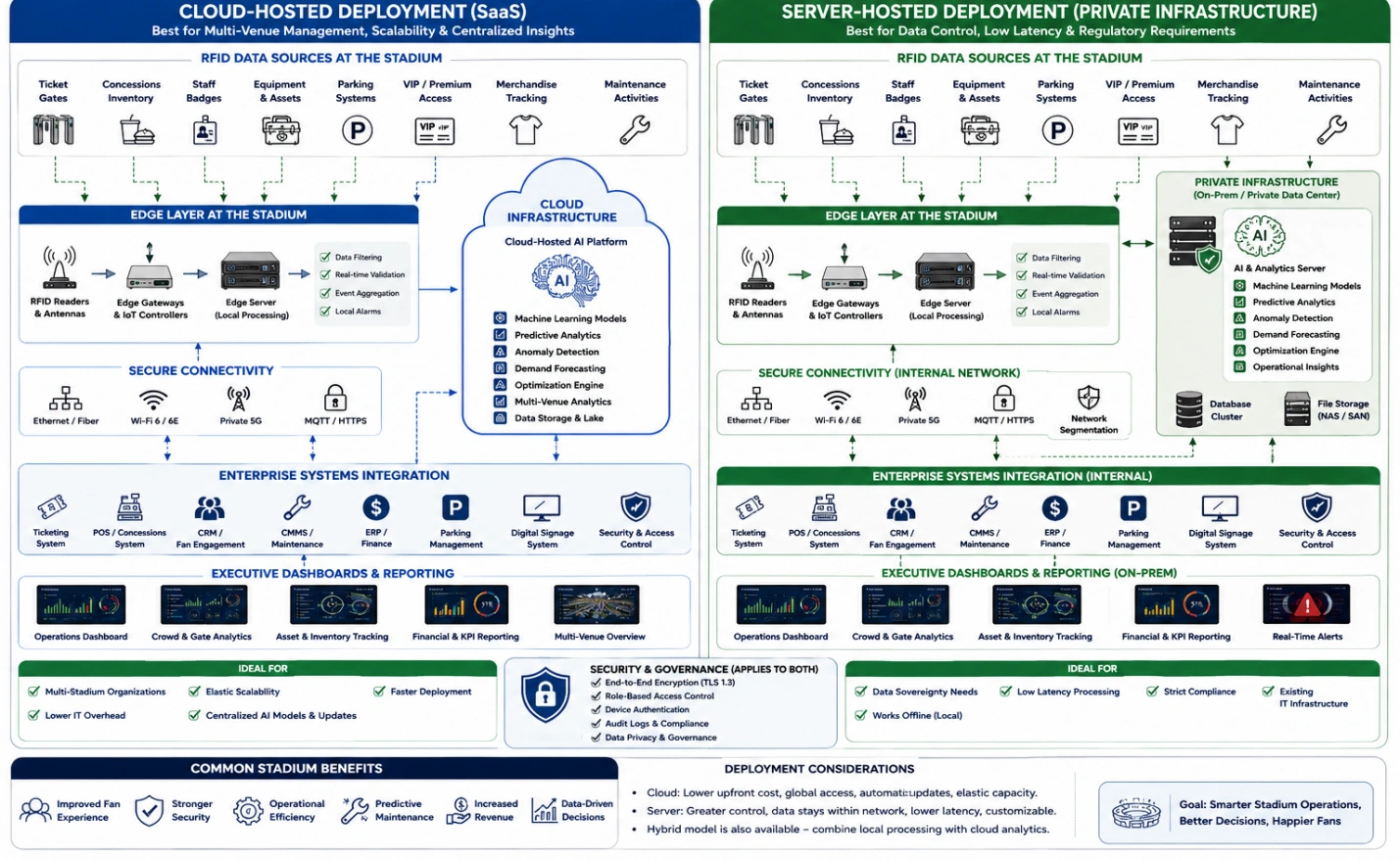
This deployment diagram compares cloud-hosted and privately hosted server deployments for AI-powered RFID stadium solutions. It illustrates how RFID readers, edge servers, AI analytics, enterprise software, and executive dashboards are connected through secure communication networks, helping stadium operators choose the most appropriate deployment model based on scalability, latency, security, and operational requirements.
Business Value and Operational Benefits of AI-Powered RFID in Stadiums
Combining AI with RFID-generated operational data provides measurable improvements across venue operations.
Enhanced Fan Experience
AI helps reduce wait times, optimize entry procedures, improve concession availability, and streamline navigation throughout the venue. Faster services contribute to higher visitor satisfaction and increased repeat attendance.
Improved Operational Efficiency
Automated identification and intelligent analytics reduce manual inventory counts, minimize equipment searches, optimize staffing, and improve coordination between departments.
Stronger Security
AI continuously analyzes RFID credential activity to identify unusual access patterns, unauthorized equipment movement, and potential security concerns, enabling security teams to respond more quickly.
Predictive Maintenance
Maintenance teams receive recommendations based on equipment utilization, operating history, and RFID-tracked movement, allowing servicing to occur before failures interrupt events.
Better Resource Utilization
AI identifies underused equipment, predicts staffing requirements, and recommends more efficient deployment of operational resources.
Increased Revenue Opportunities
Accurate forecasting of attendance, merchandise demand, concession sales, and premium hospitality utilization supports better purchasing decisions and improves overall profitability.
Scalable Venue Operations
Whether supporting a 10,000-seat arena or a 100,000-seat stadium, AI-powered RFID solutions can scale with venue growth while maintaining operational visibility.
Throughout these deployments, GAO has supported organizations by supplying RFID hardware, IoT systems, and technical expertise that enable reliable identification and data collection for AI-driven operational improvements.
AI-Powered RFID Executive Dashboard for Intelligent Stadium Operations
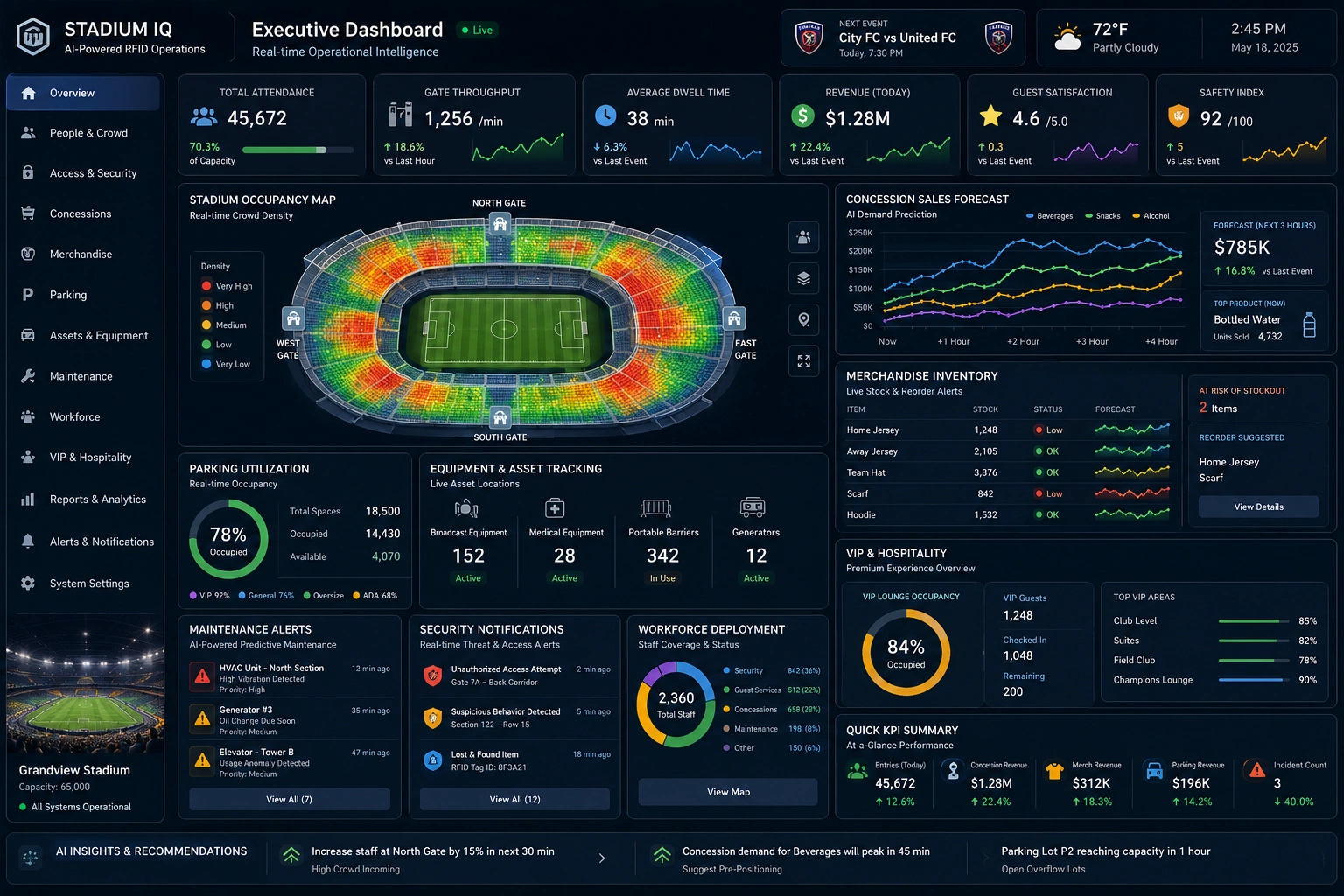
This executive dashboard demonstrates how AI-powered RFID analytics provide real-time operational intelligence for stadium management. It consolidates occupancy levels, gate throughput, concession sales forecasts, merchandise inventory, parking utilization, equipment tracking, predictive maintenance alerts, security notifications, workforce deployment, VIP lounge occupancy, and executive KPIs into a single interface, enabling data-driven decisions that improve operational efficiency, fan experience, and venue security.
Engineering Best Practices for Successful Stadium Deployments
Successful AI-powered RFID implementations require careful planning beyond hardware installation.
Recommended practices include:
- Conduct comprehensive site surveys before reader installation.
- Test RF coverage under full event attendance conditions.
- Position antennas to minimize interference from metal structures and electronic equipment.
- Establish data governance policies for operational information.
- Validate integrations with ticketing, POS, and maintenance software before production deployment.
- Define measurable KPIs before implementation.
- Train operational staff on AI-generated recommendations.
- Monitor system performance continuously and refine AI models using operational feedback.
- Schedule routine maintenance for readers, antennas, and supporting network equipment.
Organizations that follow these practices typically achieve more consistent operational performance and faster adoption by venue personnel.
AI-Powered RFID Real-World Stadium Deployment for Intelligent Venue Operations
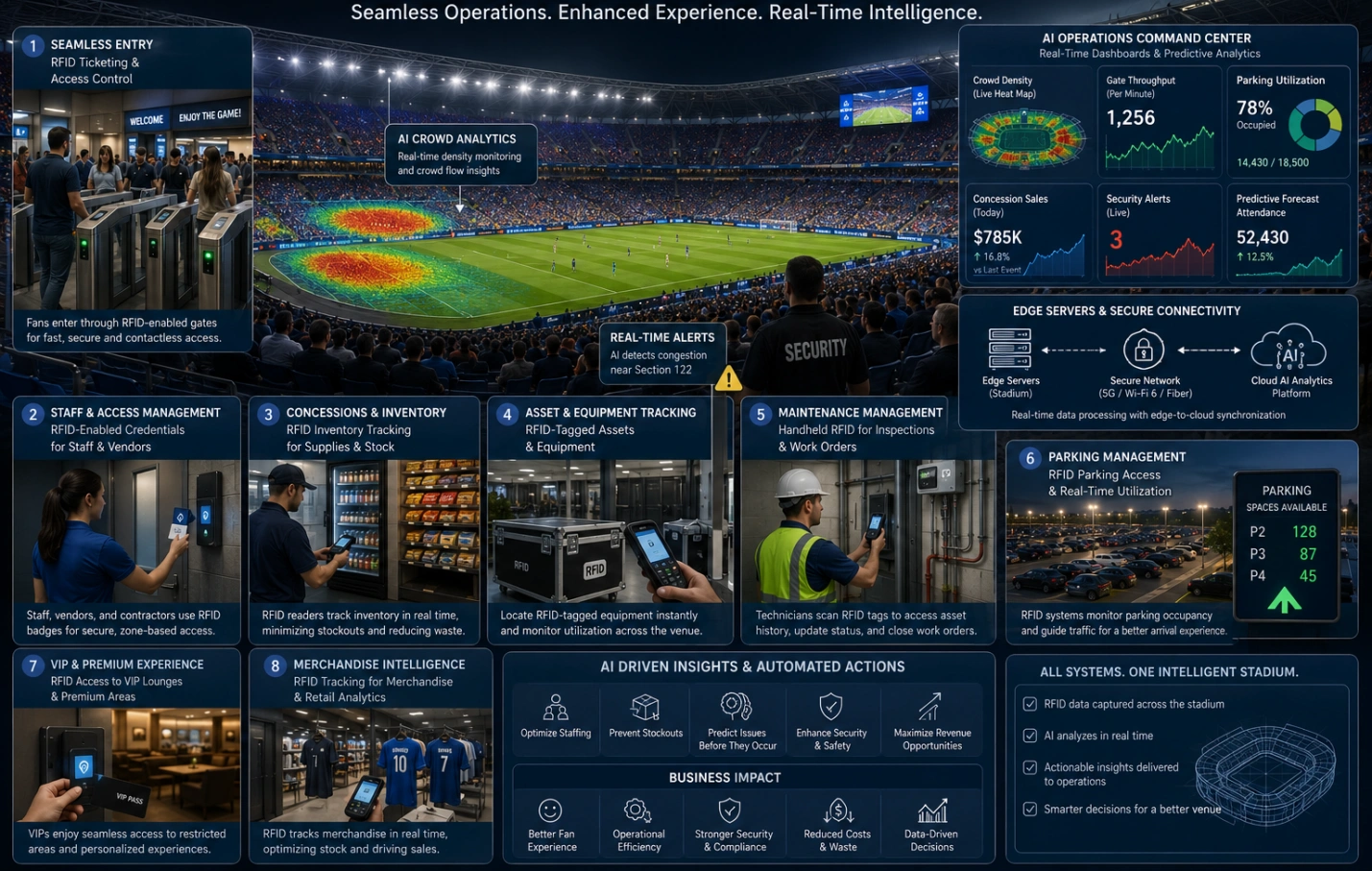
This illustration depicts a live stadium event where AI-powered RFID technologies support end-to-end venue operations. Spectators enter through RFID-enabled ticket gates while staff authenticate with RFID credentials, concession inventory is tracked in real time, maintenance teams locate tagged equipment using handheld RFID readers, and AI dashboards continuously monitor crowd density, parking utilization, security alerts, and operational performance through secure edge-to-cloud connectivity.
Achieving Smarter Stadium Management with AI and RFID Technologies
AI-powered RFID solutions enable stadium operators to move beyond simple identification toward predictive, data-driven venue management. By combining RFID-generated operational data with AI analytics, organizations can improve crowd safety, optimize staffing, streamline maintenance, enhance fan experiences, and make informed business decisions based on real-time intelligence.
Organizations planning these initiatives should define operational objectives, evaluate infrastructure requirements, integrate with existing business software, implement robust cybersecurity practices, and establish measurable KPIs before deployment.
For more than three decades, GAO has invested in RFID, BLE, and IoT research and development while supporting organizations across the United States and Canada. With headquarters in New York City and Toronto, GAO is recognized among the world’s leading B2B RFID and BLE suppliers, delivering high-quality hardware, rigorous quality assurance, and expert remote and on-site technical support. Readers interested in learning more about AI-enabled RFID systems for stadiums can explore GAO’s engineering expertise, technology solutions, and professional support services.
Building the Future of Industrial AI and IoT with Aperture Venture Studio and GAO
For more than three decades, GAO Group of Companies has invested extensively in research and development for industrial RFID, BLE, and IoT technologies. As generative AI has demonstrated significant value in operational environments such as modern stadiums, we have expanded our work in AI and IoT solutions and established Aperture Venture Studio to accelerate the development and commercialization of advanced AI and IoT innovations for organizations across diverse industries.
Aperture has attracted leading AI and IoT technical experts, experienced business executives, influential investors, and established industry partners. Through initiatives such as the Aperture Ventures Summit and TekSummit, we continue to foster technical collaboration, share practical engineering knowledge, and strengthen AI and IoT communities.
We welcome you to engage with us as:
- Advisors, co-founders, or employees
- Investors
- Customers seeking advanced AI and IoT solutions