
AI-Driven Cold Storage Logistics with RFID
AI-Driven Operations for Student Housing Communities
AI and RFID for Student Housing combines AI-driven analytics with UHF RFID, HF RFID, and LF RFID to improve asset visibility, inventory control, maintenance, move-in and move-out operations, package handling, laundry management, amenity management, and selected access or security workflows. The objective is not simply to identify tagged objects. Student housing operators can use physical-event data to understand where assets are, how frequently they are used, where operational delays occur, and which conditions require staff attention. RFID readers, antennas, tags, handheld devices, network gateways, and facility systems generate operational events that AI can analyze for anomaly detection, demand forecasting, utilization analysis, and workflow optimization. Applications can span residence halls, apartment-style student housing, common rooms, study areas, fitness facilities, mailrooms, leasing offices, maintenance shops, laundry rooms, storage areas, and parking-related operations. Properly designed solutions can reduce manual searches and improve service responsiveness while keeping resident identity and access data under appropriate security and privacy controls.
AI and RFID in Student Housing
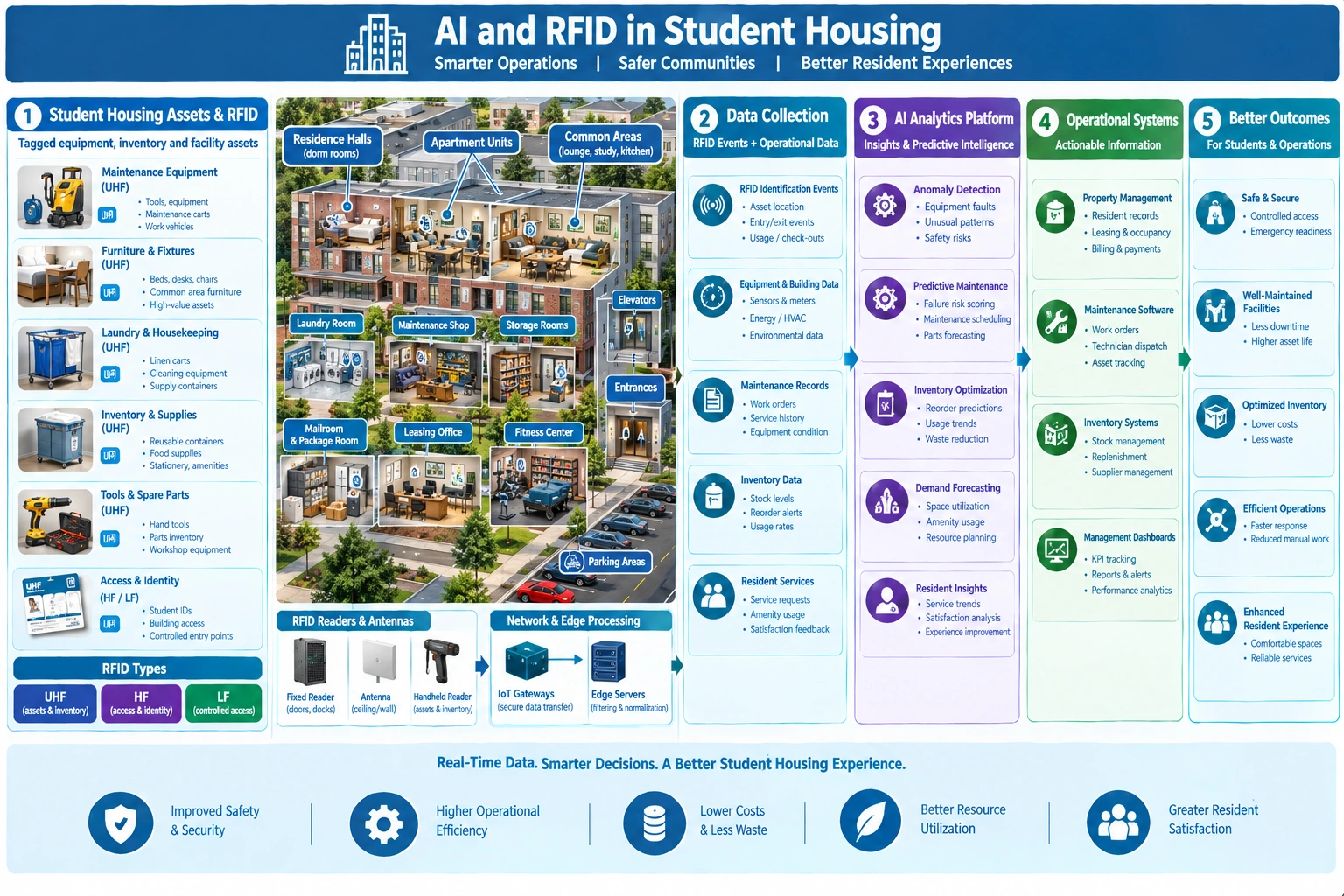
AI and RFID connect student housing assets, facilities, maintenance, inventory, and resident services for smarter operational decisions.
What AI and RFID Mean for Student Housing
Student housing combines residential occupancy with property management, leasing, hospitality-style services, facilities maintenance, security, package handling, housekeeping, laundry, amenity management, and frequent resident turnover. The operational environment is therefore different from conventional residential real estate.
A typical student housing property may process thousands of physical assets and operational events during a semester. Furniture, appliances, maintenance tools, spare parts, cleaning equipment, access devices, laundry carts, package-handling equipment, room furnishings, and amenity assets move repeatedly between apartments, residence halls, storage areas, maintenance shops, and common spaces.
RFID provides machine-readable identification for selected physical assets and events. AI adds analytical capabilities that can evaluate movement history, utilization, demand, dwell time, maintenance records, inventory levels, work orders, occupancy-related patterns, and workflow timing.
For student housing operators, this can answer practical questions such as:
- Where is a shared maintenance tool or cleaning asset?
- Which furniture or facility assets have moved from their assigned location?
- Which maintenance parts are being consumed faster than expected?
- Which equipment remains unused for unusually long periods?
- Which laundry carts or reusable assets have not returned to designated areas?
- Which move-out inspection workflows consistently take longer than expected?
- Which maintenance requests are associated with recurring equipment or building issues?
- Which property areas experience repeated inventory shortages?
- Which operational events deviate from normal semester or turnover patterns?
AI should support property managers, maintenance supervisors, leasing personnel, resident-service teams, and other authorized employees rather than replace their judgment.
Resident privacy is particularly important. A student housing RFID deployment does not need to identify or continuously track every resident to provide substantial value. Many high-value applications involve physical assets, inventory, work orders, rooms, and facility zones instead.
Student Housing Applications for AI-Enabled RFID
Move-In and Move-Out Asset Management
Semester-based turnover creates concentrated operational workloads. Furniture, appliances, room fixtures, keys or access-related equipment, cleaning supplies, carts, maintenance tools, and other assets may be inspected, moved, repaired, stored, or reassigned within a short period.
RFID can associate physical assets with unique identifiers and designated locations. Handheld RFID readers can accelerate room-level or area-level asset verification, while fixed readers can capture selected movement events.
AI can analyze historical turnover data to identify bottlenecks in inspection, furniture movement, cleaning, maintenance, and room readiness.
For example, if move-out processing repeatedly produces delays between inspection and maintenance completion in particular building zones, AI can identify the recurring pattern. Managers can then adjust staffing, equipment allocation, work sequencing, or spare-parts availability.
The goal is not simply faster scanning. The operational objective is a more predictable turnover cycle.
Furniture and Appliance Tracking
Student housing properties commonly contain beds, desks, chairs, dressers, sofas, refrigerators, microwaves, televisions, appliances, and other furnishings that may need to be relocated, repaired, replaced, or stored.
Selected higher-value or operationally significant assets can receive RFID identifiers. Staff using handheld readers can verify inventories during room inspections, renovations, turnover, or preventive maintenance.
AI can evaluate:
- Asset utilization
- Relocation frequency
- Maintenance frequency
- Loss or disappearance patterns
- Storage dwell time
- Demand by building or floor
- Replacement requirements
- Repeated movement between specific locations
This provides property managers with a stronger basis for deciding whether an asset should be repaired, relocated, retained in storage, or replaced.
Maintenance Tool and Equipment Visibility
Maintenance teams often move tools, meters, ladders, carts, diagnostic equipment, replacement equipment, and specialized maintenance devices throughout a student housing property.
When tools are not returned to designated locations, technicians may lose time searching for them. RFID can provide recent location or zone events, while AI can identify recurring tool-movement patterns and abnormal dwell times.
A maintenance supervisor could use this information to identify tools that frequently remain outside the maintenance shop or assets that repeatedly disappear from expected storage zones.
RFID does not determine whether a tool is being used correctly. It supplies physical-event information that can be combined with work orders and maintenance workflows.
Spare Parts and Maintenance Inventory
Maintenance shops often hold electrical components, plumbing fittings, HVAC parts, lighting components, locks, door hardware, filters, fasteners, cleaning supplies, and other replacement materials.
RFID-enabled inventory management can provide physical identification for selected parts, containers, bins, or high-value components. AI can analyze consumption patterns and identify replenishment requirements.
This is especially useful before major student turnover periods. Historical work orders can reveal that certain replacement parts are consumed at substantially higher rates during move-out and move-in cycles.
AI forecasting can help maintenance managers stage appropriate quantities before peak periods rather than reacting to shortages after technicians are already waiting for parts.
Laundry Operations
Shared laundry facilities are common in student housing. Operators may manage laundry equipment, laundry carts, reusable cleaning materials, linen inventories in selected housing models, and maintenance supplies.
RFID can identify selected reusable assets and track movement between laundry rooms, storage locations, maintenance areas, and service operations.
AI can identify recurring equipment-service patterns, abnormal asset movement, and operational demand changes. For example, if laundry-related service events increase consistently during certain periods, historical information can help maintenance teams prepare parts and technician availability.
RFID should complement, rather than replace, the machine telemetry supplied by commercial laundry equipment.
Package and Mailroom Operations
Student housing properties frequently receive large volumes of resident packages, particularly around the beginning of academic terms and holiday periods.
RFID may be useful for reusable package carts, shelving assets, containers, or other material-handling equipment rather than necessarily tagging every individual parcel. UHF RFID can provide movement visibility for tagged carts or reusable containers as they move through package rooms and storage areas.
AI can analyze package-room workload patterns, equipment availability, storage utilization, and operational throughput when appropriate data is available from property or package-management systems.
The value comes from optimizing the physical package-handling process rather than adding RFID identification where barcode or existing parcel systems already provide adequate item-level visibility.
Amenity and Common-Area Asset Management
Student housing amenities can include fitness centers, study rooms, lounges, gaming areas, outdoor spaces, shared kitchens, conference rooms, and recreational facilities.
Furniture, cleaning equipment, audiovisual equipment, fitness accessories, tools, and other selected assets can be tracked with RFID.
AI can analyze asset utilization and maintenance patterns to help property managers determine where equipment is being overused, underused, repeatedly relocated, or frequently damaged.
This information can support decisions about equipment placement, preventive maintenance, replacement cycles, and amenity inventory.
Housekeeping and Turnover Operations
Student housing requires concentrated cleaning and inspection activity during move-out and move-in periods. Cleaning carts, vacuum equipment, reusable supplies, inspection equipment, and other operational assets can be tracked using RFID.
AI can evaluate task completion times, equipment availability, room turnover sequences, and recurring workflow delays when integrated with appropriate work-order or property-management software.
A useful implementation does not treat AI as a replacement for housekeeping supervisors. Instead, it gives supervisors evidence about where work is accumulating and which operational resources are creating bottlenecks.
Student Housing AI Use-Case Matrix
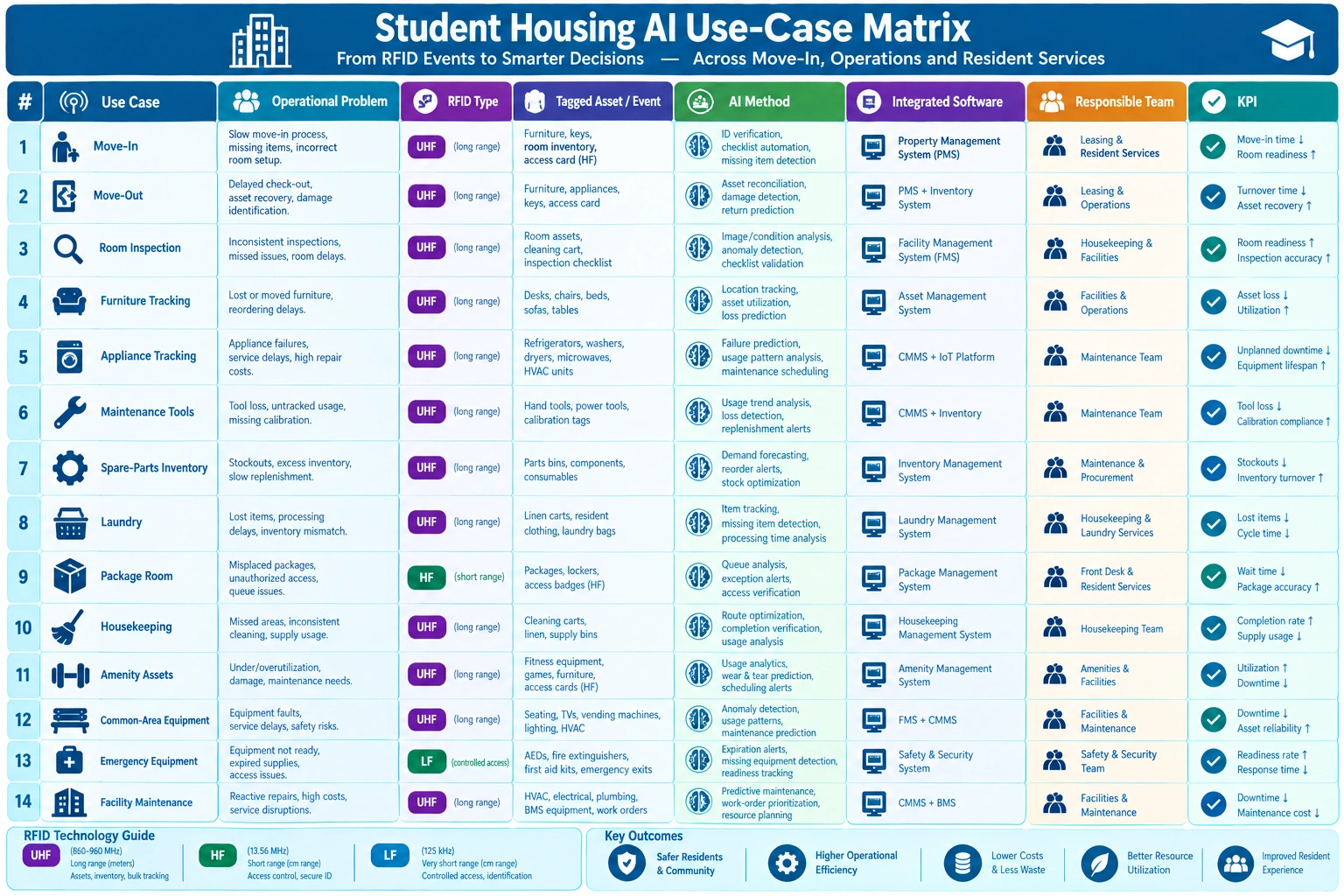
A comparison of student housing workflows showing RFID inputs, AI methods, software integration, teams, decisions, and KPIs.
From RFID Events to AI-Driven Student Housing Decisions
An effective student housing deployment begins with a defined operating problem and then determines what physical events are required to solve it.
Physical Data Acquisition
RFID readers capture observations from tagged assets through fixed readers, doorway installations, zone readers, handheld devices, or mobile equipment.
A move-out inventory workflow may use handheld RFID readers to verify room assets. A maintenance shop may use fixed read points to detect selected tools entering or leaving a controlled storage area. A laundry operation may use readers at cart movement points.
The required read range should be established from the workflow rather than from the theoretical maximum range of the RFID equipment.
Network and Edge Processing
Reader data can travel through Ethernet, Wi-Fi, cellular connections, or other approved property network infrastructure.
An edge gateway or local server can normalize timestamps, remove duplicate reads, apply zone logic, buffer events during network interruptions, and forward validated events to central software.
This processing is important because a moving RFID tag can generate multiple reads while passing through a reader’s field. Raw observations should not automatically be interpreted as multiple independent business events.
Event Normalization
Middleware transforms RFID observations into business-level events.
Examples include:
- Maintenance tool entered the maintenance shop
- Furniture asset detected in a storage area
- Tagged cart left the package room
- Spare-parts container reached a defined location
- Room inventory verification completed
- Reusable asset moved from one residence hall zone to another
- Equipment remained outside its assigned area beyond an expected interval
This event layer connects physical RFID observations with actual student housing workflows.
AI Analytics
AI models can analyze normalized events against historical patterns, work orders, inventory records, building zones, semester schedules, and operational rules.
Relevant methods include anomaly detection, time-series forecasting, classification, clustering, predictive maintenance modeling, and optimization techniques.
For example, an anomaly model can identify unusual movement of a tagged maintenance asset. A forecasting model can estimate spare-parts demand before a move-out cycle. A utilization model can identify furniture or amenity equipment that is consistently underused.
AI should prioritize actionable exceptions rather than generating alerts for every RFID event.
Integration with Student Housing Software
Student housing operators may use property management systems, leasing software, maintenance and work-order systems, inventory applications, package-management software, access-control systems, building automation systems, accounting systems, resident communication systems, and business intelligence tools.
RFID data becomes more valuable when integrated with these systems through APIs, middleware, message queues, databases, or other approved interfaces.
The authoritative system for each data type should be defined. For example, property management software may remain authoritative for unit assignment and occupancy records, while RFID software provides physical asset movement events.
Operational Response
The final stage converts AI analysis into action.
A finding might trigger:
- Dispatch of a maintenance technician
- Search for a misplaced asset
- Replenishment of spare parts
- Redistribution of furniture or equipment
- Investigation of an unusual movement event
- Adjustment of storage capacity
- Preparation for a high-volume turnover period
- Preventive maintenance review
- Package-room resource adjustment
- Verification of room inventory
The resulting action and its outcome can be recorded so that future AI analysis has better operational context.
RFID Technologies and AI Systems for Student Housing
RFID frequency selection should be driven by the physical characteristics of the student housing workflow.
UHF RFID for Asset and Inventory Visibility
UHF RFID is generally suited to longer-range identification of tagged furniture, maintenance equipment, carts, reusable containers, tools, selected inventory, and other physical assets.
Student housing deployments require careful consideration of metal furniture, appliances, electrical equipment, shelving, doors, and dense building interiors. On-metal tags may be necessary for selected assets.
Reader placement should be engineered so that the desired zone is detected without unintentionally capturing assets in neighboring rooms, corridors, or storage areas.
HF RFID for Controlled Short-Range Interactions
HF RFID can support applications where a shorter read distance and intentional proximity are useful. Potential student housing applications include workstation identification, controlled asset verification, equipment cabinets, or other close-range interactions.
The shorter operational range can be advantageous when broad-area reads would produce too many unwanted observations.
LF RFID for Specialized Proximity Identification
LF RFID can support selected proximity-based identification workflows where its operating characteristics fit the physical application.
Frequency selection should consider required read distance, tag construction, environmental conditions, asset materials, throughput, installation cost, and the desired degree of spatial selectivity.
RFID Readers, Antennas, Tags, and Handheld Devices
A student housing deployment may include fixed RFID readers, antennas, handheld readers, RFID tags, network gateways, edge computers, servers, and operator workstations.
Tag selection is particularly important. A tag that performs well on a plastic storage container may perform poorly when placed directly on a metal appliance or near dense electrical equipment.
A pilot should therefore use representative student housing assets such as refrigerators, metal furniture, carts, tools, appliances, cleaning equipment, spare-parts containers, and room furnishings.
GAO provides RFID, BLE, and IoT hardware products and systems that organizations can use for physical asset identification, inventory visibility, facility operations, and connected property workflows. Our technical support can assist with evaluating hardware characteristics, deployment conditions, integration requirements, and application-specific configurations.
AI Methods for Student Housing Operations
AI methods should correspond to specific property-management questions.
- Anomaly detection: Identifies unusual asset movement, dwell time, or workflow sequences.
- Demand forecasting: Estimates spare-parts, equipment, furniture, and operational supply requirements.
- Asset utilization analysis: Identifies heavily used and underused equipment across residence halls and amenities.
- Classification: Categorizes operational events according to defined workflow conditions.
- Predictive maintenance: Uses historical service and utilization information to prioritize selected maintenance activities.
- Clustering: Identifies recurring operational patterns across buildings, floors, assets, or semester periods.
- Computer vision: Can complement RFID for selected facility-inspection or inventory workflows when privacy and security requirements permit.
- Edge AI: Can support local analysis where response time, network resilience, or data minimization favors local processing.
Cloud Version for Student Housing
A cloud-hosted AI and RFID deployment can centralize data from multiple student housing properties. Local readers and edge gateways collect events while cloud software performs centralized analytics, reporting, AI model management, and cross-property comparisons.
This approach can be useful for housing operators managing multiple residence communities with standardized operating procedures.
Cloud deployment can simplify centralized software updates and provide consolidated reporting. However, the property still requires reliable local networking and should retain appropriate edge processing and event buffering for connectivity interruptions.
Server Version for Privately Hosted Student Housing Systems
A Server Version can run on an edge server, customer-managed server, private data center, or other privately hosted enterprise infrastructure.
This model can be appropriate when a student housing operator requires tighter control over data location, local processing, integration boundaries, or network dependencies.
Local processing can also be valuable for workflows that need rapid response or continued operation when a wide-area connection is temporarily unavailable.
Hybrid Deployment for Multi-Property Housing Operations
A hybrid model can combine local edge processing with centralized cloud or privately hosted servers.
For example, a residence hall can locally filter RFID observations, perform zone logic, and buffer events while central systems aggregate long-term utilization, inventory, maintenance, and turnover information across properties.
This arrangement separates time-sensitive facility processing from broader portfolio analytics.
Security and Privacy Controls
Student housing systems can contain sensitive information when physical events become associated with residents, student identifiers, employee identities, access credentials, or leasing records.
RFID deployments should therefore use data minimization and avoid placing unnecessary personally identifiable information directly into tag memory. A tag can generally use a unique identifier that is mapped to an asset record within controlled software.
Security controls should include role-based access, strong authentication, least-privilege permissions, encryption where appropriate, network segmentation, audit logging, secure device configuration, controlled administrative access, and defined data-retention policies.
Student housing operators should also evaluate applicable federal, state, local, institutional, contractual, and property-specific privacy requirements. The applicable rules depend on the organization’s role and the information being processed.
Student Housing RFID Integration and System Engineering
The physical RFID installation is only one component of a student housing solution. Long-term performance depends on how accurately physical events are converted into useful property-management information.
Property Management Integration
Property management software can provide unit, building, asset, work-order, and occupancy context where appropriate. RFID systems can contribute physical movement and verification events.
The integration should expose only the information required for the workflow. A furniture-tracking application does not normally need unrestricted access to resident profiles.
Maintenance Management Integration
Integration with maintenance and work-order software allows RFID events to provide physical context for service operations.
For example, a tagged appliance can be associated with a maintenance record while RFID events provide information about its movement between a student unit, storage area, and maintenance shop.
AI can then identify recurring repair patterns or unusually high service frequency for selected assets.
Inventory and Procurement Integration
RFID-generated inventory events can supplement stock records for selected maintenance and facility supplies.
AI can combine consumption history with seasonal turnover schedules, historical work orders, and supplier lead times to improve replenishment planning.
This is particularly useful for student housing because demand is often strongly affected by the academic calendar.
Access Control and Security Integration
RFID may complement access-control systems in selected controlled asset or facility workflows. However, physical access credentials and asset RFID should not automatically be treated as interchangeable.
Where resident access information is involved, integration should follow the property’s security policies, identity-management requirements, and applicable privacy obligations.
Building Management Integration
Student housing properties may use building automation systems to manage HVAC, lighting, energy systems, elevators, access-controlled doors, and other building services.
RFID can supply physical asset information that complements building-system telemetry. AI can then combine asset movement, maintenance history, environmental information, and work-order data for selected facility-management use cases.
RFID should not override life-safety or building-control functions without a separately engineered and validated control system.
Continuing Part 2 from H3: Building Management Integration, with the remaining engineering, KPI, implementation, and closing sections.
Building Management Integration
RFID event data can complement building management systems when tagged assets, maintenance activities, and room conditions must be associated with specific buildings, floors, units, or amenity areas. AI can correlate RFID movement with work orders, inspection schedules, equipment histories, and occupancy-related operational patterns.
For example, repeated movement of portable HVAC equipment between rooms may indicate recurring maintenance demand, while abnormal movement of emergency equipment can generate an exception for facilities personnel. RFID should remain focused on identification and location events, while building management software remains responsible for building equipment control and facility operations.
Engineering and Commissioning Considerations
Successful student housing RFID deployment depends more on read-zone engineering and operational process design than on simply installing readers. Concrete structures, metal doors, elevators, utility rooms, furniture, appliances, and dense residential layouts can produce substantially different RF conditions from one location to another.
Site Survey and RF Characterization
A site survey should identify:
- Building construction materials and floor layouts
- Metal-intensive areas and equipment rooms
- Elevator lobbies and vertical circulation paths
- Loading docks and receiving areas
- Mailrooms and package storage zones
- Laundry rooms and shared amenity spaces
- Maintenance shops and storage rooms
- Typical movement paths for staff and tagged assets
- Reader mounting locations and available network/power connections
Testing should use representative RFID tags and actual tagged assets rather than relying solely on theoretical read ranges.
Read-Zone Engineering
Read zones should correspond to operational decisions. A reader at a receiving entrance may need to establish that an asset entered the property, while a reader near a controlled equipment room may need to determine whether an item crossed a specific boundary.
Directional antennas, reader power settings, antenna placement, shielding, tag orientation, and filtering rules should therefore be engineered together. Excessive read range can be as problematic as insufficient coverage because unintended reads can create false movement events.
Tag Selection and Attachment
Tag selection should match the physical asset and operating environment.
UHF tags are generally appropriate for high-volume furniture, equipment, inventory, laundry, and maintenance assets where longer-range identification is beneficial. HF tags can support shorter-range identification workflows such as controlled check-in or close-proximity verification. LF RFID may be appropriate for specialized identification requirements where its operating characteristics provide a practical advantage.
Tag attachment must account for metal surfaces, liquid-containing objects, temperature exposure, cleaning chemicals, mechanical abrasion, and repeated handling. A tag that performs well during laboratory testing can behave differently when attached to a metal appliance or installed inside a densely furnished residence.
Commissioning and Acceptance Testing
Commissioning should validate the complete operational chain rather than only reader functionality.
Acceptance testing can verify:
- Tag identification accuracy
- Read-zone boundaries
- Duplicate-event filtering
- Missed-read behavior
- Reader and antenna performance
- Network connectivity
- Edge processing
- RFID middleware event normalization
- Integration with housing and maintenance software
- AI alert generation
- User permissions and audit logging
- Failure recovery and offline operation
Operational staff should participate in acceptance testing because the final criterion is not simply whether a tag can be read. The system must generate trustworthy information that staff can act upon.
AI Capabilities That Improve Student Housing Operations
AI adds value when RFID data is combined with operational history and contextual information rather than treated as isolated tag reads.
Predictive Maintenance
AI can evaluate RFID-linked asset histories alongside maintenance records, inspection results, usage frequency, and replacement history. Facilities teams can prioritize equipment showing increasing service demand instead of relying exclusively on fixed preventive-maintenance intervals.
Inventory Optimization
Historical RFID movement can reveal which replacement parts, appliances, furniture categories, or maintenance supplies experience the highest turnover. AI can support reorder recommendations while accounting for seasonal move-in and move-out cycles.
Turnover Forecasting
Student housing has highly seasonal operational patterns. AI can analyze prior turnover periods, work-order volumes, asset movements, housekeeping activity, and inspection results to help estimate labor and material requirements before a major occupancy transition.
Exception Detection
AI can identify unusual movement patterns such as assets appearing in unexpected buildings, equipment remaining outside its assigned area, or high-value portable items moving repeatedly between locations. Exception-based workflows reduce the need for staff to manually inspect every RFID event.
Operational KPIs and Performance Measurement
Student housing operators should establish measurable KPIs before deployment so that RFID and AI investments can be evaluated against operational outcomes.
KPI
Operational Measurement
Asset location accuracy
Percentage of tracked assets correctly associated with their expected location
Inventory accuracy
Difference between system inventory and physically verified inventory
Move-in readiness
Percentage of rooms prepared before scheduled resident occupancy
Turnover cycle time
Time required to inspect, repair, clean, restock, and release a unit
Missing asset rate
Number or percentage of assets not located when required
Maintenance response time
Time from maintenance event creation to staff response
Maintenance completion time
Time required to close an assigned work order
Search time
Staff time spent locating equipment, furniture, or supplies
RFID read accuracy
Correct reads relative to expected tagged-asset movements
False-read rate
Percentage of RFID events incorrectly associated with a location
Inventory variance
Difference between recorded and verified quantities
Equipment utilization
Frequency and duration of asset usage or movement
Spare-parts availability
Percentage of required maintenance parts available when needed
Package processing time
Time from package receipt to resident-ready status
Laundry asset availability
Availability of required tagged laundry assets
Room readiness compliance
Percentage of units meeting defined turnover criteria
GAO can help organizations align RFID hardware, connected devices, software, and deployment practices with measurable operational requirements rather than treating RFID as an isolated identification project.
Scalability, Cybersecurity, and Lifecycle Management
A student housing deployment may begin with one residence hall and later expand across multiple buildings, campuses, or property portfolios. The system should therefore support additional readers, tags, buildings, users, and event volumes without requiring a complete redesign.
Role-based access should restrict information according to operational responsibility. Facilities personnel may require asset and maintenance information, while housing administrators may need room and inventory information. Network segmentation, encrypted communications, credential management, firmware governance, audit logging, and controlled administrative access should be incorporated into deployment planning.
Privacy design is particularly important when RFID data can be associated with residents, staff, room assignments, access events, or other identifiable information. Organizations should determine which data is necessary, establish retention policies, restrict access, and review applicable institutional, contractual, privacy, housing, and education-related requirements with qualified legal and compliance personnel.
Lifecycle management should also address tag replacement, reader maintenance, battery-powered handheld equipment, software updates, network changes, asset reassignment, and decommissioning procedures.
Implementation Roadmap for Student Housing
A phased deployment reduces operational risk and provides measurable evidence before broader rollout.
Phase 1 – Operational Assessment
Document asset categories, room turnover procedures, maintenance workflows, inventory processes, package operations, laundry workflows, and existing housing software. Identify the highest-cost manual processes and the operational decisions that require more reliable asset information.
Phase 2 – RFID and AI Design
Define tag types, reader locations, handheld requirements, read zones, network connectivity, event-processing rules, AI use cases, integrations, security controls, and KPI baselines. Physical testing should use representative buildings and assets.
Phase 3 – Pilot Deployment
Select a controlled residence hall, maintenance area, or asset category. Tag representative equipment and furniture, configure readers, connect software systems, and measure actual read performance and workflow impact.
Phase 4 – Integration and AI Validation
Connect RFID events with property management, maintenance, inventory, procurement, access-control, and relevant building systems. Validate AI-generated recommendations and exceptions against actual staff decisions.
Phase 5 – Portfolio Expansion
Expand by building, asset class, or operational function. Standardize installation practices, tag naming conventions, integration interfaces, security controls, acceptance testing, and KPI reporting.
Business Value of AI and RFID for Student Housing
The strongest business case comes from connecting physical asset visibility to specific operational outcomes.
AI and RFID can reduce time spent searching for furniture, appliances, maintenance equipment, spare parts, and other mobile assets. More reliable inventory information can reduce unnecessary purchases and improve accountability during resident turnover. RFID-linked maintenance records can provide stronger asset histories, while AI can identify patterns that would be difficult to recognize through manual spreadsheets and periodic inspections.
Operational teams can also gain better visibility during peak move-in and move-out periods. Instead of relying entirely on manual room checks and disconnected inventory records, housing staff can use verified asset events, exception alerts, maintenance history, and AI-assisted prioritization to focus attention where it is most needed.
Practical Recommendations for Student Housing Operators
Organizations planning AI and RFID adoption should:
- Begin with high-value operational problems rather than RFID hardware selection alone.
- Select asset categories where identification produces measurable operational value.
- Conduct RF testing using actual furniture, appliances, equipment, and building conditions.
- Design read zones around business events such as receipt, issue, return, transfer, and exception.
- Integrate RFID events with existing housing, maintenance, inventory, and procurement software.
- Use AI for forecasting, anomaly detection, prioritization, and decision support rather than replacing operational controls.
- Establish baseline KPIs before deployment.
- Separate resident-identifying information from unnecessary RFID event data wherever practical.
- Define role-based access and audit requirements before production deployment.
- Pilot the system during representative operating conditions, including peak turnover periods.
- Standardize tagging, commissioning, maintenance, and replacement procedures before portfolio expansion.
- Review lifecycle costs covering tags, readers, antennas, networking, software, integration, support, and ongoing maintenance.
Conclusion
AI and RFID provide student housing operators with a practical method for connecting physical assets to maintenance, inventory, turnover, resident-service, and facilities workflows. UHF RFID can support high-volume asset identification, while HF and LF RFID can address specialized close-range or identification requirements. AI can then transform accumulated RFID events and operational records into forecasts, exceptions, prioritization, and decision support.
The resulting solution is most effective when engineered around real student housing workflows rather than deployed as a standalone tracking system. Careful RF characterization, tag selection, software integration, cybersecurity, privacy controls, commissioning, and KPI measurement are essential to long-term performance.
GAO brings three decades of experience supporting U.S. and Canadian organizations with RFID, BLE, IoT hardware, and related systems. GAO Group companies have served Fortune 500 companies, leading R&D organizations, universities, and government agencies, supported by substantial R&D investment, stringent quality assurance, and expert technical support.
Building the Future of Industrial AI and IoT with Aperture Venture Studio and GAO RFID Inc.
For more than three decades, GAO Group of Companies has invested heavily in R&D for industrial RFID, BLE, and IoT. As generative AI became increasingly useful for industrial applications, GAO has continued developing AI and IoT solutions, including RFID and BLE technologies, while Aperture Venture Studio brings together technical experts, operational executives, investors, and leading companies to advance practical AI and IoT solutions. GAO also supports technical communities and industry discussions through initiatives such as Aperture Ventures Summit and TekSummit. We welcome advisors, employees, investors, and customers to participate in this continuing development.
This completes the continuation of Part 2 and brings the page through implementation, KPIs, business value, conclusion, and the required closing section.