
AI and RFID for Supermarkets
AI-Driven Inventory and Store Operations for Supermarkets
Supermarkets are using AI-driven inventory management, automated replenishment, loss prevention, and shelf intelligence to improve product availability while controlling labor and operating costs. RFID provides item-level identification and event data that can feed these AI applications, particularly for high-value, fast-moving, promotional, and operationally difficult merchandise. Combined with computer vision, POS data, electronic shelf labels, IoT sensors, edge computing, and enterprise retail software, RFID can help supermarkets move from periodic inventory counts toward more continuous inventory visibility. AI models can analyze item movement, sales velocity, stock discrepancies, replenishment patterns, and operational events to recommend or automate actions. The resulting system can support store associates, inventory managers, loss-prevention teams, distribution centers, and retail operations managers with more timely information for decisions involving replenishment, inventory accuracy, exception handling, and merchandise movement. GAO supplies RFID, BLE, and other IoT hardware products and systems that can support these supermarket applications.
How AI Changes RFID-Based Supermarket Inventory Management
Traditional supermarket inventory processes often depend on cycle counts, barcode scanning, receiving records, POS transactions, and employee observations. Those sources remain important, but they can leave gaps between the inventory quantity recorded by a retail system and the physical merchandise actually available for sale.
AI can use RFID event data as one of several operational signals rather than treating RFID as an isolated tracking system. A supermarket can associate an RFID read with a product identifier, location, time, reader zone, and operational event, then combine that information with sales and inventory records.
This enables applications such as:
- AI inventory accuracy: Compare expected stock derived from receiving and POS transactions with observed RFID events to identify unexplained discrepancies.
- AI replenishment: Estimate when shelf or backroom inventory is likely to fall below an operational threshold and prioritize replenishment tasks.
- AI stockout detection: Combine item movement, sales velocity, shelf observations, and RFID events to identify products that may be unavailable even when the retail system shows inventory.
- AI loss prevention: Detect unusual merchandise movement patterns involving high-value products, restricted areas, exits, or inventory transfers.
- AI receiving verification: Compare expected inbound merchandise with RFID reads during receiving to identify missing, unexpected, or incorrectly associated items.
- AI exception management: Rank inventory anomalies by financial impact, sales velocity, store location, or probability of operational error.
- AI labor optimization: Use predicted workload and inventory exceptions to help store managers assign associates to receiving, replenishment, cycle counting, or verification tasks.
RFID is particularly useful when a supermarket needs automated identification of multiple tagged items without requiring every item to be individually scanned. UHF RFID is generally suited to longer-range item identification at receiving, backroom, inventory, and controlled store locations. HF RFID can be relevant for shorter-range identification or specialized customer-interaction applications, while LF RFID is appropriate for specific short-range identification requirements.
The important engineering distinction is that RFID supplies identification and event observations, while AI interprets those observations alongside other supermarket data sources. AI therefore should not be expected to compensate for poorly designed RFID coverage, incorrect tag placement, incomplete master data, or unreliable transaction records.
Supermarket Applications for AI-Based Inventory and Merchandise Visibility
AI Inventory Accuracy for Store and Backroom Operations
Inventory accuracy is a fundamental requirement for supermarket replenishment. A store may have a product physically present in a backroom while its inventory record is inaccurate, or the system may show stock that has already been sold, misplaced, damaged, transferred, or removed.
RFID events can provide additional physical observations. AI software can compare these observations against expected inventory states and identify discrepancies requiring investigation.
For example, an AI model could recognize that a product expected in a backroom has not generated an expected movement event despite continued sales activity. The system could prioritize that discrepancy for an associate rather than requiring a broad manual search.
This approach is particularly useful for:
- High-value merchandise
- General merchandise sold alongside grocery products
- Health and beauty products
- Electronics and small appliances
- Seasonal merchandise
- Promotional displays
- Products subject to frequent inventory discrepancies
- Items managed individually or in relatively small quantities
AI-Assisted Replenishment and Shelf Availability
Supermarket replenishment is influenced by sales velocity, promotions, delivery schedules, shelf capacity, backroom inventory, planograms, store traffic, and local demand.
AI can combine these variables to determine which products require attention. RFID provides an additional physical signal by identifying whether tagged merchandise has moved through receiving, backroom, sales-floor, or controlled checkpoint areas.
A replenishment system can therefore move beyond a simple rule such as “inventory below minimum quantity.” It can consider whether inventory is physically accessible, whether merchandise is moving toward the sales floor, whether demand has changed, and whether an apparent shortage is caused by an inventory-record discrepancy.
The result is a more targeted replenishment workflow in which store associates receive prioritized exceptions instead of manually checking every department.
AI Supermarket Replenishment Workflow
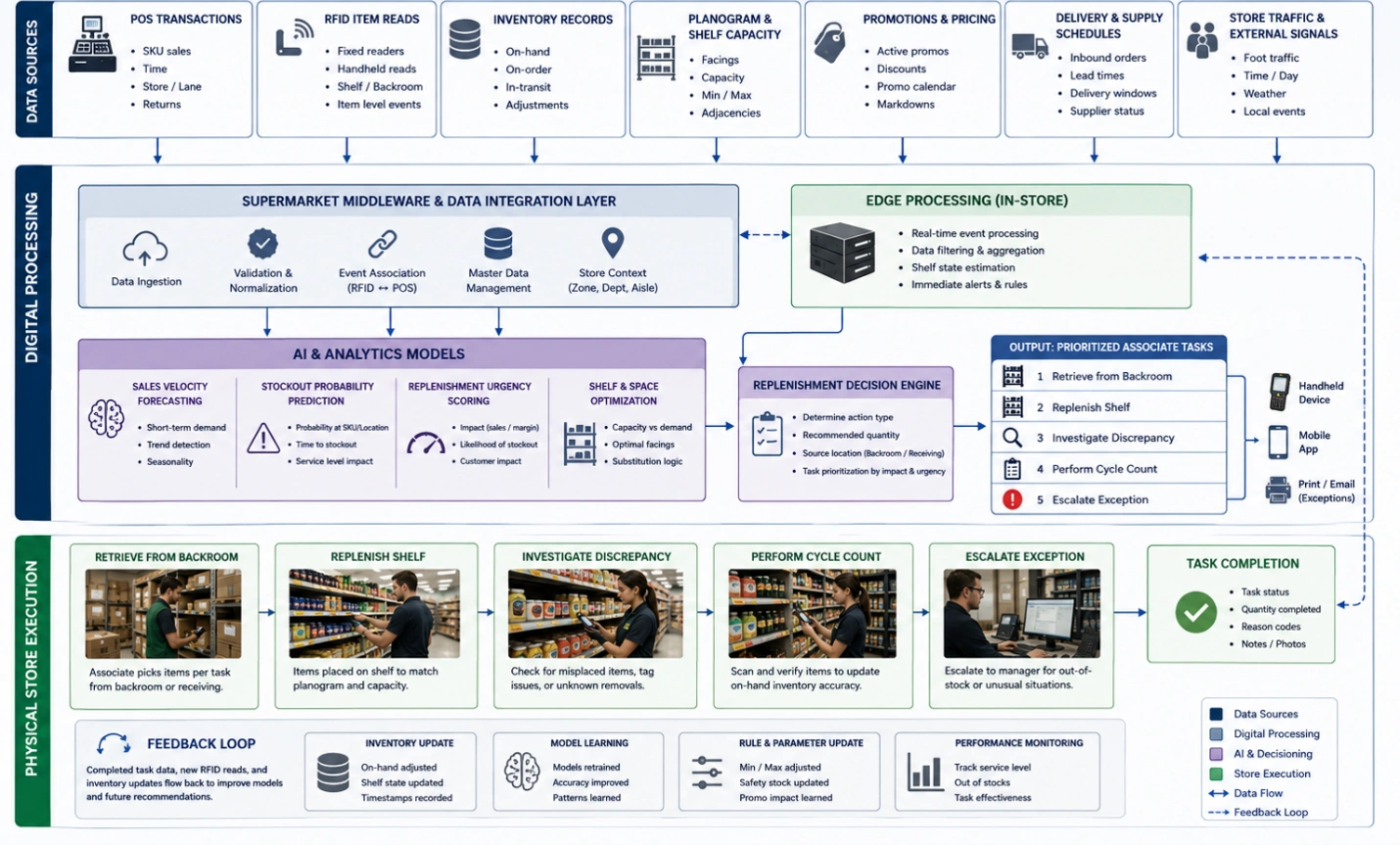
Shows how POS, RFID, inventory, shelf, promotion, delivery, and traffic data flow through AI models to generate prioritized replenishment tasks and feed completed actions back into inventory systems.
AI-Driven Receiving and Inbound Verification
Receiving is one of the most important control points for supermarket inventory data. Merchandise arrives through distribution centers, suppliers, direct-store deliveries, or other replenishment channels and must be reconciled with purchase orders, advance shipping notices, delivery documentation, and inventory records.
RFID can automate identification of tagged cases, cartons, totes, pallets, or individual merchandise as they pass through a receiving area. AI can then help classify exceptions rather than simply reporting every mismatch equally.
A receiving solution can evaluate:
- Expected versus observed item quantities
- Unexpected RFID identities
- Missing expected items
- Duplicate reads
- Product-location mismatches
- Supplier or shipment anomalies
- Repeated receiving discrepancies
- Unusual receiving duration or throughput
- Exceptions associated with particular product categories
Edge processing can be useful at the receiving dock because immediate exception feedback may be required before merchandise is moved into the backroom or sales area. The central retail system can subsequently receive normalized events and reconciliation results.
AI for Inventory Anomalies and Loss Prevention
Loss prevention increasingly depends on correlating multiple signals rather than relying on isolated alarms. RFID can contribute merchandise identity and movement events, while computer vision can provide visual context and POS systems can provide transaction information.
For example, an unusual RFID movement near a controlled exit may become more meaningful when combined with the absence of a corresponding transaction and a computer-vision event. AI can rank such events for investigation instead of generating an indiscriminate alert for every merchandise movement.
This is especially relevant to supermarkets that operate mixed-format stores containing grocery products, pharmacy merchandise, consumer electronics, cosmetics, alcohol, high-value specialty products, or other merchandise requiring different control procedures.
Any loss-prevention implementation should account for privacy, data governance, access controls, retention requirements, and applicable jurisdictional requirements. AI should assist authorized personnel rather than automatically treating an anomalous event as evidence of theft.
Supermarket Data Flow from RFID Capture to AI Decision-Making
An AI-enabled supermarket inventory system normally involves several layers of data processing. The physical RFID reader is only one component of the complete solution.
Item and Event Data Capture
RFID readers capture tag identifiers when products pass through configured read zones. Depending on the operational requirement, supermarkets may use:
- Fixed UHF RFID readers at receiving or controlled transition points
- RFID antennas positioned around dock doors or backroom pathways
- Handheld RFID readers for targeted inventory verification
- RFID portals for controlled merchandise movement
- RFID-enabled workstations or verification points
- HF or LF RFID readers for specialized short-range applications
Tag reads should be associated with time, reader identity, zone, and other relevant contextual information. Read filtering and duplicate suppression are important because a single physical movement can generate multiple RF observations.
Store Edge Processing
An edge computer or local server can process RFID events before transmitting normalized data to central software. This can reduce unnecessary network traffic and provide local decision support when connectivity to a remote environment is degraded.
Typical edge functions include:
- RFID read filtering
- Duplicate-event suppression
- Reader health monitoring
- Event normalization
- Local rule processing
- Temporary data buffering
- Local AI inference where appropriate
- Integration with store equipment
- Local exception notification
Edge processing is particularly useful for supermarket receiving areas and other operational points where immediate feedback can prevent merchandise from progressing further into the store with an unresolved discrepancy.
Middleware and Retail Software Integration
RFID events generally need an integration layer before they can become useful to supermarket applications. Middleware can transform raw reader observations into standardized business events and connect those events with product master data, store locations, purchase orders, inventory records, and transaction systems.
Common integration targets include:
- Retail inventory management systems
- Warehouse management systems
- Order management systems
- POS systems
- Enterprise resource planning software
- Merchandise management systems
- Workforce management software
- Loss-prevention systems
- Business intelligence systems
- Data warehouses and AI analytics environments
APIs, message queues, event streams, databases, and standard enterprise integration methods can be used depending on the supermarket’s existing IT environment.
AI Analytics and Business Actions
AI software can consume normalized RFID events together with other supermarket data. Different models may be appropriate for different decisions.
Demand forecasting models can estimate future product requirements. Classification models can categorize inventory exceptions. Anomaly-detection models can identify unusual merchandise movements or inventory states. Computer-vision models can analyze shelf or checkout imagery. Optimization methods can prioritize replenishment work based on urgency, sales impact, labor availability, and store conditions.
The final output should be an operational action rather than an abstract AI score.
Examples include:
- Replenish a specific shelf
- Search a specified backroom location
- Verify a suspected inventory discrepancy
- Perform a targeted cycle count
- Inspect a receiving exception
- Review a merchandise movement event
- Escalate a high-priority loss-prevention exception
- Update or reconcile an inventory record following authorized verification
RFID-Enabled Supermarket Operations: From Physical Capture to AI-Driven Actions
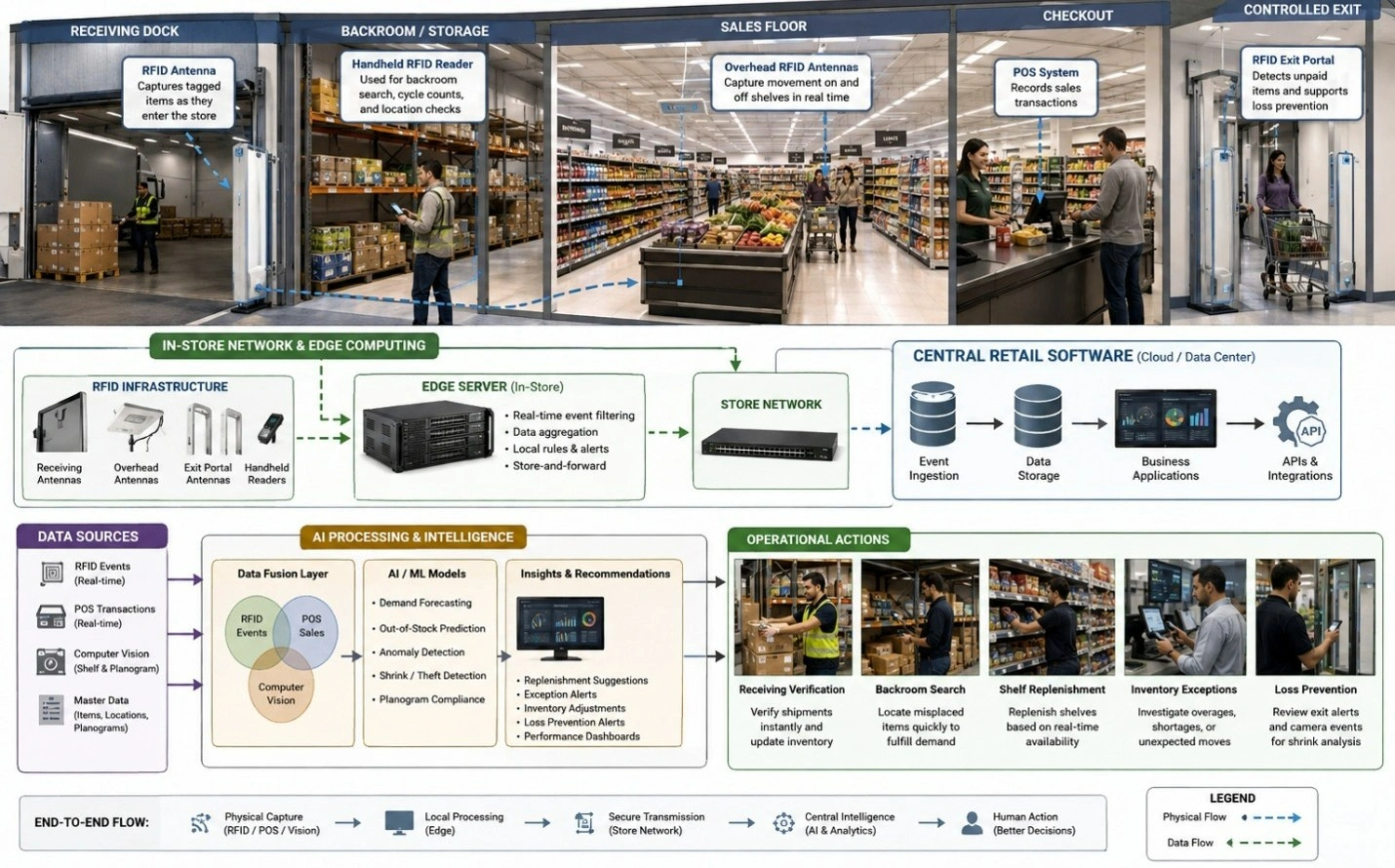 A realistic technical illustration showing how RFID infrastructure, store networks, edge computing, AI software, POS data, and computer vision work together to support supermarket operations.
Engineering Considerations for Supermarket RFID and AI Deployment
A successful deployment starts with the physical operating environment rather than the AI model. Supermarkets contain metal shelving, refrigeration equipment, liquids, dense product packaging, moving carts, forklifts, customers, employees, and constantly changing merchandise arrangements. These conditions can affect RFID read performance and require site-specific testing.
Tag selection is equally important. Product packaging, material composition, liquid content, metallic surfaces, tag orientation, attachment location, and required read distance can influence performance. A tag that performs well on a dry packaged product may behave differently when attached to a liquid-filled container or metalized package.
Reader placement should therefore be validated against the actual supermarket workflow. Engineers should assess:
- Receiving-door geometry
- Antenna orientation
- Read-zone boundaries
- Backroom layout
- Shelf construction
- Refrigerated and frozen areas
- Product density
- Human and equipment movement
- Expected tag orientation
- Reader interference
- Network availability
- Electrical and physical installation constraints
AI deployment introduces another engineering requirement: data quality must precede model complexity. A sophisticated anomaly-detection model cannot reliably identify inventory problems if RFID reads are incomplete, product identifiers are incorrectly mapped, timestamps are unreliable, or store transactions are not synchronized.
A practical implementation therefore typically proceeds through controlled commissioning, RFID read-performance testing, event validation, integration testing, baseline measurement, AI model evaluation, and operational optimization.
Supermarket Deployment Models for AI and RFID Systems
Supermarket operators generally need to choose between cloud-hosted software and privately hosted server deployments based on store connectivity, data governance, latency requirements, existing IT standards, and the scale of the retail operation.
Cloud Version
A cloud-hosted deployment centralizes AI analytics, reporting, model management, and multi-store data processing within cloud infrastructure. Store RFID readers and edge computers transmit normalized events to cloud software through secure network connections.
This model is well suited to supermarket groups operating many geographically distributed stores because a centralized environment can simplify:
- Multi-store inventory analytics
- AI model management
- Cross-store comparison
- Centralized reporting
- Remote system administration
- Software updates
- Aggregation of RFID, POS, computer vision, and IoT data
- Demand forecasting across locations
- Centralized anomaly analysis
Cloud processing is particularly valuable when supermarket management wants to compare inventory accuracy, receiving exceptions, replenishment performance, and merchandise movement across stores.
A store should still retain appropriate local processing for latency-sensitive operations. Sending every raw RFID observation directly to a remote environment can introduce unnecessary bandwidth consumption and dependency on wide-area connectivity. Local filtering and event normalization can reduce this burden.
Server Version
A server deployment places software on edge servers, customer-managed servers, private data centers, or other privately hosted enterprise infrastructure. This approach can be appropriate for supermarket organizations with established private IT environments, stringent data-control requirements, or applications that need processing to remain within a controlled network.
A privately hosted deployment can provide:
- Local control over operational data
- Integration with existing retail databases
- Reduced dependency on external connectivity
- Local processing for selected AI workloads
- Integration with existing identity and security infrastructure
- Greater control over software deployment and update schedules
A hybrid arrangement is also possible. RFID event filtering and immediate operational decisions can occur at the store or regional edge, while aggregated information and computationally intensive AI workloads are processed centrally.
The appropriate choice depends less on whether cloud or private servers are inherently better and more on the supermarket’s existing IT environment and operational requirements.
Security, Privacy, and Data Governance for Supermarket AI
Security needs to cover the complete supermarket data path rather than only the RFID reader.
RFID identifiers, inventory events, employee activity, POS information, video data, and AI-generated operational records can have different sensitivity levels. Combining them can create additional privacy and security considerations.
A supermarket implementation should establish appropriate controls for:
- Reader and edge-device authentication
- Network segmentation
- Encryption in transit
- Encryption at rest where appropriate
- Role-based access control
- Privileged administrator access
- Secure API authentication
- Device configuration management
- Software and firmware updates
- Audit logging
- AI model access controls
- Data retention policies
- Data minimization
- Incident response
- Backup and recovery
Computer vision requires particular attention because cameras can capture customers and employees. RFID systems used for inventory should not automatically be treated as personnel-tracking systems. If employee or customer-associated data is introduced, the supermarket should establish an appropriate legal, privacy, retention, and governance framework before deployment.
Cybersecurity testing should also include the interfaces connecting RFID readers to store networks and middleware. A reader that is physically secure but connected to an inadequately segmented network can still introduce operational risk.
AI Models and Supermarket Decision Intelligence
Different supermarket problems require different AI techniques. A single model should not be expected to handle inventory forecasting, loss prevention, shelf analysis, and receiving reconciliation equally well.
Demand Forecasting
Machine-learning forecasting models can analyze historical sales, seasonality, promotions, holidays, weather-related patterns, store characteristics, and other available signals. RFID can provide additional information about physical merchandise movement where tagged products are involved.
The important distinction is between sales demand and physical availability. A product with low sales may have low demand, but it could also be unavailable on the shelf. Combining POS and physical inventory observations helps reduce the risk of interpreting every sales decline as reduced demand.
Anomaly Detection
Anomaly detection can identify inventory conditions that differ from normal supermarket behavior.
Examples include:
- Unexpected merchandise movement
- Repeated receiving discrepancies
- Inventory quantities inconsistent with physical observations
- Unusual movement near controlled areas
- Repeated unexplained stock adjustments
- Abnormal replenishment patterns
- Unusual product-location changes
AI should rank anomalies according to operational significance. A minor discrepancy involving a slow-moving product should not necessarily receive the same priority as a discrepancy involving a high-volume or high-value item.
Computer Vision and Multimodal AI
Computer vision can provide information that RFID cannot. A camera can determine whether a shelf appears empty, whether merchandise is positioned incorrectly, or whether a visual event occurred in a particular area.
RFID can complement this information by providing product identity and movement observations.
A multimodal supermarket system can therefore combine:
- RFID identity and movement events
- POS transactions
- Computer-vision observations
- Inventory records
- Store-location information
- IoT sensor measurements
- Promotion data
- Delivery information
AI can then correlate these signals to produce a more useful operational assessment.
KPIs for Measuring AI-Enabled Supermarket Operations
Supermarket technology projects should be evaluated using measurable operational outcomes rather than AI model accuracy alone.
Important KPIs include:
- Inventory accuracy percentage
- On-shelf availability
- Stockout rate
- Inventory record discrepancy rate
- Receiving reconciliation accuracy
- Receiving processing time
- Cycle-count labor hours
- Replenishment response time
- Shelf replenishment completion rate
- Sales lost from stockouts
- Shrink rate
- Exception resolution time
- False-alert rate
- RFID read accuracy
- RFID read-zone containment
- RFID reader uptime
- Data-processing latency
- AI prediction accuracy
- Forecast error
- Inventory turnover
- Labor hours per inventory count
- Merchandise location accuracy
- Backroom-to-shelf replenishment time
- System availability
- Mean time to resolve device failures
A baseline should be established before deployment. Otherwise, a supermarket may know that an AI system generates thousands of recommendations but cannot determine whether those recommendations improve inventory availability or reduce labor requirements.
A useful pilot compares selected stores or departments before and after deployment while controlling for promotions, seasonality, assortment changes, and other operational variables.
Implementation Roadmap for Supermarket AI and RFID
Successful implementation generally starts with a narrowly defined operational problem rather than attempting to instrument the entire supermarket immediately.
Define the Business Problem
Select a measurable problem such as inventory accuracy, receiving discrepancies, replenishment delays, high-value merchandise visibility, or shrink investigation.
Document the existing workflow and establish a baseline KPI.
Survey the Store Environment
Assess receiving doors, backrooms, shelves, refrigeration equipment, product materials, reader locations, network connectivity, electrical availability, and employee workflows.
The survey should identify RF interference risks and areas where RFID reads could unintentionally extend beyond the desired read zone.
Select Tags and Readers
Tag selection should reflect the actual merchandise being tracked. Testing should include representative packaging rather than relying exclusively on laboratory specifications.
Reader and antenna selection should account for required read distance, throughput, mounting constraints, read-zone geometry, and environmental conditions.
Commission the RFID System
Validate read rates, read-zone containment, duplicate-event handling, tag association, reader connectivity, and event timestamps.
Testing should occur under realistic operating conditions, including moving employees, carts, pallets, cases, and merchandise.
Integrate Retail Data
Connect normalized RFID events with product master data, inventory records, POS transactions, receiving information, and relevant store-location data.
The integration should define ownership for product identifiers, location identifiers, timestamps, inventory states, and exception statuses.
Establish AI Baselines
Before allowing AI recommendations to drive operational actions, collect sufficient historical data to characterize normal supermarket behavior.
AI models should initially operate in a monitored or advisory mode where appropriate. Store personnel can validate recommendations and provide feedback before automation is expanded.
Optimize and Scale
After validating the pilot, evaluate which stores, departments, merchandise categories, and workflows benefit most.
Scaling should account for:
- Reader density
- Network capacity
- Edge-processing requirements
- Tag procurement
- Installation labor
- Software integration
- AI inference costs
- Device maintenance
- Employee training
- Cybersecurity operations
- Support requirements
GAO can support organizations evaluating RFID, BLE, and IoT hardware requirements as they move from controlled supermarket pilots toward larger deployments.
Supermarket AI & RFID Implementation Lifecycle
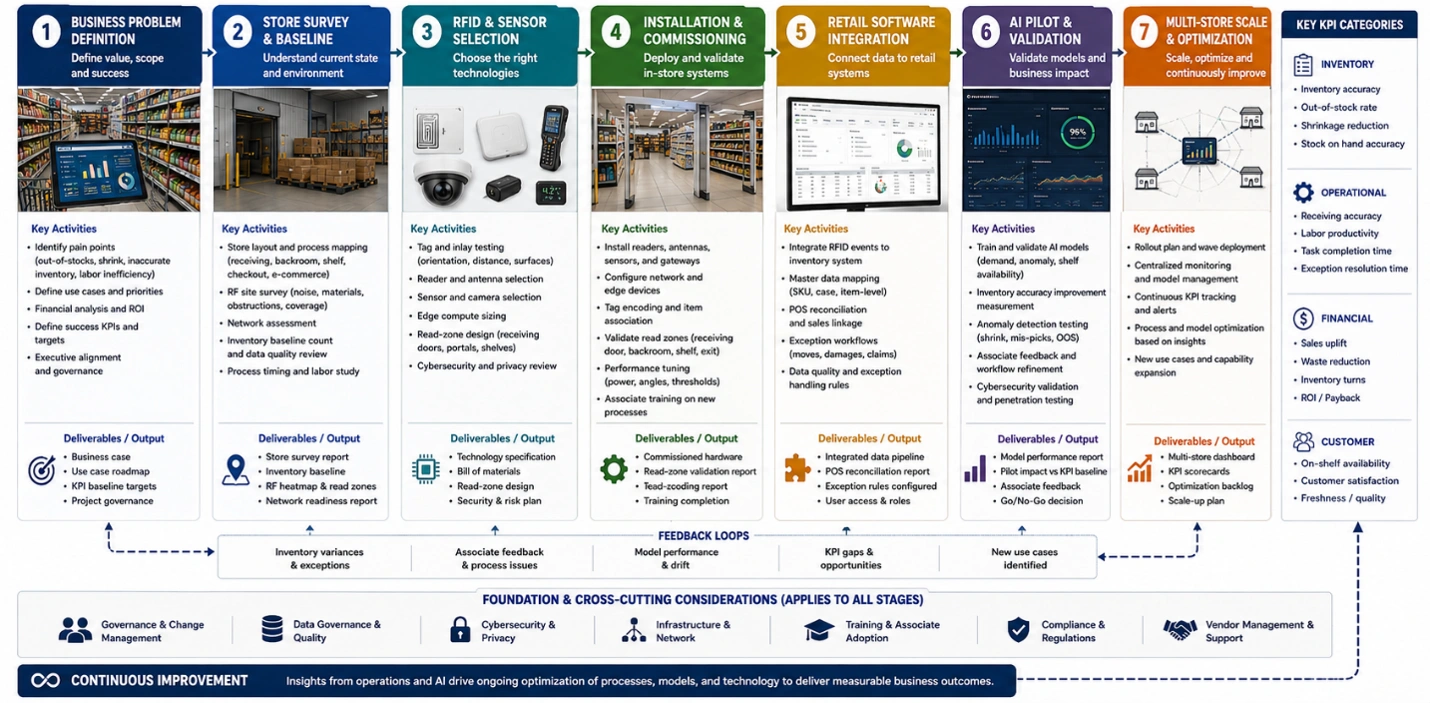 A seven-stage implementation lifecycle guides supermarket teams from business problem definition and store surveying through RFID selection, commissioning, software integration, AI validation, and multi-store optimization, with KPI tracking and operational feedback loops.
Practical Trade-Offs When Combining AI with RFID in Supermarkets
RFID does not automatically equal inventory accuracy. Poor tag placement, unsuitable tags, metal or liquid products, reader placement, and uncontrolled read zones can produce incomplete or ambiguous observations.
More sensors do not automatically produce better AI. Additional RFID readers, cameras, BLE devices, and IoT sensors increase data volume and operational complexity. Each additional signal should have a defined business purpose.
Automation should follow validation. A recommendation that affects inventory records, replenishment, or loss-prevention workflows should be tested against real store conditions before being fully automated.
Physical workflows remain important. AI can identify that a product is probably missing from a shelf, but the supermarket still needs a reliable process for an associate to locate, replenish, verify, or escalate the item.
Integration quality can determine project success. A technically strong RFID installation can deliver limited value if product master data, POS records, inventory states, and store-location data cannot be reliably associated with RFID events.
The best sensing technology depends on the use case. RFID is highly useful for item identity, but computer vision may be better for visual shelf conditions, BLE may be more suitable for proximity, and GPS/cellular IoT may be appropriate for outdoor mobile assets.
These trade-offs reinforce an important implementation principle: supermarket AI should be designed around operational decisions, with RFID and other sensing technologies selected according to the physical evidence required for those decisions.
Why GAO Supports AI-Enabled Supermarket Solutions
GAO provides RFID, BLE, and IoT hardware products and systems that can be incorporated into supermarket inventory, merchandise visibility, asset tracking, and connected-store projects. Our role can include supplying the sensing hardware required for receiving, inventory verification, controlled checkpoints, and other store workflows.
GAO’s experience with RFID and IoT technologies is supported by long-term investment in research and development and quality-assurance processes. The broader GAO organization has served U.S. and Canadian customers for three decades, including Fortune 500 companies, research organizations, universities, and government agencies.
Headquartered in New York City and Toronto, Canada, GAO is recognized among leading B2B and B2G suppliers of BLE and RFID technologies. Our technical support can be provided remotely or onsite depending on project requirements.
For supermarket organizations evaluating AI inventory management, automated replenishment, RFID-enabled receiving, loss-prevention analytics, or connected-store applications, the practical starting point is to define the operational decision that needs improvement and then determine what physical data is required to support it.
Key Takeaways for Supermarket AI and RFID Deployment
AI can make supermarket inventory and store operations more responsive by interpreting physical merchandise events alongside POS, computer vision, IoT, and operational data.
The most valuable implementations focus on specific supermarket problems:
- Improve inventory accuracy by comparing physical RFID observations with transaction and inventory records.
- Prioritize replenishment using sales velocity, physical availability, shelf conditions, and backroom inventory.
- Reduce receiving discrepancies through automated item identification and exception analysis.
- Support loss prevention by correlating merchandise movement with transaction and visual information.
- Use edge processing when store-level decisions require low latency or continued operation during connectivity interruptions.
- Use cloud or privately hosted servers according to the supermarket’s IT, security, data-governance, and scalability requirements.
- Measure the deployment using operational KPIs such as on-shelf availability, inventory accuracy, stockout rate, exception-resolution time, shrink, labor hours, and receiving throughput.
- Treat RFID as one sensing layer within a broader AI and IoT solution rather than as a universal substitute for computer vision, BLE, GPS, or other technologies.
- Validate physical RFID performance and data quality before relying on AI-generated decisions.
- Scale only after a controlled pilot demonstrates measurable improvement in the selected supermarket workflow.
The strongest supermarket deployments connect accurate physical observations to actionable software workflows. AI provides the decision intelligence, while RFID and complementary IoT technologies provide evidence about what is physically happening across receiving, backroom, sales-floor, and controlled merchandise areas.
Building the Future of Industrial AI and IoT with Aperture Venture Studio and GAO RFID Inc.
For more than three decades, GAO has invested heavily in R&D for industrial RFID, BLE, and IoT technologies. As generative AI has become useful for practical industrial and retail applications, we have continued developing AI and IoT solutions, including technologies that connect RFID and BLE data with intelligent software. We founded Aperture Venture Studio to build, launch, and scale next-generation AI and IoT companies and initiatives relevant to industries such as department-store operations.
Aperture has attracted AI and IoT technical experts, experienced executives, investors, and leading companies. We have also developed the Aperture Ventures Summit and TekSummit to facilitate discussion of advanced AI and IoT topics.
GAO welcomes participation from:
- Advisors, co-founders, or employees
- Investors
- Customers