
AI for Surface Mining: Asset Tracking, Safety and Operational Intelligence
AI for Surface Mining Operations: From Equipment Data to Better Decisions
AI is changing surface mining by turning equipment, material, workforce, and environmental data into operational decisions that can be acted on quickly. AI for surface mining can support haul-truck utilization, mobile-equipment safety, maintenance planning, inventory control, material traceability, site access, and identification of assets across pits, haul roads, stockpiles, workshops, warehouses, and processing areas. RFID provides a practical identification layer for equipment components, tools, maintenance parts, containers, PPE, samples, and other mine assets, while other IoT sensors, cameras, GNSS, machine telemetry, and environmental sensors provide complementary data. AI models can correlate these data streams to identify anomalies, predict maintenance requirements, detect process deviations, and prioritize operational actions. For surface mines, the value comes less from any single sensor and more from combining reliable field data with operational context, edge processing, analytics, and existing mine-management systems.
AI and RFID Deployment in Surface Mining: Connected Mine Operations
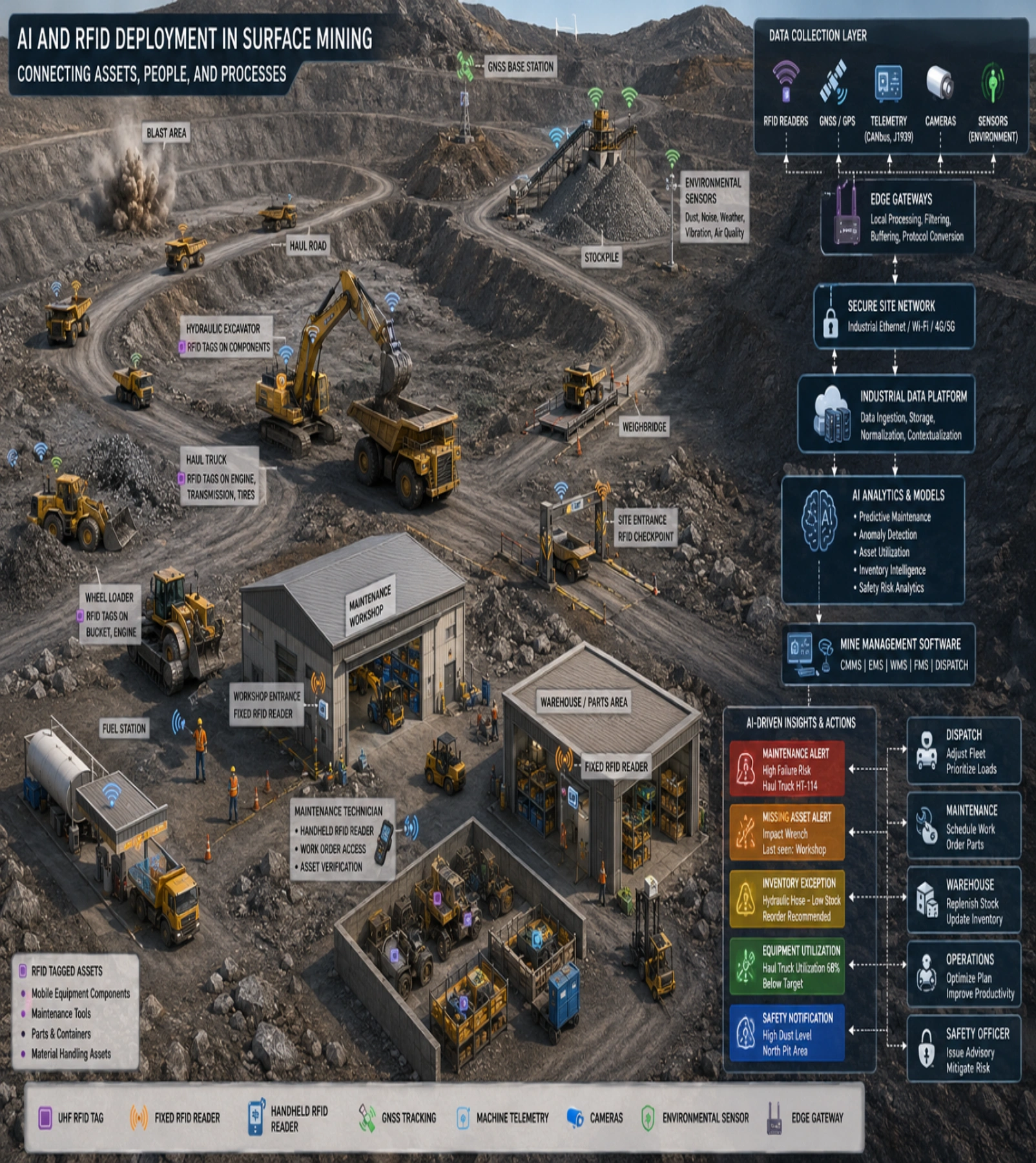
This visual illustrates how UHF RFID, GNSS, machine telemetry, cameras, environmental sensors, and edge gateways connect surface-mining assets and operations. It shows data moving through a secure site network into AI analytics and mine-management software, where insights support predictive maintenance, asset tracking, inventory management, equipment utilization, dispatch, and safety decisions.
What AI Means for Modern Surface Mining
AI for surface mining refers to the application of machine learning, computer vision, predictive analytics, anomaly detection, optimization algorithms, and, where appropriate, Physical AI to mining processes and connected equipment.
The strongest implementations do not treat AI as a replacement for mine engineering or operational controls. Instead, AI adds analytical capability to information already generated by mine equipment, sensors, workers, maintenance systems, production records, and field identification technologies.
AIoT, or Artificial Intelligence of Things, combines artificial intelligence with IoT devices, sensors, connected equipment, and industrial systems. In a surface mine, an AIoT solution may combine:
- UHF, HF, or LF RFID identification
- Machine telemetry and onboard equipment sensors
- GNSS positioning and geofencing
- Computer vision cameras
- Vibration, temperature, pressure, and condition sensors
- Weather and environmental monitoring
- Industrial gateways and edge computers
- Wireless and wired mine communications
- Maintenance management and inventory software
- Fleet management and dispatch systems
- AI and machine-learning models
- Operational dashboards and alerting systems
RFID is particularly useful where the operational question is “Which physical item is this, and when or where was it detected?” AI becomes valuable when the question changes to “What does this sequence of detections, equipment events, and operational measurements mean, and what should the mine do next?”
For example, an RFID record showing that a hydraulic component entered a maintenance workshop is useful by itself. When combined with equipment hours, maintenance history, vibration measurements, work orders, component replacement history, and operating conditions, AI can help identify patterns associated with premature component replacement or maintenance delays.
GAO supplies RFID readers, tags, and RFID-based systems that can provide the physical identification layer for asset, inventory, traceability, and operational workflows. GAO’s mining-related technology offerings include UHF RFID readers and tags intended for tracking equipment and materials.
Surface Mining Applications for AI-Driven Operational Intelligence
AI Asset Tracking for Surface Mining Equipment and Components
Large surface mines contain thousands of physical assets distributed across locations that can change continuously. These include haul-truck components, excavator attachments, loaders, drill accessories, pumps, generators, welding equipment, diagnostic instruments, tires, batteries, hydraulic components, hoses, filters, lubricants, tools, spare parts, containers, and maintenance kits.
AI-assisted asset tracking can correlate RFID detection events with equipment records, maintenance history, location zones, work orders, and utilization data.
Relevant applications include:
- Tracking maintenance tools between workshops, field service vehicles, and equipment bays
- Associating replacement components with specific haul trucks, loaders, excavators, drills, or support equipment
- Detecting assets that remain in an unexpected zone
- Identifying maintenance parts that have been issued but not consumed
- Supporting equipment-component genealogy
- Improving spare-parts visibility
- Detecting unusual movement patterns
- Supporting maintenance audit trails
- Reducing manual asset-counting activities
- Improving reconciliation between physical inventory and maintenance records
AI Inventory Management for Mining Parts and Consumables
Surface mine maintenance operations depend on the availability of critical spares. A missing filter or hydraulic component can delay equipment availability and affect production schedules.
RFID can provide automated item identification at receiving points, stores, maintenance counters, and controlled issue areas. AI can then evaluate inventory movements against historical consumption, planned maintenance, equipment utilization, lead times, and abnormal demand.
The resulting system can support:
- Spare-parts demand forecasting
- Stockout-risk detection
- Slow-moving inventory identification
- Critical-component availability monitoring
- Automated inventory reconciliation
- Maintenance-kitting verification
- Purchase planning based on actual consumption patterns
- Identification of discrepancies between physical and software inventory
The engineering objective is not simply to count more accurately. It is to connect inventory status with equipment availability and maintenance requirements.
AI Predictive Maintenance for Surface Mining Equipment
Predictive maintenance is one of the strongest AI opportunities in surface mining because mobile equipment operates under variable loads, dust, vibration, temperature, gradients, and duty cycles.
AI models can analyze:
- Engine hours
- Hydraulic pressure
- Oil temperature
- Coolant temperature
- Vibration signatures
- Fuel consumption
- Payload
- Operating cycles
- Component age
- Maintenance history
- Failure history
- Environmental conditions
- RFID-based component identity and movement history
RFID helps establish which physical component is installed, removed, stored, repaired, or returned. AI can use that component identity as a feature in maintenance analysis.
A practical implementation should not automatically treat an AI prediction as a maintenance command. A better workflow is to generate a risk score or maintenance recommendation, validate it against equipment-maintenance procedures, and then allow qualified maintenance personnel to determine the appropriate action.
AI-Assisted Mobile Equipment Safety
Surface mining includes interaction among haul trucks, light vehicles, excavators, loaders, graders, drills, service vehicles, pedestrians, and other mobile equipment. Safety systems can use multiple technologies rather than relying on a single identification method.
MSHA’s current surface mobile-equipment safety requirements require operators of surface metal and nonmetal mines to develop and maintain a written safety program addressing hazards associated with mobile equipment. MSHA also identifies technologies including GNSS, radar, lidar, ultrasound, infrared, and electromagnetic or RFID approaches among technologies that may support mobile-equipment safety evaluation.
AI can analyze multiple data sources to identify patterns such as:
- Repeated vehicle interaction within defined operational zones
- Abnormal vehicle movement
- Unexpected entry into restricted areas
- Recurrent congestion around loading and dumping points
- Deviations from designated travel routes
- Repeated near-conflict conditions
- Unusual equipment behavior
RFID can contribute reliable identity information where tagged equipment or personnel-worn identifiers are appropriate. However, RFID should not automatically be treated as a complete collision-avoidance or safety-control system. Mine-specific hazard analysis, applicable regulations, equipment certification requirements, communications performance, and functional-safety considerations must determine the final design.
AI for Material Traceability and Mine-Site Workflow Control
Surface mining involves movement of ore, overburden, waste material, samples, explosives-related operational processes, maintenance supplies, fuel, spare parts, and other materials.
AI can analyze material movement and process data to identify inconsistencies between planned and actual workflows. RFID can identify containers, samples, tools, parts, and other discrete physical objects where automated identification is technically suitable.
Potential applications include:
- Sample container identification and chain-of-custody support
- Maintenance-material traceability
- Parts receiving and issue verification
- Container movement tracking
- Warehouse-to-workshop traceability
- Stockpile-related operational records when discrete tagged objects are involved
- Automated verification of material-handling workflows
The technology selection must reflect the physical material. Metal, liquids, bulk material, extreme temperatures, heavy contamination, and mechanical impact can affect RFID tag performance, so tag construction and mounting location require field testing.
The Surface Mining Data-to-Decision Workflow
A reliable AI solution for surface mining begins with a controlled data path from physical operations to an operational decision.
Field Data Acquisition
The first layer captures physical events and operating conditions.
Typical sources include:
- RFID tags attached to selected assets, tools, components, containers, and maintenance items
- Fixed RFID readers at controlled mine-site locations
- Handheld RFID readers used during inspections and maintenance
- Equipment telematics
- GNSS receivers
- Machine controllers and onboard diagnostics
- Vibration and temperature sensors
- Computer vision cameras
- Environmental sensors
- Operator-entered maintenance records
- Weighbridge and material-handling records
UHF RFID is generally appropriate for longer-range identification and high-throughput item reads where the physical environment supports reliable RF performance. ISO/IEC 18000-63:2021 specifies an air interface for RFID devices operating from 860 MHz to 960 MHz and is intended to support interoperability for item-management applications.
HF and LF RFID may be more appropriate for specific short-range identification requirements, specialized asset identification, or applications where the read-zone needs to be tightly controlled. The correct frequency is determined by tag geometry, mounting material, read distance, environmental conditions, required throughput, and the operational workflow rather than by frequency preference alone.
Mine-Site Connectivity and Edge Processing
Field data must move reliably from equipment and identification points to software that can interpret it.
Depending on the mine, communications can involve:
- Industrial Ethernet
- Wi-Fi
- Private wireless networks
- Cellular connectivity
- Long-range IoT communications
- RFID reader network connections
- Serial or industrial interfaces
- Gateway-to-server communications
- Secure IP networking
Edge computing is valuable when the mine needs rapid local processing, intermittent connectivity tolerance, bandwidth reduction, or local operation of time-sensitive functions.
For example, an edge gateway can filter duplicate RFID reads, normalize timestamps, associate a tag with a reader zone, remove obviously invalid events, and forward only useful events to the central software.
This matters because raw RFID reads are not automatically equivalent to confirmed asset movements. A mine may need read filtering, zone logic, duplicate suppression, antenna tuning, timestamp synchronization, and event correlation before an RFID observation becomes a reliable business event.
Data Normalization and Mine Software Integration
The next stage converts heterogeneous field data into consistent operational records.
A practical data model can associate:
Asset ID → Tag ID → Equipment ID → Component → Location Zone → Timestamp → Work Order → Maintenance Event → Sensor Data → AI Result
Middleware can then connect RFID readers and IoT gateways with existing mine systems such as:
- Fleet management systems
- Computerized maintenance management systems
- Enterprise resource planning systems
- Warehouse management software
- Inventory management systems
- Laboratory information systems
- Production management software
- Safety-management systems
- Business intelligence databases
API-based integration is generally preferable to forcing operators to work in disconnected applications. The objective is to make the physical event available within the software where the operational decision already occurs.
AI Analytics and Decision Support
Once data has been normalized, AI models can analyze historical and real-time information.
Depending on the use case, methods may include:
- Classification
- Regression
- Time-series forecasting
- Anomaly detection
- Clustering
- Predictive maintenance models
- Computer vision
- Optimization algorithms
- Risk scoring
- Pattern recognition
- Rule-based logic combined with machine learning
For surface mining, model performance should be evaluated using operational metrics rather than model accuracy alone. A predictive-maintenance model, for example, should be assessed by whether it provides useful warning time, reduces unnecessary interventions, identifies meaningful failure modes, and fits actual maintenance workflows.
NIST’s AI Risk Management Framework provides a voluntary framework for managing AI risks and incorporating trustworthiness considerations throughout AI system design, development, use, and evaluation. This provides a useful reference for surface-mining organizations developing governance around AI-generated recommendations.
Operational Action
The final stage converts analysis into an action that a mine department can understand and execute.
Examples include:
- Maintenance receives a high-risk component alert
- Warehouse personnel receive an inventory discrepancy notification
- Operations identifies an underutilized haul truck
- A supervisor investigates an unusual equipment movement
- A technician verifies a component before installation
- Dispatch receives an operational exception
- Management reviews equipment availability and maintenance trends
The most useful AI system is therefore not simply a model or dashboard. It is a controlled workflow that connects physical mine activity, trustworthy data, analysis, human judgment, and an operational response.
Surface Mining AI Data-to-Decision Workflow
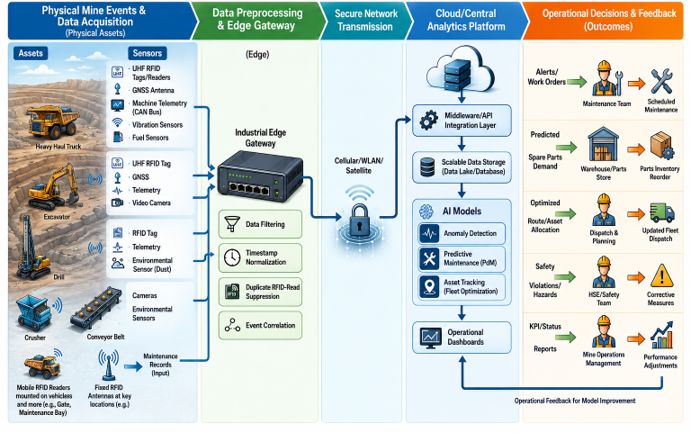
This detailed horizontal workflow diagram illustrates the technical lifecycle of data in an open-pit surface mine, from haul trucks, RFID readers, IoT sensors, and other field sources through edge processing and secure connectivity to AI analytics and mine-management software. It shows how AI outputs such as predictive maintenance, asset tracking, and anomaly detection become operational actions for maintenance, dispatch, warehouse, operations, and safety teams, with feedback supporting continuous model improvement.
AI and RFID Deployment Models for Surface Mining
A surface-mining solution should be designed around the mine’s connectivity, data-governance requirements, operational continuity needs, and existing software environment. The choice between cloud-hosted and privately hosted software should be made after evaluating the mine’s communications infrastructure, latency requirements, cybersecurity policies, remote-site constraints, and integration requirements.
H3: Cloud Version for Distributed Surface Mining Operations
A cloud-hosted deployment can be appropriate when mining organizations operate multiple pits, processing facilities, warehouses, maintenance locations, or geographically distributed sites and need centralized access to operational information.
A cloud deployment can provide:
- Centralized storage of RFID events, equipment records, maintenance data, and AI results
- Multi-site reporting and operational comparison
- Scalable computing resources for machine-learning workloads
- Centralized software updates and model management
- Remote access for authorized maintenance, engineering, and management personnel
- Integration with cloud-based ERP, CMMS, inventory, and business-intelligence applications
- Centralized AI model training using data from multiple surface-mining locations
Cloud processing is particularly useful for computationally intensive analytics that do not require millisecond-level response. Historical equipment data can be consolidated to train predictive-maintenance models, compare component failure patterns, or identify differences in maintenance performance between mine sites.
Cloud connectivity should not be treated as a substitute for local operational resilience. Critical field functions should continue to operate safely when a remote mine temporarily loses connectivity.
Server Version for Controlled Mine-Site Data Processing
A Server Version can run on a customer-managed edge server, mine-site server room, private data center, industrial server, or other privately hosted infrastructure.
This model can be advantageous when:
- Mine data must remain within controlled infrastructure
- Connectivity to external cloud services is intermittent
- Local response is important
- Existing mine software is privately hosted
- Internal IT teams require direct control over software and data
- The mine has strict cybersecurity or operational-technology policies
- AI processing needs to continue during wide-area network interruptions
A hybrid deployment can combine both approaches. RFID event processing, local dashboards, and time-sensitive analytics can run on site, while selected historical data and model-training workloads are synchronized with centralized computing resources.
For remote surface mines, this hybrid approach can reduce dependence on continuous wide-area connectivity without sacrificing centralized analytics.
Surface Mining AI and RFID Hardware and Software Stack
The technology stack should be selected according to the physical workflow rather than starting with a particular device.
RFID Hardware
Typical RFID hardware can include:
- Rugged UHF RFID tags for equipment and industrial assets
- Metal-mount RFID tags for metallic mining equipment
- High-temperature or industrial tags for demanding maintenance environments
- RFID handheld readers for field inspections
- Fixed RFID readers for workshop, warehouse, and controlled-entry locations
- RFID antennas positioned according to required read zones
- RFID printer/encoders for asset labeling
- HF or LF RFID devices where short-range identification is more suitable
Surface-mining environments create difficult RF conditions. Large metal surfaces, hydraulic equipment, vehicles, dust, mud, vibration, weather exposure, electromagnetic interference, and changing tag orientation can all affect read reliability.
A tag that performs well in a warehouse may not perform similarly when mounted on a haul truck, excavator attachment, steel component, or outdoor container.
Edge Computing and Industrial Gateways
Edge computers can collect RFID reads and sensor data before sending selected events to centralized software.
Useful edge functions include:
- RFID duplicate-read filtering
- Event timestamping
- Reader health monitoring
- Local buffering during network interruptions
- Asset-zone determination
- Sensor-data preprocessing
- Protocol conversion
- Local rule execution
- AI inference for selected low-latency use cases
The edge layer is particularly important when the mine has intermittent connectivity or when unnecessary raw data transmission would consume valuable bandwidth.
AI and Machine-Learning Software
Different surface-mining problems require different AI methods.
Examples include:
- Predictive maintenance for hydraulic, engine, drivetrain, and auxiliary components
- Anomaly detection for equipment operating patterns
- Time-series forecasting for maintenance demand and spare-parts consumption
- Computer vision for defined inspection and safety applications
- Classification models for maintenance-event categorization
- Optimization algorithms for selected fleet, routing, or resource-allocation problems
- Natural-language interfaces for querying structured maintenance or asset information where appropriate
AI models should be trained and validated using mine-specific operational data whenever possible. A model developed from unrelated equipment or operating conditions can produce misleading results when deployed across different truck classes, ore characteristics, climate conditions, maintenance practices, or duty cycles.
Integration Software and APIs
The system should integrate with the software already used by mine personnel.
Common integration targets include:
- CMMS and maintenance-management systems
- ERP systems
- Inventory and warehouse systems
- Fleet-management systems
- Dispatch systems
- Production-management software
- Safety-management applications
- Laboratory systems
- Data historians
- Business-intelligence software
An RFID event can therefore become a maintenance record, inventory transaction, asset-location event, or verification step rather than remaining isolated in a dedicated RFID application.
Cloud, Server and Hybrid Deployment for Surface Mining AI and RFID
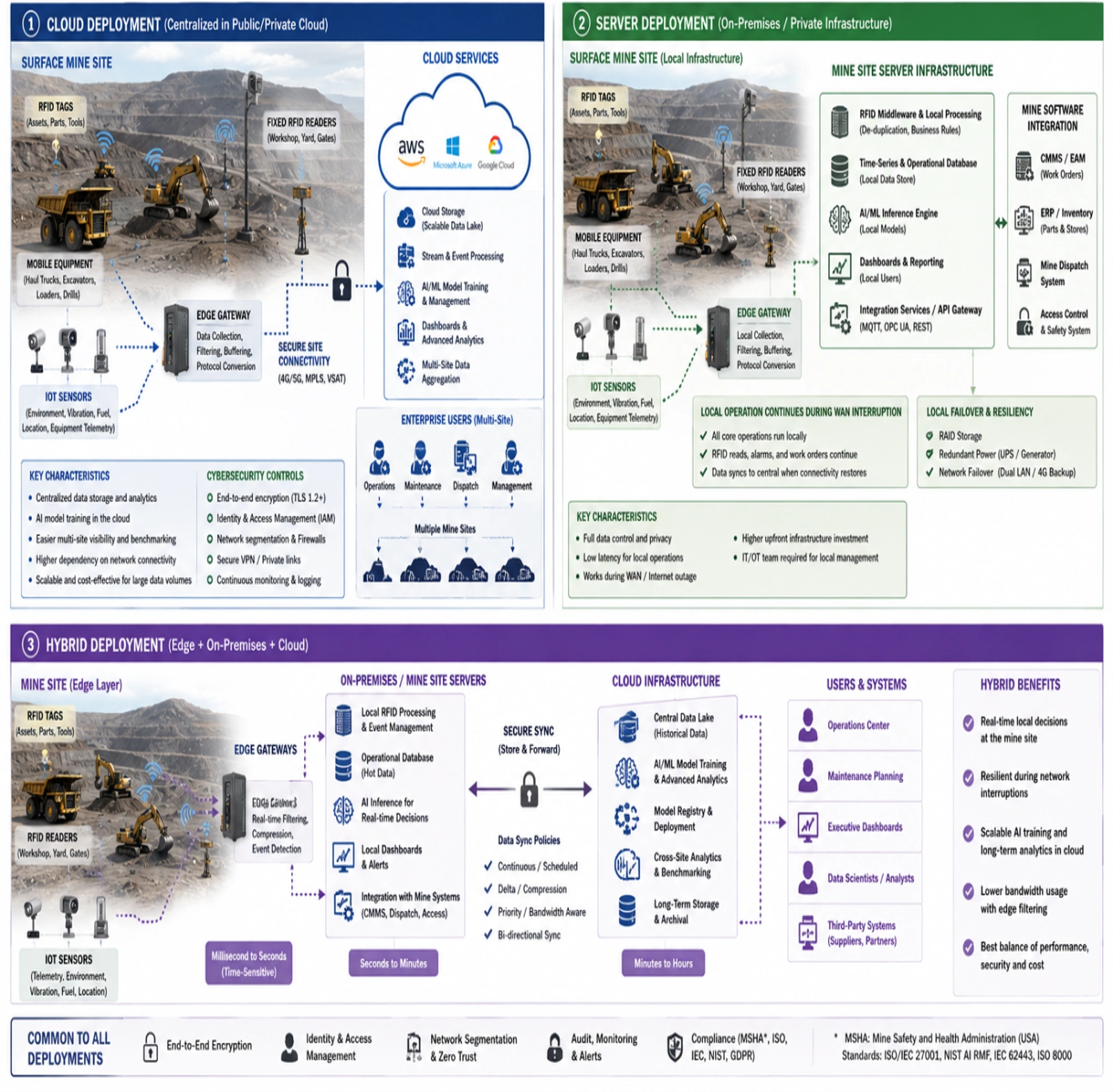
This technical comparison illustrates cloud, privately hosted server, and hybrid deployment models for surface mining operations. It shows how RFID, IoT sensors, edge gateways, mine-site servers, cloud infrastructure, AI analytics, cybersecurity controls, and mine-management systems work together, highlighting the trade-offs between centralized analytics, local processing, connectivity resilience, scalability, and operational continuity.
Engineering Considerations for Surface Mining RFID Deployment
Successful RFID deployment depends on engineering the read environment rather than simply installing readers.
Tag Selection and Mounting
Tag selection should account for:
- Metal mounting surfaces
- Required read distance
- Equipment vibration
- Mechanical impact
- Mud and dust
- Water exposure
- Temperature
- UV exposure
- Chemical exposure
- Cleaning processes
- Required service life
- Asset geometry
- Required identification frequency
For a metallic component, an RFID tag designed for free-space mounting may perform poorly. A metal-compatible tag can provide more predictable performance when installed correctly.
Tag placement should also consider whether maintenance activities, replacement procedures, painting, pressure washing, or mechanical handling could damage or obstruct the tag.
Reader and Antenna Engineering
Fixed readers should be positioned according to the intended business event.
For example, a workshop entrance may require a controlled read zone that determines when an asset enters or leaves a maintenance area. A warehouse doorway may require a different antenna configuration because multiple tagged parts can pass through the zone simultaneously.
Important engineering variables include:
- Antenna orientation
- Reader transmit power
- Tag orientation
- Reader-to-tag distance
- Read-zone geometry
- RF reflections
- Adjacent readers
- Metal structures
- Vehicle speed
- Tag density
- Expected simultaneous reads
A pilot should measure actual read performance under realistic operating conditions rather than relying only on laboratory specifications.
RFID Data Quality
A technically functioning reader can still produce poor business information if the event-processing logic is weak.
For example, a tag may be detected repeatedly while a truck remains beside a reader. The software should not interpret every read as a new movement.
Event-processing logic can therefore apply:
- Duplicate suppression
- Time windows
- Reader-zone rules
- Direction logic
- Asset-state transitions
- Confidence scoring
- Reader health checks
- Exception handling
This transforms raw RFID observations into meaningful mine events such as component received, tool issued, asset entered workshop, or part returned to stores.
Cybersecurity and AI Governance for Connected Surface Mines
Connecting mine equipment, RFID readers, edge computers, AI software, and enterprise applications expands the operational technology attack surface.
A surface-mining deployment should therefore incorporate security throughout the lifecycle rather than adding cybersecurity after commissioning.
Key controls can include:
- Network segmentation between operational technology and business networks
- Role-based access control
- Strong authentication
- Encrypted communications
- Secure API authentication
- Device identity management
- Firmware and software update procedures
- Endpoint protection for applicable servers
- Backup and recovery procedures
- Audit logging
- Configuration management
- Vulnerability management
- Monitoring of unusual network behavior
- Controlled remote support access
AI introduces additional governance considerations. Training data should be traceable, model versions should be controlled, and operational personnel should understand whether an AI result is a prediction, classification, recommendation, or automated action.
NIST’s AI Risk Management Framework organizes AI risk-management activities around Govern, Map, Measure, and Manage, with trustworthiness considered throughout the AI lifecycle. NIST’s current materials also identify security and resilience as important characteristics of trustworthy AI.
For safety-related surface-mining applications, AI-generated recommendations should be carefully separated from formally engineered safety controls unless the complete system has been designed, validated, and approved for that safety function.
Surface Mining Regulations, Standards and Engineering References
Technology deployment should be evaluated against the regulations applicable to the mine’s jurisdiction and commodity.
For U.S. surface metal and nonmetal mines, MSHA’s 30 CFR Part 56 Subpart T requires operators to develop, implement, and update a written safety program for surface mobile equipment. The requirements address hazard identification and risk reduction associated with mobile-equipment movement and operation, as well as maintenance and repair procedures.
Relevant technical references may also include:
- MSHA requirements applicable to the mine and equipment
- Applicable OSHA requirements where relevant to the operating context
- ISO/IEC RFID standards
- Mine-specific electrical and hazardous-location requirements
- Industrial cybersecurity policies
- Customer OT security standards
- Equipment manufacturer requirements
- Applicable radio-frequency regulations
- Internal maintenance and safety procedures
For UHF RFID, ISO/IEC 18000-63:2021 specifies the air interface for RFID devices operating in the 860 MHz to 960 MHz band for item-management applications. ISO also publishes conformance test methods under ISO/IEC 18047-63:2023.
Standards should be treated as engineering references rather than a substitute for a site-specific compliance review.
Surface Mining AI and RFID KPIs
The success of a deployment should be measured using operational outcomes rather than the number of RFID readers installed or AI models developed.
Useful KPIs include:
- Equipment availability
- Mechanical availability
- Mean time between failures
- Mean time to repair
- Maintenance schedule compliance
- Unplanned downtime
- Preventive-maintenance completion
- Predictive-alert precision
- Warning time before component failure
- Spare-parts stockout frequency
- Inventory accuracy
- Parts issue-to-installation time
- Tool retrieval time
- Asset-location accuracy
- RFID read success rate
- False-event rate
- RFID event processing latency
- Workshop turnaround time
- Equipment utilization
- Haul-truck cycle efficiency
- Queue time
- Fuel consumption per operating hour
- Maintenance cost per operating hour
- Safety-event frequency
- Restricted-zone event frequency
- AI model drift
- Data completeness
- System availability
- Mean time to recover from system failure
A KPI should have a baseline established before deployment. Otherwise, a mine cannot determine whether the new system improved an operational process.
For example, if the objective is maintenance optimization, the baseline should include existing unplanned downtime, component replacement intervals, work-order completion times, spare-parts availability, and maintenance labor requirements.
Surface Mining Implementation Lifecycle
A phased implementation reduces operational risk and provides evidence before scaling.
Planning and Site Assessment
Start by mapping the operational problem rather than selecting technology first.
A site assessment should document:
- Mine layout
- Equipment classes
- Asset population
- Maintenance workflows
- Parts-storage processes
- Existing communications
- RFID read zones
- Environmental conditions
- Existing software
- Data ownership
- Cybersecurity requirements
- Applicable regulations
- Existing KPIs
The team should then define a measurable business objective such as improving component traceability, reducing maintenance-tool search time, improving inventory accuracy, or providing earlier warning of selected equipment conditions.
Pilot Deployment
A pilot should represent the real mine environment.
A useful pilot can include:
- One workshop entrance
- One parts-storage area
- A defined set of maintenance tools
- Selected equipment components
- A small number of RFID readers
- A representative sample of tags
- Edge processing
- Existing maintenance-system integration
- A limited AI use case
The pilot should intentionally include difficult conditions such as metal surfaces, moving vehicles, multiple tags, outdoor exposure, and network interruptions.
Commissioning and Validation
Commissioning should verify both technology performance and business-event accuracy.
Testing can cover:
- RFID read reliability
- Tag durability
- Reader coverage
- Antenna configuration
- Network reliability
- Edge buffering
- Time synchronization
- Data integrity
- API integration
- User permissions
- AI prediction performance
- Dashboard accuracy
- Alarm behavior
- Failure recovery
A reader achieving a high laboratory read rate is not enough. The final acceptance criterion should be whether the complete system correctly supports the intended surface-mining workflow.
Optimization and Scaling
After the pilot, the mine can determine which workflows justify expansion.
Scaling may extend from maintenance tools to:
- Critical spare parts
- Mobile-equipment components
- Service vehicles
- Workshop equipment
- Consumable inventory
- Containers
- Samples
- Additional mine locations
AI models should also be monitored after deployment. Changes in equipment models, operating conditions, maintenance practices, seasons, sensor configurations, and mine plans can change the data distribution used by a model.
Surface Mining AI and RFID Deployment Lifecycle
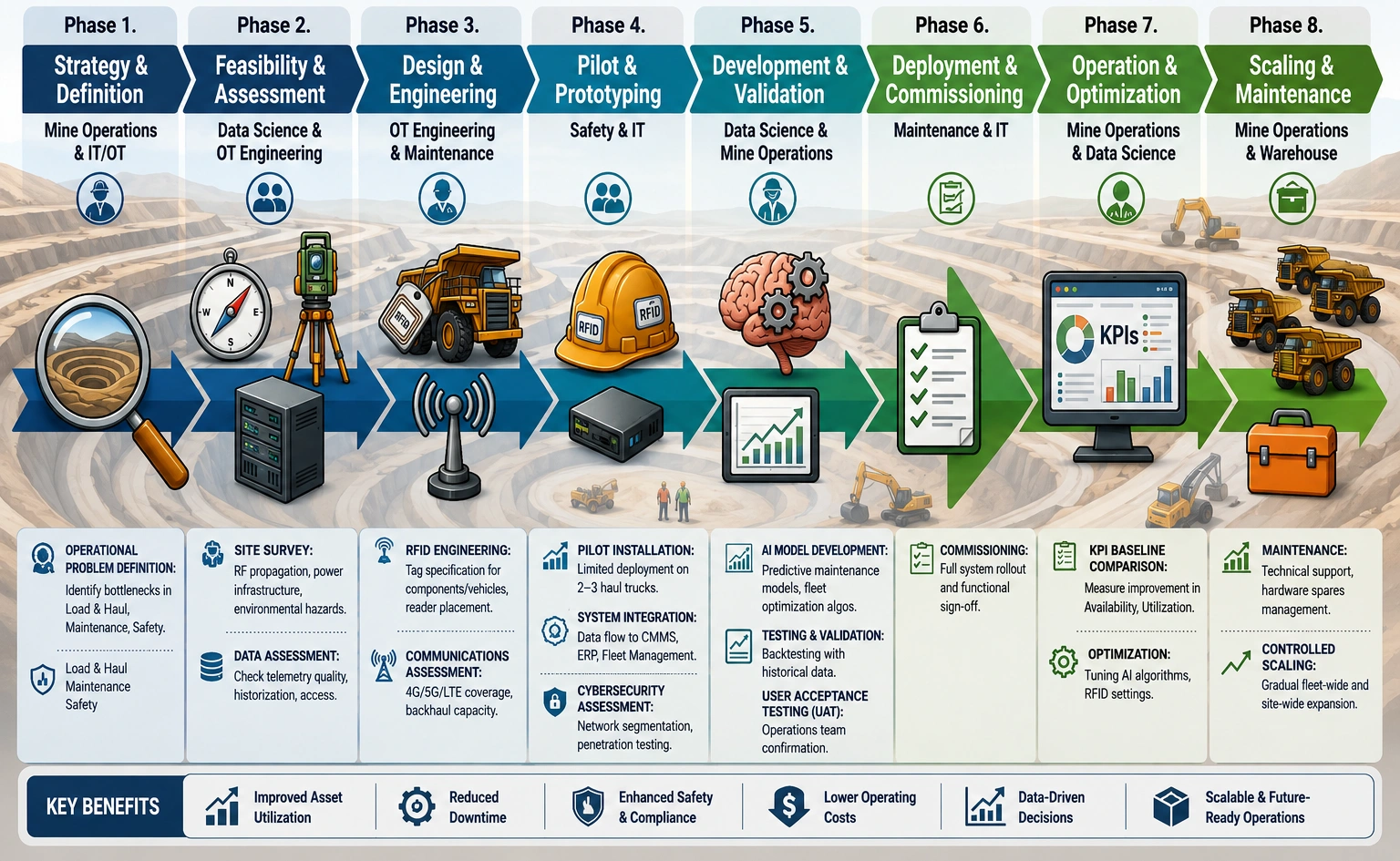
This lifecycle diagram presents the complete implementation path for AI and RFID solutions in surface mining, from operational problem definition and site assessment through RFID engineering, pilot deployment, system integration, cybersecurity, AI validation, commissioning, KPI measurement, optimization, maintenance, and controlled scaling.
Practical Engineering Lessons for Surface Mining AI
Several implementation principles consistently matter when AI and RFID are introduced into a demanding mine environment.
- Start with an operational decision.Define what mine personnel need to decide differently before selecting sensors, RFID readers, or AI models.
- Treat RFID as an identification layer.RFID is strongest when it establishes the identity and movement of physical objects. AI adds value by interpreting that information with other operational data.
- Design for the mine environment.Metal, vibration, dust, moisture, temperature, vehicle movement, and outdoor exposure must be considered during tag and reader selection.
- Validate read zones physically.Computer drawings alone cannot fully predict RF behavior around large mining equipment and metal structures.
- Keep edge processing where operational continuity requires it.A remote mine should not become dependent on a cloud connection for every local event.
- Integrate with existing mine software.Operators should not have to repeatedly enter the same asset, component, maintenance, or inventory information into disconnected applications.
- Use human review for consequential AI recommendations.Maintenance and safety decisions should remain aligned with qualified personnel, established procedures, and applicable controls.
- Measure business outcomes.Inventory accuracy, equipment availability, downtime, maintenance turnaround, and data quality are more meaningful than device counts.
- Design for lifecycle maintenance.Tags, readers, antennas, edge computers, software integrations, AI models, and cybersecurity controls all require ongoing support.
- Scale after proving the workflow.A successful pilot should demonstrate measurable operational value before the system is expanded across additional pits, workshops, warehouses, or equipment classes.
GAO RFID and IoT Technology for Surface Mining
GAO provides RFID, BLE, IoT hardware products, and systems that can support physical asset identification and connected operational workflows. For surface-mining deployments, this can include RFID readers, tags, antennas, handheld equipment, and related systems used as part of asset tracking, inventory, maintenance, and traceability solutions.
Headquartered in New York City and Toronto, Canada, GAO is ranked among the top 10 leading B2B and B2G BLE and RFID suppliers globally. GAO and its sister companies, GAO Research and GAO Tek, form GAO Group, with operations based in New York City and Toronto.
For three decades, GAO Group has served customers across the United States and Canada, including Fortune 500 companies, leading research and development organizations, prestigious universities, and U.S. and Canadian government agencies. Its engineering approach emphasizes substantial R&D investment, stringent quality assurance, and expert technical support that can be provided remotely or onsite.
For a surface mine evaluating AI-driven asset tracking, maintenance intelligence, inventory management, or material traceability, GAO’s role can extend beyond supplying individual RFID components. The practical objective is to select hardware and systems that fit the physical mine environment, integrate with operational software, and generate reliable data that can support downstream analytics and AI.
Key Takeaways for AI and RFID in Surface Mining
AI for surface mining becomes most valuable when it connects physical mine operations with reliable, contextualized data and actionable decisions.
The most important technical conclusions are:
- AI can improve predictive maintenance, equipment utilization, inventory management, asset tracking, material traceability, and selected safety analytics.
- RFID provides physical asset identity and event information that can complement machine telemetry, GNSS, computer vision, and other IoT data.
- UHF RFID is often useful for longer-range item identification, while HF and LF can be selected for specific short-range or specialized workflows.
- Edge processing can maintain local functionality and reduce dependence on wide-area connectivity.
- Cloud deployment can support centralized analytics and multi-site operations.
- Server deployment can provide greater local control and support mine-site data processing.
- Hybrid deployment can combine local operational resilience with centralized analytics.
- AI models should be validated using mine-specific data and measured against operational KPIs.
- Cybersecurity, regulatory requirements, data quality, and human oversight should be considered throughout deployment.
- Successful implementation requires site assessment, pilot testing, commissioning, integration, KPI measurement, optimization, and controlled scaling.
GAO can help surface-mining organizations evaluate RFID and IoT hardware and systems according to their asset-tracking, maintenance, inventory, and operational data requirements. Readers seeking to evaluate a specific surface-mining workflow can learn more about GAO’s RFID and IoT technology, engineering capabilities, products, and technical support through GAO.
Building the Future of Industrial AI and IoT with Aperture Venture Studio and GAO RFID Inc.
For more than three decades, GAO Group of Companies has invested heavily in R&D of industrial RFID, BLE, and IoT. As generative AI has become increasingly useful in industrial applications, we have been developing AI and IoT technologies, including RFID and BLE, and we have founded Aperture Venture Studio to advance practical AI and IoT solutions for industrial applications such as surface mining.
Aperture has attracted AI and IoT technical experts, entrepreneurial and operational executives, influential investors, and leading companies. We have also developed the Aperture Ventures Summit and TekSummit to discuss advanced AI and IoT topics. These activities have helped build strong technical communities around industrial AI and IoT.
We welcome you to join us as:
- Advisors, co-founders, or employees
- Investors
- Customers