
AI and RFID for Textile Manufacturing
AI-Powered RFID Solutions for Textile Manufacturing
The textile manufacturing industry is rapidly embracing Artificial Intelligence (AI) and RFID technology to improve production efficiency, inventory accuracy, product traceability, quality assurance, and supply chain transparency. From fiber receiving and yarn production to weaving, dyeing, finishing, garment manufacturing, warehousing, and distribution, AI-powered RFID systems enable manufacturers to automate identification, optimize operations, and make intelligent, data-driven decisions.
RFID provides automatic identification of raw materials, work-in-progress (WIP), production assets, equipment, and finished textile products, while AI analyzes operational data to predict demand, optimize production schedules, reduce waste, improve machine utilization, and detect quality issues before they impact production. Together, these technologies help textile manufacturers achieve higher productivity, improved regulatory compliance, better inventory control, and enhanced customer satisfaction. GAO has supported manufacturing organizations by providing industrial RFID hardware and IoT solutions that enable reliable data collection across complex production environments.
Understanding AI-Driven RFID in Textile Manufacturing
AI-enabled RFID combines automatic identification with intelligent analytics to create a connected manufacturing environment. Unlike traditional barcode systems that require manual scanning and line-of-sight visibility, RFID tags automatically identify materials, equipment, and finished products throughout production.
Within textile manufacturing, RFID supports:
- Cotton bale identification
- Synthetic fiber tracking
- Yarn inventory management
- Fabric roll identification
- Dye lot traceability
- Work-in-progress monitoring
- Sewing line tracking
- Garment serialization
- Warehouse inventory management
- Finished goods distribution
Artificial Intelligence transforms RFID-generated operational data into actionable insights by using machine learning, predictive analytics, anomaly detection, computer vision, and optimization algorithms.
Instead of simply reporting inventory movements, AI predicts production delays, identifies machine failures, detects fabric defects, optimizes warehouse operations, and recommends corrective actions before operational problems affect production schedules.
AI-Powered RFID Across Textile Manufacturing: End-to-End Intelligent Production and Enterprise Integration
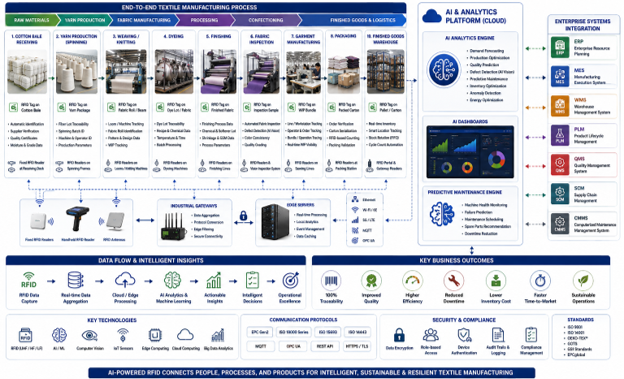
This enterprise infographic illustrates how AI-powered RFID technology enables end-to-end visibility throughout the textile manufacturing lifecycle. It demonstrates RFID-enabled tracking from cotton bale receiving, yarn production, weaving, knitting, dyeing, finishing, fabric inspection, garment manufacturing, packaging, warehousing, and distribution while integrating AI analytics, predictive maintenance, ERP, MES, WMS, PLM, QMS, cloud analytics, and industrial gateways to improve operational efficiency, quality, traceability, and production intelligence.
Core Components of an AI-Enabled RFID Solution
A modern textile manufacturing facility integrates RFID technology, AI software, industrial networking, enterprise systems, and intelligent analytics into one coordinated solution.
RFID Identification Layer
RFID tags uniquely identify:
- Cotton bales
- Yarn cones
- Fabric rolls
- Dye batches
- Production containers
- Work-in-progress materials
- Sewing bundles
- Finished garments
- Shipping cartons
- Warehouse pallets
Different RFID frequencies support different manufacturing requirements:
- UHF RFID for warehouse inventory, pallet tracking, logistics, and finished goods.
- HF RFID for laboratory samples, quality documentation, and production records.
- LF RFID for specialized industrial applications where metal interference or harsh environments exist.
RFID Data Capture Layer
Industrial RFID readers automatically collect identification data using:
- Fixed RFID readers
- Conveyor-mounted readers
- Production line readers
- Warehouse portal readers
- Handheld RFID readers
- Forklift-mounted readers
- Dock door readers
- Automated storage systems
Continuous RFID data capture eliminates manual scanning delays while improving inventory visibility and production accuracy.
AI Analytics Layer
Artificial intelligence converts RFID events into operational intelligence through:
- Demand forecasting
- Production scheduling
- Inventory optimization
- Predictive maintenance
- Quality prediction
- Fabric defect detection
- Workflow optimization
- Supply chain analytics
- Energy optimization
- Production performance analysis
AI continuously learns from production history to improve manufacturing decisions and operational efficiency.
AI and RFID Deployment Across Textile Manufacturing Operations
Successful implementation requires RFID integration throughout every stage of textile manufacturing rather than isolated deployments.
The workflow begins when raw materials such as cotton, wool, polyester fibers, and specialty textiles arrive at the receiving dock. RFID-tagged material containers are automatically identified by fixed readers, while AI verifies supplier information, purchase orders, quality certificates, delivery schedules, and inventory records.
Environmental monitoring systems can associate temperature and humidity data with RFID-tagged raw materials, allowing AI to determine whether storage conditions meet manufacturing requirements before production begins.
End-to-End Operational Workflow for AI-Driven RFID in Textile Manufacturing
Following raw material verification, RFID-enabled traceability continues throughout spinning, weaving, knitting, dyeing, finishing, garment production, packaging, warehousing, and distribution. AI continuously analyzes operational data generated by RFID readers, production equipment, quality inspection systems, environmental sensors, and enterprise software to improve efficiency while maintaining consistent product quality.
Raw Material Storage and Inventory Management
Each incoming raw material is assigned a unique RFID identity linked to supplier information, quality inspection reports, storage conditions, lot numbers, and inventory records.
AI continuously evaluates:
- Inventory turnover
- Raw material availability
- Safety stock levels
- Supplier performance
- Warehouse utilization
- Production demand forecasts
- Material aging and replenishment risks
Rather than relying on periodic inventory counts, RFID provides real-time inventory visibility while AI predicts future material requirements and minimizes stock shortages or excess inventory.
Spinning and Yarn Production
During spinning operations, RFID tags identify fiber lots, yarn cones, production machines, and work orders.
RFID automatically verifies:
- Correct raw material usage
- Production batch identification
- Machine assignment
- Process sequence
- Yarn lot genealogy
AI analyzes machine performance, spindle utilization, yarn quality, and production throughput to optimize spinning efficiency and reduce waste.
Weaving, Knitting, and Fabric Production
RFID tracks fabric rolls, weaving beams, knitting batches, and work-in-progress materials throughout production.
AI continuously monitors:
- Loom utilization
- Machine efficiency
- Fabric production rates
- Process bottlenecks
- Downtime events
- Production quality
Machine learning identifies abnormal operating conditions before they impact production schedules or fabric quality.
Dyeing and Finishing Operations
Dyeing and finishing are critical stages where consistent process control directly affects product quality.
RFID identifies:
- Dye batches
- Fabric rolls
- Processing vessels
- Chemical containers
- Production recipes
AI evaluates process parameters such as temperature, dye concentration, processing time, and equipment performance to detect deviations and recommend corrective actions before quality defects occur.
Quality Inspection
Quality inspection systems verify fabric and garment quality through laboratory testing and automated inspection processes.
HF RFID simplifies sample identification while AI supports:
- Fabric defect detection
- Color consistency analysis
- Surface inspection
- Pattern verification
- Quality trend analysis
AI correlates inspection results with historical production data, helping engineers identify recurring manufacturing issues and improve process stability.
Garment Manufacturing and Packaging
During garment production, RFID tracks sewing bundles, production orders, operators, packaging materials, and finished products.
RFID verifies:
- Production order completion
- Correct garment identification
- Packaging materials
- Shipping cartons
- Finished product serialization
AI evaluates production throughput, workstation efficiency, and operator productivity to optimize workflow and reduce manufacturing delays.
Warehouse Operations and Distribution
UHF RFID enables automated warehouse management by tracking:
- Fabric rolls
- Finished garments
- Shipping cartons
- Warehouse pallets
- Forklift movement
- Inventory transfers
AI recommends warehouse slotting strategies, predicts shipping demand, optimizes picking routes, and supports faster order fulfillment.
End-to-end RFID traceability enables rapid product recalls and improves supply chain transparency across distribution centers.
Technology Components Supporting AI-Powered RFID Solutions
Modern textile manufacturing combines industrial RFID hardware with intelligent AI software to create a connected production environment.
RFID Hardware
Typical RFID hardware includes:
- UHF RFID tags
- HF RFID tags
- LF RFID tags
- Fixed industrial RFID readers
- Handheld RFID readers
- Conveyor-mounted readers
- Dock door readers
- RFID antennas
- RFID printers and encoders
- Industrial gateways
GAO provides industrial RFID hardware designed to operate reliably in textile manufacturing environments with high production volumes and demanding operational conditions.
AI Software Components
Common AI capabilities include:
- Machine learning prediction models
- Predictive maintenance
- Computer vision inspection
- Production optimization
- Demand forecasting
- Inventory optimization
- Fabric defect detection
- Quality prediction
- Anomaly detection
- Decision support systems
These capabilities continuously improve as larger RFID datasets become available from manufacturing operations.
Enterprise Software Integration
AI-enabled RFID solutions integrate with:
- Enterprise Resource Planning (ERP)
- Manufacturing Execution Systems (MES)
- Warehouse Management Systems (WMS)
- Product Lifecycle Management (PLM)
- Quality Management Systems (QMS)
- Supply Chain Management (SCM)
- Computerized Maintenance Management Systems (CMMS)
- Customer Relationship Management (CRM)
Enterprise integration provides a unified view of production, inventory, quality, maintenance, and logistics across textile manufacturing facilities.
AI-Powered RFID Workflow for End-to-End Textile Manufacturing and Enterprise Integration
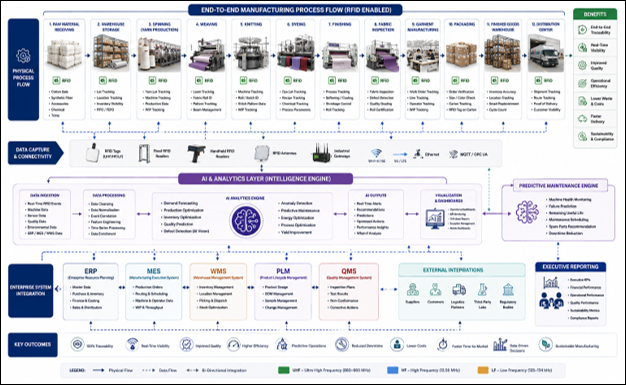
This enterprise workflow diagram illustrates the complete AI-powered RFID process across textile manufacturing, from RFID-tagged raw material receiving through warehouse storage, spinning, weaving, knitting, dyeing, finishing, fabric inspection, garment manufacturing, packaging, finished goods warehousing, and distribution. It also demonstrates real-time data flow through RFID infrastructure, ERP, MES, WMS, PLM, QMS, AI analytics, predictive maintenance, operational dashboards, and executive reporting, enabling intelligent production management, enhanced traceability, optimized workflows, and data-driven decision-making.
Cloud and Server Deployment Models for AI-Enabled RFID in Textile Manufacturing
Selecting the appropriate deployment model depends on production scale, IT infrastructure, cybersecurity requirements, operational latency, and regulatory policies. Textile manufacturers typically implement either cloud-hosted software, privately managed server deployments, or hybrid configurations.
Cloud Deployment
Cloud-hosted deployments centralize RFID data and AI analytics within secure cloud infrastructure managed by the software provider.
Cloud deployment is well suited for:
- Multi-plant textile manufacturers
- Global apparel brands
- Contract textile manufacturers
- Centralized production monitoring
- Enterprise-wide inventory management
- Supplier collaboration
- Executive performance dashboards
Benefits include:
- Faster implementation
- Lower infrastructure maintenance
- Automatic software updates
- Elastic computing resources
- Centralized reporting
- Simplified disaster recovery
Manufacturers operating multiple production facilities can compare production efficiency, inventory turnover, machine utilization, and quality metrics across all sites through centralized AI dashboards.
Server Deployment
Many textile manufacturers prefer privately managed server deployments because of proprietary production processes, customer confidentiality, or internal cybersecurity policies.
Server-based deployments are suitable for organizations requiring:
- Local data ownership
- Low-latency production decisions
- Restricted internet connectivity
- Internal cybersecurity governance
- Private AI model training
- Manufacturing data isolation
Private servers may operate within factory data centers, regional enterprise facilities, or customer-managed infrastructure while maintaining full control over production data.
GAO supports RFID deployments for both cloud-hosted and privately managed manufacturing environments.
Hybrid Deployment
Many organizations combine both deployment models.
A hybrid solution performs real-time RFID processing and production control locally while synchronizing summarized operational data with cloud software for enterprise reporting, AI model training, long-term analytics, and executive dashboards.
This approach balances operational responsiveness with centralized business intelligence.
Communication Infrastructure and Industry Standards
Reliable communication ensures accurate RFID data collection and supports continuous AI-driven decision-making across textile manufacturing operations.
RFID Communication Technologies
Common RFID communication technologies include:
- Ultra High Frequency (UHF)
- High Frequency (HF)
- Low Frequency (LF)
- EPC Gen2
- ISO 18000 Series
- ISO 15693
- ISO 14443
The appropriate RFID technology depends on read distance, production environment, material characteristics, and operational requirements.
Industrial Networking
RFID readers exchange data with enterprise software through industrial communication technologies including:
- Industrial Ethernet
- Wi-Fi 6/6E
- MQTT
- OPC UA
- REST APIs
- TCP/IP
- HTTPS/TLS
- VPN
Reliable industrial networking minimizes communication delays while supporting continuous manufacturing operations.
Industry Standards and Compliance
Textile manufacturers often comply with international quality and manufacturing standards such as:
- ISO 9001
- ISO 14001
- OEKO-TEX® Standard 100
- Global Organic Textile Standard (GOTS)
- ISO 45001
- GS1 identification standards
- EPCglobal RFID standards
RFID-generated digital records simplify compliance documentation, while AI helps quality teams identify inconsistencies before audits occur.
Cybersecurity Considerations for AI-Enabled RFID Systems
Cybersecurity is essential because RFID infrastructure exchanges operational data among production equipment, enterprise software, warehouses, suppliers, and logistics networks.
Important security practices include:
- Role-based access control
- Multi-factor authentication
- RFID device authentication
- Secure firmware management
- Encrypted communications
- VPN connectivity
- Continuous network monitoring
- AI-assisted anomaly detection
- Regular vulnerability assessments
- Backup and disaster recovery planning
AI enhances cybersecurity by identifying abnormal RFID reader behavior, unauthorized inventory movement, unusual network activity, and suspicious user access patterns before they affect manufacturing operations.
Maintaining cybersecurity throughout the RFID deployment lifecycle protects intellectual property, production continuity, and sensitive manufacturing information.
Key Technical Capabilities and Business Benefits
Integrating AI with RFID technology delivers measurable improvements throughout textile manufacturing.
End-to-End Traceability
Every raw material, yarn lot, fabric roll, work-in-progress item, and finished garment can be tracked throughout production, simplifying compliance and recall management.
Improved Inventory Accuracy
Real-time RFID identification eliminates manual inventory counting while AI predicts replenishment needs and reduces stock shortages.
Intelligent Production Scheduling
Machine learning models analyze production capacity, inventory availability, workforce allocation, and equipment utilization to optimize manufacturing schedules.
Predictive Maintenance
AI evaluates RFID-linked equipment history, operating hours, maintenance records, and sensor data to predict failures before unexpected downtime occurs.
Enhanced Product Quality
AI-powered quality analytics detect abnormal production trends, identify recurring defects, and support continuous process improvement.
Reduced Operational Costs
Automation reduces manual data entry, inventory reconciliation, production delays, and material waste while improving labor productivity and overall equipment effectiveness (OEE).
AI-Enabled RFID System Architecture for Intelligent Textile Manufacturing
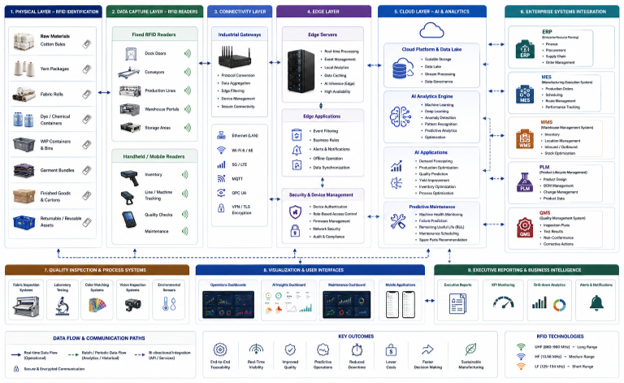
This architecture diagram illustrates how AI-enabled RFID technology integrates with textile manufacturing operations through RFID tags, fixed and handheld readers, industrial gateways, edge servers, cloud software, and enterprise applications including ERP, MES, WMS, PLM, and QMS. It demonstrates end-to-end data flow from raw material identification to AI analytics, predictive maintenance, quality inspection systems, operational dashboards, and executive reporting, enabling real-time visibility, optimized production, enhanced traceability, and data-driven decision-making.
Engineering Best Practices for Successful AI-Enabled RFID Deployment
Successfully deploying AI-enabled RFID solutions in textile manufacturing requires careful planning, standardized implementation procedures, continuous monitoring, and long-term optimization. Manufacturers should adopt engineering best practices that improve system reliability, scalability, and operational efficiency.
Planning and Requirement Analysis
Before implementation, manufacturers should evaluate:
- Production workflows
- Product categories
- Inventory management processes
- Warehouse layout
- Existing enterprise software
- Machine connectivity
- RFID read range requirements
- Environmental conditions
- Future expansion plans
Defining clear operational objectives ensures the RFID solution aligns with production goals and business requirements.
Hardware Selection
Selecting appropriate RFID hardware depends on:
- Fabric materials
- Metal equipment interference
- Read distance requirements
- Temperature and humidity conditions
- Production speed
- Reader installation locations
- Tag durability
- Warehouse operating conditions
Pilot testing and RFID site surveys help determine optimal reader placement and antenna configuration, ensuring consistent read accuracy across production facilities.
Enterprise System Integration
A successful deployment connects RFID data with business systems such as ERP, MES, WMS, PLM, QMS, SCM, and CMMS. Standard APIs, middleware, and industrial communication protocols enable reliable data exchange while eliminating isolated information silos.
Commissioning and Testing
Before full production deployment, manufacturers should conduct:
- RFID read accuracy testing
- Network communication validation
- AI model verification
- Enterprise software integration testing
- User acceptance testing
- Performance benchmarking
- Failover and disaster recovery testing
Comprehensive validation minimizes deployment risks and ensures stable operation under real manufacturing conditions.
Continuous Monitoring and Optimization
Long-term success requires ongoing system optimization.
Continuous improvement activities include:
- RFID reader calibration
- Firmware updates
- AI model retraining
- Inventory accuracy audits
- Cybersecurity reviews
- Preventive maintenance
- KPI monitoring
- Production performance analysis
GAO has helped organizations implement industrial RFID hardware and intelligent IoT systems that support reliable long-term manufacturing operations through quality products and technical expertise.
Practical Implementation Recommendations
Organizations implementing AI-powered RFID in textile manufacturing should consider the following recommendations:
- Begin with a pilot deployment in a high-value production area.
- Define measurable KPIs before implementation.
- Select RFID frequencies based on manufacturing requirements.
- Integrate RFID data with existing enterprise software.
- Prioritize cybersecurity throughout the deployment lifecycle.
- Train production, warehouse, maintenance, and quality personnel.
- Establish AI governance and data quality procedures.
- Regularly evaluate AI model performance.
- Perform periodic RFID infrastructure maintenance.
- Develop scalable implementation strategies for future expansion.
Following these recommendations reduces implementation risks while maximizing operational efficiency and return on investment.
AI-Powered RFID for Textile Manufacturing: Intelligent Production, Traceability, and Inventory Control
AI-powered RFID solutions are transforming textile manufacturing by enabling intelligent inventory management, real-time production visibility, predictive maintenance, automated quality inspection, and end-to-end product traceability. By combining automated RFID identification with AI-driven analytics, textile manufacturers can improve production efficiency, reduce waste, strengthen regulatory compliance, optimize warehouse operations, and deliver higher-quality products.
As textile production continues to become more digital and data-driven, AI-enabled RFID solutions will play an increasingly important role in improving manufacturing performance, supply chain resilience, and operational decision-making.
GAO continues to support manufacturers with industrial RFID hardware, IoT systems, and technical expertise that enable scalable, reliable, and intelligent textile manufacturing solutions.
Building the Future of Industrial AI and IoT with Aperture Venture Studio and GAO
For more than three decades, GAO Group of Companies has invested heavily in the research and development of industrial RFID, BLE, and IoT technologies. As artificial intelligence has become increasingly valuable in textile manufacturing and industrial automation, we have expanded our focus to develop AI-enabled IoT solutions while establishing Aperture Venture Studio to accelerate innovation in intelligent manufacturing technologies serving textile production and other industrial sectors.
Aperture has attracted leading AI researchers, IoT specialists, experienced technology executives, influential investors, and industry organizations. Through initiatives such as the Aperture Ventures Summit and TekSummit, we continue fostering collaboration and knowledge sharing across AI and IoT communities.
We welcome professionals and organizations to engage with us as:
- Advisors, collaborators, or employees
- Investors
- Customers seeking advanced AI and RFID solutions