
AI-Powered Theme Park Operations Using RFID Technology
AI-Powered Theme Park Operations Using RFID Technology
Modern theme parks are evolving into highly connected environments where operational efficiency, guest satisfaction, safety, and revenue optimization depend on accurate real-time information. Artificial intelligence supported by RFID technology enables theme park operators to automate visitor identification, monitor attraction capacity, optimize workforce deployment, improve asset visibility, strengthen security, and personalize guest experiences while reducing operational costs.
Rather than functioning as an isolated technology, RFID serves as one of the primary data acquisition methods within an AI-driven operational system. RFID wristbands, smart tickets, ride access credentials, merchandise tags, equipment identifiers, and maintenance tracking labels continuously generate operational data that AI analyzes to improve decision making across every stage of theme park operations.
Theme parks increasingly integrate AI with RFID, computer vision, IoT sensors, mobile applications, digital ticketing systems, point-of-sale software, predictive analytics, and operational intelligence tools to create responsive environments capable of adapting to guest behavior in real time. Organizations working with GAO benefit from decades of experience supplying RFID and IoT technologies that support demanding operational environments throughout North America.
AI-Enabled RFID Theme Park Environment for Intelligent Guest and Operations Management
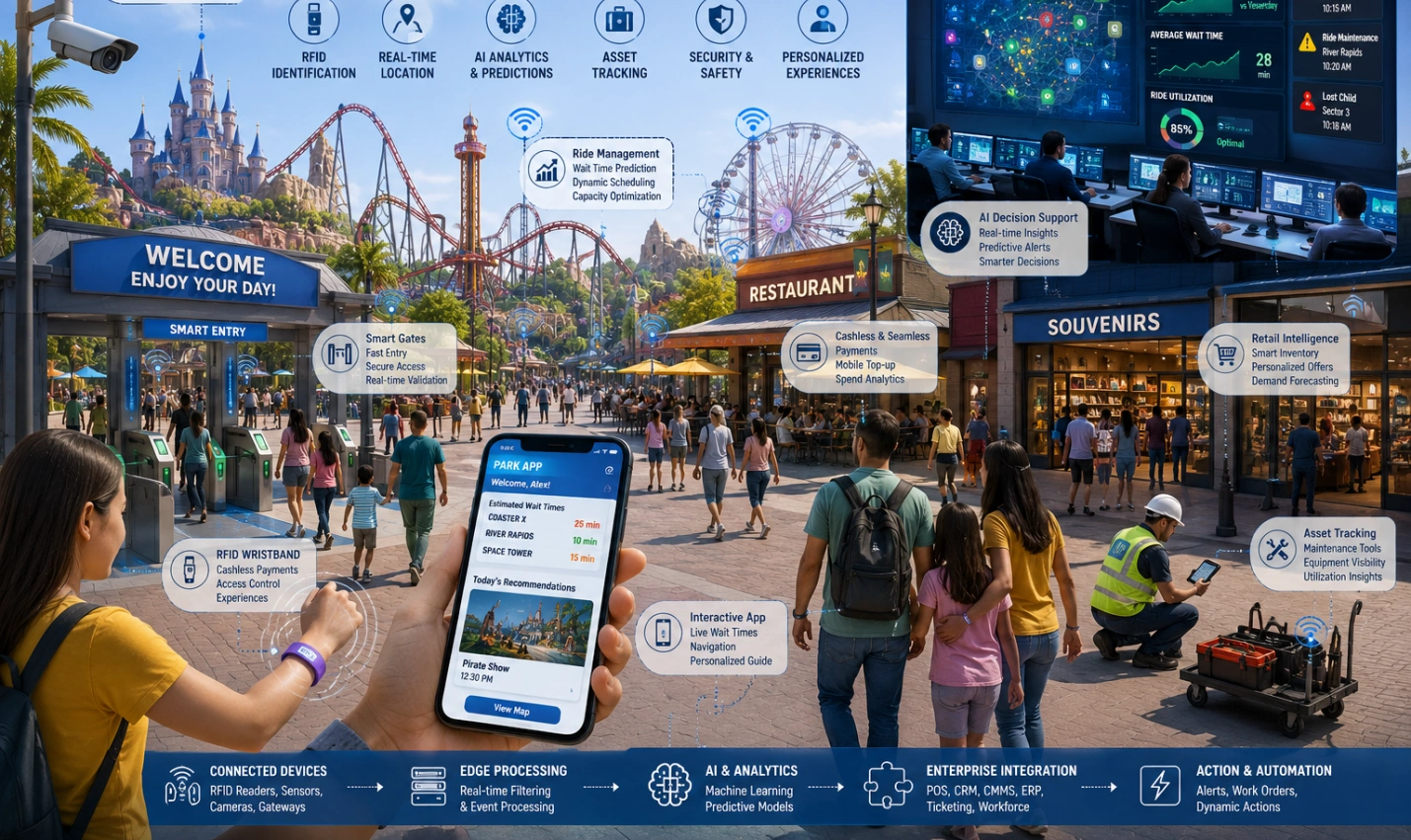
This illustration depicts a modern theme park where RFID wristbands, AI analytics, IoT sensors, and connected operational systems work together to streamline guest access, optimize ride management, track assets, enhance security, and improve real-time decision-making across the park.
Understanding AI-Driven RFID Systems for Theme Parks
Large amusement parks operate as complex environments containing thousands of moving guests, hundreds of employees, numerous attractions, retail outlets, restaurants, entertainment venues, maintenance facilities, transportation systems, and critical infrastructure. Coordinating these resources requires continuous situational awareness that traditional manual processes cannot provide.
Artificial Intelligence of Things (AIoT) combines artificial intelligence with connected sensors, RFID readers, IoT devices, edge computing, and enterprise software to automate operational intelligence. Within theme parks, RFID provides continuous identification of guests, staff members, equipment, merchandise, rental assets, maintenance tools, uniforms, emergency equipment, and operational inventory.
Artificial intelligence transforms this continuous stream of RFID events into actionable operational intelligence by identifying behavioral patterns, forecasting demand, detecting anomalies, predicting equipment failures, recommending staffing adjustments, and optimizing attraction throughput.
Unlike barcode systems that require direct scanning, RFID enables rapid identification without requiring line-of-sight. This capability becomes especially valuable in high-volume environments where thousands of guests simultaneously enter attractions, restaurants, shops, parking facilities, and entertainment venues.
AI continuously analyzes RFID-generated operational events to support decisions involving:
- Guest flow optimization
- Ride queue prediction
- Dynamic staffing
- Crowd density monitoring
- Attraction utilization
- Preventive maintenance
- Merchandise replenishment
- Rental equipment tracking
- Emergency response coordination
- Revenue optimization
Many organizations rely on GAO’s RFID readers, antennas, tags, gateways, and IoT hardware to build dependable identification systems capable of operating reliably throughout demanding hospitality environments.
Why AI is Transforming Theme Park Operations
Theme parks continually balance guest satisfaction with operational efficiency. Long wait times, attraction downtime, overcrowding, lost rental equipment, inefficient staffing, security incidents, and maintenance delays all directly affect guest experience and profitability.
Artificial intelligence introduces predictive decision making rather than reactive management.
Instead of merely recording operational events, AI identifies trends before operational issues become visible.
Examples include:
- Predicting excessive queue formation before ride entrances become congested
- Forecasting restaurant demand during special events
- Detecting abnormal visitor movement that may indicate emergencies
- Predicting attraction maintenance requirements before failures occur
- Recommending workforce redistribution based on guest traffic
- Identifying retail inventory shortages before merchandise becomes unavailable
- Detecting unauthorized movement of expensive maintenance equipment
- Forecasting parking congestion using historical attendance patterns
RFID significantly improves AI performance because every guest interaction creates structured operational data that machine learning models can continuously analyze.
Common operational objectives include:
- Reducing attraction waiting times
- Increasing ride utilization
- Improving guest satisfaction scores
- Enhancing safety compliance
- Lowering maintenance costs
- Increasing retail conversion
- Improving restaurant throughput
- Optimizing workforce scheduling
- Increasing annual pass engagement
- Maximizing operational visibility
How AI Converts RFID Events into Intelligent Theme Park Operations
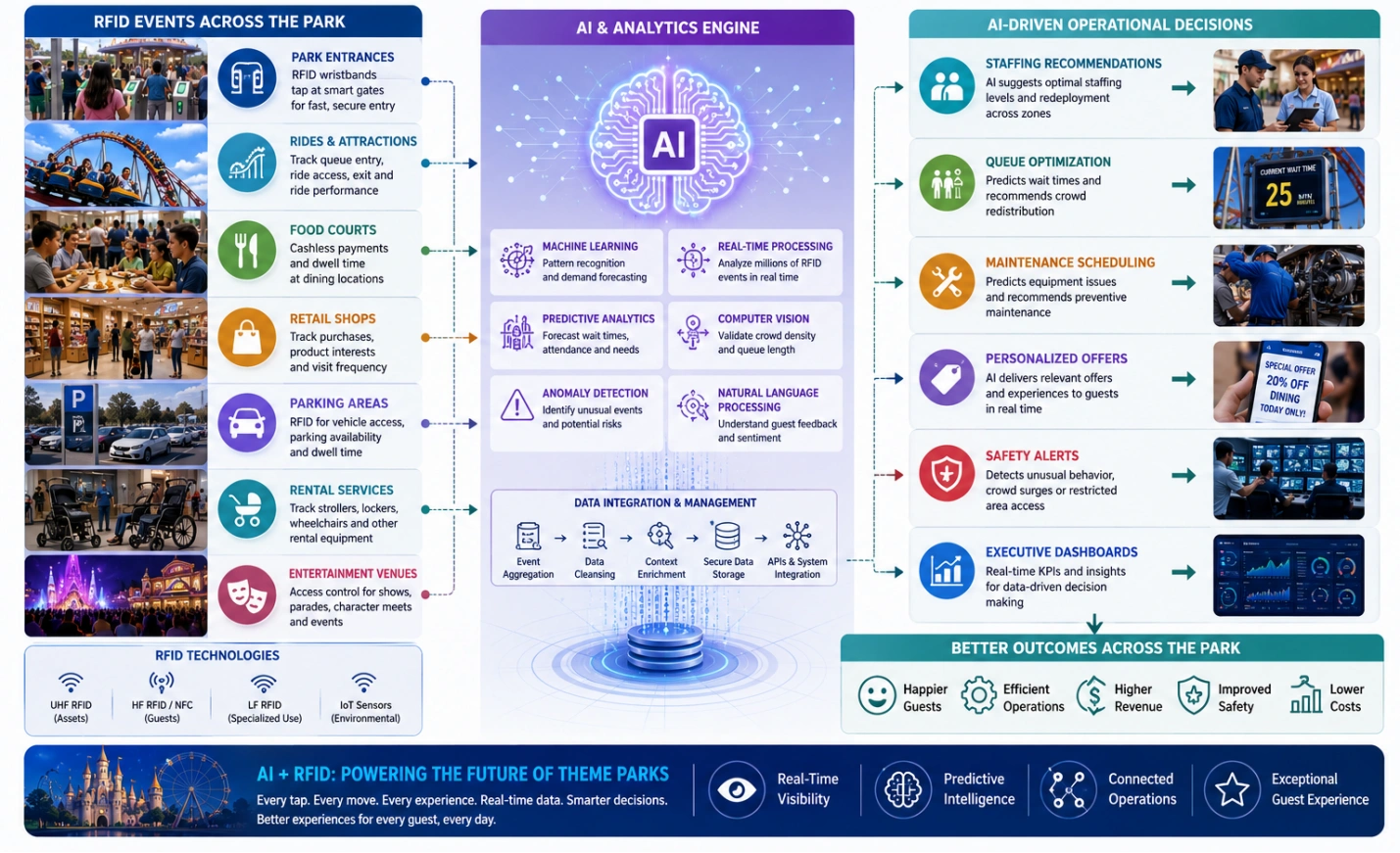
This infographic illustrates how RFID-generated data from theme park entrances, attractions, dining venues, retail stores, parking facilities, rental services, and entertainment venues flows into an AI analytics engine. The AI processes these real-time events to optimize staffing, predict queue times, schedule preventive maintenance, deliver personalized guest offers, generate safety alerts, and provide executive dashboards that improve operational efficiency and guest experiences.
Major AI Applications Enabled by RFID in Theme Parks
Intelligent Guest Access Management
RFID wristbands eliminate paper tickets while providing secure identification throughout the park.
AI analyzes entrance patterns to:
- Predict arrival surges
- Optimize gate staffing
- Detect fraudulent access
- Recommend additional security screening
- Balance entrance utilization
Dynamic admission management reduces bottlenecks while improving security.
AI Queue Management
Queue management remains one of the most important operational challenges for large attractions.
RFID continuously identifies guest entry into ride queues.
AI combines this information with:
- Ride throughput
- Historical attendance
- Weather forecasts
- Staff availability
- Ride performance
- Special event schedules
Machine learning predicts waiting times with increasing accuracy throughout the day.
Guests receive updated estimated wait times through mobile applications or digital displays, improving overall satisfaction while distributing visitors more evenly across attractions.
Personalized Guest Experiences
Artificial intelligence builds visitor preference profiles using RFID interactions collected throughout the park.
Examples include:
- Favorite ride categories
- Restaurant preferences
- Shopping habits
- Entertainment attendance
- Walking routes
- Attraction frequency
- Visit duration
These insights support personalized recommendations such as:
- Nearby attractions
- Dining suggestions
- Retail promotions
- Entertainment schedules
- Express ride opportunities
- Family activity recommendations
Personalization improves guest engagement without requiring constant manual interaction.
Ride Capacity Optimization
Every attraction has operational limits based on:
- Vehicle availability
- Dispatch intervals
- Safety inspections
- Staffing
- Maintenance schedules
- Weather conditions
AI evaluates RFID-based attendance alongside operational metrics to recommend:
- Additional ride operators
- Temporary attraction closures
- Queue redistribution
- Maintenance windows
- Express pass allocation
- Ride scheduling adjustments
These recommendations improve attraction utilization while maintaining safety requirements.
Asset Tracking
Large theme parks manage thousands of operational assets, including:
- Rental strollers
- Wheelchairs
- Maintenance tools
- Cleaning equipment
- Audio systems
- Event equipment
- Parade assets
- Food service carts
- Utility vehicles
- Spare ride components
RFID continuously identifies asset locations.
AI detects:
- Missing equipment
- Unauthorized movement
- Idle assets
- Utilization trends
- Maintenance requirements
- Replacement planning
Operational visibility reduces unnecessary equipment purchases while improving workforce productivity.
AI-Enabled RFID Guest Journey Across a Modern Theme Park
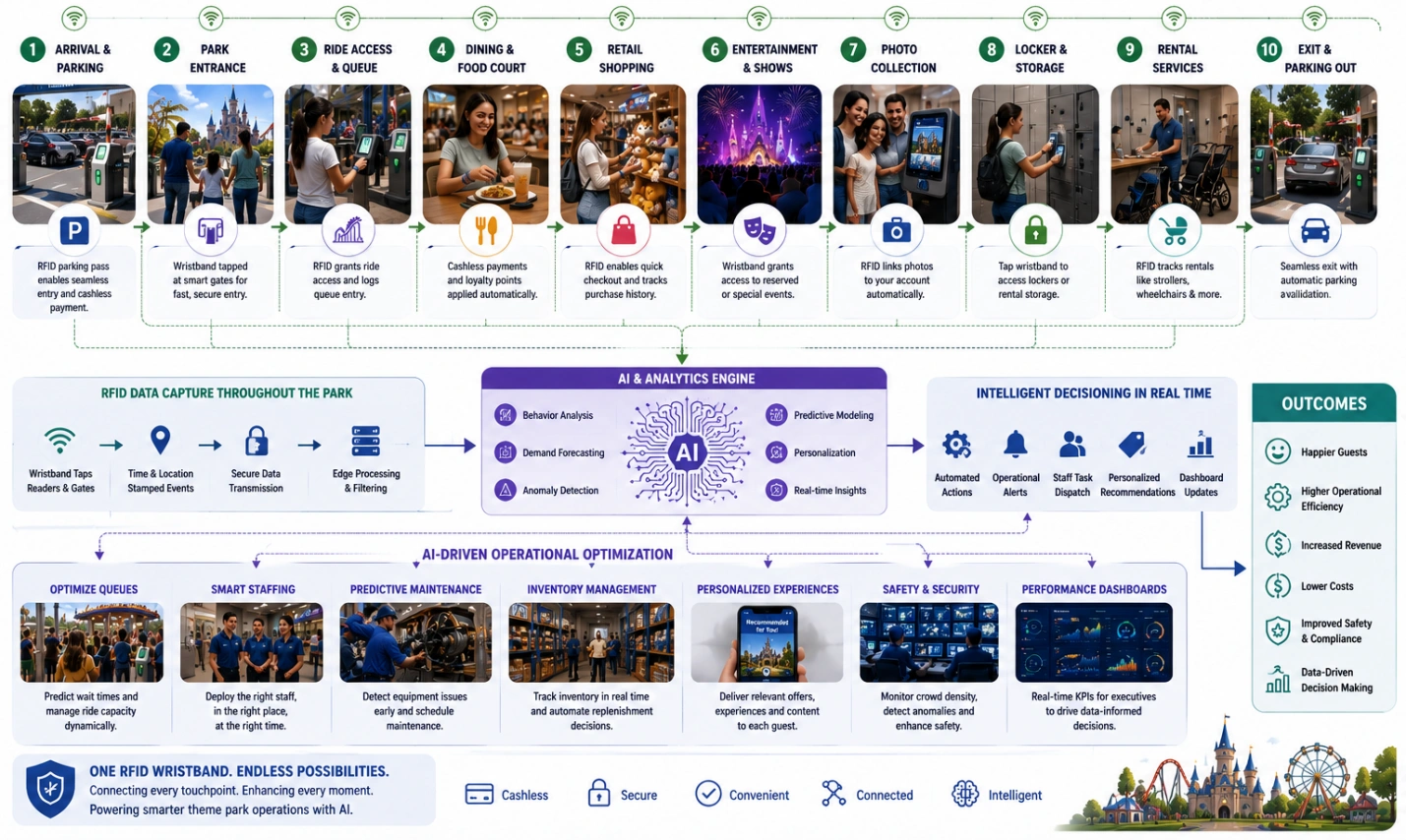
This workflow diagram illustrates the complete RFID-enabled guest journey through a modern theme park. It shows how RFID wristbands capture interactions at parking, park entrances, rides, dining locations, retail stores, entertainment venues, photo stations, lockers, rental services, and exit points. AI continuously analyzes these events to optimize queue management, staffing, predictive maintenance, personalized guest experiences, and executive decision-making.
Operational Workflow of an AI-Enabled RFID Theme Park System
Successful deployment depends on integrating identification technologies, operational software, AI analytics, and business processes into a coordinated solution.
A typical operational workflow begins when guests purchase digital tickets linked to RFID wristbands or smart cards. Identity information is securely stored within ticket management software before arrival. Upon entering the park, fixed RFID readers at admission gates authenticate credentials, record entry events, and synchronize guest information with operational databases.
Throughout the day, RFID readers positioned at ride entrances, restaurants, retail locations, rental stations, lockers, parking facilities, and event venues continuously capture interaction events. Mobile RFID readers used by operations teams supplement fixed infrastructure by locating maintenance equipment, rental assets, and high-value inventory across the park.
These identification events are transmitted through secure wired Ethernet, industrial Wi-Fi, or private cellular networks to edge servers or cloud-hosted software, where middleware filters duplicate reads, validates tag identities, associates events with operational contexts, and prepares structured datasets for AI processing.
Artificial intelligence then evaluates guest movement, ride utilization, crowd density, staffing levels, asset locations, and historical attendance patterns to generate predictive insights. Operational dashboards present recommendations to park managers, while automated business rules can trigger actions such as dispatching additional staff, adjusting queue strategies, scheduling preventive maintenance, or notifying security personnel of unusual activity.
The processed information also integrates with ticketing systems, customer relationship management software, point-of-sale systems, workforce management applications, maintenance management software, and business intelligence tools, creating a unified operational view that supports informed decision making across the entire theme park.
RFID Technology, AI Components, Software, Communications, and Deployment Considerations
An effective AI-enabled theme park solution depends on much more than RFID readers and tags. Reliable operation requires coordinated hardware, AI software, communications infrastructure, middleware, cybersecurity controls, and integration with existing hospitality systems. Each component contributes differently to operational intelligence and guest experience.
RFID Hardware
Theme parks typically deploy multiple RFID technologies depending on operational requirements.
- UHF RFID for asset tracking, maintenance equipment, inventory, uniforms, rental devices, and logistics
- HF RFID (including NFC) for guest wristbands, ticket validation, cashless payments, lockers, and interactive attractions
- LF RFID where short-range identification and environmental resilience are required
Supporting hardware includes:
- Fixed RFID readers
- Handheld RFID readers
- Smart RFID gates
- Embedded ride readers
- RFID antennas
- Industrial RFID printers
- Rugged RFID tags
- Wristbands
- Smart cards
- Equipment identification labels
GAO supplies RFID hardware designed for demanding environments where continuous operation, high read accuracy, and reliable performance are essential.
AI Software Components
Artificial intelligence transforms raw RFID events into operational intelligence using multiple analytical methods.
Common AI capabilities include:
- Machine learning for attendance forecasting
- Predictive analytics for ride demand
- Reinforcement learning for queue optimization
- Computer vision for crowd verification
- Natural language processing for guest support
- Recommendation engines for personalized experiences
- Anomaly detection for security monitoring
- Predictive maintenance models for attractions
- Workforce optimization algorithms
- Revenue forecasting models
Rather than replacing operational staff, AI augments decision making by identifying patterns too complex or too large for manual analysis.
Supporting Software Systems
AI-enabled RFID deployments integrate with a wide range of operational software commonly used in theme parks, including:
- Ticketing and admission management
- Customer relationship management (CRM)
- Point-of-sale (POS) systems
- Enterprise resource planning (ERP)
- Computerized maintenance management systems (CMMS)
- Workforce management software
- Digital signage systems
- Mobile guest applications
- Building management systems
- Geographic information systems (GIS)
- Business intelligence dashboards
- Incident management software
- Identity and access management systems
Middleware validates RFID events, removes duplicate reads, synchronizes timestamps, applies business rules, and distributes normalized data to downstream applications for AI analysis.
Communication Infrastructure
Reliable communications are essential because thousands of RFID transactions may occur every minute during peak attendance.
Common communication technologies include:
- Industrial Ethernet
- Wi-Fi 6 and Wi-Fi 6E
- Private 5G
- LTE
- Fiber backbones
- MQTT
- HTTPS
- REST APIs
- OPC UA where facility automation is integrated
- Message queuing services
- Secure VPN connectivity for remote administration
Communication redundancy minimizes operational disruption during network maintenance or localized failures.
Cloud Version
Cloud-hosted deployments are well suited for organizations seeking centralized management across multiple parks or geographically distributed entertainment properties.
Benefits include:
- Simplified software updates
- Elastic computing resources
- Centralized AI model training
- Remote operational visibility
- Disaster recovery
- Multi-site reporting
- Reduced infrastructure management
Cloud deployment is particularly advantageous for seasonal parks with fluctuating attendance because computing resources can scale according to operational demand.
Server Version
Server-based deployments operate on privately managed servers located within a theme park, private data center, or customer-controlled hosting facility.
Organizations often select this approach when requiring:
- Local processing of operational data
- Reduced network latency
- Greater administrative control
- Compliance with internal security policies
- Integration with legacy operational systems
- Continuous operation during external network interruptions
Many operators adopt hybrid deployments where edge servers process time-sensitive operational events while cloud resources perform long-term analytics and AI model training.
AI-Enabled RFID Solution Block Diagram for Intelligent Theme Park Operations
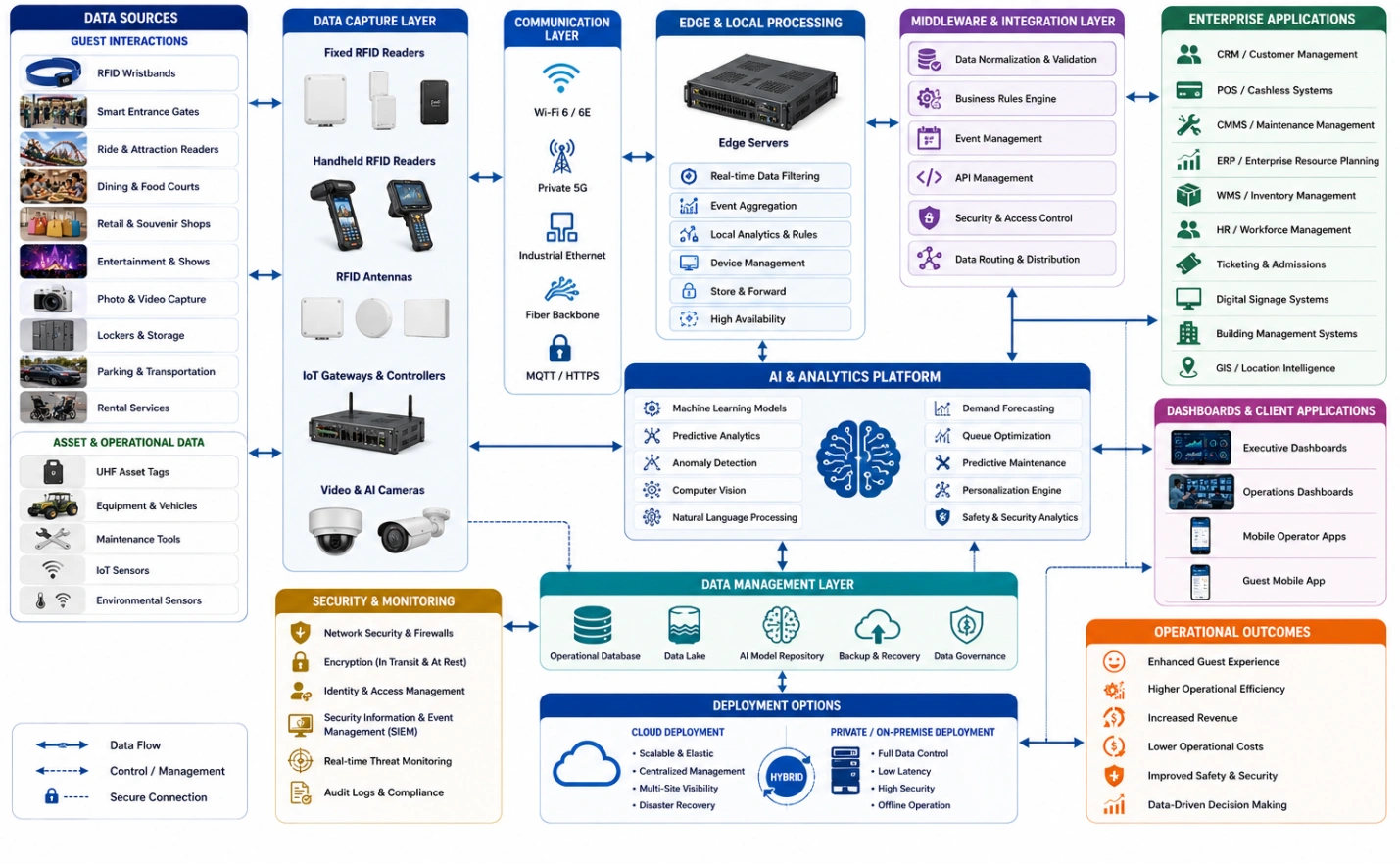
This block diagram illustrates the complete AI-enabled RFID solution for a modern theme park. It shows how RFID wristbands, UHF asset tags, fixed and handheld RFID readers, IoT devices, communication networks, edge servers, middleware, AI analytics, enterprise software, security systems, dashboards, and cloud or private server deployments work together to automate guest experiences, optimize operations, improve asset visibility, and support real-time decision-making.
Cybersecurity, Privacy, and Engineering Considerations
Because AI-driven theme park systems process guest identities, payment credentials, operational telemetry, and employee information, cybersecurity and privacy should be incorporated throughout the deployment lifecycle rather than added after implementation.
Recommended engineering practices include:
- Encrypt RFID communications where supported
- Implement TLS for network communications
- Use role-based access control
- Apply multi-factor authentication for administrative users
- Segment operational technology and business networks
- Maintain centralized audit logging
- Rotate encryption keys according to policy
- Secure API integrations with authentication tokens
- Continuously monitor for anomalous network behavior
- Validate firmware integrity before deployment
- Conduct periodic vulnerability assessments
- Implement redundant backup and disaster recovery procedures
Operational privacy should also address guest consent, data retention policies, and compliance with applicable regulations such as GDPR, CCPA, PCI DSS for payment processing, ISO/IEC 27001 information security practices, and regional privacy legislation where applicable.
Successful implementations also consider RF site surveys, reader placement, antenna orientation, tag selection, interference testing, ride-specific environmental conditions, and routine calibration to maintain consistent read accuracy.
Technical Capabilities and Business Benefits
Combining AI with RFID enables measurable operational improvements across the entire theme park.
Operational Improvements
- Faster guest admission
- Reduced ride waiting times
- Higher attraction throughput
- Improved workforce productivity
- Better equipment utilization
- Lower inventory losses
- Improved maintenance scheduling
- Reduced operational downtime
- Enhanced emergency response
- More accurate attendance forecasting
Business Benefits
- Increased guest satisfaction
- Higher repeat visitation
- Greater annual pass engagement
- Improved retail and food service revenue
- Lower operating costs
- Reduced capital expenditures on replacement assets
- Better resource allocation
- Improved decision making
- Stronger regulatory compliance
- Higher operational resilience
Scalability Advantages
AI-enabled RFID solutions can scale from a single attraction to large destination resorts with multiple parks, hotels, water parks, entertainment districts, and transportation systems. Modular deployment allows operators to expand functionality over time without replacing existing infrastructure.
Key Performance Indicators
Typical KPIs include:
- Guest satisfaction score
- Net Promoter Score (NPS)
- Average queue time
- Ride availability
- Attraction throughput
- Asset utilization rate
- Equipment loss rate
- Preventive maintenance compliance
- Workforce productivity
- Average retail transaction value
- Food service throughput
- Incident response time
- Revenue per guest
- Park capacity utilization
GAO has supported organizations throughout the United States and Canada by supplying RFID, BLE, and IoT hardware that enables reliable data collection for operational intelligence and AI-driven decision making.
Traditional Theme Park Operations vs. AI-Enabled RFID Operations
| Operational Area | Traditional (Manual) Operations | AI-Enabled RFID Operations |
|---|---|---|
| Admission & Entry | Manual ticket verification, paper tickets or QR codes, long queues, and limited visibility into guest flow. | RFID wristbands enable fast, contactless admission with real-time attendance tracking and automated capacity monitoring. |
| Queue Management | Static queues with limited visibility into wait times. Guests rely on posted estimates or staff updates. | AI analyzes RFID data to predict wait times, optimize queue distribution, and dynamically manage attraction capacity. |
| Maintenance | Reactive maintenance based on breakdowns or scheduled inspections, leading to unexpected downtime. | AI uses RFID and operational data to enable predictive maintenance, reducing downtime and extending ride life. |
| Asset Tracking | Manual inventories, spreadsheets, and visual inspections increase the risk of misplaced or lost assets. | RFID tags provide real-time asset visibility, automated inventory management, location tracking, and utilization analytics. |
| Staffing & Workforce | Staffing decisions are based primarily on historical trends and manual supervision. | AI forecasts visitor demand and recommends optimal staff allocation using real-time attendance and operational data. |
| Security & Safety | Manual patrols, CCTV monitoring, and delayed incident response limit situational awareness. | RFID and AI continuously monitor guest movement, detect anomalies, identify overcrowding, and support faster incident response. |
| Retail & Food Services | Separate POS systems with limited visibility into guest purchasing behavior and inventory. | RFID supports cashless transactions, loyalty integration, real-time inventory tracking, and AI-driven sales analytics. |
| Guest Personalization | Generic promotions and standardized experiences with limited understanding of visitor preferences. | AI analyzes RFID interactions to deliver personalized ride recommendations, dining suggestions, retail offers, and entertainment experiences. |
| Operational Analytics | Reporting is generated manually from multiple disconnected systems, delaying decision-making. | AI consolidates RFID data into real-time dashboards, predictive analytics, and operational insights for faster, data-driven decisions. |
| Overall Business Impact | Higher operating costs, longer queues, reactive maintenance, limited visibility, and lower guest satisfaction. | Improved operational efficiency, predictive decision-making, enhanced guest experiences, optimized resources, increased revenue, and stronger safety performance. |
This comparison table contrasts traditional manual theme park operations with AI-enabled RFID operations across key operational areas, demonstrating how artificial intelligence and RFID improve efficiency, guest experiences, security, maintenance, staffing, and data-driven decision-making.
Implementation Recommendations
Organizations planning AI-enabled RFID deployments should approach implementation in phased stages.
Recommended practices include:
- Define measurable operational objectives before selecting technology.
- Conduct comprehensive RF site surveys across attractions, retail areas, hotels, parking facilities, and maintenance zones.
- Select RFID tag types appropriate for each operational asset and guest application.
- Design network capacity for peak attendance rather than average daily traffic.
- Integrate RFID event data with ticketing, POS, CRM, CMMS, ERP, and business intelligence software early in the project.
- Establish cybersecurity, privacy, and governance policies before production deployment.
- Validate AI models using representative seasonal attendance patterns and special event scenarios.
- Train operations, maintenance, security, and guest services personnel on new workflows and decision-support tools.
- Monitor KPIs continuously and refine AI models as operational conditions evolve.
- Plan for future expansion to hotels, transportation systems, water parks, and adjacent entertainment venues through modular solution design.
With headquarters in New York City and Toronto, Canada, GAO is recognized among the leading global suppliers of RFID and BLE technologies for B2B and public-sector organizations. For more than three decades, GAO Group companies have supported Fortune 500 enterprises, leading research institutions, universities, and government agencies through sustained investment in research and development, rigorous quality assurance, and expert technical support delivered remotely and onsite.
Enabling the Next Generation of Intelligent Theme Parks
AI-powered theme park management supported by RFID technology enables operators to move from reactive operations to predictive, data-driven decision making. By combining intelligent identification, operational analytics, connected devices, and machine learning, theme parks can improve guest experiences, increase operational efficiency, strengthen security, optimize maintenance, and enhance financial performance.
RFID functions as the trusted source of operational data, while AI transforms that information into recommendations and automated actions that improve every stage of the guest journey. Careful planning, secure integration, phased deployment, and continuous optimization help ensure that these solutions deliver measurable long-term value.
Organizations evaluating AI-enabled theme park initiatives should prioritize business objectives, interoperability, cybersecurity, and scalable system design while selecting proven technology partners capable of supporting long-term operational growth.
End-to-End AI-Enabled RFID Lifecycle for Intelligent Theme Park Operations
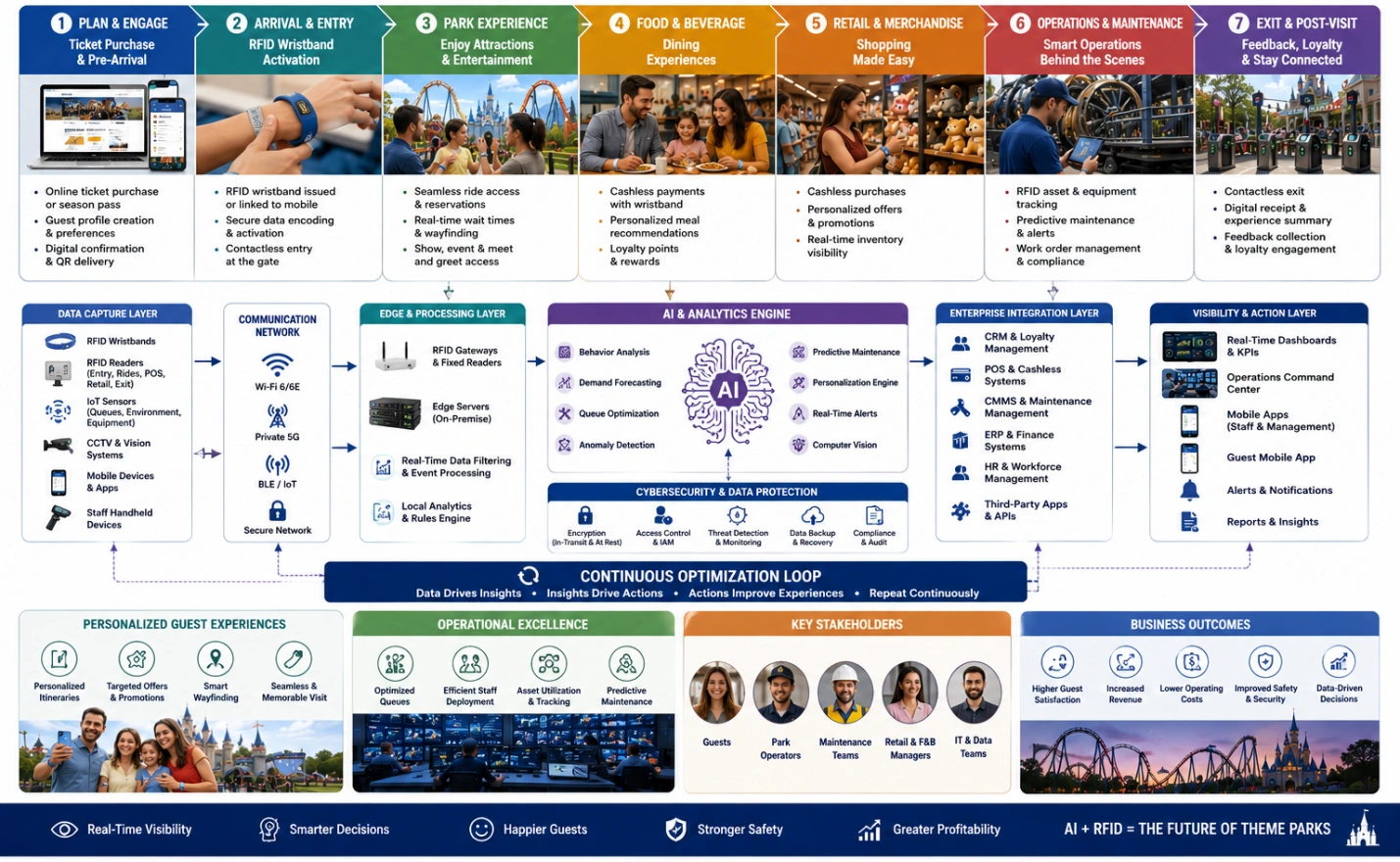
This enterprise infographic illustrates the complete lifecycle of an AI-enabled RFID solution for a modern theme park. It follows the guest journey from online ticket purchase and RFID wristband activation through park entry, attractions, dining, retail, maintenance, and post-visit engagement. The infographic also shows how RFID data flows through IoT sensors, communication networks, edge servers, AI analytics, cybersecurity, enterprise software integration, and operational dashboards to enable predictive maintenance, personalized guest experiences, real-time decision-making, and continuous operational optimization.
Building the Future of Industrial AI and IoT with Aperture Venture Studio and GAO
For more than three decades, GAO Group of Companies has invested extensively in the research and development of RFID, BLE, IoT, and related industrial technologies. As artificial intelligence has matured into a practical tool for operational intelligence, GAO has expanded its work in AI-enabled IoT solutions that help organizations modernize operations across industries, including hospitality and theme parks. To accelerate innovation and collaboration in these areas, we founded Aperture Venture Studio to help advance AI and IoT technologies that address emerging industry needs.
Aperture has attracted leading AI researchers, IoT engineers, operational executives, investors, and technology organizations committed to advancing intelligent connected systems. Through initiatives such as the Aperture Ventures Summit and TekSummit, we foster technical collaboration, knowledge sharing, and practical discussions on advanced AI and IoT applications. Together, these efforts have helped build diverse technical communities focused on the future of intelligent connected solutions. We welcome participation from advisors, co-founders, employees, investors, and customers interested in shaping the next generation of AI and IoT innovation.