
AI and RFID for Tire Manufacturing
AI-Driven Tire Manufacturing with RFID Traceability
Tire manufacturing requires continuous control of raw materials, compound batches, semi-finished components, green tires, curing processes, finished inventory, tooling, and production equipment. AI and IoT systems can connect these operational data sources to improve traceability, production visibility, quality management, maintenance, and material flow. RFID provides machine-readable identification for tires, material containers, molds, pallets, carts, and other production assets, while AI analyzes the resulting operational data to identify patterns, exceptions, delays, and quality risks.
For tire plants, the value comes from connecting physical production activities with digital production records. A tire can be associated with compound information, component preparation, building operations, curing conditions, inspection results, storage location, and shipment status. AI can then use this structured history for anomaly detection, process analysis, demand forecasting, maintenance planning, and operational decision support.
GAO supplies RFID, BLE, and IoT hardware products and systems that can support these applications, including identification and data-capture components used to connect physical manufacturing activities with software-based monitoring and analytics.
AI and RFID Enabled Tire Manufacturing Operations
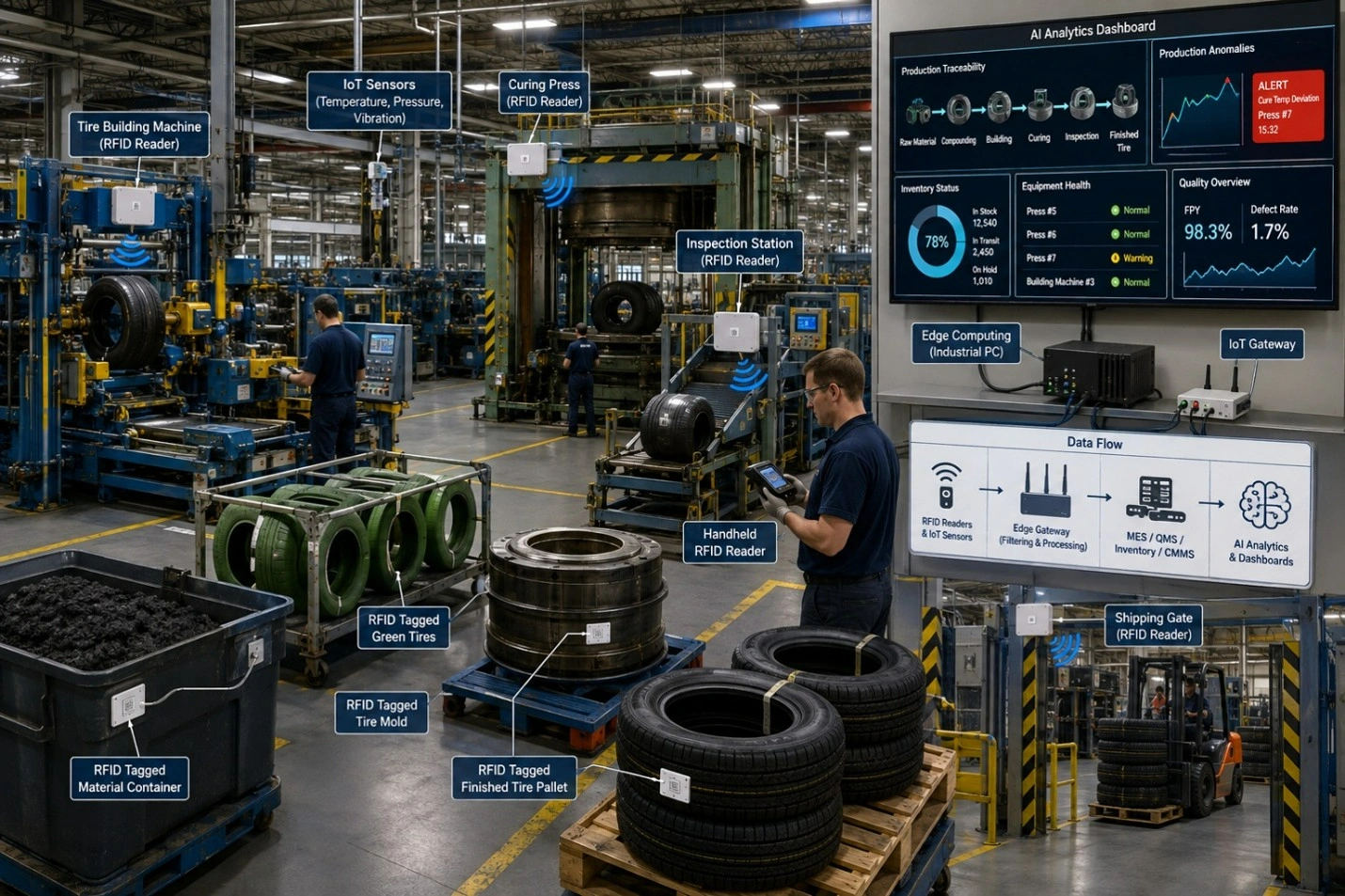
A modern tire manufacturing plant showing RFID-tagged materials, green tires, molds, pallets, fixed and handheld RFID readers, IoT sensors, edge computing, and an AI analytics dashboard. The visual illustrates how production and asset data can flow from factory operations into traceability, quality, inventory, and equipment-health analytics.
What AI and RFID Mean for Modern Tire Production
AI-enabled tire manufacturing focuses on using production data to improve decisions across the plant. RFID acts as an identification and data-capture mechanism within selected workflows, allowing software to associate physical objects with digital records.
For example, an RFID-tagged material container can provide an automated identity at a production checkpoint. The manufacturing system can associate that identity with a compound batch, material status, production order, or work center. Similar identification can be applied to reusable containers, pallets, carts, molds, tooling, and selected tire-related assets.
AI becomes more valuable when these records are combined with additional production information. Machine parameters, curing data, environmental measurements, inspection results, maintenance records, operator events, and manufacturing execution system data can provide context that RFID alone cannot provide.
Important relationships include:
- RFID identifies physical objects and provides event data when they pass defined read points.
- IoT sensors provide machine, environmental, energy, and equipment measurements.
- Edge computing can process selected production data close to manufacturing equipment.
- Middleware normalizes RFID and sensor events before sending them to business applications.
- AI models analyze historical and real-time data to identify patterns, anomalies, and operational risks.
- Manufacturing execution systems can associate production events with work orders and process records.
- Quality systems can correlate traceability information with inspection and nonconformance records.
- Maintenance systems can combine asset movement and machine-condition information with maintenance history.
- Inventory systems can use identification events to improve material and finished-goods visibility.
This combination is particularly relevant to tire plants because production involves multiple sequential processes. Material preparation, component production, tire building, curing, inspection, storage, and shipment generate large numbers of physical and digital events.
Where AI Applications Deliver Value in Tire Manufacturing
Raw Material and Compound Traceability
Rubber compounds and other tire-making materials require controlled identification and batch traceability. RFID can identify containers, bins, carts, or other reusable handling units where the physical configuration supports reliable tagging.
AI can analyze material movement and production records to detect unusual routing, delayed material consumption, discrepancies between planned and actual usage, or recurring production conditions associated with particular batches.
A practical implementation should establish exactly which physical object is being identified. Tagging a reusable material container may be more appropriate than attempting to identify loose material itself. The RFID event should then be linked to the corresponding material and batch record in manufacturing software.
Tire Building and Work-in-Process Tracking
Tire building involves multiple components and process stages before a green tire reaches curing. RFID can support identification of selected work-in-process carriers, pallets, production orders, or other trackable units.
AI can analyze cycle times, queue durations, routing deviations, and production sequence information. This can help manufacturing teams identify bottlenecks between component preparation and tire building, investigate recurring delays, and improve production scheduling.
A useful implementation does not attempt to make RFID responsible for every process measurement. Instead, RFID should identify the object or production unit while machine controllers, sensors, and manufacturing systems provide the process data associated with it.
Curing Press and Mold Management
Curing is one of the most important stages in tire production because green tires are transformed into finished tires through controlled heat, pressure, and time. Molds and curing-related tooling therefore represent valuable assets for identification and management.
RFID can support mold identification, movement tracking, storage management, and maintenance records when tag placement is engineered for the operating environment. High temperatures, metal surfaces, pressure, cleaning processes, and mechanical handling can influence RFID performance and tag selection.
AI can use mold history together with production and maintenance information to identify unusual utilization patterns, recurring process deviations, or maintenance conditions. This creates a more complete view of the relationship between tooling and production performance.
Quality Inspection and Traceability
Tire plants commonly perform multiple inspection and testing activities before products are released. RFID can associate a tire, carrier, pallet, or production record with inspection events when the physical identification method is compatible with the product and inspection process.
AI can then correlate inspection results with upstream production data. Instead of treating an inspection failure as an isolated event, analytics can examine relationships involving material batches, production equipment, process parameters, curing records, tooling, and production shifts.
This approach can support earlier investigation of recurring quality patterns. It should not replace established quality procedures or validated inspection equipment. AI outputs should remain subject to appropriate engineering and quality controls.
Finished Tire Inventory and Internal Logistics
Finished tires move through staging, storage, picking, and shipping processes. RFID can improve visibility of tagged tires, pallets, racks, carts, or other logistics units when read performance has been validated for the physical environment.
AI can use inventory movement records to identify unusual dwell times, bottlenecks, inventory discrepancies, or inefficient movement patterns. Production and logistics teams can use these insights to improve staging decisions and reduce unnecessary handling.
GAO’s RFID and IoT hardware can be considered as part of a broader identification and data-capture system, with the appropriate reader, antenna, tag, gateway, and software configuration selected according to the plant’s operating conditions.
RFID and AI Workflow for Tire Manufacturing Traceability
The completed workflow shows nine tire manufacturing stages, from raw material and compound preparation through shipment, with RFID checkpoints connecting physical production events to edge processing, middleware, MES, inventory, quality, maintenance, ERP, and AI analytics. The AI layer identifies anomalies, bottlenecks, traceability relationships, quality correlations, and predictive-maintenance opportunities.
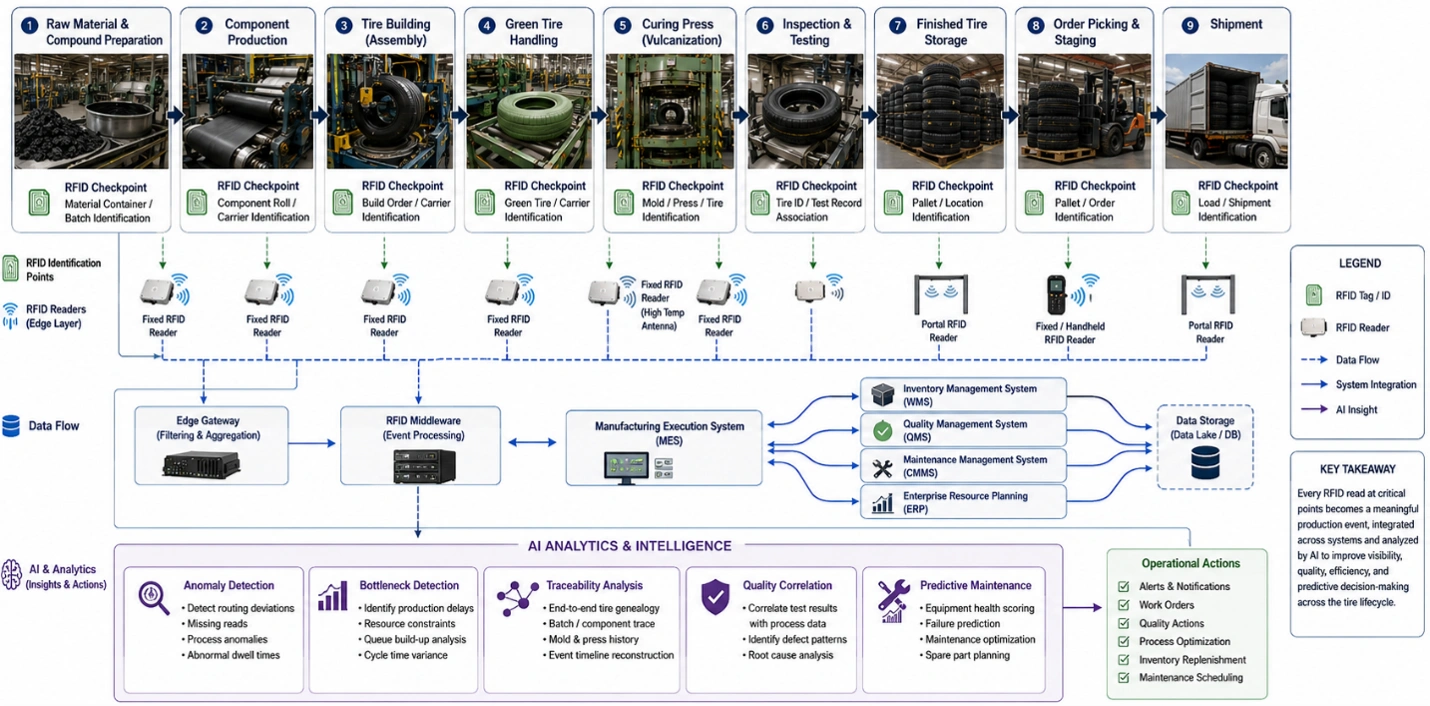
Tire Manufacturing Data Flow from RFID Events to AI Decisions
A practical AI and RFID solution begins with physical event capture and ends with an operational decision. The complete workflow should be designed around the manufacturing process rather than around the technology alone.
Data Acquisition
RFID readers capture tag identifiers at defined locations. Depending on the application, readers may be fixed, portal-based, conveyor-mounted, handheld, or integrated into production checkpoints. RFID events can be combined with barcode scans, machine data, PLC signals, industrial sensors, inspection systems, and operator inputs.
Tag selection is critical. Tire manufacturing can expose identification hardware to rubber processing areas, heat, metal, chemicals, vibration, cleaning processes, and mechanical handling. The tag, mounting method, reader configuration, and antenna position should therefore be validated through site testing.
Communication and Edge Processing
Reader data can travel through industrial Ethernet, Wi-Fi, or other appropriate plant communication infrastructure to an edge computer, gateway, or server. Edge processing can filter duplicate reads, validate event sequences, associate readers with locations, and reduce unnecessary transmission of raw events.
For time-sensitive workflows, local processing can also provide faster responses to abnormal events or routing conditions.
Middleware and Data Normalization
RFID readers do not automatically understand the complete manufacturing meaning of an event. Middleware can transform raw tag reads into operational events such as material arrival, mold movement, carrier transfer, inventory receipt, or production checkpoint completion.
This normalized information can then be mapped to production orders, batches, equipment identifiers, tire records, or logistics records.
AI Analytics
AI models can operate on historical and real-time manufacturing data. Depending on the application, techniques can include anomaly detection, classification, regression, forecasting, clustering, optimization, and machine learning-based predictive models.
For example, an anomaly detection model could identify an unusual combination of production delay, equipment condition, material movement, and inspection results. A forecasting model could estimate inventory requirements or expected production throughput. A predictive maintenance model could combine machine-condition data with equipment history to estimate maintenance risk.
Business and Operational Actions
The final output should support a measurable manufacturing decision. Examples include:
- Investigating an abnormal production route.
- Reviewing a material or compound batch.
- Checking a mold or tooling record.
- Escalating a suspected equipment issue.
- Replenishing production material.
- Adjusting internal logistics priorities.
- Investigating inspection failures.
- Reviewing production bottlenecks.
- Updating maintenance priorities.
- Supporting finished-goods inventory reconciliation.
This data-to-decision chain is important because AI analytics should be connected to defined operational actions and KPIs rather than implemented as an isolated dashboard.
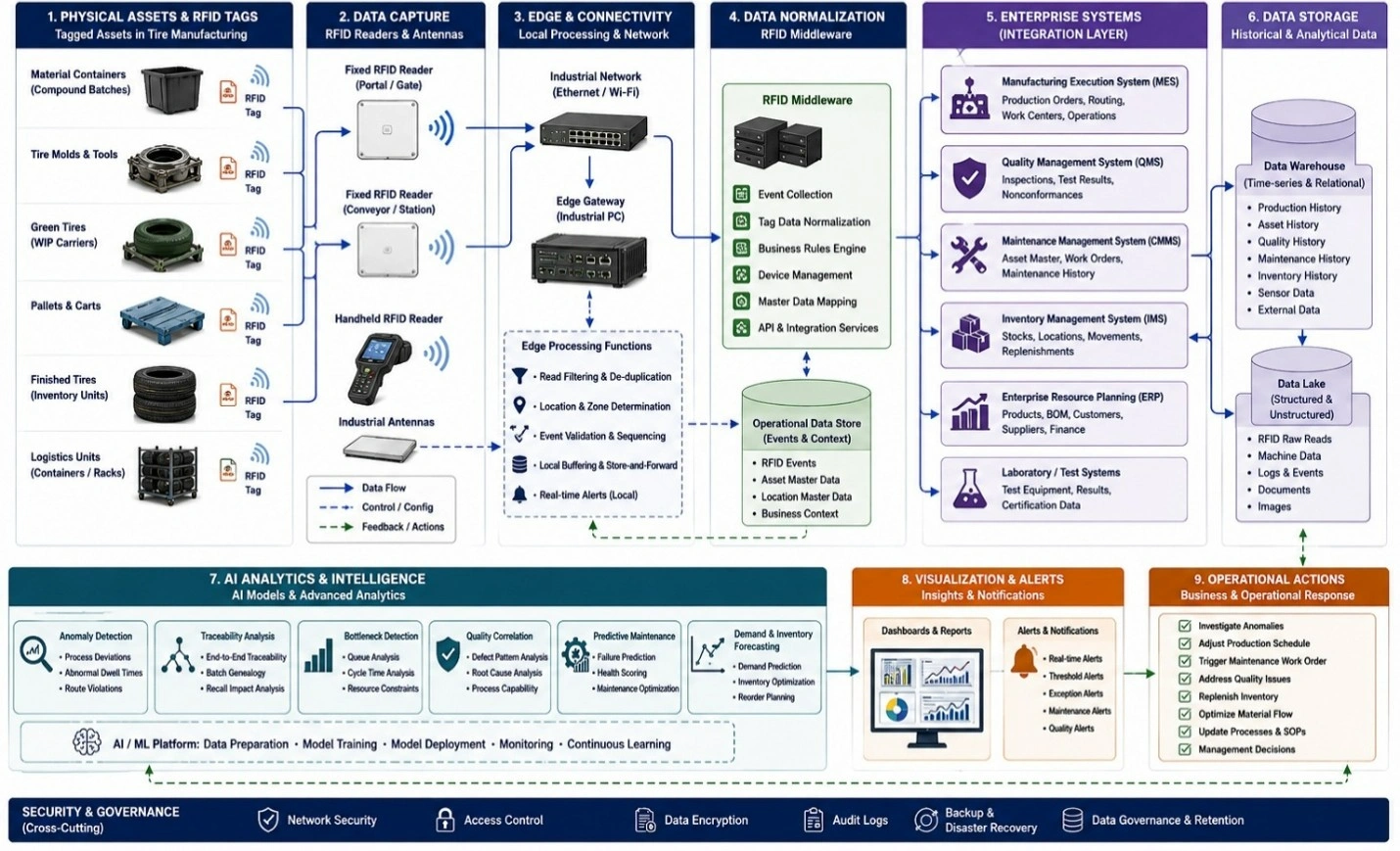
Tire Manufacturing RFID Data Flow to AI Analytics
The completed diagram shows the end-to-end flow from RFID-tagged tire manufacturing assets through fixed and handheld readers, industrial networks, edge processing, RFID middleware, manufacturing and enterprise systems, data storage, AI analytics, dashboards, alerts, and operational actions. Security and governance controls are shown across the complete data flow.
RFID Hardware and AI Software for Tire Plants
The appropriate technology configuration depends on the physical environment, read distance, material composition, process temperature, tag placement, required identification speed, and integration requirements. Tire manufacturing should therefore use application-specific engineering rather than a single RFID configuration across every process.
UHF RFID for Plant-Level Identification
UHF RFID is generally suited to longer-range identification applications where multiple tagged objects must be detected without direct line of sight. Potential tire manufacturing applications include pallet movement, finished-goods logistics, reusable container tracking, material handling, and selected work-in-process workflows.
Metallic equipment and dense industrial environments can affect RF performance. Antenna orientation, reader power, tag characteristics, mounting position, and reader placement should therefore be validated through an RFID site survey and pilot test.
HF and LF RFID for Specialized Identification
HF RFID can be useful for shorter-range identification applications where controlled read zones and proximity-based interaction are desirable. LF RFID can support certain specialized identification requirements where its characteristics match the application.
The choice between UHF, HF, and LF should be based on the physical workflow and required read behavior rather than simply selecting the technology with the longest read range.
Industrial Sensors and Edge Computing
RFID provides identity information, but tire manufacturing also requires process information. Industrial sensors can capture temperature, vibration, pressure, energy consumption, environmental conditions, and equipment status.
Edge computing can combine these measurements with RFID events to create richer operational records. For example, a tooling movement event becomes more useful when it can be associated with production utilization, maintenance history, and process conditions.
Manufacturing and Enterprise Software Integration
RFID data may need to integrate with manufacturing execution systems, enterprise resource planning systems, warehouse or inventory applications, computerized maintenance management systems, quality management systems, databases, and analytics software.
Application programming interfaces, message brokers, industrial communication protocols, or middleware can be used according to the existing plant environment.
GAO can support organizations evaluating RFID and IoT hardware and system requirements as part of a broader manufacturing digitization initiative, with implementation decisions based on the customer’s workflows, equipment, operating environment, and integration requirements.
Visualizing a Real Tire Plant RFID Deployment
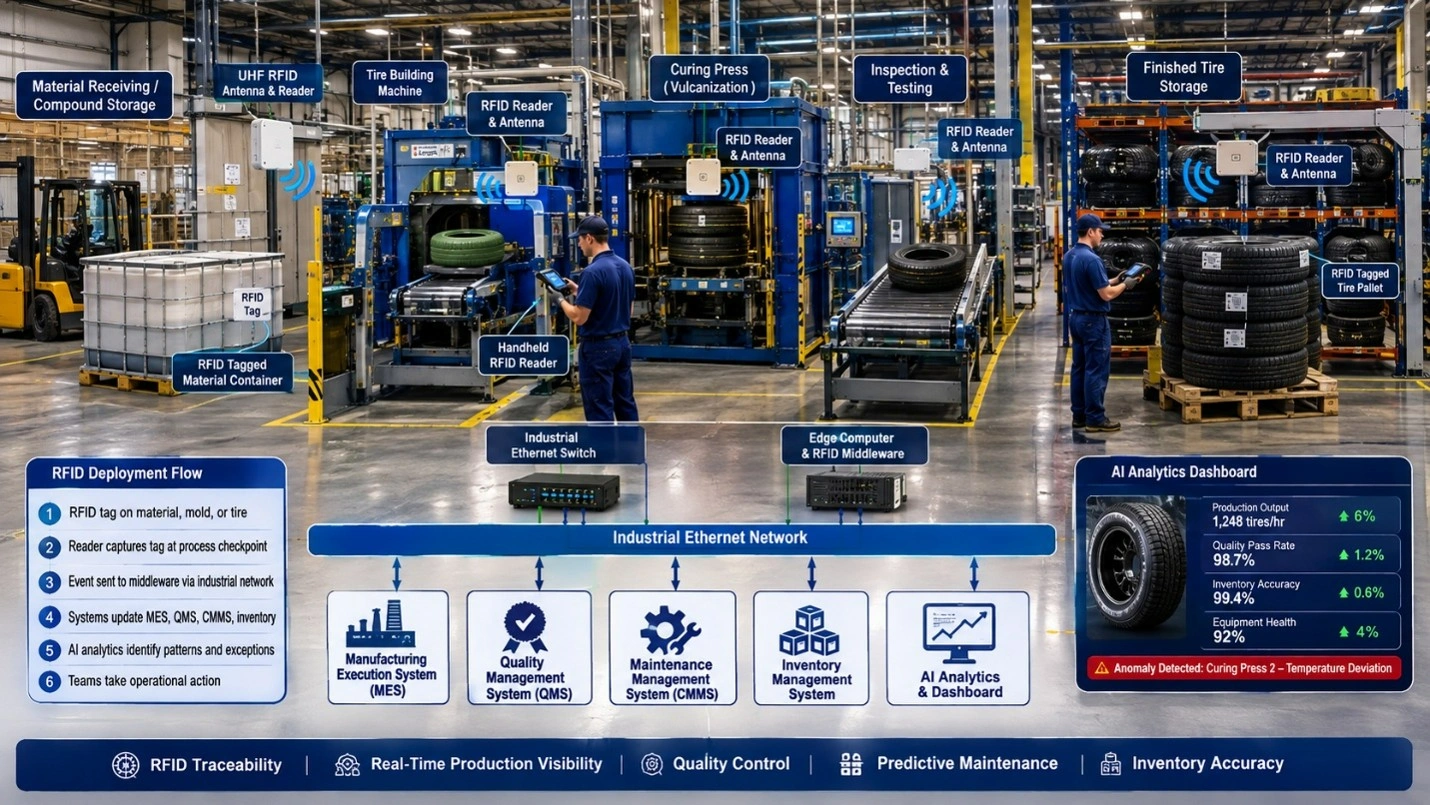
Real-World RFID Deployment in a Tire Manufacturing Plant
The completed deployment scene shows RFID read zones across material handling, tire building, curing, inspection, finished-tire storage, and shipment. It includes tagged materials and pallets, RFID readers and antennas, an industrial IoT network, edge computing, middleware, MES, QMS, inventory and maintenance systems, and AI analytics.
Cloud and Server Deployment for Tire Manufacturing
Tire manufacturers can deploy AI and RFID software using either cloud-hosted services or privately hosted server infrastructure. The appropriate model depends on plant connectivity, data governance, cybersecurity requirements, latency, existing IT systems, and the desired operating model.
Cloud Version
A cloud-hosted deployment can centralize data from RFID readers, IoT gateways, manufacturing systems, and multiple production facilities. This can be useful for organizations operating several tire plants that need consistent analytics, centralized reporting, and cross-site production visibility.
Cloud deployment can also simplify infrastructure scaling because computing and storage resources can be expanded according to data volumes. AI model development and centralized analytics may benefit from access to larger computing resources.
However, cloud connectivity should not be treated as a substitute for local industrial controls. Production-critical functions should continue to operate safely when external connectivity is interrupted. Edge processing can retain essential event handling and local decision logic while synchronizing appropriate information with cloud systems.
Server Version
A server deployment can place RFID middleware, databases, analytics software, and AI services on factory servers, privately managed infrastructure, edge servers, or private data centers. This model can be appropriate where manufacturing data must remain within controlled infrastructure or where plant connectivity is limited.
Server-based deployment can also reduce dependence on external network connectivity for applications that require local processing. Organizations may retain greater control over software configuration, data storage, network segmentation, and integration with existing manufacturing systems.
The trade-off is that the organization or its service provider may have greater responsibility for server maintenance, backup, monitoring, patching, redundancy, and capacity planning.
Selecting the Deployment Model
A tire manufacturer should evaluate the deployment model against operational requirements rather than selecting cloud or server infrastructure as a purely IT preference.
- Use cloud deployment when centralized multi-plant analytics, scalable computing, and shared reporting are major priorities.
- Use private server deployment when data control, local processing, existing factory infrastructure, or connectivity constraints are important.
- Use a hybrid model when local RFID event processing and production operations require edge or factory infrastructure while enterprise analytics are centralized.
- Maintain local buffering and recovery mechanisms for RFID events so temporary network interruptions do not automatically create traceability gaps.
- Segment RFID and IoT infrastructure from safety-critical control networks unless integration has been specifically engineered and validated.
Technical and Operational Benefits for Tire Manufacturing
Combining AI with RFID-based identification can improve manufacturing performance because the two technologies address different parts of the information problem. RFID provides physical identity and movement events, while AI can interpret those events together with production, machine, quality, and logistics information.
Stronger Production Traceability
A traceability system can associate production records with identifiable material containers, carriers, tooling, molds, production orders, and logistics units.
This can reduce reliance on manual recording and improve the ability to reconstruct production history during quality investigations.
For tire manufacturing, traceability becomes especially valuable when engineers need to investigate relationships among material batches, production equipment, curing operations, inspection outcomes, and finished-product movement.
Better Work-in-Process Visibility
RFID events can provide automatic indications that a tagged object has entered or left a defined production area. AI can analyze these events to identify abnormal dwell times, routing deviations, or recurring process delays.
Production managers can therefore move from manually asking where an item is to analyzing why a particular production flow is repeatedly delayed.
Improved Inventory Accuracy
Material containers, pallets, carts, and finished-goods handling units can be tracked through defined RFID checkpoints. AI can compare expected movement against observed movement and identify discrepancies.
This can help reduce time spent searching for materials or reconciling inventory records manually.
Predictive Maintenance Support
Maintenance teams can combine equipment sensor data, maintenance history, production utilization, and RFID-based asset movement information.
AI models can identify patterns that indicate increasing maintenance risk. For example, unusual equipment utilization combined with changing vibration or temperature measurements may justify inspection before a failure interrupts production.
RFID itself does not predict equipment failure. Its value is in providing reliable asset identity and contextual event information that can be combined with condition-monitoring data.
Quality Investigation and Root-Cause Analysis
Quality engineers can benefit from connecting inspection results with upstream production records.
An AI system can search for relationships between nonconforming products and variables such as material batches, production equipment, molds, production periods, machine parameters, or routing events.
Such analytics can prioritize investigations, but engineering teams should validate suspected causes using established quality procedures and controlled process investigations.
Reduced Manual Data Entry
Automated identification can reduce repetitive scanning and manual recordkeeping at selected process points. This can improve data consistency and allow operators to focus on production tasks.
The greatest benefit normally comes from eliminating specific high-frequency manual transactions rather than attempting to automate every activity.
Multi-Plant Scalability
A standardized identification and data model can allow multiple tire plants to report comparable operational events.
A central analytics environment can then compare production performance, inventory movement, asset utilization, quality patterns, and maintenance indicators across facilities while retaining plant-specific operating rules.
AI and RFID Benefits for Tire Manufacturing
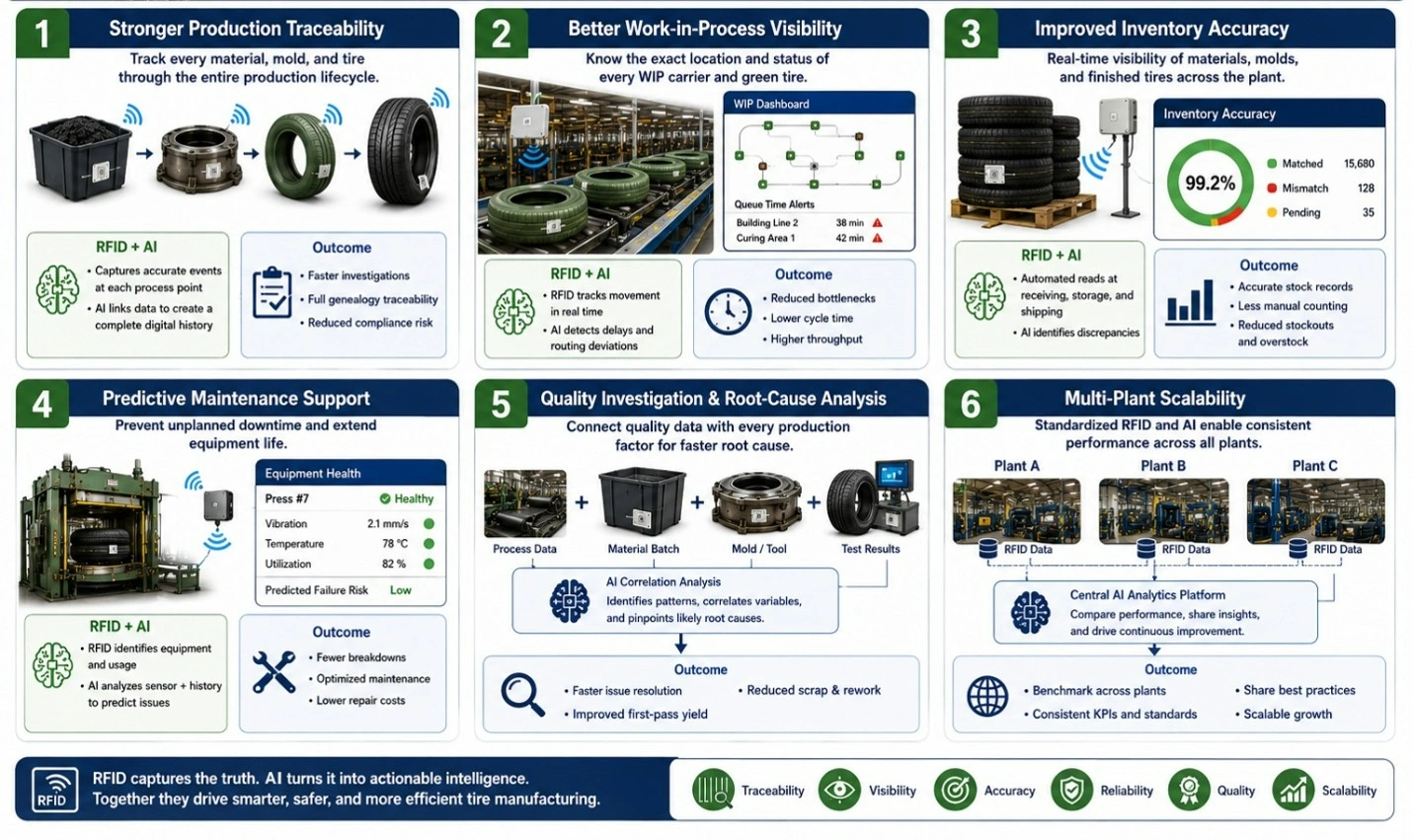
The completed infographic presents six tire-manufacturing benefits: stronger production traceability, improved work-in-process visibility, inventory accuracy, predictive maintenance support, quality investigation and root-cause analysis, and multi-plant scalability. It shows how RFID captures production events while AI converts the data into actionable operational insights.
Engineering Considerations Before Deployment
Successful deployment depends more on workflow engineering and validation than on reader installation alone.
Define the Identification Object
The first question should be what needs to be identified. Possible objects include:
- Material containers
- Compound batches
- Work-in-process carriers
- Green tire handling units
- Tire molds
- Production tooling
- Maintenance assets
- Pallets
- Carts
- Finished-goods units
The object should have a stable identity and a clearly defined relationship with the manufacturing information system.
Conduct an RFID Site Survey
RF behavior can change significantly around metal machinery, conveyors, storage racks, curing equipment, electrical infrastructure, and other industrial objects.
A site survey should identify reader locations, antenna orientation, expected read zones, tag mounting surfaces, interference sources, network availability, and areas where unwanted reads could occur.
The objective is not simply to achieve maximum read range. The objective is to achieve reliable and controlled reads at the correct process location.
Validate Tags in the Actual Environment
Laboratory specifications are not sufficient for industrial deployment. Tags should be tested on the actual material, container, tooling, pallet, or equipment where they will be installed.
Testing should consider:
- Metal proximity
- Rubber and composite materials
- Temperature exposure
- Cleaning procedures
- Mechanical impact
- Vibration
- Required read distance
- Tag orientation
- Reader power
- Antenna polarization
- Read-zone density
- Expected tag population
Establish Event Rules
A raw RFID read is not necessarily a meaningful manufacturing event. Software should determine how multiple reads become an operational transaction.
For example, several consecutive reads from the same tag should not necessarily create multiple material-arrival transactions. Middleware can apply filtering, timing, location, and sequence rules before generating the final event.
Integrate with Existing Systems
The RFID system should complement existing manufacturing software rather than create a disconnected database.
Relevant integrations may include:
- Manufacturing execution systems
- Enterprise resource planning software
- Quality management systems
- Computerized maintenance management systems
- Warehouse and inventory systems
- Production databases
- Laboratory information systems
- Industrial control and monitoring systems
- Business intelligence and analytics software
Establish Cybersecurity Controls
RFID readers, gateways, edge computers, servers, and cloud services become part of the plant’s connected technology environment.
Security controls should include network segmentation, identity and access management, secure configuration, software patching, encryption where appropriate, logging, backup procedures, endpoint protection, and controlled remote access.
Cybersecurity design should also distinguish manufacturing data systems from safety-critical industrial control systems.
Secure AI and RFID Integration for Tire Manufacturing
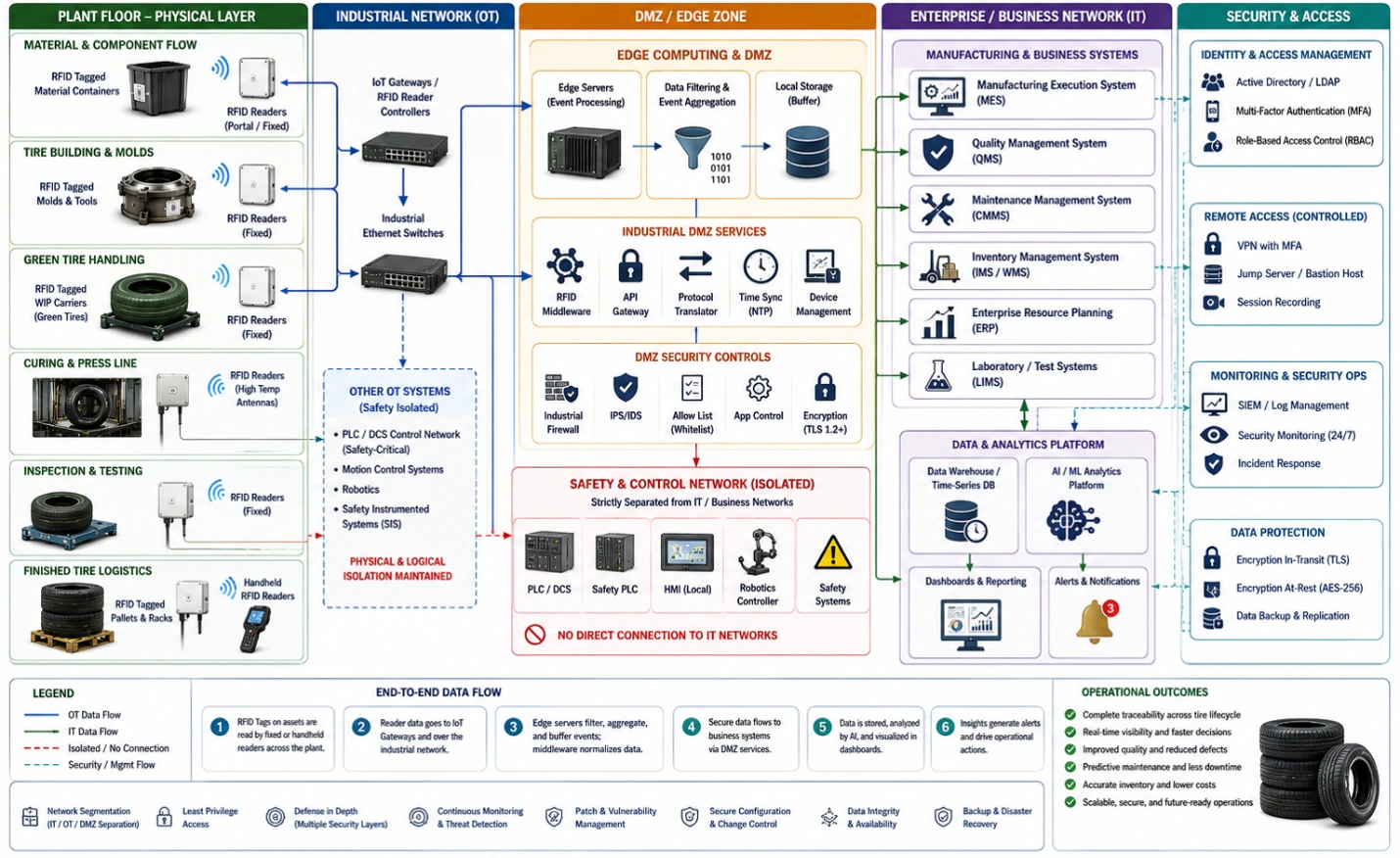
The completed architecture diagram shows segmented tire manufacturing layers from RFID-tagged materials, molds, WIP carriers, curing, inspection, and finished-tire logistics through industrial OT networks, edge computing, an industrial DMZ, enterprise systems, AI analytics, and security operations. It highlights firewalls, access controls, encryption, monitoring, isolated safety systems, and controlled remote access.
Tire Manufacturing KPIs for AI and RFID Projects
Technology deployment should be evaluated using manufacturing outcomes rather than reader counts or tag counts alone. Appropriate KPIs depend on the workflow selected for automation.
Relevant measures can include:
- Material traceability completeness
- Work-in-process location accuracy
- Inventory record accuracy
- Production cycle time
- Queue or dwell time
- Material search time
- Production throughput
- Asset utilization
- Mold utilization
- Maintenance-related downtime
- Mean time between failures
- Mean time to repair
- Quality defect rate
- First-pass yield
- Scrap or rework rate
- Traceability investigation time
- RFID read accuracy
- RFID event-processing latency
- Manual transaction reduction
- Finished-goods reconciliation accuracy
Baseline measurements should be collected before deployment where practical. Otherwise, it becomes difficult to determine whether improvements are actually attributable to the new system.
AI and RFID Tire Manufacturing KPI Dashboard
The completed dashboard displays tire manufacturing performance through production throughput, work-in-process dwell time, material traceability completeness, inventory accuracy, RFID read accuracy, mold utilization, maintenance downtime, first-pass yield, defect rate, and traceability investigation time. It also includes production trends, RFID zone performance, active alerts, exceptions, and AI-generated operational insights.
Implementation Roadmap for Tire Manufacturing
A phased deployment reduces technical and operational risk. The first deployment should normally target a workflow where identification creates a measurable operational improvement.
Assessment and Workflow Selection
Document material flows, production checkpoints, asset movements, existing data systems, manual transactions, and quality or maintenance problems.
Select a use case with a clear business objective and measurable baseline.
RFID Site Survey and Hardware Testing
Evaluate tag technologies, reader types, antennas, mounting methods, network infrastructure, and environmental conditions.
Perform controlled tests around actual tire manufacturing equipment before committing to plant-wide deployment.
Pilot Deployment
Implement the selected workflow in a limited production area. Measure read reliability, false reads, event latency, operator interaction, system availability, and data quality.
Software Integration and AI Validation
Connect RFID events to manufacturing and business systems. Validate event rules and data relationships before training or deploying AI models.
AI models should be tested against historical and operational data and evaluated using appropriate performance measures.
Production Commissioning
After technical and operational acceptance testing, expand the solution to production use. Establish monitoring, support procedures, backups, cybersecurity controls, and maintenance responsibilities.
Optimization and Expansion
Use measured results to improve reader placement, tag selection, event rules, AI models, dashboards, and workflow procedures.
Additional use cases can then be added, such as mold tracking, maintenance asset visibility, finished-tire logistics, material traceability, or quality investigation.
AI and RFID Tire Manufacturing Implementation Roadmap
The completed roadmap illustrates six deployment phases: operational assessment and workflow selection, RFID site survey and tag testing, pilot deployment, software integration and AI validation, production commissioning, and optimization with multi-workflow expansion. It also highlights manufacturing use cases, deliverables, validation gates, KPI baselines, cybersecurity, training, and continuous improvement.
Practical Recommendations for Tire Manufacturers
The strongest implementations begin with a specific manufacturing problem rather than a technology purchase. A tire manufacturer considering AI and RFID should first identify where missing traceability, manual transactions, poor asset visibility, production delays, inventory discrepancies, or recurring quality investigations create measurable cost or operational risk.
Recommended practices include:
- Start with one well-defined manufacturing workflow and measurable KPIs.
- Select RFID tags according to the actual physical environment.
- Test tag performance on real tire plant materials and equipment.
- Treat RFID reads as operational events that require software validation.
- Combine RFID identity data with machine, quality, maintenance, and production information.
- Use edge processing where local response or connectivity resilience is important.
- Choose cloud, server, or hybrid deployment according to plant requirements.
- Design cybersecurity controls before connecting new devices to production networks.
- Establish data ownership, retention, and access policies.
- Validate AI recommendations against engineering and quality procedures.
- Train operators and maintenance personnel on the new workflow.
- Expand only after the pilot demonstrates measurable operational value.
GAO can support tire manufacturers and system integrators with RFID, BLE, and IoT hardware products and technical solutions used for industrial identification, monitoring, and connected workflows. Its experience serving organizations in the United States and Canada includes work involving Fortune 500 companies, research organizations, universities, and government agencies, supported by product R&D and remote or onsite technical assistance.
Conclusion: Building an AI-Enabled Tire Manufacturing Operation
AI and RFID can provide tire manufacturers with a practical route toward stronger traceability, production visibility, inventory control, quality investigation, asset management, and predictive maintenance support. RFID identifies physical objects and captures movement events, while AI adds analytical capabilities by connecting those events with production, equipment, quality, and operational data.
The most effective implementation is not necessarily the one with the largest number of tags or readers. It is the system that solves a clearly defined manufacturing problem, produces trustworthy data, integrates with existing production software, and generates measurable improvements.
Manufacturers should begin with workflow assessment, site testing, controlled deployment, cybersecurity validation, KPI baselining, and operational acceptance before scaling to additional production processes.
Building the Future of Industrial AI and IoT with Aperture Venture Studio and GAO RFID Inc.
For more than three decades, GAO Group of Companies has invested heavily in R&D for industrial RFID, BLE, and IoT. As AI has become increasingly useful in industrial applications, we have continued developing AI and IoT solutions, including technologies relevant to connected tire manufacturing, and founded Aperture Venture Studio to build, launch, and scale next-generation AI and IoT companies for various industries.
Aperture has attracted AI and IoT technical experts, entrepreneurial and operational executives, investors, and leading companies. We have also developed the Aperture Ventures Summit and TekSummit to discuss advanced AI and IoT topics.
We welcome you to join us as:
- Advisors, co-founders, or employees
- Investors
- Customers
For tire manufacturers evaluating AI-enabled traceability, connected production, industrial IoT, or RFID-based identification, GAO can provide technical information and support for evaluating suitable hardware products and system approaches.
Technology Selection Decision Tree for Tire Manufacturing
Short Description:
The completed decision tree guides tire manufacturers from the primary operational problem—such as traceability, WIP tracking, tooling, inventory, quality, monitoring, maintenance, or inspection—through data requirements, read range, asset materials, environmental conditions, real-time needs, system integration, and AI requirements to appropriate combinations of RFID, BLE, IoT sensors, computer vision, edge AI, and machine learning.
Alt Text:
Tire manufacturing decision tree selecting RFID, IoT, AI, and vision technologies for traceability, monitoring, and inspection.