
AI and RFID for Transmission Manufacturing
Why AI-Powered Manufacturing Visibility Matters in Transmission Manufacturing
Transmission production involves hundreds of precision-engineered components that must be assembled according to exact specifications. A single missing bearing, incorrectly matched gear set, improperly calibrated torque wrench, or delayed material replenishment event can affect production throughput and product quality.
Common transmission manufacturing challenges include:
- Component traceability across multiple production stages
- Work-in-process inventory visibility gaps
- Tool lifecycle management complexity
- Production bottlenecks within assembly cells
- Unplanned CNC machine downtime
- Gear machining quality deviations
- Torque verification inconsistencies
- Automated guided vehicle coordination issues
- Supplier material synchronization challenges
- End-of-line testing failures
- Recall investigation complexity
- Spare parts inventory optimization
AI-driven manufacturing intelligence supported by RFID-generated operational data helps identify patterns, predict disruptions, and automate decision-making processes before problems impact production schedules.
GAO has supplied RFID and industrial IoT solutions to organizations seeking improved operational visibility, helping manufacturers establish reliable data collection foundations necessary for advanced AI initiatives.
AI-Enabled RFID Transmission Manufacturing Workflow and Real-Time Production Intelligence
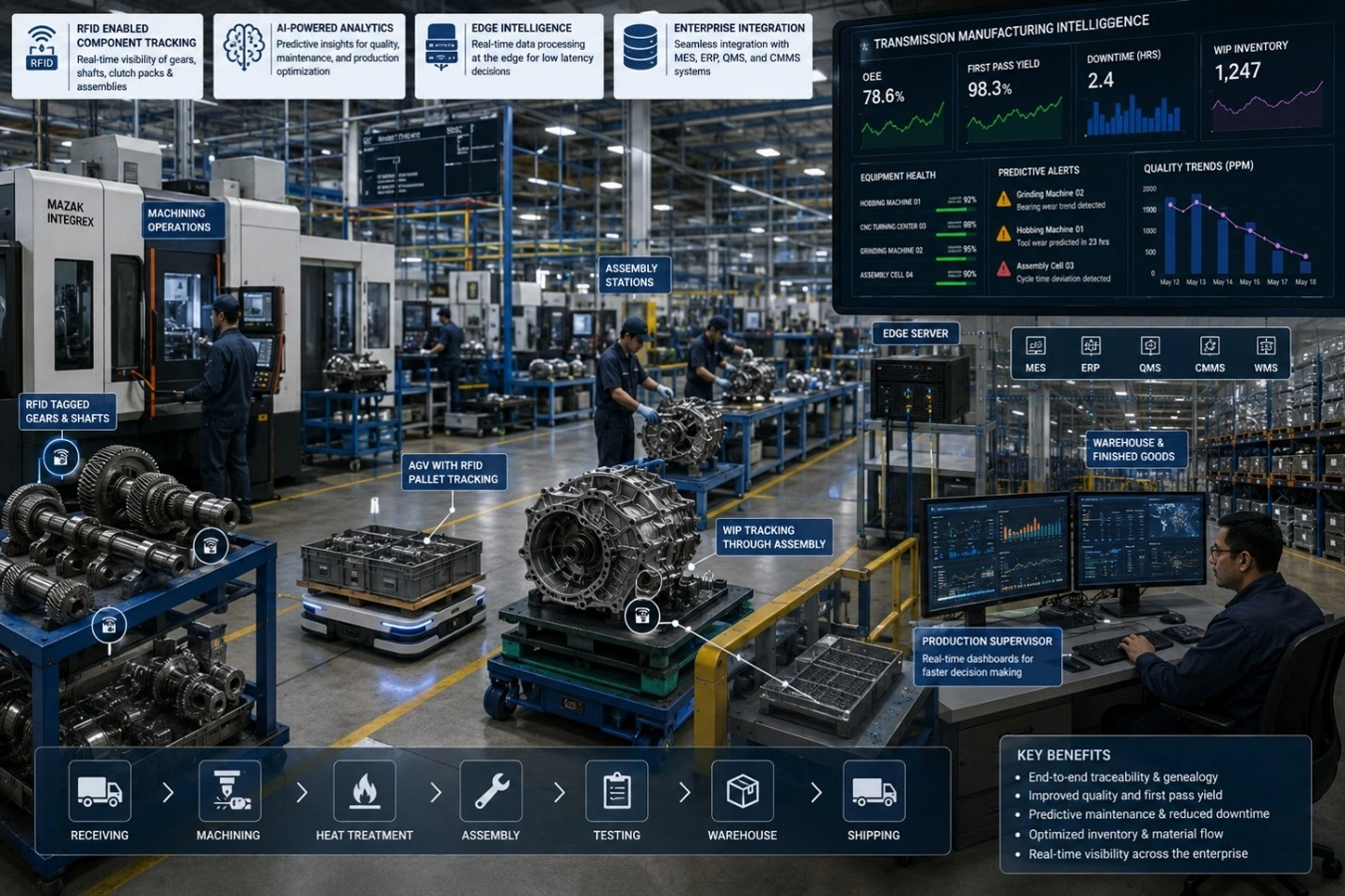
This visual illustrates a modern automotive transmission manufacturing facility where RFID-tagged components, pallets, and assemblies are tracked throughout machining, assembly, testing, warehousing, and shipping operations. AI analytics, edge computing, and enterprise software integration provide real-time visibility into production performance, equipment health, inventory status, and quality metrics. The key takeaway is that combining RFID traceability with AI-driven decision-making improves operational efficiency, product quality, predictive maintenance, and end-to-end manufacturing visibility.
Core Concepts of AI and RFID in Transmission Manufacturing
Transmission manufacturing increasingly relies on AIoT, which combines artificial intelligence with connected industrial systems, sensors, RFID infrastructure, manufacturing equipment, and operational software.
RFID as the Operational Data Source
RFID technology enables automatic identification and tracking of manufacturing assets without requiring direct line-of-sight scanning.
Relevant RFID implementations include:
- UHF RFID for pallet tracking
- UHF RFID for work-in-process monitoring
- RFID-enabled returnable container management
- Tool identification and calibration tracking
- Production carrier tracking
- Warehouse inventory management
- Finished transmission traceability
- Material handling automation
AI as the Decision Intelligence Layer
Artificial Intelligence analyzes production data generated by RFID systems, machine sensors, quality inspection equipment, and enterprise software.
Common AI applications include:
- Predictive maintenance
- Demand forecasting
- Production scheduling optimization
- Defect prediction
- Inventory optimization
- Bottleneck detection
- Process anomaly detection
- Workforce planning support
- Quality trend analysis
- Supplier performance evaluation
The combination creates a continuously improving manufacturing environment where operational decisions are increasingly supported by data rather than manual observation alone.
Key AI Applications Across Transmission Manufacturing Operations
AI Inventory Management for Transmission Components
Transmission facilities often manage thousands of stock keeping units, including gears, synchronizers, bearings, shafts, clutch packs, seals, fasteners, sensors, valve bodies, and transmission control modules.
AI systems analyze RFID movement records to:
- Predict component consumption
- Optimize reorder points
- Reduce safety stock requirements
- Identify slow-moving inventory
- Improve warehouse slotting strategies
- Detect inventory discrepancies
AI Quality Assurance for Precision Transmission Assembly
Quality requirements within transmission manufacturing are exceptionally demanding because dimensional deviations can affect performance, durability, and noise characteristics.
AI models evaluate:
- Gear measurement data
- Torque verification records
- Surface finish inspection results
- Heat treatment parameters
- Runout measurements
- End-of-line test results
RFID-generated genealogy records provide complete production histories that improve root-cause investigations and corrective action processes.
AI Predictive Maintenance for Production Equipment
Transmission production lines depend heavily on:
- CNC machining centers
- Gear hobbing machines
- Grinding machines
- Heat treatment furnaces
- Robotic assembly cells
- Automated conveyors
- Leak testing equipment
- Dynamometers
AI analyzes equipment utilization, maintenance history, vibration data, temperature readings, and RFID-recorded tool usage patterns to predict failures before downtime occurs.
AI Predictive Maintenance Workflow for RFID-Enabled Transmission Manufacturing Operations
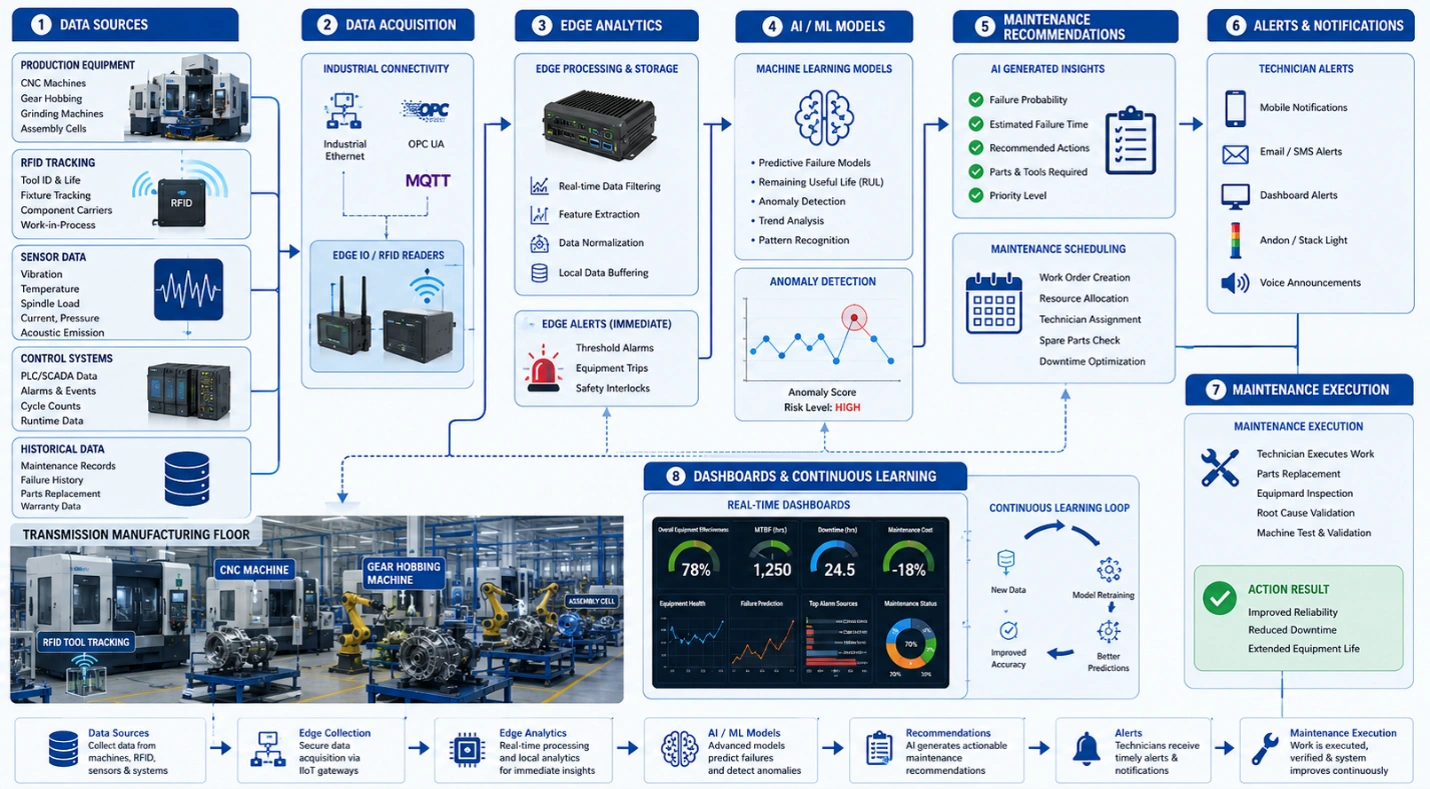
This visual demonstrates how RFID tool tracking, machine sensors, industrial connectivity, and historical maintenance records are combined within a transmission manufacturing environment to support predictive maintenance. Data is collected through edge devices, analyzed by AI and machine learning models, and transformed into maintenance recommendations, technician alerts, and scheduled interventions. The workflow highlights a continuous improvement cycle that reduces unplanned downtime, improves equipment reliability, and extends the operational life of critical transmission manufacturing assets such as CNC machines, gear hobbing equipment, and assembly systems.
AI Production Scheduling Optimization
Transmission manufacturing environments frequently experience schedule disruptions caused by:
- Material shortages
- Machine failures
- Labor availability changes
- Supplier delays
- Quality holds
- Engineering changes
AI scheduling engines use RFID-derived production status information to dynamically optimize:
- Work order sequencing
- Resource allocation
- Shift planning
- Production balancing
- Material movement priorities
Transmission Manufacturing Workflow Supported by AI and RFID
A modern AI-enabled transmission manufacturing solution typically follows a structured operational workflow.
Component Identification and Material Receipt
Incoming components such as gears, shafts, bearings, housings, clutch assemblies, and electronic control modules receive RFID identification or are associated with RFID-enabled containers.
Captured information may include:
- Supplier information
- Lot numbers
- Batch records
- Inspection status
- Material certifications
- Receiving timestamps
Production Tracking During Machining Operations
Components move through:
- Turning operations
- Milling operations
- Gear hobbing
- Gear shaping
- Grinding processes
- Heat treatment
- Surface finishing
RFID readers automatically record movement between production stages, creating a digital production history.
Assembly Process Monitoring
Assembly stations continuously capture:
- Component consumption
- Assembly sequence verification
- Torque tool usage
- Operator assignments
- Station cycle times
- Process completion status
AI models evaluate these operational records to identify process inefficiencies and emerging quality risks.
End-of-Line Testing and Quality Validation
Completed transmissions undergo:
- Leak testing
- Functional testing
- Shift quality verification
- Noise testing
- Vibration analysis
- Dynamometer testing
AI systems correlate test results with manufacturing history to identify hidden process relationships.
Distribution and Logistics Management
Finished transmissions are tracked through:
- Finished goods warehouses
- Distribution centers
- Shipping operations
- Dealer supply networks
RFID-generated movement data supports shipment verification and recall management processes.
AI and RFID Transmission Manufacturing Workflow for End-to-End Traceability
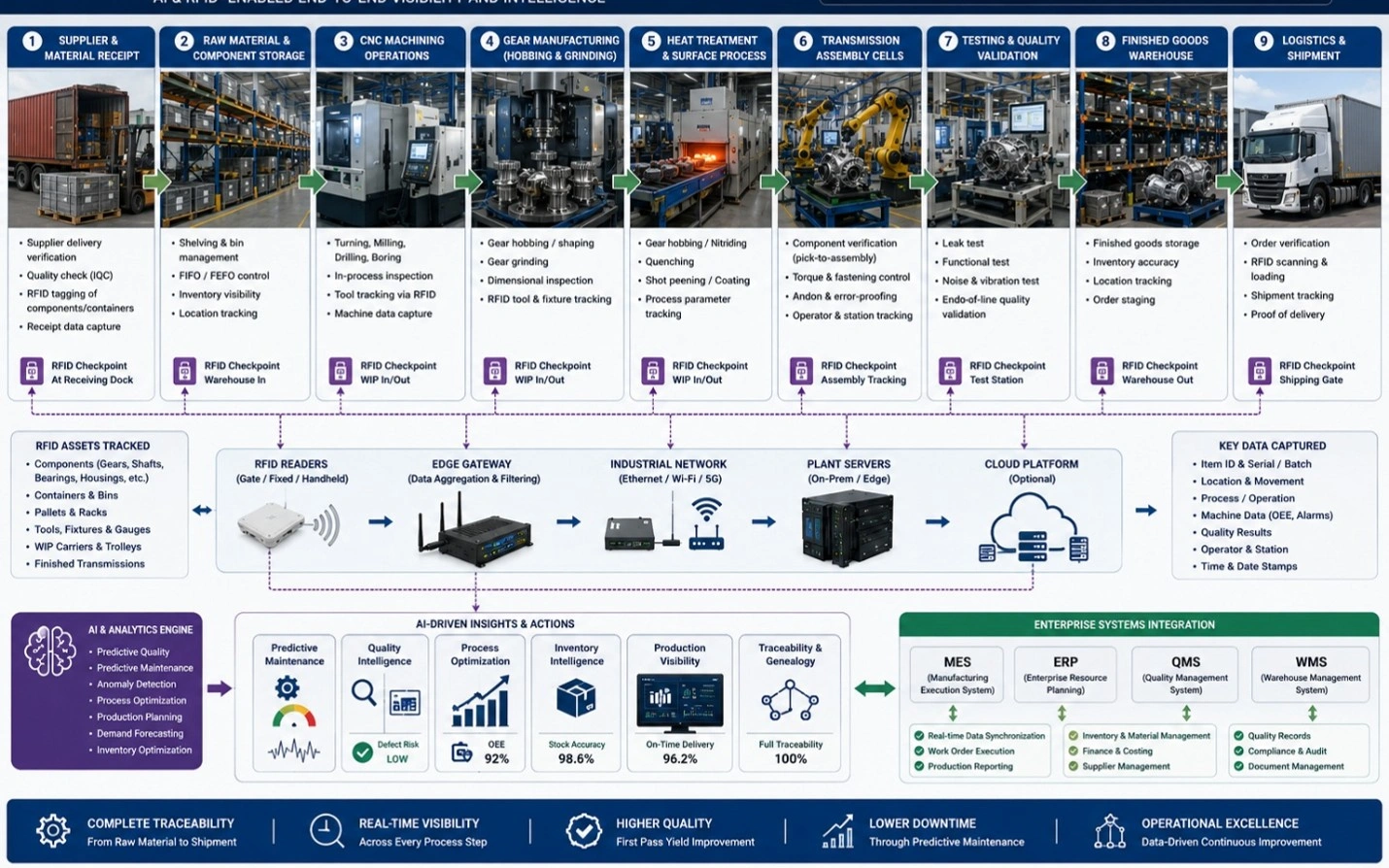
This visual illustrates the complete transmission manufacturing lifecycle, beginning with supplier receiving and warehouse storage and continuing through CNC machining, gear manufacturing, heat treatment, assembly, testing, finished goods storage, and shipment. RFID checkpoints capture real-time operational data at every production stage, while AI analytics transform that data into predictive maintenance insights, quality intelligence, inventory optimization, and production visibility. The diagram also highlights integration with MES, ERP, QMS, and WMS software to support end-to-end traceability, operational efficiency, and data-driven manufacturing decisions.
Technology Components Supporting AI-Driven Transmission Manufacturing
Successful deployment requires coordinated integration of hardware, software, communications infrastructure, analytics engines, and manufacturing systems.
RFID Hardware Components
Core RFID infrastructure typically includes:
- Fixed industrial RFID readers
- UHF RFID antennas
- Rugged RFID tags
- High-temperature RFID tags
- RFID-enabled tooling identifiers
- Handheld RFID readers
- RFID printer encoders
- Industrial RFID gateways
Transmission manufacturing environments often require specialized tags capable of surviving machining fluids, elevated temperatures, vibration exposure, and metal-rich environments.
Data Collection Infrastructure
Supporting technologies commonly include:
- Industrial Ethernet
- OPC UA communication
- MQTT messaging
- SCADA systems
- PLC controllers
- Edge computing gateways
- Industrial wireless networks
- Time-sensitive networking
Enterprise Software Integration
Operational data frequently integrates with:
- Manufacturing Execution Systems (MES)
- Enterprise Resource Planning software
- Warehouse Management Systems
- Quality Management Systems
- Computerized Maintenance Management Systems
- Product Lifecycle Management software
- Supply Chain Management systems
These integrations allow AI systems to combine production, inventory, maintenance, quality, and logistics information into a unified decision-support environment.
AI and RFID Systems Integration for Transmission Manufacturing Operations
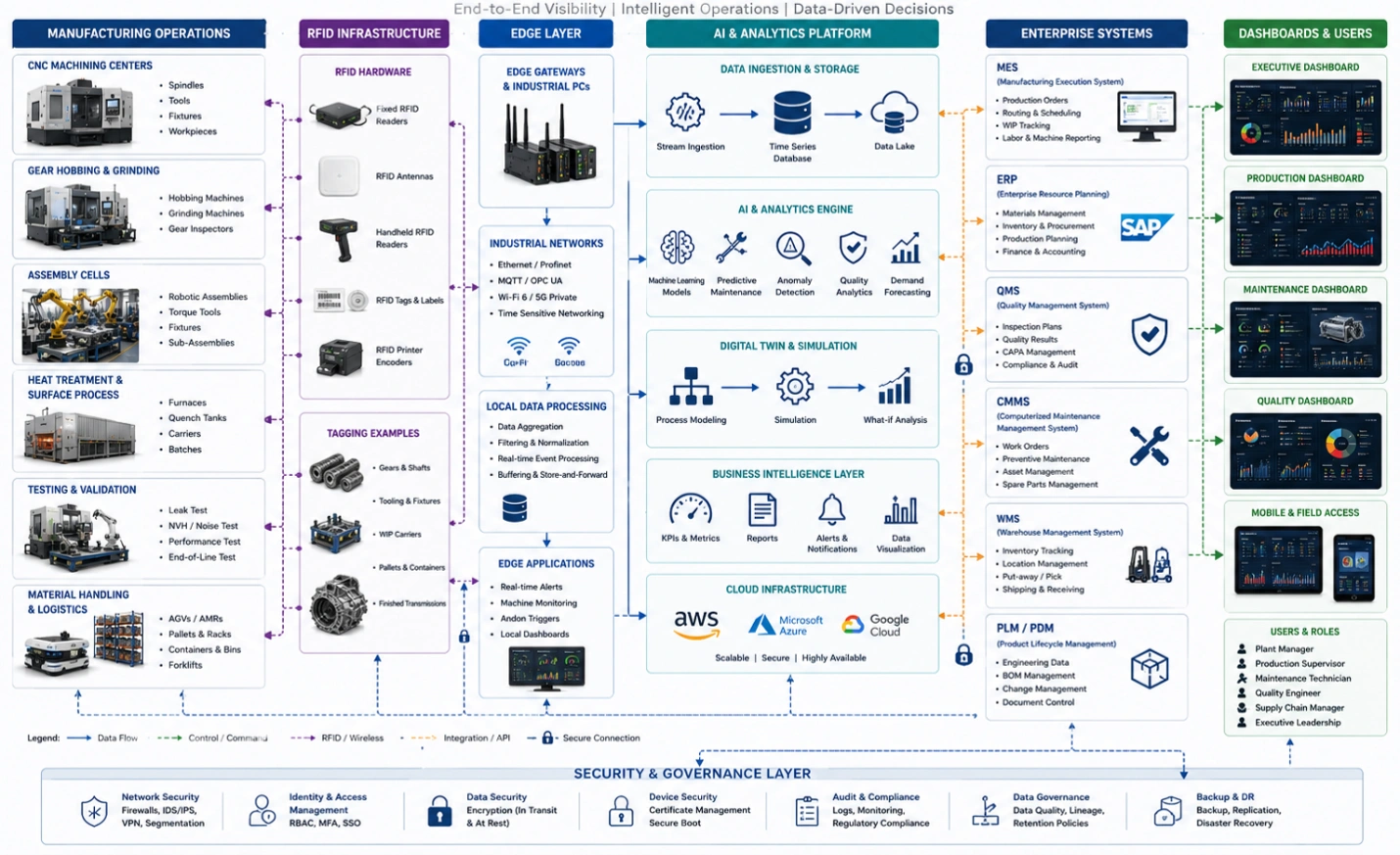
This diagram illustrates how RFID infrastructure, edge computing, industrial networks, AI analytics engines, and enterprise software systems work together within a transmission manufacturing environment. It shows secure data flows connecting production equipment, RFID readers, MES, ERP, QMS, CMMS, and cloud services to provide real-time operational visibility, predictive analytics, maintenance intelligence, and quality management. The key takeaway is that integrated AI and RFID systems enable end-to-end traceability, faster decision-making, and improved manufacturing performance across the entire transmission production lifecycle.
Cloud and Server Deployment Models for Transmission Manufacturing
Transmission manufacturing facilities vary significantly in scale, automation maturity, cybersecurity requirements, and data governance policies. Selecting the appropriate deployment model depends on production complexity, regulatory requirements, latency sensitivity, and integration requirements.
Cloud Deployment
Cloud-hosted manufacturing intelligence solutions are commonly used when organizations require centralized visibility across multiple transmission manufacturing plants, suppliers, and distribution facilities.
Advantages include:
- Centralized reporting across facilities
- Faster software updates
- Simplified scalability
- Enterprise-wide analytics
- Supplier collaboration support
- Cross-site benchmarking
- Reduced local infrastructure requirements
Typical cloud applications include:
- Production performance dashboards
- Supply chain visibility
- Demand forecasting
- Inventory optimization
- Executive reporting
- Multi-facility quality analysis
Server Deployment
Server-based deployments operate on factory servers, privately hosted infrastructure, industrial data centers, or customer-managed computing environments.
Advantages include:
- Lower operational latency
- Enhanced data control
- Support for isolated manufacturing networks
- Reduced dependency on internet connectivity
- Greater customization flexibility
- Alignment with strict automotive cybersecurity requirements
Typical server-based applications include:
- Real-time production monitoring
- Robotic assembly control support
- Machine-level predictive maintenance
- Automated quality inspections
- Production scheduling optimization
- Industrial automation integration
Many transmission manufacturers implement hybrid approaches where time-sensitive manufacturing intelligence remains on local servers while strategic analytics operate within cloud environments.
Cloud vs Server Deployment for AI and RFID Transmission Manufacturing Systems
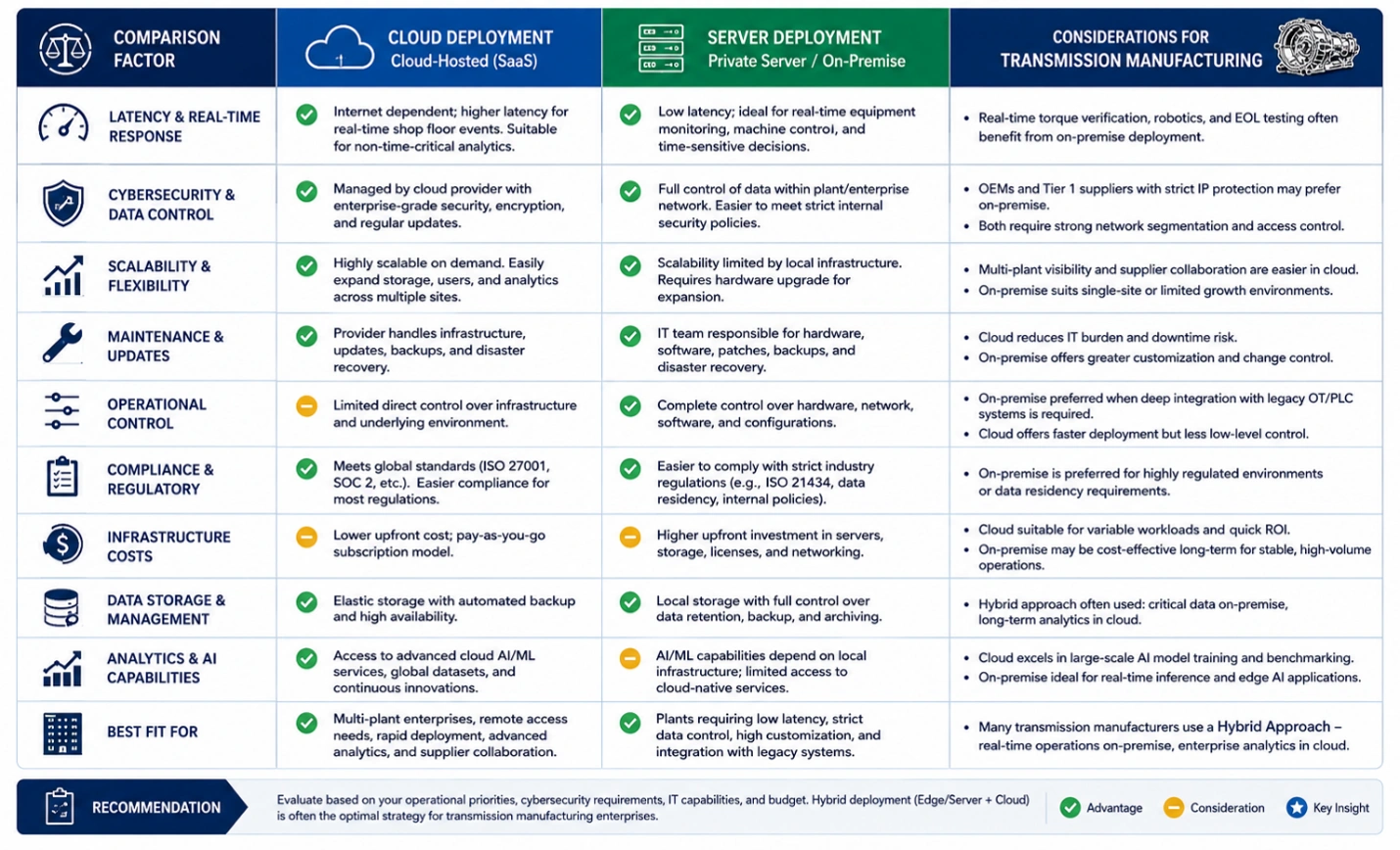
This comparison visual evaluates cloud-hosted and private server deployment models for AI-enabled RFID transmission manufacturing environments. It compares key factors including latency, cybersecurity, scalability, maintenance responsibilities, operational control, compliance requirements, infrastructure costs, data management, and AI analytics capabilities. The diagram highlights how deployment choices impact manufacturing operations and emphasizes that many transmission manufacturers adopt a hybrid strategy combining local operational intelligence with cloud-based enterprise analytics.
AI Models and Analytics Supporting Transmission Production
Artificial Intelligence solutions within transmission manufacturing utilize multiple analytical approaches depending on operational objectives.
Machine Learning Models
Machine learning algorithms support:
- Equipment failure prediction
- Quality trend analysis
- Production forecasting
- Inventory optimization
- Supplier performance assessment
- Process parameter optimization
Common approaches include:
- Random Forest
- Gradient Boosting
- XGBoost
- Support Vector Machines
- Time Series Forecasting
Deep Learning Applications
Deep learning models assist with:
- Visual defect inspection
- Surface finish evaluation
- Gear tooth anomaly detection
- Assembly verification
- Automated quality assessment
Common technologies include:
- Convolutional Neural Networks (CNNs)
- Vision Transformers
- Object Detection Models
- Semantic Segmentation Models
Edge AI Processing
Edge AI enables rapid decision-making close to production equipment.
Typical use cases include:
- Real-time anomaly detection
- Production line monitoring
- Robotic assembly verification
- Tool wear prediction
- Operator assistance systems
Edge processing reduces latency while minimizing unnecessary data transmission across manufacturing networks.
Cybersecurity and Data Protection Considerations
Automotive transmission production facilities increasingly rely on connected systems, making cybersecurity a critical design consideration.
Manufacturing Cybersecurity Requirements
Key protection objectives include:
- Production continuity
- Intellectual property protection
- Supplier data security
- Quality record integrity
- Operational technology protection
- Regulatory compliance
Security Controls
Recommended security measures include:
- Network segmentation
- Role-based access control
- Multi-factor authentication
- Device identity management
- Data encryption
- Security event monitoring
- Vulnerability management
- Backup and recovery procedures
RFID Security Measures
RFID deployments often incorporate:
- Tag authentication
- Secure reader management
- Encrypted communications
- Access control policies
- Device certificate management
Automotive manufacturers frequently align security programs with standards such as:
- ISO 27001
- IEC 62443
- NIST Cybersecurity Framework
- ISO 21434
- IATF 16949 quality requirements
GAO has supported organizations implementing RFID and industrial IoT technologies where security, reliability, and operational continuity are essential requirements.
Cybersecurity Framework for AI-Enabled RFID Transmission Manufacturing Systems
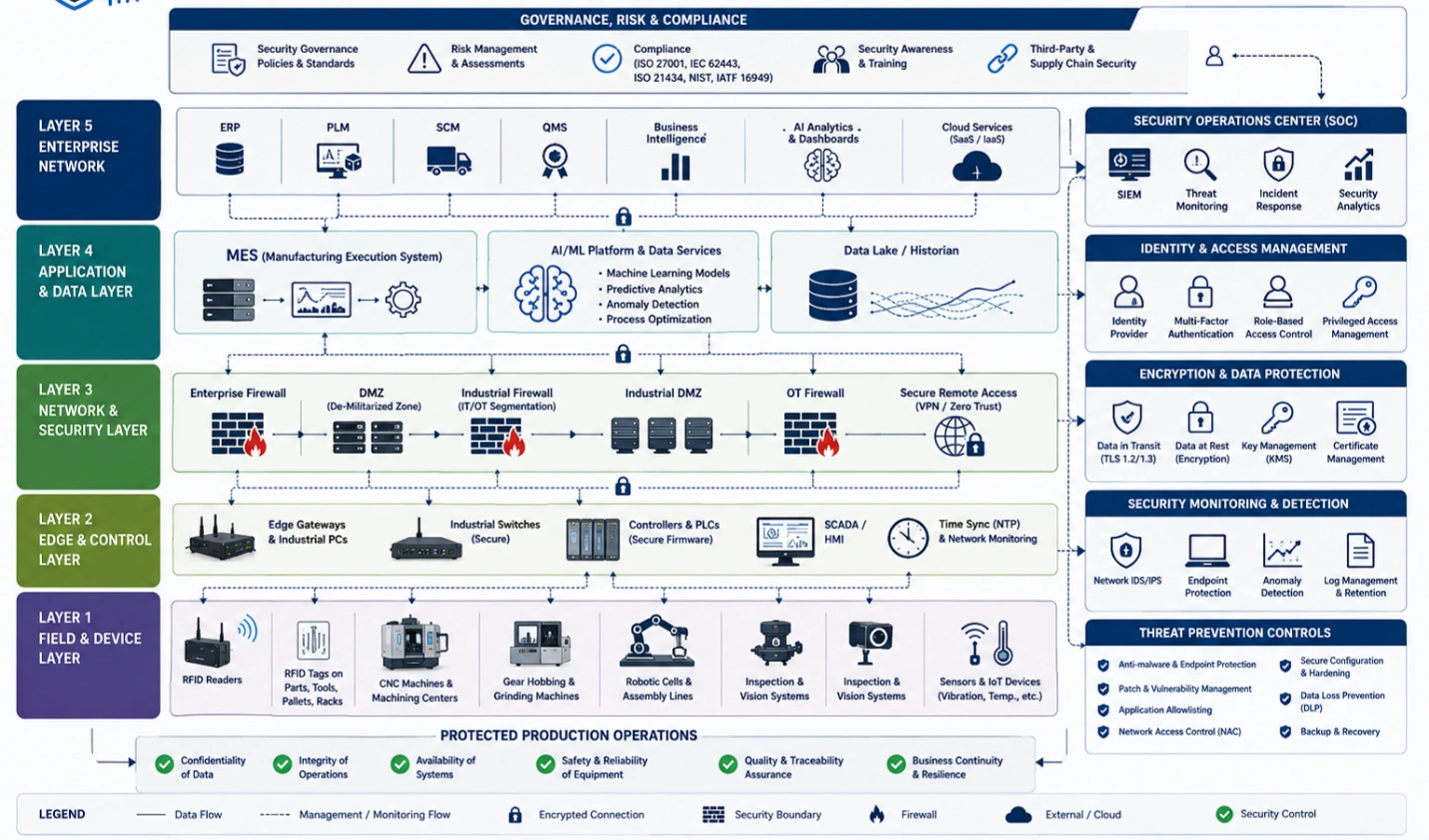
This visual illustrates a layered cybersecurity framework designed to protect AI-enabled RFID transmission manufacturing operations. It demonstrates how governance controls, identity management, encryption, industrial network segmentation, security monitoring, firewalls, and threat prevention mechanisms safeguard manufacturing equipment, RFID infrastructure, AI analytics systems, MES, ERP, and operational technology environments. The key takeaway is that a defense-in-depth security strategy helps ensure data integrity, operational continuity, traceability, equipment reliability, and compliance across connected transmission manufacturing facilities.
Technical Capabilities Enabled by AI-Driven Transmission Manufacturing Intelligence
The combination of AI analytics and RFID-enabled operational visibility delivers capabilities that extend beyond traditional production tracking.
End-to-End Component Genealogy
Manufacturers can establish complete production histories covering:
- Raw materials
- Machining operations
- Heat treatment processes
- Assembly activities
- Quality inspections
- Testing results
- Shipping records
This capability significantly improves recall management and root-cause investigations.
Dynamic Production Optimization
AI continuously evaluates:
- Machine utilization
- Work-in-process levels
- Material availability
- Labor allocation
- Production constraints
Recommendations are generated to improve throughput while minimizing bottlenecks.
Real-Time Operational Visibility
Manufacturing managers gain visibility into:
- Production status
- Equipment utilization
- Inventory movement
- Quality trends
- Maintenance conditions
- Logistics performance
Predictive Decision Support
Predictive analytics help forecast:
- Machine failures
- Quality deviations
- Material shortages
- Capacity constraints
- Delivery risks
- Maintenance requirements
These capabilities support proactive operational management rather than reactive decision-making.
AI-Driven RFID Transmission Manufacturing Performance Dashboard
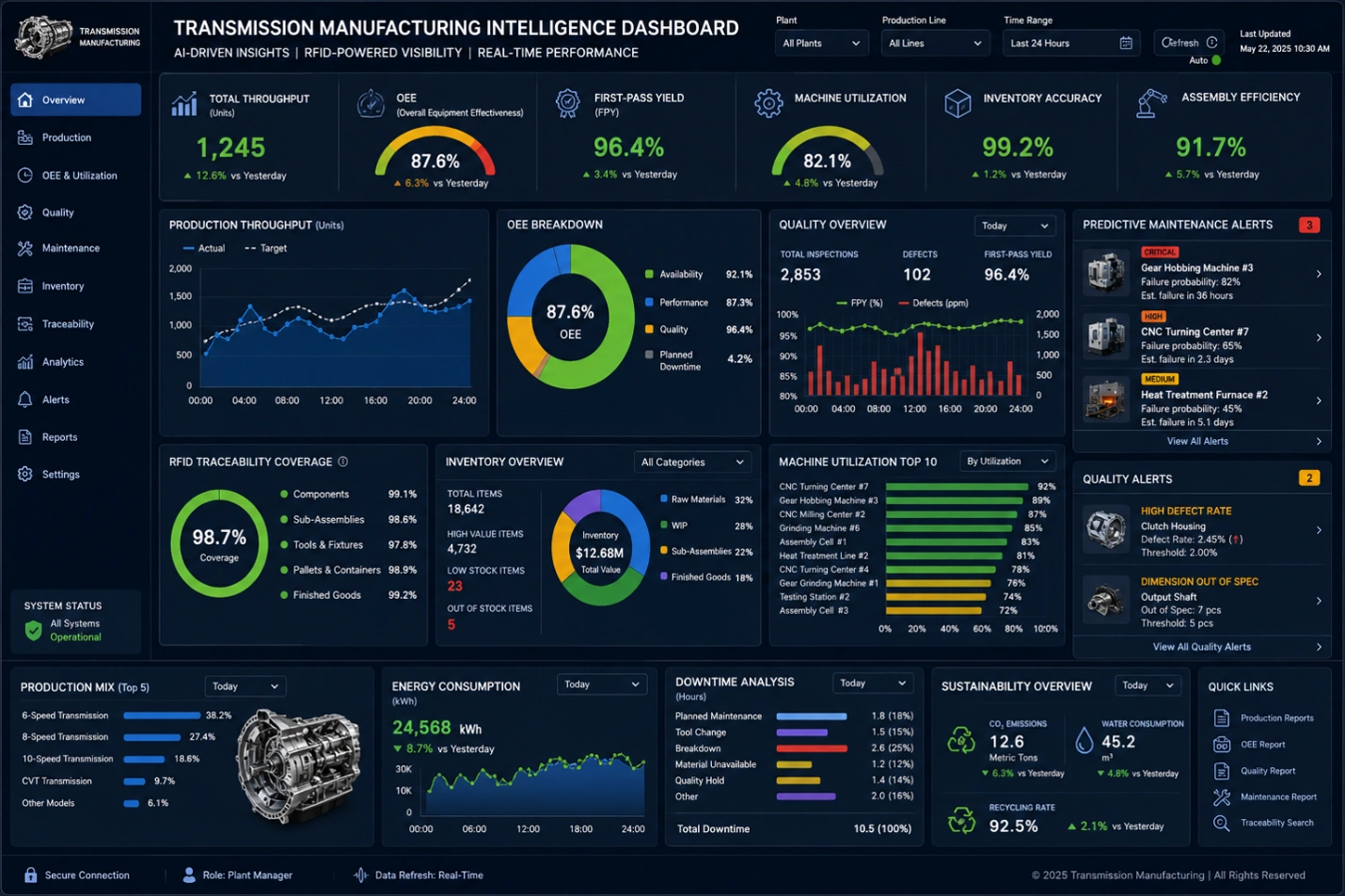
This dashboard visual presents real-time operational intelligence for transmission manufacturing, combining RFID traceability data, AI analytics, production metrics, quality indicators, maintenance alerts, and inventory performance into a single management view. It highlights critical KPIs such as throughput, OEE, first-pass yield, machine utilization, assembly efficiency, inventory accuracy, downtime analysis, and predictive maintenance insights, enabling faster and more informed production decisions.
Business Benefits for Automotive Transmission Manufacturers
Organizations implementing AI-enabled RFID manufacturing intelligence often pursue measurable operational improvements across production, quality, inventory, maintenance, and logistics functions.
Production Performance Improvements
Potential benefits include:
- Improved throughput
- Reduced cycle times
- Increased OEE
- Faster bottleneck resolution
- Improved schedule adherence
- Better resource utilization
Quality Improvements
Operational advantages may include:
- Higher first-pass yield
- Reduced rework
- Faster defect detection
- Improved process consistency
- Stronger compliance reporting
- Enhanced traceability
Inventory and Supply Chain Improvements
Manufacturers may achieve:
- Improved inventory accuracy
- Reduced excess inventory
- Better warehouse utilization
- Improved material availability
- Faster inventory audits
- Enhanced supplier coordination
Maintenance Improvements
Maintenance organizations often benefit from:
- Reduced unplanned downtime
- Better spare parts planning
- Improved maintenance scheduling
- Increased equipment availability
- Extended equipment life
Strategic Business Value
Long-term benefits include:
- Better manufacturing agility
- Improved customer satisfaction
- Enhanced operational resilience
- Greater data-driven decision making
- Improved competitiveness
Key Performance Indicators for AI-Enabled Transmission Manufacturing
Organizations commonly track the following metrics to evaluate implementation success:
| KPI | Operational Objective |
|---|---|
| Overall Equipment Effectiveness (OEE) | Improve asset utilization |
| First Pass Yield (FPY) | Reduce defects and rework |
| Inventory Accuracy | Improve material visibility |
| Production Throughput | Increase output capacity |
| Mean Time Between Failures (MTBF) | Improve equipment reliability |
| Mean Time To Repair (MTTR) | Reduce downtime duration |
| Schedule Adherence | Improve production planning |
| Traceability Coverage | Strengthen genealogy records |
| Quality Defect Rate | Reduce manufacturing defects |
| Warehouse Turnover | Improve inventory efficiency |
| Assembly Cycle Time | Increase production speed |
| Order Fulfillment Accuracy | Improve logistics performance |
Implementation Best Practices for Transmission Manufacturing Facilities
Successful projects typically begin with clearly defined business objectives rather than technology selection alone.
Recommended implementation practices include:
- Conduct comprehensive production workflow assessments
- Identify critical traceability requirements
- Prioritize high-value use cases
- Validate RFID read performance in metal-intensive environments
- Integrate with MES and ERP software early
- Establish cybersecurity requirements before deployment
- Define measurable KPIs
- Implement pilot projects before facility-wide expansion
- Develop data governance policies
- Continuously retrain AI models using operational data
Manufacturers should also evaluate environmental conditions such as metal interference, machining fluids, vibration, temperature exposure, and electromagnetic noise when selecting RFID hardware.
AI-Enabled RFID Transmission Manufacturing Implementation Roadmap
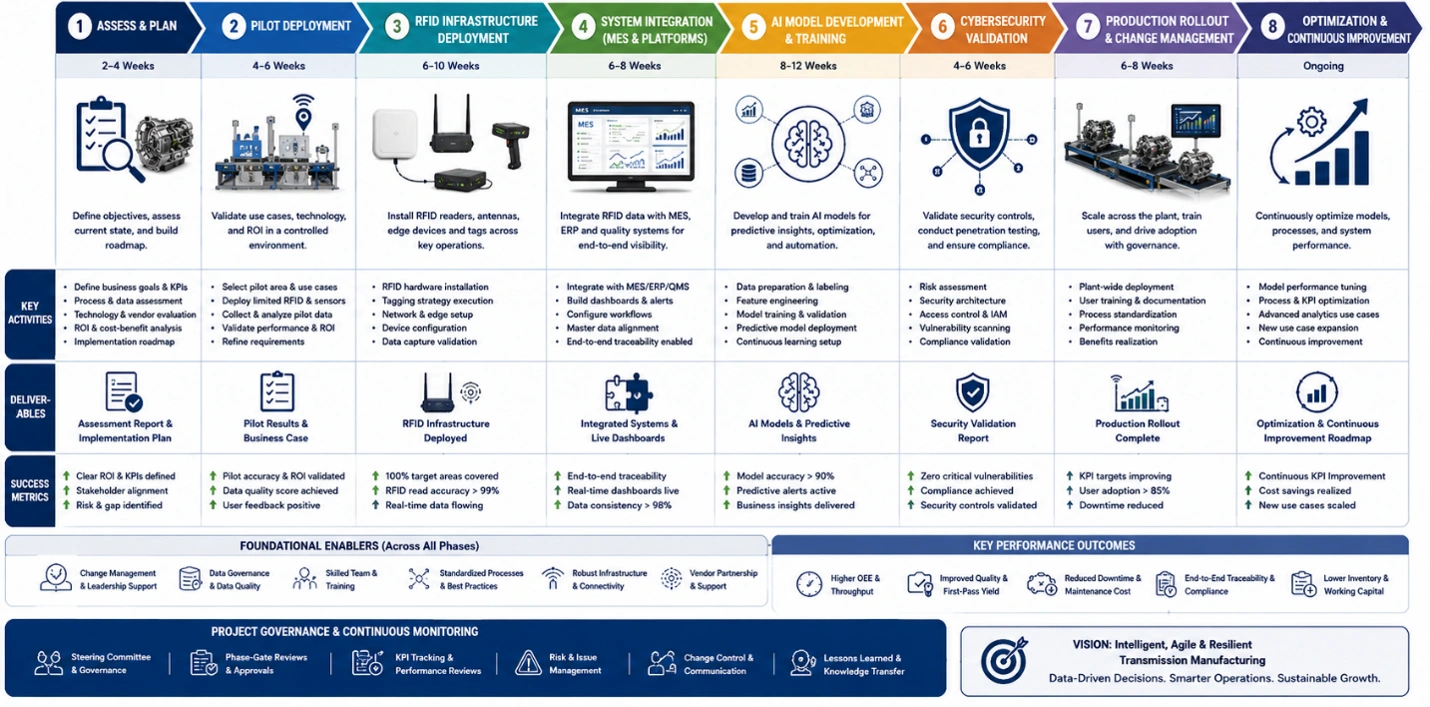
This roadmap visual outlines a phased deployment strategy for implementing AI-enabled RFID technologies within a transmission manufacturing facility. It guides stakeholders through assessment, pilot validation, RFID infrastructure deployment, MES and ERP integration, AI model development, cybersecurity validation, production rollout, and continuous optimization. The key takeaway is that a structured, phased approach helps manufacturers reduce implementation risk, accelerate adoption, improve operational performance, and maximize long-term return on investment.
Advancing Transmission Manufacturing Through AI-Powered Operational Intelligence
Automotive transmission manufacturing continues to evolve toward highly connected, data-driven production environments where operational efficiency, quality assurance, traceability, and asset utilization are increasingly dependent on intelligent decision support.
RFID-enabled visibility provides the reliable operational data foundation required for advanced manufacturing intelligence. Artificial Intelligence transforms this information into predictive insights that improve production scheduling, maintenance planning, quality management, inventory optimization, and supply chain coordination.
Organizations adopting these technologies can strengthen competitiveness by improving throughput, reducing downtime, enhancing product quality, and enabling real-time operational awareness across the entire transmission production lifecycle.
GAO, headquartered in New York City and Toronto, Canada, has spent decades supplying RFID, BLE, and industrial IoT technologies to organizations across North America. Through extensive experience supporting Fortune 500 companies, research institutions, government agencies, and manufacturing organizations, we help customers implement reliable identification, tracking, sensing, and connected intelligence solutions that support modern industrial operations.
Building the Future of Industrial AI and IoT with Aperture Venture Studio and GAO
For more than three decades, GAO Group of Companies has invested extensively in research, development, and deployment of RFID, BLE, IoT, and industrial connectivity technologies. As Artificial Intelligence has become increasingly valuable within manufacturing environments such as transmission production facilities, we have expanded our focus on Industrial AI, AIoT, predictive analytics, machine vision, and intelligent automation solutions. To further accelerate innovation across industrial sectors, we established Aperture Venture Studio to help advance and scale transformative AI and IoT initiatives that address real-world operational challenges.
Aperture has attracted leading AI and IoT technical experts, experienced operational executives, influential investors, and major technology organizations. Through initiatives such as Aperture Ventures Summit and TekSummit, we facilitate discussions on emerging AI and IoT technologies while supporting vibrant technical communities focused on industrial innovation.
We welcome you to engage with us as:
- Advisors, co-founders, or employees
- Investors
- Customers
Learn more about how GAO’s engineering expertise, RFID technologies, industrial IoT solutions, and AI-enabled manufacturing intelligence can support your transmission manufacturing modernization initiatives.