
AI and RFID for UAV (Drone) Manufacturing
AI-Driven UAV Manufacturing with RFID-Based Visibility
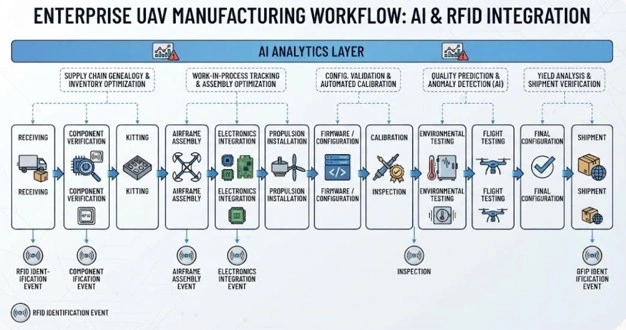
Artificial intelligence is changing UAV (drone) manufacturing by helping production teams analyze manufacturing data, identify quality risks, optimize material flows, and make faster decisions across engineering and assembly operations. RFID provides an important source of machine-readable identification and location data for components, tools, work-in-process assemblies, and finished UAV systems. When RFID-generated data is combined with AI, manufacturers can move beyond simple identification toward predictive and data-driven production management. For UAV manufacturers, this combination is particularly relevant because drone production involves many serialized components, configuration-controlled assemblies, electronics, batteries, motors, flight-control systems, airframes, payload modules, and test equipment. A single UAV may pass through receiving, kitting, assembly, firmware loading, calibration, inspection, environmental testing, flight testing, and final configuration before shipment. AI can correlate information from these stages while RFID helps establish which physical item, subassembly, tool, or container generated each event. GAO supplies RFID, BLE, IoT, and related hardware products and systems that can support organizations implementing connected identification and tracking processes. Its experience serving organizations in the United States and Canada, including major corporations, research organizations, universities, and government agencies, provides relevant engineering context for connected industrial applications.
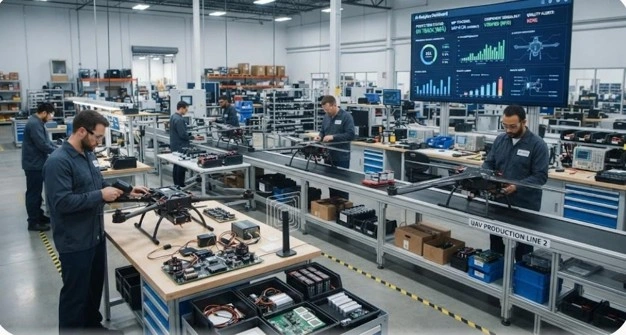
Enterprise Aerospace UAV Manufacturing Facility with RFID Production Tracking
What AI Means for UAV (Drone) Manufacturing
AI for UAV manufacturing refers to the use of machine learning, computer vision, predictive analytics, anomaly detection, optimization algorithms, and other AI techniques to improve engineering, production, inspection, testing, maintenance, and supply-chain decisions. The value is not created by AI alone. UAV manufacturing generates information from many physical and digital sources, including:
- RFID identification events for components, assemblies, tools, containers, and work orders
- Machine and production equipment data
- Manufacturing execution system records
- Enterprise resource planning data
- Quality inspection results
- Computer vision images
- Environmental measurements
- Battery test information
- Motor and propulsion test data
- Flight-test measurements
- Firmware and configuration records
- Operator and technician activities
- Supplier and material information
AI can correlate these sources to identify relationships that are difficult to detect through manual review. For example, repeated quality deviations may become visible when production data is analyzed according to supplier lot, component revision, workstation, assembly sequence, environmental conditions, or technician process. RFID can provide the physical identity needed to connect these events to specific UAV components and assemblies. This is especially useful when manufacturers need component genealogy, configuration traceability, or rapid identification of work-in-process items.
Where AI Improves UAV Production Operations
AI for UAV Component and Inventory Management
Drone manufacturers manage diverse inventories containing electronic components, batteries, motors, propellers, sensors, wiring harnesses, fasteners, airframe parts, payload equipment, and specialized assemblies. AI can analyze inventory movement and consumption patterns to support material planning and identify unusual usage. RFID can associate physical components with inventory records and provide automated identification when tagged materials move through receiving, storage, kitting, and production areas. Relevant applications include:
- AI-assisted inventory forecasting
- Automated identification of incoming UAV components
- Component movement tracking
- Kit completeness verification
- Serialized component traceability
- Battery inventory monitoring
- High-value electronics tracking
- Detection of unexpected material movement
- Work-in-process visibility
- Inventory reconciliation
The engineering objective is not simply to know how many parts are present. Manufacturers need to know which part, which revision, which lot, where it is, where it was used, and, where applicable, which UAV assembly contains it.
AI for UAV Assembly and Work-in-Process Tracking
UAV production frequently involves multiple assembly stations. An airframe may move between structural assembly, electronics integration, propulsion installation, software configuration, calibration, inspection, and testing. RFID identification events can help associate a UAV or subassembly with each production stage. AI can then analyze production histories to identify bottlenecks, abnormal cycle times, repeated rework, or process deviations. Potential AI-driven improvements include:
- Detecting abnormal assembly cycle times
- Predicting production bottlenecks
- Identifying recurring rework patterns
- Comparing actual production sequences with expected workflows
- Detecting missing process events
- Correlating defects with specific component lots
- Forecasting workstation workload
- Supporting production scheduling decisions
For serialized UAV production, maintaining an accurate digital record of assembly history is particularly important. A physical UAV should remain associated with the correct component and process records throughout its manufacturing lifecycle.
Enterprise UAV Manufacturing Workflow: AI and RFID Integration
AI for UAV Quality Inspection
Quality assurance is critical for UAV manufacturing because defects in structural components, electronics, propulsion systems, wiring, batteries, or flight-control assemblies can affect system performance and safety. Computer vision can inspect physical characteristics such as assembly positioning, surface defects, connector conditions, labeling, and selected structural features. Machine learning can identify patterns in inspection results and help prioritize areas requiring human review. RFID adds identity and traceability. An inspection result can be associated with the specific serialized UAV, subassembly, component, or production batch involved. This creates opportunities for:
- Automated inspection data association
- Defect pattern analysis
- Quality trend detection
- Supplier-lot correlation
- Rework analysis
- First-pass yield monitoring
- Nonconformance investigation
- Component genealogy
- Inspection history retrieval
AI should support qualified inspection processes rather than replace required engineering validation or human quality decisions where those controls are necessary.
AI for UAV Testing and Calibration
Testing can generate significant quantities of technical data. UAV manufacturers may perform motor tests, battery tests, sensor calibration, communication tests, environmental tests, software verification, and flight testing. AI can examine test measurements to identify abnormal patterns and prioritize units for investigation. RFID can help connect test records with the exact UAV or subassembly undergoing the procedure. A useful implementation associates the physical unit with:
- Test station
- Test procedure
- Test timestamp
- Hardware configuration
- Firmware version
- Operator or process identifier
- Component genealogy
- Test measurements
- Pass or fail result
- Rework history
This provides a stronger basis for analyzing why certain UAV configurations repeatedly require additional testing or corrective action.
AI and RFID Workflow for UAV Manufacturing
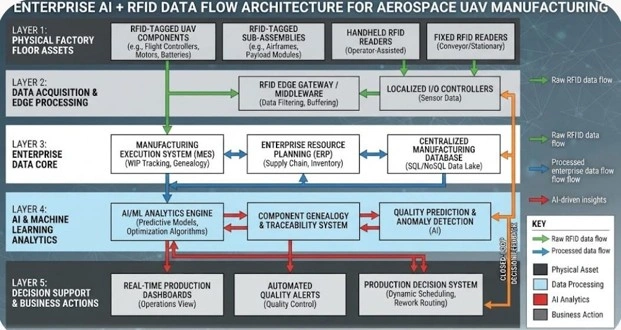
A practical AI-enabled UAV manufacturing workflow begins with physical identification and data capture. RFID readers detect tagged components, containers, tools, or assemblies as they enter defined manufacturing areas. Fixed readers can automate identification at selected points, while handheld readers can support technician-controlled verification. The captured events are transferred through the facility’s communication infrastructure to middleware or application software. Depending on the implementation, the processing layer may run on an industrial computer, edge server, private server, or cloud infrastructure. AI services then analyze the combined manufacturing information. A typical data flow is:
- RFID-tagged UAV components generate identification events
- Readers capture tag identifiers and associated event information
- Edge devices or middleware filter and normalize raw data
- Manufacturing software associates events with work orders and serialized assets
- Production, quality, and test records are combined with identification data
- AI models analyze historical and real-time information
- Analytics identify anomalies, trends, bottlenecks, or quality risks
- Production personnel receive alerts, dashboards, or recommendations
- Engineers investigate exceptions and determine corrective actions
- Results are retained as part of the UAV manufacturing record
The quality of this workflow depends heavily on data modeling. A tag identifier by itself has limited value. The system should associate the identifier with meaningful information such as part number, serial number, revision, batch, supplier, work order, UAV configuration, and manufacturing stage.
Enterprise AI + RFID Data Flow Architecture for Aerospace UAV Manufacturing
Technical Components for AI-Enabled UAV Manufacturing
A successful implementation combines identification hardware, sensing, communication, software, AI processing, and enterprise integration.
RFID Hardware
UHF RFID is generally useful when manufacturers need longer read ranges and rapid identification of multiple tagged items. It can support receiving areas, inventory locations, production checkpoints, containers, and selected work-in-process applications. HF RFID can be useful where shorter-range, controlled identification is preferred. LF RFID can serve specialized identification scenarios where its characteristics fit the application. The correct RFID frequency and tag design should be selected according to the physical environment. Carbon fiber, metal structures, batteries, electronics, liquids, and dense assemblies can influence RFID performance. UAV manufacturing therefore requires tag placement and reader configuration to be validated against actual components rather than selected only from theoretical read-range specifications.
Edge Processing and Middleware
Edge processing can filter duplicate reads, normalize RFID events, apply business rules, and forward relevant information to manufacturing applications. For example, a production checkpoint may generate multiple RFID reads for one UAV as it passes through a reader field. Middleware can convert these raw events into a meaningful manufacturing event such as: “UAV serial number entered electronics integration station.” This reduces unnecessary data and gives downstream applications structured events.
AI and Machine Learning
AI methods suitable for UAV manufacturing can include:
- Anomaly detection for manufacturing and test data
- Predictive models for equipment and process behavior
- Classification models for quality inspection
- Computer vision for selected inspection tasks
- Forecasting for material requirements
- Optimization models for production scheduling
- Pattern recognition for defect and rework analysis
- Natural-language interfaces for manufacturing information retrieval
Model selection should follow the manufacturing problem and available data. A sophisticated model is not automatically better if the underlying production data is incomplete, inconsistent, or poorly labeled.
Cloud Version and Server Version
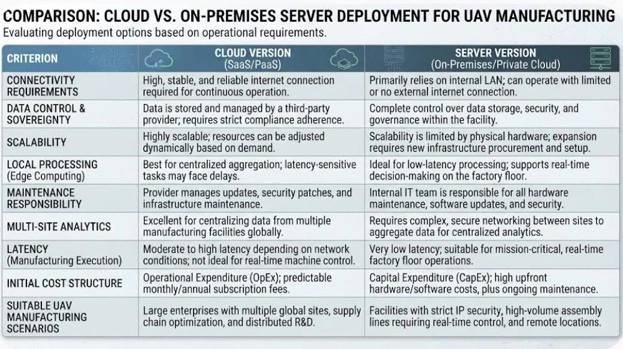
A Cloud Version can be appropriate when UAV manufacturing operations require centralized access across multiple facilities, remote analytics, scalable computing resources, or integration with cloud-based enterprise applications. Cloud deployment can also simplify centralized model management when production data from multiple sites needs to be analyzed together. A Server Version can be deployed on edge servers, factory servers, customer-managed infrastructure, private data centers, or other privately hosted environments. This approach can be appropriate when manufacturers require greater control over data processing, have connectivity restrictions, need local operation, or want critical manufacturing analytics to remain within controlled infrastructure. A hybrid implementation can also divide responsibilities. Time-sensitive RFID event processing can occur locally while aggregated manufacturing data and AI model training are handled centrally.
Cloud vs. On-Premises Server Deployment Comparison for UAV Manufacturing
Security and Data Protection
Connected UAV manufacturing systems should protect both operational data and configuration information. Security controls can include:
- Network segmentation
- Role-based access control
- Authentication and authorization
- Encryption in transit and at rest
- Secure device management
- Audit logging
- Software patch management
- Endpoint protection
- Backup and recovery procedures
- Monitoring for abnormal system activity
RFID security should also be considered within the broader manufacturing security model. Readers, gateways, middleware, databases, APIs, and enterprise applications form an interconnected operational environment and should be managed accordingly.
Engineering Considerations Before Deployment
AI-enabled RFID deployment should begin with the manufacturing process rather than with hardware selection. UAV manufacturers should first identify the specific operational problem, such as missing component traceability, inaccurate work-in-process status, excessive manual scanning, difficult genealogy investigation, production bottlenecks, or inconsistent inspection records. The next step is to determine where physical identification adds measurable value. Important design considerations include:
- Which UAV components require serialization?
- Which manufacturing events must be captured?
- Which assets can be reliably tagged?
- Where should RFID readers be installed?
- Which components contain metal or carbon-fiber materials that may affect RFID performance?
- Which events require real-time processing?
- Which data belongs in MES or ERP records?
- Which AI decisions require historical training data?
- Which processes still require human verification?
- What happens when an RFID read is missed?
- How should duplicate or unexpected reads be handled?
- How will the system operate during network interruptions?
- How will RFID data be validated during commissioning?
A pilot should ideally represent a real UAV production workflow rather than a laboratory demonstration. Testing should include actual component materials, production speeds, reader locations, tag orientations, technician behavior, and environmental conditions.
Realistic Aerospace UAV Production Line with Integrated RFID and AI Analytics
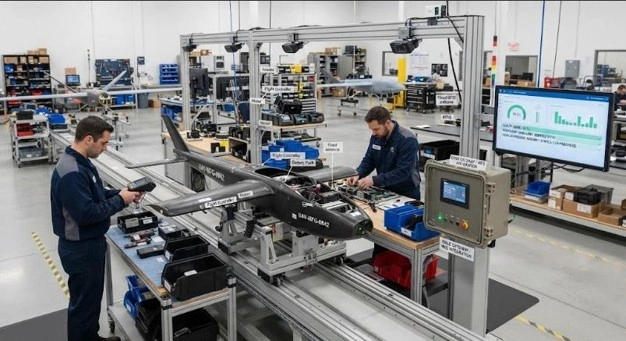
GAO Support for Connected UAV Manufacturing
GAO has developed and supplied RFID, BLE, and IoT hardware products and systems for organizations requiring connected identification, tracking, sensing, and data collection. Its R&D activities and quality assurance processes support applications where reliable hardware integration is important. GAO Group companies have operated from New York City and Toronto, Canada, serving customers across the United States and Canada for three decades. This experience includes work involving Fortune 500 companies, R&D organizations, universities, and government agencies. For UAV manufacturing, the practical objective is to connect physical production activity with trustworthy digital records. AI can then use these records to improve visibility, detect patterns, support quality analysis, and assist production decisions.
UAV Production Intelligence: Real-Time Operations Dashboard
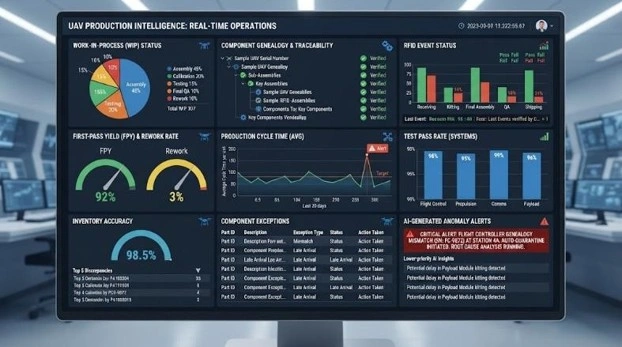
AI-Enabled Capabilities Across UAV Manufacturing
Combining AI with RFID-generated production data can extend UAV manufacturing from basic asset identification to continuous process analysis. The strongest results come when identification events are correlated with quality, testing, inventory, engineering, and production records.
Predictive Production Analysis
Machine learning models can analyze historical production records to identify conditions associated with extended cycle times, rework, failed tests, or material shortages. For UAV manufacturers, this can reveal relationships between production variables that are difficult to identify through manual reporting. Examples include:
- Predicting which production orders may experience material shortages
- Identifying workstations associated with repeated delays
- Detecting abnormal production cycle times
- Identifying component lots associated with elevated defect rates
- Forecasting workload for assembly and test stations
- Prioritizing production exceptions for engineering review
These predictions should be treated as decision-support outputs. Manufacturing engineers should validate important findings against process specifications and physical evidence before changing production procedures.
Component Genealogy and Configuration Control
UAV configuration management becomes increasingly complex as manufacturers offer different airframes, propulsion systems, sensors, communications equipment, batteries, payloads, and firmware combinations. RFID can provide physical identification while manufacturing software maintains relationships between serialized parts and UAV assemblies. AI can analyze these relationships to identify configuration patterns associated with particular production or test outcomes. A useful genealogy record can connect:
- UAV serial number
- Airframe serial number
- Flight controller
- Motors and propulsion components
- Battery
- Sensors
- Payload
- Communications hardware
- Firmware version
- Component revision
- Supplier or lot
- Assembly station
- Inspection results
- Test results
This information can significantly reduce the time required to investigate a quality issue because engineers can retrieve the relevant manufacturing history without manually reconstructing it from disconnected records.
AI-Assisted Material Planning
UAV production schedules can be disrupted when a critical component is unavailable. Batteries, motors, sensors, flight controllers, electronic components, and specialized structural parts may have different procurement cycles and inventory requirements. AI can analyze historical consumption, current production schedules, inventory movement, supplier information, and expected demand to identify potential shortages. RFID-based identification improves the quality of inventory information by reducing dependence on manual inventory counts at selected locations. The result is a more reliable relationship between physical stock and production planning data.
AI for Rework and Nonconformance Analysis
Rework can consume production capacity and obscure the actual causes of manufacturing problems. AI can analyze historical nonconformance records and correlate them with component identity, production station, process sequence, supplier lot, and test results. For example, if several UAVs requiring a particular motor revision show similar test anomalies, the system can identify the recurring relationship for engineering investigation. The objective is not to automatically declare a component defective. Instead, AI can help quality engineers identify patterns that deserve attention.
Operational Benefits of AI-Enabled UAV Manufacturing
Better Production Visibility
RFID can reduce manual identification steps at selected production checkpoints. AI then turns accumulated production information into operational insight. Manufacturing managers can gain clearer visibility into:
- Current work-in-process location
- Production stage
- Component availability
- Assembly progress
- Test status
- Inspection status
- Rework conditions
- Production exceptions
- Material movement
- Serialized asset history
This is especially useful when UAV production involves multiple parallel assembly and test activities.
Faster Quality Investigations
When a quality issue is detected, engineers often need to determine which components, suppliers, production steps, and previous tests may be related. A connected manufacturing record can reduce the time required to retrieve this information. AI can further assist by searching historical patterns and identifying similar cases. This supports faster root-cause investigation while preserving human engineering judgment.
Improved Inventory Accuracy
Manual inventory processes can introduce counting errors and delays. RFID provides automated identification at suitable storage and production points, while AI can analyze movement and consumption patterns. Potential improvements include:
- Reduced manual counting
- Faster inventory reconciliation
- Better visibility of serialized components
- Improved material availability information
- Detection of unusual material consumption
- More accurate production planning
Higher Production Efficiency
AI can identify production bottlenecks and recurring process delays from historical and real-time data. When these insights are connected to physical UAV production events, managers can determine where intervention is most valuable.
For example, if one assembly station repeatedly becomes a bottleneck before final testing, production data can help determine whether the underlying issue is staffing, tooling, material availability, rework, process sequence, or equipment capacity.
AI-Driven UAV Manufacturing Benefit Matrix
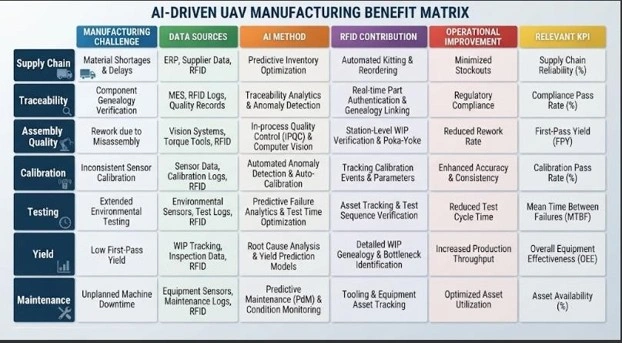
UAV Manufacturing KPIs Supported by Connected Data
A well-designed AI and RFID solution should be evaluated using measurable manufacturing outcomes rather than RFID read counts alone. Relevant KPIs can include:
- Inventory accuracy
- Work-in-process accuracy
- First-pass yield
- Overall production cycle time
- Assembly cycle time
- Rework rate
- Defect rate
- Test pass rate
- Nonconformance rate
- Material shortage frequency
- Order fulfillment performance
- Production schedule adherence
- Component genealogy retrieval time
- Quality investigation time
- Asset identification accuracy
- Equipment utilization
- Production throughput
- Mean time to detect process anomalies
- Mean time to resolve manufacturing exceptions
- RFID event capture reliability
RFID read performance is still an important technical metric, but the business case should connect system performance to UAV manufacturing objectives. For example, improving the speed of component genealogy retrieval can have greater operational value than simply increasing the number of RFID reads if the manufacturer already has adequate identification coverage.
UAV Production Intelligence: Real-Time Operations Dashboard
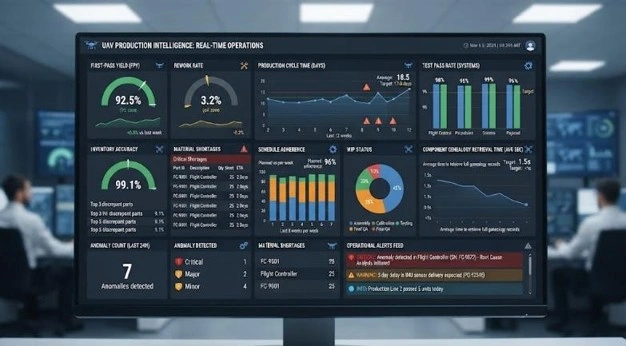
Integration with UAV Manufacturing Software
AI and RFID should not operate as isolated systems. Their value increases when identification and analytical information can be associated with existing manufacturing processes. Relevant software may include:
- Manufacturing Execution Systems (MES)
- Enterprise Resource Planning (ERP)
- Warehouse Management Systems (WMS)
- Quality Management Systems (QMS)
- Product Lifecycle Management (PLM) software
- Computerized Maintenance Management Systems (CMMS)
- Laboratory or test management systems
- Production scheduling software
- Supplier management systems
- Asset management applications
- Databases and analytics systems
Integration can use APIs, database interfaces, message queues, web services, or other supported enterprise integration methods. A practical data model should distinguish between a physical RFID event and a manufacturing event. For example, several low-level reads can be transformed into one validated event indicating that a serialized UAV assembly reached a specific production station. This approach prevents raw RFID traffic from overwhelming manufacturing databases and creates cleaner information for AI processing.
Communication and Data Infrastructure
UAV manufacturing environments may combine wired Ethernet, industrial Wi-Fi, private wireless networks, and other communications technologies depending on facility requirements. RFID readers communicate with local processing equipment or software, while edge systems can handle time-sensitive processing close to the manufacturing operation. A resilient implementation should consider:
- Network availability
- Reader connectivity
- Data buffering
- Local processing
- Time synchronization
- Device monitoring
- API availability
- Database performance
- Cloud connectivity
- Backup communication paths where justified
Local buffering can be important because a temporary network interruption should not automatically result in the loss of critical production events.
RFID Deployment Considerations for UAV Components
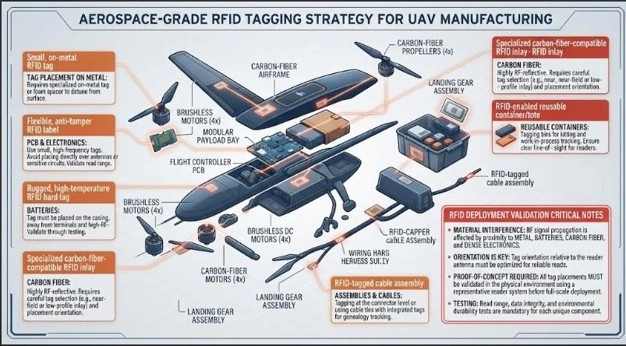
UAV manufacturing introduces material and electromagnetic considerations that should be addressed during system design. Carbon-fiber structures, metallic components, batteries, electronic assemblies, and densely packed equipment can affect RFID tag performance. Tag placement should therefore be validated on the actual component or assembly. Potential deployment locations include:
- Receiving stations
- Component storage areas
- Kitting stations
- Assembly cells
- Tool storage
- Test stations
- Quality inspection points
- Finished UAV storage
- Shipping areas
Not every component needs an RFID tag. Tagging strategy should be based on traceability requirements, component value, process risk, identification frequency, and technical feasibility. For critical serialized components, direct component identification may be appropriate. For smaller items, RFID-tagged bins or kits may provide a more practical approach.
Aerospace-Grade RFID Tagging Strategy for UAV Manufacturing
Testing, Commissioning, and Optimization
A production deployment should include structured testing before operational rollout. RFID commissioning should verify:
- Tag readability
- Reader coverage
- Read-zone behavior
- Read accuracy
- Reader interference
- Tag orientation sensitivity
- Detection at production speeds
- Duplicate-event handling
- Missed-read handling
- Middleware processing
- Database updates
- MES or ERP integration
- Alert generation
AI systems require a separate validation process. Data quality should be examined before model performance is evaluated. Important questions include:
- Is enough historical production data available?
- Are quality outcomes correctly labeled?
- Are production records complete?
- Are component identifiers consistent?
- Are process changes represented in the training data?
- How frequently should models be retrained?
- How will model drift be detected?
- Who approves AI-generated recommendations?
A pilot should establish baseline KPIs before deployment. After implementation, the same metrics can be compared to determine whether the system is delivering measurable operational improvement.
Cybersecurity and Access Control for UAV Manufacturing
UAV manufacturing may involve sensitive engineering information, production records, configuration information, and test data. Connected manufacturing systems should therefore be incorporated into the organization’s cybersecurity program. Security design should consider the complete data path from RFID reader to production application. Recommended controls include:
- Segmentation of manufacturing networks
- Least-privilege access
- Strong authentication
- Encrypted communications
- Secure API access
- Reader and gateway inventory
- Security patching
- Audit logging
- Backup and recovery
- Monitoring of abnormal access
- Controlled administrative privileges
AI models and databases should also be protected against unauthorized modification. Incorrect production data can produce incorrect analytical conclusions, making data integrity an important part of AI reliability.
Scaling AI and RFID Across UAV Production
A pilot deployment may begin with one production cell or a limited number of serialized assemblies. Scaling should occur only after technical and operational requirements have been validated. Expansion can progress from:
- One production station
- Multiple assembly stations
- Complete production lines
- Test and inspection operations
- Inventory and receiving
- Finished UAV operations
- Multiple manufacturing facilities
Standardized tag-selection criteria, reader configurations, event definitions, APIs, data models, and security controls can make expansion easier. Multi-site manufacturers may also benefit from centralized analytics while maintaining local production processing. This can allow engineers to compare production trends between facilities without requiring every operational function to depend on a remote system.
Practical Implementation Recommendations for UAV Manufacturers
A successful deployment should focus on measurable manufacturing problems rather than implementing RFID or AI simply because the technologies are available. Recommended practices include:
- Start with a clearly defined UAV manufacturing use case
- Identify the production events that require reliable traceability
- Select RFID frequency and tags according to actual component materials
- Test tag placement on production-equivalent UAV components
- Establish a consistent serialized asset and component data model
- Integrate RFID events with existing manufacturing software
- Use edge processing where low latency or local operation is important
- Establish data-quality controls before training AI models
- Keep human engineering review for consequential quality decisions
- Define cybersecurity requirements before connecting production systems
- Establish baseline KPIs before deployment
- Pilot the solution in a representative production environment
- Validate the system under realistic operating conditions
- Monitor AI model performance after deployment
- Expand to additional production processes only after measurable results are demonstrated
GAO can support organizations evaluating RFID, BLE, and IoT hardware and systems for connected manufacturing applications. The appropriate solution depends on the UAV production workflow, physical materials, required identification range, integration requirements, and operating environment.
The Future of AI-Enabled UAV Manufacturing
UAV manufacturing is becoming increasingly data-driven as manufacturers manage more complex configurations, tighter production requirements, advanced electronics, and increasingly connected test processes. AI can help manufacturers move from retrospective reporting toward predictive analysis. RFID contributes physical identification that connects digital records to the actual components and assemblies moving through production. Future implementations may combine RFID with computer vision, machine learning, edge computing, industrial IoT sensors, digital production records, and automated analytics. The objective is not simply to collect more data. It is to establish trustworthy relationships between physical UAV assets, manufacturing processes, engineering information, and business decisions. For UAV manufacturers, the strongest implementations will be those that improve traceability, quality, production efficiency, material availability, and engineering decision-making while fitting existing manufacturing processes.
Key Takeaways for AI and RFID in UAV Manufacturing
AI-enabled UAV manufacturing can use RFID-generated identification data as one component of a broader manufacturing information system. The combination can improve visibility across component receiving, kitting, assembly, inspection, testing, inventory, and finished UAV operations. Key technical insights include:
- AI can analyze production, quality, inventory, and testing data to identify patterns and anomalies.
- RFID can connect digital manufacturing records with physical UAV components and assemblies.
- Component genealogy can accelerate quality investigations and configuration analysis.
- AI can support material forecasting, production analysis, and rework investigation.
- Computer vision and RFID can complement each other by combining visual inspection with physical asset identity.
- Edge processing can support local event processing and resilient manufacturing operations.
- Cloud and privately hosted server deployments can address different operational and data-control requirements.
- Cybersecurity, data integrity, and access control should be considered throughout deployment.
- KPI-based validation is more meaningful than measuring RFID activity alone.
- Pilot testing with real UAV components and production workflows is essential before large-scale deployment.
GAO provides RFID, BLE, IoT, and related hardware products and systems that can help organizations build connected manufacturing processes. Organizations evaluating AI-enabled UAV manufacturing can examine their current traceability, production, quality, inventory, and testing challenges to determine where connected identification and AI analytics can provide the greatest practical value.
Building the Future of Industrial AI and IoT with Aperture Venture Studio and GAO RFID Inc.
For more than three decades, GAO Group of Companies has invested heavily in R&D for industrial RFID, BLE, and IoT. As AI became increasingly useful in industrial applications, we expanded our work in AI and IoT, including RFID and BLE technologies, and founded Aperture Venture Studio to support the development and scaling of AI and IoT solutions relevant to industrial applications such as UAV manufacturing. Aperture brings together technical experts, operational leaders, investors, and companies working across AI and IoT. We have also developed Aperture Ventures Summit and TekSummit to facilitate discussions on advanced AI and IoT topics. We welcome you to participate as:
- Advisors, co-founders, or employees
- Investors
- Customers