
AI and RFID for Underground Mining: Intelligent Workforce Safety, Asset Visibility, and Operational Intelligence
Intelligent Underground Mining with AI and RFID
Underground mining is one of the world’s most technically demanding industrial environments, requiring continuous visibility into personnel, equipment, materials, and underground conditions to maintain safe and productive operations. AI and RFID enable mining organizations to identify, locate, monitor, and optimize critical resources throughout underground tunnels while transforming operational data into actionable intelligence. RFID technologies, including UHF RFID, HF RFID, and LF RFID, automatically identify miners, mobile equipment, tools, consumables, explosives, spare parts, and production assets. Artificial intelligence continuously analyzes RFID events together with sensor data, production information, maintenance records, ventilation conditions, and fleet activity to detect abnormalities, predict equipment failures, optimize material movement, and improve workforce safety.
For underground mining operations, AI and RFID improve operational awareness, reduce equipment downtime, strengthen emergency preparedness, enhance regulatory compliance, and support more efficient production planning. Rather than replacing mining personnel, AI assists engineers, mine supervisors, dispatchers, maintenance planners, and safety managers by providing intelligent recommendations based on continuously collected operational data. GAO has supplied RFID hardware products, IoT systems, and technical expertise that help industrial organizations improve visibility, operational reliability, and asset intelligence across demanding environments such as underground mining.
AI and RFID-Enabled Smart Underground Mining Operations Architecture
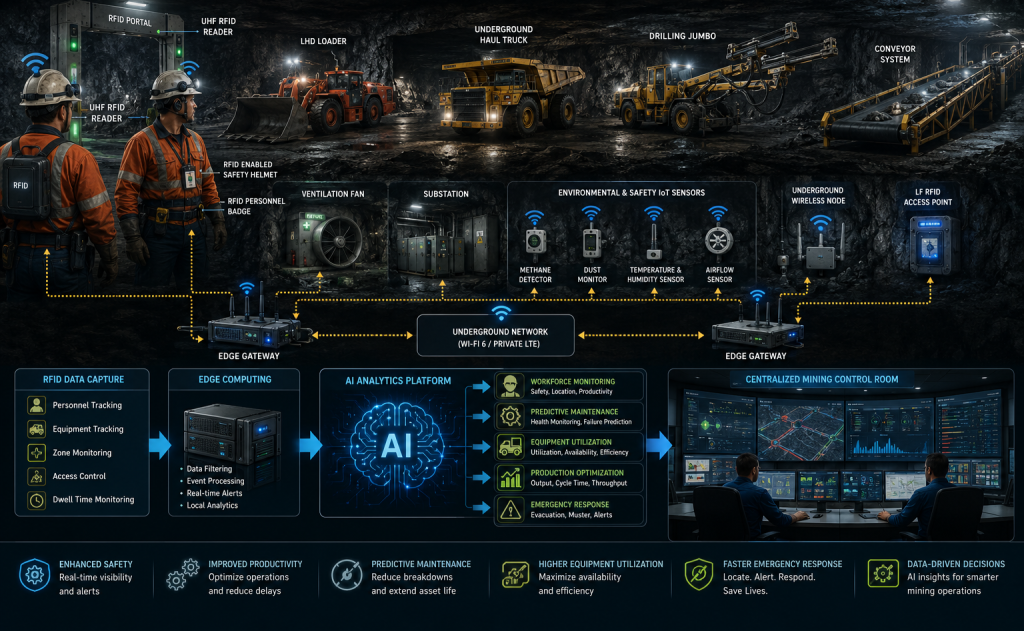
A comprehensive hero illustration depicting an underground hard rock mining operation powered by AI, RFID, and IoT technologies. The visual shows RFID-enabled miners, connected mining equipment, environmental monitoring sensors, underground communication infrastructure, edge computing gateways, AI analytics, and a centralized control room, with data flows demonstrating real-time workforce monitoring, predictive maintenance, production optimization, equipment utilization, and emergency response
Understanding AI and RFID for Underground Mining
Underground mining depends on precise coordination between personnel, production equipment, ventilation systems, material handling processes, and safety infrastructure. Traditional manual tracking methods often provide incomplete operational visibility because personnel and assets continuously move through extensive tunnel networks where GPS signals are unavailable. AI and RFID overcome these limitations by creating a continuously updated digital representation of underground operations based on automated identification and intelligent data analysis.
RFID functions as the identification layer by assigning a unique digital identity to workers, vehicles, machinery, tools, production materials, maintenance components, and safety equipment. Fixed readers installed at mine portals, shaft stations, haulage drifts, conveyor transfer points, maintenance workshops, refuge chambers, explosives magazines, and production levels automatically capture RFID tag information whenever tagged assets move through monitored locations. Handheld RFID readers support inventory verification, inspection activities, maintenance operations, and field audits where fixed infrastructure is impractical.
Artificial intelligence functions as the decision-making layer by continuously processing RFID events alongside operational information collected from industrial IoT sensors, fleet management systems, ventilation monitoring systems, geotechnical monitoring equipment, production databases, and maintenance management software. AI models recognize operational patterns, identify deviations from expected behavior, predict equipment failures, optimize dispatch decisions, and generate recommendations that help mining personnel improve productivity while maintaining strict safety standards.
Together, AI, RFID, industrial IoT, and mining software create an intelligent operational system capable of supporting real-time situational awareness throughout underground mining operations.
RFID Technologies Used in Underground Mining
Different RFID frequencies provide unique operational advantages depending on environmental conditions, reading distance, asset characteristics, and application requirements.
UHF RFID
UHF RFID provides longer reading distances and supports automated identification of moving assets throughout underground transportation routes.
Typical underground mining applications include:
- Underground haul truck identification
- LHD loader tracking
- Conveyor belt asset monitoring
- Ore cart identification
- Underground warehouse inventory
- Production material movement
- Spare parts logistics
- Vehicle checkpoint monitoring
HF RFID
HF RFID performs well where shorter reading distances and secure data exchange are required.
Typical applications include:
- Maintenance history recording
- Equipment inspection logs
- Tool management
- Calibration records
- Maintenance documentation
- Underground workshop operations
- Component lifecycle management
LF RFID
LF RFID provides reliable performance around metal structures, moisture, dust, vibration, and harsh underground environments where other identification technologies may experience reduced performance.
Typical applications include:
- Personnel identification
- Mine access control
- Refuge chamber access
- Emergency accountability
- Safety equipment identification
- Underground checkpoint verification
- Hazardous area authorization
Why Artificial Intelligence Is Essential for Underground Mining
Modern underground mining operations generate millions of operational events every day. RFID systems continuously identify equipment movements, worker locations, maintenance activities, production material transfers, and logistics operations. Environmental monitoring systems simultaneously measure methane concentration, oxygen levels, carbon monoxide, temperature, humidity, dust concentration, airflow, vibration, and ground stability.
Artificial intelligence transforms these independent data streams into operational intelligence by identifying relationships that would be difficult for human operators to recognize manually.
AI continuously evaluates:
- Equipment utilization patterns
- Fleet congestion
- Worker movement trends
- Maintenance history
- Conveyor throughput
- Ore transportation efficiency
- Shift productivity
- Ventilation performance
- Production bottlenecks
- Safety compliance
- Underground traffic flow
- Resource allocation
Machine learning models improve prediction accuracy as historical operational information accumulates, enabling increasingly reliable recommendations for maintenance planning, workforce deployment, production scheduling, and operational risk management. This allows mine operators to move from reactive decision-making toward predictive and condition-based operational management while reducing unplanned downtime and improving worker safety.
AI and RFID Applications Across Underground Mining Operations
AI and RFID technologies deliver value throughout the complete underground mining lifecycle, from personnel access and production development to ore extraction, material transportation, maintenance, emergency preparedness, and regulatory compliance. Unlike surface mining operations, underground mines operate in GPS-denied environments where continuous asset visibility and personnel accountability are critical for both operational efficiency and worker safety.
GAO has helped industrial organizations deploy RFID hardware products and AIoT solutions that improve operational visibility, equipment utilization, and workforce management in challenging industrial environments where reliability is essential.
Workforce Identification and Personnel Safety
Worker accountability is among the highest priorities in underground mining. Every miner, contractor, maintenance technician, geologist, blasting specialist, surveyor, and emergency response team member can be equipped with an RFID-enabled identification badge or integrated RFID safety helmet.
RFID readers positioned at shaft entrances, decline portals, production levels, refuge chambers, maintenance areas, and restricted zones automatically record personnel movement without requiring manual check-ins.
AI continuously evaluates personnel movement to identify:
- Workers entering restricted areas
- Personnel remaining underground after shift completion
- Lone worker situations
- Missed checkpoint events
- Unexpected movement patterns
- Emergency evacuation progress
- Unauthorized access attempts
- Workforce distribution across production levels
- Delayed response during emergency drills
These capabilities improve emergency accountability while helping mine supervisors optimize workforce deployment throughout underground operations.
Mobile Equipment Identification and Fleet Optimization
Underground mining depends on a diverse fleet of specialized mobile equipment operating simultaneously through confined haulage drifts and production headings.
Typical assets include:
- Load Haul Dump (LHD) loaders
- Underground haul trucks
- Development drilling jumbo rigs
- Production drilling rigs
- Roof bolters
- Scaling machines
- Shotcrete sprayers
- Explosive charging vehicles
- Utility vehicles
- Personnel carriers
- Fuel service trucks
- Water service vehicles
RFID portals automatically identify each vehicle as it passes strategic underground checkpoints.
AI analyzes fleet movement to optimize:
- Equipment dispatch
- Production routing
- Waiting time at ore passes
- Loading cycle efficiency
- Traffic congestion
- Haul route utilization
- Equipment idle time
- Fuel consumption
- Equipment availability
Operations managers gain continuous visibility into fleet utilization while reducing unnecessary equipment movement and production delays.
Tool Tracking and Maintenance Asset Management
Underground maintenance operations rely on thousands of specialized tools, diagnostic instruments, replacement components, hydraulic assemblies, electrical equipment, ventilation parts, and safety devices distributed across multiple underground workshops and storage locations.
RFID enables automatic identification of:
- Torque tools
- Hydraulic pumps
- Welding equipment
- Portable gas detectors
- Ventilation instruments
- Electrical testing devices
- Battery-powered tools
- Spare motors
- Conveyor rollers
- Gearboxes
- Bearings
- Hydraulic cylinders
- Mechanical seals
AI evaluates historical tool usage, maintenance demand, and inventory turnover to recommend:
- Inventory replenishment
- Spare parts optimization
- Preventive maintenance scheduling
- Calibration planning
- Tool allocation between work crews
- Workshop inventory balancing
This reduces maintenance delays while improving equipment readiness.
Ore Movement and Material Traceability
Material movement within underground mines involves multiple interconnected production processes including drilling, blasting, loading, hauling, crushing, conveying, hoisting, stockpiling, and processing.
RFID automatically records material movement throughout these processes by identifying:
- Ore carts
- Production containers
- Conveyor transfer equipment
- Sampling containers
- Processing batches
- Concentrate shipments
- Waste rock movement
- Maintenance materials
AI combines RFID events with production data to optimize:
- Ore routing
- Production scheduling
- Crusher utilization
- Conveyor loading balance
- Stockpile management
- Mill feed consistency
- Material traceability
- Production reporting accuracy
Production engineers obtain better visibility into ore flow while minimizing bottlenecks across underground material handling operations.
Ventilation Infrastructure Monitoring
Ventilation systems are fundamental to underground mining safety. Fans, regulators, ventilation doors, ducting systems, air quality monitoring devices, and emergency ventilation equipment require continuous monitoring to maintain safe working conditions.
RFID simplifies identification and maintenance tracking for ventilation assets while AI analyzes operational information collected from environmental monitoring systems.
AI supports:
- Ventilation equipment maintenance planning
- Airflow optimization
- Ventilation circuit analysis
- Energy consumption reduction
- Equipment condition assessment
- Critical component replacement planning
- Maintenance prioritization
When integrated with environmental sensors, AI helps detect abnormal ventilation performance before conditions affect production or worker safety.
Underground Emergency Response and Incident Management
Emergency response requires immediate knowledge of personnel locations, equipment availability, refuge chamber occupancy, emergency supplies, and evacuation status.
RFID automatically identifies:
- Personnel entering refuge chambers
- Emergency response equipment
- Medical supplies
- Rescue vehicles
- Emergency breathing apparatus
- Fire suppression equipment
- Communication devices
AI supports emergency coordinators by:
- Identifying missing personnel
- Calculating evacuation progress
- Recommending evacuation routes
- Locating rescue resources
- Prioritizing incident response
- Predicting congestion during evacuation
- Monitoring emergency equipment availability
These capabilities significantly improve situational awareness during critical incidents.
AI and RFID-Enabled Underground Mining Operations Workflow
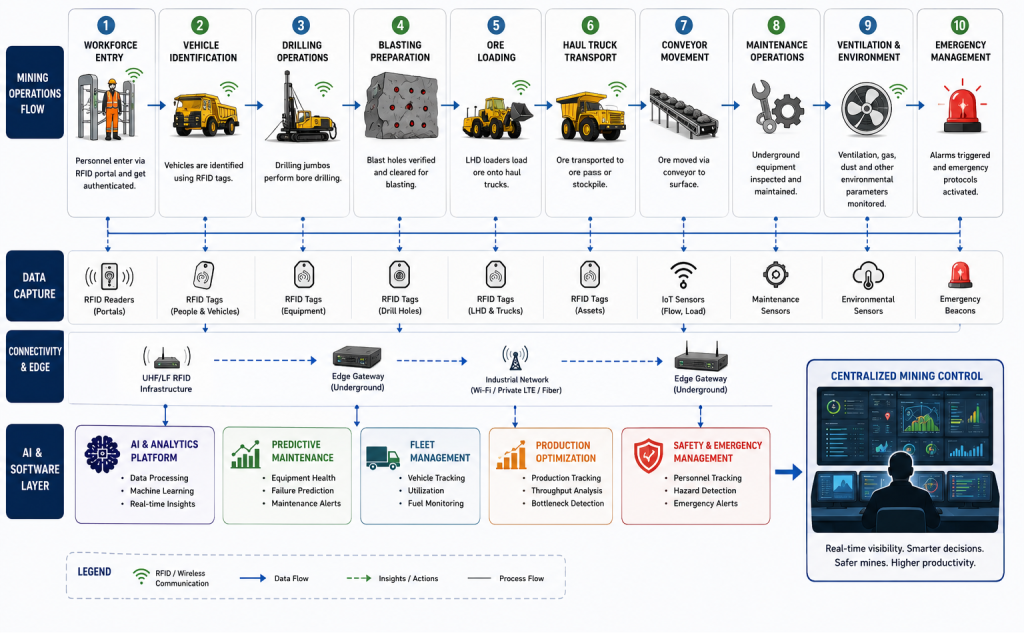
A simplified workflow diagram showing how AI, RFID, and IoT technologies support underground mining operations from workforce entry and equipment identification through drilling, ore transportation, maintenance, environmental monitoring, and emergency management. The workflow illustrates how operational data is collected, transmitted through edge gateways, analyzed by AI software, and displayed in a centralized mining control room to improve safety, productivity, and asset performance.
End-to-End Operational Workflow for AI and RFID in Underground Mining
Successful AI and RFID deployments follow a structured operational workflow that transforms physical mining activities into actionable operational intelligence. Each stage contributes to improved visibility, faster decision-making, safer operations, and higher production efficiency.
Stage 1: RFID Data Acquisition
Operational data collection begins as RFID readers capture the identities of tagged personnel, mobile equipment, tools, materials, spare parts, and production assets at key underground locations.
Typical data acquisition points include:
- Mine portals
- Shaft stations
- Decline entrances
- Underground workshops
- Ore passes
- Conveyor transfer stations
- Fuel bays
- Explosives magazines
- Refuge chambers
- Warehouse facilities
- Maintenance shops
- Loading and dumping points
Each RFID event records the asset identity, reader location, timestamp, and movement direction, creating a continuous digital record of underground activities.
Stage 2: Environmental and Operational Data Collection
Alongside RFID identification, industrial IoT devices continuously collect operational data from underground systems, including:
- Methane concentration
- Oxygen levels
- Carbon monoxide
- Temperature
- Relative humidity
- Dust concentration
- Airflow velocity
- Equipment vibration
- Hydraulic pressure
- Electrical load
- Conveyor speed
- Pump performance
- Ground movement
- Water inflow
- Energy consumption
Combining RFID events with sensor measurements creates a comprehensive operational dataset that supports advanced AI analysis.
Stage 3: Secure Data Transmission
Collected information is transmitted through resilient underground communication systems designed for harsh mining environments. Depending on mine design and operational requirements, communication may include fiber optic backbones, industrial Ethernet, leaky feeder systems, industrial Wi-Fi, private LTE or 5G networks, and wireless mesh connections. Edge gateways aggregate RFID and sensor data, apply initial validation, and securely forward information to higher-level software for analytics and decision support. This distributed communication approach minimizes latency, maintains data integrity, and supports continuous operation even in areas with intermittent connectivity.
RFID Infrastructure, AI Technologies, and System Components for Underground Mining
A successful AI and RFID solution for underground mining combines rugged RFID hardware, industrial communication networks, intelligent software, AI models, cybersecurity controls, and integration with mining management systems. Every component contributes to maintaining continuous operational visibility despite harsh underground conditions such as dust, vibration, moisture, metallic interference, confined spaces, and limited communication coverage.
Rather than functioning as isolated technologies, RFID, AI, industrial IoT, edge computing, and mining software operate as a coordinated system that supports worker safety, equipment management, production optimization, maintenance planning, and regulatory compliance. GAO has supplied RFID hardware products and industrial IoT solutions that help mining organizations deploy reliable identification and monitoring systems capable of operating in demanding underground environments.
RFID Hardware Components
Reliable hardware selection is critical because underground mining environments expose equipment to shock, vibration, dust, humidity, water ingress, corrosive conditions, and mechanical impacts.
Typical RFID hardware includes:
- UHF RFID fixed readers
- HF RFID readers
- LF RFID readers
- Multi-frequency RFID readers
- Rugged handheld RFID readers
- RFID tunnel portals
- Vehicle-mounted RFID readers
- Explosion-resistant RFID reader enclosures
- RFID antennas for narrow tunnel installations
- Circular polarization antennas
- Directional antennas
- Industrial RFID printers and encoders
- Intrinsically safe RFID personnel badges
- RFID safety helmet tags
- Equipment identification tags
- Metal-mount RFID tags
- High-temperature RFID tags
- Impact-resistant RFID asset tags
- Chemical-resistant RFID labels
- Battery-assisted passive RFID tags for long-range applications
Hardware selection depends on reading distance, environmental conditions, installation location, tag density, asset type, and operational objectives.
Industrial IoT Sensors Supporting AI Analysis
RFID identifies assets and personnel, while industrial IoT sensors provide the operational context that AI requires for intelligent decision-making.
Common underground mining sensors include:
- Methane sensors
- Oxygen sensors
- Carbon monoxide sensors
- Carbon dioxide sensors
- Hydrogen sulfide sensors
- Airflow sensors
- Differential pressure sensors
- Temperature sensors
- Humidity sensors
- Dust concentration monitors
- Vibration sensors
- Acoustic monitoring sensors
- Motor current sensors
- Hydraulic pressure sensors
- Oil condition sensors
- Conveyor speed sensors
- Belt alignment sensors
- Pump flow sensors
- Ground deformation sensors
- Rock movement monitoring instruments
- Water level sensors
- Energy meters
- Power quality analyzers
AI combines RFID identification with these sensor measurements to generate operational intelligence that supports safer and more efficient mining activities.
Artificial Intelligence Models Used in Underground Mining
Different AI techniques solve different operational challenges throughout underground mining.
Machine Learning
Machine learning analyzes historical production data, RFID events, maintenance records, and environmental measurements to identify operational trends and predict future outcomes.
Typical applications include:
- Equipment failure prediction
- Maintenance forecasting
- Production optimization
- Fleet utilization analysis
- Spare parts forecasting
- Energy consumption prediction
Deep Learning
Deep learning processes complex datasets generated from underground monitoring systems and industrial sensors.
Typical applications include:
- Equipment anomaly detection
- Underground traffic pattern analysis
- Production forecasting
- Ventilation performance modeling
- Conveyor performance optimization
Computer Vision
When integrated with underground cameras, computer vision enhances RFID data by analyzing operational activities visually.
Typical applications include:
- PPE compliance verification
- Conveyor belt inspection
- Ore fragmentation assessment
- Equipment damage detection
- Tunnel obstruction identification
- Rock fall monitoring
- Vehicle traffic analysis
Predictive Analytics
Predictive analytics evaluates historical operational performance together with current RFID events to estimate future operational conditions.
Typical outputs include:
- Remaining useful life of equipment
- Maintenance priorities
- Component replacement schedules
- Production bottleneck prediction
- Fleet demand forecasting
- Ventilation maintenance planning
Optimization Algorithms
Optimization models evaluate thousands of operational variables simultaneously to improve resource allocation.
Typical optimization objectives include:
- Haul route selection
- Equipment dispatching
- Shift scheduling
- Maintenance resource allocation
- Underground traffic management
- Warehouse inventory optimization
- Production sequencing
Communication Infrastructure
Reliable communications are essential because underground mines span extensive tunnel networks where uninterrupted data exchange directly affects operational awareness and safety.
Common communication technologies include:
- Industrial Ethernet
- Fiber optic backbone networks
- Industrial Wi-Fi
- Private LTE
- Private 5G
- Leaky feeder communication systems
- Wireless mesh networks
- Serial communication links
- Redundant network switches
- Industrial edge gateways
Frequently used communication protocols include:
- MQTT
- OPC UA
- Modbus TCP
- Modbus RTU
- EtherNet/IP
- PROFINET
- REST APIs
- HTTPS
- AMQP
- SNMP
These technologies enable secure and reliable transmission of RFID events, environmental sensor readings, equipment diagnostics, maintenance information, and production data between underground operations and centralized control systems.
AI and RFID Solution Stack for Underground Mining
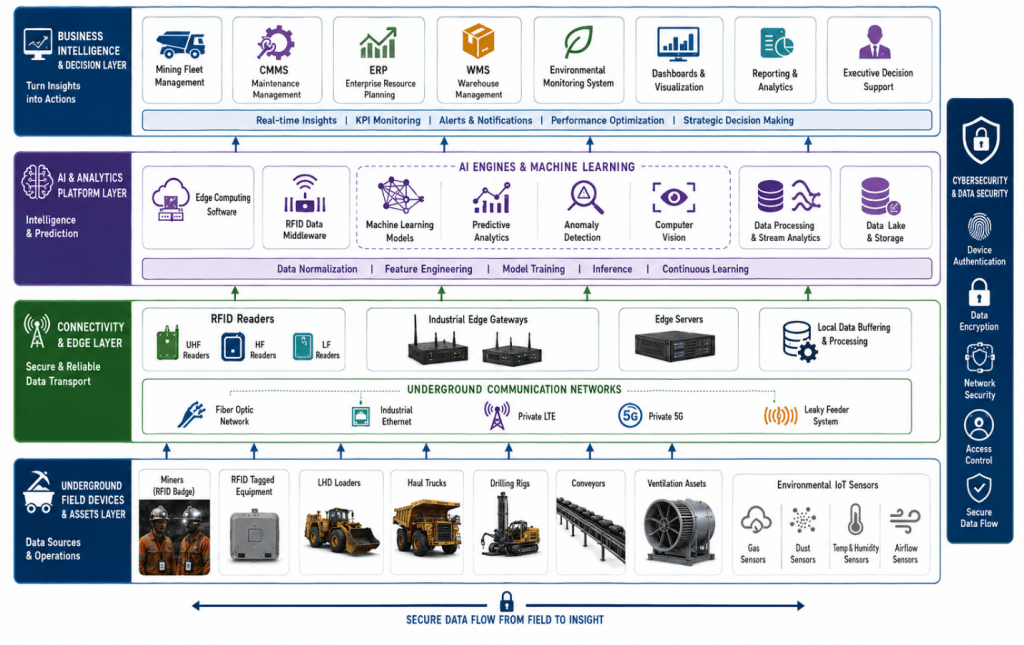
A layered system architecture illustrating how AI, RFID, and IoT technologies integrate across underground mining operations. The diagram shows field devices and RFID-tagged assets connected through underground communication networks and edge gateways to AI analytics platforms, with processed data delivered to enterprise applications, operational dashboards, and executive decision support systems for real-time monitoring and optimized decision-making.
Cloud and Server Deployment Models for AI and RFID in Underground Mining
Selecting the appropriate deployment model is one of the most important engineering decisions for AI and RFID solutions in underground mining. The decision affects system performance, cybersecurity, operational resilience, regulatory compliance, scalability, maintenance responsibilities, and disaster recovery planning. Many mining organizations adopt a hybrid approach, where time-sensitive operational processing occurs on privately managed infrastructure while long-term analytics and reporting are supported through cloud services.
GAO has helped organizations evaluate deployment requirements and supply RFID hardware and IoT systems that integrate with both cloud-hosted and privately managed software environments.
Cloud Version
The Cloud Version uses software hosted within managed cloud infrastructure while RFID readers, edge gateways, and underground IoT devices continue operating locally within the mine. Operational data is securely transmitted from underground communications networks to cloud-hosted applications for centralized processing, reporting, analytics, and long-term storage.
Typical cloud-hosted software includes:
- RFID management software
- AI analytics software
- Asset management software
- Fleet performance dashboards
- Predictive maintenance software
- Workforce management software
- Environmental monitoring software
- Reporting and business intelligence tools
- Data lake repositories
- Historical operational databases
Cloud deployments are particularly appropriate when organizations operate multiple underground mines across different geographical regions and require centralized operational visibility.
Advantages include:
- Centralized monitoring across multiple mining sites
- Simplified software updates
- Elastic computing resources for AI workloads
- Long-term historical data storage
- Faster deployment of new analytical models
- Easier collaboration between regional engineering teams
- Remote access for technical specialists
- Simplified disaster recovery planning
Engineering considerations include:
- Reliable external network connectivity
- Data synchronization policies
- Operational latency requirements
- Regulatory data residency requirements
- Secure encrypted communications
- Identity and access management
- Network redundancy
Operational control functions that require millisecond response times generally remain at the edge even when higher-level analytics are processed in the cloud.
Server Version
The Server Version deploys software on customer-managed infrastructure located within the mining organization’s private data center, regional operations center, or dedicated industrial server environment. Processing may also occur on ruggedized edge servers installed near underground communication hubs or surface control rooms.
This deployment model provides organizations with direct control over software, operational data, cybersecurity policies, and infrastructure management.
Typical privately managed software includes:
- RFID middleware
- Fleet management software
- Maintenance management software
- Production reporting systems
- Dispatch software
- AI inference services
- Historian databases
- Environmental monitoring software
- Identity management systems
Advantages include:
- Greater control over operational information
- Reduced dependence on external connectivity
- Lower communication latency
- Simplified compliance with internal security policies
- Local processing for safety-critical applications
- High availability during external network interruptions
- Flexible integration with existing mining systems
Organizations operating remote mines with intermittent wide-area connectivity frequently prefer privately managed deployments because operational decision-making remains available even when external communication links experience interruptions.
Hybrid Deployment
Many underground mining companies implement a hybrid deployment strategy that combines local processing with cloud-based analytics.
A typical hybrid deployment performs:
Local processing
- Personnel accountability
- Equipment identification
- Emergency notifications
- Vehicle dispatch
- Access control
- Environmental monitoring
- Ventilation alarms
- Production event collection
Cloud processing
- Predictive maintenance
- Historical trend analysis
- AI model training
- Fleet benchmarking
- Executive reporting
- Multi-site operational comparisons
- Long-term production optimization
- Enterprise business intelligence
This approach balances operational resilience with advanced analytical capabilities.
Comparison Table: Cloud vs. Server vs. Hybrid Deployment for AI and RFID in Underground Mining
| Feature | ☁️ Cloud Version | 🖥️ Server Version (On-Premises) | 🔄 Hybrid Deployment |
| Deployment Location | Public or private cloud | On-site mining data center | Combination of on-site servers and cloud |
| Processing Latency | Moderate (network dependent) | Very low | Low for critical tasks; moderate for cloud analytics |
| Operational Resilience | Depends on internet connectivity | High during network outages | Very high with local and cloud redundancy |
| Maintenance Responsibility | Cloud service provider | Mining organization IT team | Shared between provider and mining IT |
| Cybersecurity Control | Shared responsibility model | Full organizational control | Shared with enhanced local security |
| AI Processing | Centralized cloud AI and analytics | Local AI inference and analytics | Edge AI with cloud-based advanced analytics |
| Disaster Recovery | Built-in cloud backup and recovery | Organization-managed backup systems | Local failover with cloud disaster recovery |
| Scalability | Excellent; resources scale on demand | Limited by on-site infrastructure | High scalability with flexible expansion |
| Integration Flexibility | Easy integration with cloud applications | Best for legacy mining systems | Supports both legacy and cloud platforms |
| Connectivity Requirements | Reliable internet connection required | Operates independently of internet | Local operations continue; cloud sync when connected |
| Recommended Underground Mining Use Cases | Multi-site mining operations, centralized analytics, remote monitoring | High-security mines, low-latency control, isolated operations | Large underground mines requiring real-time control with enterprise-wide analytics |
Enterprise Software Integration
AI and RFID systems deliver the greatest operational value when they exchange information with the software already used to manage underground mining operations. Integration eliminates duplicate data entry, improves information consistency, and enables automated workflows across production, maintenance, logistics, safety, and compliance.
Common integration targets include:
- Computerized Maintenance Management Systems (CMMS)
- Enterprise Resource Planning (ERP) software
- Mine Planning software
- Fleet Management Systems (FMS)
- Warehouse Management Systems (WMS)
- Human Resource Information Systems (HRIS)
- Learning Management Systems (LMS)
- Environmental Monitoring Systems
- Production Reporting Systems
- Laboratory Information Management Systems (LIMS)
- Safety Management Systems
- Geographic Information Systems (GIS)
- Business Intelligence software
- Document Management Systems
AI uses integrated operational information to produce recommendations that are based on a comprehensive understanding of mining activities rather than isolated RFID events.
Examples include:
- Automatically generating maintenance work orders when RFID movement history and vibration analysis indicate abnormal equipment behavior.
- Updating equipment availability after maintenance completion.
- Synchronizing workforce attendance with shift management software.
- Recording production movements as ore passes through RFID checkpoints.
- Verifying that inspection tools have valid calibration records before underground use.
- Updating warehouse inventory immediately after spare parts are issued.
These integrations reduce manual administration while improving operational accuracy across underground mining activities.
Edge Computing for Underground Mining
Edge computing plays a critical role because underground mining operations cannot always depend on uninterrupted communication with centralized computing resources.
Edge servers positioned within mine communication rooms or surface control facilities perform local processing for:
- RFID event filtering
- Personnel accountability
- Equipment identification
- Access authorization
- Alarm generation
- Environmental threshold monitoring
- AI inference
- Local dashboard updates
- Temporary operational data storage
Processing information close to operational activities reduces latency, minimizes bandwidth consumption, and allows essential safety functions to continue operating during communication disruptions.
Modern edge computing solutions also synchronize operational information with higher-level software once communication paths become available, ensuring consistent historical records without interrupting mining operations.
Cybersecurity and System Reliability for AI and RFID in Underground Mining
Cybersecurity is a fundamental engineering requirement for AI and RFID deployments in underground mining because operational technology (OT), information technology (IT), and connected IoT devices exchange safety-critical information that directly influences workforce protection, equipment operation, production continuity, and regulatory compliance. A cybersecurity strategy should protect RFID infrastructure, AI software, communication networks, industrial servers, edge computing devices, and integrated mining applications throughout their operational lifecycle.
GAO supports organizations by supplying industrial RFID hardware and IoT systems that can be incorporated into secure mining environments while following established cybersecurity and operational reliability practices.
Identity and Access Management
Only authorized personnel should be permitted to access operational software, RFID configuration tools, AI applications, and administrative functions.
Recommended practices include:
- Multi-factor authentication (MFA)
- Role-based access control (RBAC)
- Least-privilege access policies
- Centralized identity management
- Single sign-on where appropriate
- Strong password policies
- Privileged account monitoring
- Periodic access reviews
- Automatic session timeout
- Secure credential management
These controls reduce the risk of unauthorized configuration changes or operational disruptions.
Data Protection
Operational information generated from RFID readers, industrial sensors, AI analytics, and mining software should remain protected throughout collection, transmission, storage, and reporting.
Recommended controls include:
- TLS encryption for data in transit
- AES encryption for stored information
- Secure database management
- Digital certificates
- Secure key management
- Encrypted backups
- Database integrity verification
- Data retention policies
- Secure archival procedures
- Controlled data deletion
Protecting operational data improves regulatory compliance while preserving production history and maintenance records.
Network Security
Underground communication systems connect RFID readers, edge gateways, industrial controllers, AI software, and enterprise applications. Network segmentation reduces the impact of potential cybersecurity incidents.
Typical security controls include:
- Industrial firewalls
- VLAN segmentation
- Secure VPN connections
- Intrusion detection systems
- Intrusion prevention systems
- Network traffic monitoring
- Secure remote maintenance access
- Device authentication
- MAC address management
- Continuous network logging
Separating operational networks from business networks reduces cybersecurity risk while maintaining operational continuity.
Operational Resilience
Mining operations require continuous availability even when communication failures or hardware faults occur.
Engineering best practices include:
- Redundant RFID readers at critical checkpoints
- Dual power supplies for edge servers
- Uninterruptible power supplies (UPS)
- High-availability server clusters
- Automatic database replication
- Network redundancy
- Backup communication links
- Regular backup validation
- Disaster recovery testing
- Preventive infrastructure maintenance
These measures help maintain operational visibility during equipment failures or planned maintenance activities.
Cybersecurity Architecture for AI and RFID-Enabled Underground Mining
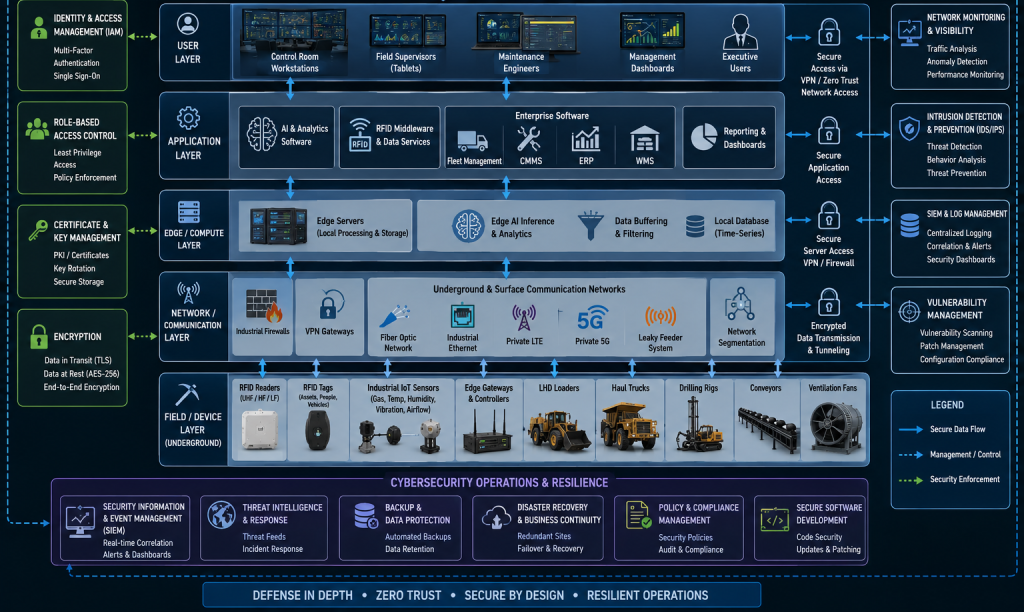
A layered cybersecurity block diagram illustrating how AI, RFID, and industrial IoT systems in underground mining are protected from field devices to enterprise applications. The visual shows secure data flow through RFID readers, IoT sensors, edge gateways, communication networks, AI platforms, enterprise software, and user workstations, surrounded by multiple cybersecurity controls including identity management, encryption, industrial firewalls, intrusion detection, SIEM, backup systems, disaster recovery, VPNs, and role-based access control.
Technical Capabilities of AI and RFID for Underground Mining
Combining AI with RFID enables underground mining organizations to move beyond simple identification and tracking. The solution continuously transforms operational events into actionable intelligence that supports safer working conditions, improved equipment performance, more efficient production, and informed operational decision-making.
Real-Time Operational Visibility
RFID continuously identifies personnel, equipment, production materials, and critical assets as they move throughout underground workings. AI consolidates this information into real-time operational dashboards that provide supervisors, dispatchers, maintenance planners, and control room personnel with current operational status.
Capabilities include:
- Personnel accountability
- Equipment location tracking
- Fleet utilization monitoring
- Material movement visibility
- Maintenance status monitoring
- Inventory visibility
- Shift progress monitoring
- Production tracking
This visibility allows operational decisions to be based on current field conditions rather than delayed manual reports.
Predictive Maintenance
AI analyzes RFID history together with sensor measurements, maintenance records, equipment operating hours, vibration patterns, temperature trends, lubrication history, hydraulic performance, and electrical parameters.
The system supports:
- Failure prediction
- Remaining useful life estimation
- Maintenance prioritization
- Spare parts forecasting
- Maintenance scheduling
- Equipment health scoring
- Downtime reduction
- Maintenance cost optimization
Predictive maintenance reduces unexpected failures while improving equipment availability and maintenance planning.
Intelligent Fleet Management
Underground mobile equipment represents one of the largest operational investments within a mining operation.
AI evaluates:
- Vehicle movement
- Loading cycles
- Haul routes
- Waiting times
- Traffic congestion
- Idle periods
- Fuel consumption
- Operator utilization
Optimization recommendations improve fleet productivity while reducing unnecessary equipment movement.
Enhanced Workforce Safety
RFID provides continuous awareness of workforce location while AI evaluates movement patterns and environmental conditions to improve safety management.
Capabilities include:
- Restricted area monitoring
- Emergency accountability
- Evacuation monitoring
- Lone worker protection
- Workforce density analysis
- Shift compliance
- Hazard exposure monitoring
- Emergency resource coordination
These capabilities support both routine operations and emergency response planning.
Production Optimization
AI combines RFID movement history with production reporting to improve overall mining efficiency.
Optimization areas include:
- Ore flow balancing
- Conveyor utilization
- Crusher feed consistency
- Material routing
- Shift productivity
- Production scheduling
- Resource allocation
- Loading efficiency
Operational managers gain improved visibility into production bottlenecks and opportunities for process improvement.
Business Benefits of AI and RFID in Underground Mining
Successful AI and RFID implementations deliver measurable operational and financial improvements across underground mining operations.
Operational benefits include:
- Improved personnel accountability
- Greater equipment visibility
- Reduced equipment downtime
- Faster maintenance response
- Improved production planning
- Better inventory accuracy
- Reduced manual data collection
- Enhanced emergency preparedness
- Improved ventilation management
- Better utilization of underground assets
Business benefits include:
- Lower operating costs
- Increased equipment utilization
- Improved workforce productivity
- Reduced maintenance expenditure
- Improved regulatory compliance
- Better operational reporting
- Increased production consistency
- More accurate capital planning
- Improved risk management
- Stronger long-term operational resilience
Key performance indicators (KPIs) commonly improved include:
- Equipment availability
- Mean Time Between Failures (MTBF)
- Mean Time to Repair (MTTR)
- Overall Equipment Effectiveness (OEE)
- Fleet utilization
- Ore throughput
- Shift productivity
- Maintenance compliance
- Inventory accuracy
- Personnel accountability rate
- Emergency response time
- Production schedule adherence
These measurable improvements help underground mining organizations achieve both operational excellence and long-term business sustainability while maintaining a strong focus on workforce safety and regulatory compliance.
Engineering Best Practices and Implementation Recommendations
Successful AI and RFID deployments in underground mining require more than selecting appropriate hardware. Long-term performance depends on careful planning, engineering validation, communication reliability, system integration, cybersecurity, and continuous operational optimization. Each underground mine has unique geological conditions, tunnel layouts, production methods, ventilation systems, and operational procedures that influence system design.
GAO has supported industrial organizations by supplying RFID hardware products and IoT solutions while assisting customers in selecting technologies appropriate for demanding industrial environments.
Deployment Planning
A successful implementation begins with a comprehensive assessment of operational requirements.
Planning activities typically include:
- Identifying operational objectives
- Mapping underground production levels
- Surveying shaft stations and decline access
- Evaluating communication coverage
- Identifying critical assets
- Selecting RFID tag types
- Determining reader locations
- Defining AI use cases
- Identifying software integration requirements
- Developing cybersecurity policies
- Planning system scalability
- Establishing project success criteria
Proper planning reduces implementation risks while improving long-term system performance.
RFID Hardware Selection
Hardware should be selected according to underground environmental conditions rather than price alone.
Engineering considerations include:
- Read distance requirements
- Metal interference
- Water exposure
- Dust concentration
- Shock resistance
- Vibration tolerance
- Temperature range
- Chemical exposure
- Explosion protection requirements
- Power availability
- Maintenance accessibility
- Expected service life
Selecting industrial-grade RFID hardware improves operational reliability and minimizes maintenance requirements.
Reader Placement Optimization
Reader placement has a significant impact on data quality.
Recommended installation locations include:
- Mine portals
- Shaft stations
- Decline entrances
- Production levels
- Haulage drifts
- Conveyor transfer points
- Maintenance workshops
- Underground warehouses
- Refuge chambers
- Fuel stations
- Explosives storage areas
- Vehicle maintenance facilities
Coverage validation should include field testing under normal production conditions to verify read accuracy, minimize blind spots, and optimize antenna orientation.
AI Model Development
Artificial intelligence performs best when trained using operational data collected from actual underground mining activities.
Recommended practices include:
- Using representative historical datasets
- Removing inaccurate records
- Validating sensor quality
- Retraining models periodically
- Monitoring prediction accuracy
- Comparing AI recommendations with engineering observations
- Documenting model assumptions
- Maintaining version control
- Testing new models before deployment
Continuous model refinement improves prediction accuracy as mining operations evolve.
Operational Commissioning
Before full production deployment, organizations should conduct comprehensive commissioning activities.
Typical validation includes:
- RFID read-rate verification
- Communication network testing
- AI model validation
- Software integration testing
- Alarm verification
- Emergency response simulations
- User acceptance testing
- Cybersecurity assessment
- Performance benchmarking
- Backup and recovery testing
Comprehensive commissioning minimizes operational disruption and improves user confidence.
Summary of AI and RFID for Underground Mining
AI and RFID have become important technologies for improving underground mining safety, operational efficiency, equipment management, and production visibility. RFID provides reliable identification of personnel, mobile equipment, production materials, maintenance assets, and critical infrastructure throughout GPS-denied underground environments. Artificial intelligence transforms these identification events into operational intelligence by analyzing production trends, maintenance history, environmental conditions, and equipment performance.
When combined with industrial IoT sensors, edge computing, secure communication networks, and integrated mining software, AI and RFID support predictive maintenance, intelligent fleet management, workforce accountability, material traceability, ventilation monitoring, and data-driven operational decision-making. Whether deployed through cloud-hosted software, privately managed servers, or hybrid solutions, successful implementations depend on careful engineering design, cybersecurity, interoperability, and ongoing optimization.
Organizations planning AI and RFID initiatives should evaluate operational objectives, communication infrastructure, hardware durability, software integration requirements, and long-term scalability before deployment. With decades of experience supplying RFID, BLE, and IoT technologies, GAO continues to help organizations modernize underground mining operations through reliable hardware products, technical expertise, rigorous quality assurance, and responsive engineering support for customers across the United States and Canada.
AI and RFID Solution Overview for Underground Mining Operations
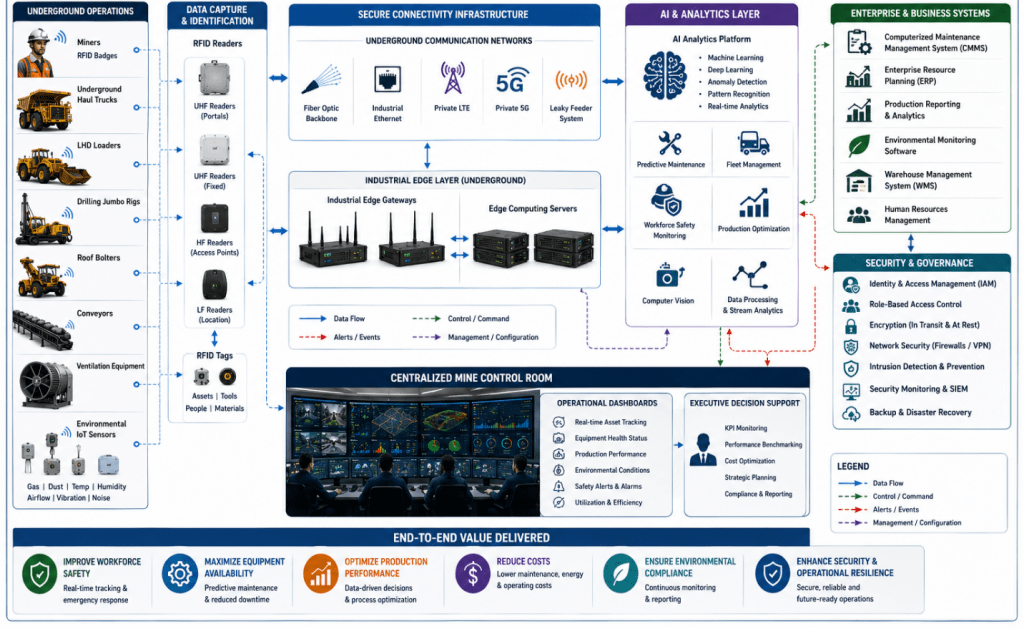
A comprehensive solution overview diagram illustrating an end-to-end AI and RFID deployment across an underground mining operation. The visual connects RFID-enabled personnel and equipment, industrial IoT sensors, underground communication networks, edge computing, AI analytics, enterprise applications, and a centralized mine control room. Directional data flows demonstrate how operational information supports predictive maintenance, fleet management, production optimization, workforce safety, environmental monitoring, and executive decision-making.
Building the Future of Industrial AI and IoT with Aperture Venture Studio and GAO RFID Inc.
For more than three decades, GAO Group of Companies has invested extensively in research and development for industrial RFID, BLE, and IoT technologies. As artificial intelligence has become increasingly valuable for underground mining and other industrial operations, we have expanded our work in AI and IoT solutions, including RFID and BLE, while establishing Aperture Venture Studio to accelerate the development and adoption of advanced industrial AI and IoT solutions across critical sectors. This initiative complements our long-standing engineering expertise and strengthens collaboration among AI specialists, IoT professionals, operational leaders, investors, and technology partners.
Through Aperture Ventures Summit and TekSummit, we continue to promote technical knowledge sharing on advanced AI, RFID, BLE, and IoT applications. These initiatives have helped build strong technical communities that support innovation, practical engineering, and real-world industrial deployment. We welcome organizations and professionals to engage with us as:
- Advisors
- Employees
- Investors
- Customers
Together, we can advance safer, smarter, and more efficient underground mining through practical AI and RFID solutions supported by GAO’s engineering expertise, high-quality hardware products, and comprehensive technical support.