
AI and RFID for Utility Substations
AI-enabled utility substations use connected asset identification, operational data, and intelligent analytics to improve equipment verification, inspection workflows, maintenance planning, inventory control, and field-worker decision-making. RFID provides a practical identification and data-capture layer for substation assets such as transformers, circuit breakers, disconnect switches, protective relays, control cabinets, batteries, cables, tools, test instruments, and spare parts. AI can then correlate RFID observations with maintenance records, inspection results, sensor readings, work orders, and asset histories to identify anomalies and prioritize actions.
For utility substations, the value is not simply replacing manual asset identification with RFID. The larger opportunity is to create reliable asset context for AI-driven maintenance and operational decisions. GAO can support these deployments with RFID, BLE, and IoT hardware products and systems that help utilities connect physical substation assets with maintenance and information systems.
How AI-Enabled Substation Asset Management Works
AI for utility substations combines artificial intelligence with IoT devices, sensors, connected equipment, and industrial systems. Depending on the application, the solution may use machine learning, computer vision, Edge AI, Industrial AI, or Physical AI for operational decision-making.
RFID acts as an enabling identification technology rather than the AI itself. UHF RFID is particularly useful where utilities need longer-range identification of tagged equipment, tools, materials, and maintenance inventory. HF RFID can support shorter-range identification and controlled read points, while LF RFID can be appropriate for specialized low-frequency identification requirements.
The resulting system can associate an identified physical asset with information such as:
- Substation asset ID and equipment class
- Transformer, breaker, switchgear, relay, battery, or control cabinet information
- Installation location and electrical bay
- Manufacturer and model
- Serial number and maintenance history
- Inspection status
- Calibration or test status
- Open work orders
- Spare-part requirements
- Previous failure or anomaly records
- Technician activity
- RFID observation time and location
AI becomes more useful when these observations are combined with other operational data. For example, an AI model can compare a transformer’s maintenance history, temperature measurements, inspection findings, and asset identity against historical patterns. The resulting analysis can help maintenance teams determine which assets require closer inspection rather than treating every scheduled inspection as equally urgent.
GAO’s RFID and IoT solutions can provide the physical identification and data-capture components required to connect substation equipment with software used for asset management, maintenance, inventory, and operational analysis.
AI-Enabled Utility Substation Operational Workflow
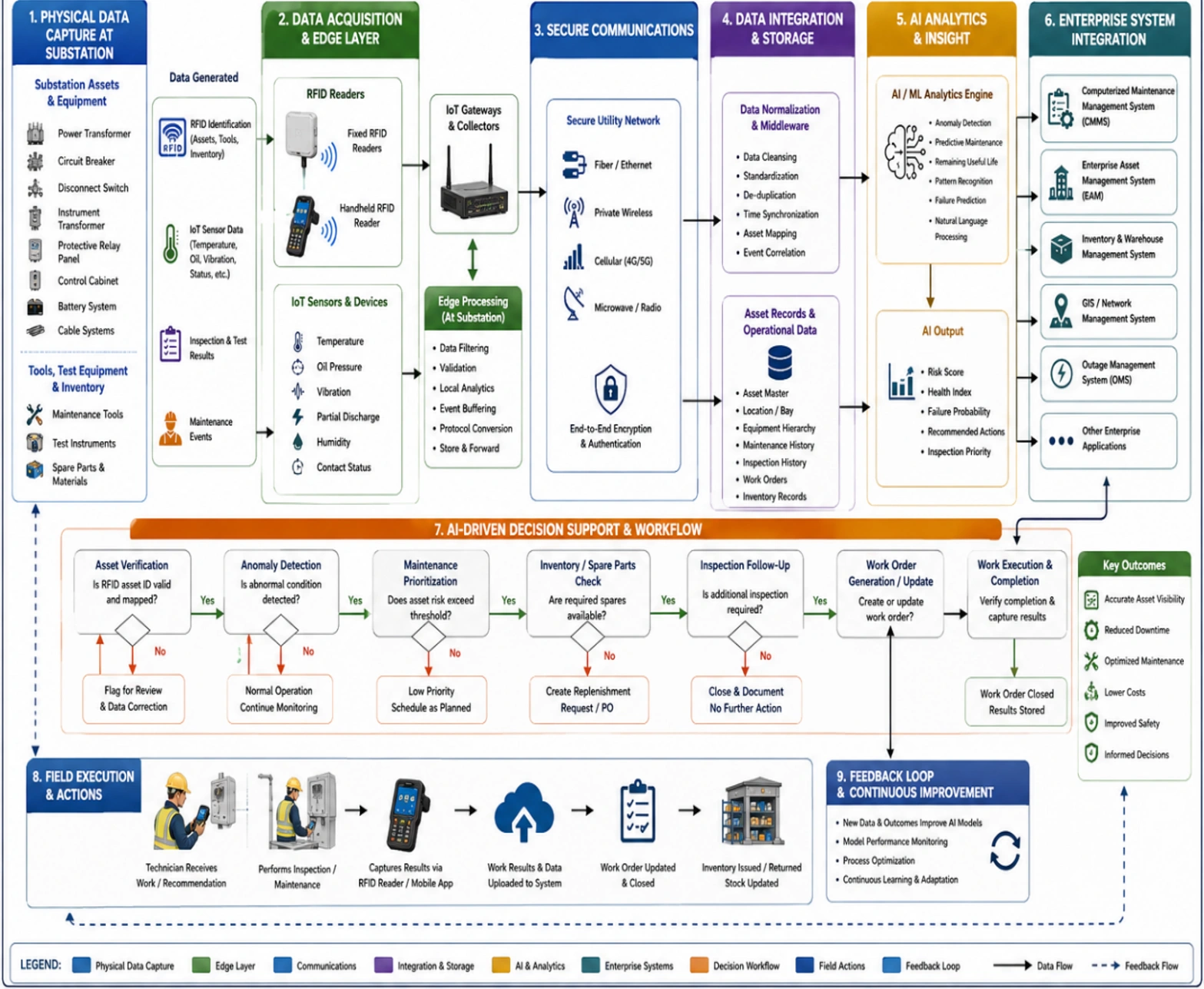
This workflow diagram shows how utility substation data moves from RFID-tagged assets, IoT sensors, inspections, and maintenance events through edge processing, secure communications, data integration, AI analytics, and enterprise systems. It highlights decision points for asset verification, anomaly detection, maintenance prioritization, inventory replenishment, inspection follow-up, work-order execution, and continuous improvement.
Where AI Delivers Value Across Utility Substations
AI-enabled substation operations are most valuable when they address specific field and maintenance problems. The appropriate use case depends on substation configuration, equipment criticality, existing instrumentation, environmental conditions, communications availability, and the utility’s maintenance practices.
Asset Verification and Equipment Identification
Substations contain large numbers of electrically and mechanically distinct assets that may appear similar to field personnel. RFID tagging can provide machine-readable identification for equipment, cabinets, components, tools, and materials.
AI can use verified asset identity as contextual information when processing inspection records or maintenance events. This reduces the risk of attaching a work order, inspection result, or maintenance record to the wrong equipment.
AI-Assisted Preventive and Predictive Maintenance
Maintenance teams can combine RFID asset identity with transformer monitoring, breaker operation data, thermal measurements, battery information, partial discharge observations, vibration data, inspection findings, and historical maintenance records.
Machine learning models can identify patterns associated with abnormal equipment behavior. A maintenance application can then prioritize assets based on condition, criticality, historical failure patterns, and operational consequences.
RFID is particularly useful here because the AI system needs to know which physical asset generated a particular inspection or maintenance event. Reliable identification strengthens the relationship between field observations and the asset record.
Inspection and Field-Service Verification
A technician can use an RFID reader to verify the identity of an asset before performing an inspection, test, or maintenance procedure. The resulting event can be associated with the correct equipment record.
AI can subsequently evaluate inspection data for missing information, inconsistent readings, abnormal observations, or recurring defects. Utilities can use these findings to improve inspection quality and prioritize follow-up work.
Tools, Test Equipment, and Spare-Parts Management
Substation maintenance requires specialized tools, meters, test instruments, replacement components, personal protective equipment, and emergency spares. RFID can identify these items at controlled storage locations or during issue and return processes.
AI-based inventory analysis can use historical consumption, work-order demand, equipment criticality, and replenishment patterns to identify potential shortages or unusual inventory behavior.
This is especially useful for geographically distributed substations where a missing test instrument or critical replacement component can delay field work.
Work-Order Accuracy and Maintenance Compliance
A work-management system can associate RFID verification events with maintenance work orders. The system can determine whether the technician reached the intended substation, interacted with the intended equipment, and completed the required asset-specific activity.
AI can analyze work-order histories to identify recurring delays, incomplete tasks, unusual maintenance durations, and assets that repeatedly generate corrective work.
Safety and Operational Readiness
RFID should not be treated as a replacement for established electrical safety procedures. Instead, it can provide an additional digital verification mechanism.
For example, asset identification can help confirm that a technician is working against the intended equipment record before a maintenance workflow proceeds. Additional safeguards, authorization controls, switching procedures, lockout/tagout processes, and utility-specific safety practices remain essential.
Utility Substation Challenges That AI and RFID Address
Substation operators frequently deal with operational conditions that make accurate asset information difficult to maintain. Equipment can be distributed across outdoor yards, control buildings, relay rooms, battery areas, cable trenches, and restricted-access locations. Asset labels can become damaged, records can become outdated, and manual inspections can produce inconsistent data.
The principal challenges include:
- Manual asset identification during inspections and maintenance
- Inconsistent equipment labeling and documentation
- Asset records that do not accurately reflect field conditions
- Difficulty correlating field observations with the correct asset
- Limited visibility into tools and test instruments
- Spare-parts shortages for critical equipment
- Delayed maintenance reporting
- Repetitive inspection documentation
- Difficulty prioritizing maintenance across large asset populations
- Disconnected maintenance, inventory, and asset-management records
- Communication limitations at remote substations
- Harsh environmental conditions affecting electronic equipment
- Cybersecurity requirements for connected operational systems
- Need for reliable operation during network outages
AI does not eliminate these engineering constraints. Its effectiveness depends on data quality, asset identity, sensor reliability, communications availability, model validation, and appropriate integration with existing utility systems.
A strong implementation therefore starts with a clear operational problem rather than simply deploying RFID readers or an AI model.
AI-Enabled Substation Operational Workflow
The operational workflow begins when physical assets, tools, materials, and equipment generate identification or condition data. RFID readers, IoT sensors, inspection devices, and existing substation equipment provide inputs to local or centralized software.
A typical workflow includes:
- Asset identification:RFID tags provide unique identifiers for selected substation assets, tools, components, or inventory items.
- Data capture:Fixed RFID readers, handheld readers, gateways, sensors, and inspection systems collect identification and operational observations.
- Communication:Data moves through Ethernet, Wi-Fi, cellular, private wireless networks, or other approved utility communications infrastructure, depending on the site.
- Edge processing:Local computing can filter duplicate RFID reads, validate device messages, perform preliminary analytics, and continue selected functions during temporary network disruption.
- Data normalization:Middleware converts heterogeneous device data into consistent asset and event records.
- Asset association:RFID observations are mapped to equipment IDs, locations, work orders, inventory records, or maintenance events.
- AI analysis:Machine learning and other AI methods evaluate inspection results, equipment condition, work-order patterns, inventory behavior, or operational anomalies.
- Decision support:The system generates alerts, maintenance priorities, inspection recommendations, inventory notifications, or exception reports.
- Enterprise integration:Relevant information can be exchanged with computerized maintenance management systems, enterprise asset management systems, inventory applications, geographic information systems, outage management systems, and other approved utility software.
- Field action:Maintenance planners and technicians receive actionable information through authorized applications or dashboards.
- Feedback:Completed work, inspection findings, corrective actions, and new equipment observations return to the data environment to improve future analysis.
The critical engineering principle is traceability. A utility should be able to determine how an AI recommendation relates to the underlying asset, data observations, model output, and maintenance action.
AI-Enabled Utility Substation Asset Management
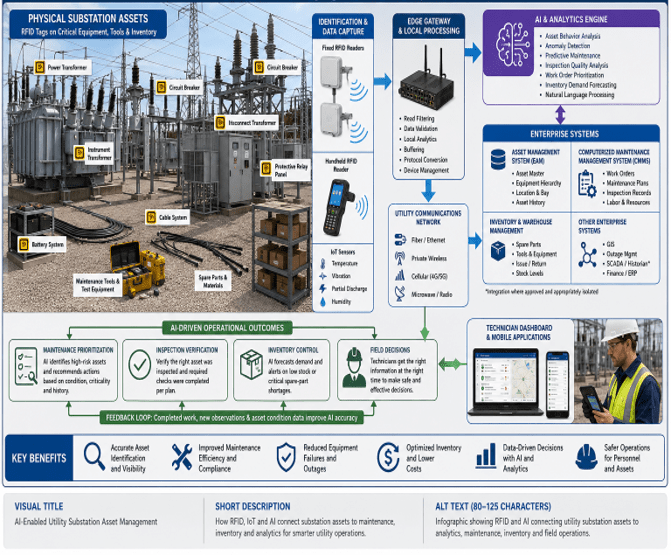
This infographic shows how RFID-tagged substation assets, IoT sensors, fixed and handheld readers, edge processing, utility communications, and AI analytics connect with asset management, maintenance, inventory, and other utility systems. It highlights how these connected data flows support maintenance prioritization, inspection verification, inventory control, and informed field decisions.
Deployment Scenarios for AI and RFID in Utility Substations
The physical deployment should reflect the substation’s equipment layout, security requirements, operating environment, communications infrastructure, and maintenance workflow.
Outdoor Substation Yard
Outdoor yards can use appropriately rated RFID tags and readers to identify transformers, breakers, disconnect switches, grounding equipment, cabinets, and maintenance materials. Reader placement must account for metal surfaces, equipment geometry, antenna orientation, read-zone boundaries, and electromagnetic conditions.
UHF RFID can provide practical read distances for selected identification tasks, but utilities should validate read performance under actual installation conditions rather than relying solely on laboratory specifications.
Control Building and Relay Room
Control buildings can use RFID identification for relay cabinets, protection equipment, test instruments, maintenance tools, documents, and selected replaceable components. Controlled read points can associate technician activity or equipment movement with maintenance workflows.
AI analysis can then correlate these events with inspection and work-order information.
Battery and Auxiliary Systems
Battery rooms and auxiliary electrical systems contain assets that require periodic inspection, testing, and replacement. RFID identification can improve verification of battery strings, cabinets, test equipment, and replacement components where the selected tag and reader are suitable for the operating environment.
Substation Warehouse and Spare-Parts Area
RFID-enabled inventory control can identify incoming, stored, issued, returned, and transferred components. AI can analyze consumption patterns and equipment criticality to support replenishment planning.
This approach is particularly relevant when multiple substations share regional spare-parts facilities.
RFID Deployment at an Electrical Utility Substation
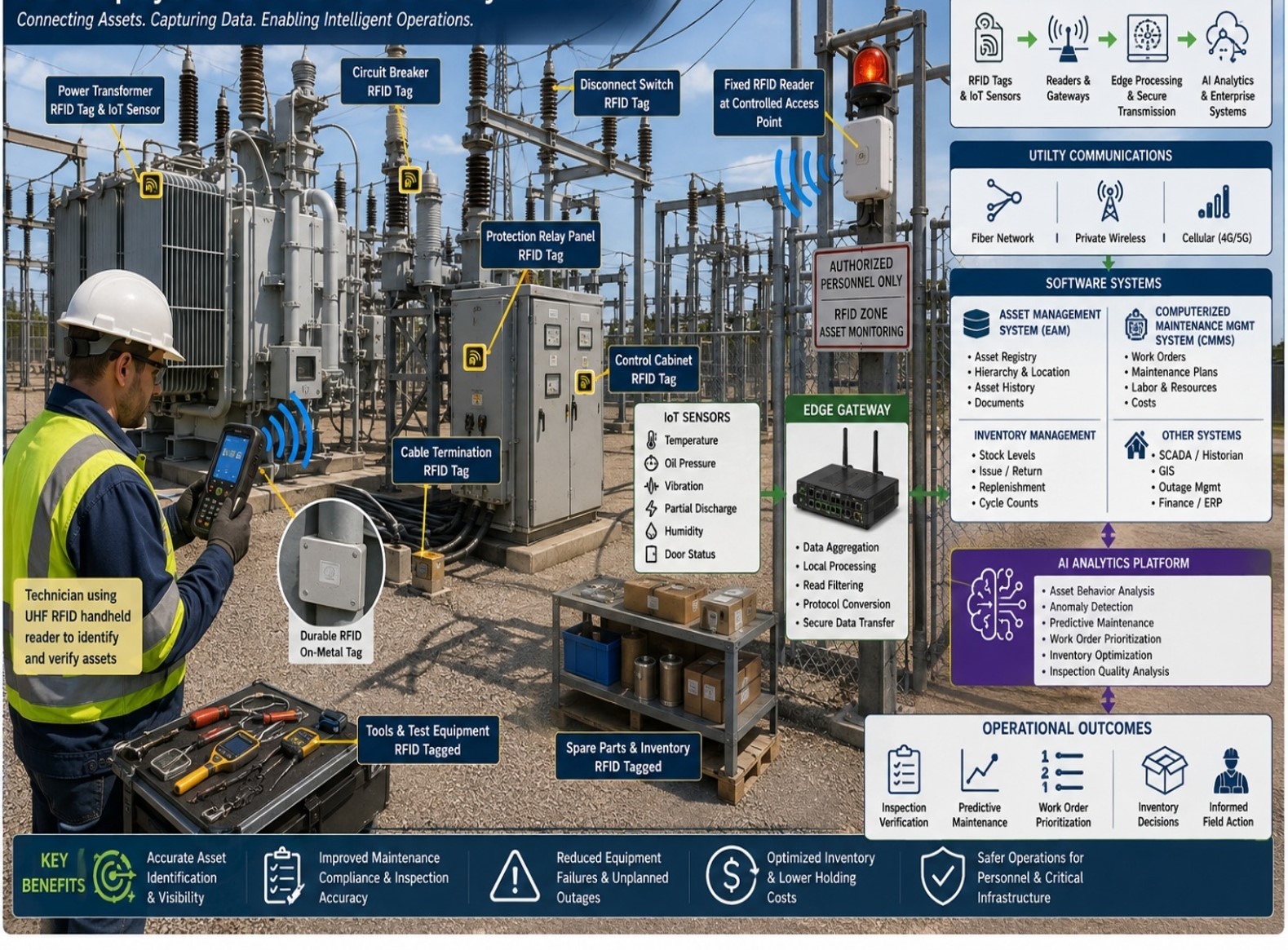
This visual shows a field technician using a UHF RFID reader to verify tagged substation equipment, tools, and inventory. It illustrates how RFID readers, IoT sensors, edge processing, secure communications, AI analytics, and utility software support inspection verification, predictive maintenance, work-order prioritization, and inventory decisions.
Engineering Considerations for Substation RFID Deployment
RFID performance inside utility substations depends heavily on physical installation conditions. Metal equipment, conductive structures, cabinets, cable trays, transformer components, and enclosure geometry can affect radio-frequency behavior. Tag selection should therefore be based on the asset material, mounting position, required read distance, environmental exposure, and expected service life.
Key engineering considerations include:
- Select tags designed for metal-mounted equipment when tagging metallic substation assets.
- Validate read performance at the actual mounting location.
- Define controlled read zones where accidental reads could create incorrect operational events.
- Use handheld readers where technicians need flexible asset verification.
- Use fixed readers where repeatable automated detection provides operational value.
- Consider temperature, moisture, UV exposure, chemicals, vibration, and mechanical impact for outdoor installations.
- Establish a tag replacement and asset-relabeling process for equipment changes.
- Maintain a reliable mapping between RFID identifiers and utility asset identifiers.
- Separate identification data from safety-critical control functions unless the complete system has been engineered and approved for that purpose.
- Validate operation during network interruptions and determine which functions must remain available locally.
- Test cybersecurity controls before connecting the solution to utility operational or corporate networks.
GAO’s role can include supplying RFID and IoT hardware and systems that fit the selected deployment scenario, while the utility and its engineering integrators remain responsible for site-specific electrical, communications, cybersecurity, safety, and commissioning requirements.
AI Data Quality and Asset Identity
AI performance depends on more than model selection. Utility substation data must be correctly associated with the physical equipment that produced it.
A reliable asset identity model should maintain relationships among the RFID identifier, utility asset number, equipment hierarchy, substation location, electrical bay, equipment type, manufacturer, model, serial number, maintenance history, inspection records, and work orders.
This relationship is particularly important for AI-based anomaly detection. A temperature anomaly associated with the wrong transformer can result in an incorrect maintenance recommendation. Similarly, a work-order completion event attached to the wrong breaker can create false confidence in maintenance compliance.
Utilities should therefore establish data-quality controls before scaling AI analytics. These controls can include asset-master validation, duplicate detection, tag commissioning procedures, reader health monitoring, timestamp synchronization, exception handling, and periodic reconciliation between field conditions and enterprise records.
Utility Substation Asset Identity and AI Data Quality
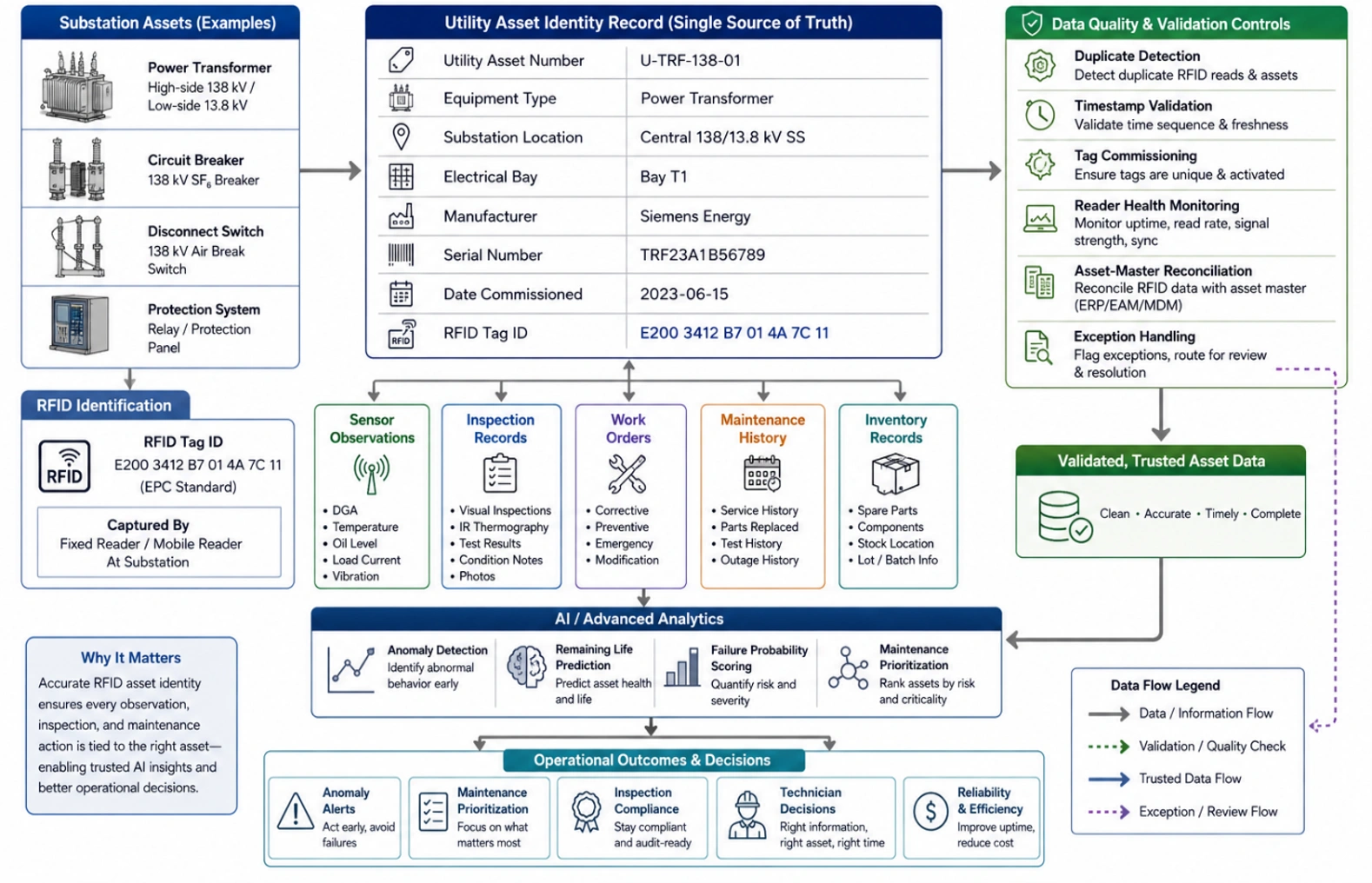
Enterprise data-flow diagram showing how validated RFID asset identity connects substation data to trusted AI analytics and operational decisions.
Substation AI, RFID Hardware, Software, and Deployment Models
A production deployment requires more than RFID tags and an AI model. Utility substations need a coordinated set of identification hardware, sensing devices, communications equipment, processing resources, software interfaces, security controls, and operational procedures.
RFID Technologies for Substation Applications
The appropriate RFID technology depends on the physical asset and required identification workflow.
- UHF RFID:Suitable for longer-range identification of selected outdoor equipment, tools, maintenance materials, and inventory. On-metal tags are commonly required for metallic substation assets.
- HF RFID:Useful for controlled, shorter-range identification where technicians intentionally bring a reader close to an asset, tool, document, or component.
- LF RFID:Can support specialized identification applications where low-frequency characteristics and shorter read distances are advantageous.
The objective is not to maximize reading distance. A well-designed substation system should produce reliable identification within a defined operational zone while minimizing unintended reads.
Readers, Gateways, and Edge Computing
Fixed RFID readers can monitor defined locations, while rugged handheld readers allow technicians to verify individual assets during inspections and maintenance. RFID gateways and industrial edge computers can aggregate identification events with data from sensors and other connected equipment.
Edge processing can perform functions such as:
- RFID read filtering and duplicate suppression
- Asset-ID validation
- Local event processing
- Reader health monitoring
- Temporary data buffering
- Protocol conversion
- Local anomaly detection
- Secure forwarding to centralized software
Edge processing becomes especially valuable at remote substations where communications bandwidth or network availability may be constrained.
AI and Machine Learning
AI methods should be selected according to the operational problem. A utility may use supervised machine learning for known equipment-condition patterns, unsupervised learning for anomaly detection, time-series models for equipment behavior, natural-language processing for maintenance records, and computer vision for selected inspection applications.
AI should provide explainable operational outputs where practical. A maintenance planner generally needs to understand why an asset was prioritized, which observations contributed to the recommendation, and what additional inspection may be appropriate.
Utility Software Integration
RFID and AI data can be integrated with existing utility applications rather than creating isolated databases. Relevant systems may include:
- Enterprise asset management systems
- Computerized maintenance management systems
- Geographic information systems
- Work management software
- Inventory and warehouse management systems
- Outage management systems
- Supervisory control and data acquisition systems where approved and appropriately isolated
- Energy management systems where applicable
- Inspection and mobile workforce applications
- Data historians
- Security information and event management systems
Integration should use controlled interfaces and clearly defined data ownership. Asset identity, work-order status, inspection information, and AI recommendations should have explicit source-of-truth rules.
Cloud Version and Server Version
Cloud Version uses cloud-hosted software and analytics managed within cloud infrastructure. This model can simplify centralized management across geographically distributed substations and can provide scalable computing resources for AI analytics and fleet-wide reporting.
Cloud deployment is generally more appropriate when:
- Substations have reliable secure connectivity to approved cloud services.
- Centralized analytics across many facilities is important.
- Utility policies permit the relevant data to be processed in cloud infrastructure.
- The organization wants centralized software administration.
- AI workloads may require variable computing capacity.
Server Version places software on edge servers, customer-managed servers, private data centers, utility facilities, or other privately hosted enterprise infrastructure. It can provide greater control over data location, local processing, network dependencies, and integration boundaries.
Server deployment is generally appropriate when:
- Substation connectivity is limited or intermittent.
- Operational data must remain within controlled utility infrastructure.
- Local processing is required for latency or resilience.
- Existing utility data centers already host maintenance and operational applications.
- Cybersecurity policies restrict selected workloads from external cloud environments.
A hybrid approach can combine local RFID and edge processing with centralized analytics. For example, an edge server can validate RFID events and buffer data locally while approved summarized information is transferred to centralized AI software.
Deployment Options for AI-Enabled RFID Substation Asset Management
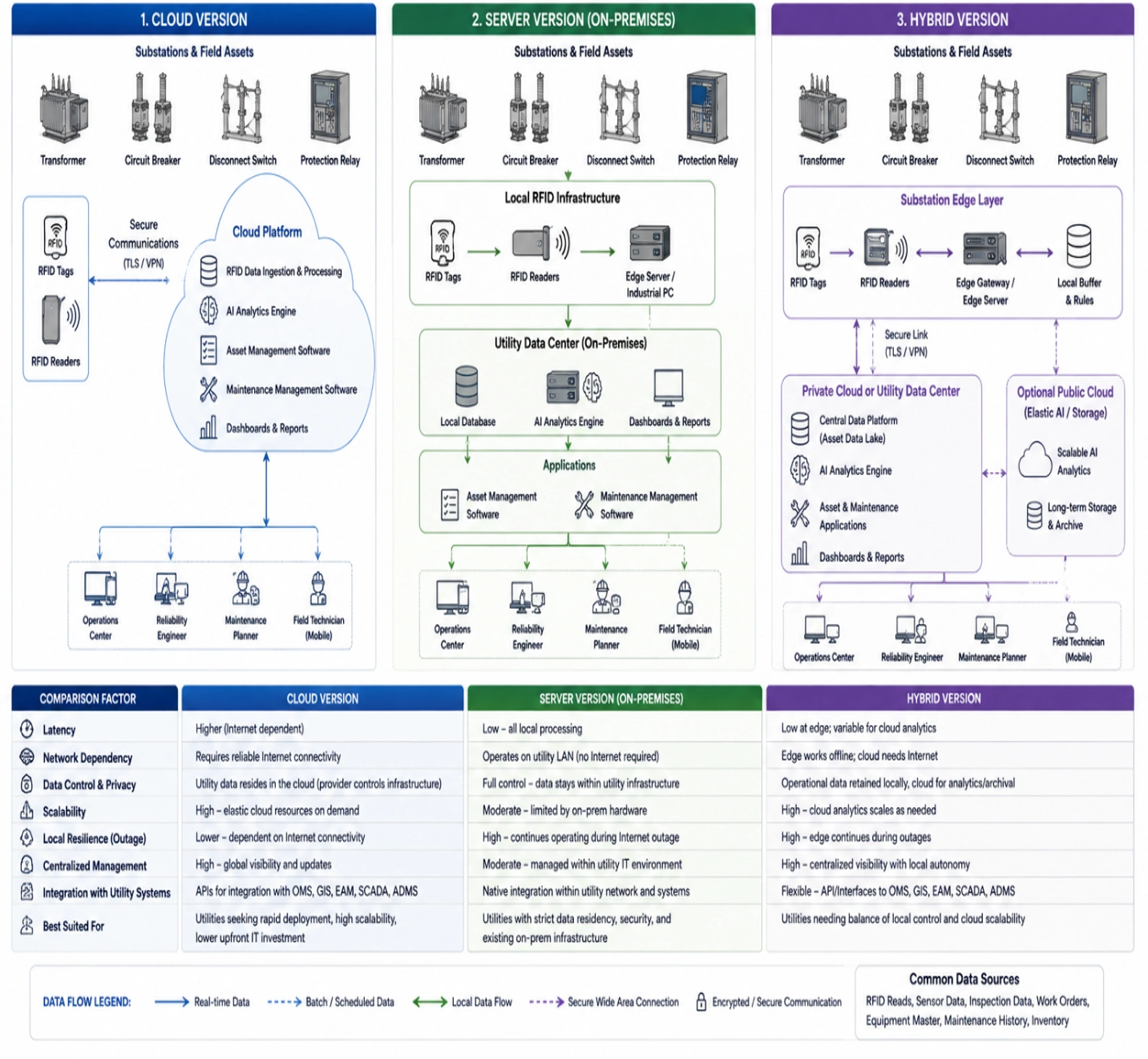
Three-column architecture comparison of cloud, on-premises server, and hybrid RFID deployment models for utility substations.
Cybersecurity for AI-Enabled Utility Substations
Connecting RFID readers, edge computers, sensors, and analytics software to utility environments introduces additional cybersecurity considerations. Asset identification systems should not become an uncontrolled path into operational technology networks.
A security design should distinguish between asset identification traffic, enterprise IT applications, and operational technology systems. Where integration with operational technology is necessary, communication boundaries, authentication, authorization, monitoring, and data-flow controls should be explicitly engineered.
Important controls include:
- Device identity and authentication
- Role-based access control
- Encryption for data in transit
- Secure credential management
- Network segmentation
- Firewall and gateway controls
- Secure software updates
- Endpoint hardening
- Audit logging
- Security monitoring
- Reader and gateway inventory
- Vulnerability management
- Backup and recovery procedures
- Incident response procedures
- AI model access controls
- Data retention and governance policies
Utility organizations should align implementation with their applicable cybersecurity policies and regulatory obligations. NIST Cybersecurity Framework concepts and industrial cybersecurity practices such as IEC 62443 can provide useful reference points where applicable, while the utility’s own security governance remains authoritative.
AI introduces additional considerations. Models, training datasets, prompts where applicable, model outputs, and automated recommendations require access controls and monitoring. An AI-generated maintenance recommendation should not automatically initiate a safety-critical control action without the appropriate engineering validation and authorization.
Layered Cybersecurity for AI-Enabled Utility Substations
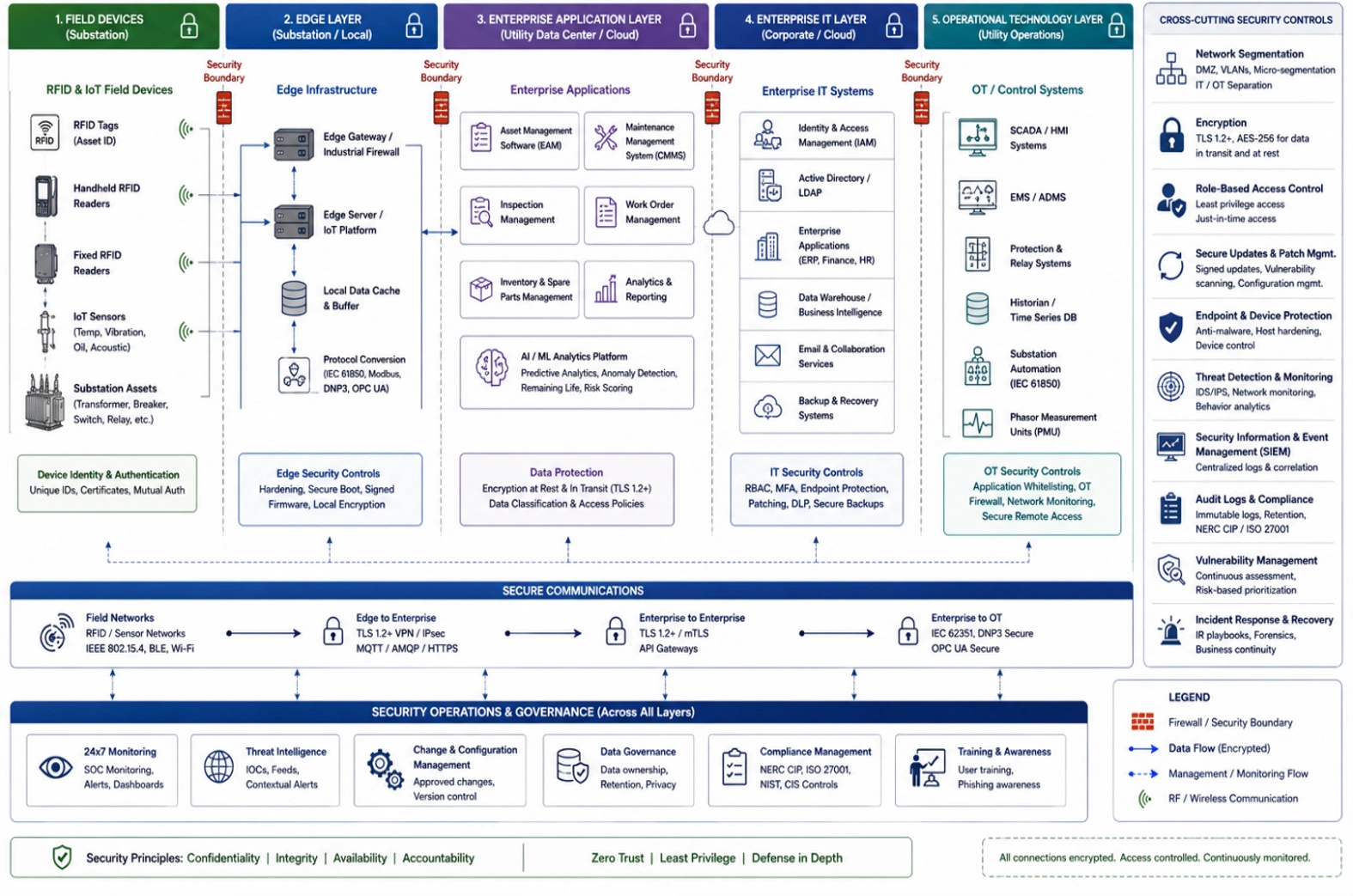
Defense-in-depth architecture showing security boundaries and controls across RFID devices, edge systems, enterprise applications, IT, and OT.
Implementation Roadmap for Utility Substations
A phased implementation reduces technical and operational risk. The first stage should establish the business and engineering problem, followed by controlled hardware testing and integration.
Assessment and Planning
Document the existing asset hierarchy, maintenance processes, inspection procedures, inventory workflows, communications infrastructure, cybersecurity requirements, and enterprise applications.
Select an initial use case with measurable operational value. Asset verification, critical-spare inventory, or maintenance workflow validation can provide practical starting points.
RFID and Sensor Selection
Evaluate UHF, HF, or LF RFID according to the physical use case. Test tag performance on representative equipment, especially metal surfaces and outdoor assets.
Assess readers, antennas, handheld devices, gateways, edge computers, and environmental ratings according to the actual substation conditions.
Pilot Deployment
A pilot should include representative equipment rather than an artificially simple laboratory environment. Measure read performance, asset-record accuracy, workflow adoption, network behavior, and integration reliability.
The pilot should also test failure conditions such as temporary communications loss, damaged tags, duplicate reads, unavailable servers, and incorrect asset mappings.
Software and AI Integration
Connect validated RFID events to the appropriate asset and maintenance systems. Establish data-quality rules before training or deploying AI models.
AI should initially operate in a decision-support role where practical. Maintenance personnel can review recommendations, provide feedback, and identify false positives before broader automation is considered.
Commissioning and Scale-Up
Production commissioning should include reader configuration, tag registration, asset reconciliation, cybersecurity validation, user access configuration, network testing, backup verification, and operational acceptance testing.
After commissioning, utilities can expand from a pilot substation to additional facilities based on measurable results.
Practical Deployment Recommendations from GAO
Successful AI-enabled utility substation deployments depend on disciplined engineering rather than technology selection alone. Utilities should treat RFID identification, AI analytics, communications, cybersecurity, and maintenance software as connected parts of an operational workflow.
Recommended practices include:
- Start with a measurable substation maintenance or asset-management problem.
- Establish the authoritative asset identifier before deploying AI analytics.
- Test RFID tags and readers on representative substation equipment.
- Use controlled read zones where accidental identification could create incorrect records.
- Select outdoor-rated and metal-compatible tags where required.
- Keep safety-critical electrical controls separate from non-critical identification workflows unless a fully engineered integration is approved.
- Use edge processing where network availability or response requirements justify local computation.
- Validate AI models against actual utility maintenance data before relying on automated recommendations.
- Track false positives and false negatives rather than reporting model accuracy as a single number.
- Integrate with existing asset management and maintenance systems where practical.
- Define cybersecurity boundaries before connecting field devices to utility networks.
- Establish procedures for tag replacement, asset replacement, equipment relocation, and asset-master reconciliation.
- Measure operational outcomes against a pre-deployment baseline.
- Scale only after the pilot demonstrates reliable technical and operational performance.
GAO has supplied RFID, BLE, and IoT hardware products and systems to organizations that need practical identification and connected-device capabilities. For utility substation projects, these capabilities can form part of a broader engineering solution designed around asset verification, maintenance workflows, inventory control, and AI-assisted operational decision-making.
Key Takeaways for AI-Enabled Utility Substations
AI can improve utility substation operations when it is connected to reliable physical-world data. RFID provides a practical way to establish machine-readable asset identity for selected substation equipment, tools, materials, and inventory. AI can then combine that identity with condition data, inspections, work orders, maintenance histories, and operational information.
The strongest implementations focus on measurable problems such as asset-record accuracy, preventive maintenance compliance, inspection verification, spare-parts availability, and maintenance prioritization. Engineering validation remains essential because substation environments contain metal structures, electrical equipment, restricted areas, harsh outdoor conditions, and strict cybersecurity and safety requirements.
Utilities evaluating these solutions can work with GAO to explore RFID, BLE, IoT hardware, connected systems, and technical support appropriate for specific substation workflows.
Building the Future of Industrial AI and IoT with Aperture Venture Studio and GAO
For more than three decades, GAO Group of Companies has invested heavily in R&D for industrial RFID, BLE, and IoT. As generative AI became increasingly useful for industrial applications, we expanded our work on AI and IoT technologies and founded Aperture Venture Studio to help advance practical AI and IoT solutions for applications such as utility asset management, substation operations, and industrial connected systems.
Aperture has attracted AI and IoT technical experts, entrepreneurial and operational executives, influential investors, and leading companies. We have also developed Aperture Ventures Summit and TekSummit to discuss advanced AI and IoT topics.
GAO, headquartered in New York City and Toronto, Canada, is ranked among the top 10 leading B2B and B2G BLE and RFID suppliers globally. GAO and its sister companies, GAO Research Inc. and GAO Tek Inc., form GAO Group, serving customers across the U.S. and Canada, including Fortune 500 companies, leading R&D organizations, universities, and government agencies. Our substantial R&D investment, stringent quality assurance, and remote and onsite expert support help customers deploy practical RFID, BLE, and IoT solutions.
We welcome you to join us as:
- Advisors, co-founders, or employees
- Investors
- Customers