
AI and RFID for Vaccine Distribution
AI-Enabled Vaccine Distribution with RFID and Intelligent Cold-Chain Monitoring
For vaccine distributors, public-health logistics organizations, pharmaceutical wholesalers, 3PL providers, immunization programs, hospitals, clinics, and regional depots, the combination can reduce manual scanning, improve lot and expiration visibility, identify unusual handling patterns, and support faster response to temperature excursions or shipment delays. The solution does not replace validated temperature monitoring or vaccine-handling procedures. Instead, it adds an intelligent operational layer around them. CDC guidance continues to emphasize reliable temperature monitoring, calibrated devices, documented excursions, appropriate storage equipment, and controlled vaccine handling.
AI-Enabled Vaccine Distribution with RFID: Cold-Chain and AI Analytics
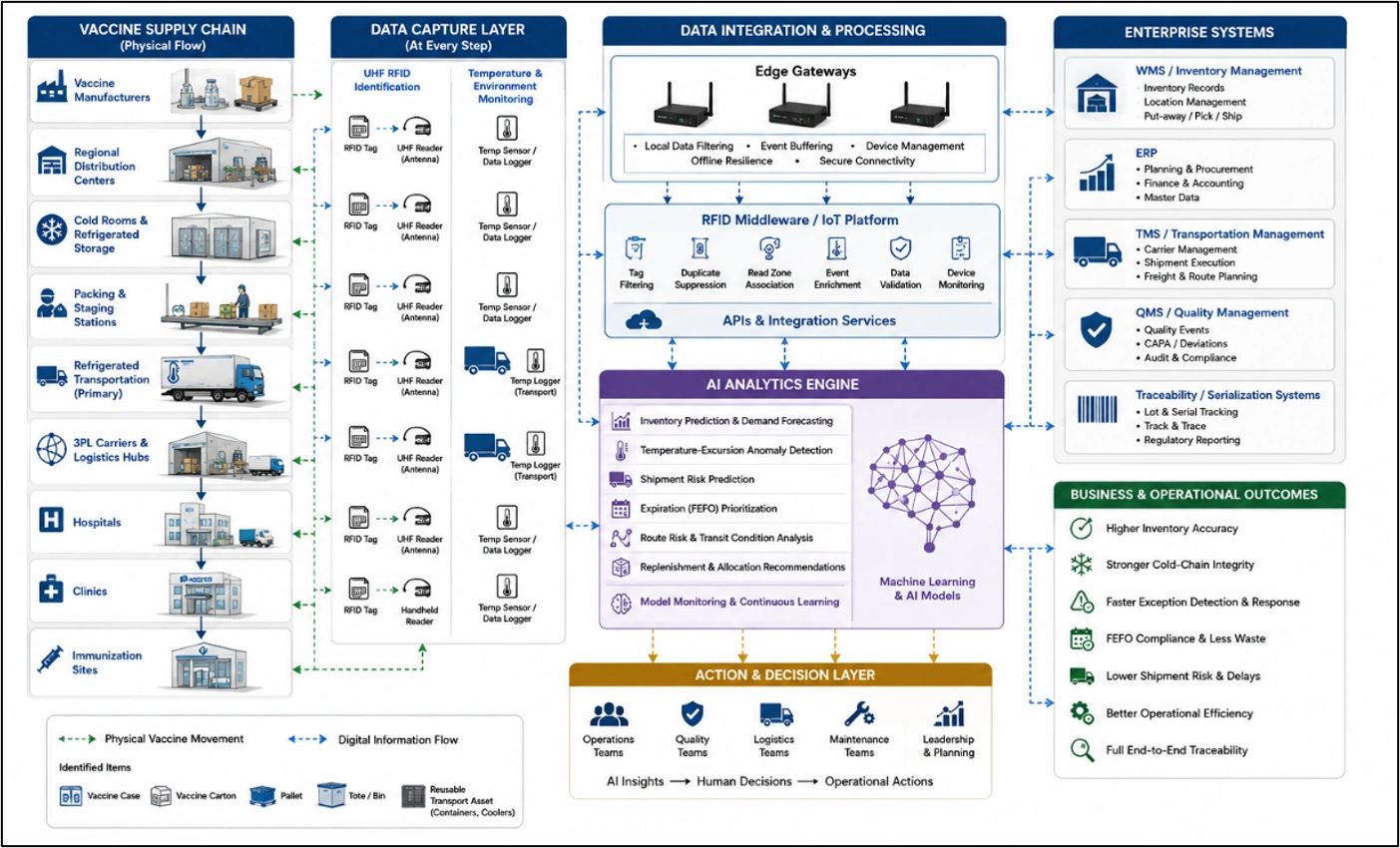
The diagram illustrates how RFID identification, temperature monitoring, edge gateways, middleware, and AI analytics connect vaccine movement from manufacturers through distribution centers to hospitals, clinics, and immunization sites. It highlights AI functions such as inventory forecasting, temperature-excursion detection, shipment-risk prediction, FEFO prioritization, and replenishment recommendations, with enterprise systems supporting operational decisions.
Why AI Matters in Vaccine Distribution
Vaccine distribution is a condition-sensitive logistics process in which product identity, lot information, expiration, location, custody, storage conditions, and transportation history must remain connected. A vaccine shipment can move through receiving docks, quarantine areas, cold rooms, picking zones, staging areas, refrigerated vehicles, cross-docks, regional depots, and healthcare delivery locations. Each transition creates an opportunity for inventory errors, delayed handling, incorrect allocation, or incomplete traceability.
AI becomes useful when the volume and velocity of these events exceed what operators can reliably evaluate manually. Instead of treating RFID reads, temperature measurements, shipment records, and inventory transactions as isolated data points, AI can correlate them to identify operational patterns.
Relevant AI capabilities include:
- Temperature-excursion anomaly detection: Identify unusual temperature behavior by analyzing continuous sensor readings, storage-unit behavior, transport conditions, door events, dwell time, and historical patterns.
- Shipment-risk prediction: Estimate whether a vaccine shipment is likely to experience excessive dwell time, delayed delivery, connectivity loss, or environmental deviation.
- AI inventory management: Forecast vaccine demand, identify inventory imbalances, and support allocation decisions using historical consumption, seasonality, expiration dates, lead times, and regional requirements.
- Expiration-aware inventory optimization: Identify lots approaching expiration and prioritize appropriate allocation or FEFO workflows.
- Cold-chain event correlation: Associate temperature conditions with specific vaccine shipments, containers, lots, and locations rather than reviewing temperature data separately.
- Anomaly-based asset tracking: Detect unexpected movement of vaccine containers, reusable thermal shippers, insulated containers, or pallets.
- Predictive equipment monitoring: Analyze refrigerator, freezer, ultra-low-temperature storage, compressor, door, power, and environmental signals to identify developing equipment problems.
- AI-assisted exception management: Prioritize alerts according to product value, vaccine sensitivity, duration of deviation, location, shipment status, and available corrective actions.
WHO guidance recognizes electronic temperature monitoring and logging as important tools for monitoring vaccine temperatures throughout the supply chain. The engineering opportunity is therefore not simply to add more sensors. The objective is to connect trustworthy identification and condition data to decisions that vaccine distribution personnel can act upon.
Vaccine Distribution Processes Most Suitable for AI
The highest-value deployments normally begin with operational processes where product identity, location, condition, and timing must be correlated.
Vaccine Receiving and Put-Away
Receiving operations must establish what arrived, how much arrived, which lots were received, where the shipment originated, and whether handling conditions require review.
RFID can automatically capture tagged cases, cartons, pallets, or reusable containers as they pass through receiving portals. AI can compare expected and observed shipments, detect quantity discrepancies, identify unexpected dwell time, and flag shipments requiring quality review.
A practical receiving workflow can correlate:
- Purchase order or advance shipping notice
- Vaccine product identifier
- Lot or batch information
- Expiration date
- Case or pallet identity
- Receiving timestamp
- RFID reader location
- Temperature history
- Carrier and shipment identifier
- Quarantine or release status
The result is a more complete receiving event than a simple barcode scan because the physical movement and digital transaction can be correlated automatically.
Cold-Room and Refrigerated Storage Management
Cold rooms, vaccine refrigerators, freezers, and ultra-low-temperature equipment generate operational data that should be evaluated alongside inventory information.
AI can identify relationships between storage conditions and inventory movement, such as:
- Repeated temperature excursions after door openings
- Temperature instability associated with a particular storage unit
- Excessive product dwell time in staging areas
- Inventory concentration in a high-risk storage location
- Increasing temperature recovery time after door events
- Repeated movement of the same lot between storage locations
- Abnormal inventory aging
- Unexpected movement outside an authorized storage zone
CDC guidance recommends continuous monitoring and recording devices for vaccine storage and specifies characteristics such as calibrated probes, alarms, minimum and maximum readings, and configurable recording intervals. RFID therefore complements, rather than substitutes for, validated temperature monitoring equipment.
Vaccine Picking, Allocation, and Order Fulfillment
Picking errors can involve the wrong product, lot, quantity, destination, or expiration priority. AI-supported inventory software can combine RFID observations with WMS transactions and demand information.
A distribution center can use the resulting intelligence to identify:
- Lots approaching expiration
- Inventory below target levels
- Orders at risk of late fulfillment
- Stock located in the wrong storage zone
- Repeated picking exceptions
- Unusual manual handling
- Demand changes by geography or customer type
RFID provides automated identification at storage and movement checkpoints, while AI helps determine which inventory action should receive attention first.
Refrigerated Shipment Preparation
Shipment preparation is particularly suitable for combining identification, condition monitoring, and AI.
A tagged vaccine shipment can be associated with its order, destination, container, thermal packaging configuration, temperature-monitoring device, carrier, and planned departure time. AI can evaluate whether the shipment is likely to encounter operational risk before it leaves the distribution facility.
For example, a shipment may be flagged because its planned transportation duration is unusually long, its departure is delayed, its destination has historically experienced receiving delays, or its thermal container has shown abnormal performance in previous trips.
Transportation and Delivery
Transportation introduces variables that distribution centers cannot fully control. These can include traffic, carrier delays, weather, loading delays, cross-docking, temporary storage, cellular connectivity interruptions, and unexpected delivery-window changes.
AI can combine shipment identity with:
- GPS or telematics information
- Temperature measurements
- RFID location events
- Carrier milestones
- Door or container events
- Estimated arrival time
- Route history
- Delivery appointment information
- Historical excursion patterns
The objective is to identify risk early enough for an operator to intervene.
RFID Deployment in a Vaccine Distribution Center: Real-World Cold-Chain Tracking
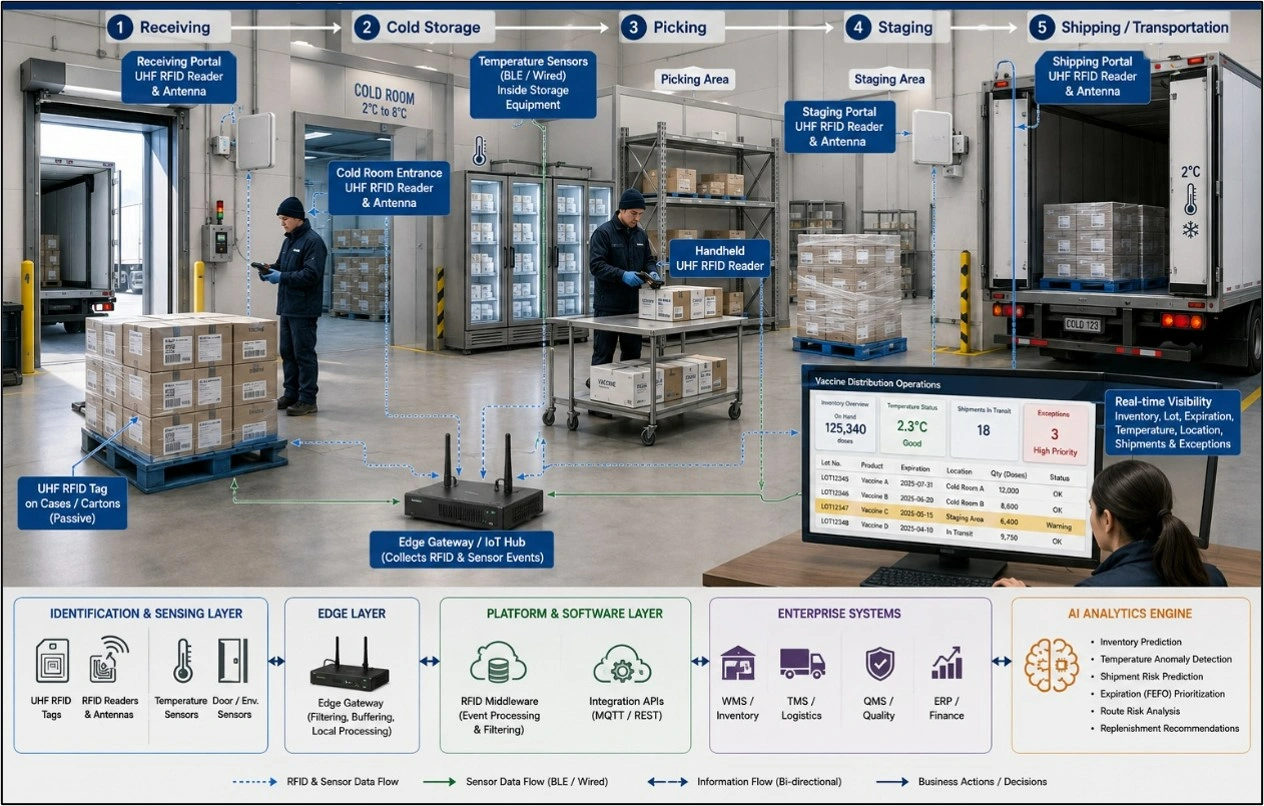
The visual shows a realistic vaccine distribution center where UHF RFID readers and tags track vaccine cases through receiving, cold storage, picking, staging, and refrigerated shipping. Temperature sensors, an edge gateway, RFID middleware, enterprise software, and AI analytics provide visibility into inventory, lot and expiration data, shipment status, temperature conditions, and distribution exceptions.
AI-Driven Vaccine Distribution Applications
AI applications should be selected according to the operational decision they improve rather than simply according to the availability of data.
AI Cold-Chain Risk Detection
AI models can learn normal temperature behavior for specific storage equipment, transport configurations, routes, and handling processes. Statistical models, anomaly detection, time-series models, and machine learning can then identify deviations that deserve investigation.
A useful implementation distinguishes between an alert and a validated excursion. The AI system can prioritize an event, but product disposition should remain governed by approved vaccine handling procedures, manufacturer requirements, quality processes, and applicable regulatory controls.
AI Vaccine Inventory Optimization
Vaccine demand can vary with immunization campaigns, seasonal diseases, public-health programs, regional demand, population changes, and scheduled vaccination activities.
Forecasting models can combine historical order quantities with:
- Product and presentation
- Lot availability
- Expiration dates
- Regional consumption
- Replenishment lead time
- Safety stock
- Shipment schedules
- Open orders
- Seasonal patterns
- Program-specific demand
The output can support planners without turning the AI model into an uncontrolled automatic ordering mechanism.
AI-Powered Lot and Expiration Management
Lot-level visibility becomes particularly valuable when inventory contains products with different expiration dates.
AI can identify inventory that should receive attention before it becomes a write-off risk. RFID observations can establish whether physical stock is actually present at the expected location, reducing the risk of making allocation decisions from stale inventory records.
Predictive Cold-Storage Equipment Monitoring
Refrigerators, freezers, cold rooms, and related equipment can generate temperature, compressor, power, door, humidity, and alarm data.
AI can identify gradual changes that may precede equipment failure, such as increasing recovery time or recurring temperature instability. Maintenance teams can then investigate equipment before a failure compromises a larger vaccine inventory.
GAO can support these deployments with RFID, BLE, sensing, reader, gateway, and IoT hardware that can be incorporated into vaccine storage and distribution workflows. The engineering objective is to match the sensing and identification equipment to the physical environment, read range, packaging materials, temperature conditions, and required data quality rather than treating every vaccine distribution site as identical.
End-to-End AI Vaccine Distribution Workflow
A production deployment should connect physical vaccine handling with digital events from receiving through final delivery.
Data Acquisition
The first layer captures physical and transactional observations.
Typical inputs include:
- UHF RFID reads from vaccine cases, cartons, pallets, totes, and reusable shipping assets
- HF RFID where short-range identification or controlled point-of-use interactions are appropriate
- LF RFID for specialized low-frequency identification requirements where applicable
- Digital temperature logger measurements
- Fixed and mobile temperature sensors
- Cold-room environmental measurements
- Refrigerator and freezer alarms
- Door-open events
- GPS and vehicle telematics
- Warehouse scan events
- Purchase orders and advance shipping notices
- Shipment and carrier milestones
- Inventory transactions
- Lot and expiration records
- Quality and excursion records
RFID frequency selection should follow the physical use case. UHF RFID is generally suited to longer-range automated identification across warehouse portals and shipment handling points. HF RFID can be useful for short-range controlled interactions. LF RFID is more specialized and should be considered only when its propagation and identification characteristics fit the specific vaccine distribution requirement.
RFID and Sensor Communication
Fixed readers, antennas, handheld readers, temperature devices, and IoT gateways transmit observations to local processing systems.
Industrial Ethernet, Wi-Fi, BLE, cellular connectivity, and other communications can be combined depending on the facility and transportation environment.
Engineering design should account for:
- RF interference
- Metal shelving
- Refrigerated-room construction
- Liquid-rich vaccine packaging
- Antenna placement
- Reader power levels
- Tag orientation
- Read-zone overlap
- Network availability
- Gateway buffering
- Time synchronization
- Device authentication
- Data-loss recovery
RFID performance should be validated using the actual packaging and storage configuration. A tag that performs well on an empty test carton may behave differently when cases are stacked, wrapped, placed beside metal equipment, or surrounded by temperature-controlled packaging.
Edge Processing and Event Filtering
Raw RFID reads should not automatically become business events.
Middleware or edge software can perform:
- Duplicate-read suppression
- Reader-zone filtering
- Tag validation
- Read-confidence evaluation
- Timestamp normalization
- Device health checks
- Sensor-data validation
- Local buffering
- Event correlation
- Location inference
- Shipment association
For example, five RFID reads of the same vaccine case within a short period should normally become one meaningful movement event rather than five independent inventory transactions.
AI Inference
Cleaned events are passed to AI services for analysis.
Depending on the application, the AI layer can use:
- Time-series forecasting
- Anomaly detection
- Classification models
- Regression models
- Clustering
- Predictive maintenance models
- Demand forecasting
- Optimization algorithms
- Rules combined with machine learning
- Computer vision where visual inspection is useful
The AI result should be operationally interpretable. A useful alert might state that a refrigerated shipment has an elevated excursion risk because departure was delayed, the container has experienced abnormal thermal behavior, and the projected transit duration exceeds the historical safe operating pattern.
Enterprise Software Integration
The AI and RFID solution should exchange structured information with systems already used by vaccine distribution personnel.
Potential integrations include:
- WMS for inventory and warehouse movement
- ERP for purchasing, financial, and order information
- TMS for transportation planning and carrier events
- EAM or CMMS for cold-storage equipment maintenance
- QMS for quality investigations and corrective actions
- LIMS where laboratory workflows are relevant
- Healthcare traceability systems
- Immunization information systems where applicable
- Data warehouses and analytics systems
- Identity and access management systems
- SIEM and security monitoring systems
GS1 EPCIS is particularly relevant when vaccine distribution organizations need standardized event-based visibility. EPCIS represents events through information such as what happened, when it happened, where it happened, and why it happened, while current EPCIS capabilities also support sensor data and cold-chain-related information.
End-to-End AI Workflow for Vaccine Distribution with RFID
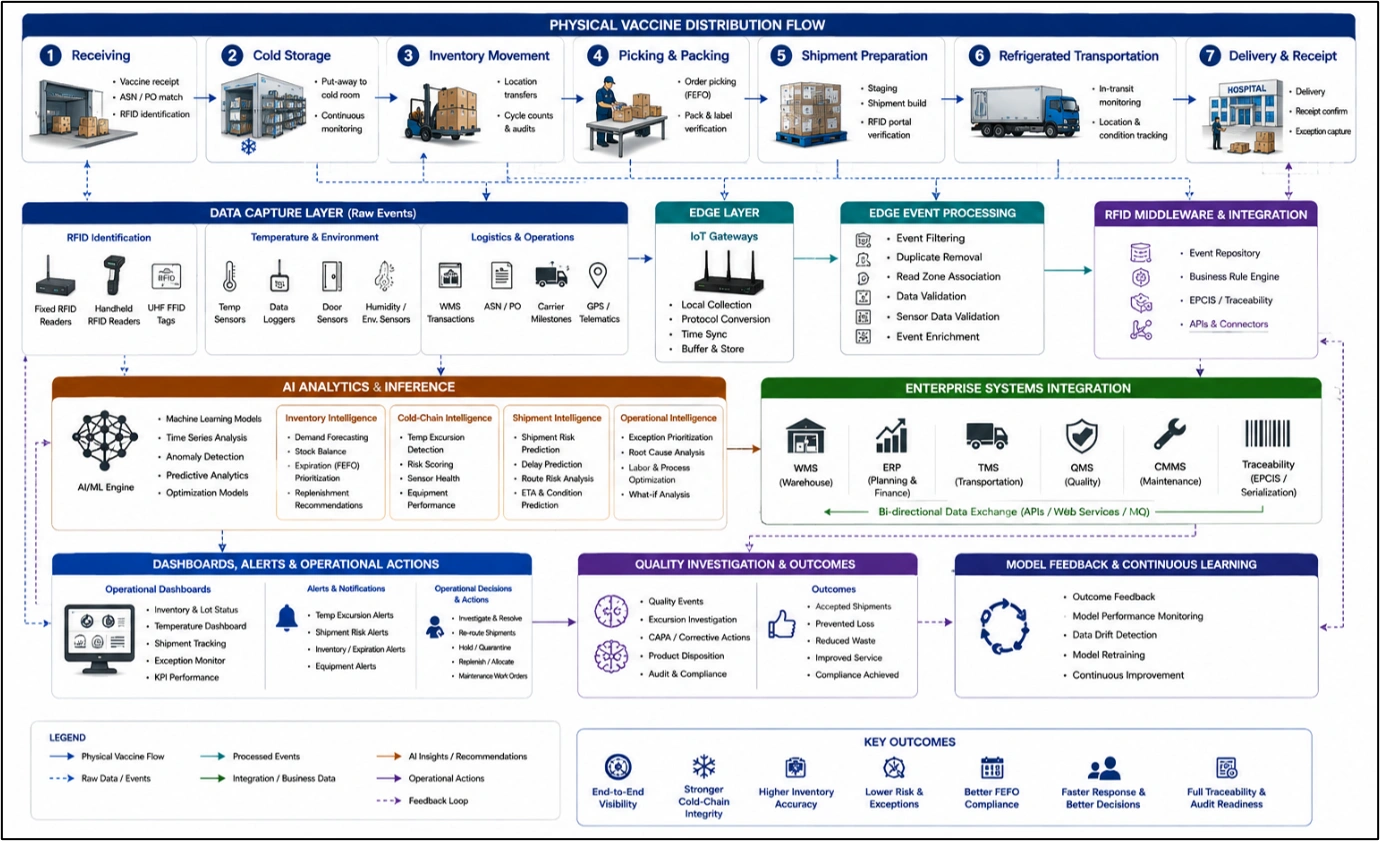
The workflow illustrates how vaccine identification, temperature monitoring, RFID events, and logistics data move from receiving through cold storage, shipment, refrigerated transportation, and delivery. Edge processing and RFID middleware convert raw events into validated data for AI analytics, WMS, ERP, TMS, QMS, and traceability systems, while operational outcomes and quality investigations feed back into model improvement.
Traceability and Regulatory Context for Vaccine Distribution
Traceability requirements differ by jurisdiction, vaccine program, product type, and supply-chain role. A vaccine distribution system should therefore map its data model and retention practices to the applicable regulatory and quality requirements rather than assuming that RFID itself provides compliance.
GS1 traceability standards define concepts such as Critical Tracking Events and Key Data Elements, providing a structured approach to connecting product movement with relevant business information. GS1 also identifies RFID and EPCIS among technologies and standards that can support traceability.
For U.S. pharmaceutical distribution, the Drug Supply Chain Security Act establishes requirements for interoperable electronic identification and tracing of certain prescription drugs at the package level as they move through the supply chain.
A vaccine distribution implementation should therefore consider:
- Product and package identification requirements
- Lot and expiration traceability
- Chain-of-custody events
- Receiving and shipping records
- Temperature records
- Calibration documentation
- Quality-event records
- Quarantine and release status
- Authorized-user access
- Audit trails
- Data retention
- Electronic record controls
- Applicable federal, state, provincial, and local requirements
- Manufacturer-specific storage and handling instructions
AI should support these controls rather than obscure them. A model-generated recommendation should be traceable to the underlying data, model version, rule set, and operational event that produced the recommendation.
Engineering Considerations for Vaccine Distribution RFID
RFID implementation in vaccine distribution requires more than selecting a reader and attaching a tag.
Tag Selection
Tag selection should consider:
- Vaccine carton and case construction
- Liquid content
- Foil or metallic packaging
- Pallet configuration
- Required read distance
- Portal geometry
- Temperature exposure
- Tag attachment method
- Labeling requirements
- Cost per tagged handling unit
- Reusability requirements for thermal containers
UHF RFID is generally the most relevant option for automated warehouse and shipment movement because it supports longer-range reads and high-volume identification. HF and LF should be evaluated for narrower, controlled identification points where their technical characteristics provide a better fit.
Read-Zone Engineering
A vaccine distribution center may require different reader configurations at receiving docks, cold-room entrances, picking stations, staging areas, and shipping portals.
Reader placement should be tested under realistic conditions involving loaded pallets, insulated containers, metal racks, refrigerated equipment, personnel movement, and multiple adjacent tags.
The objective is not maximum read count. The objective is reliable business-event detection with minimal false positives and missed reads.
Data Quality
AI performance depends on event quality.
Poor RFID reads, unsynchronized clocks, missing temperature records, duplicate events, incorrect location mappings, and incomplete shipment associations can create misleading AI outputs.
A production solution should therefore establish data-quality KPIs such as:
- RFID read success rate
- Duplicate-event rate
- Missed-event rate
- Sensor data completeness
- Timestamp synchronization accuracy
- Shipment-event correlation rate
- Inventory-location accuracy
- Temperature-data availability
- AI alert precision
- False-alert rate
- Mean time to acknowledge critical exceptions
Cloud and Server Deployment for AI Vaccine Distribution
The deployment model should reflect data sensitivity, network reliability, AI processing requirements, integration constraints, and the operating model of the vaccine distributor.
A Cloud Version can centralize AI analytics, dashboards, historical data, fleet-wide inventory analysis, model management, and cross-site reporting. This approach can be useful for organizations operating multiple vaccine distribution centers or geographically distributed storage and delivery operations.
A Server Version can place application software and AI services on customer-managed servers, private data centers, regional servers, or edge computing infrastructure. This approach can be appropriate when local processing, network independence, data residency, integration control, or low-latency response is important.
A hybrid arrangement is often technically practical. RFID readers and sensors can feed an edge gateway that performs local filtering and immediate exception detection while selected events and historical data are synchronized with centralized software.
The appropriate model depends on the operational requirement, not on a blanket preference for cloud or private infrastructure.
Security and Resilience
Security controls should cover both the physical RFID environment and the connected software environment.
Relevant controls include:
- Device identity and authentication
- Role-based access control
- Encrypted communications
- Network segmentation
- Secure API integration
- Certificate management
- Secure firmware and device lifecycle management
- Audit logging
- SIEM integration
- Backup and recovery
- Edge data buffering
- Connectivity-loss handling
- Least-privilege access
- Security monitoring
- Controlled software updates
Cold-chain continuity also requires resilience. If a network connection fails while vaccines remain in a refrigerated vehicle or storage room, local devices should continue collecting critical information and preserve events for later synchronization.
AI, RFID, and Supporting Technology Components
A production vaccine distribution solution combines identification, sensing, connectivity, software integration, AI analytics, and operational controls. Each component should have a defined responsibility so that an AI recommendation can be traced back to reliable physical and transactional data.
RFID Hardware
RFID hardware establishes automated identity and movement visibility for vaccine distribution.
- UHF RFID fixed readers: Capture vaccine cases, cartons, pallets, totes, and reusable shipping containers at receiving, storage, staging, and shipping checkpoints.
- UHF RFID antennas: Define controlled read zones at dock doors, cold-room entrances, conveyor points, and shipment portals.
- Handheld RFID readers: Support cycle counts, exception investigation, inventory verification, and location audits.
- HF RFID readers: Support short-range identification where controlled proximity interactions are preferable to long-range portal reads.
- LF RFID readers: Address specialized low-frequency identification requirements where their propagation characteristics are appropriate.
- RFID tags: Identify handling units, logistics assets, reusable thermal containers, and other trackable objects.
- Edge gateways: Aggregate RFID and sensor events and provide local processing and connectivity.
GAO supplies RFID hardware and IoT systems that can be incorporated into these vaccine distribution workflows, with equipment selection based on read distance, packaging, deployment environment, and integration requirements.
Temperature and Environmental Sensing
RFID establishes what moved and where it was observed, while temperature-monitoring equipment establishes cold-chain conditions.
Depending on the application, sensing can include:
- Temperature probes
- Digital data loggers
- Refrigerator temperature sensors
- Freezer sensors
- Cold-room sensors
- Humidity sensors
- Door-position sensors
- Power-failure sensors
- Compressor or equipment telemetry
- Vehicle temperature monitoring
- Thermal-container monitoring
A critical engineering distinction is that an RFID event does not prove that a vaccine remained within its required temperature range. Product disposition should use validated temperature-monitoring procedures and applicable manufacturer and regulatory requirements.
RFID Middleware and Event Processing
Middleware converts reader observations into useful vaccine distribution events.
Typical processing includes:
- Reader and antenna identification
- Tag filtering
- Duplicate suppression
- Read-zone association
- Timestamp normalization
- Device-health monitoring
- Location mapping
- Shipment association
- Inventory reconciliation
- Event enrichment
- API or message-based integration
MQTT can be useful for lightweight IoT telemetry, while REST APIs, message queues, database interfaces, and standards-based event exchange can connect RFID and sensor systems with warehouse and logistics software.
AI Analytics and Machine Learning
The appropriate AI method depends on the decision being supported.
- Time-series models can forecast demand and analyze temperature behavior.
- Anomaly detection can identify unusual storage or transportation patterns.
- Classification models can prioritize shipment or equipment risks.
- Regression models can estimate expected temperature recovery, transit conditions, or equipment behavior.
- Predictive maintenance models can identify developing refrigeration problems.
- Optimization algorithms can support inventory allocation and replenishment decisions.
- Clustering can identify recurring operational patterns across facilities, routes, carriers, or storage equipment.
- Computer vision can supplement RFID for package verification, label inspection, loading validation, or visual checks where cameras are appropriate.
AI models should be monitored after deployment. Changes in vaccine demand, packaging, transportation routes, storage equipment, carrier behavior, or operating procedures can cause model drift.
Continuous AI Improvement Loop for Vaccine Distribution Operations
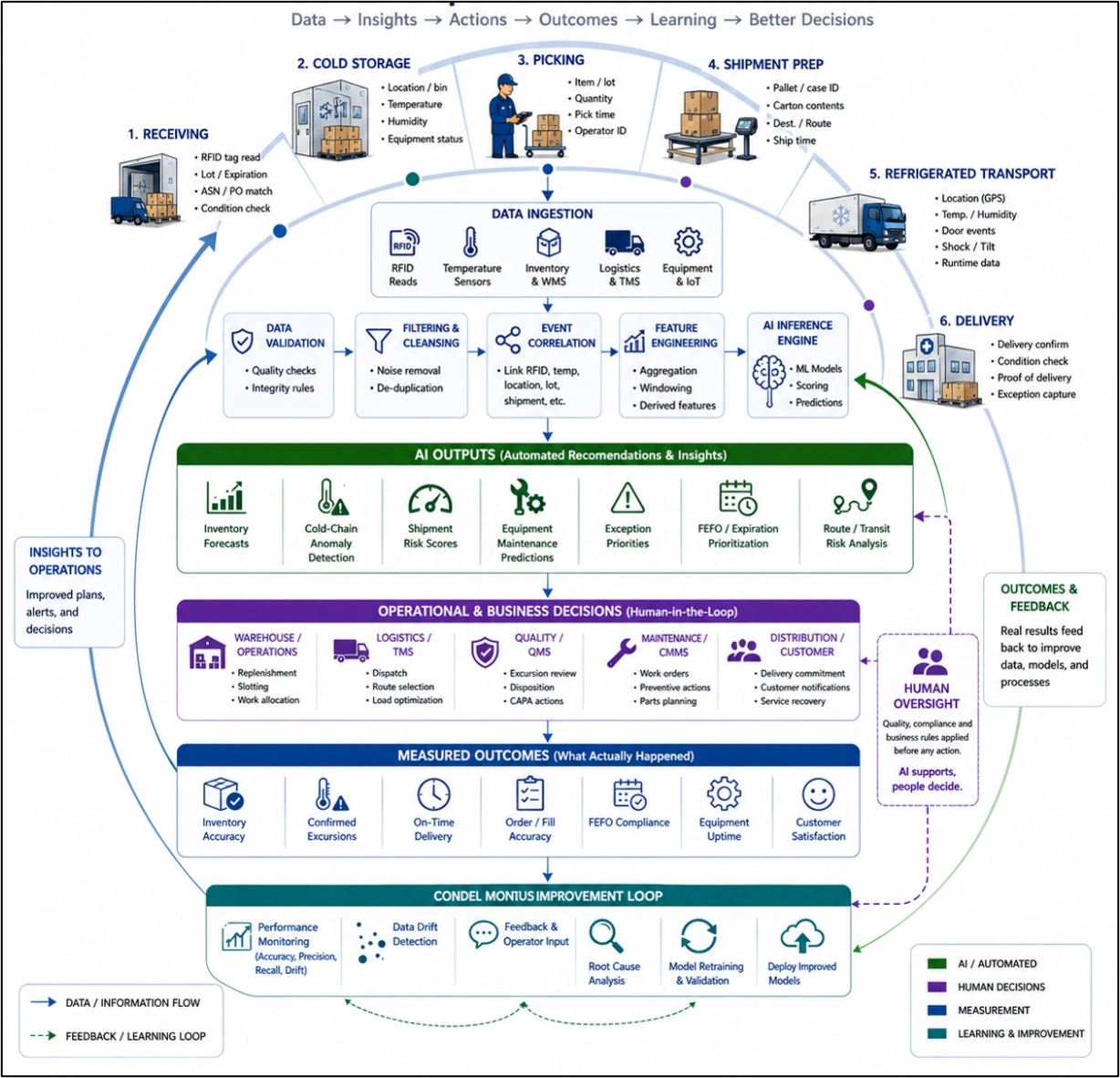
This circular control-loop diagram shows how vaccine distribution data from receiving, cold storage, picking, shipment preparation, refrigerated transport, and delivery flows through validation, cleansing, event correlation, feature engineering, and AI inference. It connects AI-generated recommendations to human-reviewed warehouse, logistics, quality, maintenance, and distribution decisions, then feeds measured outcomes, operator feedback, model monitoring, and retraining back into continuous improvement.
Technical Capabilities and Operational Improvements
Combining AI with automated identification and sensing can improve vaccine distribution because it connects physical events with decisions.
Higher Inventory Accuracy
Automated RFID observations can reduce dependence on manual inventory counts at selected checkpoints. AI can then reconcile physical observations against WMS records and identify discrepancies for investigation.
This is especially valuable for high-value vaccine inventory, where an inaccurate system-of-record quantity can cause unnecessary replenishment, missed orders, or incorrect allocation.
Faster Exception Detection
A traditional workflow may require personnel to review several systems before determining whether a shipment or storage unit requires attention.
AI can correlate the underlying signals and prioritize exceptions. An operator can therefore receive a risk-oriented notification rather than reviewing every temperature, inventory, and shipment event individually.
Better Cold-Chain Visibility
AI can identify relationships between temperature conditions, storage equipment, shipment duration, handling events, and physical movement.
This can help distinguish isolated sensor anomalies from recurring operational patterns that warrant investigation.
Improved FEFO Execution
FEFO, or first-expire, first-out, is particularly important for vaccine inventory.
RFID can establish physical location and movement while AI inventory logic considers expiration dates, demand, order requirements, and available stock. The combined data can support more effective allocation of lots approaching expiration.
The system should still enforce approved inventory and quality rules rather than allowing a predictive model to independently release or dispose of vaccine product.
Predictive Refrigeration Maintenance
Cold-storage equipment problems can affect large quantities of vaccine inventory.
AI can evaluate historical temperature behavior, recovery time, compressor signals, power events, alarm frequency, and maintenance history to identify equipment that deserves inspection.
The resulting workflow can connect the AI alert to a CMMS or EAM system so maintenance personnel receive a structured work request rather than an isolated analytics notification.
Reduced Manual Handling and Data Entry
Automated identification can reduce repetitive scanning at defined process points. Operators can spend more time resolving exceptions, checking cold-chain conditions, and managing vaccine allocation.
The practical benefit depends on read reliability. Poorly designed RFID zones can create more exception work than they remove, making site surveys and commissioning essential.
Vaccine Distribution KPIs for AI and RFID Programs
A meaningful deployment should measure both technology performance and vaccine distribution outcomes.
| KPI | What It Measures | AI/RFID Contribution |
| Inventory accuracy | Agreement between physical and digital inventory | RFID movement and cycle-count validation |
| RFID read success rate | Reliability of automated identification | Reader, antenna, and tag performance |
| Shipment traceability completeness | Percentage of required movement events captured | RFID and logistics event correlation |
| Temperature-data completeness | Availability of usable cold-chain measurements | Sensor and gateway monitoring |
| Excursion detection time | Time between abnormal conditions and notification | AI anomaly detection |
| Exception response time | Time required to acknowledge and investigate | AI prioritization and workflow integration |
| FEFO compliance | Correct expiration-based allocation | RFID location plus inventory analytics |
| Order fulfillment accuracy | Correct product, lot, quantity, and destination | RFID verification and WMS integration |
| Shipment dwell time | Time spent at distribution checkpoints | RFID location events |
| Inventory aging | Exposure to expiration risk | Forecasting and lot analytics |
| Cold-storage equipment availability | Operational readiness of refrigeration equipment | Predictive maintenance |
| False-alert rate | Percentage of alerts not requiring action | AI model performance |
| AI prediction accuracy | Reliability of forecasts or classifications | Model monitoring |
| Data completeness | Availability of required operational data | Middleware and integration controls |
| Mean time to resolution | Duration of operational exceptions | AI-assisted prioritization |
KPI definitions should be agreed upon before deployment. For example, “inventory accuracy” needs a defined counting methodology, tolerance, product hierarchy, and reconciliation interval if facilities are going to compare results consistently.
Implementation Lifecycle for AI Vaccine Distribution
Successful deployment should proceed from operational requirements rather than from RFID hardware selection alone.
Process and Data Assessment
Start by mapping vaccine movement from supplier receipt through final delivery.
Identify:
- Receiving checkpoints
- Cold-storage locations
- Picking processes
- Quarantine areas
- Staging zones
- Shipment lanes
- Cross-dock activities
- Delivery confirmation
- Temperature-monitoring points
- Existing barcode workflows
- WMS and TMS transactions
- Quality review procedures
- Equipment maintenance processes
The assessment should identify where a reliable digital event is currently missing and whether RFID, sensing, software integration, or AI can close that gap.
RFID Site Survey and Tag Testing
A physical survey should evaluate:
- Storage racks
- Refrigerated rooms
- Doorways
- Dock doors
- Pallet dimensions
- Case stacking
- Metal surfaces
- Liquid-rich packaging
- Reader mounting locations
- Network connectivity
- Power availability
- Human traffic
- Forklift traffic
Representative vaccine packaging and realistic loaded configurations should be used for testing.
Data and Integration Design
Define the data relationship between product, lot, case, pallet, shipment, order, location, temperature device, carrier, and customer.
An event model should answer questions such as:
- What object was observed?
- Which vaccine product does it represent?
- Which lot is associated with it?
- Where was it observed?
- When was it observed?
- Which shipment or order contains it?
- What temperature data applies to it?
- What operational status does it have?
- Which system is authoritative for the information?
AI Model Validation
AI should initially operate under controlled conditions.
A practical approach is to compare AI predictions with known historical events and then conduct a monitored production pilot.
Validation should consider:
- Precision
- Recall
- False-positive rate
- False-negative rate
- Prediction latency
- Data completeness
- Model drift
- Explainability
- Operator acceptance
- Impact on quality workflows
High-risk decisions should retain human review and established vaccine handling controls.
Commissioning and Acceptance Testing
Testing should cover the complete chain rather than RFID hardware alone.
Recommended tests include:
- Tag readability
- Portal read-zone containment
- Handheld read performance
- Duplicate suppression
- Location determination
- Inventory reconciliation
- Temperature data correlation
- Network outage recovery
- Edge buffering
- Cloud synchronization
- API integration
- AI alert generation
- User notification
- Audit logging
- Security controls
- Backup and recovery
- Exception workflow
A successful reader test does not constitute a successful vaccine distribution deployment. The final acceptance criterion should be whether the complete workflow produces trustworthy operational events and actionable decisions.
Cybersecurity, Interoperability, and Operational Resilience
AI-enabled vaccine distribution creates additional connections among physical devices, warehouse systems, logistics software, cloud or private servers, and quality records.
A defense-in-depth approach should protect the complete data path.
Cybersecurity Controls
Relevant controls include:
- Unique device identities
- Strong authentication
- Role-based access control
- Network segmentation
- Encrypted communications
- Secure API authentication
- Certificate lifecycle management
- Security event logging
- SIEM integration
- Endpoint protection for servers
- Controlled firmware updates
- Vulnerability management
- Backup and recovery
- Least-privilege permissions
- Administrative activity auditing
RFID readers and IoT gateways should not be placed on unrestricted networks simply because their primary function is physical identification.
Interoperability
Vaccine distribution frequently involves multiple manufacturers, distributors, carriers, warehouse systems, healthcare organizations, and government programs.
Interoperability should therefore be considered during system design rather than added after deployment.
Relevant technologies and standards can include:
- EPCIS
- GS1 identification standards
- MQTT
- REST APIs
- Webhooks
- SQL interfaces
- JSON
- XML
- OPC UA where industrial equipment integration is required
- Enterprise identity standards
- Standardized timestamp and location models
The implementation should maintain clear ownership of master data. AI should not silently overwrite authoritative product, lot, customer, or quality information.
Resilience During Connectivity Loss
A refrigerated shipment cannot stop collecting temperature information simply because a cellular or WAN connection is unavailable.
Edge devices should therefore support:
- Local event buffering
- Persistent storage
- Store-and-forward synchronization
- Timestamp integrity
- Device-health monitoring
- Local alerting where required
- Automatic reconnection
- Duplicate protection after synchronization
The same principle applies to distribution centers. Local operations should retain sufficient functionality to continue safe vaccine handling during temporary network outages.
Practical Deployment Recommendations for Vaccine Distribution
A technically sound AI and RFID program should prioritize data quality and operational outcomes over the number of connected devices.
- Begin with a clearly defined vaccine distribution problem such as inventory inaccuracy, incomplete shipment traceability, excessive manual counting, FEFO failures, cold-chain exception response, or refrigeration maintenance.
- Map the physical vaccine flow before selecting RFID readers and antennas.
- Test RFID tags against representative vaccine packaging, cases, pallets, thermal containers, and storage configurations.
- Use UHF RFID primarily where automated longer-range identification provides a measurable operational advantage.
- Use HF or LF RFID only when their specific short-range or specialized identification characteristics fit the process.
- Keep validated temperature monitoring independent of RFID identification when required by vaccine handling procedures.
- Correlate RFID identity with lot, expiration, shipment, location, and temperature data.
- Filter duplicate RFID observations before generating inventory or movement transactions.
- Keep AI recommendations traceable to source events and model versions.
- Use AI to prioritize quality and logistics exceptions rather than bypassing established vaccine disposition controls.
- Establish measurable baseline KPIs before deployment.
- Pilot the solution at a representative distribution center before expanding across facilities.
- Validate network-outage behavior, edge buffering, and synchronization before production acceptance.
- Integrate AI outputs into WMS, TMS, QMS, CMMS, or EAM workflows where an operational owner exists.
- Monitor model performance after deployment and retrain only through controlled model-management procedures.
- Segment RFID readers, gateways, servers, and connected equipment according to cybersecurity requirements.
- Document ownership for product master data, inventory status, temperature records, quality decisions, and AI-generated recommendations.
GAO’s experience supplying RFID, BLE, and IoT hardware products and systems can support organizations that require practical identification, sensing, gateway, and connectivity components for these deployments. GAO has served U.S. and Canadian customers for approximately three decades, including Fortune 500 companies, research organizations, universities, and government agencies, with remote and onsite technical support.
Key Takeaways for AI-Enabled Vaccine Distribution
AI can make vaccine distribution more responsive by transforming large volumes of identification, temperature, inventory, shipment, and equipment data into prioritized operational intelligence.
The strongest implementations treat RFID as an enabling identification technology rather than as the entire solution. UHF RFID can automate selected movement and inventory events, while temperature sensors provide condition data and AI correlates the resulting information with warehouse, transportation, quality, and maintenance records.
For vaccine distributors, the practical objective is measurable improvement in inventory accuracy, traceability, exception response, FEFO execution, cold-chain visibility, equipment reliability, and operational resilience.
GAO can help organizations evaluate RFID hardware, sensing, gateways, and connected IoT systems according to the physical and software requirements of vaccine distribution. Readers can learn more about GAO’s technology products, engineering capabilities, and technical support when developing or expanding an AI-enabled vaccine distribution solution.
Building the Future of Industrial AI and IoT with Aperture Venture Studio and GAO RFID Inc.
For more than three decades, GAO Group of Companies has invested heavily in R&D for industrial RFID, BLE, and IoT. As AI has become increasingly useful for industrial applications, we have expanded our work in AI-enabled IoT, including solutions relevant to vaccine distribution, cold-chain visibility, RFID traceability, and intelligent logistics. We have also founded Aperture Venture Studio to help advance practical AI and IoT solutions for applications such as healthcare logistics and vaccine supply-chain operations.
Aperture has attracted AI and IoT technical experts, entrepreneurial and operational executives, investors, and leading companies.
We have also developed Aperture Ventures Summit and TekSummit to discuss advanced AI and IoT topics.
These activities have contributed to broader technical communities around AI and IoT.
We welcome you to join us as:
- Advisors, co-founders, or employees
- Investors
- Customers