
AI and RFID for Vehicle Rental
AI-Powered RFID for Modern Vehicle Rental Fleet Management
Artificial intelligence combined with RFID technology is transforming vehicle rental operations by enabling real-time fleet visibility, automated vehicle identification, predictive maintenance, intelligent utilization analysis, and data-driven operational decision-making. Vehicle rental companies increasingly rely on AI-supported RFID systems to reduce vehicle downtime, accelerate rental transactions, improve fleet availability, strengthen security, and optimize maintenance scheduling across distributed rental locations.
Within the vehicle rental industry, RFID serves as the primary data acquisition technology while AI continuously analyzes operational information generated throughout the vehicle lifecycle. RFID tags attached to vehicles, keys, maintenance assets, and supporting equipment continuously capture operational events. AI algorithms interpret these events to identify anomalies, forecast maintenance requirements, optimize fleet allocation, predict rental demand, and improve customer service performance. Together, these technologies help rental operators increase fleet utilization, reduce operational costs, improve regulatory compliance, and deliver faster rental experiences.
Understanding AI-Enabled RFID Systems for Vehicle Rental
Vehicle rental organizations manage thousands of mobile assets operating across airports, urban rental branches, corporate leasing centers, maintenance facilities, logistics yards, and vehicle remarketing operations. Managing these assets efficiently requires continuous visibility into vehicle location, operational status, maintenance history, reservation schedules, and utilization rates.
RFID provides automated identification of vehicles without requiring manual barcode scanning or direct visual contact. Depending on operational requirements, vehicle rental companies commonly deploy:
- UHF RFID for long-range vehicle identification at entry gates, exit lanes, fleet storage yards, maintenance depots, and automated inspection checkpoints.
- HF RFID for secure driver authentication, smart key management, document verification, and controlled access applications.
- LF RFID for harsh operating environments where metal interference, moisture, or rugged conditions affect communication reliability.
Artificial intelligence transforms RFID-generated operational data into actionable intelligence by applying:
- Machine learning for fleet demand forecasting
- Predictive analytics for preventive maintenance scheduling
- Computer vision-assisted vehicle inspection
- Reinforcement learning for fleet allocation optimization
- Natural language processing for customer support automation
- Time-series forecasting for seasonal rental demand prediction
- Anomaly detection for unauthorized vehicle movement
- Intelligent scheduling for maintenance resource planning
Rather than functioning independently, RFID continuously feeds trusted operational data into AI software, enabling accurate decision-making throughout the vehicle rental lifecycle.
GAO has supported organizations across North America by supplying RFID hardware products and intelligent identification systems that help improve fleet visibility, automate asset tracking, and simplify operational workflows for demanding industrial environments.
Operational Challenges Driving AI-Powered RFID Adoption in Vehicle Rental
Vehicle rental companies face operational complexity because vehicles constantly move among rental counters, airport terminals, maintenance facilities, cleaning stations, fueling locations, customer destinations, transport carriers, and remarketing channels. Manual tracking methods frequently introduce delays, misplaced vehicles, inaccurate inventory records, and increased labor costs.
Common operational challenges include:
- Limited real-time visibility into fleet location across multiple rental branches
- Lost or misplaced vehicle keys
- Delayed vehicle turnaround after customer returns
- Unplanned maintenance events resulting in fleet downtime
- Inefficient fleet balancing between rental locations
- Fraudulent vehicle usage or unauthorized movement
- Manual inventory audits requiring significant labor
- Difficulty forecasting seasonal rental demand
- Vehicle inspection inconsistencies
- Compliance tracking for safety inspections and maintenance records
- Long customer wait times during vehicle pickup and return
- Poor utilization of premium vehicle categories
- High operating expenses associated with manual fleet management
- Delayed damage reporting
- Inefficient remarketing of retired fleet assets
AI-enabled RFID solutions address these challenges by automating identification, improving data accuracy, and enabling predictive operational planning based on continuously updated fleet information.
AI-Driven RFID Applications Across the Vehicle Rental Lifecycle
AI-supported RFID systems enhance nearly every operational stage within vehicle rental businesses.
Intelligent Fleet Identification
UHF RFID readers installed at rental exits, parking entrances, maintenance garages, fueling stations, and logistics checkpoints automatically identify vehicles without stopping traffic. AI validates expected vehicle movement against reservation schedules and operational policies.
Automated Vehicle Check-In and Check-Out
RFID automatically confirms vehicle identity, rental contract association, customer authorization, and return status. AI verifies transaction consistency, identifies exceptions, and reduces manual verification time.
Predictive Vehicle Maintenance
Historical RFID movement data, maintenance records, telematics information, and AI forecasting models predict component wear before failures occur. Maintenance managers receive prioritized work orders based on predicted failure probability, vehicle utilization, mileage, and service history.
Smart Key Management
HF RFID tags attached to vehicle keys enable automated key inventory management within secure storage cabinets. AI monitors key movement, detects unauthorized access attempts, and identifies missing assets in real time.
Dynamic Fleet Allocation
Machine learning evaluates reservation demand, local events, seasonal trends, weather conditions, airport traffic, and historical rental patterns to recommend optimal vehicle distribution among rental branches. RFID provides the real-time fleet status needed for these recommendations.
RFID-Enabled AI Workflow for Intelligent Vehicle Rental Operations
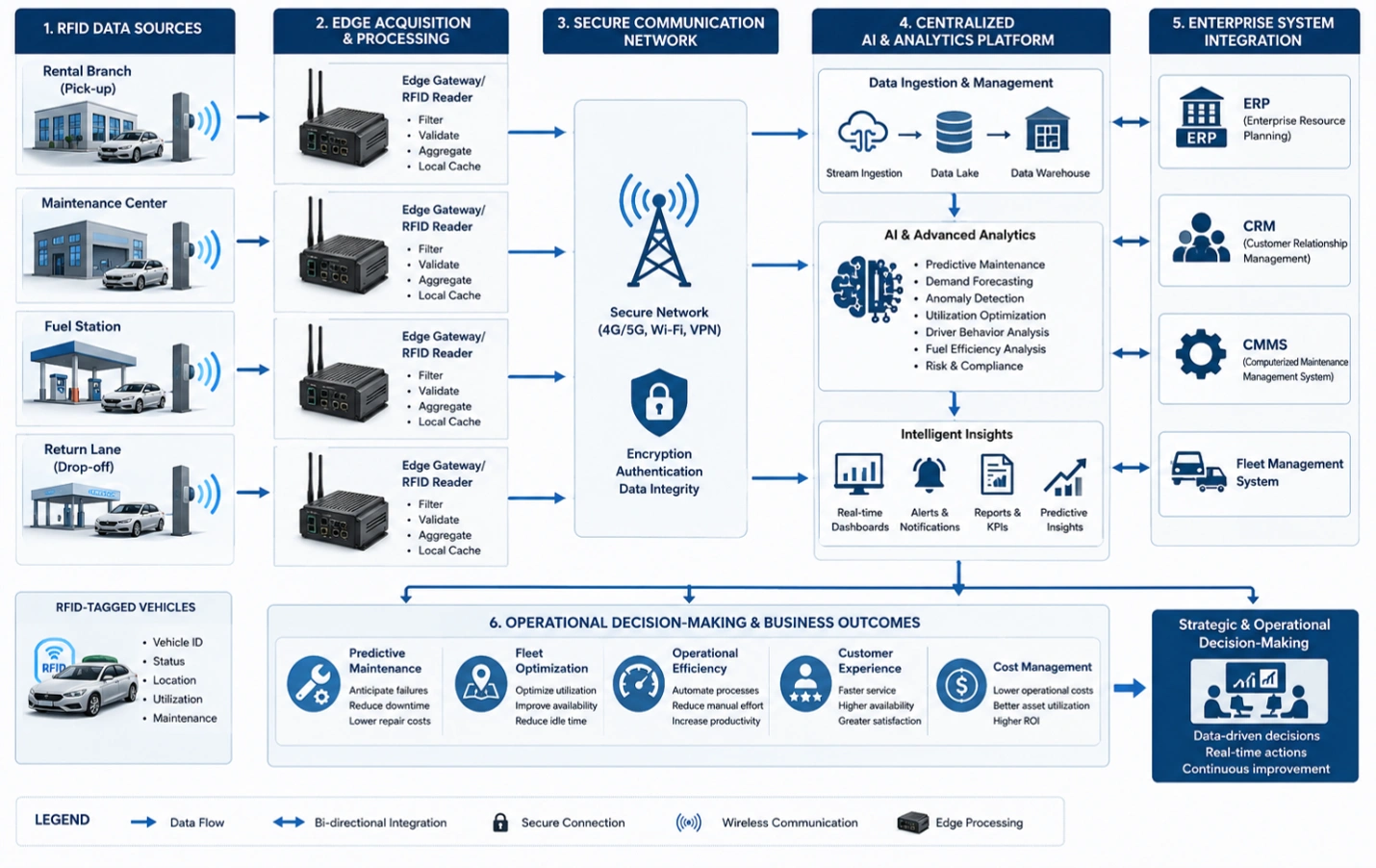
This workflow diagram illustrates the end-to-end process of RFID-enabled vehicle rental operations, from RFID-tagged vehicles and distributed RFID readers to edge processing, secure data transmission, AI analytics, and enterprise system integration. It demonstrates how AI-driven insights support predictive maintenance, fleet optimization, and data-driven operational decision-making, improving efficiency, asset utilization, and customer service.
Operational Workflow from RFID Data Acquisition to AI-Driven Decision-Making in Vehicle Rental
AI-enabled RFID solutions create a continuous digital workflow that follows each rental vehicle from fleet acquisition through customer rental, servicing, relocation, and eventual retirement. Instead of relying on manual updates, every significant operational event is automatically captured, verified, analyzed, and converted into actionable intelligence.
Vehicle Registration and RFID Tag Commissioning
Every newly acquired vehicle receives a unique RFID identity during fleet onboarding. Depending on operational requirements, UHF RFID tags are typically mounted inside the windshield or another protected location, while HF RFID may be assigned to smart keys or secure driver authentication devices. Each RFID identifier is associated with vehicle information including:
- Vehicle Identification Number (VIN)
- License plate number
- Vehicle category
- Manufacturer and model
- Model year
- Fuel or battery type
- Current mileage
- Warranty status
- Insurance records
- Registration information
- Assigned rental branch
- Maintenance history
The RFID identity becomes the trusted digital reference used throughout the vehicle’s operational lifecycle.
Automated Data Capture Throughout Fleet Operations
RFID readers installed at strategic operational locations automatically capture vehicle movement without interrupting normal workflows. Typical deployment locations include:
- Airport rental exits
- Customer return lanes
- Fleet storage compounds
- Vehicle washing facilities
- Fueling stations
- Electric vehicle charging stations
- Maintenance workshops
- Inspection bays
- Logistics transfer hubs
- Secure parking areas
Every RFID event records essential operational data such as:
- Vehicle identity
- Reader location
- Timestamp
- Movement direction
- Gate identifier
- Signal quality
- Vehicle status
- Associated transaction ID
This eliminates manual logging while providing highly accurate fleet visibility.
Edge Processing and Event Validation
Before transmitting operational data to enterprise software, edge computing devices perform immediate validation and filtering. Edge processing reduces unnecessary network traffic and enables rapid local decision-making.
Typical edge functions include:
- Duplicate RFID read elimination
- Signal strength validation
- Reader health monitoring
- Vehicle movement verification
- Event prioritization
- Temporary data buffering during network interruptions
- Local alarm generation
- Unauthorized movement detection
Real-time processing enables rental operators to respond immediately to exceptions such as vehicles exiting without authorization or entering restricted maintenance zones.
Secure Communication Infrastructure
Validated RFID events are transmitted through secure communication networks to centralized software systems. Common communication technologies include:
- Ethernet
- Wi-Fi 6
- Private 5G networks
- LTE connectivity
- VPN-secured internet connections
- MQTT messaging
- HTTPS APIs
- OPC UA where operational technology integration is required
Encryption mechanisms such as TLS protect operational data during transmission between RFID infrastructure and enterprise applications.
Enterprise Software Integration
AI-supported RFID systems deliver the greatest value when integrated with business software already used by vehicle rental organizations. Middleware synchronizes RFID events with multiple operational systems, including:
- Fleet Management Systems (FMS)
- Vehicle Rental Management Software
- Enterprise Resource Planning (ERP)
- Customer Relationship Management (CRM)
- Computerized Maintenance Management Systems (CMMS)
- Accounting and billing software
- Reservation and booking platforms
- GPS fleet telematics
- Insurance management systems
- Business intelligence dashboards
Integration ensures that operational decisions are based on a single, consistent source of fleet information.
AI Analytics and Intelligent Decision-Making
Once RFID data reaches centralized databases, AI models analyze historical and real-time information to support operational decisions.
Common AI capabilities include:
- Predictive maintenance scheduling
- Rental demand forecasting
- Fleet utilization optimization
- Dynamic vehicle allocation
- Customer behavior analysis
- Damage risk prediction
- Idle vehicle identification
- Revenue optimization
- Branch capacity planning
- Fraud detection
- Vehicle lifecycle forecasting
- Automated exception management
Rather than generating reports alone, AI recommends operational actions, allowing fleet managers to respond proactively.
Engineering Considerations for AI-Enabled RFID Deployment
Successful deployment requires careful engineering beyond installing RFID readers. Vehicle rental environments introduce unique technical challenges that influence hardware selection, reader placement, software integration, and long-term system performance.
Key considerations include:
- Selecting RFID tags resistant to heat, UV exposure, vibration, and moisture.
- Optimizing reader placement to minimize missed reads and interference from metal vehicle bodies.
- Calibrating antenna power to avoid overlapping read zones.
- Ensuring interoperability with telematics, GPS, and reservation systems.
- Designing scalable infrastructure for multi-branch operations.
- Implementing redundant communication paths to maintain availability.
- Establishing role-based access controls for fleet data.
- Planning preventive maintenance for readers and antennas.
- Conducting periodic read accuracy testing.
- Monitoring cybersecurity risks across connected RFID devices.
GAO supports customers with RFID hardware, deployment guidance, and technical expertise that help organizations implement reliable identification systems tailored to demanding operational environments.
Enterprise RFID and AI System Architecture for Intelligent Vehicle Rental Management
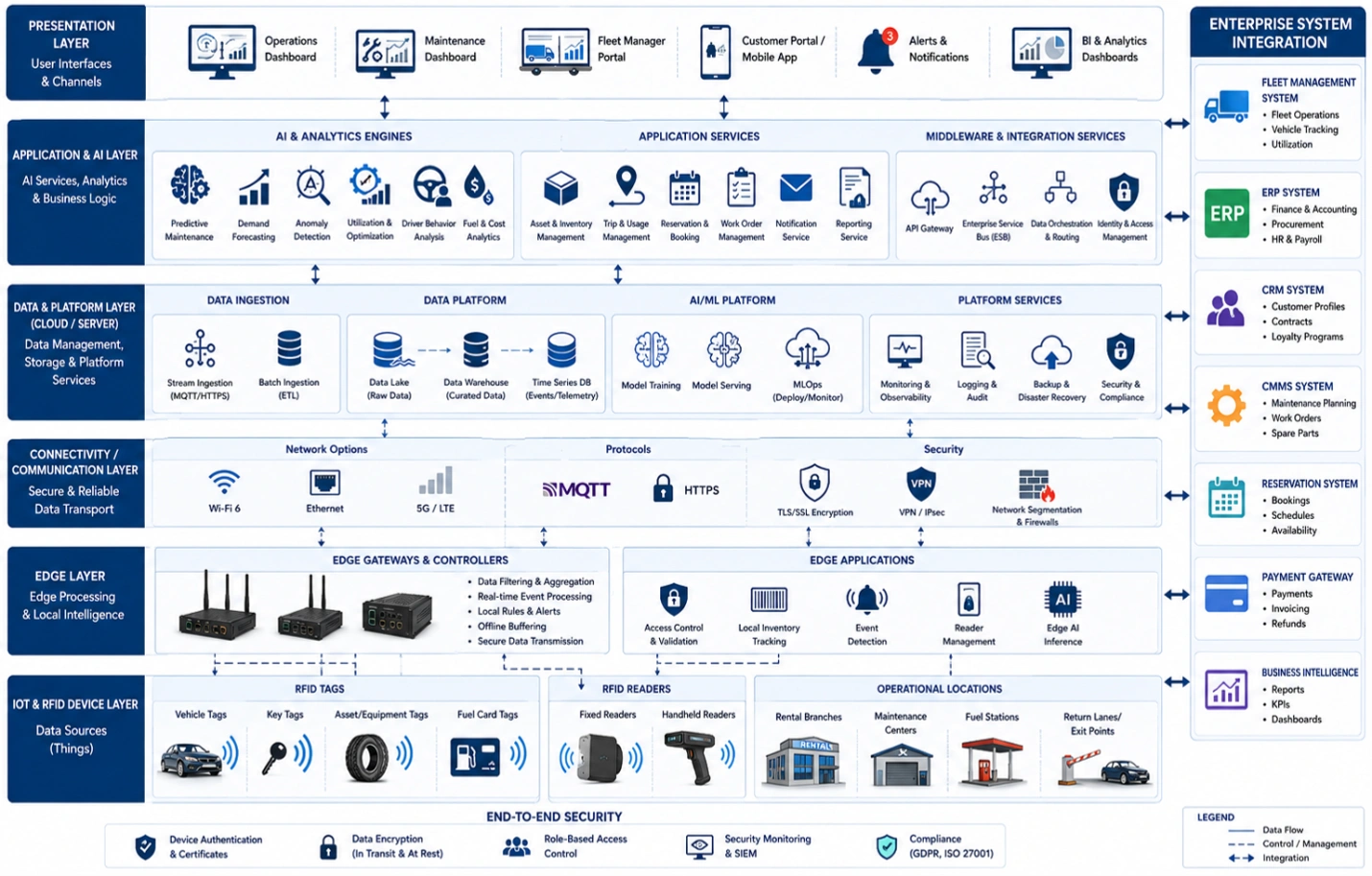
This layered architecture diagram illustrates how RFID hardware, communication networks, edge gateways, AI analytics, middleware, cloud infrastructure, and enterprise applications interact within an intelligent vehicle rental ecosystem. It highlights the seamless flow of operational data from RFID-enabled assets to AI-driven analytics and enterprise platforms, enabling real-time fleet visibility, predictive maintenance, automated operations, and informed business decision-making.
RFID Technology, AI Models, Software, Communication Protocols, and Deployment Considerations for Vehicle Rental
A successful AI-enabled RFID solution for vehicle rental depends on the coordinated operation of identification hardware, communication infrastructure, AI software, enterprise applications, and cybersecurity controls. Rather than functioning as isolated technologies, these components form an intelligent operational system that continuously monitors fleet activity, supports automated decision-making, and improves service delivery throughout the rental lifecycle.
RFID Hardware Components
Reliable hardware selection directly affects system performance, read accuracy, and long-term operational stability.
RFID Tags
Vehicle rental organizations typically deploy multiple RFID tag types depending on the asset being identified.
UHF RFID Tags
Ideal for:
- Rental vehicles
- Fleet inventory
- Parking yard management
- Gate automation
- Vehicle dispatch
- Logistics tracking
Typical characteristics:
- Long read distance
- Fast multi-tag reading
- Suitable for outdoor deployments
- High-speed vehicle identification
HF RFID Tags
Commonly used for:
- Smart vehicle keys
- Driver authentication
- Employee identification cards
- Secure document tracking
- Access control
Typical characteristics:
- Short-range secure communication
- Strong authentication capability
- Reliable operation for user identification
LF RFID Tags
Recommended for:
- Harsh maintenance environments
- Metal-intensive work areas
- Specialized equipment identification
- Service tools
Typical characteristics:
- High resistance to environmental interference
- Stable performance around metal surfaces
- Reliable short-range communication
RFID Readers and Antennas
Different reader configurations support different operational workflows.
Fixed RFID Readers
Installed at:
- Entry gates
- Exit lanes
- Airport rental facilities
- Fleet compounds
- Maintenance workshops
- Vehicle wash stations
Primary functions:
- Continuous vehicle identification
- Automated access control
- Fleet movement monitoring
- Real-time inventory updates
Handheld RFID Readers
Used by:
- Fleet inspectors
- Maintenance technicians
- Inventory personnel
- Yard managers
Typical applications:
- Vehicle verification
- Key inventory audits
- Damage inspections
- Manual exception handling
RFID Antennas
Directional and omnidirectional antennas are selected according to:
- Lane width
- Vehicle speed
- Parking layout
- Read zone requirements
- Environmental conditions
Proper antenna placement minimizes missed reads while reducing cross-lane interference.
Artificial Intelligence Technologies
Artificial intelligence transforms RFID-generated operational data into predictive and prescriptive recommendations rather than simple historical reports.
Common AI methods include:
Machine Learning
Supports:
- Rental demand prediction
- Fleet utilization optimization
- Vehicle allocation
- Customer behavior analysis
Predictive Analytics
Forecasts:
- Preventive maintenance schedules
- Tire replacement timing
- Battery health
- Engine servicing requirements
- Component failure probability
Time-Series Forecasting
Analyzes:
- Seasonal rental demand
- Airport traffic patterns
- Holiday utilization
- Fleet availability trends
Anomaly Detection
Identifies:
- Unauthorized vehicle movement
- Unexpected route deviations
- Missing vehicle keys
- Unusual rental durations
- Suspicious operational behavior
Computer Vision
Can integrate with RFID systems for:
- Automated damage detection
- License plate verification
- Vehicle condition assessment
- Return-lane inspection
Enterprise Software Components
AI-powered RFID solutions integrate with existing business software to maintain consistent operational information across departments.
Common software integrations include:
- Fleet Management Systems (FMS)
- Enterprise Resource Planning (ERP)
- Customer Relationship Management (CRM)
- Computerized Maintenance Management Systems (CMMS)
- Reservation Management Software
- Vehicle Inspection Software
- Asset Management Systems
- Financial and Billing Systems
- Identity and Access Management (IAM)
- Business Intelligence (BI) dashboards
Middleware synchronizes RFID events with these systems, eliminating duplicate data entry and improving operational consistency.
Communication Protocols
Reliable communication ensures timely transfer of RFID data throughout the vehicle rental operation.
Frequently used protocols include:
- EPCglobal Gen2 (ISO/IEC 18000-63) for UHF RFID communication
- ISO/IEC 14443 for HF RFID smart card applications
- ISO/IEC 15693 for vicinity card communication
- MQTT for lightweight IoT messaging
- HTTPS REST APIs for secure application integration
- TCP/IP for network communication
- Ethernet for fixed infrastructure connectivity
- Wi-Fi 6 for wireless reader deployment
- LTE and Private 5G for geographically distributed branches
- VPN tunnels for secure remote communication
These technologies enable secure and scalable connectivity between RFID devices, edge gateways, AI software, and enterprise systems.
Cloud Version vs. Server Version
Selecting an appropriate deployment model depends on operational scale, regulatory requirements, IT resources, and performance objectives.
Cloud Version
Cloud-hosted deployments are well suited for organizations operating multiple rental branches across different geographic regions.
Advantages include:
- Centralized fleet visibility
- Simplified software updates
- Elastic scalability
- Remote access to operational dashboards
- Lower infrastructure maintenance
- Rapid deployment of AI model updates
Typical use cases include nationwide vehicle rental companies, airport rental networks, and organizations with distributed fleets.
Server Version
Server-based deployments are preferred when organizations require direct control over operational data or must comply with internal cybersecurity and data governance policies.
Advantages include:
- Full control of infrastructure
- Lower latency for local operations
- Enhanced data sovereignty
- Integration with existing private IT environments
- Custom security configurations
- Greater flexibility for specialized workflows
This deployment model is often selected by government fleets, defense-related vehicle pools, and organizations with stringent regulatory requirements.
Cybersecurity and Data Protection
Because RFID systems exchange operational and customer-related information, strong cybersecurity measures are essential.
Recommended security mechanisms include:
- TLS encryption for data transmission
- AES encryption for sensitive stored data
- Role-based access control (RBAC)
- Multi-factor authentication (MFA)
- Secure API authentication
- Digital certificates for device identity
- Continuous security monitoring
- Network segmentation
- Security Information and Event Management (SIEM) integration
- Regular vulnerability assessments and firmware updates
These controls help protect fleet information, customer records, and operational systems from unauthorized access and cyber threats.
AI-Enabled RFID Deployment Decision Tree for Vehicle Rental Organizations
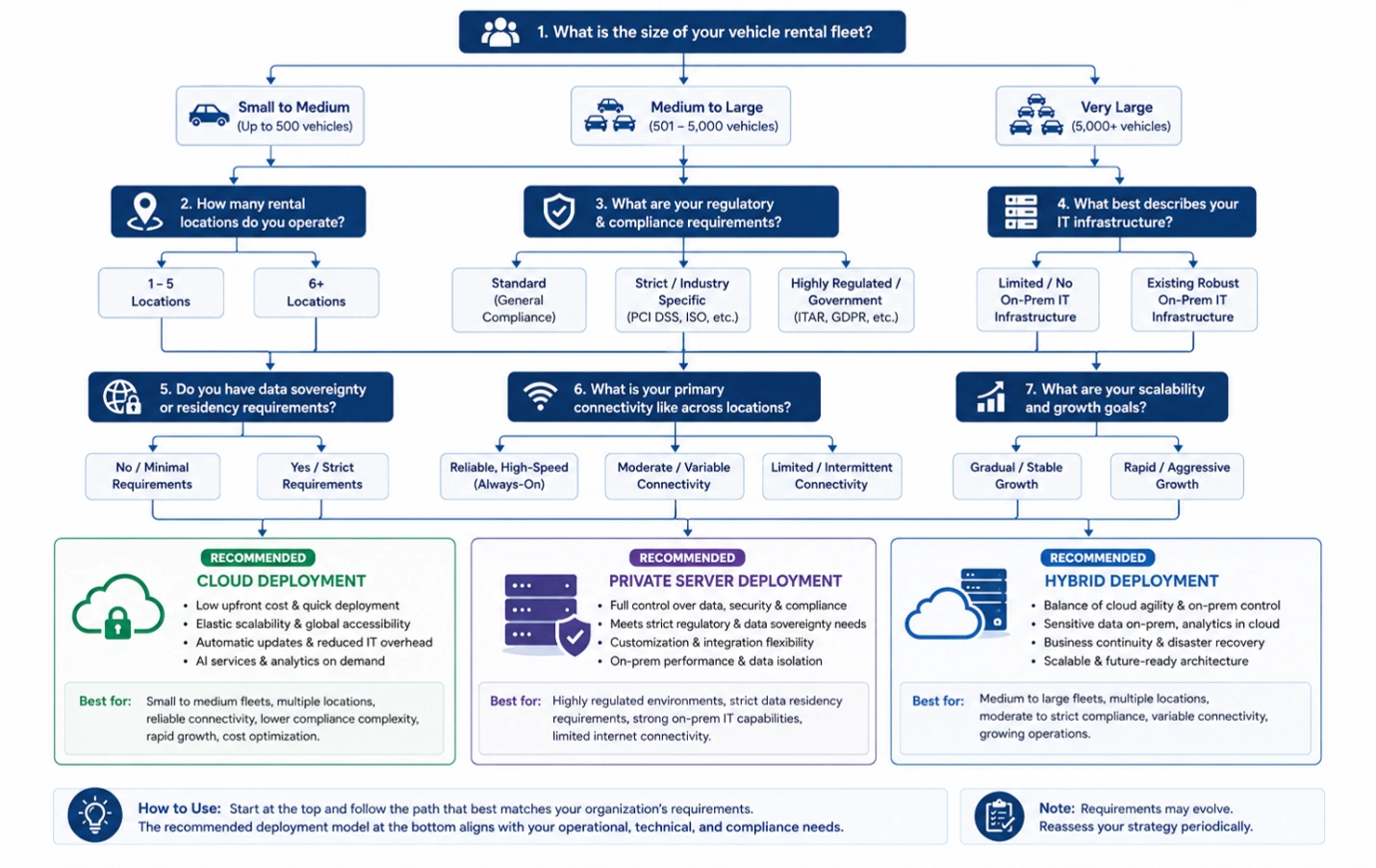
This decision tree guides vehicle rental organizations in selecting the most suitable AI-enabled RFID deployment model based on fleet size, operational scale, regulatory requirements, IT infrastructure, data sovereignty, connectivity, and future growth objectives. It concludes with tailored recommendations for Cloud, Private Server, or Hybrid deployment to support secure, scalable, and efficient fleet management.
Key Technical Capabilities of AI-Enabled RFID for Vehicle Rental
Vehicle rental companies require more than automated identification. Modern AI-enabled RFID solutions deliver continuous operational intelligence that improves fleet visibility, asset utilization, customer service, maintenance planning, and security. By combining RFID-generated operational events with AI analytics, organizations can automate repetitive tasks while enabling proactive operational decisions.
Real-Time Fleet Visibility
RFID readers continuously identify vehicles as they move between rental branches, airport terminals, maintenance facilities, fueling stations, washing areas, and customer return lanes. AI correlates these identification events with reservation schedules, maintenance records, and utilization metrics to present an accurate, real-time view of fleet status.
Operational advantages include:
- Continuous vehicle location awareness
- Faster vehicle retrieval
- Reduced search time within parking compounds
- Improved branch-to-branch fleet transfers
- Accurate inventory reconciliation
- Better fleet availability forecasting
Intelligent Fleet Utilization Optimization
Vehicle rental profitability depends heavily on maximizing fleet utilization while minimizing idle vehicles.
Machine learning models analyze:
- Historical reservation data
- Seasonal demand
- Airport passenger volumes
- Local events
- Customer preferences
- Vehicle categories
- Rental duration trends
AI recommends relocating vehicles to branches where future demand is expected, helping reduce shortages and unnecessary fleet transfers.
Benefits include:
- Higher utilization rates
- Lower idle inventory
- Increased rental revenue
- Improved customer satisfaction
- Reduced transportation costs
Predictive Maintenance and Asset Health Management
Traditional maintenance schedules often rely on fixed mileage or calendar intervals. AI enhances this process by evaluating RFID movement records alongside telematics, maintenance logs, diagnostic codes, and service histories.
The system can predict:
- Engine servicing requirements
- Brake wear
- Tire replacement timing
- Battery degradation
- Fluid maintenance intervals
- Component failure risks
Predictive maintenance minimizes unexpected vehicle downtime and extends fleet lifespan while improving safety.
Automated Rental Transactions
RFID simplifies vehicle pickup and return by automatically verifying vehicle identity, assigned reservation, customer authorization, and return status. AI validates transaction data, detects inconsistencies, and updates enterprise systems in real time.
Operational improvements include:
- Shorter customer wait times
- Faster check-in and check-out
- Reduced manual data entry
- Lower transaction errors
- Improved billing accuracy
- Increased staff productivity
Enhanced Security and Fraud Prevention
AI continuously evaluates RFID-generated events to detect unusual operational patterns that may indicate security issues.
Examples include:
- Unauthorized vehicle movement
- Vehicles leaving designated areas outside business hours
- Missing smart keys
- Duplicate key usage
- Suspicious rental behavior
- Unexpected vehicle returns
- Access attempts to restricted fleet zones
Real-time alerts enable staff to investigate incidents before operational disruptions occur.
Business Benefits and Operational Improvements
Organizations implementing AI-enabled RFID solutions typically achieve measurable improvements across operational, financial, and customer service metrics.
Operational Benefits
- Faster fleet inventory audits
- Improved vehicle turnaround times
- Reduced manual administrative work
- Better maintenance scheduling
- Higher fleet availability
- More efficient branch balancing
- Increased operational transparency
- Improved regulatory compliance
Financial Benefits
- Lower labor costs
- Reduced vehicle downtime
- Improved asset utilization
- Decreased maintenance expenses
- Lower inventory discrepancies
- Reduced fuel waste during vehicle searches
- Increased fleet revenue generation
Customer Experience Benefits
- Faster vehicle pickup
- Shorter return processing
- Improved reservation accuracy
- Better vehicle availability
- Reduced waiting lines
- More reliable rental experiences
Scalability and Long-Term Deployment Considerations
AI-enabled RFID systems should be designed to scale as rental businesses expand. Whether operating a single location or a nationwide network, the solution should support:
- Additional rental branches without major redesign
- New RFID readers and antennas
- Expansion of cloud or private server infrastructure
- Integration with future AI models
- Increased transaction volumes
- Support for electric vehicle fleets
- Compatibility with autonomous vehicle technologies
- Multi-language user interfaces
- Disaster recovery and business continuity planning
Organizations should also establish governance policies for RFID tag lifecycle management, AI model retraining, cybersecurity monitoring, and software updates to ensure consistent long-term performance.
GAO has helped organizations implement RFID hardware and intelligent identification solutions that support scalable fleet management while maintaining reliability, interoperability, and expert technical support.
AI-Enabled RFID Vehicle Rental Lifecycle: Enhancing Fleet Operations from Acquisition to Remarketing
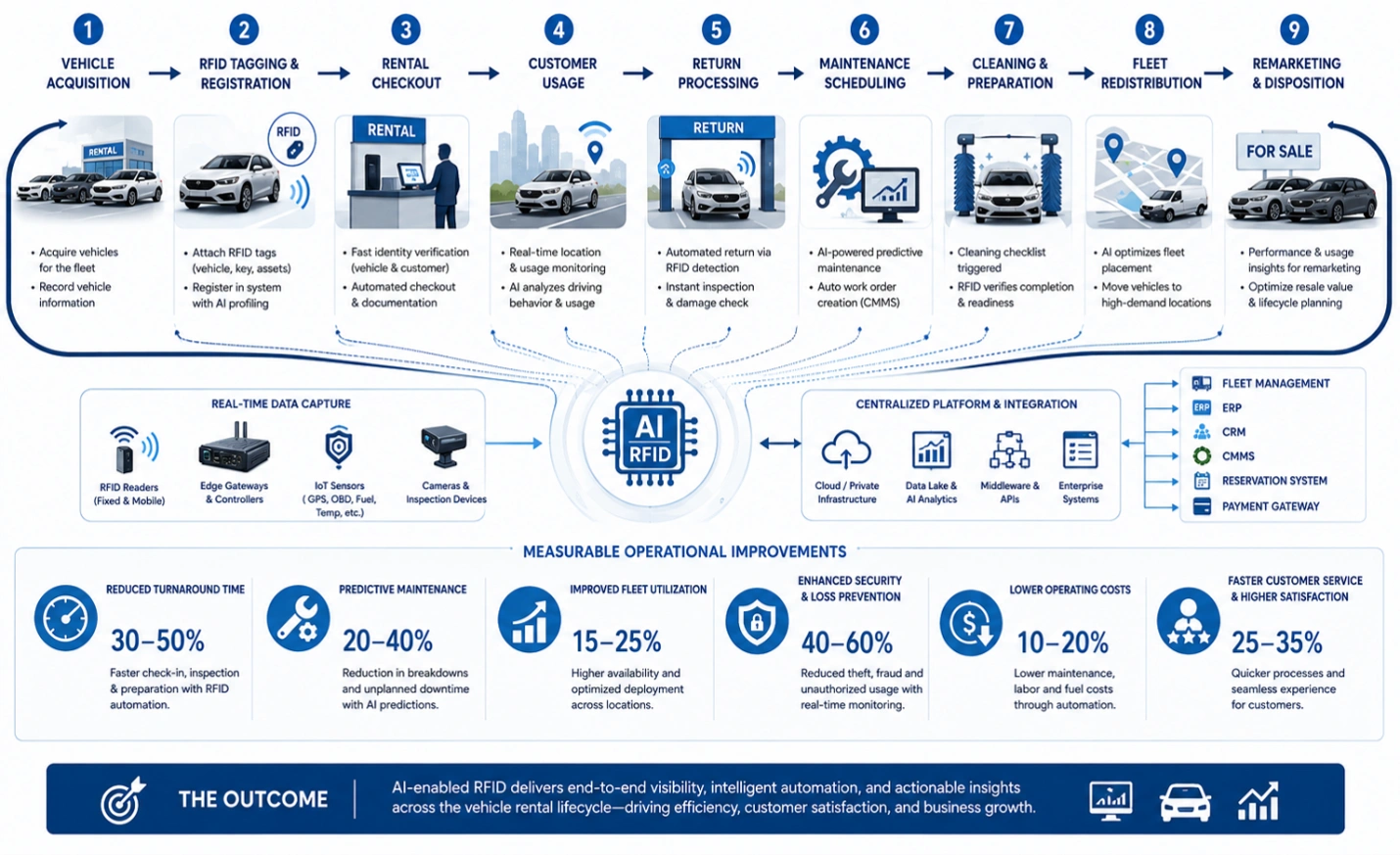
This infographic illustrates the complete vehicle rental lifecycle enhanced by AI-enabled RFID technology, from vehicle acquisition and RFID tagging to rental, return, maintenance, fleet redistribution, and remarketing. It highlights how real-time data, AI analytics, and enterprise integration improve operational efficiency, predictive maintenance, fleet utilization, security, and customer experience while reducing costs and turnaround times.
Implementation Recommendations for Vehicle Rental Organizations
Successful deployment requires careful planning, phased implementation, and continuous optimization. Recommended best practices include:
- Conduct a detailed fleet and workflow assessment before deployment.
- Select RFID tags appropriate for vehicle type, environmental conditions, and read-range requirements.
- Perform site surveys to determine optimal reader and antenna placement.
- Integrate RFID systems with existing fleet management, ERP, CRM, and maintenance software.
- Begin with a pilot deployment at a representative rental location before expanding across the network.
- Define key performance indicators (KPIs) such as fleet utilization, vehicle turnaround time, maintenance compliance, inventory accuracy, and customer wait times.
- Train operational staff on RFID workflows, exception handling, and AI-generated recommendations.
- Monitor system performance continuously and refine AI models using updated operational data.
- Implement cybersecurity controls, regular firmware updates, and periodic system audits to maintain long-term reliability.
Advancing Intelligent Vehicle Rental with AI-Enabled RFID
AI-enabled RFID is transforming vehicle rental from reactive fleet management to predictive, data-driven operations. Automated vehicle identification, intelligent maintenance planning, optimized fleet allocation, and real-time operational visibility help rental organizations improve efficiency, enhance customer experiences, and reduce operating costs.
By integrating RFID hardware with artificial intelligence, secure communication technologies, and enterprise software, vehicle rental companies can make faster and more informed operational decisions while maintaining accurate fleet records and strengthening security.
GAO supplies RFID hardware products and intelligent identification systems that help organizations deploy reliable AI-enabled vehicle rental solutions. Drawing on decades of experience serving Fortune 500 companies, research institutions, and government organizations across North America, GAO supports customers with technical expertise, quality hardware, and professional engineering assistance throughout the deployment lifecycle.
Building the Future of Industrial AI and IoT with Aperture Venture Studio and GAO RFID Inc.
For more than three decades, GAO Group has invested extensively in research and development of industrial RFID, BLE, and IoT technologies. Building on this expertise, we continue advancing AI-powered RFID solutions that address operational challenges across industries, including vehicle rental. We have also established Aperture Venture Studio to help accelerate the development and growth of AI and IoT innovations for real-world industrial applications. Together with our technical communities, industry events such as Aperture Ventures Summit and TekSummit, and a network of experienced engineers and technology leaders, we welcome collaboration from advisors, investors, customers, and professionals interested in shaping the future of intelligent AI and IoT solutions.