
AI and RFID for Warehouse Clubs
AI-Driven Warehouse Club Operations with RFID
Warehouse clubs operate high-volume retail environments where palletized inventory, case goods, individual merchandise, shopping carts, reusable containers, high-value products, and member orders move through receiving docks, backrooms, sales floors, fulfillment areas, and outbound loading zones. AI-driven warehouse club operations use data from RFID identification, point-of-sale systems, warehouse management software, cameras, sensors, inventory records, and transaction systems to improve inventory accuracy and operational decisions. RFID provides machine-readable item and asset identity, while AI analyzes inventory movement, replenishment patterns, exceptions, demand signals, and operational conditions.
For warehouse clubs, the combination can support AI inventory management, automated receiving, shelf availability analysis, shrink and loss investigation, pallet tracking, fulfillment verification, and labor planning. GAO supplies RFID hardware products and systems that can provide the identification and event data required for these applications. The resulting solution can connect physical merchandise movement with warehouse club inventory records and AI-driven operational analysis.
AI-Driven Warehouse Club Operations with RFID and AI
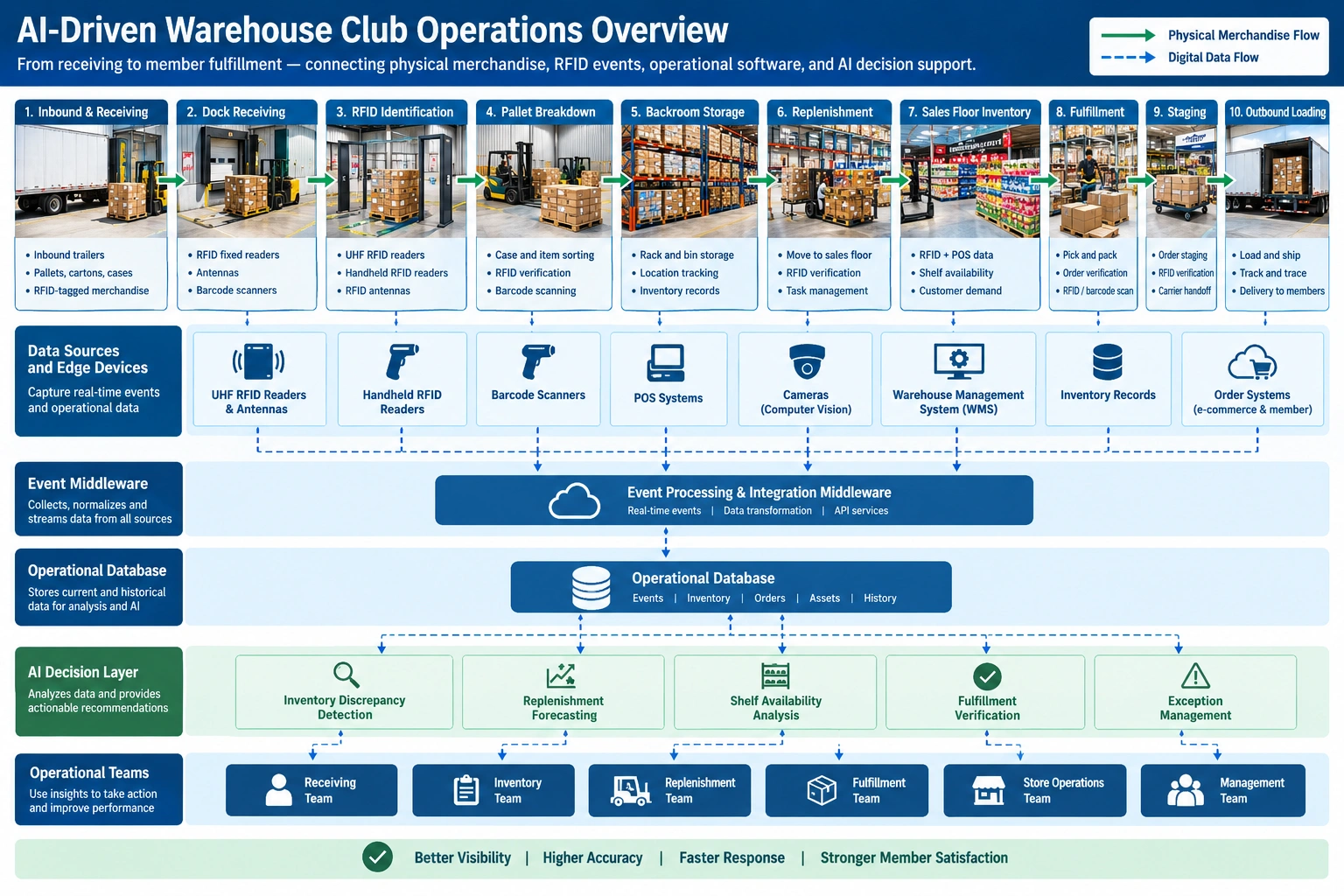
This workflow illustrates how warehouse club merchandise moves from inbound receiving through outbound fulfillment while RFID readers, barcode scanners, POS systems, warehouse management software, and order systems generate operational data. Event middleware and an operational database feed AI functions for inventory discrepancy detection, replenishment forecasting, shelf availability, fulfillment verification, and exception management.
How AI Inventory Management Works in Warehouse Clubs
AI inventory management for warehouse clubs combines merchandise identification with transaction, inventory, fulfillment, and operational data. The objective is not simply to count products. A useful system must determine whether inventory records reflect what is physically present, where merchandise is located, whether replenishment is required, and whether an operational exception needs investigation.
RFID can establish item, case, carton, pallet, or reusable-asset identity depending on the deployment. AI then uses those events alongside POS transactions, purchase orders, advance shipping notices, warehouse management records, order demand, receiving activity, and replenishment history.
This distinction is important because warehouse club inventory has several simultaneous states. A pallet may be physically received but not yet put away. A case may be in a backroom location while the inventory system records it as available. Merchandise may have been allocated to a member order but remain in a staging area. A product can therefore exist physically while being operationally unavailable.
AI models can correlate these states and identify discrepancies that conventional inventory reports may not expose quickly.
Warehouse Club Inventory Visibility and Exception Detection
AI-enabled inventory visibility can analyze RFID read events against expected warehouse club transactions.
Relevant exception conditions include:
- Expected pallets or cartons not detected after receiving
- Merchandise received but not associated with a completed receiving transaction
- Inventory assigned to a location but repeatedly detected elsewhere
- Replenishment stock remaining in the backroom while sales-floor availability declines
- Unexpected movement of high-value merchandise
- Member-order items detected outside their expected fulfillment or staging zone
- Repeated inventory discrepancies associated with a particular process step
- RFID reads that conflict with POS, warehouse management, or order records
- Reusable containers, carts, totes, or other tracked assets remaining outside expected circulation patterns
The AI system should treat unusual events as exceptions for investigation rather than automatically interpreting them as theft, employee error, or process failure. Operational context, reader coverage, tag readability, transaction timing, and physical handling conditions should be considered before an action is taken.
Why RFID Data Matters to Warehouse Club AI
AI requires reliable operational data. A warehouse club can have sophisticated analytics software while still producing poor decisions if the underlying inventory events are incomplete or incorrectly associated with locations.
RFID contributes physical-world observations such as:
- Tag or item identity
- Reader location
- Read-zone or antenna identity
- Timestamp
- Detection frequency
- Movement sequence
- Receiving or staging location
- Association with pallet, carton, case, or reusable asset
- Customer, supplier, order, or department context where available
Middleware should convert raw RFID observations into useful operational events. Duplicate reads can be filtered, read-zone rules can be applied, and observations can be correlated with purchase orders, receiving transactions, put-away events, replenishment records, or member-order workflows.
That processing creates a more reliable data foundation for AI inventory management.
Warehouse Club Applications for AI-Enabled RFID Operations
Warehouse club deployments should be designed around specific operational problems rather than around RFID hardware alone. The most useful applications connect physical merchandise movement to a measurable business process.
AI Receiving and Inbound Inventory Verification
Receiving is a critical control point because large quantities of merchandise can enter warehouse club facilities within a relatively short period. Manual barcode scanning can become difficult when pallets contain numerous cases or when receiving teams must process mixed merchandise rapidly.
UHF RFID readers positioned around dock doors, receiving lanes, portals, or conveyor areas can capture multiple tagged items without requiring every item to be individually presented to a scanner. Handheld readers can supplement fixed infrastructure when personnel need to locate or verify particular merchandise.
AI can compare the observed merchandise with advance shipping notices, purchase orders, expected case quantities, supplier records, and receiving transactions.
Potential operational outputs include:
- Receiving discrepancies requiring verification
- Unexpected merchandise detected during inbound processing
- Missing expected cases or tagged assets
- Duplicate or inconsistent receiving events
- Receiving cycle-time analysis
- Supplier shipment pattern analysis
- Identification of recurring receiving exceptions
The engineering challenge is to distinguish a true receiving event from a transient RFID observation. Read-zone configuration, portal shielding, antenna positioning, tag orientation, reader power, conveyor speed, and adjacent dock activity can all influence event quality.
AI Backroom Inventory Management
Warehouse club backrooms often hold substantial quantities of reserve inventory. Merchandise can move between receiving, reserve storage, replenishment staging, sales-floor locations, and fulfillment areas throughout the day.
AI can analyze RFID location events together with inventory balances and replenishment activity to identify conditions such as:
- Reserve merchandise that has not moved despite sales demand
- Product availability declining on the sales floor while reserve inventory exists
- Merchandise stored in unexpected zones
- Slow-moving inventory occupying constrained storage space
- Replenishment activity inconsistent with historical demand
- Inventory records that do not correspond with repeated physical observations
The resulting analysis can support replenishment prioritization and inventory investigation without requiring employees to manually search every storage area.
AI Shelf Availability and Merchandise Replenishment
Warehouse club merchandise is frequently displayed in bulk quantities, pallets, floor stacks, endcaps, racks, and other high-volume configurations. Shelf availability therefore involves more than determining whether a single retail shelf contains an item.
AI can combine RFID events with POS transactions, inventory records, replenishment history, store-zone information, and, where appropriate, computer vision. The system can identify merchandise whose sales activity suggests replenishment while physical observations indicate that reserve stock remains available.
Computer vision can provide additional context for visual conditions such as empty display areas, misplaced products, damaged packaging, or display congestion. RFID can provide product identity and movement information that a camera alone may not reliably determine.
AI Fulfillment Verification for Warehouse Club Orders
Warehouse clubs increasingly support digitally initiated member orders and pickup or delivery workflows. Fulfillment accuracy depends on finding the correct merchandise, assembling the order, staging it in the correct area, and associating the physical order with the corresponding transaction.
RFID can help establish item presence during picking and staging. AI can compare those observations with order contents and expected fulfillment states.
A warehouse club fulfillment workflow may include:
- Order creation
- Inventory allocation
- Picking task generation
- Merchandise identification
- Order assembly
- RFID or barcode verification
- Staging-zone confirmation
- Member pickup or outbound delivery
- Order completion
AI can identify unusual order states, repeated picking exceptions, delayed staging, inventory substitutions, or discrepancies between allocated and physically detected merchandise.
AI Tracking of Reusable Warehouse Club Assets
Not every tracked object in a warehouse club is merchandise. Reusable totes, carts, pallets, cages, containers, racks, and other handling assets can affect labor productivity and material movement.
RFID can provide identity for reusable assets, while AI can analyze their circulation history.
Useful metrics include:
- Asset turnaround time
- Dwell time by facility zone
- Utilization frequency
- Unusual accumulation
- Missing asset events
- Average return cycle
- Asset demand by operating period
Tracking these assets can reduce time spent searching for handling equipment and can help operations teams understand whether shortages are caused by demand peaks, process delays, poor circulation, or asset loss.
Warehouse Club Operational Workflow from RFID Capture to AI Decisions
A production warehouse club solution should connect physical operations and software events through a controlled sequence. The exact implementation depends on merchandise type, facility layout, reader coverage, tagging strategy, and existing software.
Data Acquisition at Warehouse Club Operating Zones
Data acquisition begins with physical observations and business transactions.
Typical sources include:
- UHF RFID readers and antennas
- Handheld RFID readers
- Barcode scanners
- POS transactions
- Purchase orders
- Advance shipping notices
- Warehouse management records
- Order management and fulfillment systems
- Computer vision systems
- Temperature or environmental sensors where relevant
- Equipment and facility telemetry
- Employee task or labor-management records
RFID is particularly useful where multiple tagged objects must be identified rapidly. HF RFID or LF RFID may be considered for specialized proximity or identification requirements where UHF propagation is not appropriate.
RFID Edge Processing and Middleware
Raw RFID reader output can contain repeated observations of the same tag. A warehouse club solution therefore benefits from an edge or middleware layer that applies read filtering and operational rules.
Relevant processing includes:
- Duplicate suppression
- Read-zone filtering
- Antenna and reader association
- Timestamp normalization
- Event correlation
- Movement-state determination
- Reader health monitoring
- Local buffering during network interruptions
- Association with facility, department, dock, aisle, staging zone, or transaction context
A useful design separates a read observation from a confirmed business event. Detecting a tag near a receiving portal does not necessarily prove that the merchandise has been accepted into inventory. Business rules should establish whether the required receiving conditions have been satisfied.
Operational Database and AI Processing
Processed events can be stored alongside warehouse club inventory, order, POS, supplier, and asset records. AI services can then analyze historical and real-time information.
Depending on the use case, AI methods may include:
- Anomaly detection for inventory and movement exceptions
- Time-series forecasting for merchandise demand
- Classification for operational exception types
- Optimization for replenishment and labor allocation
- Pattern recognition for asset circulation
- Computer vision for merchandise and display conditions
- Predictive models for equipment or facility-related events
- Natural-language interfaces for querying operational records
Traceability is important. AI-generated recommendations should be linked back to relevant item IDs, timestamps, locations, transactions, and operational records so warehouse club personnel can investigate the reason behind an alert.
Business Actions and Human Validation
AI should support warehouse club personnel rather than bypass operational controls.
A decision workflow can route exceptions to inventory managers, receiving supervisors, fulfillment leads, asset-control personnel, or other responsible employees. The employee can review supporting evidence and determine whether a corrective action is appropriate.
Actions may include:
- Recounting or locating merchandise
- Repeating a receiving verification
- Correcting an inventory record
- Creating a replenishment task
- Investigating a fulfillment discrepancy
- Moving merchandise to an assigned location
- Locating a reusable asset
- Inspecting RFID hardware or tag performance
- Escalating a recurring process exception
This human-validation step is especially important when an AI model identifies unusual behavior rather than a deterministic transaction failure.
Technical Foundation for AI-Enabled Warehouse Club Systems
The technical foundation should be selected according to merchandise characteristics, facility layout, reading distance, item density, operating speed, integration requirements, and data-governance policies.
UHF, HF, and LF RFID Selection
UHF RFID is generally the most relevant RFID frequency range for warehouse club inventory applications requiring longer read ranges and identification of multiple tagged objects. Receiving portals, backroom transition points, selected sales-floor areas, fulfillment staging, and asset movement are potential deployment locations.
HF RFID can be appropriate for shorter-range controlled identification where a warehouse club needs deliberate item interaction or proximity-based confirmation.
LF RFID generally serves specialized short-range identification requirements and can be considered where its propagation characteristics and operating range match the application.
Frequency selection should be based on testing rather than assuming that one RFID technology is suitable for every warehouse club process.
Readers, Antennas, Tags, and Handheld Equipment
Fixed RFID readers can monitor controlled transition zones, while handheld readers allow employees to search for merchandise or assets and verify exceptions.
Tag selection requires testing against the physical merchandise and environment. Dense cases, liquid products, metal packaging, foil, reflective materials, stacked pallets, and closely packed merchandise can affect RFID performance.
A warehouse club deployment may therefore use different tag constructions or mounting positions for different merchandise categories.
Reader configuration should account for:
- Read-zone boundaries
- Antenna polarization and orientation
- Reader power
- Conveyor or vehicle speed
- Tag orientation
- Merchandise density
- Metal and liquid interference
- Adjacent reader zones
- Unintended reads from nearby inventory
- Physical separation between inbound and outbound flows
Cloud Version and Server Version for Warehouse Clubs
A Cloud Version hosts the RFID event processing, operational software, databases, analytics, and AI services within cloud infrastructure. This approach can support multiple warehouse club locations, centralized reporting, remote software administration, elastic computing resources, and standardized deployment across geographically distributed facilities.
A Server Version places software on edge servers, customer-managed servers, private data centers, facility servers, or other privately hosted enterprise infrastructure. This model can be appropriate when warehouse club operators require greater control over data location, network dependencies, local processing, or integration with privately hosted operational software.
A hybrid arrangement can combine local RFID event processing with cloud-based analytics. Local processing can maintain essential operations during temporary WAN interruptions, while aggregated events can be forwarded to centralized AI services when connectivity is restored.
The appropriate deployment model depends on facility connectivity, latency requirements, data-governance policies, existing warehouse club IT practices, cybersecurity controls, integration constraints, and the number of facilities requiring centralized management.
Integration with Warehouse Club Software
RFID and AI systems should integrate with the software already responsible for warehouse club operations rather than creating isolated inventory records.
Potential integration points include:
- Warehouse management systems
- Inventory management software
- POS systems
- Order management systems
- E-commerce and member-order systems
- Enterprise resource planning software
- Supplier and procurement systems
- Transportation and yard-management systems
- Labor-management systems
- Asset-management software
- Reporting databases
- Customer service systems
REST APIs, webhooks, SQL interfaces, message queues, CSV exchange, and middleware APIs can be selected according to the existing IT environment.
AI Capabilities That Improve Warehouse Club Operations
AI provides the analytical layer that turns warehouse club operational events into actionable information. The value comes from correlating RFID observations with inventory, sales, fulfillment, supplier, and facility data rather than treating RFID reads as isolated events.
AI Inventory Forecasting and Replenishment
Demand forecasting can combine historical POS transactions, seasonal patterns, promotions, member purchasing behavior, inventory availability, lead times, supplier performance, and replenishment history.
For warehouse clubs, forecasting should also account for the physical characteristics of bulk retail. A sudden increase in demand for a high-volume case-pack item can create replenishment pressure even when aggregate inventory appears sufficient. AI can identify these conditions and provide demand estimates for replenishment planning.
RFID contributes additional evidence by showing whether reserve inventory is physically present and where it is located. This helps distinguish a genuine inventory shortage from a location or recordkeeping discrepancy.
AI-Powered Inventory Anomaly Detection
Anomaly detection can establish normal movement patterns for merchandise, reusable assets, receiving activities, and fulfillment operations.
A model may identify:
- Unusually long merchandise dwell times
- Repeated inventory discrepancies
- Unexpected movement between warehouse club zones
- Abnormal receiving quantities
- Unusual order-picking sequences
- Repeated fulfillment delays
- Abnormal reusable-asset circulation
- RFID event patterns that differ from established operating behavior
Anomaly detection should incorporate operational context. A product may legitimately remain in a staging area during a promotion, seasonal reset, inventory count, or large member-order batch. Context-aware models reduce unnecessary investigations.
AI Fulfillment and Order Accuracy
AI can compare order requirements against physical item observations, inventory availability, picking events, staging records, and completed transactions.
For pickup operations, the system can help determine whether the expected merchandise reached the assigned staging zone. For delivery orders, event sequences can help establish whether an item was picked, verified, staged, and transferred to the outbound process.
The objective is not merely to detect an incorrect order after completion. Earlier identification of an exception gives warehouse club personnel an opportunity to correct it before the member receives the order.
AI Labor and Workflow Analysis
Warehouse club operations involve receiving teams, inventory associates, replenishment employees, fulfillment workers, department personnel, asset-control staff, and supervisors. AI can analyze process timestamps and workload data to identify bottlenecks.
Potential analysis includes:
- Receiving cycle time
- Merchandise search time
- Replenishment response time
- Picking and staging duration
- Inventory investigation workload
- Congestion around receiving or fulfillment zones
- Workload variation by day and operating period
AI recommendations should remain consistent with labor policies, employee privacy requirements, and applicable workplace rules.
Computer Vision with RFID for Warehouse Club Inventory
Computer vision can complement RFID when visual condition matters. Cameras can inspect merchandise displays, pallets, packaging, aisles, or selected operational areas, while RFID supplies machine-readable identity.
For example, computer vision may detect a visibly empty display location while RFID identifies whether corresponding reserve merchandise remains nearby. A warehouse club can then investigate whether the problem is replenishment timing, inventory misplacement, incorrect records, or another operational condition.
This multimodal approach can provide more context than either technology independently.
Multimodal AI Data Fusion for Warehouse Club Inventory
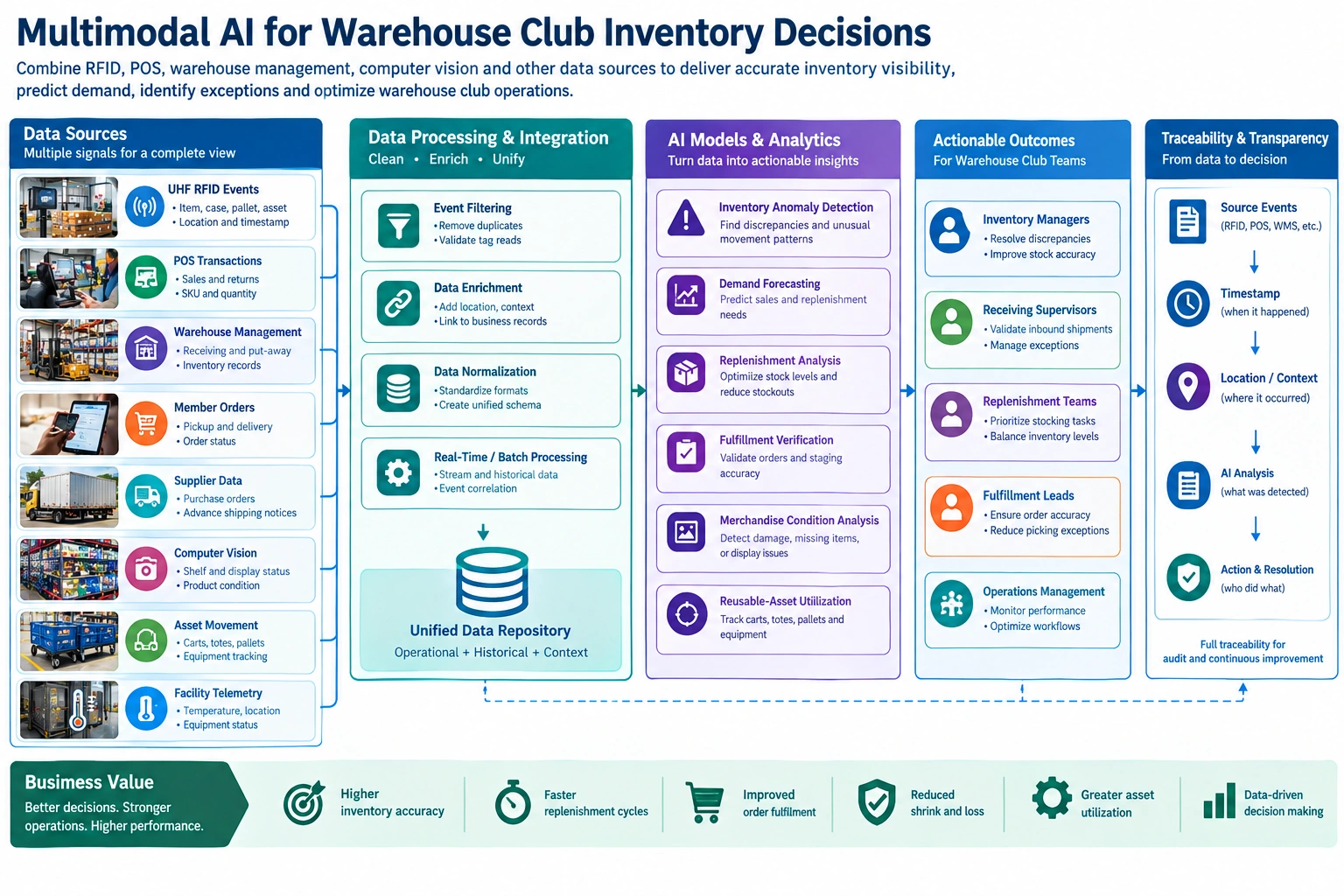
The visual shows how UHF RFID events, POS transactions, warehouse management records, member orders, supplier data, computer vision, asset movement, and facility telemetry are processed into a unified data repository. AI analytics then generate inventory, replenishment, fulfillment, merchandise-condition, and asset-utilization insights that warehouse club teams can validate and act upon.
Warehouse Club Security, Reliability, and Data Governance
AI-driven inventory systems influence receiving, inventory records, fulfillment, and operational decisions, so reliability and cybersecurity must be considered during system design rather than added after deployment.
RFID and Network Security
RFID readers should operate within controlled network segments appropriate to the warehouse club’s IT policies. Device authentication, access control, secure management interfaces, network segmentation, logging, and software-update procedures can reduce unauthorized access and operational disruption.
Network design should separate critical reader and operational traffic where appropriate. Monitoring can identify reader outages, communication failures, unexpected device behavior, or prolonged periods without expected events.
AI Data Governance
AI models depend on historical operational data, and poor data quality can produce misleading results. Warehouse club deployments should establish data ownership, retention rules, access permissions, model monitoring, and procedures for correcting erroneous source records.
Important controls include:
- Role-based access control
- Authentication and authorization
- Encryption for data in transit and at rest where appropriate
- Audit logging
- Controlled API credentials
- Database access restrictions
- Reader and server configuration management
- Backup and recovery procedures
- AI model version control
- Exception review and escalation procedures
Member-related information should be handled according to applicable privacy requirements. RFID item tracking should not automatically be treated as personal tracking. Where item identity becomes associated with a specific individual or member transaction, the data model and retention policy should reflect that additional sensitivity.
RFID Reliability and Operational Resilience
RFID performance should be validated under actual warehouse club conditions. Testing should include full pallets, mixed cartons, metal shelving, liquid products, dense merchandise, forklifts, moving employees, adjacent reader zones, and normal receiving or fulfillment speeds.
Important engineering measurements include read accuracy, false-read rate, missed-read rate, event latency, reader availability, and location-event reliability.
Local event buffering can help preserve RFID observations during temporary network outages. Once connectivity is restored, buffered events can be synchronized while maintaining their original timestamps and transaction context.
Engineering Considerations for Warehouse Club RFID Deployment
A warehouse club RFID deployment should begin with operational requirements rather than reader installation. The physical characteristics of merchandise and the movement patterns of each facility determine where RFID can provide reliable business value.
Site Survey and Read-Zone Engineering
A site survey should document receiving doors, staging areas, pallet flows, storage racks, sales-floor zones, fulfillment areas, outbound lanes, and potential sources of RF interference.
Engineers should evaluate:
- Required read range
- Expected tag population
- Merchandise density
- Tag placement
- Metal and liquid content
- Reader-to-reader interference
- Antenna orientation
- Portal dimensions
- Vehicle and conveyor speed
- Employee movement
- Required event latency
- Network availability
- Existing wireless and wired infrastructure
Controlled read zones are especially important. A reader that detects merchandise from an adjacent aisle may appear highly effective from a raw read-count perspective while producing unreliable location events.
Tag Commissioning and Item Association
Each RFID tag should be associated with the appropriate item, case, pallet, or reusable asset record during commissioning.
A practical data model can include:
- RFID tag identifier
- Merchandise SKU or asset identifier
- Product category
- Case or pallet relationship
- Supplier information
- Facility or department
- Location
- Timestamp
- Transaction identifier
- Lifecycle status
- RFID event history
The system should maintain clear relationships between physical identifiers and business records. Reusing or replacing tags requires controlled lifecycle procedures so historical events are not incorrectly attributed.
Pilot Testing in a Live Warehouse Club
Pilot deployments should focus on a limited number of operational processes and measurable KPIs.
A suitable pilot might cover one receiving area, one backroom zone, a selected merchandise category, or a defined fulfillment process. Testing should compare RFID-derived events with manually verified ground truth.
Useful measurements include:
- Item identification accuracy
- Receiving verification accuracy
- Location accuracy
- Event latency
- Inventory discrepancy detection
- Search-time reduction
- Fulfillment exception detection
- Reader availability
- False-read frequency
- Employee handling time
AI models should initially operate with human review. This provides operational feedback and creates a controlled dataset for model refinement.
Scaling Across Warehouse Club Locations
Multi-location deployments require consistent configuration while allowing for differences between facilities.
Standardized elements can include:
- RFID tag data structures
- Event schemas
- API formats
- Security policies
- Reader management
- AI model monitoring
- Reporting definitions
- KPI calculations
- Exception categories
Local configuration may still be required for facility layouts, reader placement, merchandise characteristics, operating hours, fulfillment processes, and network conditions.
GAO can support organizations with RFID hardware products and systems used for item identification, asset tracking, inventory visibility, and operational workflows. Its technical support can assist with product selection, deployment considerations, and system implementation for organizations operating across U.S. and Canadian facilities.
KPIs for AI and RFID-Enabled Warehouse Club Operations
Warehouse club deployments should measure operational outcomes rather than RFID read volume alone. KPI definitions should be established before the pilot so improvements can be compared against a baseline.
| KPI | Warehouse Club Application | Measurement Consideration |
|---|---|---|
| Inventory accuracy | Backroom and sales-floor inventory | Compare system records with verified physical counts |
| Receiving accuracy | Inbound merchandise | Compare expected and physically detected quantities |
| Receiving cycle time | Dock operations | Measure elapsed time from arrival to completed receiving |
| Inventory search time | Merchandise and asset location | Measure employee time required to locate an item |
| Replenishment response time | Sales-floor availability | Measure time from replenishment trigger to completion |
| Shelf availability | Bulk merchandise displays | Combine sales activity with physical inventory evidence |
| Fulfillment accuracy | Member orders | Compare order contents with verified physical items |
| Order staging time | Pickup and delivery | Measure time from picking completion to staging |
| RFID read accuracy | Item identification | Compare RFID observations with ground-truth inventory |
| False-read rate | Location tracking | Measure detections outside intended read zones |
| Missing-read rate | Receiving and movement | Identify expected tags not detected under controlled conditions |
| Asset turnaround time | Totes, carts, pallets, and containers | Measure circulation from issue through return |
| Exception resolution time | AI-generated alerts | Measure time from alert creation to validated resolution |
| Reader availability | RFID infrastructure | Monitor operational uptime and communication status |
| Inventory discrepancy rate | Inventory control | Track discrepancies per defined transaction or inventory sample |
| Merchandise dwell time | Backroom and staging | Measure time merchandise remains in a process state |
| Forecast accuracy | Demand planning | Compare AI forecasts with actual demand |
| Replenishment efficiency | Reserve-to-floor movement | Compare required versus completed replenishment activity |
| Fulfillment exception rate | Member orders | Track exceptions per order or order line |
| Data latency | AI decision support | Measure time from physical event to usable business event |
These KPIs should be interpreted together. A higher RFID read rate does not necessarily mean better inventory visibility if read zones are poorly controlled. Similarly, a lower exception count can indicate improvement, but it can also result from incomplete data capture. KPI governance should therefore include both technical and operational measurements.
Practical Recommendations for Warehouse Club AI and RFID Projects
Successful warehouse club deployments generally depend on disciplined integration between physical operations, RFID engineering, software, and AI.
- Start with measurable warehouse club problems such as receiving discrepancies, inventory search time, replenishment delays, fulfillment exceptions, or reusable-asset losses.
- Select RFID frequency, tags, readers, and antennas according to merchandise characteristics and facility conditions.
- Use controlled RFID read zones rather than assuming that maximum read range produces better inventory visibility.
- Separate raw RFID observations from confirmed warehouse club business events.
- Integrate RFID events with POS, warehouse management, inventory, purchasing, and order-fulfillment records.
- Use AI to analyze correlated operational data rather than relying exclusively on RFID reads.
- Maintain human validation for significant inventory, fulfillment, security, or operational exceptions.
- Establish ground-truth measurements before training or evaluating AI models.
- Test RFID performance using actual warehouse club merchandise, including liquids, metal packaging, dense cases, and palletized goods.
- Monitor false reads, missed reads, reader availability, event latency, and location accuracy after commissioning.
- Use local buffering where network interruptions could otherwise cause loss of operational events.
- Apply role-based access, secure communications, audit logging, configuration management, and controlled software updates.
- Establish data-retention and access policies before connecting item-level events with member or transaction information.
- Standardize event schemas and integration interfaces when deploying across multiple warehouse club locations.
- Revalidate AI models when merchandise mix, facility layouts, operating processes, or demand patterns change.
- Treat AI recommendations as decision support and preserve traceability to the underlying warehouse club events.
- Select Cloud Version, Server Version, or a hybrid implementation according to connectivity, data-control, latency, integration, and IT requirements.
- Work with an experienced RFID supplier when the project requires specialized tags, fixed readers, handheld equipment, antennas, middleware, or customized system integration.
Business and Technical Value of AI-Enabled Warehouse Club Operations
Combining AI with RFID-enabled identification can connect physical warehouse club activity with digital inventory and transaction records. That connection can improve the speed and quality of operational decisions because personnel receive information tied to identifiable merchandise, locations, timestamps, and process states.
The most practical value areas include:
- More timely inventory discrepancy detection
- Better visibility into reserve and staging inventory
- More structured receiving verification
- Earlier identification of fulfillment exceptions
- Improved replenishment analysis
- Better understanding of reusable-asset circulation
- Faster investigation of misplaced merchandise
- More consistent multi-location reporting
- Improved traceability of operational events
- More informed planning based on historical and real-time data
The financial impact depends on merchandise value, transaction volume, current inventory accuracy, labor requirements, facility configuration, RFID tagging costs, integration effort, and the operational processes selected for automation or decision support. A business case should therefore be based on measured baseline conditions rather than generic assumptions about RFID or AI savings.
GAO Technology Support for Warehouse Club RFID Systems
GAO supplies RFID, BLE, and IoT hardware products and systems that can support warehouse club applications including item identification, inventory tracking, asset management, and operational monitoring. Its offerings can be incorporated into receiving, backroom inventory, fulfillment, staging, and reusable-asset workflows according to project requirements.
GAO’s parent group has invested substantially in product and system R&D for three decades and serves organizations across the United States and Canada. GAO Group companies have worked with Fortune 500 companies, major R&D organizations, universities, and government agencies, supported by quality-assurance processes and technical assistance delivered remotely or onsite.
GAO is headquartered in New York City and Toronto, Canada. Its position among leading B2B and B2G RFID and BLE suppliers provides a technical foundation for organizations evaluating hardware and system requirements for warehouse club deployments.
For warehouse club operators, the appropriate next step is to define the target workflow, merchandise categories, facility conditions, integration requirements, and measurable KPIs before selecting RFID equipment or AI software. GAO can provide technical information about RFID products, system components, and deployment considerations for these requirements.
Conclusion: Building AI-Enabled Warehouse Club Operations
AI-driven warehouse club operations depend on accurate physical-world data, reliable inventory processes, effective software integration, and controlled decision workflows. RFID can provide item and asset identity across receiving, storage, replenishment, fulfillment, and staging, while AI can analyze those events with POS, warehouse management, order, supplier, and operational data.
The strongest implementations begin with a defined operational problem, validate RFID performance in real warehouse club conditions, integrate events with existing software, establish measurable KPIs, and introduce AI decision support with appropriate human validation.
Warehouse club organizations evaluating AI inventory management, RFID asset tracking, automated receiving, fulfillment verification, or operational analytics can explore GAO’s RFID products and technical solutions and consult its engineering support for deployment-specific requirements.
Building the Future of Industrial AI and IoT with Aperture Venture Studio and GAO RFID Inc.
For more than three decades, GAO Group of Companies has invested heavily in R&D for industrial RFID, BLE, and IoT. As generative AI became increasingly useful for industrial applications, we expanded our work across AI and IoT, including RFID and BLE, and founded Aperture Venture Studio to develop AI and IoT solutions relevant to operational domains such as warehouse club inventory, asset tracking, and intelligent retail processes.
Aperture has attracted AI and IoT technical experts, entrepreneurial and operational executives, influential investors, and leading companies. We have also developed Aperture Ventures Summit and TekSummit to discuss advanced AI and IoT topics and foster technical communities.
We welcome you to join us as:
- Advisors, co-founders, or employees
- Investors
- Customers