
AI and RFID for Waste Management
How AI Is Transforming Waste Management Operations
Artificial Intelligence is transforming waste management by converting operational data from collection vehicles, containers, transfer stations, material recovery facilities, recycling operations, and disposal sites into actionable decisions. AI can analyze waste generation patterns, collection histories, container utilization, vehicle data, contamination indicators, maintenance records, and service information to improve collection planning, asset utilization, routing, maintenance, recycling, and compliance.
RFID provides an important identification and data-capture layer for these AI-enabled waste management systems. UHF RFID can identify tagged waste containers and mobile assets over longer read ranges, while HF RFID and LF RFID can support shorter-range identification requirements in controlled operational environments. When RFID events are combined with GPS, vehicle telemetry, IoT sensors, weighing systems, cameras, databases, and operational software, AI can establish a more complete view of waste collection and processing activities.
For municipalities, private waste haulers, recycling operators, transfer station operators, and environmental service providers, the objective is not simply to identify a container. The greater value comes from connecting container identity, location, service history, waste characteristics, vehicle activity, and operational events so that waste management decisions can become more measurable, predictive, and responsive.
AI-Enabled Waste Management Operations with RFID and IoT
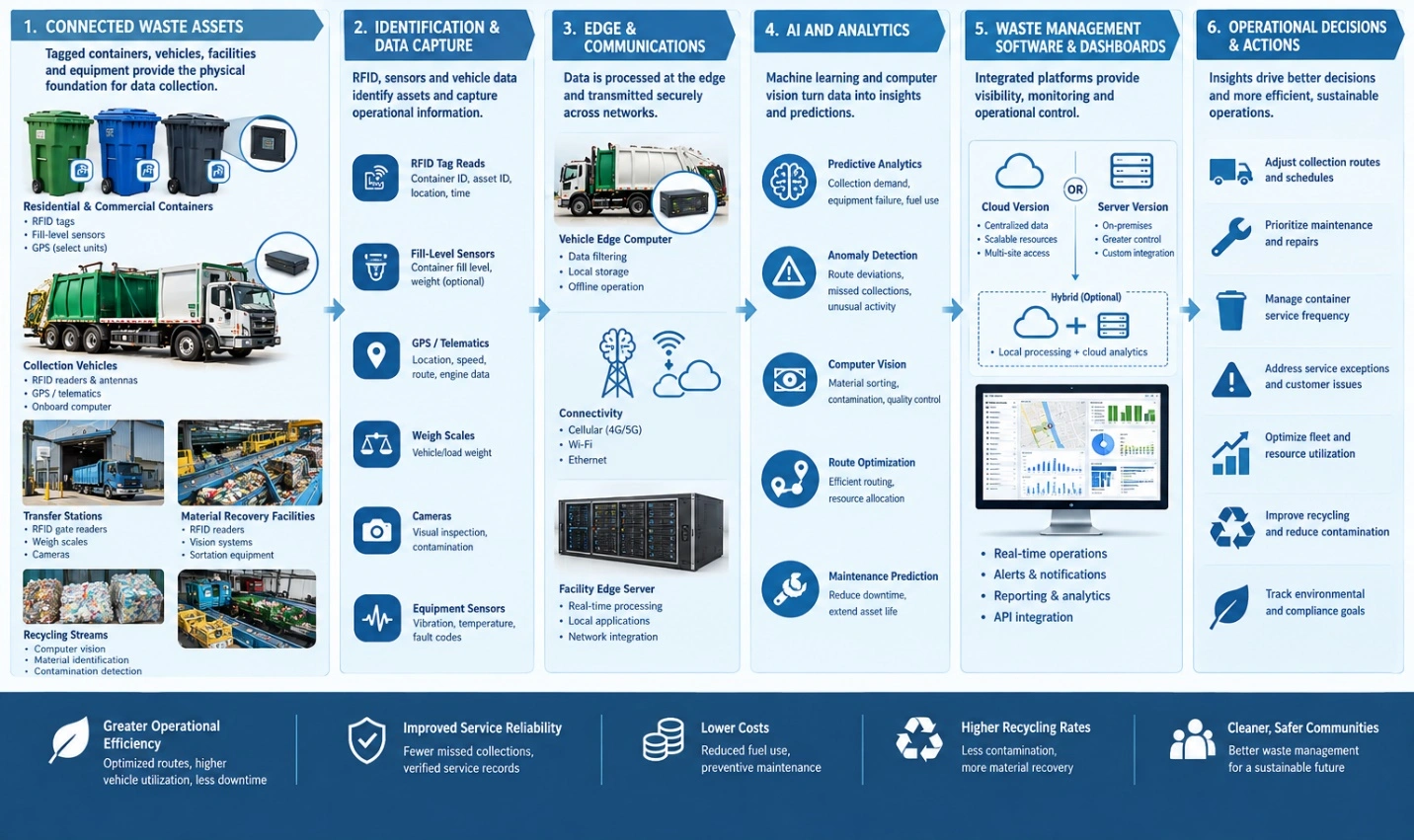
This infographic illustrates how RFID-tagged waste containers, collection vehicles, IoT sensors, edge computing, and communications feed AI analytics and waste management software. It shows how AI supports route optimization, predictive maintenance, anomaly detection, contamination monitoring, and operational decision-making across waste collection and processing.
AI, RFID, and the Digital Waste Management Workflow
AI-enabled waste management combines artificial intelligence with connected equipment, sensors, RFID devices, vehicles, and operational systems. This approach is commonly described as Artificial Intelligence of Things, or AIoT, when AI is integrated with IoT devices, connected equipment, and industrial systems. Industrial AI, Edge AI, machine learning, and computer vision can also contribute to specific waste management applications.
RFID does not replace waste management software or AI. Instead, it provides reliable identification of tagged containers, bins, carts, roll-off containers, reusable transport assets, and other equipment. The identification event becomes operational data that can be associated with time, location, vehicle, route, customer account, service activity, container type, weight, or processing event.
A typical waste management data flow can include:
- RFID-tagged waste container or operational asset
- Fixed or vehicle-mounted RFID reader
- RFID antenna and reader controller
- GPS receiver and vehicle telematics
- Fill-level, temperature, weight, or other IoT sensors where required
- Edge gateway or vehicle computer
- Cellular, Wi-Fi, Ethernet, or other suitable communications
- RFID middleware and event filtering
- Waste management database or operational software
- AI and machine learning services
- Route optimization and collection planning
- Operator dashboards and exception alerts
- Automated or human-approved operational actions
The engineering objective is to prevent isolated data silos. A container identification event becomes significantly more useful when the waste management system can associate it with a collection route, truck, scheduled service, customer location, timestamp, and subsequent processing event.
GAO can support this type of deployment with RFID, BLE, and IoT hardware products and systems that provide the physical data-capture layer required by waste management applications.
Where AI Delivers Value Across Waste Management
AI for Waste Collection and Route Optimization
Collection is one of the most data-intensive activities in waste management. Operators must coordinate vehicles, drivers, routes, collection schedules, container locations, service requirements, traffic conditions, vehicle capacity, and changing waste generation patterns.
AI can analyze historical collection data and operational conditions to identify recurring inefficiencies. When RFID container identification is connected with GPS and vehicle telemetry, the system can establish which containers were serviced, when they were serviced, and which vehicle performed the collection.
Potential applications include:
- Dynamic collection-route optimization
- Prediction of container overflow risk
- Identification of missed or incomplete collections
- Analysis of collection frequency
- Service verification
- Vehicle utilization analysis
- Collection-time prediction
- Exception detection for abnormal collection events
- Optimization of fleet deployment
RFID is particularly useful where individual container identification is operationally important. A vehicle-mounted reader can capture tagged containers as collection activity occurs, allowing service records to be generated from physical collection events rather than relying exclusively on manual confirmation.
AI for Container Utilization and Overflow Prevention
Waste containers represent distributed physical assets that may be spread across residential areas, commercial properties, construction locations, transfer facilities, and recycling operations.
AI can use RFID service histories together with fill-level sensors, collection frequency, location information, and historical generation patterns to estimate when containers are likely to require service.
A waste operator could use this information to distinguish between:
- Containers that are routinely underutilized
- Containers approaching capacity
- Locations with seasonal demand changes
- Commercial sites requiring different collection frequencies
- Assets that have not generated expected service events
- Containers associated with unusual collection behavior
This supports more targeted collection planning. Instead of treating every container as having the same service requirement, waste management teams can use historical and real-time data to adjust schedules according to observed operational conditions.
AI for Fleet and Equipment Maintenance
Collection trucks, compactors, balers, conveyors, shredders, pumps, weigh systems, hydraulic equipment, and other waste processing machinery require regular inspection and maintenance.
AI-based predictive maintenance can analyze equipment telemetry, fault codes, operating hours, vibration measurements, temperature data, maintenance history, and other signals to identify abnormal operating conditions.
RFID can complement this process by identifying maintenance assets, tools, equipment components, inspection records, and service events where item-level identification is required.
For example, a waste management organization could associate a maintenance record with a specific vehicle, compactor, baler, or mobile asset using an RFID identifier. AI can then combine the asset’s historical maintenance information with sensor and operational data to identify recurring failure patterns.
The practical objective is to move maintenance decisions from purely calendar-based scheduling toward condition-informed maintenance where the available data supports it.
AI for Recycling and Material Recovery Facilities
Material recovery facilities process large and variable waste streams containing recyclable materials, contaminants, packaging, metals, plastics, paper, cardboard, and other materials.
Computer vision and machine learning can analyze images from sorting lines to identify materials and contamination patterns. AI can assist with classification, quality monitoring, process optimization, and detection of unusual material streams.
RFID has a different but complementary role. RFID can identify reusable containers, equipment, transport assets, bins, pallets, cages, and other tagged items moving through controlled operational areas.
Combining equipment identification with AI-generated process information can help operators associate operational events with specific assets and process stages.
AI for Waste Processing and Transfer Stations
Transfer stations coordinate the movement of incoming waste, vehicles, containers, weighing operations, staging areas, compactors, and outbound loads.
AI can analyze arrival patterns, vehicle dwell times, weighing information, loading activity, equipment utilization, and historical throughput to identify congestion and capacity issues.
RFID can provide automated identification of tagged vehicles, containers, equipment, or reusable assets at defined checkpoints. When integrated with weighbridge software and operational databases, an RFID event can become part of the digital record for a waste load or service transaction.
Potential applications include:
- Automated asset identification
- Vehicle and container movement tracking
- Transfer station throughput analysis
- Queue and dwell-time analysis
- Load-event correlation
- Equipment utilization monitoring
- Exception detection
- Automated operational reporting
Enterprise RFID Waste Transfer Station: Real-World RFID, GPS & AI Workflow for Smarter Operations
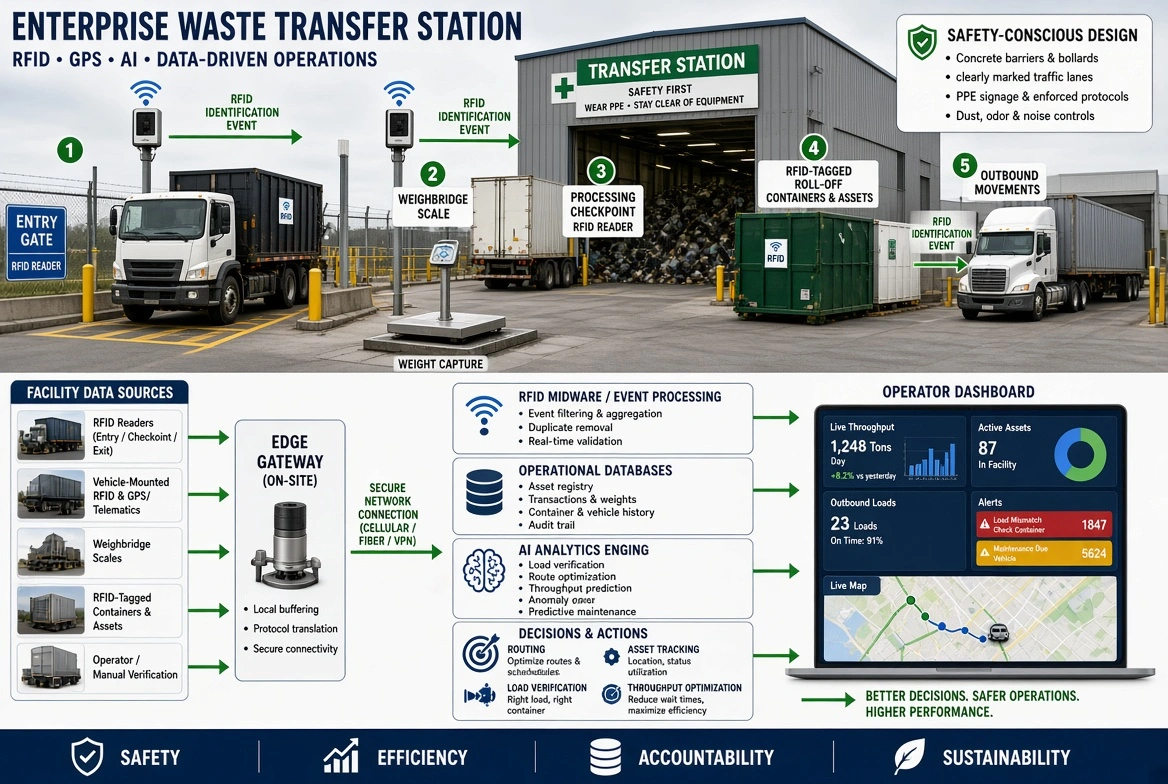
This visual shows a complete enterprise waste transfer station where RFID readers at the entry gate, weighbridge, and processing checkpoints automatically identify tagged trucks and roll-off containers. Data flows through an on-site edge gateway into middleware, operational databases, and an AI analytics engine that powers routing, load verification, asset tracking, and throughput optimization all displayed on a live operator dashboard. The result is a safety-conscious, data-driven facility that improves efficiency, accountability, and sustainability.
AI Applications Across Waste Management Assets and Processes
The strongest AI opportunities generally occur where physical waste management activities generate repeated, measurable operational events. These events can be captured through RFID, IoT sensors, vehicle systems, cameras, weighbridges, SCADA systems, maintenance systems, and other data sources.
| Waste Management Area | Data Sources | AI Application | Operational Outcome |
|---|---|---|---|
| Collection routes | RFID, GPS, vehicle telemetry, service history | Route optimization | Reduced unnecessary travel and improved scheduling |
| Waste containers | RFID, fill-level sensors, service history | Overflow prediction | More targeted collection |
| Fleet | Telematics, fault codes, maintenance records | Predictive maintenance | Earlier identification of equipment problems |
| Transfer stations | RFID, weighbridge, vehicle data | Throughput analysis | Better facility coordination |
| Recycling | Cameras, sorting data, process records | Computer vision and classification | Improved material identification |
| MRF equipment | Sensors, maintenance records | Failure prediction | Improved equipment availability |
| Reusable assets | RFID, BLE, location data | Asset tracking | Better asset visibility |
| Customer service | Service events, RFID, schedules | Exception detection | Improved service verification |
| Waste processing | Sensor and production data | Process optimization | More consistent operating conditions |
| Compliance records | RFID events, timestamps, process records | Automated anomaly detection | Improved traceability |
GAO’s RFID and IoT hardware can form part of the physical data acquisition layer for these applications, while AI software, databases, analytics tools, and waste management systems provide the processing and decision-support functions.
End-to-End AI and RFID Data Flow for Waste Collection
A practical deployment begins with the physical waste asset and ends with an operational decision. The quality of the final AI output depends heavily on the quality, consistency, timing, and context of the data entering the system.
Data Acquisition
RFID tags provide unique identifiers for selected waste containers or operational assets. Readers installed on collection vehicles, facility entrances, conveyors, gates, or other suitable locations capture tag events.
Other sensors may capture fill level, weight, temperature, vibration, equipment condition, or environmental information.
Edge Processing
An edge gateway or vehicle computer can receive RFID events and sensor data before forwarding them to central software. Local processing can remove duplicate reads, validate identifiers, associate events with a vehicle or route, buffer data during connectivity interruptions, and apply operational rules.
Edge processing is particularly useful for collection vehicles because cellular connectivity can vary across service areas. Local buffering prevents temporary network loss from automatically becoming permanent data loss.
Communications and Middleware
The communication layer may use cellular networks, Wi-Fi, Ethernet, or other suitable industrial connectivity depending on the location and application.
RFID middleware can normalize reader data and convert low-level tag reads into useful operational events such as:
- Container detected
- Container collected
- Asset entered facility
- Asset exited facility
- Vehicle identified
- Equipment checkpoint completed
This event-based approach prevents downstream AI systems from having to interpret raw RFID reader data for every application.
AI Analytics and Decision Support
Central software can combine RFID events with GPS coordinates, collection schedules, customer records, waste weights, fill-level measurements, equipment data, and historical operational records.
Machine learning models can then identify patterns, forecast demand, detect anomalies, or recommend operational adjustments.
Human operators remain important for validating decisions that affect collection schedules, fleet deployment, maintenance activities, or customer service. AI can provide recommendations and alerts while established operational controls determine which actions should be automated.
AI and RFID Technology Stack for Waste Management
An AI-enabled waste management solution typically combines identification hardware, IoT sensors, edge computing, communications, data management, AI software, and operational applications. The appropriate combination depends on whether the deployment is focused on municipal collection, commercial waste services, transfer stations, recycling facilities, fleet operations, or multiple sites.
RFID Hardware for Waste Containers and Operational Assets
RFID tags provide unique identifiers that allow waste containers and selected operational assets to be associated with digital records. UHF RFID is particularly applicable where collection vehicles or facility readers need longer-range identification. HF RFID can support shorter-range controlled identification points, while LF RFID can be considered for specialized applications where its operating characteristics are appropriate.
Tag selection requires consideration of:
- Container material and construction
- Mounting position
- Reading distance
- Reader orientation
- Metal interference
- Exposure to moisture, chemicals, abrasion, and temperature
- Expected service life
- Tag memory and identifier requirements
- Vehicle speed during collection
- Reader antenna placement
Waste containers experience substantially harsher conditions than many indoor RFID applications. Tags therefore need mechanical protection and a mounting method appropriate for repeated handling, outdoor exposure, washing, impact, and contamination.
RFID Readers, Antennas, and Vehicle Equipment
RFID readers can be installed on collection vehicles, facility gates, loading areas, transfer stations, or other controlled points.
Vehicle-mounted systems require careful antenna positioning because collection mechanisms, metal surfaces, hydraulic equipment, and the physical movement of containers can affect read performance. Reader configuration should be tested using actual container types and operational movements rather than relying only on laboratory specifications.
For fixed installations, antenna coverage should be engineered around the actual movement path of containers, vehicles, and assets. Read zones should be sufficiently controlled to reduce unintended reads from nearby tagged objects.
IoT Sensors and Vehicle Telematics
RFID becomes more useful when combined with other operational data.
Potential data sources include:
- GPS location
- Vehicle speed and engine information
- Fuel consumption
- Hydraulic system information
- Vehicle fault codes
- Container fill level
- Container weight
- Equipment vibration
- Motor temperature
- Energy consumption
- Weighbridge measurements
- Facility throughput
- Camera images
- Maintenance records
The resulting dataset gives AI software the context required to distinguish normal operational variation from potentially significant events.
Edge Computing for Collection Vehicles and Facilities
Edge computing allows data to be processed close to where it is generated. A collection vehicle can use an edge computer to receive RFID events, GPS information, and sensor readings, perform preliminary validation, store records temporarily, and transmit synchronized data to central software.
This approach is useful where mobile connectivity is inconsistent. A vehicle should not lose collection records simply because cellular communication is temporarily unavailable.
Facility-based edge computing can also support applications that require rapid local processing, such as equipment monitoring, camera-based inspection, or operational alerts.
Cloud Version and Server Version
A Cloud Version uses cloud-hosted software and services for centralized data storage, analytics, AI processing, dashboards, device management, and integration. This model can be useful for waste operators managing geographically distributed fleets or facilities because data from multiple operating locations can be consolidated into a common environment.
Cloud deployment can simplify centralized software updates, provide scalable computing resources, and support access by authorized users across multiple locations. It also requires appropriate connectivity, identity management, encryption, access control, data governance, and cloud security practices.
A Server Version deploys software on edge servers, customer-managed servers, private data centers, facility servers, or other privately hosted enterprise infrastructure. This approach can be appropriate where waste operators require greater control over data location, network dependencies, integration with existing facility systems, or operational processing.
A hybrid arrangement can also be appropriate. For example, RFID and sensor data can be processed locally at a material recovery facility while selected information is synchronized with centralized analytics.
The deployment decision should consider:
- Number and geographic distribution of collection routes
- Connectivity reliability
- Facility network design
- Existing waste management software
- Data residency requirements
- Cybersecurity policies
- AI processing requirements
- Integration requirements
- Disaster recovery objectives
- Availability of local IT support
- Operational latency requirements
GAO’s experience supplying RFID, BLE, and IoT hardware and systems can support organizations evaluating the physical data acquisition requirements of these deployment models.
AI-Enabled Waste Management Technology Stack: Layered Architecture from Sensors to Intelligence
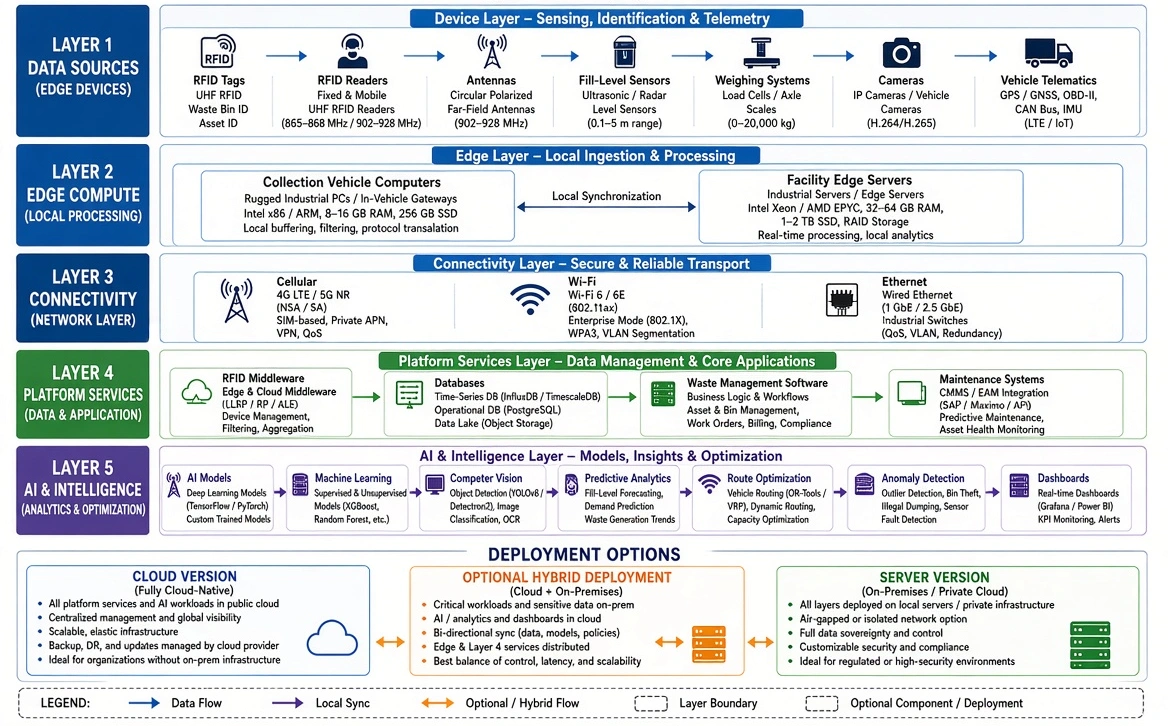
This professional layered diagram maps the complete technology stack for AI-enabled waste management, from Layer 1 device sources (RFID tags, readers, sensors, cameras, and telematics) through edge compute, secure connectivity, platform services, and AI intelligence. It clearly distinguishes Cloud Version, Server Version, and optional Hybrid deployment options, showing how physical data flows into actionable insights for route optimization, predictive maintenance, and operational decisions.
AI Capabilities That Improve Waste Management Performance
Predictive Analytics for Collection Demand
Historical collection records can reveal patterns in waste generation across neighborhoods, commercial customers, industrial facilities, and seasonal periods.
AI models can use these patterns to estimate future collection requirements. This can help planners adjust vehicle allocation, collection frequency, staffing, and route planning.
The model should account for operational factors rather than relying solely on historical averages. Holidays, seasonal events, commercial activity, weather-related disruptions, and changes in customer behavior can alter waste volumes.
Machine Learning for Anomaly Detection
Anomaly detection can identify operational events that differ from expected patterns.
Examples include:
- A container recorded as serviced outside its expected route
- Unexpected gaps in collection history
- Abnormally long vehicle dwell time
- Unusual fuel consumption
- Repeated equipment faults
- Unexpected container movement
- Sudden changes in waste weight
- Unusual transfer station throughput
- Abnormal processing equipment behavior
Anomaly detection does not automatically establish that an event is an error or fraudulent activity. It identifies a condition that warrants investigation or operational review.
Computer Vision for Waste Sorting and Contamination
Computer vision can analyze images captured along recycling and sorting processes. Machine learning models can classify visible material types and identify contamination patterns.
Applications may include:
- Plastic identification
- Paper and cardboard classification
- Metal detection
- Glass identification
- Contamination monitoring
- Sorting-line quality inspection
- Material composition analysis
Computer vision and RFID address different identification requirements. Computer vision can identify characteristics visible in an image, while RFID provides a persistent digital identity for a tagged physical object. Combining the two can be useful where both material information and asset identity matter.
AI-Assisted Fleet Maintenance
Predictive maintenance models can analyze equipment operating data alongside historical service records.
A model may identify that a particular class of vehicle, hydraulic component, compactor, conveyor motor, or baler is exhibiting an operating pattern associated with previous failures.
RFID can provide an asset identifier that connects the physical equipment with its digital maintenance record. This helps avoid ambiguity when multiple similar vehicles or pieces of equipment are operating within the same facility or fleet.
AI-Assisted Workforce and Service Planning
Waste management operations depend on coordination among dispatchers, drivers, mechanics, facility operators, supervisors, environmental personnel, and customer service teams.
AI can support planning by analyzing route workloads, service histories, vehicle availability, facility throughput, maintenance schedules, and expected waste volumes.
The resulting recommendations can help operational personnel evaluate:
- Route workloads
- Vehicle assignments
- Maintenance priorities
- Collection frequency
- Facility staffing requirements
- Expected peak periods
- Service exceptions
Operational decisions should remain subject to established safety procedures, regulatory requirements, and human oversight.
Engineering Design Considerations for Waste Management RFID Deployments
RFID deployment success depends on physical and operational engineering, not simply reader installation.
Tag Placement and Read Reliability
Waste containers differ significantly in size, material, shape, and construction. Plastic carts, metal containers, roll-off containers, commercial dumpsters, and specialized bins can produce different RFID performance characteristics.
Testing should therefore use representative containers and realistic collection movements.
Engineers should evaluate:
- Tag orientation
- Reader antenna orientation
- Distance between tag and antenna
- Metal surfaces
- Liquid content
- Container density
- Collection mechanism movement
- Vehicle speed
- Environmental exposure
- Reader power configuration
Read-Zone Control
A reader that captures every nearby tag is not necessarily producing better data.
A waste collection system may need to distinguish the intended container from other tagged assets located nearby. Excessive read range can introduce false associations, especially in densely populated collection areas or transfer facilities.
Read-zone engineering should therefore balance coverage with selectivity.
Data Quality and Event Validation
AI models cannot compensate indefinitely for poor source data.
RFID systems should validate:
- Tag identity
- Timestamp
- Reader identity
- Vehicle identity
- Route identity
- Location
- Duplicate reads
- Missing events
- Unexpected sequences
Middleware can transform raw RFID reads into validated operational events before they enter analytical systems.
Integrating AI and RFID with Waste Management Software
AI and RFID solutions should integrate with existing operational systems rather than creating another isolated database.
Common integration targets include:
- Waste collection management software
- Fleet management systems
- GPS and telematics systems
- Customer information systems
- Billing systems
- Computerized maintenance management systems
- Weighbridge software
- SCADA systems
- Material recovery facility control systems
- Geographic information systems
- Business intelligence software
- Environmental compliance systems
APIs, databases, message queues, web services, and standardized data interfaces can be used according to the existing IT environment.
A practical integration process begins by defining the business event rather than simply transferring raw RFID reads. For example, the target system may require a validated container serviced event containing the container identifier, vehicle identifier, timestamp, location, route, and service status.
This approach reduces unnecessary coupling between RFID hardware and downstream applications.
GAO can supply RFID and IoT hardware that can be incorporated into broader waste management systems through appropriate middleware and integration methods.
Cybersecurity and Data Protection for AI-Enabled Waste Management
Connected waste management systems can contain operational, customer, vehicle, facility, and equipment information. Security should therefore be incorporated during system design rather than added after deployment.
Key controls can include:
- Unique device identities
- Role-based access control
- Strong authentication
- Encryption in transit
- Encryption at rest where appropriate
- Secure device configuration
- Network segmentation
- Firewall controls
- Audit logging
- Software patch management
- Backup and recovery procedures
- Monitoring of unusual device activity
- Controlled API access
- Secure credential management
Edge gateways and vehicle computers should receive particular attention because they operate outside traditional data-center environments and may be physically accessible.
AI systems also require data governance. Organizations should establish which data is collected, why it is collected, how long it is retained, who can access it, and how it is used for automated analysis.
Waste Management KPIs for AI and RFID Projects
Technology deployment should be measured against operational outcomes rather than RFID read counts alone.
Relevant KPIs can include:
| KPI | What It Measures |
|---|---|
| Collection completion rate | Percentage of scheduled services successfully completed |
| Missed collection rate | Frequency of scheduled services not completed |
| Route efficiency | Distance, time, or stops required for collection |
| Vehicle utilization | Productive use of available fleet capacity |
| Container service frequency | Actual service frequency compared with planned frequency |
| Overflow incidents | Frequency of containers reaching unacceptable capacity |
| RFID event accuracy | Reliability of validated container or asset identification |
| Asset identification rate | Percentage of target assets successfully identified |
| Average collection time | Time required for collection activities |
| Vehicle downtime | Time vehicles are unavailable for service |
| Mean time between failures | Equipment reliability measure |
| Mean time to repair | Maintenance response and repair duration |
| Transfer station dwell time | Time vehicles or loads spend within the facility |
| Facility throughput | Quantity of material processed over a period |
| Recycling recovery rate | Quantity or percentage of recoverable material recovered |
| Contamination rate | Unwanted material within recyclable streams |
| Fuel consumption | Fuel used relative to operational activity |
| Service verification rate | Percentage of services supported by reliable event records |
| Predictive maintenance alert precision | Proportion of maintenance alerts requiring confirmed action |
The baseline should be established before deployment wherever practical. This makes it possible to compare operational performance before and after the AI-enabled system is introduced.
Implementing AI and RFID in Waste Management Operations
A successful implementation should begin with an operational problem rather than with hardware selection.
Define the Waste Management Use Case
Organizations should identify a measurable problem such as missed collections, poor container visibility, excessive vehicle downtime, inefficient routing, unreliable service verification, or limited visibility into reusable assets.
The use case determines what information must be collected and which physical assets need identification.
Survey the Operating Environment
A site survey should evaluate collection vehicles, container types, facility layouts, existing RFID or IoT equipment, network availability, metal structures, wash-down procedures, environmental conditions, and operational movement patterns.
For mobile applications, testing should occur during representative collection activities rather than only when the vehicle is stationary.
Select Tags and Readers
RFID hardware should be selected according to the application rather than according to nominal read range alone.
Testing should confirm:
- Reliable identification under actual operating conditions
- Adequate read-zone coverage
- Appropriate mounting methods
- Environmental durability
- Reader and antenna compatibility
- Electrical and vehicle integration requirements
Build the Data and Integration Model
The organization should define how an RFID event becomes a waste management transaction.
Data models should establish relationships among:
- Container
- Customer or service location
- Route
- Vehicle
- Driver or crew where appropriate
- Timestamp
- GPS location
- Collection event
- Waste weight
- Facility
- Processing event
- Maintenance record
This creates a consistent information structure for downstream analytics.
Pilot Before Scaling
A controlled pilot can test representative vehicles, containers, routes, and facilities before organization-wide deployment.
Pilot measurements should include both technical and operational performance.
Technical testing can measure read reliability, duplicate events, connectivity, synchronization, battery or power behavior, and integration performance.
Operational testing can measure route time, service verification, missed collections, driver workflow, maintenance requirements, and operator acceptance.
Commission, Monitor, and Optimize
Commissioning should verify that tags, readers, antennas, edge devices, communications, middleware, databases, AI services, and operational applications work together.
After deployment, organizations should continuously review data quality and model performance. Changes in container design, vehicle configuration, facility layout, collection routes, or operational procedures can affect system performance over time.
Practical Deployment Lessons for Waste Operators
Several engineering principles are particularly important when deploying AI-enabled RFID systems in waste management.
- Design the identification system around the physical movement of waste assets.
- Test RFID tags on the actual container materials used by the operator.
- Treat read-zone control as an engineering requirement, not simply a reader configuration issue.
- Use edge buffering on mobile collection equipment where network interruptions are possible.
- Integrate RFID events with GPS and route information to establish operational context.
- Separate raw RFID reads from validated business events.
- Establish baseline KPIs before introducing AI-driven recommendations.
- Use human review for operational decisions where incorrect recommendations could affect safety, service quality, or regulatory compliance.
- Protect vehicle computers, gateways, readers, and APIs as connected operational assets.
- Design the solution so additional vehicles, containers, facilities, and AI applications can be added without rebuilding the entire data flow.
- Maintain accurate asset master data so RFID identifiers remain associated with the correct containers and equipment.
- Periodically inspect tags and mounting points because physical damage can create apparent software or reader failures.
- Use model monitoring and data-quality checks when AI predictions influence collection or maintenance planning.
Scaling AI-Enabled Waste Management Across Fleets and Facilities
Scalability requires consistent identifiers, data structures, hardware configurations, integration interfaces, and operational procedures.
A waste operator beginning with one collection route may eventually need to support hundreds of vehicles and thousands or millions of tagged containers. A transfer station pilot may later expand to multiple facilities and material recovery operations.
A scalable system should therefore accommodate:
- Additional RFID readers
- Additional collection vehicles
- Larger container inventories
- Multiple operating locations
- Additional IoT sensors
- Higher event volumes
- Additional AI models
- More users and operational roles
- Additional waste management applications
GAO’s RFID, BLE, and IoT product capabilities can be incorporated into phased deployments where organizations begin with a defined operational requirement and expand after validating the technical and business results.
Business and Operational Value of AI-Enabled Waste Management
The combination of AI, RFID, IoT sensing, vehicle data, and waste management software can improve visibility across physical operations.
Potential value areas include:
- More accurate service verification
- Better container utilization
- Improved route planning
- Earlier identification of equipment problems
- Better fleet availability
- Improved transfer station coordination
- More measurable recycling operations
- Faster investigation of service exceptions
- Stronger asset traceability
- More consistent operational reporting
- Better use of historical waste management data
- Improved decision support for supervisors and dispatchers
The actual financial or operational improvement will depend on the baseline condition, deployment quality, data quality, labor model, fleet characteristics, waste stream, and specific use case. Technology should therefore be evaluated against measurable operational objectives rather than assumed savings.
AI-Enabled Waste Management Implementation Lifecycle: From Planning to Scalable Operations
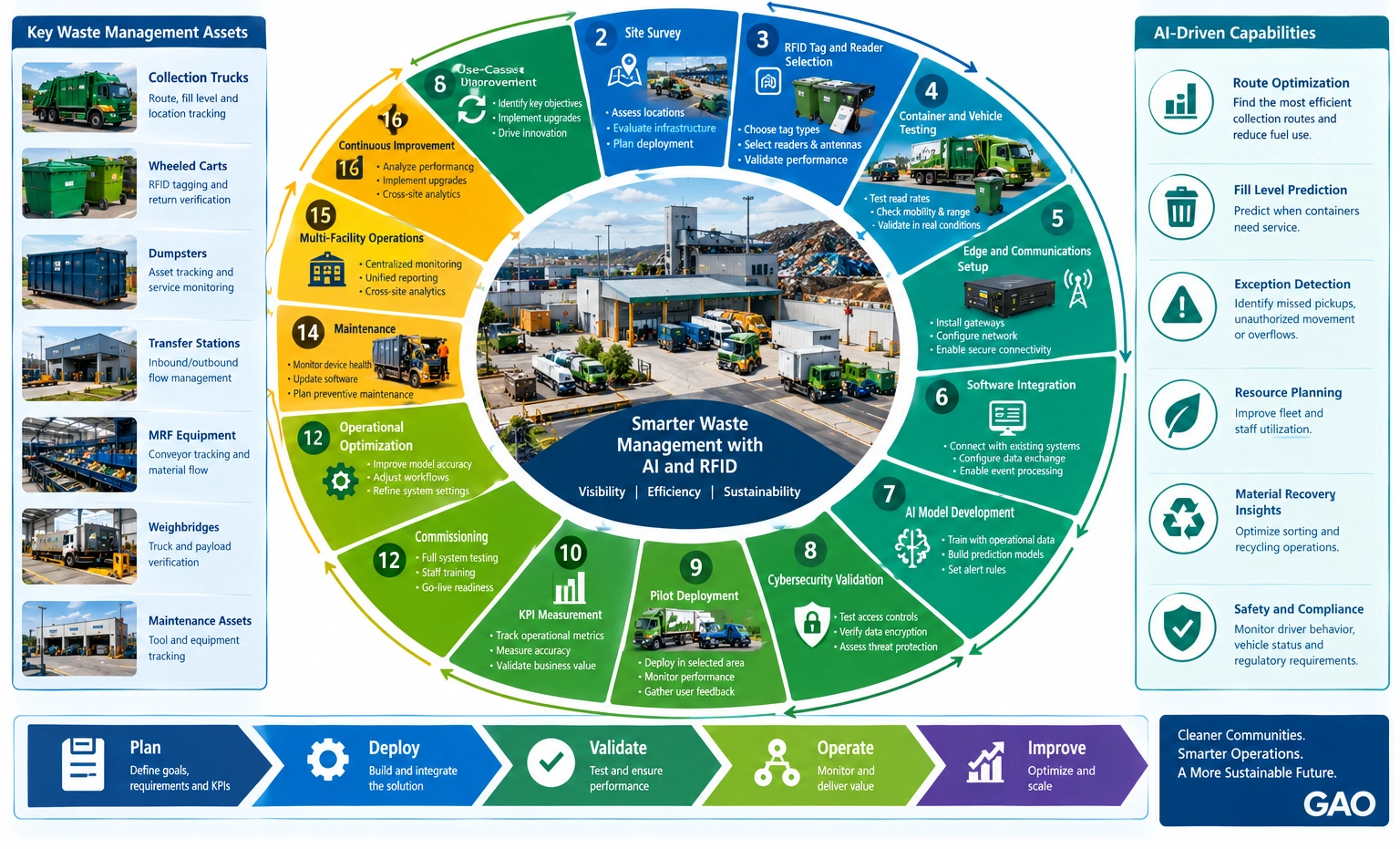
This lifecycle diagram shows the progression from waste management planning and site assessment through RFID deployment, software integration, AI model development, cybersecurity validation, pilot testing, commissioning, maintenance, and continuous optimization. It also connects collection trucks, carts, dumpsters, transfer stations, MRF equipment, weighbridges, and maintenance assets with AI-driven capabilities such as route optimization, fill-level prediction, exception detection, and resource planning.
Key Takeaways for AI and RFID in Waste Management
AI-enabled waste management is fundamentally a data and operational improvement initiative. RFID provides persistent identification for selected physical assets, while IoT sensors, GPS, telematics, computer vision, operational databases, and AI models add the context needed for analysis and decision support.
For collection operations, the combination can improve service visibility, container management, route analysis, and exception detection. For fleets and facilities, it can support predictive maintenance, equipment monitoring, throughput analysis, and operational planning. For recycling operations, AI-based computer vision can complement RFID by analyzing material characteristics and contamination.
Successful implementation depends on accurate asset identification, appropriate RFID engineering, reliable communications, strong data integration, cybersecurity, measurable KPIs, and continuous operational validation.
GAO provides RFID, BLE, and IoT hardware products and systems that can serve as components of these waste management deployments. Organizations evaluating AI-enabled waste collection, asset tracking, fleet monitoring, recycling operations, or facility automation can work with technology specialists to determine suitable hardware, integration approaches, and deployment configurations.
Building the Future of Industrial AI and IoT with Aperture Venture Studio and GAO RFID Inc.
For more than three decades, GAO Group of Companies has invested heavily in R&D covering industrial RFID, BLE, and IoT technologies. As generative AI has demonstrated practical value in industrial applications, our work has expanded to AI-enabled IoT solutions for operational environments such as waste management, asset tracking, fleet operations, and environmental services.
We founded Aperture Venture Studio to build, launch, and scale next-generation AI and IoT companies and solutions relevant to industries adopting connected operational technologies.
Aperture has attracted AI and IoT technical experts, entrepreneurial and operational executives, investors, and leading companies. We have also developed the Aperture Ventures Summit and TekSummit to discuss advanced AI and IoT topics.
GAO, headquartered in New York City and Toronto, Canada, together with its sister companies GAO Research Inc. and GAO Tek Inc., forms GAO Group. For three decades, GAO Group has served organizations across the United States and Canada, including Fortune 500 companies, R&D organizations, universities, and government agencies. Its work includes substantial R&D investment, stringent quality assurance processes, and remote or onsite technical support.
We welcome participation from:
- Advisors, co-founders, or employees
- Investors
- Customers
For waste management organizations exploring AI, RFID, BLE, and IoT applications, GAO can provide relevant technology products, technical expertise, and deployment support for evaluating and implementing connected operational systems.